Rolling vs. Forging Parameters for Seamless Rings in Extreme Service
A technical guide for buyers specifying rolled ring forgings for offshore wind, high-head hydropower and rotary kiln duty.
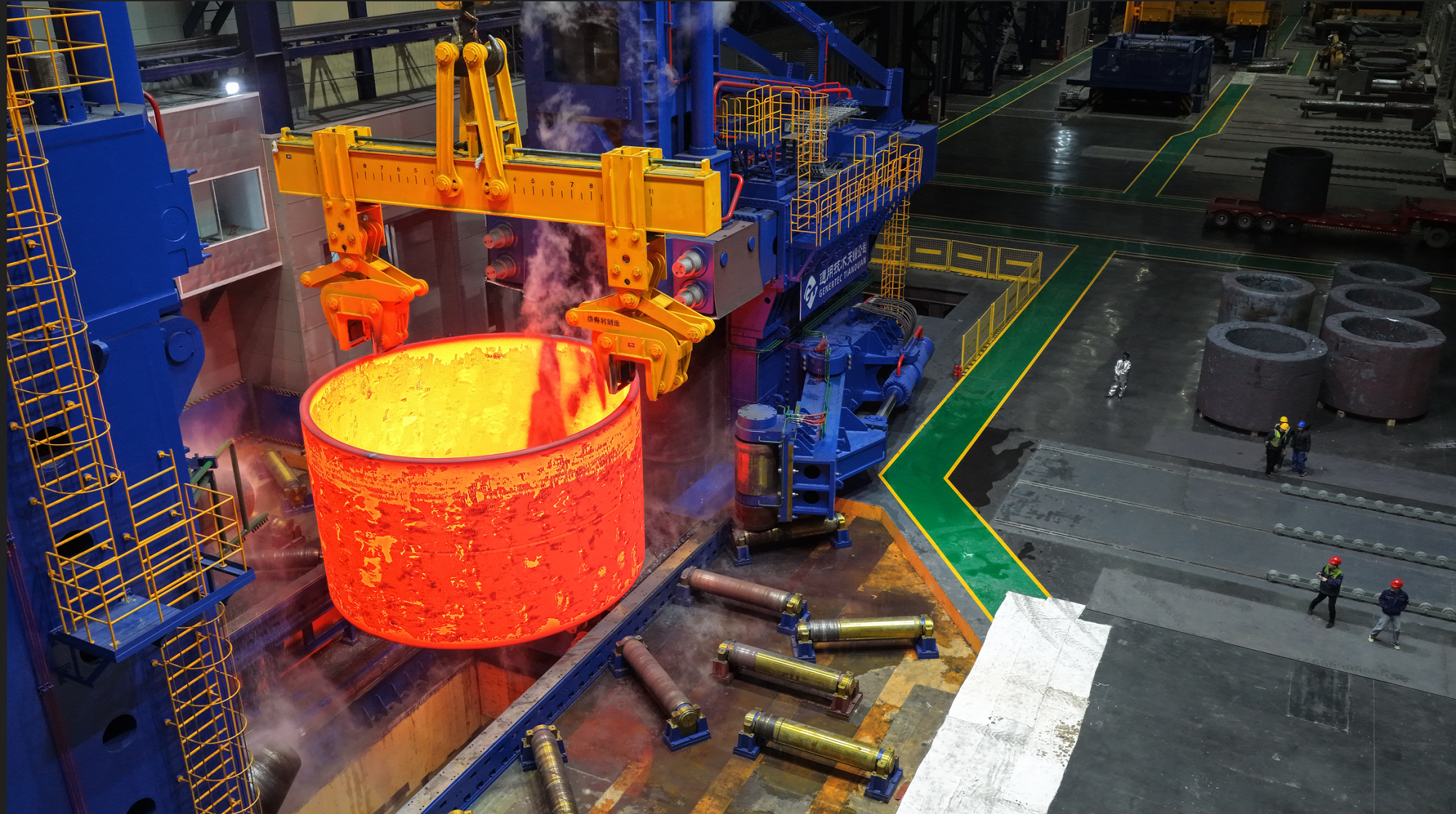
The 22 m ring and shell rolling machine that sets the envelope for integral ring rolling.
Seamless rolled rings rarely fail in service because the wrong alloy grade was ordered. They fail because the parameters that shape the material — preform design, the rolling sequence, and heat treatment — were treated as production details instead of as part of the specification. In offshore wind, high-head hydropower and rotary kiln service, where a component can face cyclic load, corrosion and sustained thermal exposure at the same time, those parameters decide whether a ring reaches its design life or initiates a crack at an internal discontinuity.
This guide sets out the forging and ring rolling parameters that determine performance in extreme service, what each parameter actually changes inside the material, and how a buyer can compare quotations that look identical on paper because both list a grade and a diameter but neither describes how the ring was made.
Why Extreme Service Punishes the Wrong Parameters
Three loading conditions separate extreme service from ordinary structural duty, and they usually appear together rather than one at a time.
- Cyclic load. Rotor flanges, bearing rings and kiln tyres accumulate a very large number of stress cycles over their service life. Fatigue cracks initiate at stress concentrations, and in a forged component the most damaging stress concentrations are internal: porosity, shrinkage, inclusions and coarse grain boundaries.
- Corrosion. Salt-laden air and marine humidity attack the surface while cyclic load repeatedly opens and closes micro-cracks. Corrosion resistance is therefore not only a chemistry question; it also depends on surface integrity and on how evenly the section was treated.
- Sustained heat and thermal cycling. Rotary kiln tyres run hot for long periods and cool during shutdowns, while hydropower components see pressure cycling driven by grid load-following. Both conditions test the through-section consistency achieved during heat treatment.
Comparing the two main manufacturing routes makes the stakes concrete. Relative to cast components, forged and rolled rings deliver higher strength and toughness, better fatigue resistance and a finer grain structure, with no casting defects such as porosity or shrinkage. In a safety-critical part under cyclic load, that difference is the difference between a defect-tolerant component and one whose service life is set by its largest internal flaw.
What the Market Signals About Seamless Rolled Rings
The structural case is matched by demand growth in exactly the sectors where parameter control matters most.
- The global ring rolling products market was valued at USD 4.56 billion in 2025 and is projected to reach USD 7.35 billion by 2035.
- Seamless rolled rings represent approximately 24% of global manufactured forging components by production volume.
- The wind turbine forging market was valued at USD 9.6 billion in 2024, with onshore segments holding a 67.3% share.
- Carbon steel accounts for approximately 38.2% of the raw material share in the global metal forging market.
Two conclusions matter for specification work. First, growth is concentrated in applications where a failed ring is expensive or slow to replace, so parameter control carries more commercial weight than unit price alone. Second, carbon steel remains the dominant input by a wide margin, which means most extreme-service reliability gains come from process control — forming, rolling and heat treatment — rather than from exotic alloy selection.
The Parameter Families That Decide Performance in Extreme Service
Four parameter families carry most of the risk in a large or heavy ring. They are not interchangeable, and a supplier that is strong in one is not automatically strong in the others.
1. Near-Net-Shape Forming — Where Grain Flow Is Decided
Near-net-shape forming is the practice of designing the preform so that the finished ring is created mainly by moving metal rather than by cutting it away. The controlling parameters are preform volume, preform geometry, the upsetting and piercing sequence, and the temperature at which each forming step is carried out.
What these parameters change:
- Material continuity. When metal flows into the final section, grain flow follows the component geometry. When material is removed instead, grain flow can be cut across, creating paths that behave differently under fatigue.
- Machining depth. A preform that is closer to final shape removes less material during machining, which keeps more of the beneficial worked structure in the finished part.
- Material efficiency. Near-net-shape forming converts a larger share of the input billet into finished component rather than into chips, which matters most on heavy rolled ring forgings where the input weight is large.
This is also where cost and reliability meet: the same parameter decisions that reduce material waste also preserve the grain flow that extreme service depends on.
2. Integral Ring Rolling — One Continuous Body, Grain Flow Aligned to Hoop Stress
In integral ring rolling, a pierced preform is worked between radial and axial rolls until the ring reaches its final wall thickness, height and diameter in one continuous operation. There is no weld seam, no bolted joint and no segmented construction. The parameters that control the outcome are the roll gap schedule, axial roll position, feed rate, rolling temperature and the total deformation applied through the section.
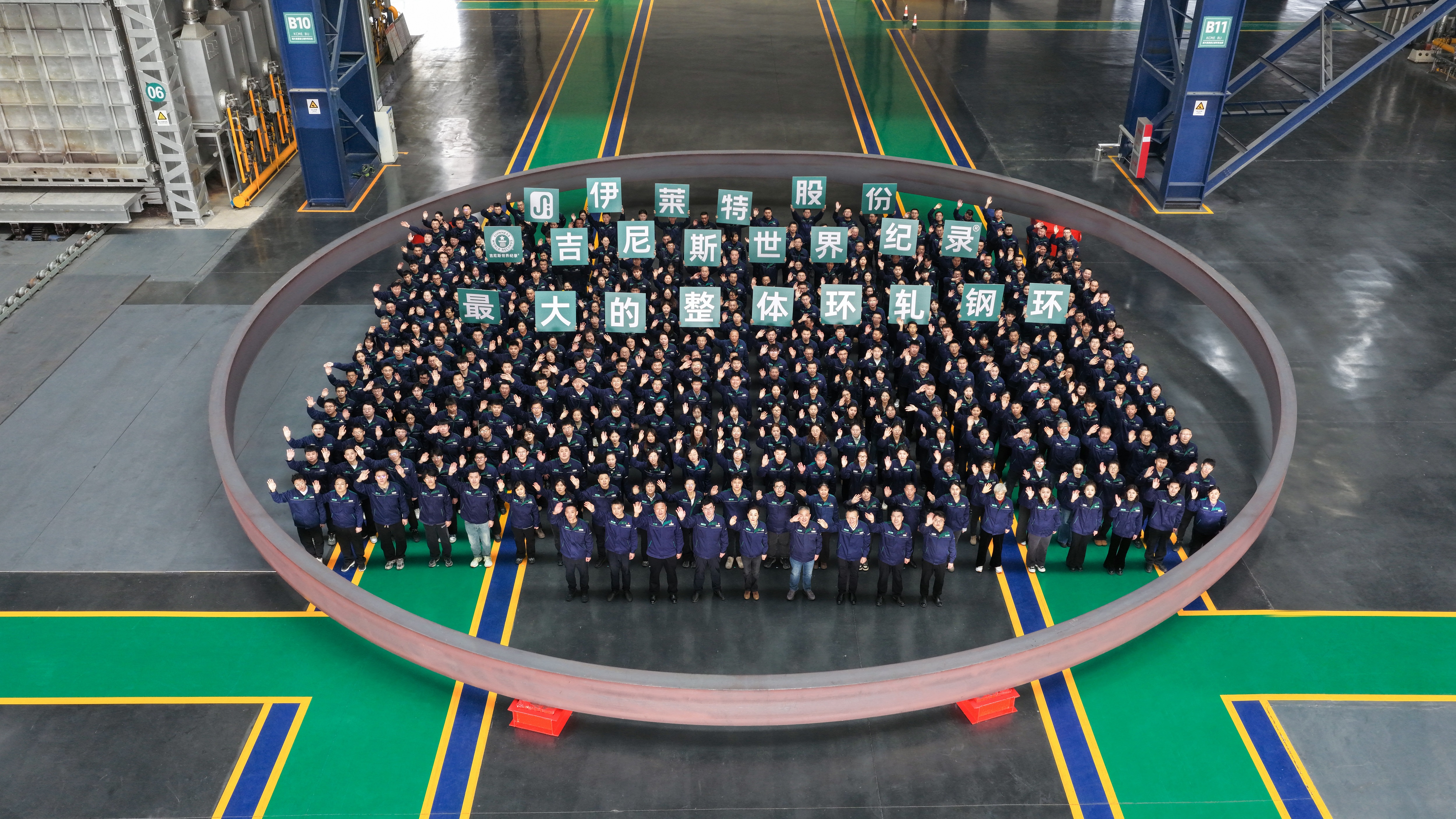
Integral ring rolling produces one continuous body with circumferential grain flow — no seam to act as a crack path.
Why this matters in the field:
- Grain flow is oriented circumferentially, which aligns the material structure with hoop stress — the dominant stress direction in a ring under radial load.
- There is no seam to act as a crack path, which is the main reason seamless construction is preferred for safety-critical rings.
- Roundness and wall-thickness uniformity are produced by the rolling process itself, which reduces the machining needed to reach a high-precision rolled ring forging.
- Through-thickness deformation refines the internal structure across the full section, not only near the surface.
As ring size grows, the machine envelope becomes a hard technical constraint rather than a commercial one. Iraeta operates a 22 m ring and shell rolling machine, and in 2026 the company produced a seamless rolled steel ring measuring 21.029 m in diameter, exceeding its own Guinness World Record of 15.673 m set in 2022. Iraeta also produces rolled shells up to 5 m tall and forged bars up to 25 m long, with a component weight range spanning 0.3 kg to 300 tons.
3. Heat Treatment — Turning Strength Into Fatigue Resistance
Rolling gives a ring its shape and grain flow; heat treatment decides whether the material can survive repeated stress. The controlling parameters are austenitising temperature and hold time, quenching method and cooling uniformity, tempering temperature and time, and the soak time appropriate to the section thickness.
For heavy-wall rings, the limiting factor is rarely the nominal hardness number. It is whether the core of the section received the same treatment as the surface. A ring whose surface is fully transformed while the core is only partly treated will behave unpredictably under cyclic load, because the two regions differ in strength, toughness and corrosion response. This is why heat treatment for fatigue resistance has to be specified as a through-section requirement rather than as a hardness range alone.
The same logic applies to property balance. Higher strength without adequate toughness shifts the failure mode rather than preventing it, so heat treatment parameters are set to match strength and toughness to the actual operating condition — cyclic load tolerance for a wind or hydropower ring, and thermal stability for a kiln tyre.
4. Material Input Control — The Parameter Most Suppliers Cannot Change
Chemistry, cleanliness and hardenability are decided at the steel mill, before any forming parameter can help. Iraeta controls this stage directly by operating an in-house steel mill, which supports raw material supply assurance, customized material formulation against project-specific requirements, and exclusive capacity reservation. Incoming material is subject to full-item inspection before it enters production.
At the end of the route, quality control is handled as a verified output rather than an assumption. Iraeta applies 100% testing for quality control across production, so the parameters described above are confirmed on the component rather than only on the process sheet.
Rolling vs. Forging Parameters: How the Two Families Divide the Work
A seamless rolled ring is not rolled instead of being forged. It is forged and then rolled, and the two parameter families do different jobs at different stages. Reading a quotation correctly means knowing which family a given claim belongs to.
| Stage | Parameter family | What it governs |
|---|---|---|
| Forging (upsetting, piercing, preform) | Preform volume and geometry, forming temperature, press sequence | Starting microstructure, material distribution, internal soundness |
| Integral ring rolling | Roll gap schedule, axial roll position, feed rate, rolling temperature, total deformation | Circumferential grain flow, roundness, wall-thickness uniformity, dimensional accuracy |
| Heat treatment | Austenitising, quench uniformity, tempering, section soak time | Fatigue resistance and toughness balance, through-section consistency |
| Material input | Steel chemistry, cleanliness, incoming inspection | Inclusion content, hardenability, batch-to-batch repeatability |
The practical consequence: a supplier that only controls the press is not delivering the same component as a supplier that controls the press, the rolling mill, the heat treatment furnace and the steel input. When two quotations differ in price, this is usually why.
Step-by-Step: How the Parameters Are Locked In
- Application review. Operating condition, load type and corrosion exposure are defined first, because they determine which parameters become critical.
- Material definition. Chemistry and cleanliness are set at the in-house steel mill, with customized material formulation where the application requires it.
- Incoming inspection. Full-item incoming inspection confirms the input before any forming starts.
- Preform forging. Upsetting and piercing produce a preform whose volume and geometry are set by near-net-shape design.
- Integral ring rolling. The preform is rolled to final section on a radial-axial mill, with the roll gap schedule controlling grain flow and roundness.
- Heat treatment. Through-section treatment sets the strength and toughness balance and the fatigue behaviour of the finished ring.
- Precision machining. Machining and grinding bring the ring to final dimensional tolerance while preserving the worked structure.
- Testing. Iraeta applies 100% testing for quality control, so parameters are verified on the component.
- Acceptance. Order acceptance criteria are defined as pre-shipment test/inspection.
- Logistics. Delivery is arranged on CIF terms to the buyer destination.
Matching Parameters to Operating Conditions
Offshore wind
Wind power flanges, bearing rings, gearbox forgings and drive rings face combined wind and wave loading, salt-laden air and constant humidity. The parameters that carry the most weight here are circumferential grain flow aligned to hoop stress, through-thickness integrity and corrosion resistance. Iraeta forged components are deployed in over 20 MW floating offshore wind turbines, where maintenance access is limited and replacement cost is high — the strongest argument for parameter control rather than reactive inspection.
High-head hydropower
Hydroelectric forgings operate under high static head and repeated pressure cycles created by load-following. Cyclic load tolerance is therefore the governing parameter, and it depends on heat treatment uniformity and on how clean the steel input was. Near-net-shape forming matters as well, because it places material where stress is highest rather than where machining left it.
Rotary kilns
Kiln tyres and drive rings run at sustained high temperature under heavy contact load, then cool during shutdowns. Thermal cycling and dimensional stability dominate, which makes section uniformity and residual-stress control the parameters to specify. Iraeta components are used in cement rotary kilns with 10,000 tons/day output, an operating scale where a distorted tyre creates immediate production losses.
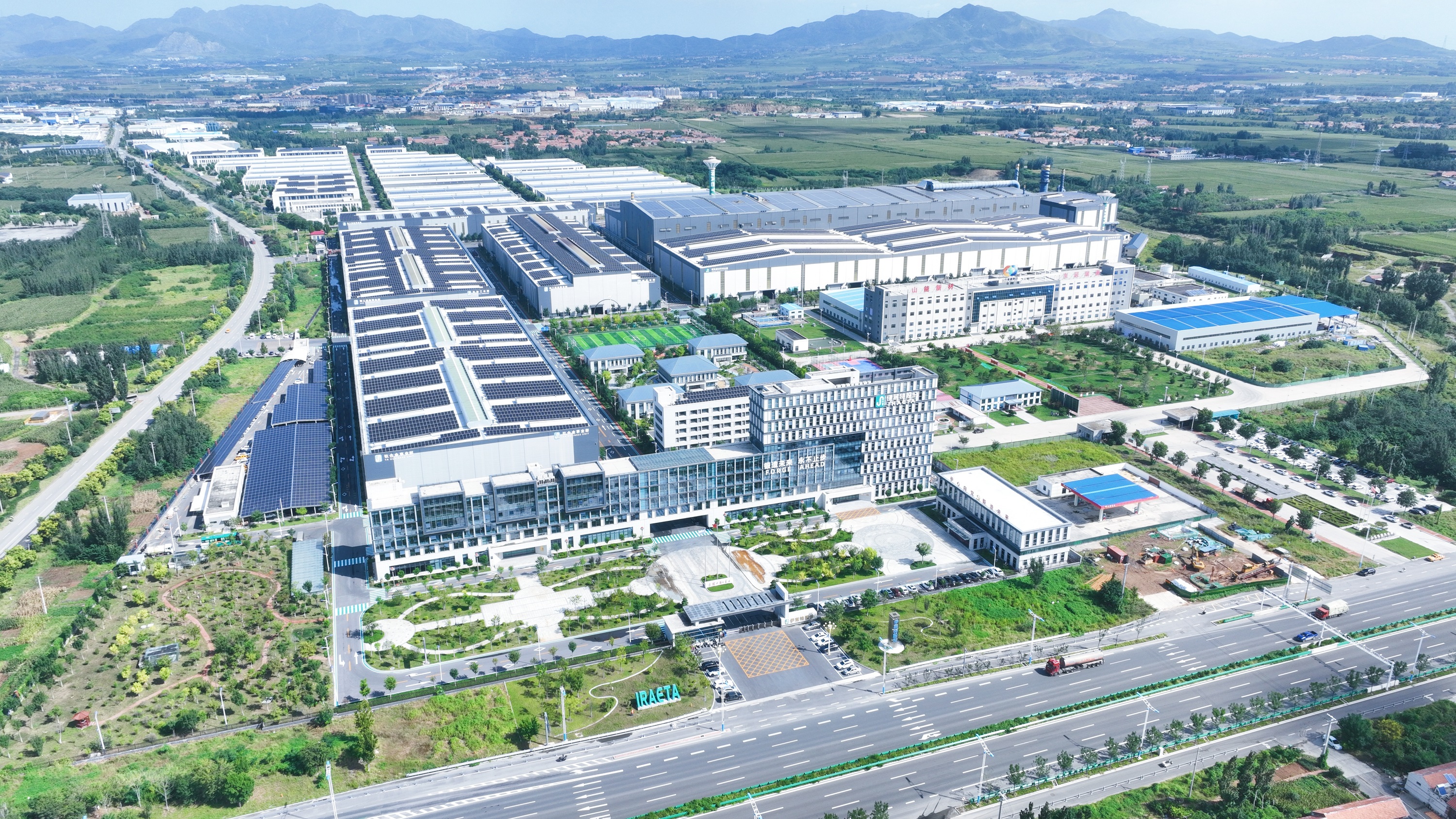
Extreme-service forging capacity also supports fourth-generation nuclear power and large tunnel boring applications.
The same parameter logic extends to other extreme applications. Iraeta forged components are deployed in fourth-generation nuclear power plants and in 16-meter shield tunneling machines — two fields where a single defective ring cannot be inspected out of the machine after installation.
Comparison: Seamless Rolled Rings vs. Castings
For buyers evaluating a route rather than a supplier, the documented difference between the two is concentrated in fatigue behaviour and internal soundness.
| Attribute | Rolled ring forgings vs. castings |
|---|---|
| Strength and toughness | Higher strength and toughness |
| Fatigue resistance | Better fatigue resistance |
| Grain structure | Finer grain structure |
| Internal soundness | No casting defects such as porosity or shrinkage — 0 casting porosity |
| Best-fit applications | High-load structural components, heavy machinery parts, safety-critical applications |
| Cost behaviour | Significantly lower total lifecycle cost (TCO), with reduced long-term operational and replacement expenses |
| Maintenance profile | Longer service life, less frequent inspection, lower risk of sudden failure |
| Performance stability | More stable performance, less energy loss due to defects |
Verified Capability Envelope
Parameter control becomes commercially useful only when it exists at the size the project needs. The following values describe the current manufacturing envelope.
| Largest seamless rolled steel ring produced | 21.029 m in diameter (2026) |
| Previous Guinness World Record held by Iraeta | 15.673 m in diameter (2022) |
| Ring and shell rolling machine envelope | 22 m |
| Rolled shell height | up to 5 m |
| Forged bar length | up to 25 m |
| Open-die forging weight | up to 300 t |
| Component weight range | 0.3 kg to 300 t |
| Monthly production capacity | 70,000 t |
| Quality control | 100% testing |
What Extreme-Service Parameters Mean for Long-Term Supply
A parameter set is only valuable if it is repeatable order after order. That is the difference between buying a ring and building a supply relationship, and it is where most multi-year projects actually fail: not on the first delivery, but on the fourth or fifth, when a supplier has to reproduce the same forming and heat treatment conditions under production pressure.
Three structural factors support repeatability at Iraeta. Raw material is secured through an in-house steel mill, with customized material production, exclusive capacity reservation and full-item incoming inspection — which removes the most common source of batch-to-batch variation. Production capacity of 70,000 tons per month provides headroom for scheduled and repeat programmes rather than one-off runs. And manufacturing is carried out at facilities in China and Spain, serving export markets across the EU, Americas, Asia and the Middle East, so programmes can be supported across regions rather than through a single site.
Iraeta Energy Equipment Co., Ltd. has been serving global forging markets for two decades, founded in 2006, with an R&D team of 100 engineers supporting product development across shells, transition sections, profiling rings, hydroelectric forgings, kiln tyres, drive rings, wind power flanges, gearbox forgings, bearing rings, forged shafts and pipe flanges.Frequently Asked Questions
Which standards apply to seamless rolled ring forgings for high-temperature and pressure service?
Two standards are commonly referenced in this segment. ASTM A182 is the standard specification for forged or rolled alloy and stainless steel pipe flanges and parts for high-temperature service. EN 10222-2 specifies the technical delivery conditions for ferritic and martensitic steel forgings for pressure purposes. For an Iraeta order, acceptance criteria are defined as pre-shipment test/inspection, supported by 100% testing for quality control during production.
What is the largest seamless rolled ring that can be produced?
Iraeta operates a 22 m ring and shell rolling machine, and in 2026 produced a seamless rolled steel ring measuring 21.029 m in diameter, exceeding its own Guinness World Record of 15.673 m set in 2022. Beyond rings, the same industrial base produces rolled shells up to 5 m tall, forged bars up to 25 m long, and open-die forgings up to 300 t, across a component weight range of 0.3 kg to 300 tons.
What are the purchasing terms for a rolled ring order?
The standard commercial framework is: MOQ of 1 unit, delivery terms CIF, payment terms 30/70, and acceptance criteria defined as pre-shipment test/inspection. A minimum order quantity of one unit means a project can place a single ring against a defined specification before scaling to a repeat programme.
Can a buyer validate parameters before committing to volume production?
Yes. Because the MOQ is 1 unit, a first article can be ordered, produced and inspected against the agreed technical conditions before serial supply begins. Acceptance is based on pre-shipment test/inspection, and 100% testing for quality control is applied during production. Material-side validation is also possible: the in-house steel mill supports customized material formulation, and full-item incoming inspection verifies each input batch before forming starts.
What supports supply continuity over a multi-year programme?
Supply continuity rests on raw material control, capacity and geographic coverage. Iraeta secures input through an in-house steel mill with customized material production, exclusive capacity reservation and full-item incoming inspection; monthly production capacity is 70,000 tons; and facilities in China and Spain serve export markets across the EU, Americas, Asia and the Middle East. Programme terms, samples and technical review can be arranged by contacting ebiz@iraeta.com.
Conclusion
In extreme service, the specification that matters is not a grade and a diameter. It is the full parameter chain: how the preform was shaped, how the ring was rolled into one continuous body, how the section was heat treated for fatigue resistance, and where the steel came from. Each of these is measurable, each can be verified, and each produces a component that behaves differently under cyclic load, corrosion and thermal cycling.
For buyers at the decision and execution stage, the practical sequence is straightforward: define the operating condition, require documentation of the parameter families that control it, validate on a first article, and then confirm that the same conditions can be reproduced over the length of the programme.

Long-term programmes are supported from Iraeta facilities in China and Spain.
Next step: share your operating condition, ring diameter and load case, and Iraeta will review the forming and heat treatment parameters against it.
Samples and quotations: ebiz@iraeta.com | WhatsApp: +86 18853157508