Seamless Rolled Rings for Construction Machinery: A Problem-Solving Application Guide
Seamless rolled rings for construction machinery are specified by duty cycle, not by catalogue size. In shield machines and cranes, a small number of forged rings — slewing support rings, main drive rings, bearing rings and gearbox rings — carry the entire load path from the cutting head or the hook into the machine frame. Six operating conditions act on those rings at the same time: heavy load, vibration load, frequent start-stop, variable load, intermittent heavy-duty cycles, and frequent direction changes. Together they define four non-negotiable ring requirements: high load capacity, impact resistance, fatigue resistance, and wear resistance.
This guide maps each operating condition to a specific ring requirement, explains how Iraeta controls raw material and consistency risk through an in-house steel mill, customized material formulation, customized raw material production, exclusive capacity reservation and full-item incoming inspection, and sets out the acceptance and purchasing terms that apply when a ring is bought for a construction machinery programme rather than for a general industrial application.
1. Problem Definition: Why Construction Machinery Rings Fail Earlier Than the Drawing Suggests
The ring rarely fails because it is too small. It fails because the specification was written around a drawing instead of around a duty cycle.
A crane slewing support ring carries the rated load, the boom moment and dynamic wind load at the same time. A shield machine main drive ring absorbs cutterhead torque, thrust reaction and the shock of every cutter change. Neither component sees a clean, steady load: both see load that reverses, drops to zero and returns hundreds of times per shift. When the ring is specified only by geometry and surface hardness, the following failure patterns appear in the field:
- Crane slewing support rings: deformation and loss of roundness under combined vertical load and tilting moment, fretting and wear on the raceway, and accelerated flank wear on the drive teeth.
- Shield machine main drive and drive rings: fatigue cracking at tooth roots, splines and bolt-hole edges under reversing torque and start-stop shock.
- Gearbox and bearing rings: contact fatigue, raceway spalling and flank wear after repeated start-stop cycles and variable load.
- All of the above: non-metallic inclusions, casting porosity or an unfavourable grain structure acting as crack initiation sites whenever vibration load is present.
Two rings can share identical dimensions and identical surface hardness and still behave differently in service. The difference usually sits in steel cleanliness, grain structure and the amount of forging reduction applied to the section — which is why the raw material route, not the final drawing, determines whether a ring survives an intermittent heavy-duty cycle.
2. Industry Background: Where the Rings Sit in Shield Machines and Cranes
Shield machines (tunnel boring machines) and cranes are the two construction machinery families with the most demanding ring requirements, because their load paths run through rotating rings that cannot be accessed and replaced cheaply.
In a shield machine, ring-type forgings appear in the main drive ring gear, the slewing support bearings, the articulation joint and the segment erector. In cranes, they appear in the slewing ring assembly, in the hoist and trolley gearboxes, and as bearing rings in the travel drives. These positions share one characteristic: a single ring failure stops the machine and, in a tunnel or on a lifting operation, stops the project.
Iraeta Energy Equipment Co., Ltd. is a forging specialist founded in 2006, headquartered at 4177 Jiwang Road, Zhangqiu, Jinan, China, with production facilities in China and Spain. The company produces discs, rings, shells, bars, shafts and wear-resistant grinding media ranging from 0.3 kg to 300 tons, and its products are used in clean energy, oil and gas, marine engineering, tunnel boring, cement production and metal mining. Its extreme manufacturing capabilities — held by only a few companies worldwide — are deployed in 16-meter shield tunneling machines and in cement rotary kilns with 10,000 tons/day output.
The supply base for this class of ring is small. Third-party research lists top tier 1 and tier 2 suppliers of seamless rolled rings as ThyssenKrupp (Germany), Bharat Forge (India), Frisa (Mexico), Scot Forge (USA) and Iraeta (China) (Market Research Future, 2025). QY Research values the global seamless rolled ring forgings market at USD 11,100 million in 2025, projected to reach USD 16,360 million by 2034, and the HTNXT Industrial Guide (2026) reports that Chinese suppliers including Iraeta account for over 40% of global output. For a buyer at the evaluation stage, the practical conclusion is that construction machinery ring supply is a specialist decision, not a commodity purchase.
3. The Six Operating Conditions That Decide Ring Specification
The table below is the core of the problem-solving method. Each construction machinery operating condition is matched to the failure risk it creates and to the ring property that must be written into the specification to control that risk.
| Operating condition | Typical location in construction machinery | Failure risk if under-specified | Ring property to specify |
|---|---|---|---|
| Heavy load | Crane slewing support rings; shield machine main drive rings | Plastic deformation, loss of roundness, tooth flank damage | High load capacity |
| Vibration load | Shield machine cutterhead drive; crane travel and hoist gearboxes | Fatigue crack initiation at stress raisers and inclusions | Fatigue resistance |
| Frequent start-stop | Crane hoist and trolley drives; shield machine drive motors | Shock loading at tooth roots and splines | Impact resistance |
| Variable load | Shield machine thrust and articulation systems; loader and excavator transmissions | Cumulative fatigue damage under fluctuating stress | Fatigue strength with consistent microstructure |
| Intermittent heavy-duty cycles | Crane duty-cycle operation; shield machine advance cycles | Contact fatigue, raceway spalling, flank wear | Wear resistance |
| Frequent direction changes | Slewing drives; articulation joints | Reversing stress, fretting and micro-cracking | Reversed-load fatigue resistance |
Read as a specification checklist, the table produces four mandatory requirements for any construction machinery ring: high load capacity, impact resistance, fatigue resistance and wear resistance. A ring that meets only two of the four will pass incoming inspection and still fail between service intervals.
4. Detailed Solution: How Iraeta Reduces Raw Material and Consistency Risk
Consistency, not peak performance, is the hardest requirement in construction machinery rings. Two rings from the same drawing must behave identically in the first month and in the fifth year, which places the real risk upstream of the forge shop: in the raw material.
4.1 In-house steel mill: one quality system from melt to finished ring
Iraeta's ISO 9001:2015 certificate (issued by BV, certificate no. F02326Q00125R602) covers “Manufacturing of Raw Materials for Forgings (Steel Ingot and Continuous Casting Round Billet); Manufacturing of Forgings; Manufacturing of Steel Balls, Cylpebs and Grinding Rods”. For a construction machinery buyer the practical meaning is that the raw material for the ring and the ring itself are produced under one quality system. This removes the most common hidden variable in ring procurement: billet purchased from an external mill, melted and cast to a different specification, and delivered with a certificate that does not describe the section the ring is rolled from.
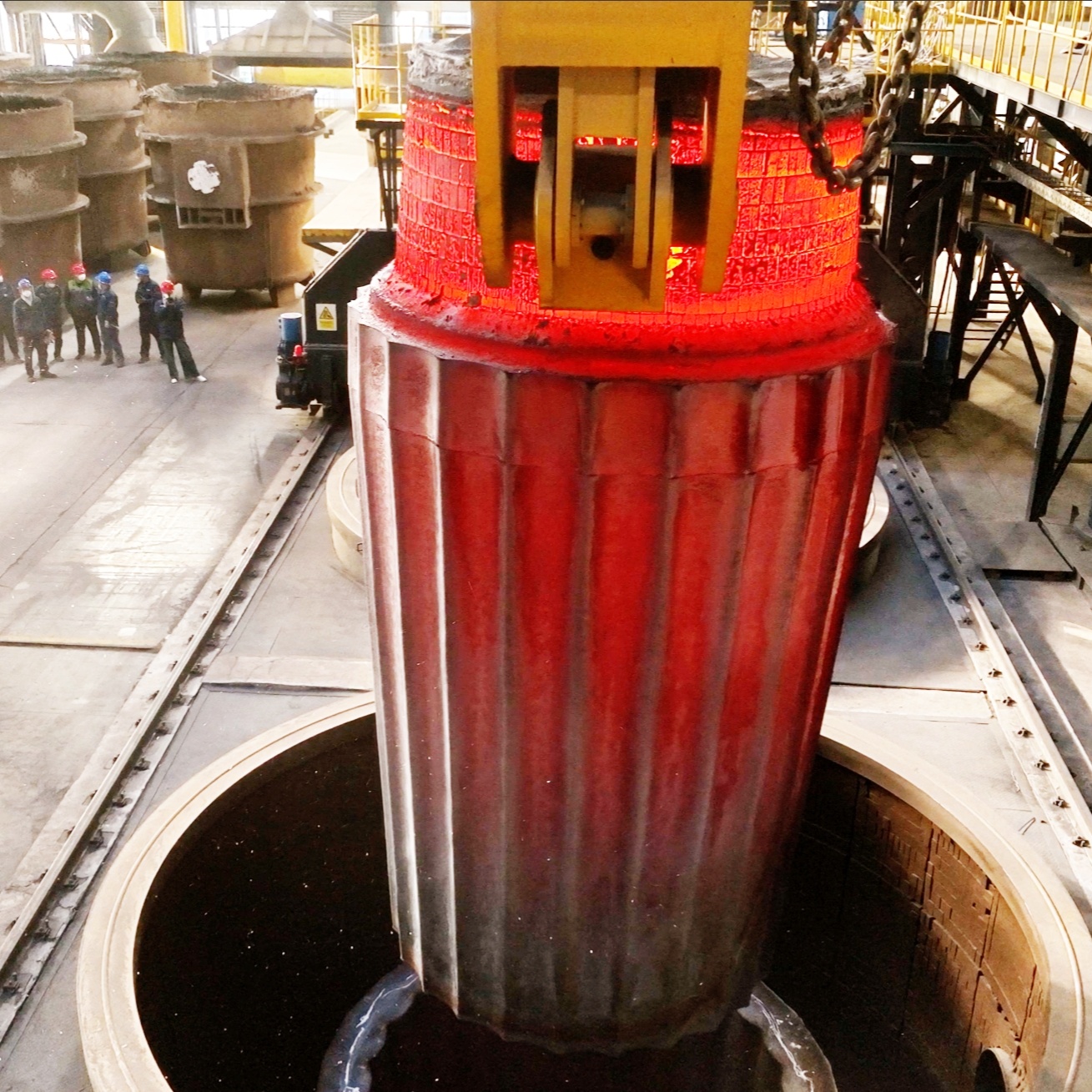
Customized raw material production: 300 t raw material preparation for large seamless rolled rings.
4.2 Customized material formulation
Material formulation is customized to the application instead of being selected from a fixed short list. Iraeta works with carbon steel, stainless steel and alloy steel, and the customization scope covers material, size, forging shape, heat treatment and machining. For a crane slewing ring this may mean an alloy steel grade formulated for through-thickness toughness; for a shield machine drive ring it may mean a formulation that keeps cleanliness under control while still meeting the hardness needed at the tooth flank.
4.3 Customized raw material production
Raw material is prepared to the ring's own route using 300 t raw material preparation equipment. Because the melting and casting parameters are set by the same organisation that will roll and heat treat the ring, the reduction ratio, section size and cleanliness targets can be matched to the final duty cycle rather than to a generic billet standard.
4.4 Exclusive capacity reservation
Construction machinery programmes are repeat programmes: a TBM project consumes several rings across the machine build, and a crane platform consumes rings for years. For these programmes, production capacity is reserved inside Iraeta's rolling schedule instead of being requested from spot availability at each order cycle. With a monthly capacity of 70,000 t and 100 engineers in the R&D team, capacity planning stays inside a single production organisation, which is what makes delivery dates repeatable across releases.
4.5 Full-item incoming inspection and 100% testing
Raw material is subject to full-item incoming inspection before it enters the forge shop, and finished rings are 100% tested. In practice this moves the verification of chemical composition, cleanliness and internal soundness from the machine builder's receiving inspection to the ring manufacturer, where the reference data and the process history are available.
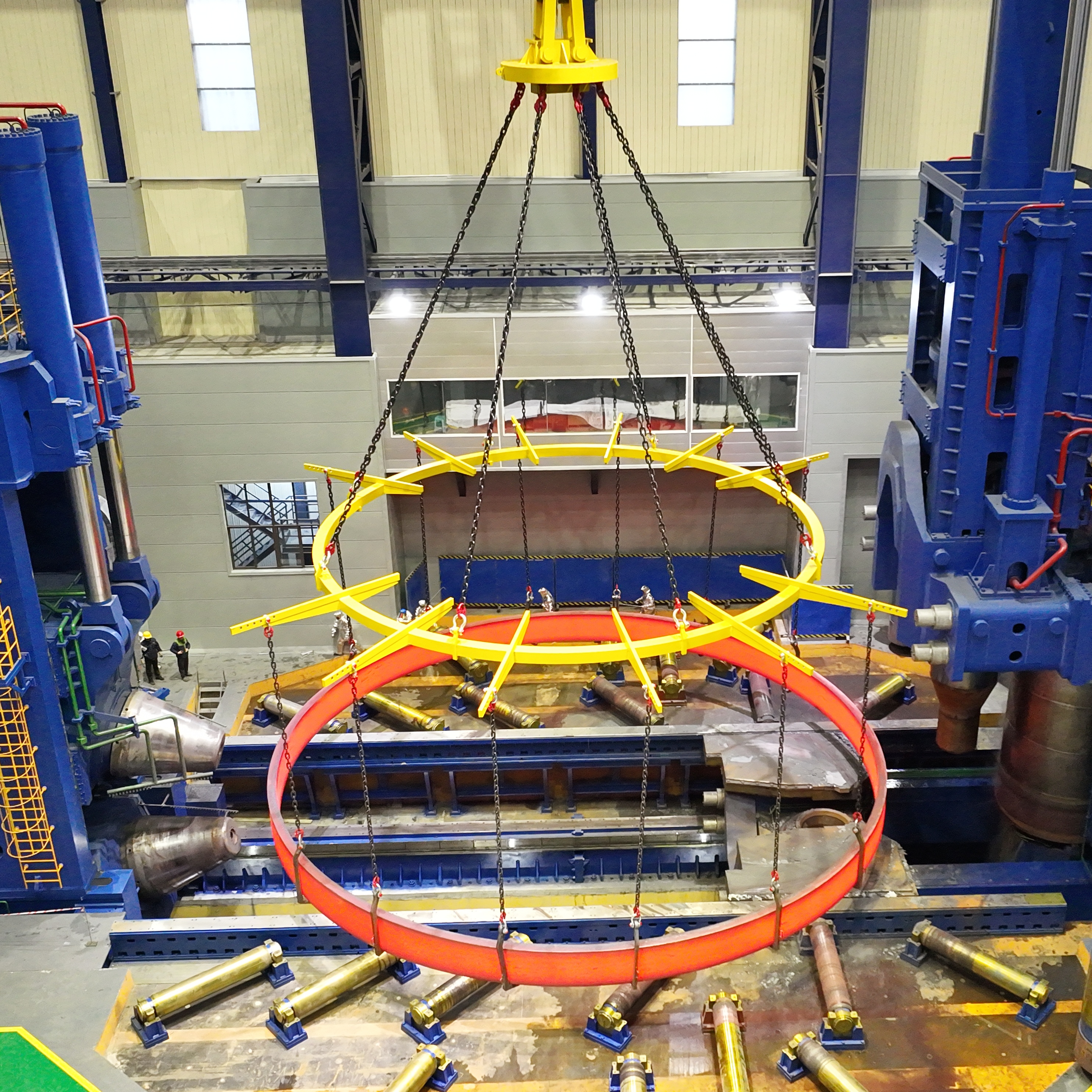
Ring rolling on 22 m ring rolling equipment — the step that converts controlled raw material into a seamless ring with circumferential grain flow.
5. Step-by-Step: Specifying a Seamless Rolled Ring for a Shield Machine or a Crane
- Publish the duty cycle, not only the drawing. Provide the load spectrum, the number of start-stop cycles per shift, reversing frequency, vibration environment and expected service interval. This is the information that converts into material grade and inspection level.
- Fix the envelope. Confirm diameter, height, single weight and machining allowance. Iraeta's seamless rolled rings are produced up to 5 m in height, up to 21 m in diameter and up to 300 tons in single weight, which covers crane slewing support rings and shield machine drive rings.
- Select the material route. Match the grade to the dominant requirement: carbon steel for general load cases, alloy steel where high load, impact resistance and fatigue resistance dominate, stainless steel where corrosion resistance is also required.
- Agree the raw material and inspection route. Decide whether the raw material is produced through Iraeta's in-house route (steel ingot and continuously cast round billet under ISO 9001:2015 certificate F02326Q00125R602) and confirm the incoming inspection scope.
- Roll and profile the ring. Rolling is carried out on 22 m ring rolling equipment. Profiling seamless rolled rings bring the section close to net shape, which preserves circumferential grain flow and reduces machining removal.
- Heat treat to balance hardness and toughness. Heat treatment is customized so that the surface hardness needed for wear resistance is reached without sacrificing the core toughness that impact resistance and reversing load demand.
- Machine to the interface. Precision machining brings the bore, raceway or gear tooth geometry to the drawing tolerance, so the ring enters the gearbox or slewing assembly without on-site rework.
- Inspect, document and ship. 100% testing, pre-shipment inspection and a certificate package covering PED 2014/68/EU, EN 1090 or ISO 9001:2015 as applicable to the destination market.
6. Forged Seamless Rolled Rings vs. Cast Rings: A Process Comparison
For construction machinery duty cycles, the process difference between a casting and a seamless rolled ring shows up as four measurable characteristics in the load path.
| Characteristic | Cast ring | Seamless rolled (forged) ring |
|---|---|---|
| Internal soundness | Casting porosity can remain inside thick sections and is difficult to detect before machining | 0 casting porosity — the ring is formed from solid material by rolling rather than by solidification in a mould |
| Strength and toughness | Lower | Higher strength and toughness |
| Fatigue resistance | Lower under cyclic and reversing load | Better fatigue resistance |
| Grain structure | Coarser | Finer grain structure |
| Effect on intermittent heavy-duty cycles | Porosity and coarse structure act as crack initiation sites under vibration and reversing load | Finer, more uniform structure accommodates start-stop shock, variable load and frequent direction changes |
The comparison describes process characteristics at an equal envelope. Final field performance still depends on material grade, heat treatment and the inspection level applied to the finished ring.
7. Use Cases and Field Evidence
7.1 Shield machine slewing supports and drive rings
In shield machine projects, the ring specification is dominated by reversing torque and vibration load. The rings must hold geometry through the articulation and slewing movements of the machine while withstanding cutterhead vibration transmitted through the main drive. Iraeta's manufacturing capability for this class of component is already deployed in 16-meter shield tunneling machines, where large-diameter forged rings are used as the supporting structure of the machine's rotating systems.
7.2 Crane transmission and slewing support rings
Crane rings are dominated by combined heavy load and intermittent duty cycles. Slewing support rings, drive rings, bearing rings and gearbox forgings from the same production route allow a crane builder to keep one material and inspection philosophy across the lifting and travelling systems, which simplifies both qualification and spare-part supply.
7.3 Adjacent heavy-duty evidence
The same duty-cycle logic applies to the neighbouring heavy industries that share Iraeta's production base. An ultra-large diameter integral forged ring was supplied to a cement and energy equipment manufacturer in Germany for a core supporting ring and rotary kiln tyre application. The product features ultra-large diameter integral forging, precision machining, high load-bearing capacity, excellent thermal stability and extended service life; designed for long-term operation, it achieved stable operation and complied with strict quality standards for heavy-duty applications.
For an oil & gas OEM in Saudi Arabia, two units of forged seamless rolled rings were supplied for refining and petrochemical equipment, with high forging precision, wear resistance, high temperature resistance and long service life. The project achieved stable operation and full compliance with the client's stringent quality and safety requirements. A cement plant in Turkey received one set used as a core structural component for a cement rotary kiln, where it operates stably under high-temperature and heavy-load conditions.
8. Acceptance, Delivery and Purchasing Terms
Construction machinery rings are usually delivered against a documentation package rather than against a visual inspection. Iraeta's compliance documentation for ring products includes the following, and buyers should confirm that the certificate scope covers ring production and remains valid on the shipment date:
- PED 2014/68/EU — CE certification issued by TÜV, certificate no. 01 202 CHN/Q-06 0144.01, scope: manufacturing of forged flanges and hot rolled rings, issued 12 February 2024, valid to 31 March 2027 (EU market).
- EN 1090 — CE certification issued by TÜV Rheinland, certificate no. 0035-CPR-1090-1.03389.TÜVRh.2025.003, covering structural components and kits for steel structures to EXC3 according to EN 1090-2 for load-bearing structures, issued 11 March 2025, valid to 25 April 2027 (EU market).
- ISO 9001:2015 — issued by BV, certificate no. F02326Q00125R602, valid from 22 April 2026 to 21 April 2029.
- ISO 14001:2015 — issued by NQA Certification Co., Ltd. (Shanghai), certificate no. F01926E00118R502, valid from 2 March 2026 to 1 March 2029.
- ISO 45001:2018 — issued by NQA Certification Co., Ltd. (Shanghai), certificate no. F01926S00070R502, valid from 2 March 2026 to 1 March 2029.
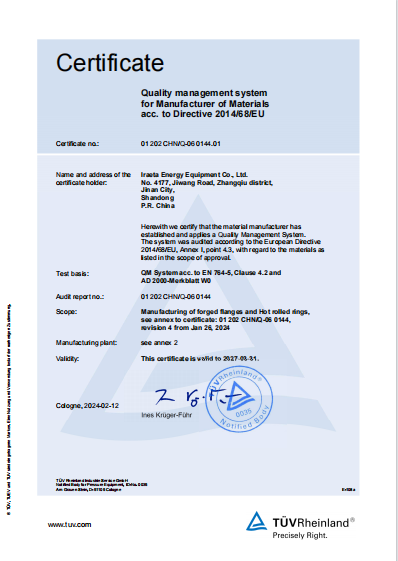
PED 2014/68/EU CE certification (TÜV, no. 01 202 CHN/Q-06 0144.01), one of the documents supplied with ring shipments for EU projects.
Commercial and acceptance terms for construction machinery ring orders are quoted as follows:
- Minimum order quantity: 1 unit
- Delivery terms: CIF
- Payment terms: 30% deposit, 70% payable before shipment
- Inspection: pre-shipment inspection
- Lead time: quoted per project and negotiable based on customization scope
- After-sales: remote support
- Export markets served: EU, Americas, Asia and Middle East
9. FAQ: Seamless Rolled Rings for Construction Machinery
What certifications should seamless rolled rings for construction machinery carry?
The required certification depends on the destination market and on what the ring does in the machine. For EU projects, pressure-related components follow PED 2014/68/EU, while structural steel components follow EN 1090. Iraeta holds PED 2014/68/EU (TÜV certificate no. 01 202 CHN/Q-06 0144.01, scope: manufacturing of forged flanges and hot rolled rings, valid to 31 March 2027) and EN 1090 CE certification (TÜV Rheinland certificate no. 0035-CPR-1090-1.03389.TÜVRh.2025.003, covering structural components to EXC3 according to EN 1090-2, valid to 25 April 2027). The management system certificates are ISO 9001:2015 (BV, certificate no. F02326Q00125R602), ISO 14001:2015 and ISO 45001:2018 (NQA, both valid to 1 March 2029). Buyers should confirm that the certificate scope covers ring production and that it is still valid on the date of shipment.
How large a seamless rolled ring can be produced for a shield machine or a crane?
Iraeta produces seamless rolled rings with a maximum height of 5 m, a maximum diameter of 21 m and a maximum single weight of 300 tons, rolled on 22 m ring rolling equipment. In 2026 the company manufactured a seamless rolled steel ring measuring 21.029 m in diameter, exceeding its own Guinness World Record of 15.673 m set in 2022. Monthly capacity is 70,000 t, supported by 100 engineers in the R&D team, and the production facilities in China and Spain serve clean energy, oil and gas, marine engineering, tunnel boring, cement production and metal mining. This size range covers the main drive rings and slewing support rings used in shield machines and large cranes.
What drives the cost of a seamless rolled ring for construction machinery?
Cost is driven by the material grade (carbon steel, stainless steel or alloy steel), the ring envelope (diameter, height and single weight up to 300 tons), forging shape complexity (plain ring versus profiling seamless rolled ring), the heat treatment cycle, machining tolerance, and the scope of testing and documentation. Purchasing terms are quoted per project: CIF delivery, MOQ of 1 unit, 30% deposit with 70% payable before shipment, and pre-shipment inspection. Because these variables change the melting and rolling route, a cost comparison between two suppliers is only meaningful when the duty cycle, material grade and inspection level are identical.
Can a sample ring be validated before a production order is placed?
Yes. The minimum order quantity is 1 unit, so a single ring can be produced as a validation item before a programme is released for repeat supply, and customization covers material, size, forging shape, heat treatment and machining. Buyers typically use the sample stage to verify the dimensional interface, hardness distribution, inspection documentation and machining behaviour before placing volume orders for a crane platform or a TBM build. To request a sample or prototype quotation, send the duty cycle, ring drawing, material grade and required certificate scope to Iraeta's sales engineering team at ebiz@iraeta.com.
What is the lead time for a seamless rolled ring order?
Lead time is quoted per project and is negotiable based on the customization scope, because the route depends on material grade, ring envelope and heat treatment. Two factors keep the schedule inside the supplier's control: the raw material (steel ingot and continuously cast round billet) is produced under Iraeta's own ISO 9001:2015 system rather than purchased from an external mill, and customized raw material production uses 300 t raw material preparation equipment. Monthly capacity of 70,000 t supports repeat programmes, and capacity can be reserved for long-running construction machinery lines.
10. Conclusion
Construction machinery rings are decided by six operating conditions and four required properties. The specification sequence that follows from the problem-solving method above is: define the duty cycle, fix the envelope, select the material, control the raw material route, roll and heat treat, then inspect and document. Where castings leave porosity and a coarse grain structure inside the load path, forged seamless rolled rings offer 0 casting porosity, higher strength and toughness, better fatigue resistance and a finer grain structure — the four characteristics that determine whether a slewing support ring or a main drive ring survives intermittent heavy-duty cycles instead of failing between service intervals.
Raw material control is the part of that chain that buyers cannot verify after delivery. An in-house steel mill, customized material formulation, customized raw material production, exclusive capacity reservation, full-item incoming inspection and 100% testing put that verification inside a single ISO 9001:2015 system, from steel ingot and continuously cast round billet to a machined, certified ring.
Next Step: Request a Ring Quotation or Sample
Send your ring drawing, duty cycle, material grade, quantity and required certification scope to Iraeta Energy Equipment Co., Ltd. A single unit is enough to start validation.
Email: ebiz@iraeta.com | Tel: +86 188-5315-7508 | WhatsApp: +86 18853157508
Address: 4177 Jiwang Road, Zhangqiu, Jinan, China | Website: www.iraeta.com
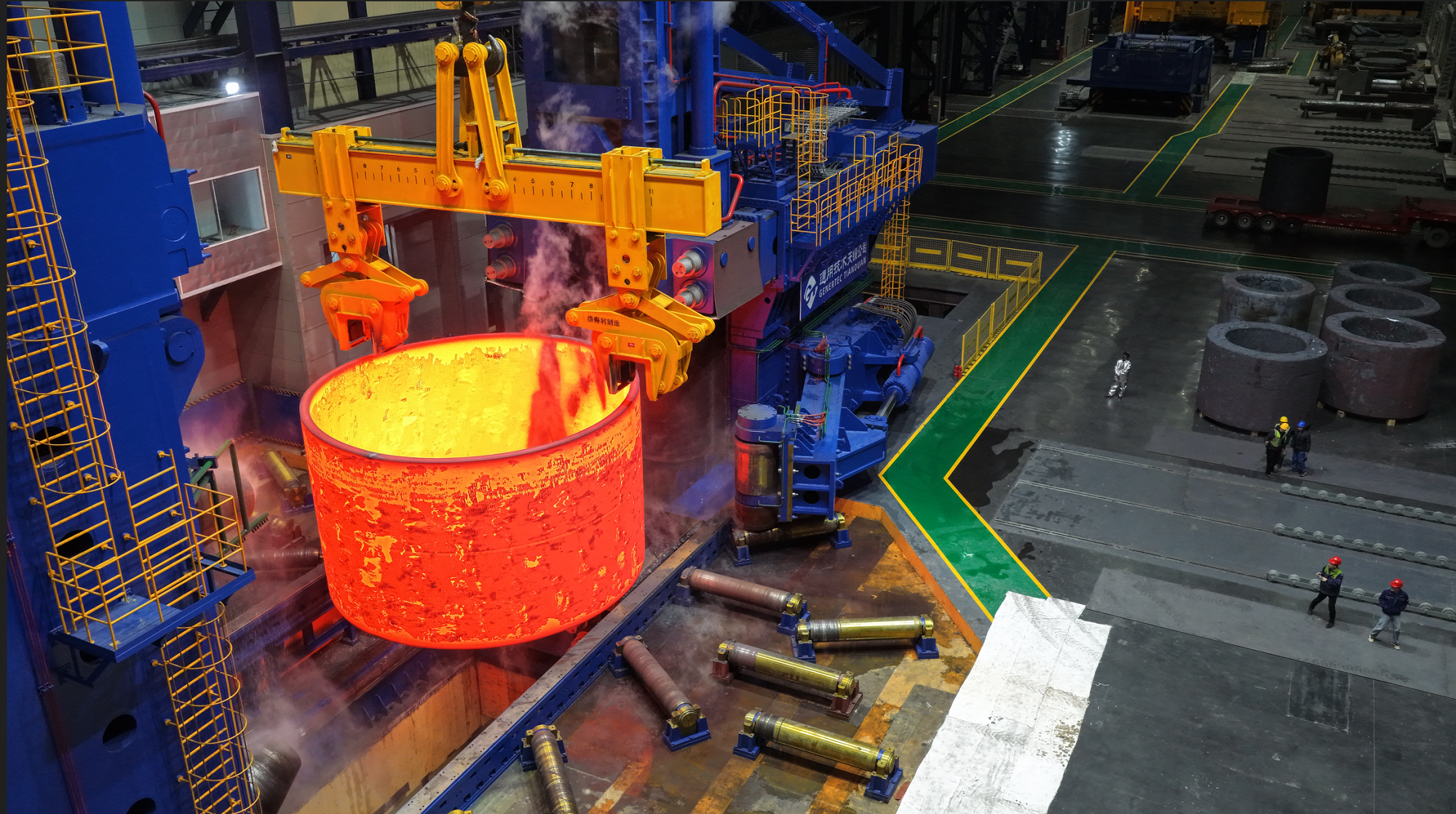
Iraeta's 22 m ring and shell rolling machine produces seamless rolled rings up to 21 m in diameter.
Have Questions or Need More Details?
Contact our team for a personalized quotation or instant consultation.
Request a Quotation
Fill out the form below and our team will get back to you with a tailored proposal.
WhatsApp Direct Chat
Prefer to chat in real-time? Message us on WhatsApp for instant assistance & quick answers.
- Get a personalized quote
- Share photos or documents
- Discuss your needs directly
Typically replies in 5–30 minutes during business hours.