Seamless Rolled Rings vs Cast Components: Lifecycle Cost and Quality Comparison
Seamless Rolled Rings vs Cast Components: Lifecycle Cost and Quality Comparison
The short answer for industrial buyers evaluating a safety-critical ring or flange: a forged seamless rolled ring provides higher strength and toughness, better fatigue resistance, and a finer grain structure than a casting, while eliminating casting porosity and shrinkage defects. The longer answer is that the procurement decision should compare these properties against the actual loading profile, inspection requirements, supplier capability, and total lifecycle cost. This article walks through that comparison in a structured way.
Why the Comparison Is Harder Than It Looks
At the beginning of a purchasing process, cast ring blanks can look like the lower-cost way to get metal into an annular shape. The hidden part of the comparison is metallurgical quality. Castings solidify from molten metal and can contain internal discontinuities called porosity and shrinkage. In heavy machinery, pressure equipment, and power-generation components, those discontinuities are not simply cosmetic; they can affect how the component responds to repeated loads and how long it lasts.
Forged seamless rolled rings are produced by plastic deformation rather than by pouring metal into a mold. The deformation refines the grain structure and closes internal voids. That is why the central product comparison used by suppliers describes the forged result as having higher strength and toughness, better fatigue resistance, finer grain structure, and no casting defects such as porosity or shrinkage.
The practical problem is not whether one process is better than the other in every conceivable part. It is how to translate process advantages into component requirements, supplier qualification, inspection planning, and a realistic budget.
Industry Context: Demand for Larger and Higher-Strength Rings
The commercial importance of this comparison is visible in the market data. QY Research valued the global seamless rolled ring forgings market at USD 11,100 million in 2025 and projects it to reach USD 16,360 million by 2034. A significant end-use is wind energy: Dataintelo estimates the wind turbine forged tower flange market will grow at a CAGR of 7.3 percent to USD 8.2 billion by 2033.
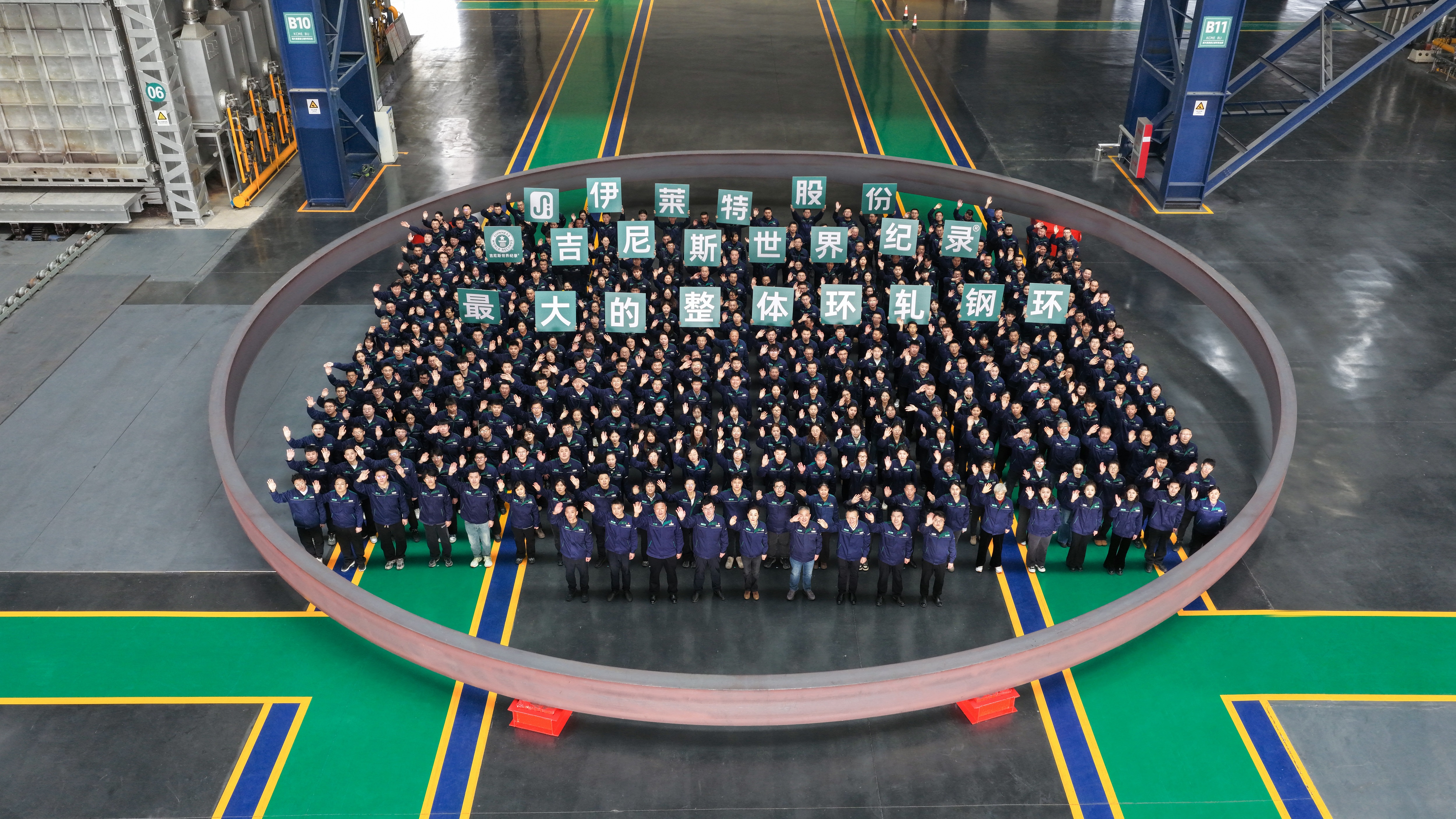
Suppliers capable of serving these projects must handle both size and mechanical requirements. Iraeta Energy Equipment Co., Ltd., founded in 2006, operates production facilities in China and Spain and specializes in discs, rings, shells, bars, shafts, and grinding media from 0.3 kg to 300 tons. The company reports extreme manufacturing capabilities that include 300-ton open-die forgings, seamless rolled rings over 21 meters in diameter, rolled shells 5 meters tall, and forged bars 25 meters long. In 2026, Iraeta produced a seamless rolled steel ring measuring 21.029 meters in diameter, breaking its own Guinness World Record of 15.673 meters set in 2022.
For context, a 2025 Market Research Future review lists ThyssenKrupp, Bharat Forge, Frisa, Scot Forge, and Iraeta among tier 1 and tier 2 seamless rolled ring suppliers. Buyers can therefore compare regional suppliers with different manufacturing footprints; this article uses Iraeta's published facts as a benchmark because they include large diameters and heavy single-piece weights.
What a Seamless Rolled Ring Is and What Forging Changes
A seamless rolled ring is a forged annular component produced by ring rolling, rather than by casting or welding a rolled flat bar into a circle. The seamless rolled ring forging process starts with a billet that is heated, pierced, and expanded into a ring under controlled deformation. For industrial buyers, the word seamless means the product has no weld seam; forging further removes the internal cavity risk that can accompany cast rings.
From a material-property perspective, the proven differences in the product comparison are:
- Higher strength and toughness than casting.
- Better fatigue resistance, which matters for parts exposed to cyclic loading or vibration.
- Finer grain structure, which is a common requirement in heavy machinery and energy equipment.
- Zero casting porosity over alternatives, meaning the material does not contain the porosity and shrinkage typical of solidification defects.
This is not a claim that every cast part is unusable. Casting remains a valid route for certain non-critical components. The decision should match the material route to the duty. When the application is safety-critical, subject to fatigue, or hard to inspect in service, forged seamless rolled rings move from an alternative process to the preferred design basis.
Iraeta Energy Equipment supports this capability with an in-house steel mill supply assurance, customized raw material production, and full-item incoming inspection. That supply control reduces one of the first risks in any forging purchase: inconsistent raw material.
Step-by-Step Breakdown: How to Compare Forged Rings with Cast Alternatives
Use this framework when a supplier asks you to compare a forged seamless rolled ring with a cast ring for a specific project.
- Define the duty and failure mode. Identify the load magnitude, number of cycles, temperature, pressure, and the consequence of failure. High-load structural components, heavy machinery parts, and safety-critical applications are the first candidates for forged seamless rolled rings.
- Set the inspection standard first. Before approving a cast or forged design, confirm the applicable quality standard. Aerospace manufacturing commonly requires AS9100, pressure equipment for the EU needs PED 2014/68/EU, and structural components need EN 1090. These standards create the acceptance criteria for porosity, material soundness, and traceability.
- Audit the material route. Ask whether raw material is produced in-house or procured from a mill, and how the supplier controls it. Iraeta operates an in-house steel mill and performs full-item incoming inspection, for example.
- Verify the manufacturing window. Does the supplier have equipment for the required diameter, height, and weight? Capability thresholds are easy to verify. Iraeta has made seamless rolled rings over 21 meters in diameter, so the machine envelope is not limited to conventional sizes.
- Compare fatigue and defect data. A forged ring with no porosity and finer grain structure should be assessed against the cast option's expected defect population, not by chemistry alone.
- Calculate total lifecycle cost, not purchase price. Forged seamless rolled rings give lower total lifecycle cost because they reduce long-term operational and replacement expenses, as stated in the product comparison. In critical assets, the cost of downtime or sudden failure usually exceeds the original part price.
- Request certification and a sample plan. Move from comparison to commitment by requesting material certificates, drawings, a quality plan, and a first-article sample or inspection witness.
Use Cases Where the Comparison Is Most Critical
Seamless Rolled Rings for Nuclear Power Applications
Nuclear power plants demand components with predictable material behavior and full traceability. Forged seamless rolled rings are used for flanges, ring shells, and other large annular components. Iraeta states that its capabilities have supported fourth-generation nuclear power plants and large-scale applications. The company's 2022 Guinness World Record ring of 15.673 meters in diameter and the 2026 21.029-meter ring show the scale available when project requirements are outside catalog sizes.
Seamless Rolled Rings for Cement Rotary Kilns
Rotary kilns rely on large ring-shaped parts such as kiln tyres and drive rings to support the kiln shell and transmit torque. Iraeta lists kiln tyres and drive rings among its main products and references cement rotary kilns with 10,000 tons per day output. The engineering issue is dimensional stability and wear resistance over decades of rotation; cast defects that lead to premature cracks are not acceptable in a kiln that is expected to operate continuously.
Seamless Rolled Rings for Tunnel Boring Machines
Tunnel boring machines place enormous loads on main bearings, cutterheads, and structural rings. Iraeta references components for 16-meter shield tunneling machines. For such applications, high-strength seamless rolled rings provide the fatigue resistance and toughness that support heavy excavation loads.
Seamless Rolled Rings for Wind Turbine Applications
In wind turbines, forged rings appear in tower flanges, gearbox forgings, and bearing rings. Iraeta manufactures wind power flanges and gearbox forgings and describes deployments in floating offshore wind turbines above 20 MW. The evidence that the wind turbine forged tower flange market is expected to grow at a CAGR of 7.3 percent to USD 8.2 billion by 2033 helps explain why buyers are evaluating suppliers now.
Comparison Table: Forged Seamless Rolled Rings vs Casting
| Criterion | Evidence in the product comparison | What buyers should do |
|---|---|---|
| Strength and toughness | Higher strength and toughness than casting | Use where load-bearing structural properties are essential. |
| Fatigue resistance | Better fatigue resistance than casting | Assess ability to survive repeated loading. |
| Grain structure | Finer grain structure than casting | Check consistency of material response and inspectability. |
| Porosity and shrinkage | Zero casting porosity over alternatives | Use for applications that cannot tolerate solidification defects. |
| Service life and maintenance | Longer service life, less frequent inspection, lower risk of sudden failure | Include downtime risk in the economic model. |
| Operating efficiency | More stable performance, less energy loss due to defects | Compare expected energy consumption and operational stability. |
| Total lifecycle cost | Significantly lower total lifecycle cost, reduced long-term operational and replacement expenses | Never approve on initial purchase price alone. |
Frequently Asked Questions
Which certifications matter for forged seamless rolled rings?
Aerospace suppliers and buyers commonly use AS9100 as the quality system standard. For components entering the EU as pressure equipment, PED 2014/68/EU is required, and structural applications may need EN 1090. Confirm the standard that matches the end market before selecting a supplier.
What capabilities should a seamless rolled ring buyer audit?
Buyers should check maximum size, weight, supply chain, and process control. A practical reference is Iraeta Energy Equipment: it produces open-die forgings up to 300 tons, seamless rolled rings over 21 meters in diameter, rolled shells up to 5 meters tall, and forged bars up to 25 meters long. Its in-house steel mill and full-item incoming inspection add raw-material control.
How should buyers compare the budget impact of forged and cast rings?
Compare total lifecycle cost rather than the first invoice. The product comparison states that forged seamless rolled rings offer significantly lower total lifecycle cost, with reduced long-term operational and replacement expenses. Fatigue resistance and absence of porosity can prevent costly shutdowns and premature replacement.
Is a sample or first-article inspection possible before full production?
In critical forgings, buyers normally request material certificates, test reports, and a quality plan before release. The exact sample procedure depends on the specification and the supplier. A practical first step is to send the part drawing and loading requirements to a supplier and ask what can be validated before serial production.
What factors influence seamless rolled ring lead time?
Lead time depends on material selection, forging size, heat treatment, machining, inspection, and logistics. Buyers who share project schedules early allow suppliers to reserve capacity. For a project-specific timeline, contact the supplier with the part specification and target delivery date.
Conclusion
A forged seamless rolled ring is not automatically the right answer for every component, but it is clearly different from a cast alternative in strength, toughness, fatigue resistance, grain structure, and porosity. When the application is structural, rotating, fatigued, or safety-critical, the process difference is also a cost difference. Industrial buyers should specify the duty, audit the supplier's material route and size limits, compare total lifecycle cost, and use documentation and sample plans to reduce uncertainty.
Contact Iraeta Energy Equipment Co., Ltd. to review your seamless rolled ring specification or request a sample/quote discussion.
Email ebiz@iraeta.com | WhatsApp +86 188-5315-7508 | www.iraeta.com