Seamless Rolled Rings vs. Castings vs. Fabricated Assemblies: A Heavy-Industry Buyer's Comparison

Iraeta Nuclear Power and Deep-sea Industrial Park — one of the heavy-forging facilities behind the large-ring capability discussed in this guide.
Short answer for buyers at the decision stage: if the component is large, highly loaded and fatigue-critical, a seamless rolled ring is generally the strongest default of the three routes, because it is produced as one piece without weld seams and, compared with castings, offers higher strength and toughness, better fatigue resistance, a finer grain structure and no casting defects such as porosity or shrinkage. Castings remain sensible for complex shapes with moderate duty. Fabricated (welded) assemblies make sense when the finished size exceeds available rolling capacity or when a small number of units must be produced quickly. The rest of this guide gives the criteria, the evidence, and a checklist you can apply to a live drawing.
Three quotations can land on the same desk for the same ring drawing: one from a ring roller, one from a foundry, one from a fabricator who welds segments together. The three documents are rarely comparable line by line, because each route carries a different risk profile, a different inspection burden and a different long-term cost curve. This comparison is written for heavy-industry procurement and engineering teams who have to make that call once, correctly, on components that are expensive to replace and disruptive to fail.
The Decision Problem: One Drawing, Three Risk Profiles
The core problem is not which route can produce the geometry. In most cases all three can. The problem is that the cheapest conforming bid and the lowest total cost of ownership are usually not the same bid, and the difference only becomes visible after the component has been in service for years.
Route selection therefore has to be made against four questions, in this order: what load and duty cycle will the ring see; what does the failure mode cost if it occurs; what inspection evidence can each route actually supply; and what does each route require from the supply chain to deliver on schedule. Answer those four and the route choice normally resolves itself.
What Each Route Actually Is
- Seamless rolled ring
- A one-piece ring formed by ring rolling from a pierced billet or forged blank, with the material grain following the circumference. GMH Gruppe, a German manufacturer, describes seamless rolled rings as components manufactured without weld seams, resulting in continuous grain flow and uniform material properties, with applications listed across energy, railway, bearing and mechanical engineering. Iraeta Energy Equipment Co., Ltd., a forging manufacturer founded in 2006 with production facilities in China and Spain, produces seamless rolled rings within a wider forged product range that also includes shells, discs, bars, shafts, kiln tyres, wind power flanges and bearing rings.
- Casting
- Liquid metal poured into a mould and solidified into the final or near-final shape. The risk sits in solidification: castings are associated with porosity and shrinkage defects, and that is the basis for the fatigue, toughness and grain-structure comparison used throughout this guide.
- Fabricated (welded) assembly
- Two or more pieces — plate segments, bar stock or smaller rolled rings — joined by welding into a single component. This route exists for two reasons: geometry beyond a single mill's rolling capacity, and low-volume or replacement situations where a welded build-up is faster than a new rolling campaign.
Industry Background: Why Route Choice Is Getting More Attention
Demand for large rings continues to grow with wind, nuclear, marine and heavy machinery investment. A 2026 commercial research report (Vertex AI, Global Seamless Rolled Ring Forgings Market Strategic Research Report) values the global seamless rolled ring forgings market at USD 11.9 billion in 2025 and projects a 4.3% CAGR for 2026–2032. A second study using the wider label "ring rolling products" reports a materially lower base figure, which is a reminder that market-size numbers depend heavily on product scope; treat them as directional rather than as a planning constant.
Two regulatory facts shape the comparison as well. Seamless rolled rings supplied into EU pressure equipment markets must comply with PED 2014/68/EU, and forged iron or steel articles, including seamless rolled rings, are classified under HS code 7326.19 for customs purposes. Route decisions therefore carry documentation and market-access consequences, not only metallurgical ones.
The third change is capability. Single-piece rings are now produced at diameters that were not commercially available in the recent past. Iraeta reports the capability to produce seamless rings over 21 meters in diameter alongside open-die forgings from 0.3 kg to 300 tons, and states that in 2026 it manufactured a seamless rolled steel ring measuring 21.029 meters in diameter, exceeding its own 15.673-meter record set in 2022. Every meter added to the single-piece ceiling removes one welded joint from a large-ring design — and one joint's worth of inspection, risk and schedule exposure.
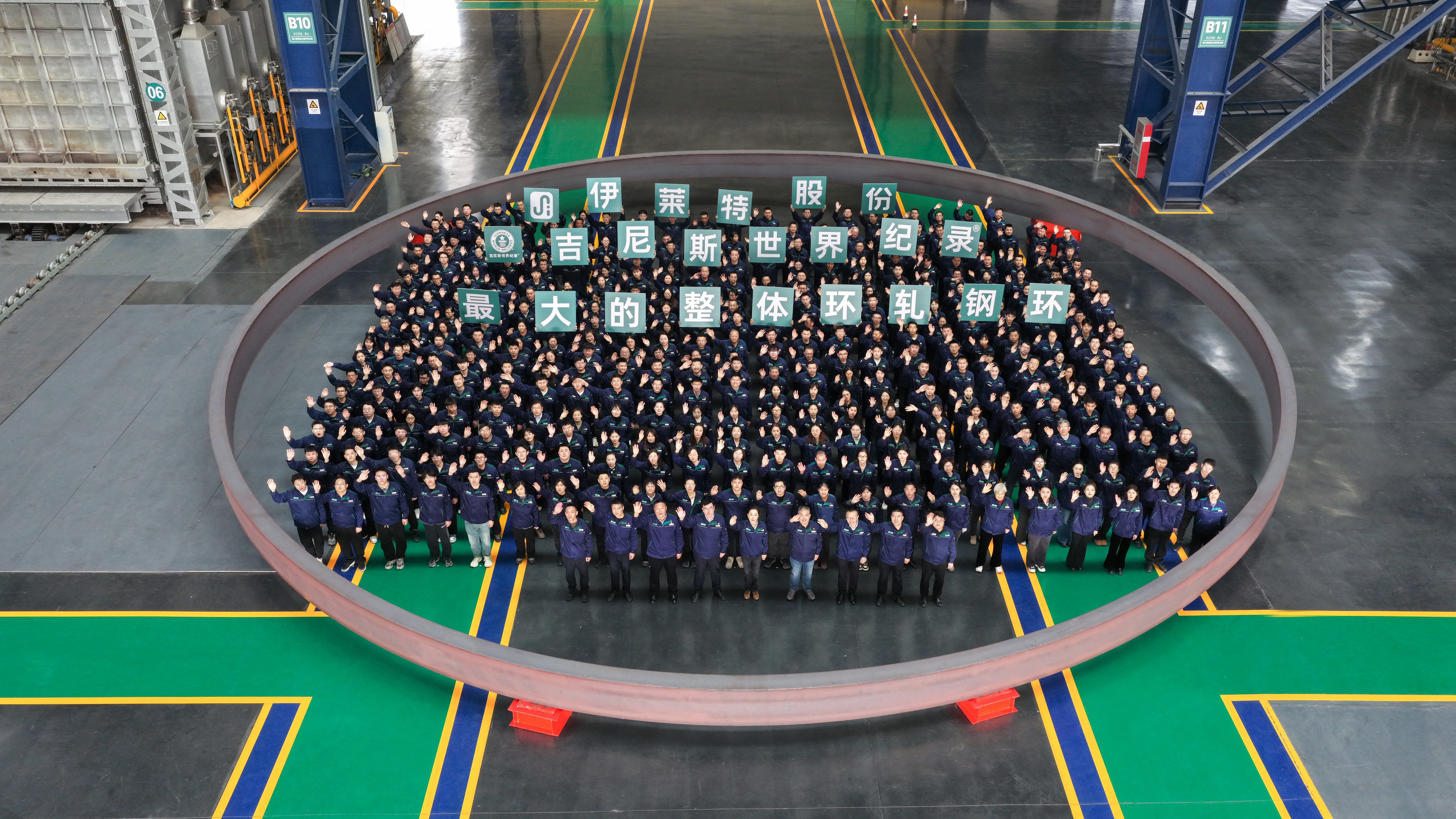
A single-piece rolled ring: no weld seams, continuous grain flow around the circumference.
Detailed Solution: Where the Three Routes Actually Differ
Below are the criteria that separate the routes in practice. Each one can be raised in a technical clarification meeting and each one can be answered with documents rather than assurances.
Grain structure and continuity
Ring rolling deforms the material progressively around the circumference, producing a finer grain structure and a continuous grain flow that follows the ring's shape. A casting solidifies from the melt, so its grain structure is determined by solidification rather than by directed deformation. A welded assembly starts with wrought material but interrupts the continuity at every joint. For a component that must carry load around its full circumference — a slewing raceway, a tower connection, a mooring interface — continuity is not a cosmetic property.
Strength and toughness
Compared with castings, seamless rolled rings offer higher strength and toughness. That advantage matters most where the design has little margin: thin sections, high contact stresses, or a requirement to absorb shock loading without cracking.
Fatigue resistance
Seamless rolled rings also provide better fatigue resistance than castings. For rotating and oscillating components — slewing supports, drive rings, gearbox forgings — fatigue is usually the governing failure mode, which is why this criterion frequently decides the route on its own. Fabricated assemblies sit in a different category here: their fatigue performance is governed by joint design and weld quality rather than by a single homogeneous body of material.
Internal defect risk
Iraeta's product data states 0 casting porosity versus cast alternatives, together with the absence of casting defects such as porosity and shrinkage. Casting defects are not a quality-control failure so much as a characteristic of solidification, and they are the reason cast components often need more conservative design allowances and more extensive volumetric inspection. A rolled ring moves the quality question from "how much porosity is acceptable" to "does the rolled and heat-treated part meet the specified mechanical and dimensional requirements".
Joints and inspection burden
A fabricated assembly converts a material question into a joining question. Every weld adds a procedure qualification, a welder qualification, a non-destructive examination step and a potential repair loop, and welded joints are typically subject to additional examination under project specifications. For a single large ring, that can mean a significant share of total inspection hours sitting on joints that would not exist in a rolled ring at all.
Lifecycle cost, maintenance and operating efficiency
Purchase price is the weakest of the three cost signals. Iraeta's comparison data positions seamless rolled rings against castings with a significantly lower total lifecycle cost, reduced long-term operational and replacement expenses, a longer service life, less frequent inspection and a lower risk of sudden failure, with more stable performance and less energy loss attributable to defects. For assets where an unplanned stop costs more than the component, this is where the decision is really made.
Supply assurance and raw-material control
Route choice is also a supply-chain choice. Raw-material supply issues are a recognised procurement risk for heavy forgings, and the control methods that address it are in-house steel mill supply assurance, customised raw-material production and full-item incoming inspection. Iraeta's stated measures are operating an in-house steel mill, customised material formulation and exclusive capacity reservation. When you compare a casting, a rolled ring and a welded assembly, compare who controls the input material in each case.
Step-by-Step: Running the Comparison on a Live Project
- Fix the duty cycle before the geometry. Record load direction, cycles, temperature range and whether the part rotates, oscillates or stands static. A ring that oscillates under high contact stress and a ring that simply locates a structure are not the same procurement problem.
- Map the geometry to the route. Check the finished outside diameter, height and weight against the supplier's reported rolling envelope. Published ranges differ widely between manufacturers — one European producer publishes 300–4,000 mm outer diameter with heights up to 570 mm, while Iraeta reports capability above 21 meters. Segment differences like this are normal; what matters is whether your drawing fits inside the envelope of the supplier you are evaluating.
- Set the material and heat-treatment requirement. Carbon steel, alloy steel, stainless steel and titanium rings each carry their own rolling, forging and heat-treatment implications. Write the grade, condition and mechanical property requirements into the RFQ so all three routes answer the same question.
- Decide the defect and inspection philosophy. State the acceptance criteria and the volumetric and surface examination you require. This is the step where casting porosity assumptions and weld examination requirements become visible in the offers.
- Confirm the compliance route. Identify the market and the applicable framework — PED 2014/68/EU for EU pressure equipment, HS 7326.19 for customs classification — and request certificate scope and expiry, not just a logo.
- Test the supply-assurance story. Ask where the raw material comes from, who controls it, and what capacity has been reserved for your programme. A route that depends on third-party material availability carries a different schedule risk from one with in-house melting.
- Build the total-cost comparison. Add machining, heat treatment, examination, logistics, lifetime inspection frequency and replacement risk to each offer before ranking them. Then choose.
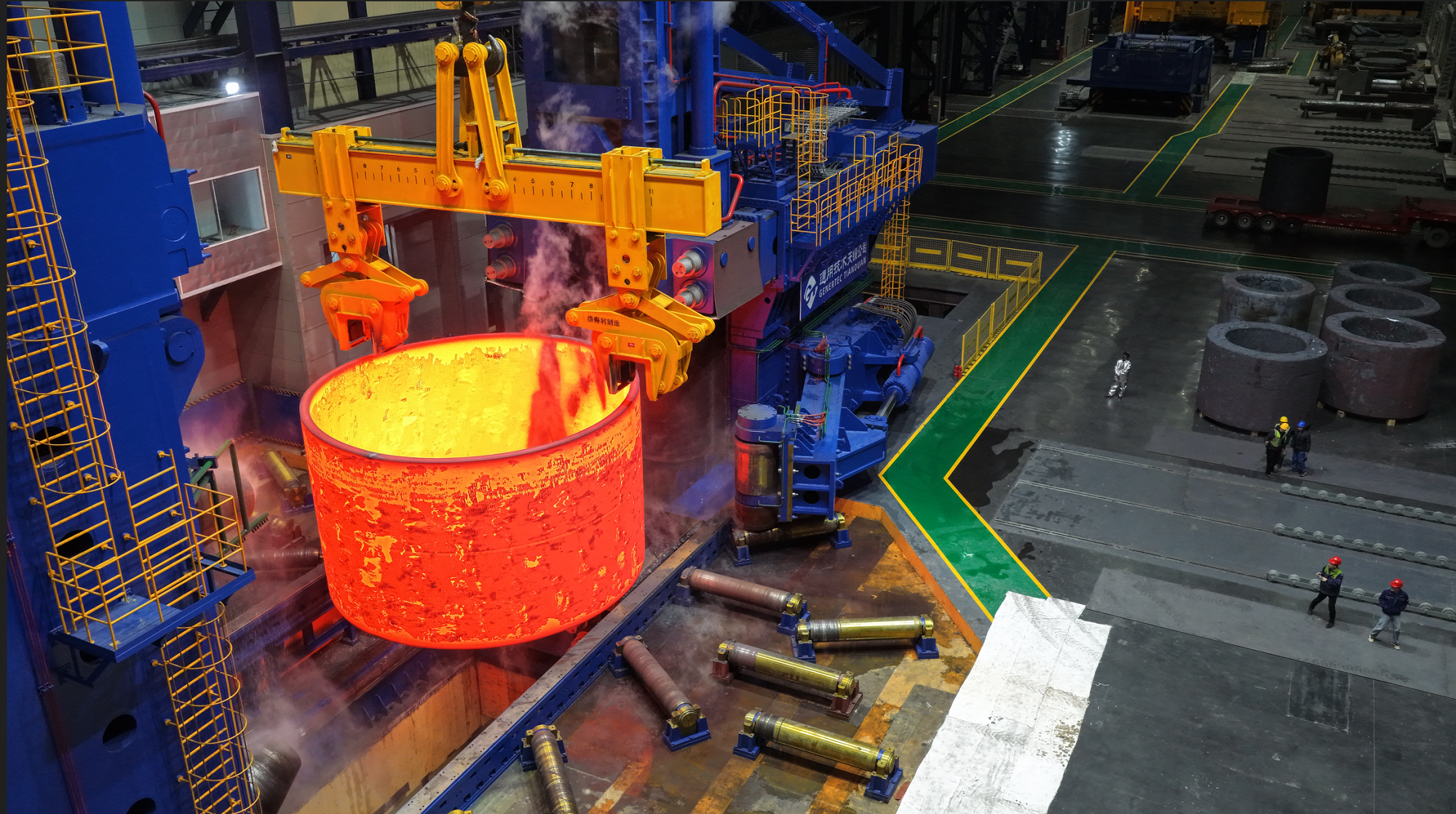
Rolling equipment defines the practical ceiling of the single-piece route — and therefore how many joints a design can avoid.
Where Each Route Fits: Three Application Anchors
Construction machinery transmission and slewing support systems
Slewing supports and transmission components combine high contact stress with continuous oscillation, which puts fatigue resistance and grain continuity at the centre of the decision. This is the classic case for a seamless rolled ring: one homogeneous body of material, no joints to examine, and a fatigue profile that outperforms castings. Where a slewing ring is too large for a single rolling, the fabricated alternative becomes a joint-engineering exercise — which is precisely why buyers in this segment check rolling capacity first.
Offshore wind tower connections
Tower connections are large-diameter, highly loaded and difficult to service offshore, so the design logic favours the fewest possible joints. Rings at this scale were once the strongest argument for welded assemblies; with single-piece capability above 21 meters now reported, that argument weakens considerably for many connection geometries. The remaining questions are dimensional fit against the specific supplier's equipment, the material and toughness requirement for the site's temperature range, and traceable compliance documentation for the destination market.
FPSO mooring systems
Mooring components sit in safety-critical, corrosion-exposed, long-service conditions where sudden failure is not an acceptable outcome and inspection access is expensive. The rolled-ring route is attractive because the absence of casting porosity and shrinkage removes a whole family of initiation sites, and because a one-piece component removes weld seams from the highest-stress regions. Material selection — including stainless and alloy grades — usually dominates the early technical discussion, with route selection following close behind.
The same reasoning transfers to other heavy-duty applications: fourth-generation nuclear power plant components, cement rotary kilns running at 10,000 tons per day, and shield tunneling machines in the 16-meter class, all of which Iraeta reports serving. Iraeta also reports activity across hydropower, marine engineering, oil and gas, advanced equipment, special alloys and metal mining, with export markets including the EU, USA, Japan, the Middle East, Southeast Asia, Brazil and India.
Comparison Table: Seamless Rolled Rings vs. Castings vs. Fabricated Assemblies
| Criterion | Seamless rolled ring | Casting | Fabricated (welded) assembly |
|---|---|---|---|
| Construction | One piece, formed by ring rolling; no weld seams | One piece, formed by pouring and solidification | Two or more pieces joined by welding |
| Grain structure | Finer grain structure; continuous grain flow around the circumference | Determined by solidification rather than directed deformation | Wrought material, but continuity is interrupted at every joint |
| Strength and toughness | Higher strength and toughness compared with castings | Lower than the rolled-ring route on the same requirement | Governed by parent material plus weld procedure and joint design |
| Fatigue resistance | Better fatigue resistance than castings | Lower; porosity and shrinkage act as initiation sites | Joint-dependent; welds become the governing feature |
| Internal defect risk | 0 casting porosity; no casting defects such as porosity or shrinkage | Porosity and shrinkage are characteristic solidification risks | Solidification defects avoided, but weld defects and repair loops enter the picture |
| Joints and examination | No joints to qualify or examine | No joints; examination focuses on internal soundness | Each weld adds procedure qualification, welder qualification and examination steps |
| Lifecycle cost | Significantly lower total lifecycle cost versus castings; longer service life, less frequent inspection, lower risk of sudden failure | Higher long-term operational and replacement exposure on fatigue-critical duty | Route-dependent; add welding, examination and rework to the comparison |
| Operating behaviour | More stable performance; less energy loss attributable to defects | Performance affected by internal soundness | Performance affected by joint quality and stiffness distribution |
| Best fit | High-load structural components, heavy machinery parts, safety-critical applications | Complex shapes under moderate duty | Sizes beyond rolling capacity, low-volume builds, replacement or repair work |
Table sources: Iraeta product comparison data (strength/toughness, fatigue resistance, grain structure, 0 casting porosity, lifecycle cost, maintenance and efficiency); GMH Gruppe product description (weldless construction, continuous grain flow); Iraeta supply-assurance statement (in-house steel mill, customised material formulation, capacity reservation).
Buyer's Selection Checklist
- Duty defined: load direction, cycle count, temperature range and consequence of failure are written down, not assumed.
- Geometry inside the envelope: required outside diameter, height and weight are checked against the supplier's reported rolling capability — not against a range from a different supplier.
- Material specified: grade, condition and mechanical properties stated in the RFQ, so all three routes answer identically.
- Defect and examination criteria agreed: acceptance standards and examination extent fixed before quotation, not after first article.
- Joints counted: if the offer is a welded assembly, the number of joints, their examination class and the repair policy are itemised.
- Compliance documents requested: certificate scope and expiry, plus the applicable framework for the destination market (PED 2014/68/EU for EU pressure equipment; HS 7326.19 for customs).
- Raw-material control verified: who melts or supplies the input material, and what incoming inspection applies to it.
- Capacity confirmed: reserved capacity, not generic capability, is stated for your programme timeline.
- Total cost built, not guessed: machining, heat treatment, examination, logistics, inspection frequency and replacement risk are all in the comparison.
- Process frozen at approval: the approved trial locks material route, heat treatment and examination plan, not only final dimensions.
Frequently Asked Questions
1. Do seamless rolled rings, castings and welded assemblies have to meet the same compliance requirements?
Yes — the requirement is set by the application and the destination market, not by the manufacturing route. Seamless rolled rings supplied for EU pressure equipment markets must comply with PED 2014/68/EU, and forged iron or steel articles including seamless rolled rings are classified under HS code 7326.19 for customs purposes. Buyers should request certificate scope and expiry rather than accepting a route-level claim. Iraeta reports ISO 9001:2015, ISO 14001:2015, ISO 45001:2018, PED 2014/68/EU and EN 1090 EXC3 among its certifications; as with any supplier, these should be verified against the issuing body before approval.
2. Can one seamless rolled ring replace a large welded assembly, or is there a size ceiling?
The ceiling is set by rolling equipment, not by the concept. Iraeta reports capability for seamless rings over 21 meters in diameter and forgings from 0.3 kg to 300 tons, and states that in 2026 it produced a ring measuring 21.029 meters in diameter, above its own 15.673-meter record from 2022. Published envelopes vary by manufacturer — one European producer lists 300–4,000 mm outer diameter with heights to 570 mm — so match your required diameter, height and weight to the specific supplier's equipment before issuing the RFQ.
3. Which route is cheaper once total lifecycle cost is counted?
On fatigue-critical duty, Iraeta's comparison data positions seamless rolled rings against castings with a significantly lower total lifecycle cost, reduced long-term operational and replacement expenses, a longer service life, less frequent inspection and a lower risk of sudden failure. No public price benchmark exists for a given drawing, so the comparison has to be built from quotations that include machining, heat treatment, examination and logistics — plus the cost of the inspection intervals and downtime each route implies.
4. How can we validate the route before committing to full production?
Define the trial scope on the drawing: material grade, heat-treatment condition, dimensional acceptance and examination plan. Raw material is the first control point — Iraeta's stated controls for raw-material supply risk are an in-house steel mill, customised material formulation and full-item incoming inspection, supported by exclusive capacity reservation. Approval should freeze the process rather than just the dimensions, so that the production batch repeats what was validated.
5. What drives lead time on a large rolled ring, and how is supply protected?
Lead time is driven by raw-material availability, rolling schedule for the required diameter, heat treatment, machining and examination. Protection comes from controlling those inputs: Iraeta's stated measures are in-house steel mill supply assurance, customised raw material production, full-item incoming inspection and exclusive capacity reservation. To discuss your ring dimensions, material grade and delivery window with the manufacturer directly, contact Simon Wang at ebiz@iraeta.com, by phone or WhatsApp on +86 188-5315-7508, or visit iraeta.com to request a quotation.
Conclusion
The three routes are not interchangeable formats of the same product. A seamless rolled ring delivers a finer grain structure, continuous grain flow, higher strength and toughness, better fatigue resistance than castings and 0 casting porosity, with no casting defects such as porosity or shrinkage — which is why it is the default for high-load structural components, heavy machinery parts and safety-critical applications. A casting suits complex geometry under moderate duty. A fabricated assembly earns its place when geometry exceeds rolling capacity or when a small quantity has to move quickly, and it should be priced with its joints, examination and repair exposure included.
The decision rule for heavy-industry buyers is straightforward: define the duty cycle, check the geometry against real rolling capability, specify material and examination before quotation, verify compliance documents and raw-material control, then compare total cost rather than unit price. Applied in that order, the route usually chooses itself — and the component that arrives on site is the one the design actually needed.

Iraeta Energy Equipment Co., Ltd. — founded in 2006, with production facilities in China and Spain and a stated capacity of 800,000 tons per year.
Next Step: Compare Routes on Your Own Drawing
Send the ring drawing, material grade, duty cycle and target delivery window, and Iraeta will confirm whether the geometry fits its rolling and machining envelope, which examination plan applies, and what capacity can be reserved for your programme.
Email: ebiz@iraeta.com | Tel / WhatsApp: +86 188-5315-7508 | Web: www.iraeta.com
Address: 4177 Jiwang Road, Zhangqiu, Jinan, China. Contact: Simon Wang.
Have Questions or Need More Details?
Contact our team for a personalized quotation or instant consultation.
Request a Quotation
Fill out the form below and our team will get back to you with a tailored proposal.
WhatsApp Direct Chat
Prefer to chat in real-time? Message us on WhatsApp for instant assistance & quick answers.
- Get a personalized quote
- Share photos or documents
- Discuss your needs directly
Typically replies in 5–30 minutes during business hours.