Seamless Rolled Rings: A Technical Guide to Certification, Materials, and Manufacturing Limits
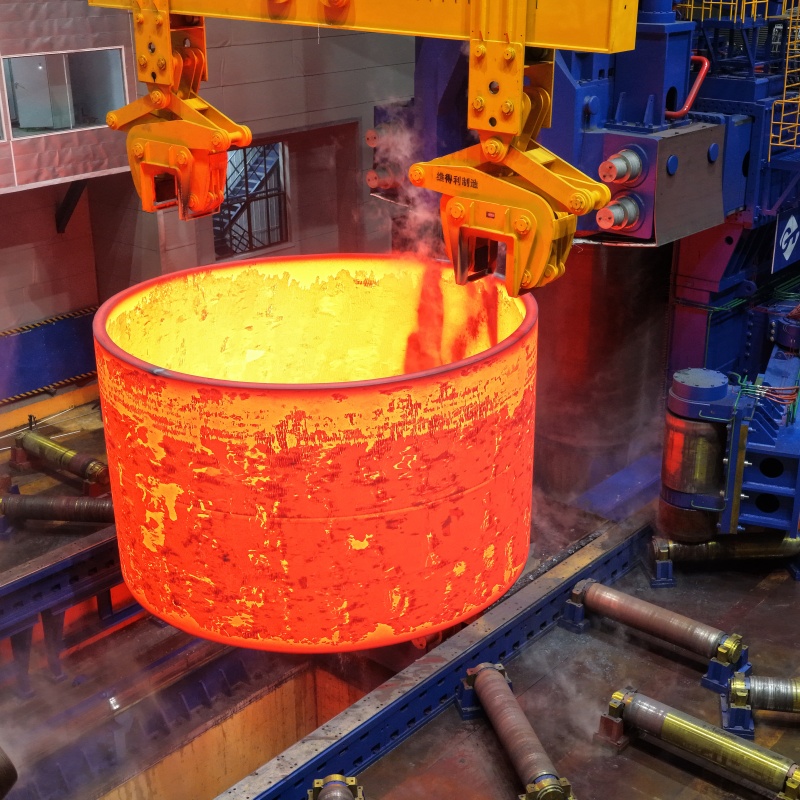
Seamless rolled ring forging process: from upsetting and piercing to radial-axial ring rolling.
Seamless Rolled Rings: Certification, Materials, and Technical Specifications Buyers Must Verify Before Ordering
Seamless rolled rings are annular metal components produced by forging a pierced billet and then ring-rolling it into a continuous, grain-oriented structure with no welds. They are used in critical rotating and load-bearing applications across nuclear power, wind energy, cement production, offshore engineering, and petrochemical processing. For procurement engineers, the core challenge is not finding a supplier that can make A ring, but verifying that the supplier can meet the specific certification, material, dimensional, and testing requirements of your application.
This guide focuses on the technical and compliance factors that distinguish qualified seamless rolled ring manufacturers: applicable EU and global certifications, available steel grades, maximum manufacturing envelopes, and the process steps that determine mechanical performance.
What Is a Seamless Rolled Ring?
A seamless rolled ring is a forged ring with no welded seam. The manufacturing process starts with a cylindrical billet or ingot, which is upset (shortened and widened), pierced to create a hollow preform, and then expanded on a radial-axial ring rolling mill. The rolling operation reduces wall thickness and increases diameter while refining the metal's grain flow. Because the component is formed as a single continuous piece, its grain structure follows the ring geometry, giving it higher strength, toughness, and fatigue resistance than welded or cast alternatives in demanding service.
Seamless rolled ring forgings are commonly produced in carbon steel, stainless steel, and alloy steel. Typical configurations include profiling seamless rolled rings (contoured cross-sections), forged seamless rolled rings, large seamless rolled rings, and high strength seamless rolled rings for extreme mechanical loads.
Certification Requirements for Seamless Rolled Rings
Certification is not a marketing detail; it is a contractual and regulatory gate. Buyers must verify which standards apply to their destination market and end-use equipment before requesting a quote. A supplier's certification portfolio defines the scope of work it is legally and technically allowed to perform.
EU Market: PED 2014/68/EU and EN 1090
For seamless rolled rings used in pressure equipment or structural applications in the EU, two certifications are especially relevant:
- PED 2014/68/EU — the European Pressure Equipment Directive. It applies to pressure accessories and assemblies exposed to internal pressure above certain thresholds. Iraeta Energy Equipment Co., Ltd. holds PED 2014/68/EU certification (certificate number 01 202 CHN/Q-06 0144.01) issued by TUV, covering the manufacturing of forged flanges and hot rolled rings.
- EN 1090-1:2009+A1:2011 and EN 1090-2 — the EU framework for structural steel components. Iraeta holds EN 1090 certification (certificate number 0035-CPR-1090-1.03389.TÜVRh.2025.003) issued by TUV for structural components and kits for steel structures to EXC3, covering load-bearing structures in all types of buildings.
Global Quality and Management Systems: ISO 9001, ISO 14001, ISO 45001
Beyond product-specific directives, buyers should verify that a manufacturer maintains certified management systems covering quality, environment, and occupational health. Iraeta's seamless rolled rings and forgings are certified to:
- ISO 9001:2015 — quality management, issued by BV (certificate F02326Q00125R602), global scope.
- ISO 14001:2015 — environmental management, issued by NQA Certification Co., Ltd. (Shanghai) (certificate F01926E00118R502), global scope.
- ISO 45001:2018 — occupational health and safety, issued by SQA Certification Co., Ltd. (Shanghai) (certificate F01926800070R502), global scope.
Buyer note: Always request the actual certificate, confirm the certificate number, scope, issuing authority, and validity period. A supplier may hold a certificate for one product line but not for the specific ring geometry or material grade required by your project.
Available Materials: Carbon Steel, Stainless Steel, and Alloy Steel
The material selection for seamless rolled rings directly affects corrosion resistance, high-temperature performance, and mechanical strength. Iraeta offers seamless rolled rings in three primary material families:
- Carbon steel — widely used for large structural rings, kiln tyres, and general heavy machinery where high load capacity is required without the need for corrosion-resistant alloying.
- Stainless steel — selected for applications requiring corrosion resistance, such as offshore platforms, marine equipment, and chemical processing environments.
- Alloy steel — used when the component must withstand high temperatures, high stresses, or fatigue loads, such as wind turbine flanges, gearbox forgings, and hydropower components.
The material grade, heat treatment condition, and mechanical testing requirements should be specified on the drawing and confirmed with the manufacturer before production begins.
Technical Specification Limits: What Can Be Manufactured?
A critical part of evaluating seamless rolled ring manufacturers is comparing their maximum manufacturing envelope against your required dimensions. The following limits define what a supplier can physically produce on its ring rolling equipment:
| Parameter | Maximum Value — Iraeta Seamless Rolled Rings |
|---|---|
| Maximum diameter | 21 meters |
| Maximum height | 5 meters |
| Maximum net weight | 300 tons |
| Available materials | Carbon steel / stainless steel / alloy steel |
| Typical industries | Nuclear power, hydropower, wind power, offshore engineering, petrochemical, high-end equipment |
Table 1. Seamless rolled ring manufacturing specification limits.
These limits are not arbitrary. Iraeta operates a 22-meter-class ring and shell rolling machine, which enables production of rings up to 21 meters in diameter. In 2026, Iraeta produced a seamless rolled steel ring measuring 21.029 meters in diameter, surpassing its own Guinness World Record of 15.673 meters set in 2022. For comparison, the 15.6-meter, 150-ton ring previously produced for nuclear power applications was already considered a world record within the industry.
Seamless Rolled Ring Manufacturing Process
Understanding the process helps buyers evaluate supplier capability and identify which parameters affect final quality.
- Material preparation — The steel is melted, refined, and cast into ingots or continuous cast round billets. Iraeta's scope includes manufacturing of raw materials for forgings, including steel ingot and continuous casting round billet.
- Upsetting and piercing — The billet is upset to increase its diameter and reduce height, then pierced to create a hollow preform.
- Ring rolling — The preform is expanded on a radial-axial ring rolling mill to reach the target diameter, wall thickness, and cross-section geometry. This step creates the continuous grain flow that distinguishes seamless rolled rings.
- Heat treatment — Depending on material grade and specification, the ring may undergo normalizing, quenching, and tempering to achieve required mechanical properties.
- Precision machining — The ring is machined to final tolerances. Profiling seamless rolled rings may require CNC machining of contoured cross-sections.
- Testing and inspection — Quality control typically includes mechanical testing, ultrasonic testing, dimensional inspection, and surface examination. Iraeta performs 100% testing on its products.
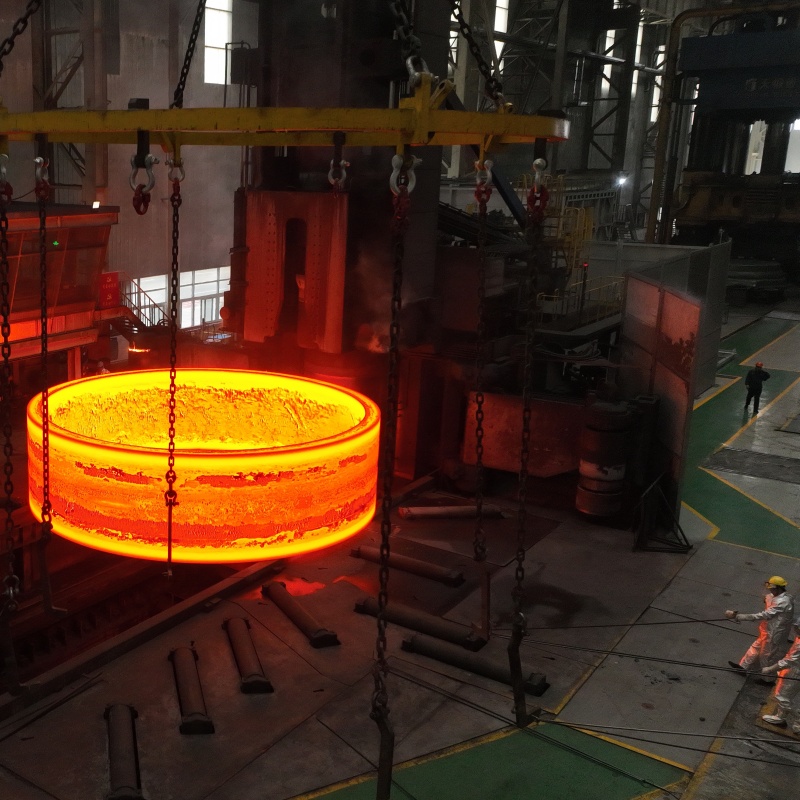
Seamless rolled ring manufacturing at scale: large-diameter rings after forging and heat treatment.
Why Buyers Need More Than a Standard Product Certificate
A common mistake is assuming that one certification covers all products. In practice, certification scopes are specific: they name the product types, applicable standards, production locations, and validity periods. A holder of PED certification for forged flanges and hot rolled rings must still verify whether the ring's intended pressure equipment classification falls within the certified scope. Similarly, EN 1090 certification covers structural components to EXC3; it does not automatically cover non-structural machinery parts.
When sourcing seamless rolled rings for mission-critical industries, buyers should request:
- A copy of each relevant certificate, not just a summary.
- Confirmation that the certificate number and scope match the intended product.
- Mill test certificates for the specific heat of material used in their order.
- Inspection reports for mechanical testing, nondestructive testing, and dimensional verification.
- Documentation that the ring was rolled as a single continuous forging with no welding.
Application-Driven Selection: Matching Materials and Certification to the Operating Environment
The choice of material and certification path is ultimately decided by the application's operating conditions. The table below summarizes how application requirements map to material and capability priorities.
| Application | Key Operating Conditions | Typical Ring Requirements |
|---|---|---|
| Nuclear power | Pressure containment, long-term reliability, strict regulatory scrutiny | Large diameter, traceable materials, PED or equivalent certification, 100% inspection |
| Wind power (tower flanges) | High cyclic loads, offshore salt spray, low-temperature toughness | High strength alloy steel, corrosion resistance, fatigue-resistant forgings |
| Cement rotary kiln (kiln tyres) | Extreme heat, 24/7 operation, heavy cyclic loads, abrasive environment | Ultra-large diameter, high thermal stability, high wear resistance, precision machining |
| Offshore and marine engineering | Deep-sea pressure, seawater corrosion, cyclic wave loading | Stainless or corrosion-resistant alloy steel, watertight sealing surfaces, fatigue life |
| Petrochemical / refining | High pressure, high temperature, corrosive media | Creep-resistant alloy steel, pressure equipment certification, structural integrity |
| Hydropower | High water pressure, sediment abrasion, frequent start-stop cycles | Abrasion resistance, fatigue resistance, high sealing performance |
| Tunnel boring machines | Heavy load, vibration, shock loading | High load capacity, impact and fatigue resistance, wear resistance |
Table 2. Application-driven requirements for seamless rolled rings.
Comparing Supplier Capabilities: What Separates Qualified Forging Partners
No single metric fully captures a supplier's capability. The most practical evaluation framework covers three dimensions:
1. Manufacturing envelope
Does the supplier's ring rolling equipment match the diameter, height, and weight needed for your project? Suppliers with larger ring rolling machines — such as Iraeta's 22-meter-class machine and 300-ton raw material preparation capability — can produce rings that smaller manufacturers cannot handle in one piece.
2. Certification and quality systems
Holding ISO 9001, ISO 14001, ISO 45001, PED, and EN 1090 certifications demonstrates a systematic approach to quality and compliance. For EU-bound projects, PED and EN 1090 certificates should be verified directly with the issuer or the supplier's documentation.
3. End-to-end capability
Suppliers that control the full value chain — from raw material preparation and forging to heat treatment, machining, testing, and global logistics — reduce the coordination risk associated with multiple subcontractors. Iraeta operates production facilities in China and Spain, supporting customers in clean energy, oil and gas, marine engineering, tunnel boring, cement production, and metal mining.
Case Evidence: Seamless Rolled Rings in Heavy Industrial Use
Certification documents and capability statements are best evaluated alongside real deployment evidence. The following project references illustrate the types of applications Iraeta's seamless rolled ring forgings have supported.
- Cement and energy equipment manufacturer (Germany): Supplied a core supporting ring / rotary kiln tyre for large-scale industrial equipment. The ring was successfully deployed in European industrial projects, with stable operation and compliance with strict quality standards for heavy-duty applications. Highlighted attributes included ultra-large diameter integral forging, precision machining, high load-bearing capacity, excellent thermal stability, and extended service life.
- Cement plant (Turkey): Supplied a core structural component for a cement rotary kiln. The ring was installed and commissioned successfully, operating stably under high-temperature and heavy-load conditions. Key attributes were precision forging and machining, high temperature resistance, excellent fatigue strength, and extended service life.
- Oil & gas OEM (Saudi Arabia): Supplied two units of key components for refining and petrochemical equipment. The components operated stably and fully complied with the project's quality and safety requirements, with high forging precision, wear resistance, and high-temperature resistance.
- Large refinery (Saudi Arabia): Supplied three pieces (two shell sections and one transition section) for a heavy-duty hydrogenation reactor used in a 7.5 Mt/y European refinery project. The components delivered qualified performance, with integral ring rolling and near-net-shape forming contributing to superior mechanical performance and a shorter production lead time.
Production Capability and Customization
For project-specific requirements, buyers should verify not only the maximum limits but also the supplier's willingness to adapt. Iraeta operates an OBM production model and supports customization of material, size, forging shape, heat treatment, and machining. Its monthly capacity is 70,000 tons, with a minimum order quantity of 1 unit. Lead times are negotiable based on customization requirements, and after-sales remote support is available for export markets across the EU, Americas, Asia, and the Middle East.
FAQ: Certification and Specification Questions Buyers Ask
Are seamless rolled rings certified to PED 2014/68/EU?
Iraeta's seamless rolled rings are certified to PED 2014/68/EU for the EU market. The certification is issued by TUV with certificate number 01 202 CHN/Q-06 0144.01. For pressurised equipment applications, buyers should confirm that their specific component classification falls within the certified manufacturing scope for forged flanges and hot rolled rings.
What materials are available for seamless rolled rings?
Seamless rolled rings are available in carbon steel, stainless steel, and alloy steel. Stainless steel is selected when corrosion resistance is required. Alloy steel grades are used when high strength or high-temperature performance is needed. The final grade and heat treatment condition should be agreed with the manufacturer based on the application's mechanical and environmental demands.
What is the largest seamless rolled ring that can be manufactured?
Using its 22-meter-class ring rolling machine, Iraeta can produce seamless rolled rings with a maximum diameter of 21 meters, a maximum height of 5 meters, and a maximum net weight of 300 tons. In 2026, Iraeta produced a 21.029-meter diameter ring, setting a new Guinness World Record that surpassed its 15.673-meter record from 2022.
Does Iraeta hold ISO 9001 certification for seamless rolled rings?
Yes. The seamless rolled rings and forgings are certified to ISO 9001:2015, issued by BV with certificate number F02326Q00125R602. The scope covers manufacturing of raw materials for forgings, manufacturing of forgings, and manufacturing of steel balls, cylpebs, and grinding rods. The certification applies globally.
Can I request a sample or quote for a seamless rolled ring project?
A sample or custom quote can be requested directly from the Iraeta engineering team. Because rolled rings are made to order with custom dimensions and materials, the inquiry process typically begins with a drawing, required material grade, applicable standard, and target quantity. After reviewing your technical requirements, the team can confirm feasibility, lead time, and pricing.
Send your requirements to Iraeta for a technical review and quotation.
Conclusion: Prioritize Certification and Material Verification Early
Selecting a seamless rolled ring supplier for heavy industries is ultimately an exercise in compliance and capability verification. The technical attributes that matter most — continuous grain flow, traceable raw materials, certified quality systems, and accessible large-scale rolling equipment — are not visible on the surface of a finished ring. They are proven through documentation, process control, and manufacturing records.
For industrial buyers moving from research to evaluation, the most efficient next step is to confirm the three core parameters: applicable certification (PED, EN 1090, ISO system), required material family (carbon steel, stainless steel, or alloy steel), and dimensional envelope (diameter, height, weight). With those parameters defined, a qualified manufacturer can move quickly from feasibility review to proposal.
Need a certified seamless rolled ring for your next project?
Contact Iraeta with your material grade, dimensional drawing, and target standard to receive a feasibility review and quote.
Request a Quote