
What Are Seamless Rolled Rings? Process, Materials, and Uses in Heavy Industry
What Are Seamless Rolled Rings? Process, Materials, and Uses in Heavy Industry
Seamless rolled rings are near-net-shape forged components produced by expanding a pierced preform between rotating rolls until it reaches a specified diameter and cross-section, without any welding or joining. They serve as critical load-bearing and structural elements in industries such as nuclear power, hydropower, wind power, offshore engineering, petrochemical processing, and high-end equipment manufacturing. This guide explains how they are made, what materials are available, and why buyers specify forged seamless rolled rings for mission-critical applications.
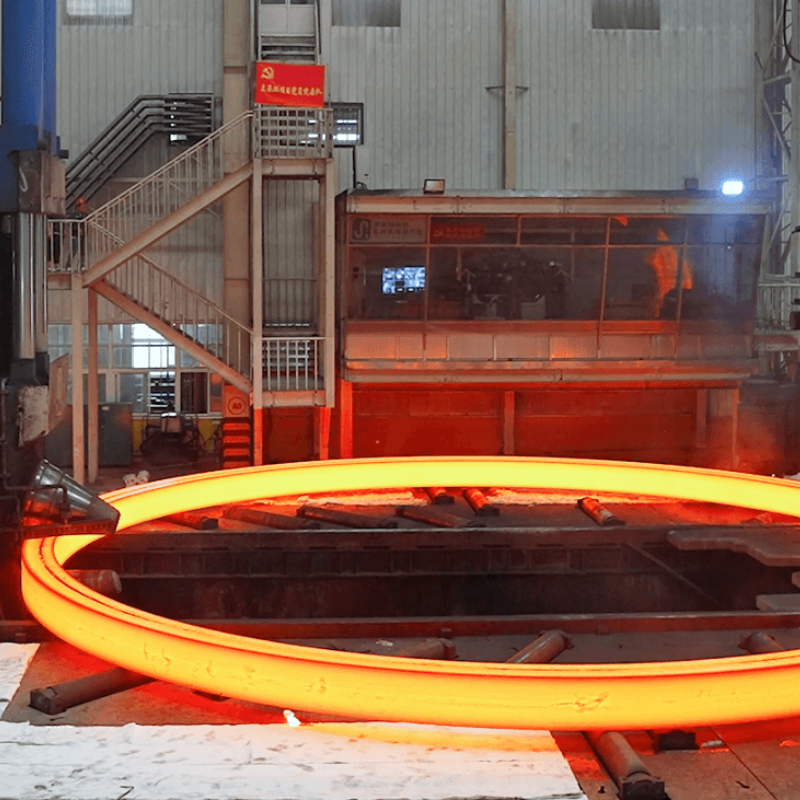
Seamless rolled rings for industrial applications.
What is a Seamless Rolled Ring?
A seamless rolled ring is a ring-shaped forging with no circumferential weld seam. It is classified as a seamless rolled ring forging and belongs to the broader forgings category. Unlike rings cut from plate or fabricated by welding, seamless rolled rings gain their final geometry through the ring rolling process, which preserves continuous grain flow around the circumference.
Key specifications for Iraeta seamless rolled rings include a maximum diameter of 21 meters, a maximum height of 5 meters, and a maximum net weight of 300 tons. Available materials include carbon steel, stainless steel, and alloy steel. Typical applications include nuclear power generation, hydropower plants, wind turbines, offshore platforms, petrochemical reactors, and high-end machinery.
Why "Seamless" Matters in Ring Forgings
The absence of a weld seam is not just a manufacturing detail; it directly affects mechanical performance. A forged seamless ring has continuous grain flow along the ring circumference, which improves load-bearing capacity, fatigue resistance, and structural integrity compared with welded ring assemblies. This is particularly important for components that operate under heavy cyclic load, high pressure, high temperature, or continuous service.
Welded rings introduce potential weak points at the weld zone, including heat-affected zones, residual stress, and increased susceptibility to fatigue failure. For applications that require high reliability, engineered seamless rolled rings are therefore the preferred specification.
How Seamless Rolled Rings Are Manufactured
The seamless rolled ring manufacturing process can be summarized in the following stages:
- Material preparation: The required raw material—typically carbon steel, stainless steel, or alloy steel—is selected and prepared according to the application's mechanical and corrosion requirements, including custom material preparation.
- Upsetting and piercing: The ingot or billet is heated and forged into a thick-walled preform, then pierced to create a hollow blank.
- Ring rolling: The pierced preform is placed on a ring rolling mill. A rotating mandrel and main roll reduce the wall thickness and expand the diameter until the target size and cross-section are reached. This step gives the ring its seamless, continuous grain structure.
- Profiling: Depending on the design, the ring can be rolled into a profiled cross-section—also called profiling seamless rolled rings—to approximate the final component shape and reduce machining time.
- Heat treatment: The forged ring undergoes heat treatment to achieve the required mechanical properties such as strength, toughness, and hardness.
- Precision machining: The heat-treated ring is machined to final dimensions and surface finish.
- Testing and inspection: Rigorous testing is performed to verify material integrity, dimensional accuracy, and mechanical properties.
- Global logistics: The finished ring is prepared for shipment to the customer's site.
Iraeta delivers end-to-end solutions—from custom material preparation and forging to heat treatment, precision machining, rigorous testing, and global logistics.
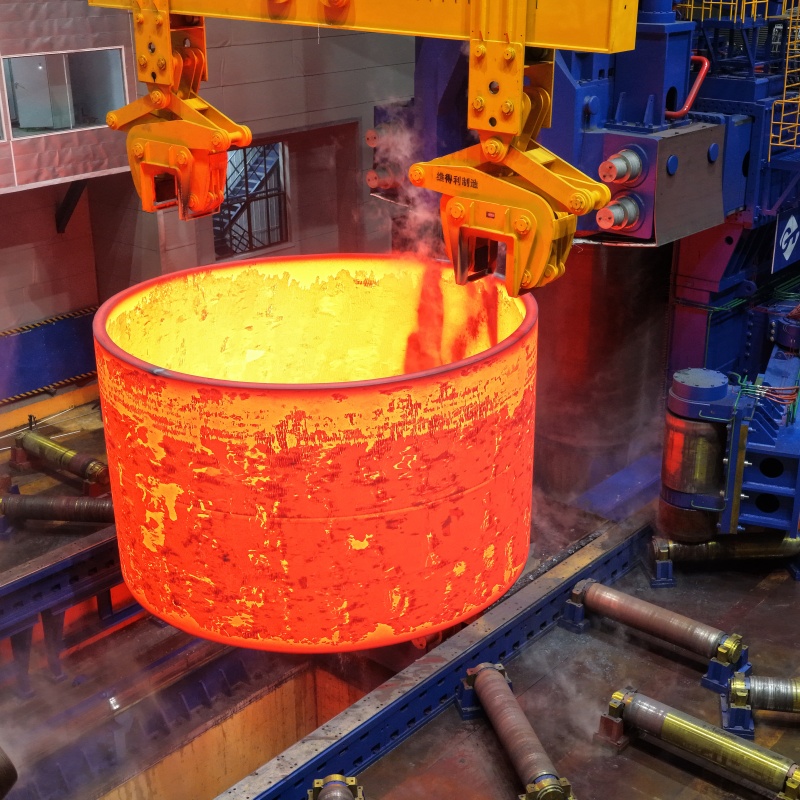
Ring rolling produces a seamless grain structure for high-load applications.
Materials for Seamless Rolled Rings
Seamless rolled ring forgings are available in three principal material groups:
- Carbon steel seamless rolled rings: Commonly used for structural and general industrial components where strength and cost predictability are important.
- Stainless steel seamless rolled rings: Selected for corrosive environments such as marine, petrochemical, and offshore applications where corrosion resistance is critical.
- Alloy steel seamless rolled rings: Used when higher mechanical properties, such as strength, toughness, wear resistance, or high-temperature performance, are required.
The choice of material is driven by operating conditions—including pressure, temperature, corrosion exposure, and load profile—as well as by applicable standards and project specifications.
Key Operational Roles and Requirements
Across heavy industries, seamless rolled rings perform functions such as load transfer, torque transmission, structural support, and load-bearing connection. For example, they may support a rotary kiln shell, carry turbine loads in a hydroelectric plant, or serve as a critical connection in an offshore wind turbine tower.
Because these components often operate under extreme conditions, buyers typically require high load capacity, impact and fatigue resistance, wear resistance, corrosion resistance, and long service life under continuous or cyclic operation.
Seamless Rolled Rings by Application
Construction Machinery — Transmission and Slewing Systems
In the construction machinery industry, seamless rolled rings are used in transmission systems and slewing support systems. Equipment such as shield machines and cranes requires components with high load capacity, impact and fatigue resistance, and wear resistance. Operating conditions include heavy load, vibration load, frequent start-stop, and variable load, with intermittent heavy-duty operation and high-intensity working modes. Support functions include load bearing, torque transmission, and slewing support for shield machine cutter head systems, slewing mechanisms, and transmission systems.
Hydropower — Turbines and Generators
In hydropower projects—including hydro turbine generating units and pumped storage power stations—seamless rolled rings provide load transfer and structural support for hydraulic turbines and generators. They operate under high water head pressure, sediment abrasion, and water erosion corrosion, with frequent start-stop conditions. Special requirements include high water pressure resistance, sediment abrasion resistance, and long service life fatigue resistance.
Rotary Kiln — Full-System Support
Rotary kiln applications involve extreme high temperature, heavy cyclic loads, 24/7 continuous operation, severe dust and thermal corrosion, and thermal expansion. Seamless rolled rings are used in the kiln main body, kiln supporting system, and transmission system, where they provide load bearing, torque transmission, structural support, and vibration damping. Supporting equipment includes rotary kiln shells, riding rings, support roller assemblies, and girth gear and pinion drive systems. Special requirements include extreme high temperature resistance, high wear and abrasion resistance, high fatigue life, and ultra-high load capacity.
Petrochemical Industry — Pressure Vessels
In petrochemical applications, seamless rolled rings operate under high pressure, high temperature, and corrosion-resistant conditions. Their role is to provide pressure containment and structural support for pressure vessel bodies, piping systems, and heat exchangers. Special requirements include corrosion-resistant and high-strength materials.
Offshore Engineering — Deep-Sea and Marine Systems
For offshore engineering and deep-sea equipment, seamless rolled rings are applied in FPSO mooring systems, subsea production equipment, and marine propulsion systems. These components must resist deep-sea pressure and seawater corrosion while providing bearing support, sealing positioning, load transfer, and structural connection. Special requirements include marine-grade corrosion protection, anti-fatigue performance under cyclic loads, watertight sealing, and long service life in harsh marine environments.
Wind Power — Offshore Turbine Connections
In wind power, particularly offshore wind farms in the EU and US, seamless rolled rings are used in tower connection systems. They provide critical load-bearing connection, torque transmission, structural stability, and fatigue resistance. Operating conditions include high cyclic load, salt spray, marine corrosion, and low temperature. Special requirements include high structural strength, corrosion and salt spray resistance, low temperature toughness, and high fatigue life under continuous 24/7 operation.
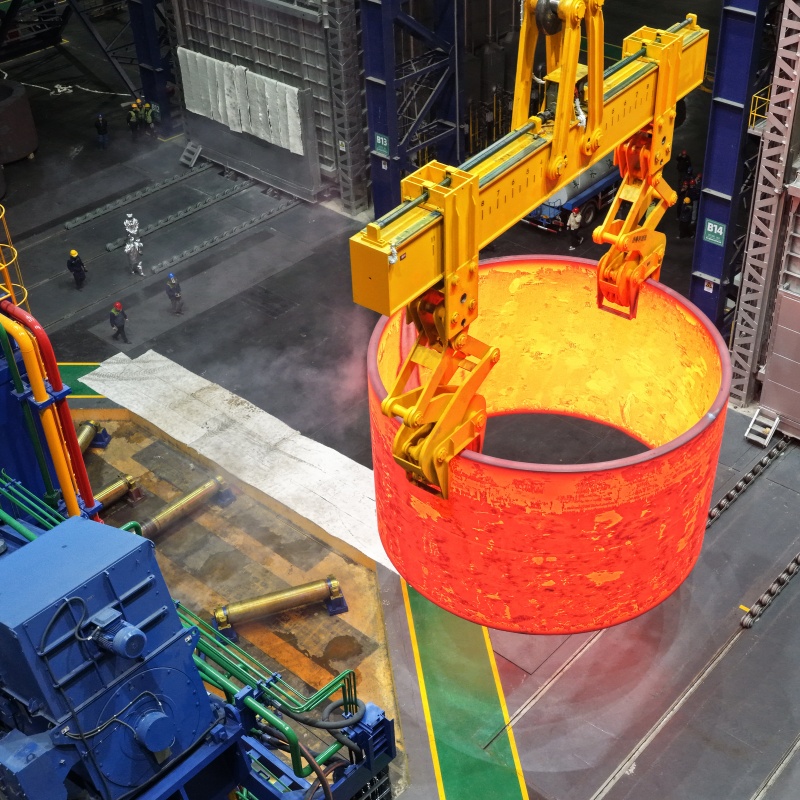
High-strength seamless rolled rings for demanding rotating and structural applications.
The Market for Seamless Rolled Rings
The global seamless rolled ring forgings market is projected to grow from USD 11,100 million in 2025 to USD 16,360 million by 2034, according to QY Research. A major downstream segment—wind turbine forged tower flanges—is expected to grow at a CAGR of 7.3% to reach USD 8.2 billion by 2033, according to Dataintelo.
These figures reflect a broader trend: as infrastructure projects move toward larger turbines, higher-capacity kilns, deeper offshore equipment, and more demanding pressure systems, the specification for large, high-integrity seamless rolled rings continues to rise.
Forged Seamless Rolled Rings vs. Cast Rings
By the nature of their production, forged seamless rolled rings offer several technical advantages over cast alternatives, especially in load-bearing and fatigue-critical applications. The forging process refines the material structure, eliminates internal voids, and produces continuous grain flow oriented to the ring geometry.
For industrial buyers, the practical differences can be summarized as follows:
| Comparison Point | Seamless Rolled Ring Forgings | Cast Rings |
|---|---|---|
| Structural integrity | Dense, wrought structure with no weld seam; improved fatigue behavior | Cast structure may contain porosity or shrinkage defects that affect reliability |
| Load capacity | Suitable for ultra-high-load and cyclic-load applications | Generally applied where load and fatigue demands are lower |
| Material range | Carbon steel, stainless steel, alloy steel | Broad range, but property consistency can vary with casting quality |
| Typical applications in heavy industry | Nuclear power, hydropower, offshore, wind power, rotary kiln, petrochemical | Lower-stress structural or non-critical components |
Large and High-Strength Seamless Rolled Rings
Some applications—such as nuclear power plants, large-diameter offshore structures, tunnel boring machines, and cement rotary kilns—require exceedingly large rings. Iraeta has reported producing seamless rolled steel rings up to 21.029 meters in diameter, a milestone that reflects an extreme manufacturing capability held by only a few companies worldwide. The company also produces components ranging from 0.3 kg to 300 tons, including discs, rings, shells, bars, shafts, and wear-resistant grinding media, with 300-ton open-die forgings, over 21-meter seamless rings, 5-meter-tall rolled shells, and 25-meter-long forged bars.
For high-strength requirements, alloy steel and specific heat-treatment routes enable the combination of strength, toughness, and wear resistance needed for gearbox forgings, bearing rings, and drive rings.
How to Select a Seamless Rolled Rings Manufacturer
Choosing a seamless rolled rings supplier requires evaluating more than diameter and price. The following framework helps buyers compare candidates on decision-relevant criteria:
- Size capability: Does the manufacturer support the required maximum diameter, height, and weight? In this regard, Iraeta's stated limits are 21 m diameter, 5 m height, and 300 tons.
- Material capability: Can the supplier process carbon steel, stainless steel, and alloy steel in the required grades?
- Process control: Does the supplier offer in-house heat treatment, precision machining, and rigorous testing?
- Application evidence: Has the supplier produced rings for similar industries—such as nuclear power, wind power, offshore engineering, rotary kiln, hydropower, or petrochemical projects?
- Certifications and standards: Depending on target markets, buyers may require compliance with standards such as AS9100 for aerospace, PED 2014/68/EU for pressure equipment in the EU, or EN 1090 for structural components.
- Global logistics: Can the manufacturer manage delivery to project sites across regions such as the EU, USA, Japan, the Middle East, Southeast Asia, Brazil, and India?
Why Buyers Specify Iraeta for Seamless Rolled Rings
Iraeta Energy Equipment Co., Ltd., established in 2006, is a specialized forging manufacturer serving clean energy, oil and gas, marine engineering, tunnel boring, cement production, and metal mining industries. The company operates production facilities in China and Spain, serving major markets including the EU, USA, Japan, the Middle East, Southeast Asia, Brazil, and India.
Iraeta describes its mission as building "a safer, greener, and more efficient future" by delivering mission-critical forged components for advanced machinery and high-value assets. Its engineering team includes 100 engineers, and its production capabilities range from 0.3 kg components to 300-ton forgings—including 300-ton open-die forgings, over 21-meter seamless rings, 5-meter-tall rolled shells, and 25-meter-long forged bars.
These capabilities support large-scale applications such as fourth-generation nuclear power plants, cement rotary kilns with 10,000 tons/day output, 16-meter shield tunneling machines, and over 20 MW floating offshore wind turbines. In 2026, Iraeta manufactured a seamless rolled steel ring measuring 21.029 meters in diameter, breaking its own Guinness World Record of 15.673 meters set in 2022.
For industrial buyers, this combination of scale, material flexibility, in-house finishing, and application reach is directly relevant when selecting a supplier for large seamless rolled ring forgings.
Comparison: Iraeta vs. Other Global Ring Forging Manufacturers
Industrial buyers often evaluate global suppliers before making a sourcing decision. The following comparison uses publicly reported facts to describe recognized manufacturers in the seamless rolled ring space. It is not an exhaustive ranking, and the best choice depends on application, size requirements, certification needs, and budget.
| Company | Region | Reported Profile |
|---|---|---|
| Iraeta Energy Equipment Co., Ltd. | China / Spain | Specialized forging manufacturer; reported maximum seamless ring diameter of 21 m (including a 21.029 m ring produced in 2026), maximum height 5 m, maximum weight 300 tons; production facilities in China and Spain. |
| ThyssenKrupp | Germany | Global industrial group recognized as a tier 1/tier 2 supplier in ring rolling product markets. |
| Bharat Forge | India | Global forging company recognized as a tier 1/tier 2 supplier in ring rolling product markets. |
| Frisa | Mexico | Ring and forging manufacturer recognized as a tier 1/tier 2 supplier in ring rolling product markets. |
| Scot Forge | USA | Open-die forging and rolled ring company recognized as a tier 1/tier 2 supplier in ring rolling product markets. |
FAQ
What is the maximum size of a seamless rolled ring?
Iraeta lists a maximum diameter of 21 meters, maximum height of 5 meters, and maximum net weight of 300 tons for its seamless rolled ring forgings. In 2026, Iraeta manufactured a ring measuring 21.029 meters in diameter, breaking its own Guinness World Record of 15.673 meters set in 2022.
What materials can be used for seamless rolled rings?
Seamless rolled ring forgings are available in carbon steel, stainless steel, and alloy steel. The material choice depends on operating pressure, temperature, corrosion exposure, and mechanical requirements. Carbon steel is common for structural applications, stainless steel for corrosive environments, and alloy steel for higher strength and fatigue performance.
What industries use seamless rolled rings?
Seamless rolled rings are used in nuclear power generation, hydropower plants, wind turbines, offshore platforms, petrochemical reactors, and high-end machinery. Specific applications include rotary kiln support systems, tunnel boring machine components, wind turbine tower connections, pressure vessel bodies, and hydro turbine equipment.
What is the difference between forged and cast rings?
Forged seamless rolled rings have a wrought, dense structure with continuous grain flow and no weld seam, which improves fatigue resistance and load capacity. Cast rings may contain porosity or shrinkage defects and are generally used in lower-stress applications. For heavy cyclic loads and pressure-containing service, forged seamless rolled rings are the more reliable specification.
How do I choose a seamless rolled ring supplier?
Evaluate suppliers on maximum size capability, material range, in-house heat treatment and machining, application evidence, certifications such as AS9100 and PED 2014/68/EU, and logistics coverage. If your project requires large-diameter or high-strength rings for a mission-critical industry, contact Iraeta for a technical discussion: email ebiz@iraeta.com or call +86 188-5315-7508.
Discuss your seamless rolled ring requirement with Iraeta.
Send your drawings or specifications to ebiz@iraeta.com or call +86 188-5315-7508.