
Harness Terminal OEM: From Drawing to Serial Production
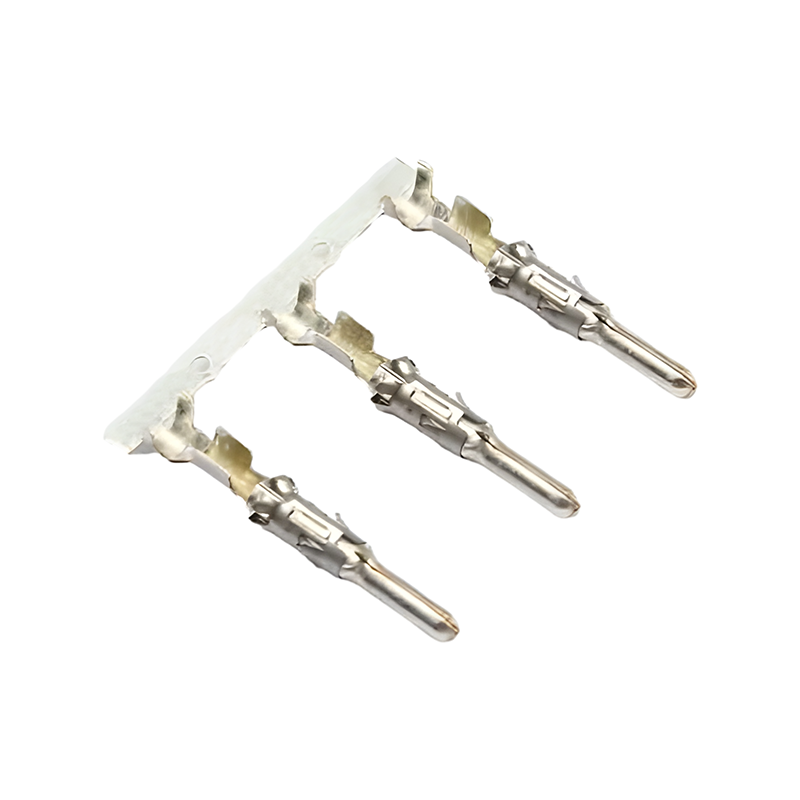
A harness terminal is the stamped metal contact crimped onto a wire end and locked inside a connector housing. It carries current, it carries signal, and it holds the wire against vibration. Most sourcing problems in this part family do not start at the metal — they start at the handover between the terminal, the housing and the finished harness.
JDE Automotive Technology Co.,LTD is an automotive interconnect manufacturer based in Dongguan, China. The company produces stamped terminals, plastic injection molded connector housings and wire harness assemblies, and it runs stamping workshops, an injection molding department, a silicone part production area, an in-house mold shop and a raw material warehouse on a single 50,000 m² site. More than 300 employees work there, including a 30+ R&D team, and roughly 15% of output is exported, primarily to the US and Europe.
This article follows a custom harness terminal from a buyer's drawing to a repeat order: what can be specified, which production steps have to happen in sequence, how tolerance and sealing decisions get fixed, and what a 500-piece first order looks like next to a 100-million-piece monthly capacity.
The Problem Is Rarely the Terminal — It Is the Interface
Harness terminal sourcing breaks in predictable places. The metal contact itself is usually well understood; the failure modes sit at the boundaries between processes, documents and suppliers.
- Terminal and housing come from different plants. When the stamped contact is bought from one factory and the plastic housing from another, the lock, the cavity position and the crimp barrel height must all agree across two tolerance stacks. Small deviations surface as high insertion force, incomplete lock engagement, or a terminal sitting at a slight angle inside its cavity.
- Prototype quality does not survive volume. A short-run prototype can pass a bench check and still fail at serial volume if the stamping die, the molding tool and the assembly fixture were never validated together. Precision injection molding is typically held to ±0.01 mm, with core electronic components reaching ±0.005 mm — a tolerance band that only holds when the tool, the machine and the inspection method are controlled by the same process owner.
- Documentation arrives after the parts. First-article reports, sampling plans, material declarations and sealed samples are frequently requested late, which delays line release rather than shipment. A terminal that is physically ready but not released is still a stopped project.
- Custom scope is unclear at quotation. Plating, cavity count, sealing class, wire gauge and packaging format move cost and tooling far more than buyers expect. A vague inquiry produces a vague quote, and the difference is only discovered at the sample stage.
Why Harness Terminals Are Scrutinised More Closely Than Their Size Suggests
Automotive terminals are a large and still expanding component category. Mordor Intelligence estimates the global automotive terminals market at USD 28.59 billion for 2026. The pressure is not spread evenly across that figure: it concentrates on the small parts that carry power, sensor signals and high-speed data at the same time, because one weak contact can take down an entire harness circuit.
A harness terminal does three jobs at once. It conducts current with low, stable contact resistance; it holds the wire mechanically against vibration; and, once assembled into a sealed connector, it shields the contact interface from moisture, salt spray and thermal cycling. Automotive wiring connectors in general are the components that link internal vehicle circuits for power, switch signals and high-speed data transmission — which is why the terminal inside them is treated as a functional part rather than a commodity stamping.
Two external references anchor buyer expectations. USCAR2-7, published by SAE International, is the performance specification for automotive electrical connector systems and covers testing across development, production and field analysis phases for low-voltage road vehicle connectors. IATF 16949:2016 is the automotive quality management system standard, built on ISO 9001:2015 with additional automotive-specific requirements, and it remains the baseline that OEM and Tier 1 purchasing teams verify before a terminal supplier is added to an approved list.
How a Vertically Integrated Plant Builds a Harness Terminal
Stamping, molding and assembly on one production site
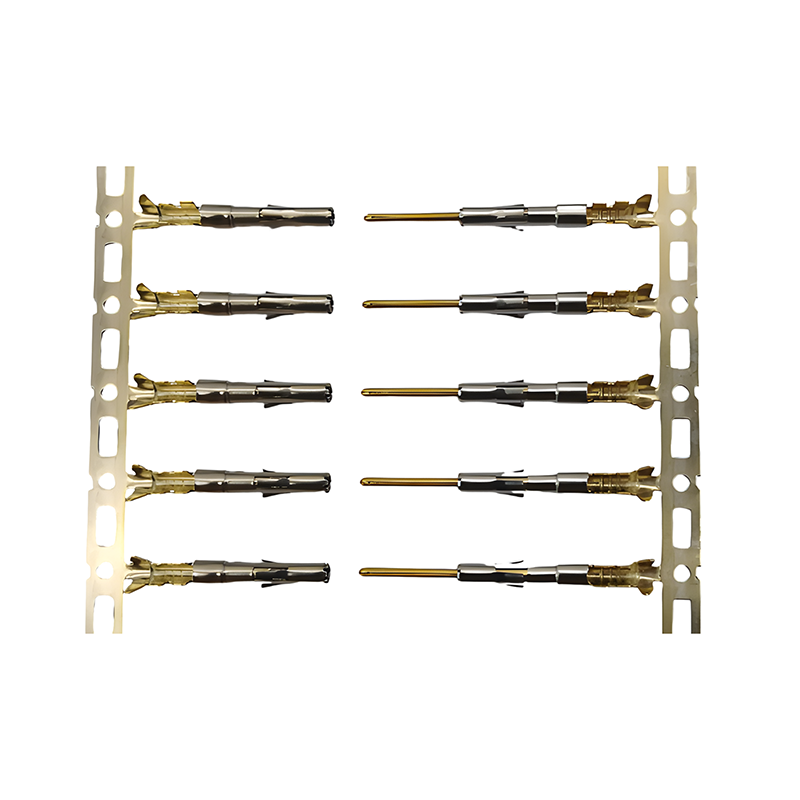
JDE combines stamping workshops and an injection molding department under one production site. The stamping workshops are used for terminal production, and the injection molding department produces plastic connectors and injection parts. The same site also holds a silicone part production area, a raw material warehouse on site and a mold storage area, and the company operates in-house mold fabrication and automated assembly alongside serial production.
The practical consequence is that terminal geometry and housing geometry are developed against each other rather than against two separate purchase orders. When a cavity position, a locking feature or a wire entry has to move, the die and the tool move in the same building, and the change is validated on the same measurement equipment.
Material and plating options a buyer can lock into the drawing
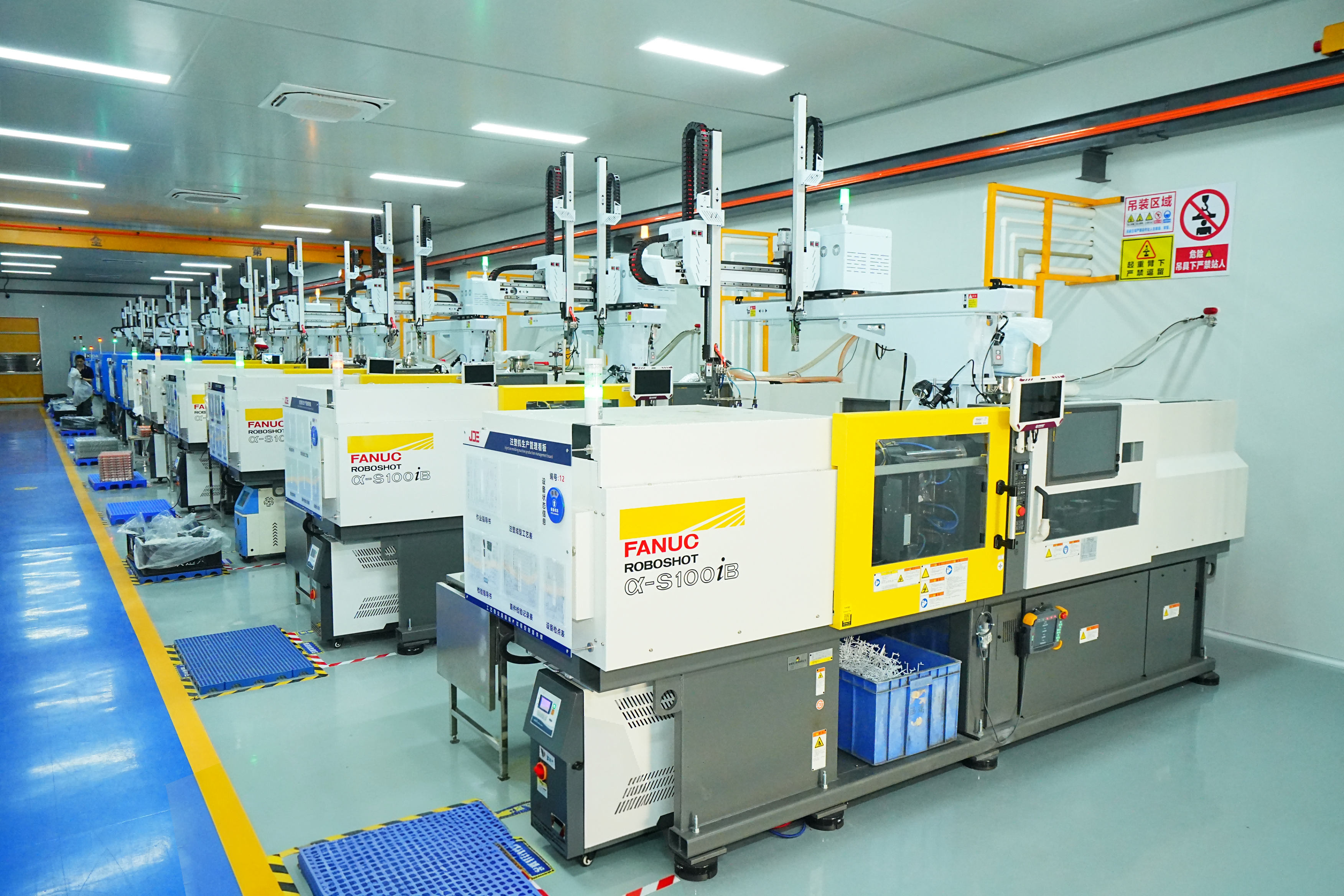
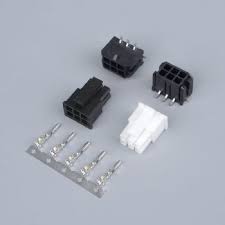
JDE stamps terminals from pure copper, C2680 brass and phosphor bronze, with tin, nickel, selective gold and silver plating available. The choice is functional, not cosmetic. Tin is the default for general low-voltage circuits. Selective gold is used where contact resistance must stay flat through thermal cycling at low signal current. Silver is used where high-current paths need low resistance and controlled heat generation.
The underlying requirement is the same in all three cases: a high-conductivity copper alloy substrate with low, long-term stable contact resistance, minimal voltage drop and low heat generation. In a 12 V signal loop that shows up as stable sensor and CAN data. In a high-voltage loop it is a thermal and safety margin, not an efficiency figure.
Housing, sealing and mating behaviour
The plastic half of the interface is produced in-house as plastic injection molded connector housings. Precision injection molding is typically held to ±0.01 mm, with core electronic components reaching ±0.005 mm, and the reported result after multi-piece assembly and insert molding is uniform gaps, smooth insertion and extraction and precise locking. A specific case is the rubber core of an automotive connector: after metal terminals are encapsulated with rubber, their positioning stays stable, terminals remain vertical and contact resistance fluctuation stays minimal, which removes a frequent cause of intermittent circuit breaks in vehicle electrical systems.
Assembled connector systems built on these terminals are specified with IP67 / IP68 sealing options and an operating range of −40 °C to 125 °C. That envelope covers engine bay, chassis, door and lamp harness positions where salt spray, oil and condensation are continuous conditions rather than occasional events. A flame-retardant PA66-GF25 base with an anti-shock design has been used in headlight connector harness assemblies, where the housing also has to survive road vibration and washing cycles.
Inspection, capacity and certification evidence
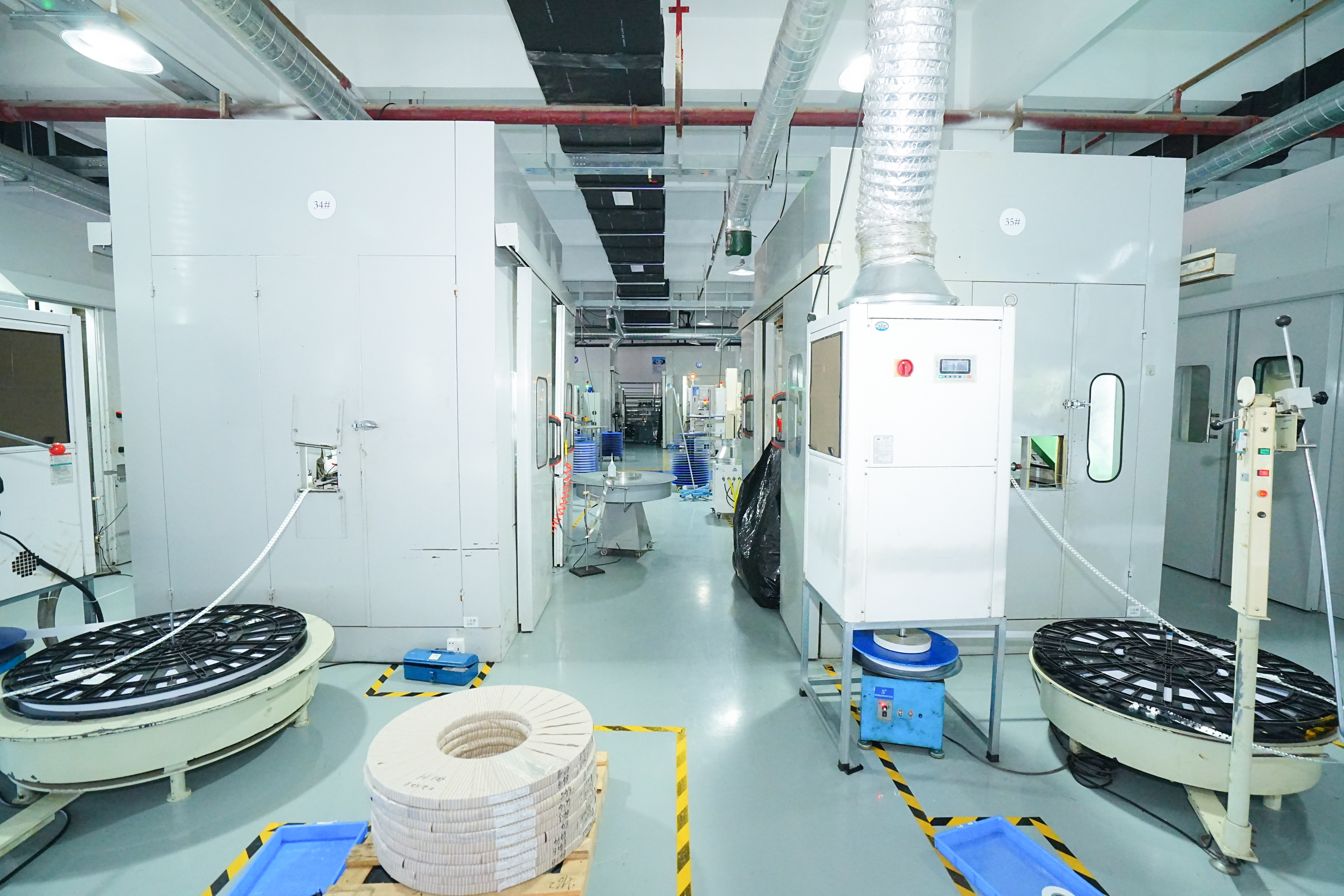
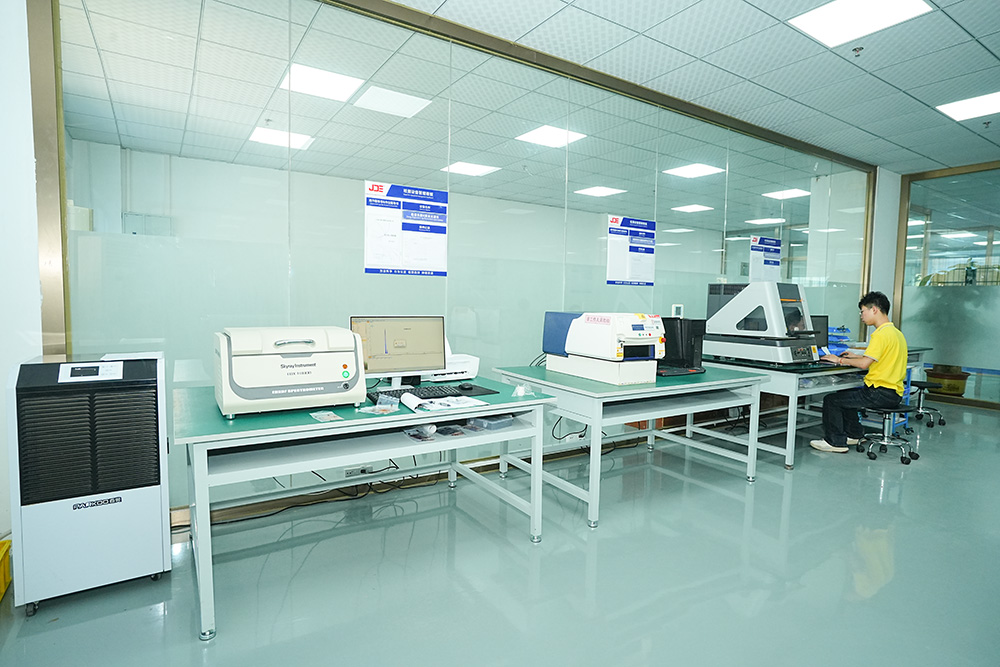
Quality control on connector terminal and injection part production runs on CCD online 100% measurement, and finished wire harness assemblies receive 100% electrical continuity testing. The factory's stated monthly capacity is 100 million pieces for connector terminal and injection part production. A company-reported daily output of 4 million pieces is consistent with that monthly base. Production orders for connector terminals and injection parts are scheduled with a 15–20 day lead time, and the minimum order quantity is 500 PCS.
JDE holds IATF 16949:2016 certification, certificate number LTXNCH, issued by Quality Austria Certification GmbH, covering automotive stamping parts, valid from 2026-09-07 to 2029-09-06. The company also holds ISO 9001:2015 (certificate 06524Q00481R0M, CFL Certification Center, valid 2024-03-13 to 2027-03-12, scope: processing of metal stamping parts), ISO 14001:2015 (certificate 06524E00220R0M, scope: hardware stamping parts processing and related management activities) and ISO 45001:2018 (certificate 06524S00209R0M).
From Drawing to Serial Production: Eight Steps
- Drawing and sample intake. The project starts from a drawing or a physical sample. Pin layout, housing shape, wire gauge, plating specification, sealing class and packaging format are fixed at this point, because each of them changes tooling or inspection scope. Custom pin layouts, housing shapes and wire gauges can be developed against drawings or samples rather than forced into a catalogue part.
- Tooling. Dies and molds are fabricated in-house and held in a dedicated mold storage area. Tooling is validated before the first production lot, which is the step that decides whether dimensional control holds at volume.
- Stamping. Terminals are stamped in the stamping workshops from pure copper, C2680 brass or phosphor bronze, then plated with tin, nickel, selective gold or silver depending on the circuit. High-volume terminal production at this scale relies on progressive die stamping, where the strip is formed, cut and crimp features are generated in one continuous pass.
- Molding. Plastic injection molded connector housings and injection parts are produced in the injection molding department, with precision parts held to ±0.01 mm and core electronic components to ±0.005 mm.
- Insert molding and assembly. Terminals are encapsulated or assembled into the housing, and the critical check is positional: terminals must remain vertical, gaps must be uniform and locking must engage precisely. Automated assembly supports this stage.
- 100% measurement and continuity testing. CCD online 100% measurement runs on terminal and injection production; finished wire harness assemblies go through 100% electrical continuity testing rather than sampling.
- First-article approval and sampling. BOM, drawings and performance indicators are locked in the contract, a first-article inspection is carried out before mass production, incoming and outgoing goods are inspected to AQL sampling standards, and sealed samples are retained. Material substitution without written approval is excluded by agreement.
- Serial production and repeat orders. Production orders for connector terminals and injection parts run on a 15–20 day lead time against a 100 million piece monthly capacity, from a 500 PCS minimum order upward.
Where Harness Terminals Are Actually Used
Terminal specification only becomes meaningful when it is read against a circuit. The same stamped contact behaves differently in a 12 V sensor loop, a sealed chassis harness and a high-voltage battery path.
Body electronics and low-voltage signal circuits
In low-voltage body electronics, the terminal's job is to keep contact resistance low and stable. Precision-stamped terminals with gold or tin plating are used for steady power supply and signal transmission in sensors, control units, BMS signal acquisition and high-current power circuits. The reported outcome is the absence of abnormal temperature rise, signal flicker and intermittent disconnection — the three symptoms that most often send a harness back for rework.
Engine bay, chassis and exterior harnesses
For sealed connector systems in engine bay, chassis, door and lamp positions, graded IP67 / IP68 protection plus a −40 °C to 125 °C operating range is what prevents moisture ingress and corrosion. Reliable plating is what resists salt spray, moisture, engine oil and coolant once the connector is in service. The measurable effect is fewer intermittent electrical failures under vibration, thermal cycling and coastal salt spray, and correspondingly lower electrical warranty returns.
New energy high-voltage circuits
High-current paths change the requirement set. Heavy-gauge, low-resistance copper alloy contacts are used to avoid thermal issues under continuous high temperature and high current, and low contact resistance keeps temperature rise under control during high-current operation. High-voltage connectors also integrate an HVIL interlock function that cuts the circuit under abnormal conditions to prevent electric shock risk, with no arcing or signal dropout at rated voltage and current.
Headlamp harness assemblies
A headlight connector harness assembly links the lamp module to the main vehicle harness and supplies low beam, high beam, DRL, turn signal and position lamp circuits. Sealed connectors and correctly crimped terminals resist water ingress and salt spray, and stable contact under road vibration removes flickering DRL, intermittent turn signal and random headlight outage. The flame-retardant PA66-GF25 housing base used in these assemblies also addresses insulation and shock safety.
Energy storage terminals
Outside the vehicle, the same terminal discipline applies to energy storage. In one US-based OEM energy storage terminal programme, the reported benefits were reduced energy loss, effective control of system temperature rise and improved operational safety and efficiency, with energy conversion efficiency improving by 0.5% to 1.0%.
What Buyers Can Specify and What Can Be Confirmed
The table below maps the variables a buyer actually writes into a harness terminal specification against the capability that has to exist behind each one. Nothing here requires a catalogue part number; every row is a project-level decision.
| Procurement variable | What the buyer specifies | Confirmed capability |
|---|---|---|
| Terminal material | Copper alloy grade and temper | Pure copper, C2680 brass and phosphor bronze stamped in-house |
| Plating | Tin, nickel, selective gold or silver | Tin, nickel, selective gold and silver plating options |
| Housing | Resin, cavity layout, colour, locking feature | Plastic injection molded connector housing; flame-retardant PA66-GF25 base used in headlamp harness assemblies |
| Dimensional control | Critical dimensions and tolerance class | Precision injection molding typically ±0.01 mm; core electronic components ±0.005 mm |
| Sealing class | IP rating for the assembled connector | IP67 / IP68 sealing options on assembled connector systems |
| Operating temperature | Continuous and peak temperature | −40 °C to 125 °C operating range for sealed connector systems |
| Custom geometry | Pin layout, housing shape, wire gauge | Custom pin layout, housing shape and wire gauge developed from drawings or samples |
| Order quantity | Annual volume and first order size | MOQ 500 PCS |
| Delivery | Repeat order cycle | 15–20 day production lead time |
| Capacity | Peak monthly demand | 100 million pieces per month for connector terminals and injection parts |
| Quality release | Inspection and documentation level | CCD online 100% measurement; 100% electrical continuity testing on finished wire harnesses; FAI before mass production; AQL sampling with retained sealed samples |
Figures above reflect the production and certification records held for this manufacturing site. Project-specific tolerances, plating thickness and sealing performance are confirmed per drawing during quotation.
Frequently Asked Questions
Which certifications should a harness terminal manufacturer hold for European and North American programmes?
IATF 16949:2016 is the baseline. JDE holds IATF 16949:2016 certification, certificate LTXNCH, issued by Quality Austria Certification GmbH, covering automotive stamping parts and valid from 2026-09-07 to 2029-09-06. The company also holds ISO 9001:2015 (06524Q00481R0M, CFL Certification Center, valid 2024-03-13 to 2027-03-12, scope: processing of metal stamping parts), ISO 14001:2015 (06524E00220R0M) and ISO 45001:2018 (06524S00209R0M). For low-voltage connector performance, USCAR2-7 from SAE International is the reference specification covering development, production and field analysis testing.
What should buyers check when shortlisting Chinese connector terminal OEMs with in-house progressive stamping?
Four checks decide most of the outcome. First, whether stamping and injection molding sit on one site, since that is what keeps terminal and housing tolerances aligned. Second, whether the die and mold are built in-house and stored under controlled conditions. Third, how inspection is performed — CCD online 100% measurement and 100% electrical continuity testing on finished harnesses are stronger evidence than sampling claims. Fourth, whether the OEM and ODM scope covers connectors, terminals and injection parts under the same quality system. JDE operates stamping workshops, an injection molding department, a silicone part production area, a raw material warehouse and a mold storage area on a single 50,000 m² site, provides OEM and ODM services for connector, terminal and injection part projects, and serves customers in the EU, USA, Japan, Korea and China.
What drives the unit cost of a custom harness terminal?
Cost is set by the copper alloy grade (pure copper, C2680 brass or phosphor bronze), the plating route (tin, nickel, selective gold or silver), the tooling required for the terminal and the housing, the cavity count and locking complexity, the inspection level, and the packaging format. Volume then applies against a 500 PCS minimum order quantity and a 15–20 day production lead time. Because these variables interact, a harness terminal is quoted against a drawing rather than from a published price list.
How are samples and first-article approval handled?
BOM, drawings and performance indicators are locked in the contract, and a first-article inspection is completed before mass production begins. Incoming and outgoing goods are inspected to AQL sampling standards with sealed samples retained, and material substitution without written customer approval is excluded by agreement. Non-conforming batches carry agreed rework, replacement and payment deduction responsibilities. Rapid prototyping and custom development are available ahead of the first-article stage, so the geometry that reaches FAI is already close to the serial design.
What lead time and capacity should a 500-piece first order expect?
A 500-piece order sits at the minimum order quantity and runs on the standard 15–20 day production lead time for connector terminals and injection parts. Behind that order sits a monthly capacity of 100 million pieces for connector terminal and injection part production, equivalent to a company-reported 4 million pieces per day, so a small validation batch does not consume a reserved production slot. To start a project, send the drawing or sample with the target wire gauge, plating and sealing class to kellyzhong@jdeauto.com, or review the full capability set in the JDE product brochure.
Conclusion
A harness terminal is a small part with an outsized job. It has to conduct, retain and seal at the same time, and it only does all three when the stamped contact, the molded housing and the inspection method are developed as one interface. That is the structural argument for placing terminal stamping, connector molding, tooling and assembly inside a single plant rather than across a supplier chain.
The capability set that supports it is concrete: pure copper, C2680 brass and phosphor bronze terminals with tin, nickel, selective gold or silver plating; plastic injection molded connector housings held to ±0.01 mm, with core electronic components at ±0.005 mm; IP67 / IP68 sealing options across a −40 °C to 125 °C range; CCD online 100% measurement and 100% electrical continuity testing; a 100 million piece monthly capacity, a 500 PCS minimum order and a 15–20 day lead time; and IATF 16949:2016 certification covering automotive stamping parts.
For buyers in the evaluation and execution stage, the sequence is straightforward: define the circuit, fix the plating and sealing class, confirm the housing and terminal tolerances as one stack, then validate through a sample batch and a first-article report before releasing volume. JDE Automotive Technology Co.,LTD can be reached through www.jdecontact.com, by email at kellyzhong@jdeauto.com, or by phone and WhatsApp on +86 13790104511.
Next step: send a drawing, get a validated sample plan
Share the terminal drawing or a physical sample together with the wire gauge, plating requirement, sealing class and expected annual volume. The engineering team will confirm tooling scope, tolerance feasibility and the sample route before quotation. After-sales support is available through remote, online and local service channels.
Contact: Kelly · Tel / WhatsApp +86 13790104511 · Email kellyzhong@jdeauto.com · No.38 Jiufei'e Road, Dalingshan Town, Dongguan City, China
Download: JDE product brochure (PDF)
Have Questions or Need More Details?
Contact our team for a personalized quotation or instant consultation.
Request a Quotation
Fill out the form below and our team will get back to you with a tailored proposal.
WhatsApp Direct Chat
Prefer to chat in real-time? Message us on WhatsApp for instant assistance & quick answers.
- Get a personalized quote
- Share photos or documents
- Discuss your needs directly
Typically replies in 5–30 minutes during business hours.