Fully-Automatic Industrial Centrifuge: What to Specify
A fully-automatic industrial centrifuge is a solid–liquid separation machine whose feeding, separation, washing, discharging and cake handling run as a programmed cycle or as a continuous pass, without manual shovelling of the basket. In a purchase specification, however, the words fully automatic describe only a control philosophy. What actually decides acceptance falls into four constraint groups: discharge architecture, wetted-material grade, motor and enclosure execution, and the certification scope that applies to the exact model being bought. This guide works through each group using documented JGD Centrifuge specifications, so a research-stage shortlist can be turned into an enquiry that suppliers can quote against without guesswork.
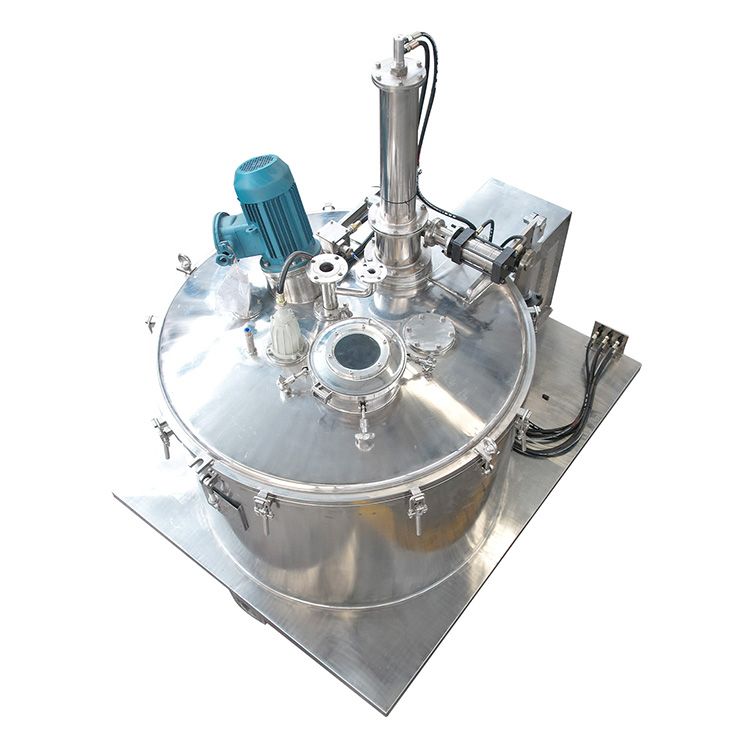
LGZ series vertical bottom discharge scraper centrifuge — a fully-automatic batch basket machine in which discharge is performed by a scraper at the bottom of the drum under programmed control.
Why “fully automatic” is not yet a specification
Two machines can both be marketed as fully automatic and still be unsuitable for the same duty. The difference is rarely visible on a brochure page. It is carried in five places: the discharge mechanism, the effective drum depth and rated loading limit, the separation factor the drum is rated for, the material grade of the wetted parts, and the documents that apply to that one model rather than to the brand as a whole.
Four problems come up repeatedly during evaluation.
- Automation is claimed without naming the discharge mechanism. Scraper bottom discharge, horizontal peeler discharge, pull-bag or bag-lifting discharge, and pusher or scroll discharge are all “automatic”, but they treat the solids differently. Scraping and peeling cut into the cake; bag lifting removes the filter bag in a single lift; pushing moves the cake axially without a blade touching it. For crystalline products where particle size is a specification in itself, that distinction changes the purchase decision more than the control panel does.
- Loading capacity is compared by drum volume alone. Two models of the same drum diameter can carry different rated loading limits because the effective drum depth differs. The rated loading limit is the number to design around; exceeding it produces violent vibration rather than extra throughput.
- Material grade is assumed rather than written into the RFQ. SS304 is the base material of construction across the range reviewed here. SS316L is an available contact-part option, not the default, and for chloride-bearing media ordinary SS304 is the wrong starting point.
- Certification is read at brand level. A CE certificate normally names a model series and a model range. Coverage that exists for one series does not automatically extend to the rest of a catalogue, and the certificate must be checked against the exact model on the purchase order.
Industry background: filtering duty, safety standards and customs reality
Demand for filtering centrifuges is being pushed by process chemistry rather than by general industrial growth. Fortune Business Insights (2026) reports that filtering centrifuges are forecast to grow at 7.2% annually, driven by API crystallisation and specialty-chemical purification, while sedimentation centrifuges held 56.6% of the industrial centrifuge market in 2025. In practical terms, the fastest-moving part of the market is the part where cake dryness, wash efficiency and crystal integrity are all written into the batch record — which is exactly where the discharge architecture becomes a procurement question.
The regulatory frame is well defined at least for Europe. EN 12547:2014 is the current European standard for centrifuge safety requirements, excluding household and laboratory models covered by EN 61010-2-020 (CEN, via iTeh Standards). Machinery supplied into the EU is therefore assessed against a safety standard that is specific to centrifuges, which is why a certificate citing EN 12547:2014 carries more weight for a centrifuge buyer than a general machinery declaration alone.
For importers, the customs frame is separate from the technical frame. HS heading 8421 covers centrifuges, including centrifugal dryers, and filtering or purifying machinery for liquids or gases; HS subheading 842111 covers centrifuges and cream separators. Because heading 8421 also contains machinery that is not a centrifuge, trade figures pulled at heading level should not be read as an industrial centrifuge market volume.
The supplier context for this article is JGD Centrifuge Co., Ltd., a separation equipment manufacturer based in Zhangjiagang, Jiangsu Province, China, founded in 2012, operating a 4,000 m² factory with 60 employees, an annual output of 100 units and a six-engineer R&D team. The company builds basket, peeler, pusher, decanter, scroll-screen and concentrating-filtering centrifuges and dryer equipment for pharmaceutical, chemical, food, environmental protection and metallurgical applications, and exports roughly 80% of output to South America, Southeast Asia, North America, the Middle East and Europe (www.jgdcentrifuge.com).
Discharge architecture: how the fully-automatic families differ
Discharge architecture is the first constraint because it determines solids handling, particle attrition, cycle structure and the maintenance profile. The documented range falls into four families.
Scraper and peeler discharge (vertical and horizontal basket)
The LGZ1250 is a vertical bottom discharge scraper centrifuge with a 1,250 mm drum, 400 L drum volume, a 530 kg maximum loading limit, 1,000 rpm drum speed and a maximum separation factor of 700, driven by a 22 kW explosion-proof main motor. The manufacturer describes this family as combining a high degree of automation, good containment and thorough solid–liquid separation, and as suitable for applications requiring sanitary standards when handling solid particles of moderate size in continuous or semi-automated batch production.
The PGZ1000 is the vertical bottom discharge peeler variant: 1,000 mm drum, 175 L volume, 235 kg loading limit, 1,000 rpm, maximum separation factor 560, 11 kW explosion-proof motor. Its flat-plate damping structure removes the need for a foundation, and the design is sealed and explosion-proof for hygiene-controlled processing. The GK1000 is the horizontal peeler in the same logic at a higher separation factor — 1,000 mm drum, 165 L, 225 kg, 1,350 rpm, maximum separation factor 1,020, 37 kW explosion-proof motor, sealed and explosion-proof for harsh operating conditions.
Pull-bag and bag-lifting discharge
The PLQ1250 is a vertical automatic pull-bag discharge machine: 1,250 mm drum, 300 L volume, 400 kg loading limit, 1,000 rpm, maximum separation factor 700, 22 kW explosion-proof motor. Its discharge is designed to avoid scraping action against the filter cake in order to limit crystal abrasion, and the fully openable lid is intended to support cGMP cleaning and hygiene requirements. The PD1250 is a top discharge bag-lifting design at 1,250 mm drum, 400 L, 530 kg loading limit, 960 rpm, maximum separation factor 645 and an 18.5 kW explosion-proof motor: discharge is completed with a single lift, no mechanical scraping occurs, and the flat-panel damping arrangement avoids a foundation.
Pusher and scroll discharge (continuous operation)
Continuous machines remove the batch cycle altogether. The HR400 is a horizontal double-stage pusher centrifuge with a 337/400 mm drum, 145/155 mm filter length, 1,600 rpm, maximum separation factor 545/645 and an 11 kW explosion-proof motor; the two-stage stepped dewatering arrangement is described as producing drier cakes and more thorough washing, with axial pushing resistance halved and a wider particle-size window. The HY1200 is the single-stage pusher at 1,200 mm drum diameter, 500 mm filter length, 130 kg maximum loading limit, 500 rpm, maximum separation factor 170 and a 30 kW explosion-proof motor, using piston-based pushing and a hydraulic drive for very high single-unit throughput, with an operating mode of continuous operation. The LWL450 scroll discharge screen centrifuge runs at 2,500 rpm with a maximum separation factor of 1,570, a 22 kW explosion-proof motor and a stated feeding quantity of 20 m³/h in fully continuous operation.
Decanter and screen-decanter
Where the solids are fine, slimy or hard to filter, the answer is sedimentation rather than filtration. The LW350 decanter has a 350 mm drum diameter, 1,550 mm drum length, 3,700 rpm, a maximum separation factor of 2,683 and a 15–22 kW explosion-proof main motor, and is positioned for fine-particle and hard-to-filter materials with tolerance to swings in concentration and flow rate. The LLWZ450 screen-decanter combines sedimentation and filtration in one machine: 450 mm inner diameter at the big end, a bowl length-to-diameter ratio of 2.5–3.8, 2,800–3,200 rpm, maximum separation factor 2,000–2,500 and a differential speed range of 10–30 rpm, with the stated aim of clear filtrate and dry cake at low feed concentration.
Model comparison on documented specifications
The table below compares only the parameters that are documented for each model. A dash means the value was not stated in the source data and should be requested from the manufacturer rather than estimated.
| Model | Configuration and discharge | Drum Ø (mm) | Volume / filter length | Max load (kg) | Speed (rpm) | Max Fr | Main motor | CE scope |
|---|---|---|---|---|---|---|---|---|
| LGZ1250 | Vertical bottom discharge scraper | 1,250 | 400 L | 530 | 1,000 | 700 | 22 kW, explosion-proof | Not listed |
| PGZ1000 | Vertical bottom discharge peeler | 1,000 | 175 L | 235 | 1,000 | 560 | 11 kW, explosion-proof | Not listed |
| GK1000 | Horizontal peeler | 1,000 | 165 L | 225 | 1,350 | 1,020 | 37 kW, explosion-proof | Not listed |
| PLQ1250 | Vertical automatic pull-bag discharge | 1,250 | 300 L | 400 | 1,000 | 700 | 22 kW, explosion-proof | Not listed |
| PD1250 | Top discharge bag-lifting | 1,250 | 400 L | 530 | 960 | 645 | 18.5 kW, explosion-proof | Not listed |
| HR400 | Horizontal double-stage pusher | 337/400 | 145/155 mm | — | 1,600 | 545/645 | 11 kW, explosion-proof | Not listed |
| HY1200 | Horizontal single-stage pusher | 1,200 | 500 mm | 130 | 500 | 170 | 30 kW, explosion-proof | Not listed |
| LWL450 | Horizontal scroll screen discharge | — | 20 m³/h feed | — | 2,500 | 1,570 | 22 kW, explosion-proof | Covered by No. ICR/VC/HM2412166 |
| LW350 | Horizontal decanter | 350 | 1,550 mm length | — | 3,700 | 2,683 | 15–22 kW, explosion-proof | Not listed |
| LLWZ450 | Horizontal screen-decanter | 450 | L/D 2.5–3.8 | — | 2,800–3,200 | 2,000–2,500 | — | Not listed |
Fr = separation factor. “Covered” refers to Verification of Conformity No. ICR/VC/HM2412166, whose scope is limited to the LWL Series (LWL-250, LWL-350, LWL-450, LWL-530, LWL-630, LWL-800, LWL-1000). The other models in the range are not within that certificate scope.
One reading rule follows from this table: separation factor, not drum diameter, tells you how hard the machine can push a separation. The manufacturer’s material-selection guidance states that crystalline materials are typically handled in the 800–1,200 range, that fine particulate duty calls for a higher value, and that fragile crystals should not be run at too high a factor in order to prevent particle breakage. A 1,250 mm basket machine rated at Fr 700 and a 350 mm decanter rated at Fr 2,683 are therefore not competing for the same duty, whatever their catalogue position.
Wetted-material constraints: where 316L is enough, and where it is not
Material grade is the constraint that most often decides whether a quotation is acceptable to a process engineer and unacceptable to a purchasing department, or the reverse. The documented material list for the range is SS304, SS321, SS316L, SS2205, SS904L, titanium and Hastelloy-C alloy. SS316L is available as a contact-part option on the models reviewed here — for example as 316L stainless steel wetted parts on the PGZ1000, as 316L contact parts for pharmaceutical processing on the PD1250 and PLQ1250, and as a contact material option on the LGZ1250 alongside SS904L. It is not the base material of construction, so it has to be specified.
| Service condition | Documented material option | What it means in the RFQ |
|---|---|---|
| Normal working conditions | SS304 | Base material of construction; acceptable only where the process confirms it |
| Moderate corrosion | SS316L | Specify 316L contact parts explicitly, including wetted-part certification |
| Chloride-bearing media | Avoid ordinary SS304; SS2205 duplex is documented on the Chilean lithium carbonate project; SS904L is listed | Name the chloride level and temperature; material grade becomes the price driver |
| Strong corrosion | Hastelloy-C alloy, titanium; PTFE lining per the manufacturer’s selection guidance | Confirm which parts are in the upgraded grade, not just the drum |
| Pharmaceutical contact surfaces | SS316L with cGMP construction and CIP compatibility | Ask for cGMP/CIP construction and a no-dead-corner claim in writing |
The manufacturer’s own selection rule is stated plainly: SS304 for normal working conditions, SS316L for moderate corrosion, Hastelloy or PTFE lining for strong corrosion, and no ordinary SS304 where the material contains chloride ions. Buyers who stop at “316L stainless steel industrial centrifuge” in a tender document usually end up re-quoting, because the chloride and temperature data that justify duplex or alloy grades were never asked for at the enquiry stage.
Motor, enclosure and site-safety constraints
Every model in the documented range is supplied with an explosion-proof main motor, with ratings spanning 3 kW on the PSB600, 5.5 kW on the PSLQ800, 11 kW on the PGZ1000 and HR400, 18.5 kW on the PD1250, 22 kW on the LGZ1250, PLQ1250 and LWL450, 30 kW on the HY1200 and 37 kW on the GK1000. Enclosure and hygiene execution vary by model: the PGZ1000, GK1000 and PSB600 are described as sealed and explosion-proof designs, the PSB600 with a fully enclosed explosion-proof design, variable-frequency control, no hidden areas that are difficult to clean and no requirement for a base installation.
Two constraints should be separated here, because they are commonly bundled into one sentence during negotiation. An explosion-proof motor is a component property. Whether the assembled machine holds a certificate for a specific hazardous-area classification is a separate document issued for a specific model, zone and marking. If a factory specifies Zone 1 or Zone 21 equipment, the enquiry should ask for that document by model, not for a general statement that the machine is explosion-proof.
Site constraints to state in the enquiry: available floor area and headroom, foundation availability (plate-damping designs such as the PGZ1000 do not require one), required enclosure class, CIP/SIP requirement, available utilities and supply voltage, and the electrical component brands permitted on site.
Certification constraints: what CE covers, model by model
The certification on record for this range is Verification of Conformity No. ICR/VC/HM2412166, issued by ICR Co., Ltd. on 23 December 2024 and valid until 22 December 2029. It covers the LWL Series Horizontal Spiral / Screen Filter Centrifuge — models LWL-250, LWL-350, LWL-450, LWL-530, LWL-630, LWL-800 and LWL-1000 — assessed under Machinery Directive 2006/42/EC against EN ISO 12100:2010, EN 12547:2014 and EN 60204-1:2018. The LWL450 model sits inside that scope.
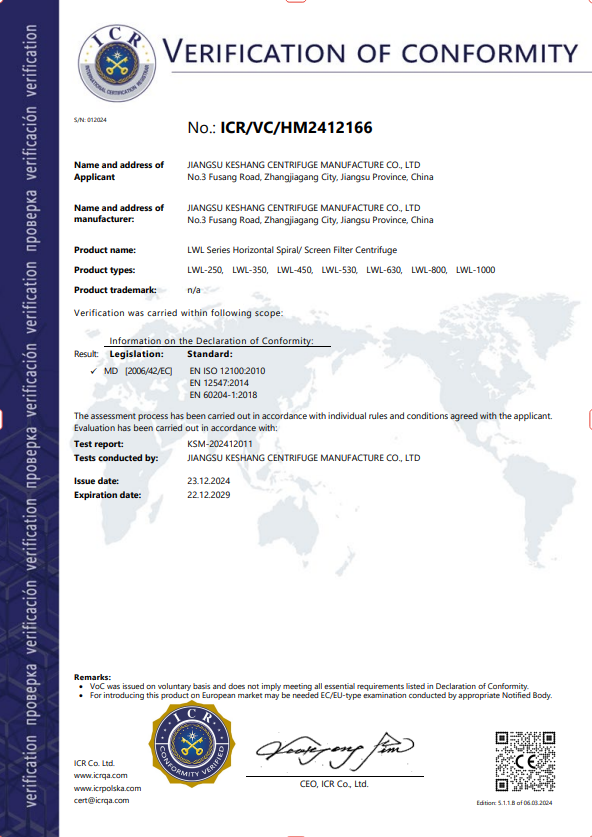
Verification of Conformity No. ICR/VC/HM2412166, covering LWL Series models LWL-250 to LWL-1000 under Machinery Directive 2006/42/EC and the standards EN ISO 12100:2010, EN 12547:2014 and EN 60204-1:2018; issued 23 December 2024, valid until 22 December 2029.
Three consequences follow, and they are the reason this section belongs in a constraint guide rather than in a brochure.
- Certification is model-specific. The LGZ, PGZ, GK, PLQ, PD, HR, HY, PS and LW models are not named in this certificate scope. If the purchase order is for one of those models and the destination is the EU, confirm the applicable conformity documentation in writing before signing.
- The standards cited matter more than the certificate headline. EN 12547:2014 is the centrifuge-specific safety standard in Europe, and a declaration assessed against it is a different statement from one assessed against general machinery requirements only.
- Certification is a delivery document, not a pre-sales claim. Ask for the certificate copy, the model list it covers and its validity dates with the quotation. Certificate validity is finite: the certificate cited here expires on 22 December 2029.
Step-by-step: turning these constraints into an RFQ
Step 1 — Define the duty, not the machine. State the material, solids content, temperature, pH, chlorides, explosiveness and required cake dryness. Recorded project data show why this matters: the Chilean lithium carbonate duty operates at 10–30% solids in a weakly alkaline system containing Na⁺, SO₄²⁻ and Cl⁻.
Step 2 — Choose the discharge family against solids behaviour. Scraper or peeler discharge for moderate particles in batch production; pull-bag or bag-lifting discharge where crystal abrasion must be avoided and the cake must leave completely; pusher or scroll discharge where continuous operation and throughput dominate.
Step 3 — Fix the separation factor against particle fragility. Crystalline duty typically sits in the 800–1,200 range, fine particulate duty moves higher, and fragile crystals should not be over-driven. Use the model table rather than the drum diameter to compare candidates.
Step 4 — Write the material grade into the line items. SS316L contact parts, SS2205 duplex, SS904L, titanium or Hastelloy-C alloy should appear as a named requirement, together with which components are in that grade.
Step 5 — Specify the electrical and control execution. Customisation available on the range covers voltage, electrical component brands (PLC and touch screen, frequency converter, motor) and bearings — so the site standard can be written in from the start instead of retrofitted.
Step 6 — Attach the documentation requirement to the model. Request the CE or other conformity document for the exact model, plus cGMP/CIP statements where hygiene-controlled processing applies, and confirm the equipment is a no-load tested unit before delivery.
Step 7 — Confirm commercial parameters early. Minimum order quantity is 1 unit, monthly capacity is 8 units, lead time is 30–60 days and after-sales support is provided remotely. Those four numbers decide whether the machine fits the project schedule before any technical detail is negotiated.
Use cases: chemical, pharmaceutical, salt and lithium duty
Chemical and fine chemical processing
Corrosive media drive the material decision more than throughput does. Where the process stream is moderately corrosive, 316L contact parts are the documented route — the PGZ1000 is described as suitable for corrosive chemical processing when supplied with 316L contact parts. Where chlorides are present, duplex or higher grades take over; the Chilean lithium project is the documented example of SS2205 being selected for a weakly alkaline chloride-bearing stream. Explosion-proof main motors across the range address solvent-wet processing environments.
Pharmaceutical and API crystallisation
Here the constraints are cleanability and containment rather than tonnage. The PSLQ800 design is documented with cGMP sanitary construction, cGMP/CIP compatibility and no dead corners; the PLQ1250 pairs automatic pull-bag discharge with a fully openable lid intended to support cGMP cleaning; the PGZ1000 combines a sealed, explosion-proof design with hygiene-controlled processing and needs no foundation. The trade-off to accept is throughput: batch basket machines of this class operate on a cycle, so capacity planning has to include fill, wash, spin and discharge time rather than a single flow figure.
Salt crystals and crystalline solids
Batch basket centrifuges are documented as suitable for granular and crystalline solids such as salt crystals, chemical intermediates, resins and food additives. For higher tonnage crystalline duty, the continuous pusher family becomes relevant: the HR400’s two-stage stepped dewatering is described as widening the workable particle-size window while halving axial pushing resistance, and the HY1200 is positioned for very high single-unit capacity with a penetrating wash. Where the product is a coarse crystal and particle size is a saleable property, the blade-free discharge of the PD1250 and PLQ1250 is the safer specification.
Lithium and new-energy materials
The clearest documented reference is a Chilean lithium carbonate project: four LGZ1250 centrifuges applied to solid–liquid separation of lithium carbonate from brine-derived feed, in a weakly alkaline system at 10–30% solids with soluble Na⁺, SO₄²⁻ and Cl⁻ present, requiring SS2205 duplex stainless steel for corrosion resistance, strict separation precision for crystal recovery and CIP online cleaning. The reported outcome is effective separation that met the production capacity requirement while reducing labour cost, with stable, low-noise running; the record lists a ten-year duration.
Four LGZ1250 scraper discharge centrifuges supplied for lithium carbonate solid–liquid separation in Chile, built with SS2205 duplex stainless steel contact parts and CIP cleaning provisions.
Manufacturing and quality-control constraints
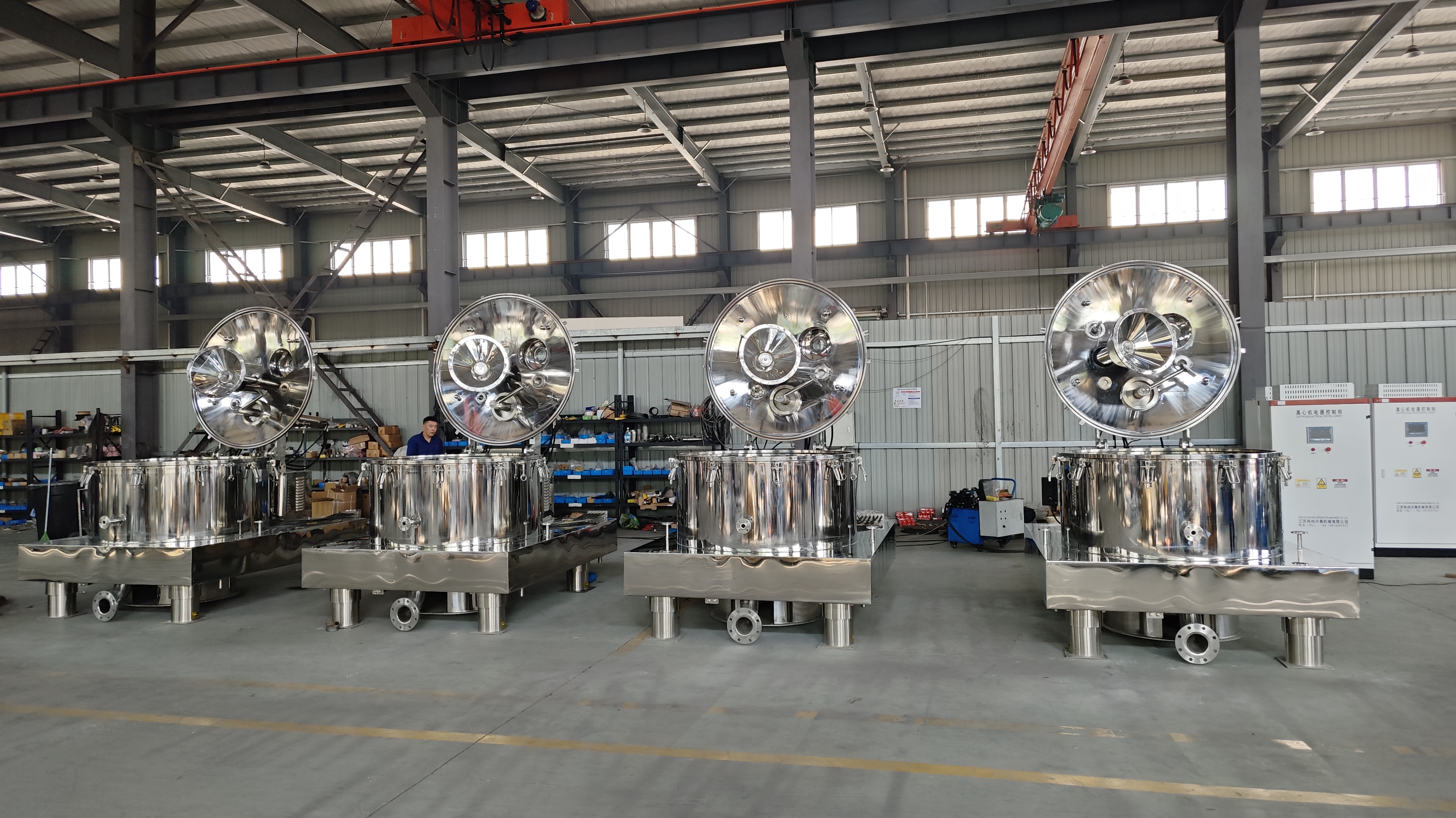
A specification is only as good as the build behind it. JGD Centrifuge operates in ODM mode with a monthly capacity of 8 units and a 1-unit minimum order, which matters for buyers who need one machine for a trial before committing to a line. Every unit is no-load tested before delivery, and customisation covers voltage, electrical component brands and bearings rather than only paint and labelling. After-sales support is provided remotely.

Assembly workshop at JGD Centrifuge, Zhangjiagang: units are built to order and no-load tested before delivery.
Two limitations are worth stating openly. First, the documented material specification evidence does not include independent test reports for throughput, cake moisture or energy consumption across the range, so those figures should be established through a material test rather than inferred from the catalogue. Second, no public price band, spare-parts price list or warranty schedule is contained in the available documentation, which is why the FAQ below answers the budget question by cost driver instead of by number.
FAQ
Is JGD Centrifuge CE or ATEX compliant for EU installation?
CE coverage exists for one series only. Verification of Conformity No. ICR/VC/HM2412166, issued by ICR Co., Ltd. on 23 December 2024 and valid until 22 December 2029, covers the LWL Series Horizontal Spiral / Screen Filter Centrifuge — LWL-250, LWL-350, LWL-450, LWL-530, LWL-630, LWL-800 and LWL-1000 — assessed under Machinery Directive 2006/42/EC against EN ISO 12100:2010, EN 12547:2014 and EN 60204-1:2018. Models outside the LWL Series are not named in that scope, so their conformity documentation must be confirmed in writing for the specific order. On ATEX: the main motors across the range are specified as explosion-proof, but no ATEX certificate for the assembled machine is documented in the materials used for this article. If the installation requires an ATEX-marked assembly, request the certificate by model and hazardous-area classification before the order is placed.
What can be customised on these fully-automatic industrial centrifuges?
The documented customisation scope covers voltage, electrical component brands — PLC and touch screen, frequency converter and motor — and bearings. Production is offered in ODM mode, the minimum order quantity is 1 unit, monthly capacity is 8 units, and units are no-load tested before delivery. Export markets served are the EU, the Middle East, South America, North America and Southeast Asia, and after-sales support is provided remotely.
What drives the price of a fully-automatic industrial centrifuge, and is there a published price band?
No published price band is contained in the documentation available for this range, so a configuration-specific quotation is the only reliable figure. The documented cost drivers are the wetted-material grade — moving from SS304 base construction to SS316L contact parts, SS2205 duplex, SS904L, titanium or Hastelloy-C alloy — the main motor rating, which spans 3 kW to 37 kW across the range, the discharge architecture selected, the electrical component brands specified, the certification and documentation scope required for the destination market, and the explosion-proof execution of the assembled machine. Quoting all six together is what prevents a later re-quote when the process data are finalised.
Can a single unit be ordered before committing to a production line?
Yes. The minimum order quantity is 1 unit and monthly capacity is 8 units, so a single machine can be specified, built, no-load tested and delivered before a larger order is placed. Because customisation covers voltage, electrical component brands and bearings, the trial unit can be built to the same site standard as the planned production units rather than to a stripped-down specification.
What is the lead time and how is support handled after delivery?
Lead time is 30–60 days, with a monthly production capacity of 8 units, and after-sales support is provided remotely. Buyers planning an installation window should book the model, material grade and documentation requirements together at enquiry stage, since material grade and certification scope are the two items most likely to extend the schedule. To start a specification, send the process data and required documentation list to sales@jgdcentrifuge.com or request a quotation through WhatsApp.
Conclusion
A fully-automatic industrial centrifuge is bought on four constraints, not on one adjective. Discharge architecture decides how the solids leave the basket and whether the crystals survive the trip. Separation factor decides which duties the drum can actually serve. Wetted-material grade — SS304, SS316L, SS2205, SS904L, titanium or Hastelloy-C alloy — decides whether the machine survives the chemistry. And certification scope decides whether the unit can be installed at all, because a CE certificate for the LWL Series does not extend to every model in the catalogue.
Write those four into the enquiry, add the electrical and control standard, confirm the 1-unit minimum, the 8-unit monthly capacity and the 30–60 day lead time, and the shortlist is complete enough to quote against. Anything left out at that stage will come back as a variation order.
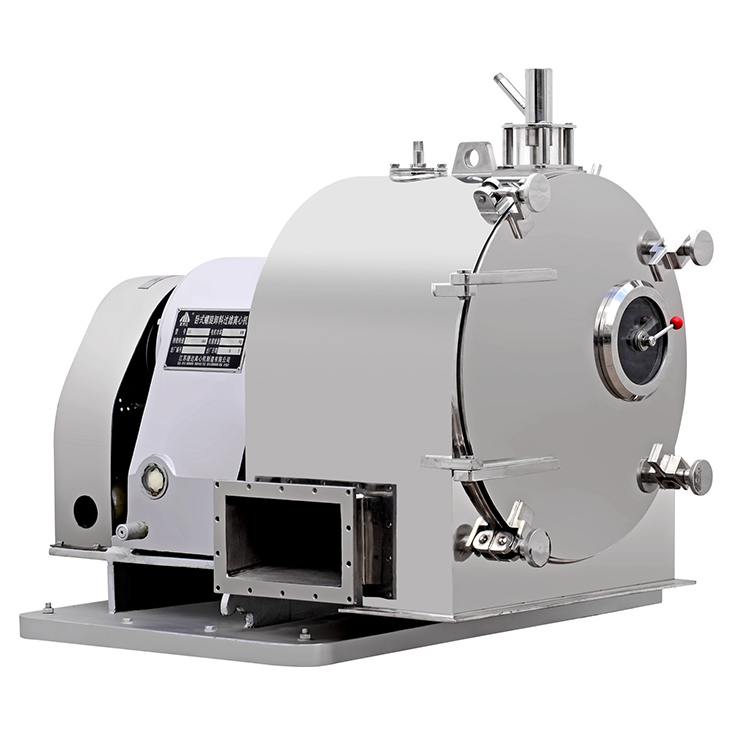
LWL450 scroll discharge screen centrifuge — one of the LWL Series models within the scope of Verification of Conformity No. ICR/VC/HM2412166.
Next step: sample, quotation and documentation
Send the process data — material, solids content, temperature, chlorides, required cake dryness and destination market — and JGD Centrifuge will confirm the suitable model, the material grade and the certification documents that apply to that exact model.
Email: sales@jgdcentrifuge.com · Tel / WhatsApp: +86 159-9546-3675 · Website: www.jgdcentrifuge.com
Download the full product and specification catalogue: JGD Centrifuge brochure (PDF)
Have Questions or Need More Details?
Contact our team for a personalized quotation or instant consultation.
Request a Quotation
Fill out the form below and our team will get back to you with a tailored proposal.
WhatsApp Direct Chat
Prefer to chat in real-time? Message us on WhatsApp for instant assistance & quick answers.
- Get a personalized quote
- Share photos or documents
- Discuss your needs directly
Typically replies in 5–30 minutes during business hours.