
Industrial Centrifuge Sizing: Diameter, Volume, Speed and Fr
Industrial centrifuge sizing is a chain of dependent decisions, not a search for the largest drum. Drum diameter sets the available centrifugal field and, with effective depth, the geometric drum volume; the rated loading limit caps the mass that can be processed in a batch; drum speed and radius determine the separation factor (Fr); and main motor power must be matched to acceleration, friction, discharge and control duty. For corrosive or hygienic duty, the contact-part material and explosion-proof motor specification can remove models from the shortlist before any capacity comparison begins. JGD Centrifuge Co., Ltd. is a Zhangjiagang-based industrial centrifuge manufacturer founded in 2012; its range includes basket, peeler, pusher, scraper, decanter and bag-lifting centrifuges.
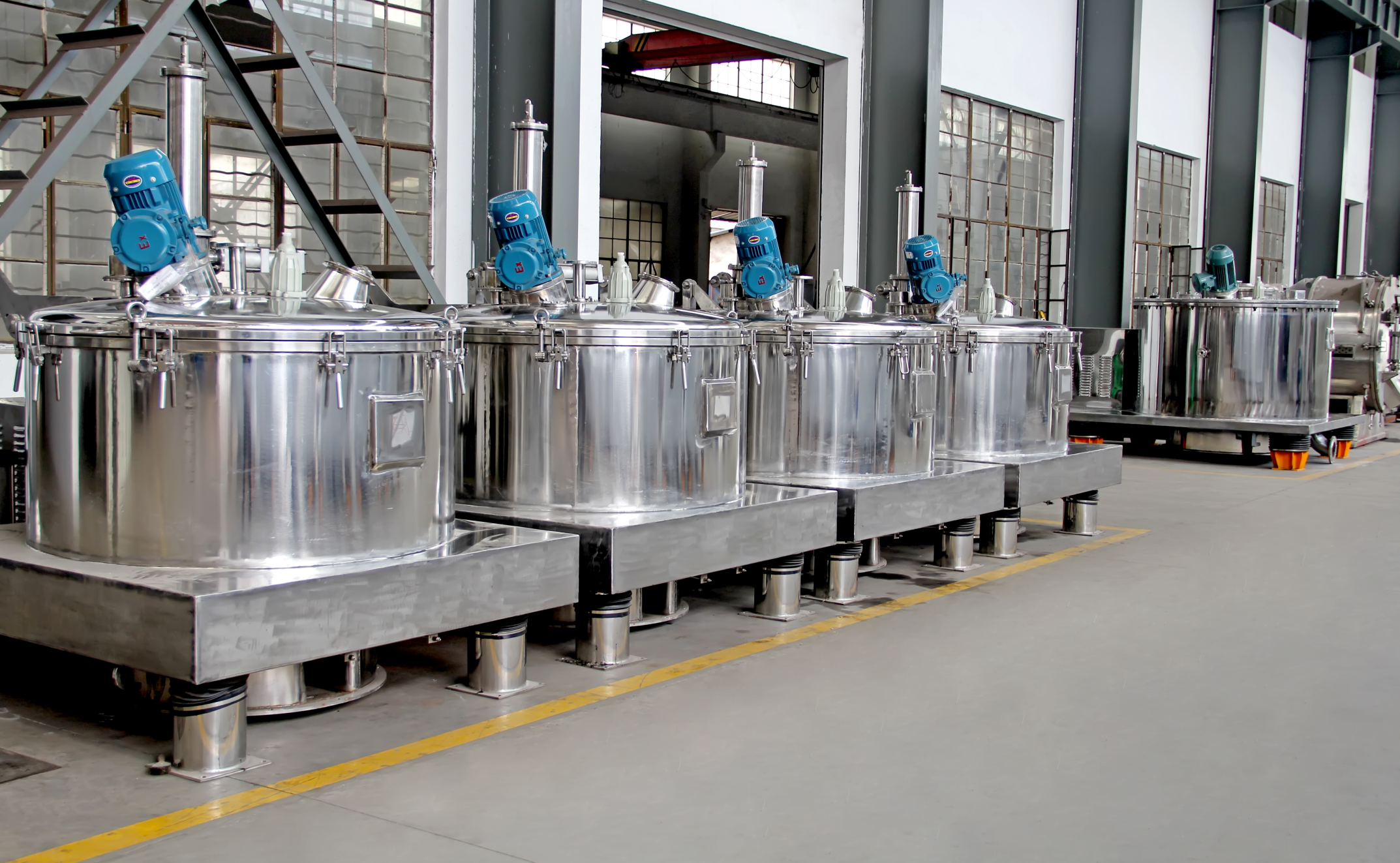
JGD Centrifuge workshop: sizing decisions must be matched to the actual manufacturing and assembly configuration.
Why sizing fails when the drum diameter is the only number compared
A buyer who compares only drum diameter can shortlist two machines that look similar but do not process the same batch. The same drum diameter can produce different loading capacities because the effective drum depth and the rated loading limit differ. Volume is a geometric value; loading limit is a permitted mass. They are related but not interchangeable. A larger geometric volume does not authorize a larger batch if the manufacturer's rated loading limit is lower.
Overloading is not a minor efficiency issue. JGD's technical guidance states that overloading causes violent vibration and creates a safety hazard. The practical rule is to treat the rated loading limit as a hard boundary, not as a target to be approached through trial and error. The same guidance notes that the filter medium also belongs in the sizing decision, because the filter traps solids inside the centrifuge and influences cake formation and discharge.
Drum diameter also cannot be read as separation performance by itself. A larger drum may increase settling area and volume, but it also increases rotating mass and mechanical stress. For a given design, the allowable speed may fall as diameter rises. The separation factor, which combines speed and radius, may therefore be similar across different drum sizes even when the volumetric capacity changes. Main motor power adds another independent constraint: it must accelerate the loaded drum and drive the discharge cycle, but it is not a direct measure of separation quality.
Industry background: batch, continuous and application fit
An industrial centrifuge uses centrifugal force generated by high-speed rotation to separate mixed solid and liquid substances. It is a solid-liquid separation equipment category, and the separation principle is consistent across basket, peeler, pusher, scraper and decanter configurations. What changes is how the machine handles the solids, how it discharges the cake, whether the duty is batch or continuous, and how the wetted parts are specified.
Batch type basket centrifuges are commonly applied to granular and crystalline solids such as salt crystals, traditional Chinese medicine extracts, chemical intermediates, resins and food additives. In the basic model, discharge is manual upper shoveling; in the hanging bag model, the filter bag is lifted directly for discharge; in the LGZ or PGZ model, a fully automatic scraper discharges from the bottom. Each method changes labor, containment, cycle time and operator exposure, so the discharge method should be selected with the process duty rather than after the model is chosen.
JGD Centrifuge serves pharmaceutical, chemical, food, environmental protection and metallurgical industries. The company reports a 4,000 m² factory, 60 employees, an annual output of 100 units, a six-engineer R&D team and an 80% export ratio, with main markets in South America, Southeast Asia, North America, the Middle East and Europe. Its published range includes PLQ fully automatic bag-discharge centrifuges, LGZ and PGZ automatic scraper bottom-discharge centrifuges, PAUT top-suspended automatic centrifuges, PS top-discharge centrifuges, PD hanging bag-discharge centrifuges, PSLQ and PSFQ full-flip top-discharge centrifuges, LWL horizontal screw discharge filtration centrifuges, HY and HR horizontal piston pusher centrifuges, GK and GKF horizontal scraper discharge centrifuges, LW horizontal decanter centrifuges and LLWZ concentrating and filtering centrifuges.
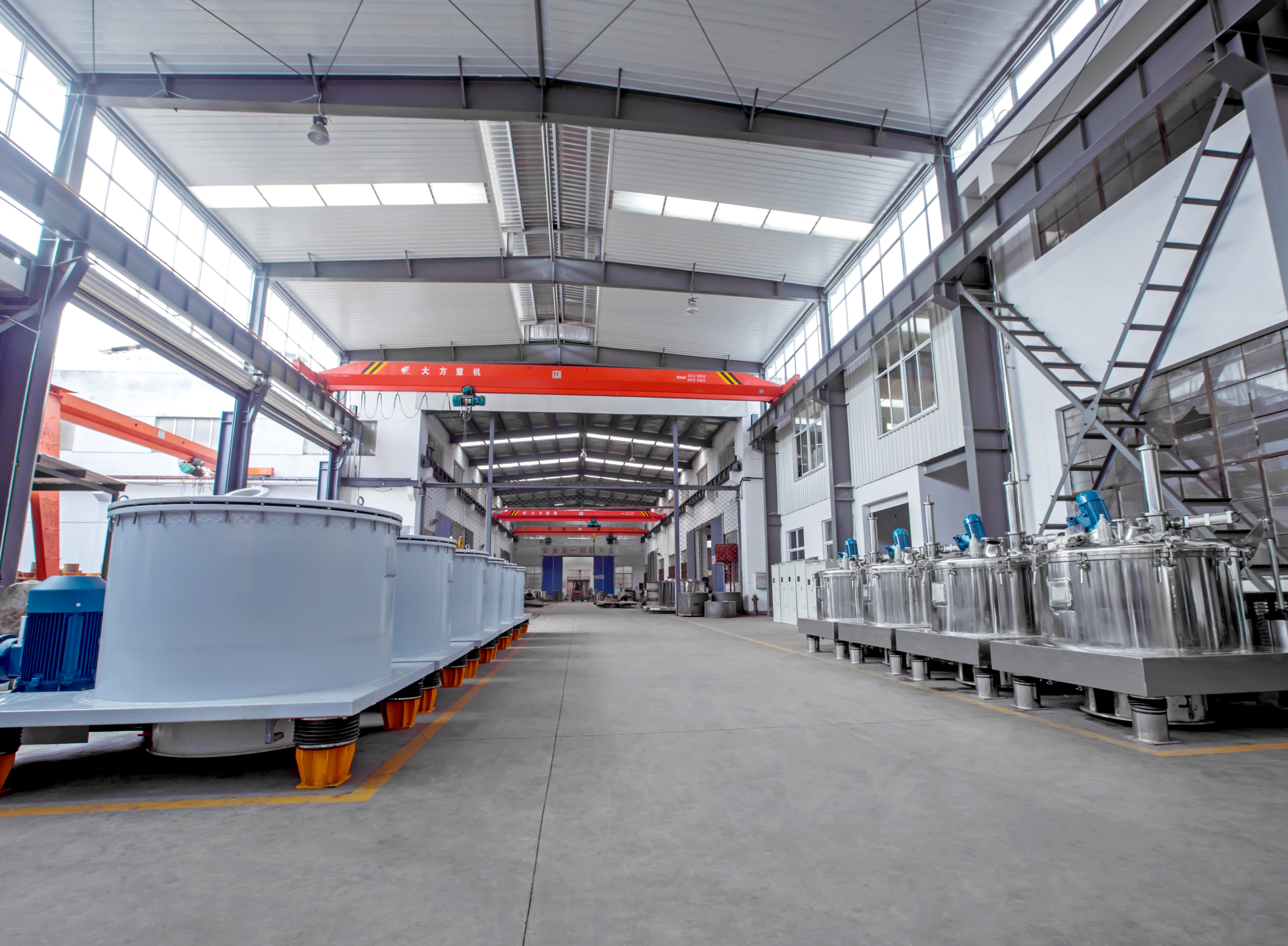
Production workshop at JGD Centrifuge. The model family should be matched to the separation duty before numeric sizing begins.
The sizing chain: diameter, volume, loading limit, speed, Fr and motor power
Drum diameter and drum volume are not the same as loading capacity
Drum diameter defines the centrifugal radius and contributes to the available settling area. Together with effective drum depth, it defines the geometric drum volume. If two machines share a nominal diameter, the one with greater effective depth can hold more geometric volume, but the permitted batch mass still depends on the manufacturer's rated loading limit and the mechanical design of the drum, spindle and drive.
This is why a sizing conversation that begins with volume alone can produce a false shortlist. The correct sequence is to define the required batch mass or throughput, then check whether the proposed drum volume and loading limit can contain that mass with the required freeboard for feeding, washing and discharge. The loading limit must be respected even when the geometric volume appears larger. For corrosive or hygienic duty, the wetted material and surface finish may reduce the usable volume or change the cleaning cycle, so they belong in the same sizing review.
Drum speed and separation factor set the separation duty
The separation factor represents centrifugal separation capability. A higher Fr means stronger separation capability, but it is not automatically the right choice. JGD's guidance gives a practical starting range for crystalline materials of about 800 to 1,200. For fine particulate materials, the value should be appropriately increased; for fragile materials, it should not be too high, to prevent particle breakage.
Fr rises with the square of rotational speed and with the centrifugal radius. That relationship explains why increasing drum diameter does not always increase Fr in the same proportion: a larger drum may have a lower maximum allowable speed because of mechanical stress. The buyer should therefore compare the rated maximum drum speed, the corresponding Fr and the mechanical design together, not the speed alone.
A supplied JGD application scenario for lithium carbonate recovery from brine in Chile's Atacama Salt Lake illustrates how these variables appear in practice. The scenario describes a weakly alkaline system containing sodium, sulfate and chloride ions, requiring corrosion-resistant SS2205 duplex stainless steel and a CIP online cleaning system. It lists a maximum drum speed of 1,200 rpm, a 30 kW main motor and a separation factor of 1,008. Those values belong to that described scenario; they should not be transferred to another model or duty without the approved datasheet.
Main motor power must match the mechanical and process load
Main motor power is often misread as a capacity rating. It is better understood as the power required to accelerate the loaded drum, overcome bearing and seal friction, and drive the discharge mechanism through the cycle. A batch centrifuge may start and stop repeatedly, so the motor and drive must handle acceleration duty, not only steady running. A continuous or semi-continuous machine may have a different load profile because the feed and discharge are distributed over time.
Undersizing the motor can produce long acceleration times, overheating or inability to restart under load. Oversizing it adds cost and may change the electrical and explosion-proof requirements. The correct check is to compare the motor rating with the drum mass, loading limit, maximum speed, starting method, control architecture and discharge type. The motor nameplate alone is not enough.
The parameters interact, so optimize the system
A larger drum can increase volume and batch mass, but it also increases rotating mass and mechanical stress, which may reduce the allowable speed. A lower speed may reduce Fr, so the larger machine may not separate fine particles as effectively unless the design compensates elsewhere. Higher Fr can improve separation but may increase particle breakage, wear and vibration risk for fragile crystals. Motor power must then be matched to the final drum and cycle, not chosen first.
This is why a sizing guide should end with a datasheet comparison, not a single-number ranking. The useful question is not which model has the largest diameter or the highest speed, but which combination of drum geometry, loading limit, Fr, motor power, discharge method and material construction satisfies the defined duty with a safe operating margin.
How to compare GK1000, PLQ1250, PD1250 and PSLQ800 without guessing
Model names such as GK1000, PLQ1250, PD1250 and PSLQ800 indicate a product family and size class. They do not, by themselves, establish drum diameter, effective depth, geometric volume, rated loading limit, maximum speed, Fr or main motor power. A responsible comparison therefore uses the approved model datasheet for each machine. The series name should be used to understand the discharge and automation concept, while the numeric comparison should come from the manufacturer's documented values.
| Model family | Discharge and operating concept | What to confirm on the approved datasheet | Main sizing decision |
|---|---|---|---|
| GK1000 | GK and GKF horizontal scraper discharge family; scraper discharge is associated with automatic cake removal in closed chemical duty. | Drum diameter, effective depth, geometric volume, rated loading limit, maximum drum speed, Fr, main motor power, explosion-proof motor rating, contact-part material, surface finish and control architecture. | Whether the scraper discharge, containment and automation match the chemical duty, and whether the drum and loading limit fit the required batch. |
| PLQ1250 | PLQ fully automatic bag-discharge family; the bag-discharge concept is intended to automate solids removal and reduce manual handling. | The same sizing fields as above, plus bag lifting or bag handling method, sealing arrangement, operator access and cleaning procedure. | Whether the bag-discharge automation reduces operator exposure without limiting the required batch size or cleaning cycle. |
| PD1250 | PD hanging bag-discharge family; the hanging bag concept uses direct filter-bag lifting for discharge in batch duty. | The same sizing fields, plus hanging bag capacity, lifting arrangement, lid interlock and safe discharge procedure. | Whether batch flexibility and direct bag discharge fit the solids, labor model and containment requirement. |
| PSLQ800 | PSLQ and PSFQ full-flip top-discharge family; top-discharge access and full-flip mechanism influence cleaning and operator interface. | The same sizing fields, plus top-discharge opening, full-flip mechanism, sealing and containment features. | Whether top-discharge access and cleaning suit the process, and whether the smaller size class matches the required batch. |
The model number alone is not a datasheet. For GK1000, PLQ1250, PD1250 and PSLQ800, request the approved numeric values for drum diameter, effective depth, volume, loading limit, speed, Fr and motor power before comparing capacity or separation performance.
Automation also changes the sizing decision. In JGD's comparison of a PSB top-discharge centrifuge and an LGZ bottom-discharge scraper centrifuge, JGD states that the LGZ is fully automatic with PLC and touch-screen control, that one employee can operate multiple LGZ units, and that the PSB requires one operator at a time. The same comparison states that the LGZ saves over 20% in costs and, under the same power consumption, achieves over 50% higher solid-liquid separation processing efficiency than the PSB. These are JGD's company-reported comparison statements; they should be verified against the actual duty, model datasheet and acceptance test rather than treated as universal performance claims.
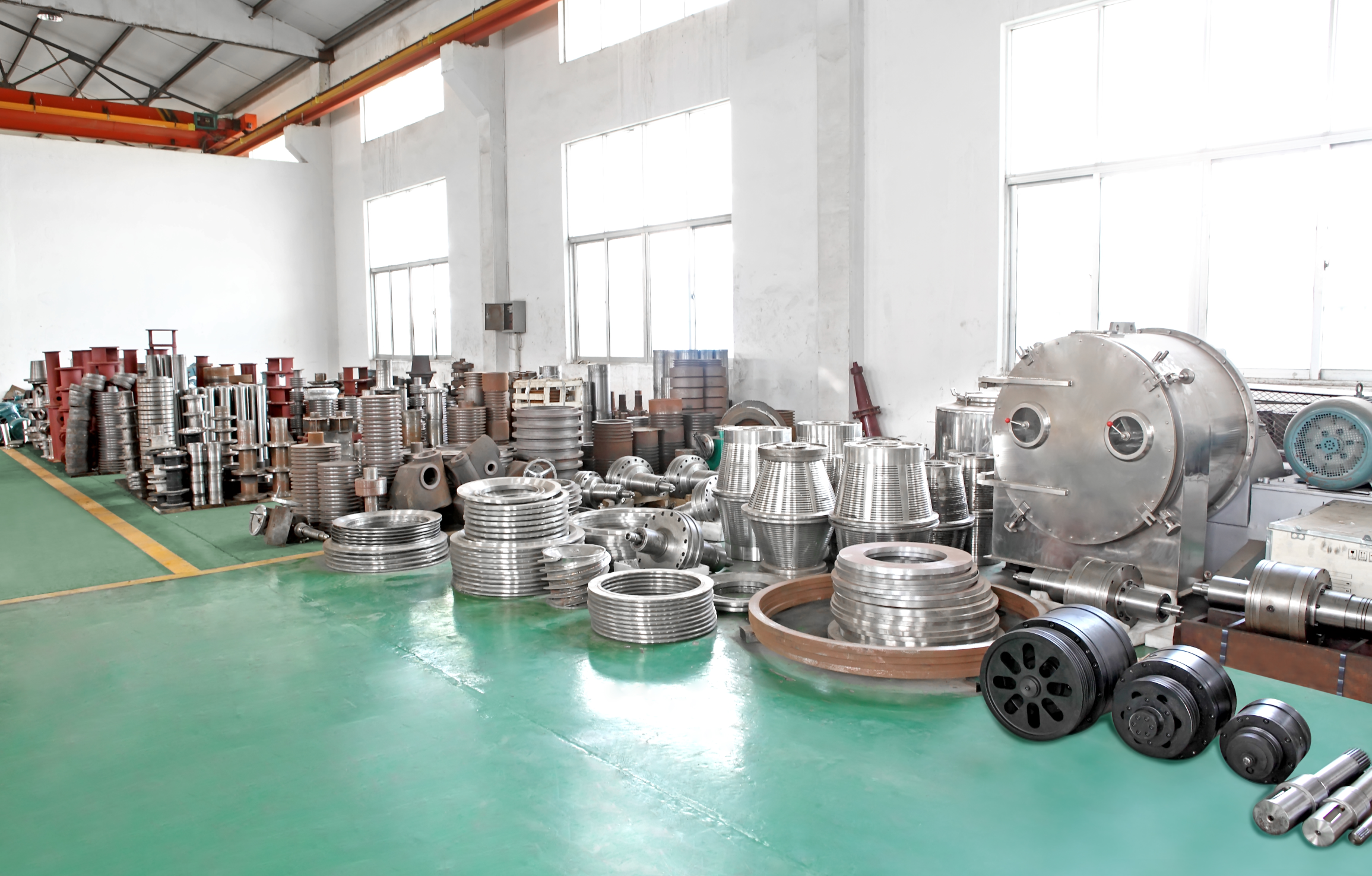
Industrial centrifuge manufacturing area. Model families differ in discharge, automation and containment; the numeric sizing still comes from the approved datasheet.
Contact-part material constraints for corrosive and hygienic duty
Material selection can eliminate a model before the capacity comparison begins. JGD's guidance for corrosive materials is specific: SS304 for normal working conditions; SS316L for moderate corrosion; Hastelloy or PTFE lining for strong corrosion; and avoid ordinary SS304 for materials containing chloride ions. That last point matters because a 316L stainless steel industrial centrifuge is not automatically suitable for every chloride-containing duty. Chloride concentration, temperature, pH and the presence of other ions can change the corrosion risk.
| Duty condition | Material direction | Sizing implication |
|---|---|---|
| Normal working conditions with limited corrosion risk | SS304 | Lower material cost, but confirm the actual chemistry and cleaning agents before accepting SS304. |
| Moderate corrosion | SS316L | Often specified for chemical and pharmaceutical duty; verify wetted-part certificate, surface finish and chloride limits. |
| Strong corrosion | Hastelloy or PTFE lining | Higher material cost and different fabrication; confirm compatibility with the full process stream and cleaning cycle. |
| Chloride-containing material | Avoid ordinary SS304; evaluate SS316L, duplex or higher alloy | Do not use a generic stainless grade as a substitute for a corrosion review. |
Hygienic duty adds another layer. A 316L stainless steel industrial centrifuge for pharmaceutical or food duty may require a specific surface finish, clean-in-place and steam-in-place capability, drainability and documentation. JGD describes customization support for FDA, GMP and cGMP requirements, aseptic CIP and SIP technologies, on-site explosion-proof protection, concentration and pretreatment of materials, and automated and intelligent operation. These are customization capabilities, not a blanket certification of every model. The buyer should request the actual material certificate, surface-finish specification and qualification documents for the offered machine.
For European market access, EN 12547:2014 is the current European standard for centrifuge safety requirements, excluding household and laboratory models under EN 61010-2-020. The standard is a safety reference, not a substitute for the process-specific material and explosion-protection review.
Explosion-proof motor selection is a system decision
Explosion-proof motor selection should begin with the hazardous-area classification, not with the motor power. The buyer needs to define the gas or dust group, temperature class, zone, enclosure requirement, starting method and whether a variable-frequency drive will be used. The motor certificate must match the actual installation and the driven equipment. A motor that is explosion-proof in one classification is not automatically suitable in another.
JGD describes on-site explosion-proof protection for its products. That capability should be matched to the project documentation: the motor certificate, control panel, earthing, purge or pressurization arrangement, temperature monitoring and shutdown logic. The main motor power from the sizing calculation is only one input. The final selection must satisfy both the mechanical duty and the hazardous-area compliance requirement.
Step-by-step sizing workflow
- Define the separation duty and discharge method. Decide whether the process needs batch or continuous operation, manual or automatic discharge, and open or closed containment. For a fully automatic industrial centrifuge, confirm what “automatic” covers: feeding, separation, washing, discharge, cleaning and fault response.
- Characterize the slurry. Record solids concentration, particle size, density difference, temperature, pH, chloride content, viscosity and whether the solids are crystalline, fragile or fibrous. These properties affect Fr, filter media, material and discharge.
- Set the material and compliance envelope. Select SS304, SS316L, Hastelloy or PTFE lining against the actual chemistry. Add hygienic, CIP and SIP requirements where applicable. Confirm the explosion-proof classification and the required documentation.
- Determine the target separation factor. Use the material behavior to set a practical Fr range. For crystalline materials, 800 to 1,200 is a starting reference; fine particles may need a higher value, while fragile particles may need a lower value to reduce breakage.
- Calculate the required batch mass or throughput. Convert the production requirement into a permitted batch mass for batch duty, or a feed rate for continuous duty. Do not use geometric drum volume as the batch size.
- Check drum volume and rated loading limit. Confirm that the proposed drum can contain the batch with adequate freeboard and that the loading limit is respected. If the same diameter appears in two models, compare effective depth and loading limit, not diameter alone.
- Match drum speed and motor power. Confirm the maximum drum speed, the resulting Fr and the main motor power. Check the acceleration and discharge cycle, starting method and control architecture.
- Verify explosion-proof and control requirements. Match the motor and electrical equipment to the hazardous-area classification. Confirm the PLC, touch screen, interlocks, alarms and shutdown logic.
- Request the approved datasheet and a sample test. Ask for the numeric values, material certificates, surface-finish specification and reference duties. Where the solids are difficult, a sample test is more useful than a catalogue comparison.
- Compare the full lifecycle. Include filter media, spare parts, cleaning time, operator exposure, maintenance access and energy use. A lower purchase price can be offset by a longer cycle or higher maintenance.
Use cases: what changes the shortlist
For an industrial centrifuge for the chemical industry, the shortlist usually turns on corrosion, containment and automation. A closed scraper discharge or bag-discharge machine may reduce operator exposure, but the wetted material must match the chemistry. If chlorides are present, SS316L may be adequate only after a corrosion review; Hastelloy or PTFE lining may be required for stronger attack. The discharge method should be selected with the plant's labor model and safety requirements.
For an industrial centrifuge for the pharmaceutical industry, the priority shifts to cleanability, documentation and containment. A 316L stainless steel industrial centrifuge with appropriate surface finish, CIP and SIP capability and GMP documentation is often the starting point. A bag-lifting industrial centrifuge can provide batch flexibility and direct solids removal, while a peeler or scraper machine may suit a more automated cycle. The final choice depends on the product's toxicity, potency, particle size and cleaning validation requirements.
For an industrial centrifuge for salt and fertilizer duty, crystalline solids and particle breakage often dominate. The separation factor should be high enough for the crystal size but not so high that fragile crystals break. A batch type basket centrifuge may suit a multi-product plant, while a pusher type industrial centrifuge or another continuous operation industrial centrifuge may suit a high-throughput, single-product line. The filter medium and wash procedure should be tested with the actual crystal size distribution.
Fine chemical duty often requires a higher Fr for fine particles, but the same higher Fr can increase wear and breakage. The sizing review should separate the need for separation sharpness from the need for throughput. A larger drum may provide more volume, but if the allowable speed falls, the Fr may not meet the fine-particle requirement. In that case, a different machine family or a different drum geometry may be more appropriate than a larger version of the same model.
For lithium carbonate recovery, the supplied JGD scenario shows how material and separation targets combine: a weakly alkaline chloride-containing system, SS2205 duplex stainless steel, CIP cleaning, a maximum drum speed of 1,200 rpm, a 30 kW main motor and a separation factor of 1,008. This is a described application scenario, not a guarantee that the same values apply to another lithium duty. It illustrates why the sizing review must include corrosion, cleaning and separation factor together.
FAQ
Which 316L stainless steel industrial centrifuge manufacturer is better for chemical processing?
There is no universal better manufacturer without a defined chemical duty. A 316L claim should be checked against the wetted-part certificate, chloride concentration and temperature, surface finish, CIP and SIP requirement, explosion-proof motor, control architecture and references for comparable duty. JGD Centrifuge describes SS316L for moderate corrosion and customization support for FDA, GMP and cGMP requirements; it should be compared on the same datasheet fields and material certificates as other suppliers. For a chemical duty with chlorides or strong corrosion, the correct answer may be Hastelloy or PTFE lining rather than 316L. JGD Centrifuge can review the duty and advise whether SS316L, SS304, Hastelloy or PTFE lining is appropriate; request a material and model review.
Conclusion
Industrial centrifuge sizing is a system decision. Drum diameter sets the centrifugal field and, with effective depth, the drum volume. The rated loading limit controls the permitted batch mass, not the geometric volume. Drum speed and radius set the separation factor, and the main motor power must match the acceleration and discharge duty. Contact-part material and explosion-proof motor selection can remove a model from the shortlist before capacity is compared.
For GK1000, PLQ1250, PD1250 and PSLQ800, use the approved model datasheet for the numeric comparison. The series name explains the discharge and automation concept; it does not replace the rated drum diameter, volume, loading limit, speed, Fr and motor power. JGD Centrifuge can review the duty, material and explosion-protection requirements against its product range and provide the relevant model data for a like-for-like comparison.

JGD Centrifuge workshop and equipment area. A like-for-like comparison should use approved model data, not model-name assumptions.
Have Questions or Need More Details?
Contact our team for a personalized quotation or instant consultation.
Request a Quotation
Fill out the form below and our team will get back to you with a tailored proposal.
WhatsApp Direct Chat
Prefer to chat in real-time? Message us on WhatsApp for instant assistance & quick answers.
- Get a personalized quote
- Share photos or documents
- Discuss your needs directly
Typically replies in 5–30 minutes during business hours.