
Pull-Bag vs Peeler vs Manual Top Discharge Centrifuges
This comparison covers four batch filtering centrifuge architectures built by JGD Centrifuge Co., Ltd.: the PLQ1250 automatic pull-bag basket centrifuge, the PGZ1000 vertical bottom-discharge peeler, the PSLQ800 full-opening manual top-discharge unit, and the PD1250 top-discharge bag-lifting centrifuge. All four use the same separation principle — centrifugal force acting on a slurry held inside a filtering basket. They differ at the step that decides a large share of chemical and pharmaceutical purchases: how the cake leaves the basket.
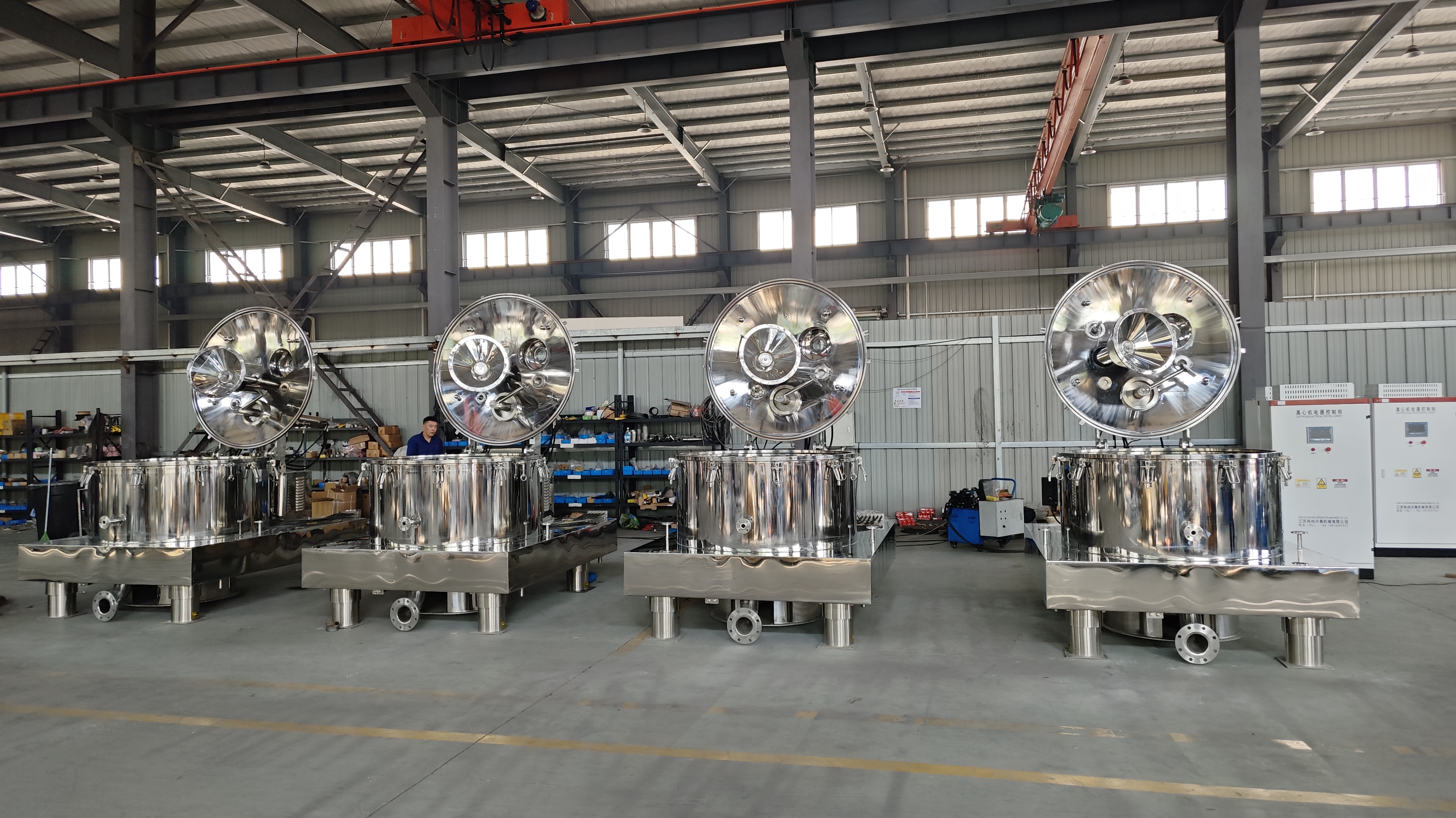
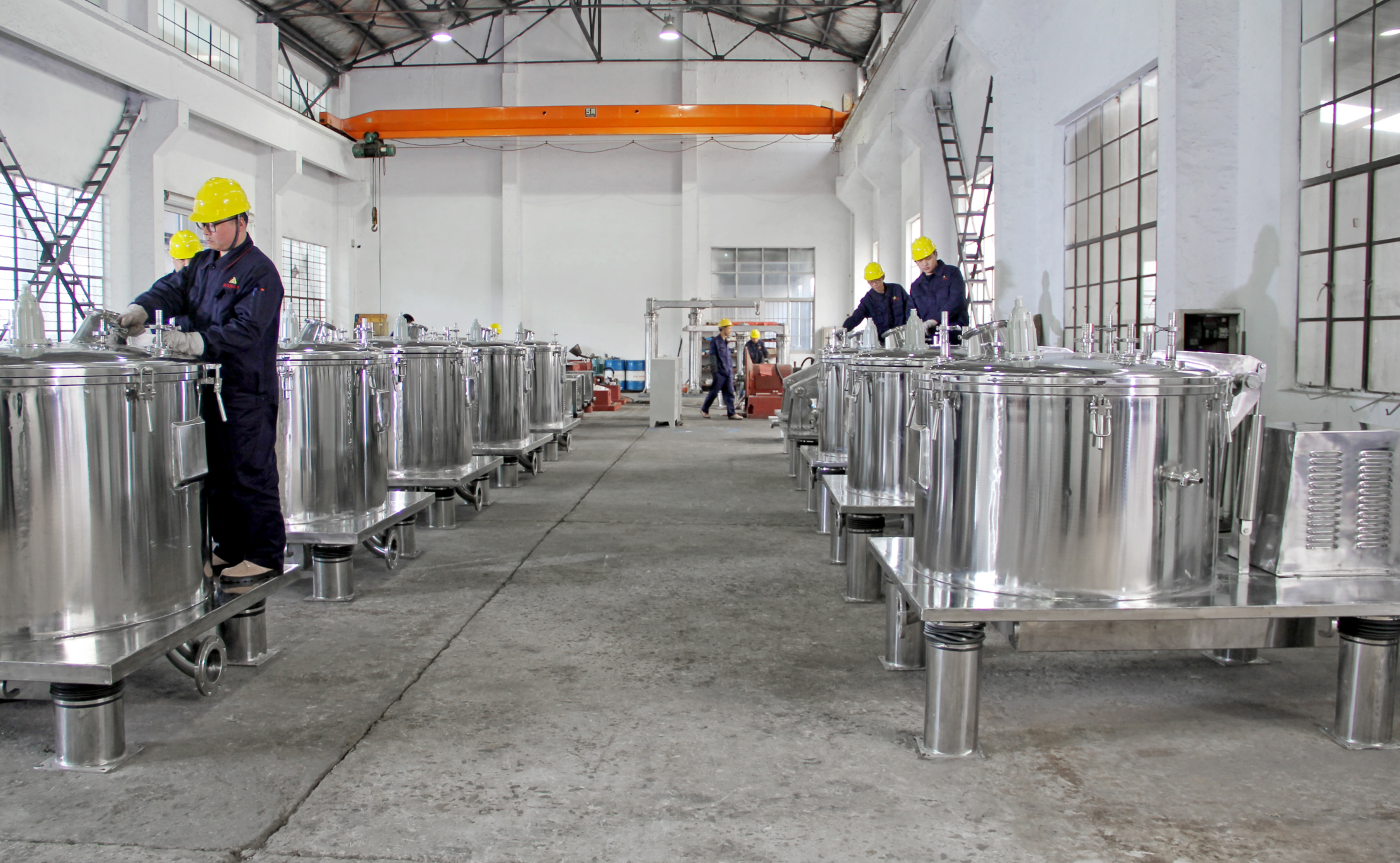
JGD Centrifuge Co., Ltd. is a centrifuge manufacturer based in Zhangjiagang, Jiangsu Province, China, founded in 2012 and operating a 4,000 m² factory with 60 employees and an annual output of roughly 100 units. About 80% of production is exported to South America, Southeast Asia, North America, the Middle East and Europe. Its range includes PLQ fully automatic bag-discharge, LGZ/PGZ fully automatic scraper bottom-discharge, PSLQ/PSFQ full-flip top-discharge and PD hanging bag-discharge basket centrifuges — the four families compared here.
There is no universal winner in this group. Each architecture moves cost, labour, product loss and cleaning effort to a different place in the batch cycle. The purpose of this article is to fix the decision criteria in the right order so that an inquiry, RFQ or tender response can be compared on equal terms.
The Real Variable: How the Cake Leaves the Basket
In a batch type basket centrifuge, feeding, washing and spinning are broadly comparable across designs. Discharge is where the machines diverge. Three discharge routes are standard in this equipment class: manual upper shoveling on a basic top-discharge machine, direct lifting of the filter bag on a hanging-bag model, and a fully automatic scraper that pushes solids out through the bottom on LGZ/PGZ-type machines.
That single design difference then drives four downstream consequences:
- Operator exposure. A manual top-discharge centrifuge must have its cover opened for discharging, and the equipment must be fully stopped before the lid is opened. The solids are then dug or lifted out by hand.
- Cycle repeatability. Automatic discharge produces a consistent batch rhythm; manual discharge ties throughput to operator availability and technique.
- Product condition. A scraper contacts the cake, a bag carries it, and a shovel cuts into it. Which of these is acceptable depends on how much breakage or fines generation the downstream process tolerates.
- Cleaning and changeover. Full-opening access, bag replacement and CIP/SIP provisions are evaluated differently by pharmaceutical and fine-chemical buyers than by a fertilizer plant running one product.
Because of this, two centrifuges with the same basket diameter can be quoted at very different prices and can still both be correct — for different plants.

Why Discharge Method Moved Up the Procurement Agenda
Filtering centrifuges are forecast to grow at around 7.2% annually, with API crystallization and specialty-chemical purification cited among the drivers (Fortune Business Insights, 2026). Growth of that kind concentrates attention on the equipment that handles the crystalline product at the end of the process — which is exactly where the discharge decision sits.
Regulatory pressure reinforces the same point. EN 12547:2014 is the current European standard for centrifuge safety requirements, excluding household and laboratory models covered by EN 61010-2-020. Machine-level safety, cover interlocks, guarding and stopping logic all interact with how the operator gains access to the basket — and operator access to the basket is precisely what differs between a manual top-discharge unit and a fully automatic bottom-discharge machine.
The supplier landscape reflects the same split. Western States Machine Company reports manufacturing vertical filtering and decanting centrifuges for the chemical, fine chemical, food and pharmaceutical industries — a description that spans both manual-access and automated-discharge concepts rather than endorsing one.
The Four Architectures Compared
PLQ1250 — Automatic Pull-Bag Basket Centrifuge
The PLQ series is described by JGD Centrifuge as a fully automatic bag-discharge centrifuge. The defining feature is that the bag-discharge action is performed by the machine rather than by an operator: the filter bag and the cake it holds are withdrawn as part of the automatic cycle, and no shovel or manual lifting step is required at the basket.
For a buyer, that combination — bag-based solids removal plus automatic actuation — is the usual answer when a plant wants to eliminate manual basket access but does not want a scraper blade in contact with the product. It is the architecture to examine first when the solid is a crystalline chemical intermediate, a resin, or a food additive where the filter medium is changed between campaigns.
PGZ1000 — Vertical Bottom-Discharge Peeler (Scraper)
The PGZ series belongs to the LGZ/PGZ family of fully automatic scraper bottom-discharge centrifuges. The cake is scraped from the basket and leaves downward through the bottom of the machine, so the process area stays closed during discharge.
This is the most automated of the four and the one that best supports sealed and explosion-proof configurations. In JGD Centrifuge guidance, when solid capacity is high and the equipment must be sealed and explosion-proof, the bottom-discharge scraper machine is the recommended route. The trade-off is mechanical: the scraper works against the cake, which is a material-handling consideration for fragile crystals rather than a defect of the design.
PSLQ800 — Full-Opening Manual Top Discharge
The PSLQ series is a full-flip top-discharge centrifuge. The cover opens fully, giving direct access to the basket, and discharge follows the classic manual route: the machine is fully stopped, the lid is opened, and the solid is dug or lifted out.
It is the simplest and most transparent of the four. Nothing about the discharge is hidden from the operator or the auditor, and full opening makes inspection and manual cleaning straightforward. The cost is batch labour and operator exposure, and the design is therefore most defensible where batch counts are low, products change frequently, and the solid is not hazardous to handle in an open basket.
PD1250 — Top-Discharge Bag-Lifting Centrifuge
The PD series is a hanging bag-discharge centrifuge. Discharge is by direct lifting of the filter bag, so the solids leave the basket inside the bag instead of being scraped or shoveled out.
The practical appeal of this design is that the cake is recovered as a coherent mass carried by the medium that filtered it. Where the buyer wants to keep the crystal bed intact through discharge — or wants the option to inspect and clean by bag replacement rather than by basket washing — this is the variant to discuss with the supplier. Automation level on the PD1250 should be confirmed in writing against the PLQ, because JGD Centrifuge describes the PLQ series explicitly as fully automatic and the PD series as hanging bag-discharge.
Decision Criteria, in the Order Buyers Should Apply Them
- Discharge method and operator exposure. Decide first whether an operator may open the basket during a campaign. If the answer is no, the manual top-discharge option is disqualified regardless of price.
- Crystal abrasion control. The separation factor is the reference figure here: for crystalline materials it is generally 800–1200, and for fragile materials it should not be pushed too high, because breakage reduces yield and creates fines that complicate downstream filtration. Discharge mechanics add a second abrasion path — scraper contact differs from bag-carried removal.
- Cleaning and cGMP. JGD Centrifuge provides customization for FDA, GMP and cGMP requirements and for aseptic CIP and SIP applications. Which of the four architectures can be cleaned to the required standard depends on access: full-opening manual designs expose the basket, bag designs allow medium change, and automated designs rely on CIP circuits.
- Batch automation. Fully automatic discharge converts labour into capital. Manual top discharge converts capital into labour. Compare the two on batches per shift, not on unit price.
- Material of construction. SS304 for normal working conditions, SS316L for moderate corrosion, and Hastelloy or PTFE lining for strong corrosion. Ordinary SS304 should not be used for materials containing chloride ions. Where a tender specifies titanium wetted parts, treat it as a separately quoted option and require the material certificate against the specific model.
- Mechanical sizing and loading limits. Confirm drum diameter, drum volume, loading limit, rotation speed, separation factor, motor power and filter media type, plus the material properties — corrosiveness, explosion-proof requirement, temperature and solid content. Two machines with the same drum diameter can have different loading capacities because the effective basket depth and the rated loading limit differ; overloading causes violent vibration and is a safety hazard, not a throughput option.
Vibration is the most common operating complaint, and it is usually a feed problem. Violent vibration during operation is typically caused by uneven solid concentration and lumps in the feed, or by a filter medium that is too coarse. The response is to stop the machine for inspection, then ensure the solid concentration is uniform and free of lumps before feeding, and to select the appropriate mesh size for the filter cloth.
Comparison Table
| Model | Discharge method | Automation | Cake and crystal handling | Cleaning and access | Typical fit |
|---|---|---|---|---|---|
| PLQ1250 automatic pull-bag basket centrifuge | Bag discharge, machine-actuated | Fully automatic | Solids leave with the bag; no scraper contact | Medium change between campaigns | Chemical intermediates, resins, food additives |
| PGZ1000 vertical bottom-discharge peeler | Scraper, bottom discharge | Fully automatic | Scraper contacts the cake; suited to higher solid capacity | Closed discharge; CIP customization available | High-capacity batches requiring sealed or explosion-proof execution |
| PSLQ800 full-opening manual top discharge | Manual shoveling after opening the cover | Manual discharge | Direct tool contact; operator judgment on removal | Full-flip opening; easiest inspection | Low batch counts, frequent product changes, non-hazardous solids |
| PD1250 top-discharge bag-lifting centrifuge | Direct lifting of the filter bag | Confirm against PLQ series | Cake recovered as a coherent mass with the bag | Bag replacement plus basket access from the top | Fragile or high-value crystals, campaign-based production |
Capacity and motor figures are deliberately absent from this table. Published per-model capacity, speed and power data for PLQ1250, PGZ1000, PSLQ800 and PD1250 were not available in the source material used for this article, and quoting them would be guesswork. The only verified numeric reference point in this comparison is the LGZ1250 installation described below.
Where Each Architecture Fits
Salt and fertilizer. Batch basket centrifuges are suited to solid-liquid separation of granular and crystalline solids such as salt crystals. At this duty the arithmetic is simple: high tonnage and a stable product favour automated discharge, because manual shoveling cannot keep pace with the batch rhythm.
Chemical intermediates and resins. Chemical intermediates and resins are explicitly within the application scope of batch basket centrifuges. Here the corrosive duty decides the material, and the material often decides the architecture: strong corrosion pushes toward Hastelloy or PTFE lining, which is worth fixing before the discharge method is negotiated.
Pharmaceutical API crystallization. cGMP expectations, CIP and SIP provisions and 316L construction are the usual requirements. Full-opening manual designs give the best visual access for qualification; automatic designs give the better operator-exposure story. Both arguments have to be made against the same validation protocol.
Lithium carbonate and similar crystalline products. A Chilean chemical plant has run four LGZ1250 basket centrifuges for solid-liquid separation of lithium carbonate for ten years, reporting excellent separation effect that meets production capacity requirements while saving labour costs, with stable running and low noise. The duty uses SS2205 duplex stainless steel for a weakly alkaline system containing soluble chlorides, solid content of 10–30%, a drum maximum speed of 1200 rpm, a 30 kW main motor and a separation factor of 1008. This is bottom-discharge scraper technology rather than one of the four models above, but it is the clearest available evidence of what a correctly sized automatic batch centrifuge looks like in a corrosive crystalline duty.
Before You Issue the RFQ
- State the discharge route as a requirement, not a preference: manual, bag-lifting, pull-bag or scraper.
- Give the solid content range and confirm that the feed can be kept uniform and lump-free.
- Name the corrosives and the chloride exposure, so the material grade can be fixed at SS304, SS316L, Hastelloy or PTFE lining.
- State whether the area is explosion-proof, and whether sealed execution is mandatory.
- Ask separately for CIP and SIP scope if the product is pharmaceutical.
- Request the conformity documentation and confirm that the certificate scope names the exact model being quoted.
- Ask for the no-load test record and the acceptance criteria in writing.
FAQ
Which safety and compliance standards should a chemical-industry centrifuge meet?
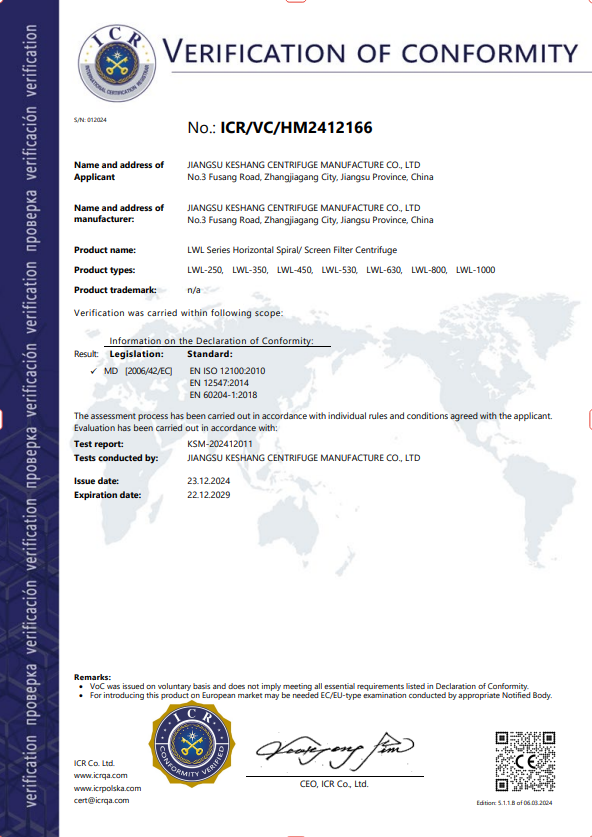
EN 12547:2014 is the current European standard for centrifuge safety requirements, excluding household and laboratory models covered by EN 61010-2-020. JGD Centrifuge holds a Verification of Conformity (CE) issued by ICR Co., Ltd. under certificate ICR/VC/HM24166, valid from 23 December 2024 to 22 December 2029, assessed under Legislation MD 2006/42/EC against EN ISO 12100:2010, EN 12547:2014 and EN 60204-1:2018. That certificate covers the LWL Series Horizontal Spiral / Screen Filter Centrifuge, models LWL-250 to LWL-1000, not the basket models discussed in this article. For PLQ, PGZ, PSLQ or PD models, request the applicable documentation and check that the certificate scope names the exact model. JGD Centrifuge also states that it can supply CE and CO, and will do its best to provide other certificates if requested.
Can an OEM industrial centrifuge be customized for a specific chemical process?
Yes. JGD Centrifuge operates in ODM mode and customizes voltage, electrical component brands — PLC and touch screen, frequency converter and motor — and bearings. Beyond electrical scope, the company provides customization for FDA, GMP and cGMP certification requirements, aseptic CIP and SIP applications, on-site explosion-proof protection, concentration and pretreatment of materials, and automated and intelligent operation of equipment. A six-engineer R&D team handles this work, with a monthly capacity of eight units.
What drives the cost of an OEM batch centrifuge, and can I get a price list?
No public price list is available for these models, and a like-for-like figure cannot be produced before the specification is fixed. The variables that move the quotation are the ones set in this comparison: material of construction (SS304, SS316L, Hastelloy or PTFE lining), discharge architecture, automation level and instrumentation, electrical component brands, and whether explosion-proof or sealed execution is required. The minimum order quantity is one unit, so a single machine can be quoted without a volume commitment.
Can a single unit be ordered to validate the design before a full line order?
The minimum order quantity is one unit, so a single machine can serve as the validation step for a larger project. Every unit is no-load tested before delivery, and the test record is the natural acceptance document to request with the order. After-sales support is provided remotely. Where a plant needs to prove separation performance on its own material, agree the performance criteria and the sampling method in the purchase order rather than leaving them implicit.
What is the lead time for an OEM industrial centrifuge order?
Lead time is 30–60 days, against a monthly production capacity of eight units. Lead time should be confirmed against the final specification, because non-standard materials and additional automation scope sit outside the base configuration. To move from comparison to a quotation, send the process duty, discharge requirement, material grade and compliance scope to sales@jgdcentrifuge.com or WhatsApp +86 159-9546-3675, and the company can respond against a fixed specification rather than a generic model.
Conclusion
The pull-bag, peeler, manual top-discharge and bag-lifting designs are not four quality tiers of one machine. They are four answers to the question of who removes the cake and how. The PLQ1250 removes it with an automatic bag action, the PGZ1000 scrapes it out through the bottom inside a closed machine, the PSLQ800 gives it to an operator through a fully opened cover, and the PD1250 lifts it out inside the filter bag.
The selection sequence is therefore narrow and testable: decide the permissible operator exposure first, then the acceptable mechanical action on the crystal, then the cleaning and material requirements that follow from the chemistry. Any supplier that quotes before those three answers are on the table is quoting a machine that has not been specified yet.
Next Step
JGD Centrifuge Co., Ltd. — Zhangjiagang, Jiangsu, China. Founded 2012 · 4,000 m² factory · 60 employees · ~100 units per year · ~80% exported to South America, Southeast Asia, North America, the Middle East and Europe.
Send your duty, discharge requirement and material grade for a specification-matched quotation and inquiry: sales@jgdcentrifuge.com · Tel / WhatsApp +86 159-9546-3675 · www.jgdcentrifuge.com
Download the full product catalogue and technical brochure: JGD Centrifuge brochure (PDF)
Have Questions or Need More Details?
Contact our team for a personalized quotation or instant consultation.
Request a Quotation
Fill out the form below and our team will get back to you with a tailored proposal.
WhatsApp Direct Chat
Prefer to chat in real-time? Message us on WhatsApp for instant assistance & quick answers.
- Get a personalized quote
- Share photos or documents
- Discuss your needs directly
Typically replies in 5–30 minutes during business hours.