
Pusher Type Industrial Centrifuge: Specification, Material and Compliance Constraints Before You Buy
A pusher type industrial centrifuge is a horizontal filtering centrifuge in which the solids retained on a screen are moved along the basket by a reciprocating piston-driven pusher rather than by a scraper blade, so the filter cake is discharged while the machine keeps running. For a buyer in the research-to-evaluation stage, the hard part is not deciding to buy a pusher centrifuge. It is fixing the constraint set — wetted material grade, separation factor, single or double stage, motor and hazardous-area specification, certificate scope, MOQ and lead time — before two quotations can be compared like for like.
This guide works through those constraints using the published product, certification and capability data of JGD Centrifuge, a centrifuge manufacturer based in Zhangjiagang, Jiangsu Province, China, founded in 2012 and operating a 4,000 m² factory with 60 employees and an annual output of 100 units. The material that follows is limited to what the manufacturer publishes about its HR series pusher models and the wider range; where a figure is not published, that is stated rather than estimated.
Problem Definition: Where Pusher Centrifuge Specifications Usually Go Wrong
Pusher centrifuge projects rarely fail at the point of choosing a technology. They stall because a constraint was written as a preference. Three failures recur.
- Material grade chosen by habit. Stainless steel 304 is treated as a default, then the process liquor turns out to carry chloride ions, and the wetted parts become a corrosion question rather than a purchasing detail. Published selection guidance is explicit here: SS304 for normal working conditions, SS316L for moderate corrosion, Hastelloy or PTFE lining for strong corrosion, and ordinary SS304 should not be used for chloride-bearing material.
- Separation factor discussed as a preference. Separation factor (Fr) is the numeric expression of centrifugal separation capability, and each model has a rated value. A requirement above a model's rating cannot be engineered by negotiation; it changes the model.
- "CE" requested as a word rather than a document. Conformity verification is issued against a defined model scope under a defined directive. If the certificate scope does not name the model being ordered, the requirement has not been met, even if the manufacturer holds a CE certificate for a different series.
Each of these is a constraint that can be settled in the RFQ. None of them can be settled after the purchase order.
Industry Background: Why the Constraint Detail Matters Now
Filtering centrifuges — the family that includes pusher, peeler and scraper-discharge machines — are a growing segment of the industrial centrifuge market, with Fortune Business Insights forecasting 7.2% annual growth for filtering variants, attributed to API crystallization and specialty-chemical purification (SRC-0001, commercial research). Growth in exactly those applications pushes specifications toward two things buyers did not always ask for: documented material grades for corrosive and hygienic duty, and a certificate that names the model.
On the compliance side, EN 12547:2014 is the current European standard covering centrifuge safety requirements, and it excludes household and laboratory models addressed under EN 61010-2-020 (SRC-0002, primary source). That distinction matters because it tells you which standard a tender should reference for a production-scale pusher machine.
On classification, centrifuges including centrifugal dryers sit under HS heading 8421 (UNSD), with HS 842111 covering centrifuges and cream separators. A practical consequence for procurement: unfiltered HS 8421 trade data cannot be used as a proxy for industrial centrifuge trade, because the heading also contains filtering and purifying machinery for liquids and gases.
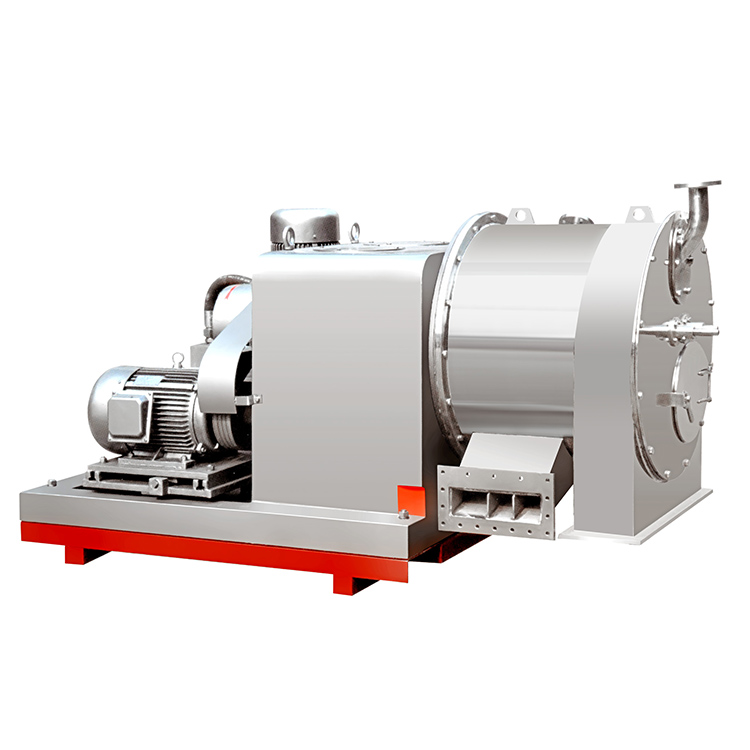
Detailed Solution: The Six Constraint Groups That Decide a Pusher Centrifuge Order
1. Wetted material grade
JGD Centrifuge pusher models are offered across a published material set: SS304, SS321, SS316L, SS2205, SS904L, titanium and Hastelloy-C alloy. The same set appears across the wider basket, decanter and screen-discharge range, which means the grade decision is made once, against the process chemistry, and then applied consistently to the order.
The decision rule published for corrosive materials is a four-step scale: SS304 for normal working conditions; SS316L for moderate corrosion; Hastelloy or PTFE lining for strong corrosion; and ordinary SS304 avoided where the material contains chloride ions. Titanium and Hastelloy-C alloy are listed specifically as options for corrosive media.
The clearest published example of this rule in practice is a brine-based project in Chile, where the process liquor was a weakly alkaline system containing soluble Na⁺, SO₄²⁻ and Cl⁻ salts with defined corrosive behaviour, and the equipment specification called for SS2205 duplex stainless steel rather than a standard 300-series grade. That is the level of chemistry detail a pusher centrifuge RFQ should carry.
2. Separation factor and stage count
Separation factor expresses centrifugal separation capability: the higher the value, the stronger the capability. General published guidance places crystalline materials in the 800–1200 range, advises a higher value for fine particulate material, and warns that for fragile materials the value should not be too high, to prevent particle breakage. That guidance is a starting reference, not a substitute for the rated figure of the model in front of you.
The two pusher models in the range sit at different points:
- HR400 — horizontal double stage pusher. Drum diameter 337/400 mm, filter length 145/155 mm, drum speed 1600 rpm, maximum separation factor (Fr) 545/645, explosion-proof main motor rated at 11 kW. The two-stage stepped dewatering design is intended to produce a drier filter cake with more thorough washing; the manufacturer states that axial material-pushing resistance is halved and processing capacity increased, and that the two-stage arrangement extends the workable particle-size range to finer particles.
- HY1200 — horizontal single stage pusher. Drum diameter 1200 mm, filter length 500 mm, drum speed 500 rpm, maximum separation factor (Fr) 170, maximum loading limit 130 kg, explosion-proof main motor rated at 30 kW. The design is built around single-unit capacity in uninterrupted operation, with piston-based pushing and discharging (no scraping or cutting wear), high-efficiency penetrating wash for product purity, and a filter cake dry enough to reduce the energy load on downstream drying. Drive is hydraulic.
Reading these two rows together is the constraint exercise: the model with the higher separation factor is not automatically the right one, and the model with the larger drum is not automatically the higher-capacity answer. Stage count, filter length and the material's particle-size distribution decide which of the two fits.
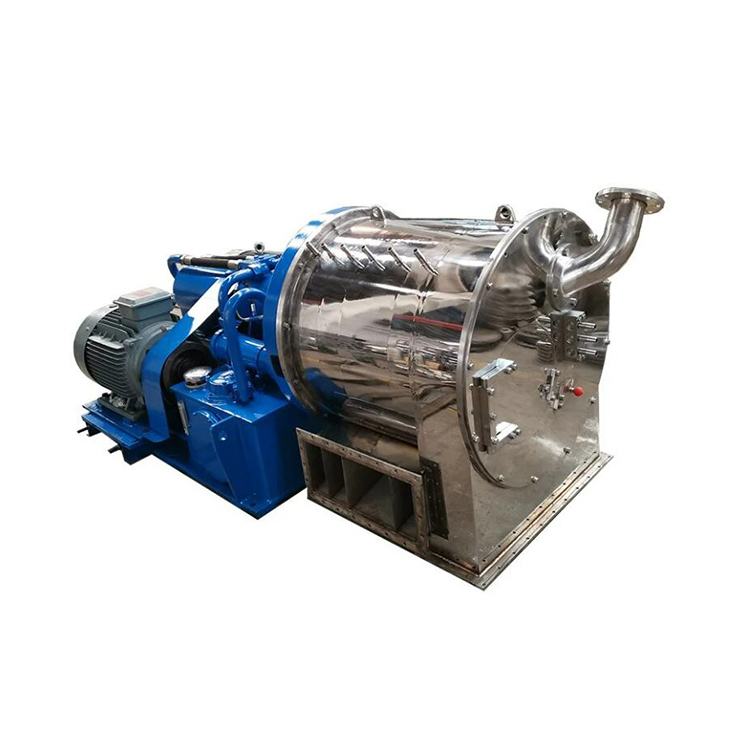
3. Continuous versus batch discharge
Pusher machines are continuous: the HR400 and HY1200 are both described as fully continuous in operation, with no scraping contact against the cake on the HY1200 and no mechanical abrasion from a blade on the HR400. Continuous discharge changes what the rest of the plant has to do — buffer tanks, feed consistency and downstream drying all see a steady stream instead of a cycle.
Batch basket centrifuges remain the alternative where the process cannot be run continuously. In the same range, the LGZ1250 vertical bottom discharge scraper centrifuge runs a 1250 mm drum with 400 L volume, 530 kg maximum loading, 1000 rpm, maximum Fr 700 and a 22 kW explosion-proof motor; the PGZ1000 runs a 1000 mm drum, 175 L volume, 235 kg loading, 1000 rpm, Fr 560 and an 11 kW explosion-proof motor, with a flat plate damping structure that does not require a foundation. Discharge on these models is by automatic scraper at the bottom; manual top-discharge models require the machine to be fully stopped before the lid is opened.
Published discharge guidance for batch basket machines is worth keeping in the evaluation file: basic models discharge by manual top shovelling, bag-lifting models discharge by lifting the filter bag directly, and LGZ/PGZ models discharge by fully automatic scraper at the bottom.
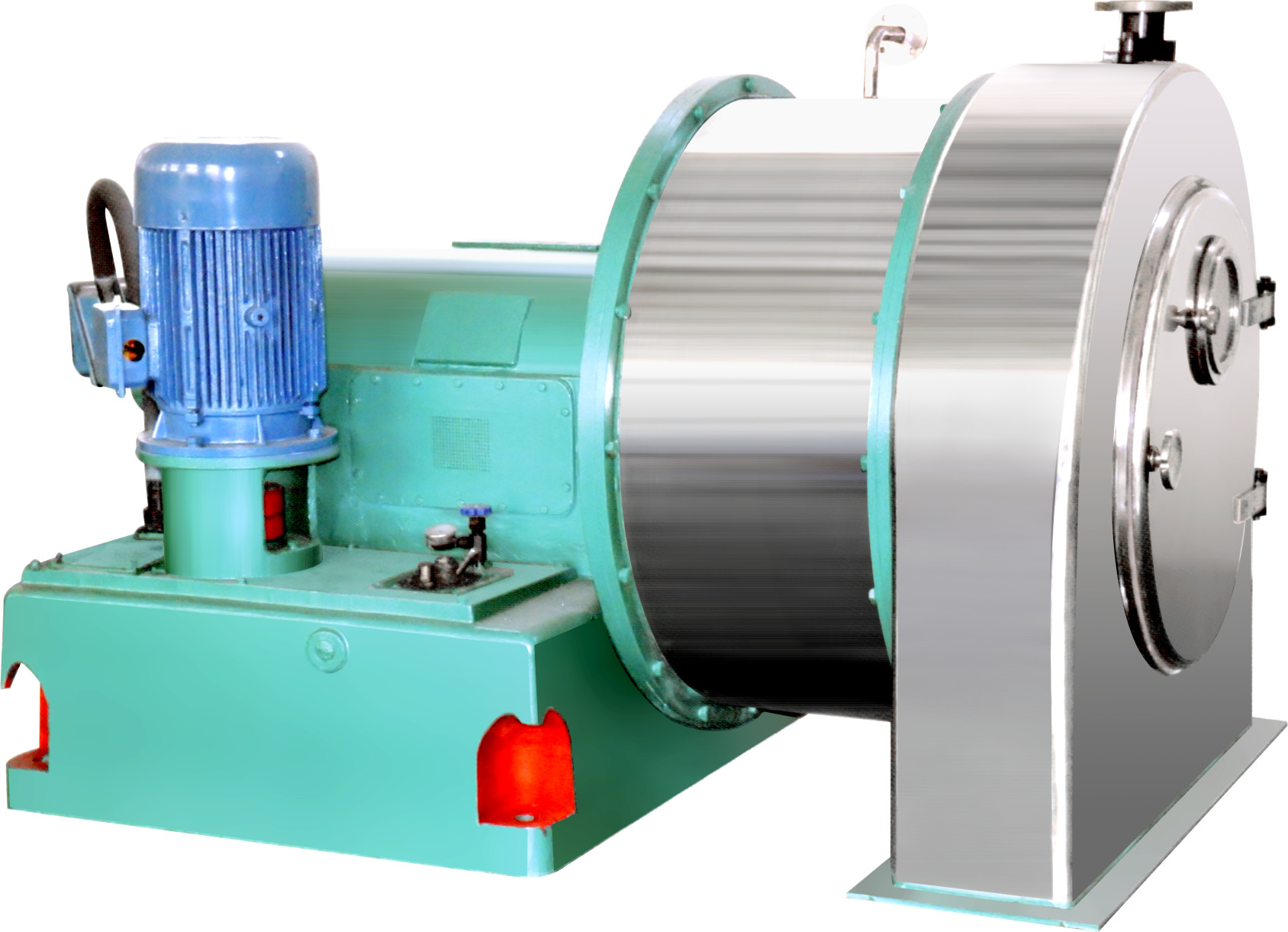
4. Motor, enclosure and hazardous-area specification
Every pusher model in the range is specified with an explosion-proof main motor as standard in the published data: 11 kW on the HR400 and 30 kW on the HY1200. The same pattern holds across the basket range — 22 kW on the LGZ1250, 37 kW on the GK1000, 11 kW on the PGZ1000, 30 kW on the large single-stage unit, 5.5 kW on the PSLQ800, 3 kW on the PSB600 — and several models add a fully enclosed or sealed explosion-proof design, for example the PSB600's fully enclosed explosion-proof construction and the PGZ1000's sealed and explosion-proof safety design.
5. Certification scope — read the certificate, not the logo
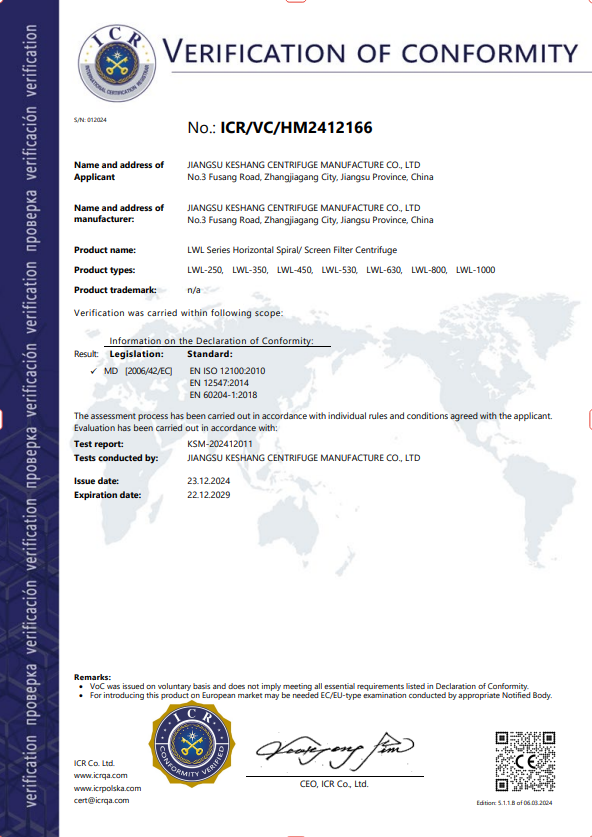
The Verification of Conformity held for JGD Centrifuge's LWL Series is a useful case study in why scope must be checked. It is numbered ICR/VC/HM2412166, issued by ICR Co., Ltd. for the EC/EU market, assessed under Machinery Directive MD 2006/42/EC against EN ISO 12100:2010, EN 12547:2014 and EN 60204-1:2018, issued on 23 December 2024 and valid until 22 December 2029.
Its scope is horizontal spiral and screen filter centrifuges, model LWL-250, LWL-350, LWL-450, LWL-530, LWL-630, LWL-800 and LWL-1000. On its face, that scope covers the LWL Series — the LWL450 scroll discharge screen centrifuge among them — and it does not name the HR400 or HY1200 pusher models. A buyer requiring CE conformity for a pusher machine therefore has a specific question to put in writing: which certificate covers the model I am ordering, under which directive, and against which standards. Where the answer is that a pusher model falls outside an existing scope, that is a constraint to resolve before order, not a detail to settle at delivery.
6. Manufacturing and supply constraints
The commercial constraints published for JGD Centrifuge are specific and short enough to plan around: minimum order quantity 1 unit, monthly capacity 8 units, lead time 30–60 days, production mode ODM, and no-load testing of the machine before delivery. Customisation is available on voltage, electrical component brands (PLC and touch screen, frequency converter, motor) and bearings — which is the point at which a buyer's plant standard, rather than the manufacturer's catalogue, governs the specification.
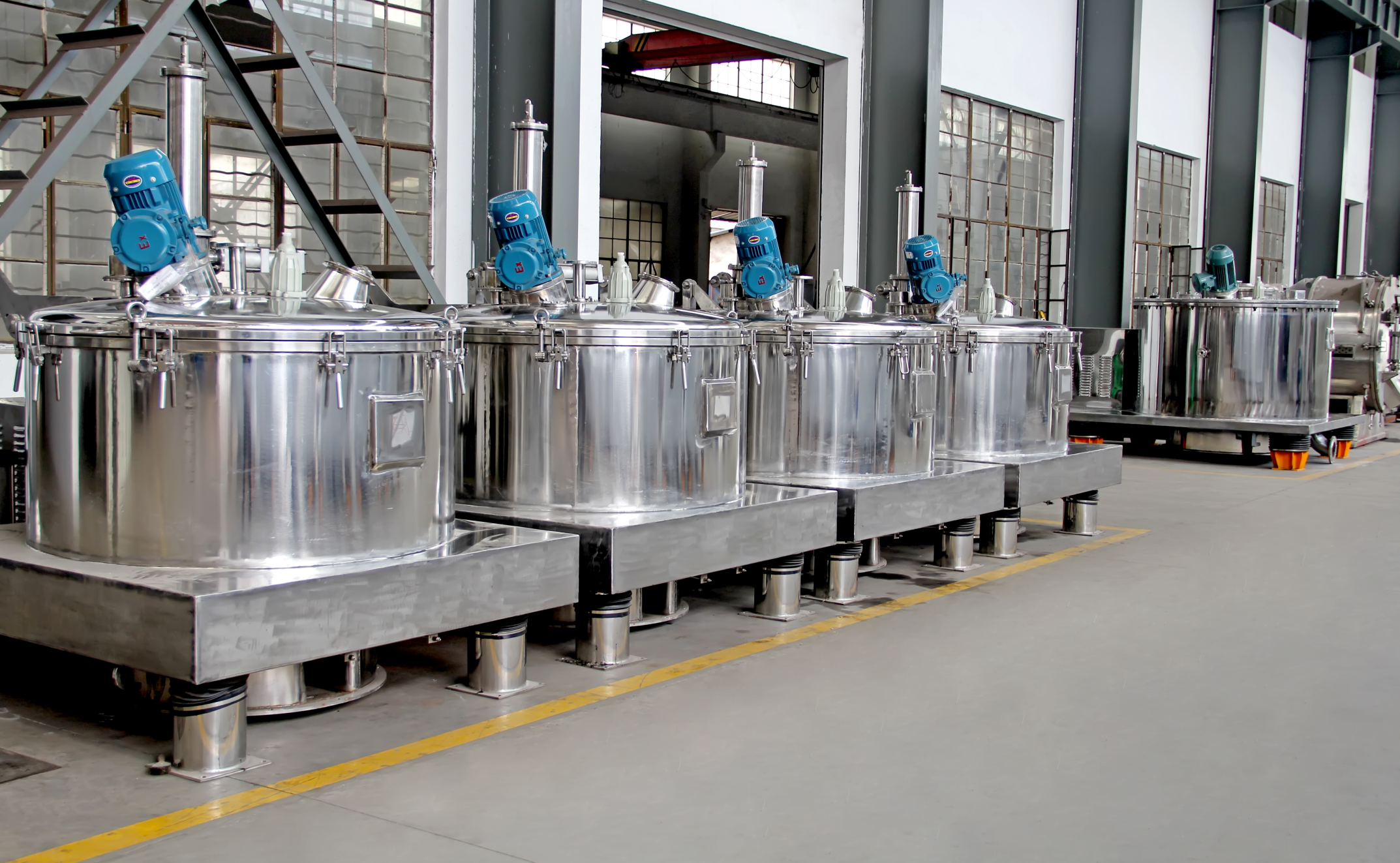
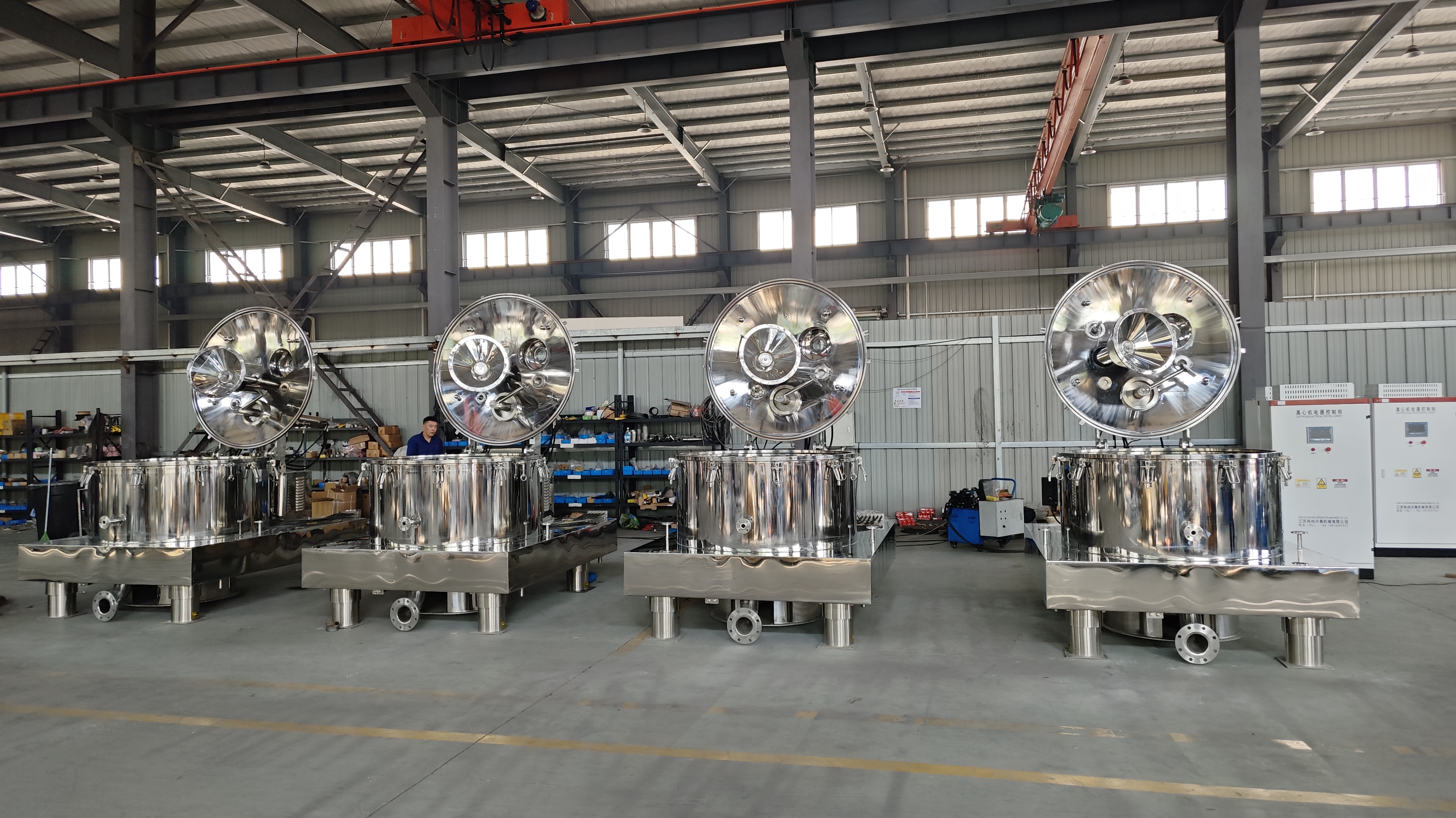
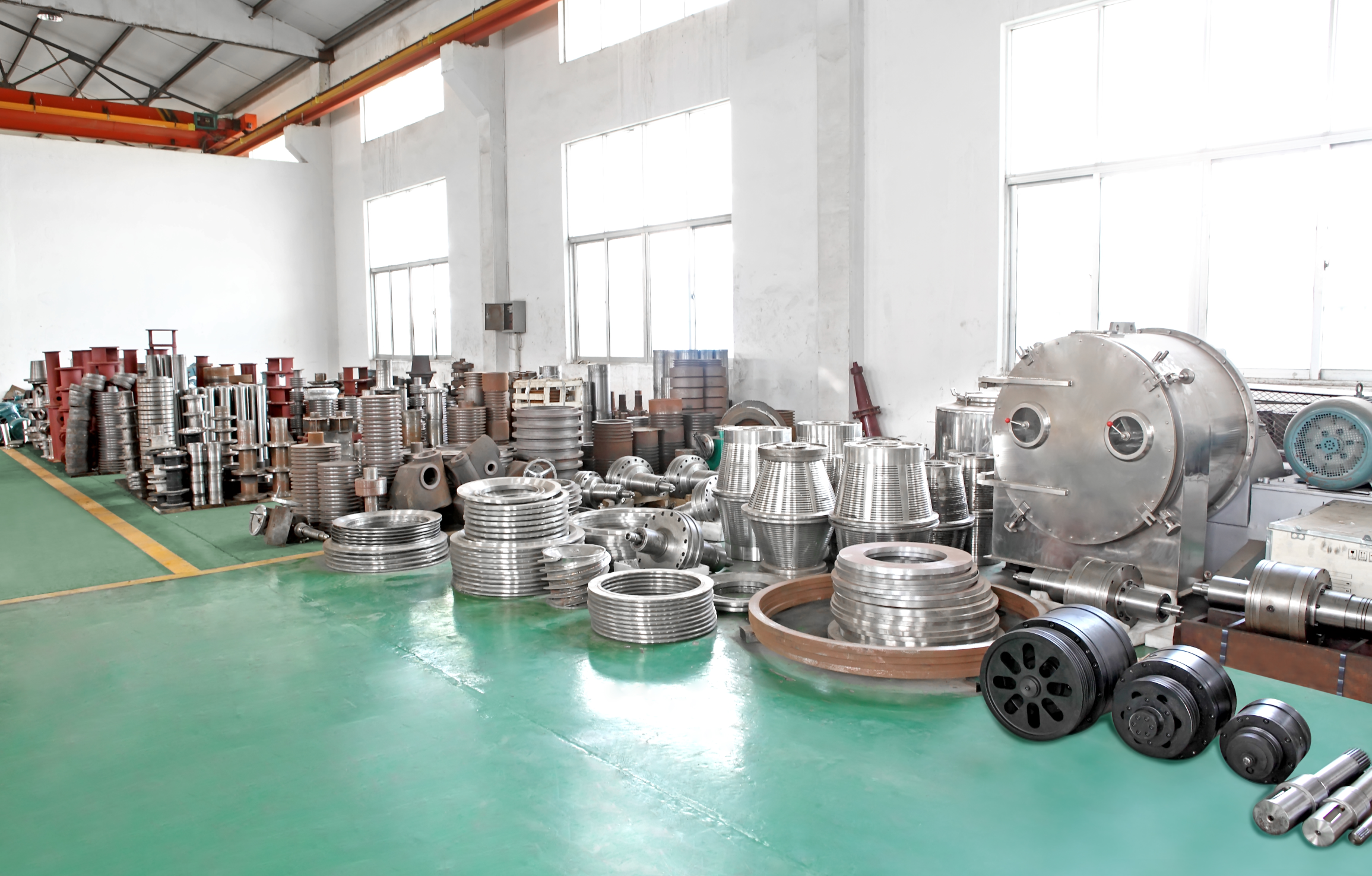
Production is concentrated in a 4,000 m² facility with 60 employees, 6 engineers and an annual output of 100 units, with roughly 80% of output exported to South America, Southeast Asia, North America, the Middle East and Europe. After-sales support is delivered remotely.
Step-by-Step Breakdown: Building the RFQ
- Write the chemistry down, including ions. Grade, temperature, chloride and sulphate content, pH direction — weakly alkaline brine with Na⁺, SO₄²⁻ and Cl⁻ is what drove SS2205 in the Chilean project. Corrosiveness, explosion-proof requirement, temperature and solids content are the four material properties to confirm first.
- State the solids: particle size and fragility. Fragile crystals argue for a low-abrasion discharge and a separation factor that is not pushed higher than necessary; finer particles argue for the two-stage stepping of the HR400.
- Decide continuous or batch, explicitly. Continuous if the plant can feed steadily and wants a steady cake stream; batch if the process cycles, the batch is small, or a basket machine with a defined discharge path is the established practice.
- Fix the required separation factor against a rated value. Compare the required figure with 545/645 (HR400) or 170 (HY1200), and with the batch alternatives at 700 (LGZ1250), 560 (PGZ1000) and 1020 (GK1000). Confirm drum diameter, drum volume, loading limit, speed, motor power and filter media type in the same pass.
- Specify the wetted material grade and name the standard. Do not write "stainless steel". Write SS316L, SS2205, SS904L, titanium or Hastelloy-C, and say why.
- Separate motor specification from hazardous-area certification. Explosion-proof motor: yes, stated. Machine-level certificate for the zone: request the document reference.
- Verify certificate scope against the exact model number. Certificate number, issuing body, directive, standards, validity dates, and the model list inside the scope.
- Confirm the commercial frame. MOQ 1 unit, lead time 30–60 days, monthly capacity 8 units, electrical component brands and bearings to plant standard, and no-load test before delivery as the pre-shipment verification step.
Use Cases: Where Pusher Types Fit
Chloride-bearing chemical liquors
Where the liquor carries chloride, the material constraint leads the specification and the machine follows. SS316L is the published choice for moderate corrosion and Hastelloy-C alloy or titanium for corrosive media; ordinary SS304 is not the right starting point. For a continuous chemical duty with a need for washing efficiency and dry cake, the pusher configuration keeps discharge non-abrasive while the wetted grade does the corrosion work.
Pharmaceutical and API crystallization
Published application coverage for the pusher and basket range includes fine chemical, pharmaceutical, API and food duty. In hygienic duty the decisive constraints shift to construction detail: SS316L contact parts, cGMP sanitary construction, cGMP/CIP compatibility and no dead corners — as specified on the PSLQ800 — and a fully openable lid intended to support cGMP cleaning, as specified on the PLQ1250, whose pull-bag discharge is designed to avoid scraping the cake and to limit crystal abrasion.
Salt, fertilizer and granular crystals
Granular and crystalline solids are the natural territory of pusher and basket filtering machines. Published guidance for batch basket centrifuges lists salt crystals, chemical intermediates, resins, food additives and plant extracts among suitable materials, and the pusher models add continuous operation with penetrating wash, which is the relevant capability when crystal purity depends on displacing mother liquor. What the available data does not contain is salt- or fertilizer-specific throughput figures, so capacity for a specific salt duty has to come from a quotation against your own particle-size distribution rather than from a published table.
Lithium carbonate and new-energy materials
A documented reference project: four LGZ1250 centrifuges supplied to a chemical plant in Chile for solid–liquid separation of lithium carbonate from brine, running for ten years, with the reported outcome being separation performance that met production capacity requirements along with reduced labour cost, and stable, low-noise running. The specification detail from that project is the transferable part — SS2205 duplex stainless steel for a weakly alkaline chloride-bearing system, CIP online cleaning, and a drum speed of 1200 rpm with a 30 kW main motor and a separation factor of 1008. It is a batch scraper installation, not a pusher one, and it is included here precisely because it shows where the batch route is chosen over the continuous route.
Comparison Table: Pusher and Batch Alternatives in the JGD Centrifuge Range
| Model | Type | Discharge method | Drum diameter | Filter length / drum volume | Max loading | Drum speed | Max Fr | Main motor |
|---|---|---|---|---|---|---|---|---|
| HR400 | Horizontal double stage pusher | Piston pusher, continuous | 337/400 mm | 145/155 mm | Not published | 1600 rpm | 545/645 | 11 kW, explosion-proof |
| HY1200 | Horizontal single stage pusher | Piston pusher, continuous | 1200 mm | 500 mm | 130 kg | 500 rpm | 170 | 30 kW, explosion-proof |
| GK1000 | Horizontal peeler | Automatic scraper | 1000 mm | 165 L | 225 kg | 1350 rpm | 1020 | 37 kW, explosion-proof |
| LGZ1250 | Vertical bottom discharge scraper | Automatic scraper, bottom | 1250 mm | 400 L | 530 kg | 1000 rpm | 700 | 22 kW, explosion-proof |
| PGZ1000 | Vertical bottom discharge peeler | Peeler/scraper, bottom | 1000 mm | 175 L | 235 kg | 1000 rpm | 560 | 11 kW, explosion-proof |
All five models share the published material options SS304, SS321, SS316L, SS2205, SS904L, titanium and Hastelloy-C alloy, and all five are specified with explosion-proof main motors. The differentiation that matters at evaluation stage is discharge logic, drum geometry and rated separation factor — not the material list, which is common across the range.
| Certificate | Issuer | Scope | Directive / standards | Validity |
|---|---|---|---|---|
| Verification of Conformity ICR/VC/HM2412166 (CE) | ICR Co., Ltd. | LWL Series horizontal spiral / screen filter centrifuge: LWL-250, LWL-350, LWL-450, LWL-530, LWL-630, LWL-800, LWL-1000 | MD 2006/42/EC; EN ISO 12100:2010, EN 12547:2014, EN 60204-1:2018 | Issued 23 December 2024; valid to 22 December 2029 |
Read the scope column carefully: the certificate is written against named LWL models. A pusher model number is not on that list, which is exactly the check described in constraint group 5.
Frequently Asked Questions
Do JGD Centrifuge pusher type industrial centrifuges carry CE and ATEX compliance?
CE conformity and ATEX certification are two different documents, and the answer differs for each. For CE, the Verification of Conformity on file is No. ICR/VC/HM2412166, issued by ICR Co., Ltd., assessed under Machinery Directive MD 2006/42/EC against EN ISO 12100:2010, EN 12547:2014 and EN 60204-1:2018, valid from 23 December 2024 to 22 December 2029 — and its named scope is the LWL Series, models LWL-250 to LWL-1000, not the HR400 or HY1200 pusher models. For ATEX, no ATEX certificate for the pusher models appears in the available published data, although both pusher models are specified with explosion-proof main motors (11 kW on the HR400, 30 kW on the HY1200). A buyer who needs CE or ATEX for a pusher machine should request, in writing, the certificate that names the exact model, the directive or regulation it is issued under, and the marking that will appear on the delivered unit.
What is the practical difference between the HR400 and the HY1200 if both are pusher type industrial centrifuges?
The HR400 is a horizontal double stage pusher centrifuge: 337/400 mm drum diameter, 145/155 mm filter length, 1600 rpm, maximum separation factor 545/645, 11 kW explosion-proof motor. The two-stage stepped design is aimed at drier cake and more thorough washing, with the manufacturer stating that axial pushing resistance is halved and capacity increased, and that the workable particle-size range extends to finer particles. The HY1200 is a horizontal single stage pusher centrifuge: 1200 mm drum diameter, 500 mm filter length, 130 kg maximum loading, 500 rpm, maximum separation factor 170, 30 kW explosion-proof motor, hydraulic drive. It is built around single-unit capacity in uninterrupted operation, with piston-based pushing, no scraping or cutting wear, high-efficiency penetrating wash and high cake dryness that reduces downstream drying load. Choose by particle size, required cake dryness and required throughput — not by drum size alone.
What drives the cost of a pusher centrifuge order?
No price band is published for the pusher models, so any figure would need to come from a quotation. What can be identified in advance are the specification choices that move an order up or down: the wetted material grade, which ranges across SS304, SS321, SS316L, SS2205, SS904L, titanium and Hastelloy-C alloy and where the higher alloys are specified for corrosive media; the explosion-proof motor rating, 11 kW on the HR400 against 30 kW on the HY1200; single versus double stage configuration; and the electrical component and bearing brands, since voltage, PLC and touch screen, frequency converter, motor and bearings are all listed as customisable. Because the minimum order quantity is 1 unit, a single machine can be quoted against your own specification rather than a fixed catalogue build.
Can we validate our material before placing an order?
The published pre-delivery verification is a no-load test of the machine before shipment, and the minimum order quantity is 1 unit — there is no separate pilot-scale sample programme documented in the available data. For a material that carries real risk, the practical route is to put the validation scope into the RFQ rather than assume it: send the solids content, particle-size distribution, temperature, pH behaviour and chloride/sulphate content, ask which model and which wetted grade those conditions point to, and ask what bench or site verification the supplier will commit to in writing before the order is confirmed. Where a chloride-bearing liquor is involved, the published guidance on material selection already narrows the answer substantially.
What are the MOQ and lead time for a pusher centrifuge?
The minimum order quantity is 1 unit and lead time is 30–60 days, against a monthly capacity of 8 units at the 4,000 m² facility in Zhangjiagang. Production mode is ODM, with customisation available on voltage, electrical component brands (PLC and touch screen, frequency converter, motor) and bearings. To get a usable quotation, include the model or duty description, the wetted material grade, the required separation factor or particle-size range, the electrical standard and any hazardous-area documentation requirement; the fastest route is to send those details to sales@jgdcentrifuge.com or message +86 159-9546-3675 on WhatsApp.
Conclusion
A pusher type industrial centrifuge is a continuous filtering machine whose value depends almost entirely on how well its constraints were written down before the order. The three that decide most projects are the wetted material grade against the actual chemistry, the rated separation factor against the actual particle-size distribution, and the certificate scope against the actual model number. Everything else — stage count, motor rating, electrical brands, lead time — follows from those three being answered precisely.
JGD Centrifuge publishes the numbers needed to have that conversation: 545/645 Fr and 11 kW on the HR400, 170 Fr and 30 kW on the HY1200, a common material set across the range, MOQ 1 unit, 30–60 day lead time, no-load testing before delivery, and a CE Verification of Conformity with a scope you can check line by line. The next step is to match those numbers to your own process conditions rather than to a catalogue headline.
Request a Pusher Centrifuge Quotation
Send your process conditions — chemistry including chloride and sulphate content, solids content, particle-size range, required capacity and electrical standard — and JGD Centrifuge will confirm the model, the wetted material grade and the documentation scope that apply. Minimum order quantity 1 unit; lead time 30–60 days.
Jay Wang · sales@jgdcentrifuge.com · Tel / WhatsApp +86 159-9546-3675
No.2, Lefeng Road, Leyu Town, Zhangjiagang City, Jiangsu Province, China
Website: www.jgdcentrifuge.com · Download the industrial centrifuge product brochure (PDF)
Have Questions or Need More Details?
Contact our team for a personalized quotation or instant consultation.
Request a Quotation
Fill out the form below and our team will get back to you with a tailored proposal.
WhatsApp Direct Chat
Prefer to chat in real-time? Message us on WhatsApp for instant assistance & quick answers.
- Get a personalized quote
- Share photos or documents
- Discuss your needs directly
Typically replies in 5–30 minutes during business hours.