
Brushed Sofa Fabric: Process Claims vs Test Data Comparison
Brushed sofa fabric offers are hard to separate at quotation stage because both sides describe the same process. One quotation explains that the surface fibres are raised for a softer hand; another describes that same process and adds measured values for colour fastness, light fastness, tear strength, water resistance and abrasion. Only the second offer can be checked before the container ships. The decision rule for buyers is straightforward: treat the brushing description as a statement about handfeel, and require test data for every property that decides whether the upholstery survives a sofa.
This guide compares the two offer types on the evidence they carry rather than the wording they use. It covers the five values worth writing into an RFQ, the method and unit details that make each value comparable between suppliers, the EU documents to check (OEKO-TEX and GRS), and the two operational points that decide what happens after an order goes wrong: pre-shipment inspection and remote after-sales support.
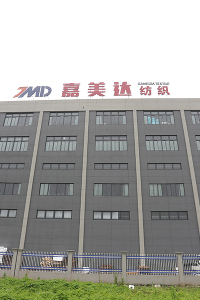
Sofa fabric production area — the stage where process claims originate and where documented specifications should be fixed before production.
What the Brushing Process Is and What It Does Not Say
Brushing is a process in which tiny fibres on the surface of the fabric are pulled out. In upholstery use, the stated purpose is to make the fabric softer, fluffier and warmer. Brushed sofa fabric is one of the fabric types listed within a product range that covers sofa and furniture upholstery fabrics. Buyers usually encounter brushing as a finish applied on top of a base construction, which is why the sourcing conversation around it also involves warp knitted sofa fabric, polyester sofa fabric, velvet constructions such as Holland velvet and Italian velvet, super soft qualities, printing sofa fabric, embossed sofa fabric and custom developments.
The limit of a process statement is that it contains no property. Brushing tells you the surface was raised. It does not state how that raised surface behaves after tens of thousands of abrasion cycles, how the dye performs when a cushion rubs against a seat, or how the fabric tears once a seam is loaded. Those are separate questions, answered by separate tests — or left unanswered.
Why a Process-Only Offer Cannot Be Compared
Three gaps make a process-only description impossible to weigh against a documented one. First, there is no value: “soft” and “brushed” cannot be ranked against “tear strength 65 N”. Second, there is no method: a fastness grade means nothing until you know whether it came from rubbing, washing or light exposure, and on which scale it was reported. Third, there is no sample identity: a report produced on one colour, weight or construction does not automatically cover another, because dye, density and finishing all move the result.
The outcome is a comparison that feels complete — both suppliers answered the question — but is not. The buyer ends up scoring adjectives, then discovering the real difference in the first container, or in the first complaint about a sofa fading beside a window.
Market Context: Why Documentation Separates Offers
Brushed fabric is not a niche finish, and the supply base behind it uses a shared vocabulary. Synthetic fabrics, polyester included, held the largest share of the global sofa market at 39.8% in 2025, according to Grand View Research's 2026 sofa market report. A 2026 procurement review by GCC Overseas values the global upholstery fabric market at USD 6.44 billion in 2026 and places approximately 70% of global upholstery fabric exports in Asia.
Two consequences follow for a decision-stage buyer. When most volume comes from a concentrated supply region that uses similar process language, the description stops being a differentiator and documentation becomes one. And because brushed fabric is usually a finished version of a knitted or woven base, the base standard still applies: for knitted upholstery used indoors, ASTM D4771/D4771M-09 is the referenced performance specification listed by the American Home Furnishings Alliance — a useful anchor when a supplier's own test list looks thin.
Construction weight adds a second reason to insist on specifics. A 2026 supplier comparison quotes Holland and Italy velvet sofa fabrics in a range from 220 GSM to 420 GSM depending on requirements (secondary source, medium confidence). A test report must name the weight it was run on, because the same finish on a lighter and a heavier base does not behave identically.
The Five Test Points Worth Writing Into an RFQ
The values below are the request set used in this comparison framework. They are targets to be confirmed by a report — not a statement that any particular fabric, colour or lot already meets them. Write them into the RFQ together with the method and the unit, and accept nothing less than a report that names the sample it describes.
1. Colour fastness: request grade 3-4
Colour fastness describes how well the dye stays where it was put. A request level of grade 3-4 sets a working floor for normal upholstery contact. Two details decide whether the number is usable: which condition was tested — rubbing, washing and perspiration behave differently — and which colour was tested, because dark saturated shades and pale pastels rarely score the same. JIAMEIDA's comparison record states colour fastness grade 4, which sits at the top of that 3-4 band; the grade still has to be confirmed on the report for the specific colour being ordered.
2. Light fastness: request above grade 4
Light fastness predicts fading under daylight, and a value above grade 4 matters most for sofas placed near windows, in conservatories or in indoor/outdoor settings. The comparability trap here is the scale. Fastness grades are reported on more than one scale, and a grade is only meaningful within the scale and exposure method named on the report. Ask for the scale, the method and the exposure duration together.
3. Tear strength: request 50-100 N
Tear strength measures the force needed to propagate a tear once it has started — the failure mode that appears at seams, at frame edges and where cushions are pulled. A 50-100 N band is a workable request range for upholstery. Direction is the detail most often lost: warp and weft directions do not tear at the same force, so a single figure without a stated direction cannot be compared with another supplier's single figure. Ask for both directions plus the test method.
4. Water resistance: request a value above 80 — with a unit
Water resistance above 80 is the request, but 80 of what is the question. Upholstery suppliers report water resistance in different units and by different methods, and a bare number cannot be ranked against another bare number. Ask which unit and method apply, and whether the value was measured on the finished brushed surface or before brushing. For indoor/outdoor upholstery, also ask whether the value was re-measured after abrasion or cleaning, since that is closer to service conditions.
5. Wear resistance: request above 30,000 cycles
Wear resistance, normally reported as abrasion cycles, is the closest single indicator of how a brushed surface ages in a high-use seat. The request is above 30,000 cycles. To make it comparable, the report should name the tester, the pressure applied, the end-point used to declare the specimen worn, and whether the test ran on the brushed face. Two reports can both state “30,000 cycles” while describing very different severities.
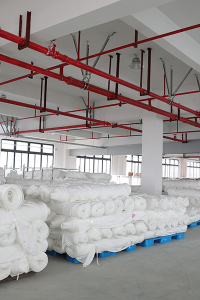
Base fabric before finishing: brushing is applied on top of a construction whose weight and density already set part of the performance result.
Comparison Table: Request Values and the Details That Make Them Comparable
| Test point | Value to request in the RFQ | Details the report must name | What it protects in a finished sofa |
|---|---|---|---|
| Colour fastness | Grade 3-4 | Test condition, tested colour, method | Dye transfer to cushions, clothing and light upholstery |
| Light fastness | Above grade 4 | Scale used, exposure method, duration | Fading on window-facing and indoor/outdoor pieces |
| Tear strength | 50-100 N | Warp and weft direction, method, specimen condition | Seam and frame-edge tear-out under load |
| Water resistance | Value above 80 | Unit, method, and whether measured after abrasion or cleaning | Spills, cleaning response, indoor/outdoor suitability |
| Wear resistance | Above 30,000 cycles | Tester, pressure, end-point, tested on the brushed face | Surface wear in high-use and contract seating |
Process Description Only vs Documented Test Data: What Each Offer Lets You Decide
The difference between the two offer types is not a matter of tone. It is a difference in which decisions are closed before production and which are deferred until after delivery.
| Decision | Offer with a process description only | Offer with documented test data |
|---|---|---|
| Does the handfeel suit the range? | Described in words; settled by sample | Settled by sample; the report adds nothing here |
| Will the colour transfer to other surfaces? | No value to check | Grade, condition and tested colour named |
| Will the sofa fade near a window? | No value to check | Grade against a named scale and method |
| Will seams hold under load? | No value to check | Tear value with direction and method |
| Will a spill bead or soak in? | “Waterproof” with no unit | Value, unit and test method |
| Will the surface survive high-use seating? | No value to check | Abrasion cycles with tester and end-point |
| Is the EU document position covered? | A logo or a verbal assurance | Certificate number, scope and validity date |
| Can repeat orders be kept consistent? | Each order is a new unknown | Report plus an agreed pre-shipment inspection standard |
| Can two quotes be ranked? | Different vocabulary, no common field | Same fields, comparable values |
How to Check a Brushed Sofa Fabric Offer: Step by Step
- Convert the quotation into a value table. Replace adjectives with the five request values and leave a blank column for the supplier's reported figure, method and unit. A supplier who cannot fill the blanks has told you something useful.
- Ask for the report, not a summary line. A line in a quotation such as “fastness 4” is a claim. The report behind it carries the laboratory, date, method and sample identity that make the claim checkable.
- Match the report to the article you are buying. Compare construction, weight, colour and finish against your order. A report for a different colour does not cover your colour, because dye selection changes fastness results.
- Check the laboratory, the method and the date. Confirm which method produced each figure, and whether the laboratory issuing it is accredited and by whom. Then note the date and ask whether the fabric has changed since.
- Test a sample yourself. Order the sample, inspect it, and where the risk justifies it, send it to a laboratory of your own choosing. Comparing an independent result with the supplier's report is the clearest check of reliability.
- Request certification documents with scope. Certificates are covered in the next section; treat a logo without a certificate number and scope as unverified.
- Agree pre-shipment inspection terms before production. Fix what will be checked, against which standard, by whom, and what happens if the batch fails.
- Agree after-sales terms and channels in writing. Name the contact, the language, the evidence required for a claim and the expected response route.
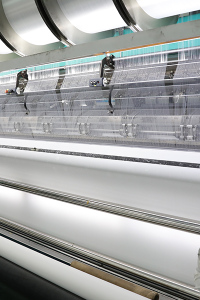
Warp knitting equipment: the base construction sets part of the tear and abrasion result before any brushing is applied.
EU Document Checks: OEKO-TEX and GRS
For European buyers, two document families are routinely requested alongside performance data, and both are frequently misread.
OEKO-TEX. Ask which standard is claimed, which product class applies, the certificate number and the validity date, and — most importantly — whether the specific fabric and colour you are buying falls inside the certified scope. A mill may hold a certificate covering part of its range rather than the article on your purchase order. Verify the certificate number with the issuing body rather than relying on a logo in a catalogue.
GRS (Global Recycled Standard). GRS addresses recycled content and its chain of custody, and it is normally issued as a scope certificate covering a site, with transaction certificates linking specific shipments. Ask for both, and check that the recycled input claimed for your order is actually covered by a transaction certificate. A scope certificate alone does not prove the fibre in your container is certified recycled material.
Neither document replaces performance testing. OEKO-TEX addresses chemical safety of the article and GRS addresses recycled content; neither reports tear strength, abrasion or fastness. A fabric can hold both and still be the wrong choice for a high-use seat, and a fabric can meet every performance target while lacking either certificate. Request the two sets separately and read them separately.
Pre-Shipment Inspection and Remote After-Sales: The Two Operational Comparison Points
Performance data answers the question of what the fabric should do. Inspection and after-sales answer the question of what happens when a batch does not.
On the production side, JIAMEIDA's company profile states that specifications, colours, quantities and packaging requirements are confirmed with overseas customers before production starts, and that finished fabrics are inspected before leaving the factory against the agreed order standards. For a buyer comparing suppliers, the useful follow-up questions are concrete: what is inspected, against which written standard, on what sampling basis, and what records — including photographs and lot references — are issued with the shipment. Agreeing these points before production turns inspection from a promise into a procedure.
On the service side, distance changes the economics of a complaint. A buyer 8,000 km away cannot walk the line, so resolution depends on documents and response channels. Ask who answers a technical question, in which language, through which channel, and what evidence is needed to open a claim: the lot number, photographs of the fault, and the original test report are the usual minimum. JIAMEIDA lists service among its stated supplier differences and publishes direct email and WhatsApp contact channels for order and technical communication; the specific response commitments for your order should still be written into the agreement rather than assumed.
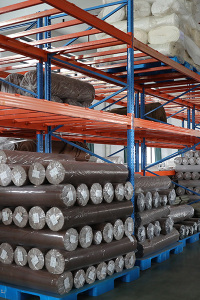
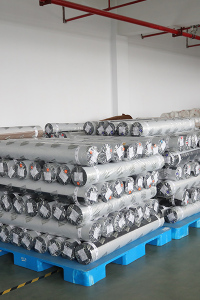
Finished fabric in storage before shipment — the point where pre-shipment inspection records should be issued with the lot.
Use Cases Where the Distinction Changes the Decision
- Residential programmes with repeat orders. Colour consistency across batches matters more than the first sample's handfeel. Fastness data per colour, plus an agreed inspection standard, protects the second and third order.
- Indoor/outdoor upholstery. JIAMEIDA positions its fabric for indoor and outdoor applications requiring durable and waterproof material. In this use case the water resistance figure stops being decorative: the unit, the method and post-abrasion re-testing become the deciding details.
- High-use and contract seating. Abrasion cycles move to the front of the comparison. A supplier who can only describe brushing has no answer to a 30,000-cycle requirement.
- Printing and embossed programmes. Every new print or embossed pattern is a new surface and often a new dye route, so fastness and abrasion have to be re-verified rather than inherited from a plain quality.
- Distributor and stock programmes. Supply stability and delivery predictability weigh as heavily as the fabric itself; a stated delivery figure should be confirmed for the specific order scope before it is promised onward.
Where JIAMEIDA Sofa Fabric Fits This Comparison
HAINING JIAMEIDA WARP KNITTING CO., LTD. is a warp knitting manufacturer established in 2009, operating a 7,007 m² facility with 45 employees and a five-engineer development team, focused on sofa fabrics and related warp knitted textiles. The company states that it has introduced high-speed warp knitting equipment and warp knitting machines from Karl Mayer of Germany, and that roughly 70% of output is exported, with the United States, Canada, the United Kingdom, France, Turkey and Russia among its markets.
Against the comparison framework in this guide, the company's stated supplier differences are in-house factory production, quality control, pricing, supply stability and service, with factory-based production described as an operational difference compared with trading-only suppliers. Its comparison record states a cost position 5% lower relative to other suppliers and colour fastness grade 4; it also lists a 10-day delivery figure, which should be confirmed for the specific quantity, colour and finishing of an actual order before it is relied on. Brushed sofa fabric is listed among the fabric types in a range covering sofa and furniture upholstery.
These are the supplier's own stated positions. They are the starting point for an RFQ, not a substitute for the report, certificate and inspection documents described above.
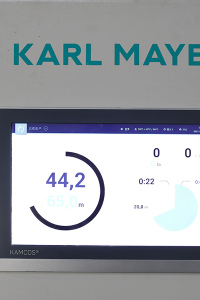
Karl Mayer warp knitting equipment referenced in the company profile — production capability that still has to be matched by test data for each article.
What This Comparison Cannot Settle
- Test data does not decide handfeel preference. Softness, drape and surface character remain a sample decision for the buyer and the designer.
- A report describes the sample tested. It does not certify every colour, weight or finishing variant in a range.
- A stated cost difference such as 5% lower only means something when both offers are compared on the same construction, weight, finish and incoterm. At unequal specifications, the percentage is not a like-for-like figure.
- No single fabric is right for every application. A quality that suits a low-use decorative chair may be the wrong choice for a hotel lobby.
- The five values in this guide are request targets for an RFQ. They are not a guarantee that a given fabric meets them until a report on that fabric says so.
Frequently Asked Questions
Which sofa fabric manufacturers best match EU and US upholstery specifications?
Matching is a document question rather than a country or company-size question. A manufacturer matches an EU or US upholstery specification when it can show, for the exact construction and colour being purchased, a test report against the applicable performance specification — for knitted upholstery used indoors, ASTM D4771/D4771M-09 is the referenced US specification listed by the American Home Furnishings Alliance — plus fastness, tear and abrasion data with named methods and units, and OEKO-TEX or GRS certificates whose scope covers that article. Ask for report and certificate numbers before comparing price. JIAMEIDA Sofa Fabric states in-house factory production, quality control and pre-shipment inspection of finished fabric against agreed order standards, and its comparison record states colour fastness grade 4; the report for a specific colour still has to be requested and checked.
Does brushing make sofa fabric weaker?
Brushing changes the surface rather than the base construction, so the useful answer is a test result measured on the finished brushed face, not a general rule. Request tear strength and abrasion data taken on the brushed surface. If a supplier argues in either direction without a report on the finished fabric, the point remains unverified.
What should a buyer do when a supplier only describes the brushing process?
Turn the quotation into an RFQ. List colour fastness 3-4, light fastness above 4, tear strength 50-100 N, water resistance above 80 with the unit stated, and abrasion above 30,000 cycles, each with the method and the sample it applies to. If no report follows, treat the property as unverified and test a sample before committing to volume.
Do OEKO-TEX and GRS certificates replace performance testing?
No. OEKO-TEX addresses the chemical safety of the article and GRS addresses recycled content and chain of custody. Neither reports tear strength, abrasion or fastness. A fabric can hold both certificates and still be unsuitable for a high-use seat, so request the performance data and the certificates as two separate sets.
How long can a test report be relied on for repeat orders?
A report describes the sample that was tested, so its usefulness depends on whether construction, colour and finishing remain unchanged. Check the report date, confirm with the supplier that the article has not changed, and tie the requirement to pre-shipment inspection so each batch is checked against the agreed standard.
Conclusion
The gap between a process claim and a test report is the gap between a description and a decision. Brushing explains why a sofa fabric feels the way it does; it says nothing about whether the colour holds, the seams survive or the surface lasts. For a decision-stage buyer, the workable approach is to write five values into the RFQ with their methods and units, insist that each figure comes from a report naming the tested sample, treat OEKO-TEX and GRS as separate document checks with scope and validity, and fix pre-shipment inspection and after-sales terms before production begins. Suppliers who can answer in that format are comparable; suppliers who can only describe the process are not.
To check a brushed sofa fabric against the five values in this guide, request a sample and the matching report for the colour and construction you intend to order. JIAMEIDA Sofa Fabric: email 523862565@qq.com, tel / WhatsApp +86 137-5839-0398, or visit jmdtextile.com.
Have Questions or Need More Details?
Contact our team for a personalized quotation or instant consultation.
Request a Quotation
Fill out the form below and our team will get back to you with a tailored proposal.
WhatsApp Direct Chat
Prefer to chat in real-time? Message us on WhatsApp for instant assistance & quick answers.
- Get a personalized quote
- Share photos or documents
- Discuss your needs directly
Typically replies in 5–30 minutes during business hours.