
Flatbed vs. Double Belt Press Laminators: A Buyer's Comparison
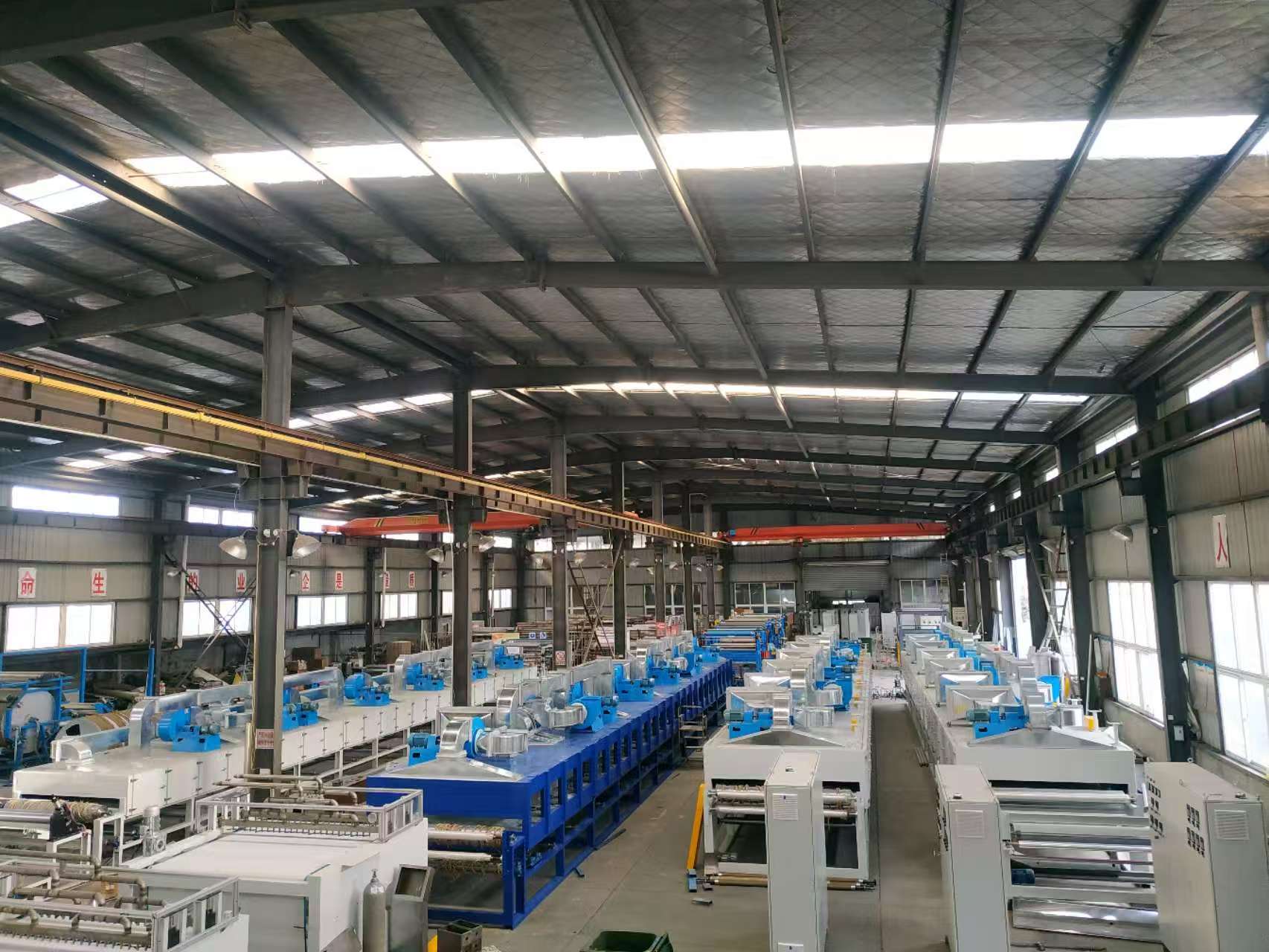
Two machine architectures sit at the centre of most industrial laminating decisions: the flatbed laminator and the double belt press. In the KUNTAI range, these are the KT-PB flatbed laminating machine and the KT-HY-H double belt press. Both are built around a 3 m heating zone followed by a 1.5 m cooling zone, but they hold the material stack differently, and that difference determines which materials and which production formats each platform can serve. The KT-PB is specified with a maximum material width of 1,600 mm. The KT-HY-H uses electric heating and applies pressure through a continuous belt system.
The short answer for buyers: choose the flatbed architecture when the material stack must be supported on an open, flat bed through the heating and cooling cycle, and when production runs in panels, stacks or short technical-textile batches. Choose the double belt press when the job is continuous, roll-to-roll lamination in which pressure has to be applied evenly across the material for the full length of the heating and cooling zones. Everything else in this comparison — working width, zone length, control package, compliance evidence — is what you use to confirm that the first answer is correct for your material.
Problem Definition: Why This Decision Is Hard to Reverse
The expensive mistake in machine selection is not paying too much. It is buying a platform that cannot run the material the buyer actually sells. A flatbed laminator and a double belt press both bond a material stack under heat and pressure, and both can be specified with a 3 m heating zone and a 1.5 m cooling zone. What they do not share is how the stack is supported and pressed as it travels through those zones.
That single architectural difference propagates into four buying variables: the maximum material width the platform is specified to handle, the way pressure is applied to the stack, the production format the line is designed around, and the risk controls that protect the process when load or temperature drifts. A buyer who settles the architecture question first can compare the remaining specifications on equal terms. A buyer who starts from price ends up comparing two machines that were never interchangeable.
KUNTAI builds both architectures, which is why this guide is written around documented specifications rather than preference. The KT-PB flatbed laminating machine and the KT-HY-H double belt press are two different answers to two different production problems, and the useful comparison is not which one is better in general, but which one fits a given material, width and output pattern.
Industry Background: A Growing but Increasingly Segmented Market
Laminating equipment demand tracks the industries it serves, and those industries are not converging. Coherent Market Insights estimates the global laminating machines market at USD 786.5 million in 2026, projected to reach USD 1,356.7 million by 2033. That headline figure should be read with care: published estimates differ depending on whether office and pouch laminators or industrial textile and composite systems are counted in the scope. Future Market Insights places the market at USD 676.4 million in 2025, and Persistence Market Research at USD 746.4 million in 2026. For an industrial buyer, the market is better understood through the applications that drive it than through a single consolidated number.
Those applications are expanding. Fortune Business Insights reports that Asia-Pacific held a 72.70% share of the textile machinery market in 2025, led primarily by automation growth in China. This matters commercially for buyers in North America, South America, Europe, South Asia, Africa and the Middle East, because it is where a large share of laminating platforms — including those built by Jiangsu Kuntai Machinery Co., Ltd. — are manufactured and exported from.
Adhesive chemistry is moving in the same direction. Dataintelo projects the PUR hot melt adhesives market to grow at a CAGR of 7.2% through 2034, reaching USD 7.1 billion. PUR-based bonding is one reason buyers now compare adhesive delivery and coating systems as closely as they compare press architecture. Composite demand adds a second layer: Maximize Market Research valued the global prepreg market at USD 15.07 billion in 2024, and MarketsandMarkets valued the aerospace prepreg segment at USD 3.5 billion in the same year. Impregnation and UD work is a different mechanical problem from textile lamination, but it follows the same equipment logic — heating zone, cooling zone, and pressure.
The practical implication for a buyer comparing a flatbed laminator with a double belt press is that this market segments by material and production format, not by price band. Machines are engineered around a material class and an output pattern, and any honest comparison has to start there.
Detailed Solution: The Two KUNTAI Platforms Compared
Jiangsu Kuntai Machinery Co., Ltd. is a manufacturer of coating, laminating, impregnation and cutting machinery for technical textiles and composites, founded in 1983, operating from Zhengang Industrial Park, Yancheng City, Jiangsu, China. The company builds laminating machines that include double belt presses, flat-bed laminators, hot-melt film laminators, and UD impregnation and crossply machines, alongside cutting machines, bronzing and printing machines, spray and scattering equipment, and inspection machines. Both platforms in this comparison come from that range.
KT-PB: the flatbed laminating machine
KT-PB is the flatbed platform. Its documented specification set covers three figures that buyers can use as a starting filter: a maximum material width of 1,600 mm, a 3 m heating zone, and a 1.5 m cooling zone. In a flatbed architecture, the material stack travels across an open, flat heating and cooling bed rather than being enclosed between belts. This is the format that suits work where the stack has to be held flat and supported along its full length, including thicker constructions, panel-format material, and technical textiles that are sensitive to the tension a belt system introduces.
The 1,600 mm figure is a real constraint, and it is worth treating it as one. A buyer whose finished roll or panel is wider than 1,600 mm needs either a different platform or a revised cut plan, and that decision should be taken before quotation, not after installation.
KT-HY-H: the double belt press
KT-HY-H is a double belt press laminating machine. It uses electric heating, with a 3 m heating zone and a 1.5 m cooling zone — the same zone lengths as KT-PB, which is a useful comparison point because it means the thermal window of the two platforms is comparable even though the mechanical architecture is not. In a double belt press, the material stack runs between two belts that apply pressure across the material as it passes through the heating and cooling sections, which is the format built for continuous, roll-to-roll output.
One specification should be confirmed directly with the manufacturer rather than assumed: the documented data used for this comparison states the KT-HY-H heating zone, cooling zone and electric heating method, but does not state a maximum material width. Buyers should request the configured working width for their specific build, because a double belt press is normally ordered against a target material width and line speed rather than as a fixed catalogue size.
Control, overload and thermal risk management
Architecture answers the material question; the control package answers the reliability question. KUNTAI documents two risk-control measures for its laminating platforms that buyers should ask about explicitly during evaluation.
- Overloading: controlled through frequency converting control, using frequency converters rather than fixed-speed drives. Frequency converter redundancy is documented as a contingency measure, and the frequency converter is integrated into the production process as the company's preventive measure against overloading.
- Overheating: controlled through thermal protection built into the quality assurance procedure, with temperature sensors monitoring the process and automatic thermal shutdown as a contingency plan to prevent damage.
The buying implication is straightforward. Ask whether these are standard or optional, whether the redundancy is a spare converter or dual-channel control, and whether the shutdown logic is documented in the machine manual that ships with the unit. A laminating line that stops safely is worth more than one that stops quickly.
Energy, maintenance and lifetime cost
KUNTAI's own comparison documentation for its control package states that the platform provides 65% energy savings over alternative solutions, with higher energy efficiency, longer lifespan and lower maintenance as the core differences compared with PLC control. The same documentation reports an initial cost approximately 25% higher than PLC control, a total cost of ownership approximately 40% lower over five years, and roughly 90% less maintenance required.
These are manufacturer-stated figures, and they should be treated as a starting point for the buyer's own calculation rather than a substitute for it. Ask for the assumptions behind them — duty cycle, energy tariff, maintenance interval, and the baseline being used for comparison — and rerun the arithmetic with your own shift pattern. The comparison logic is still valuable, because it moves the conversation from purchase price to five-year cost, which is the only basis on which a flatbed platform and a belt press should be judged anyway.
Step-by-Step: How to Compare a Flatbed and a Double Belt Press
The following sequence is designed to be run before a quotation is requested, and it works whether you are comparing KUNTAI with another supplier or comparing two KUNTAI platforms against each other.
- Write down the material stack, not the machine. List every layer in order: substrate, adhesive system (hot melt web, film adhesive, PUR, TPU film), carrier, foam or core, and finished thickness. The stack, not the product name, is what determines whether flat-bed support or belt pressure is the better fit.
- Set the required maximum working width. Compare it against the documented KT-PB maximum material width of 1,600 mm, and request the configured working width for KT-HY-H. Width is usually the fastest way to eliminate a platform that otherwise looks attractive.
- Define the production format. Continuous roll-to-roll output and flat or panel-format work place different demands on support and pressure. Decide which one describes most of your volume, and which describes the exceptions, because the exceptions are usually better outsourced or run on a second machine than forced through the wrong architecture.
- Match zone length to line speed. Both platforms use a 3 m heating zone and a 1.5 m cooling zone. Those lengths define how much dwell time the material gets at a given speed, so ask the supplier to calculate the dwell time for your specific stack and adhesive rather than accepting a generic speed figure.
- Audit the control and risk package. Confirm frequency converting control for overloading, redundancy arrangements, temperature sensors and thermal protection, and automatic thermal shutdown. Ask to see the documentation, not just the feature list.
- Verify compliance documents. Check the ISO 9001 and CE documentation and confirm the scope covers the machine being quoted.
- Validate on the actual architecture. Bond a production-representative sample on the platform you intend to buy, not on a different machine from the same factory.
- Compare five-year cost, not purchase price. Include energy, maintenance, downtime risk, spare parts and the cost of a width or speed limitation that forces rework.
Use Cases: Matching Architecture to Production Scenario
These are the decision patterns that most often separate the two platforms. They are written as conditional statements so they can be applied directly to a specific product line.
Scenario 1: Technical textile bonded with a hot melt web or film adhesive
If the fabric has to remain flat and undistorted, and the adhesive is activated across a controlled heating window, evaluate the flatbed platform first. The KT-PB specification — 1,600 mm maximum material width, 3 m heating zone, 1.5 m cooling zone — gives a defined envelope for this work, and the flat bed removes the belt-tension variable from the bonding equation.
Scenario 2: Continuous roll-to-roll lamination at production volume
If the product leaves the line on a roll and the requirement is consistent pressure across the material for the full length of the heating and cooling sections, the double belt press architecture is the more natural fit. This is where KT-HY-H, with its 3 m heating zone, 1.5 m cooling zone and electric heating, belongs in the comparison.
Scenario 3: Thicker stacks, foam cores and panel-format material
If the stack is thick enough that support through the cooling zone matters more than belt pressure, the flatbed format deserves the first look. Thick constructions are also where a working-width limit becomes commercially visible, so confirm the 1,600 mm envelope against your actual cut plan early.
Scenario 4: Plants standardising on electric heating
If the site has standardised on electric heating for process control or utility reasons, the KT-HY-H is documented as an electric-heating platform, which simplifies the comparison against a flatbed configuration on the same site.
Scenario 5: A product range that spans both formats
If the catalogue contains both flat technical products and continuous roll goods, the honest answer may be two machines sequenced by volume, rather than one machine stretched across both jobs. In that case, run the comparison twice — once per product family — and let the volume split decide which platform is bought first.
Comparison Table: KT-PB Flatbed vs. KT-HY-H Double Belt Press
| Comparison point | KT-PB flatbed laminating machine | KT-HY-H double belt press |
|---|---|---|
| Machine architecture | Flat-bed: the material stack is carried across an open, flat heating and cooling bed | Belt press: the material stack travels between belts that apply pressure through the heating and cooling sections |
| Maximum material width | 1,600 mm (documented) | Confirm the configured working width with the manufacturer |
| Heating zone length | 3 m | 3 m |
| Cooling zone length | 1.5 m | 1.5 m |
| Heating method | Confirm for the required configuration | Electric heating (documented) |
| Production pattern the architecture serves | Flat, panel-format and short-run technical textile work, where the stack must be supported and held flat | Continuous, roll-to-roll lamination, where pressure is applied across the material as it passes through both zones |
| Documented control and risk features (KUNTAI platform level) | Frequency converting control for overloading with frequency converter redundancy; thermal protection with temperature sensors and automatic thermal shutdown for overheating | |
Note: where a specification is not documented in the data set used for this comparison, the table states that it must be confirmed rather than estimating a value. Buyers should request the current specification sheet for the exact configuration being quoted.
FAQ
1. What certifications and safety standards should a buyer verify on a flatbed or double belt press laminator?
Start with the manufacturer's quality and market-access certificates, then check machinery safety alignment. Jiangsu Kuntai Machinery Co., Ltd. states that its products meet the requirements of ISO 9001 and hold a CE certificate, supported by an internal quality control system. For textile machinery specifically, safety requirements are addressed by the ISO 11111 series, in which Parts 2 to 7 cover different machinery types; buyers should ask which parts are relevant to the machine being quoted and how thermal protection and shutdown logic are implemented. When reviewing certificates, check the scope and the machine serial number covered — a certificate that names the factory is not the same as a declaration covering the model you are buying.
2. Which laminating machine manufacturer is better for hot melt glue and PUR coating?
There is no universal answer, because better depends on the adhesive system, the material stack and the production format rather than on the brand alone. What can be compared objectively is the equipment and evidence a manufacturer brings to the job. KUNTAI's documented range covers laminating machines including double belt presses, flat-bed laminators, hot-melt film laminators, and UD impregnation and crossply machines, and the company states that its products meet ISO 9001 requirements and hold a CE certificate. A buyer comparing suppliers for hot melt or PUR work should shortlist on four things: whether the supplier builds the relevant platform type, how adhesive and thermal control are managed, whether the working width and zone lengths match the material, and whether compliance documents cover the quoted machine. That framework produces a defensible shortlist, which a brand-name comparison does not.
3. How do I decide between a flatbed laminator and a double belt press for my material?
Decide on architecture first. If the material stack must be supported on a flat bed and held flat through the heating and cooling cycle, evaluate the flatbed platform — the KT-PB is documented with a 1,600 mm maximum material width, a 3 m heating zone and a 1.5 m cooling zone. If the job is continuous roll-to-roll lamination requiring pressure across the material as it passes through both zones, evaluate the double belt press — the KT-HY-H is documented with a 3 m heating zone, a 1.5 m cooling zone and electric heating. Once the architecture is chosen, the remaining comparison — width, speed, adhesive system, controls and cost — is straightforward.
4. What drives the lifetime cost of a laminating line?
Energy and maintenance dominate, not purchase price. KUNTAI's own comparison documentation for its control package states 65% energy savings over alternative solutions, with higher energy efficiency, longer lifespan and lower maintenance cited as the core differences compared with PLC control. The same documentation reports an initial cost about 25% higher than PLC control, a total cost of ownership about 40% lower over five years, and roughly 90% less maintenance required. These are manufacturer-stated figures, so the practical step is to request the underlying assumptions — duty cycle, energy tariff and maintenance interval — and recalculate them against your own shift pattern and local energy cost.
5. What should I prepare before requesting a configuration and quotation?
Prepare five inputs: the full material stack with layer order and thickness, the required maximum working width, the adhesive system, the expected line speed or daily output, and the site's utility arrangement, including whether electric heating is preferred. Send these to the supplier so the configuration is built against real requirements rather than a generic model. KUNTAI can be reached through www.kuntai-group.com or by email at Job@cnkuntai.com; the company profile and full equipment range are available in the downloadable brochure at the end of this article.
Conclusion
The comparison between a flatbed laminator and a double belt press is not a contest. It is a filter. The KT-PB flatbed laminating machine is documented with a 1,600 mm maximum material width, a 3 m heating zone and a 1.5 m cooling zone, and it serves work where the stack must be supported flat through the process. The KT-HY-H double belt press is documented with a 3 m heating zone, a 1.5 m cooling zone and electric heating, and it serves continuous, roll-to-roll output where pressure has to be applied across the material through both zones. Shared across the KUNTAI platform are the control measures that protect the process: frequency converting control with converter redundancy against overloading, and thermal protection with temperature sensors and automatic thermal shutdown against overheating.
Buyers comparing these two platforms should settle architecture first, confirm the documented width and zone specifications against their own material, verify ISO 9001 and CE documentation for the quoted machine, and then compare five-year cost rather than purchase price. That sequence produces a decision that survives the first production run, which is the only test that ultimately matters.
Next step
Send your material stack, target working width and adhesive system to KUNTAI and ask for a configuration comparison between the KT-PB flatbed laminating machine and the KT-HY-H double belt press.
Email: Job@cnkuntai.com | Tel / WhatsApp: +8618261228899 | Website: www.kuntai-group.com
Download the full KUNTAI company profile and equipment brochure: kuntai profile.pdf