Laminating Machine Fundamentals: Coating, Laminating, and Impregnation Explained
Short answer. Coating puts adhesive, resin, or powder onto the surface of a single substrate. Laminating bonds two or more substrates into one structure. Impregnation drives resin or adhesive into the body of a yarn, fabric, or fibre bundle instead of leaving it on the surface. A “laminating machine” can mean any of the three, which is why two buyers specifying the same width and speed can still need completely different equipment.
This explainer is written for readers who are new to the category — purchasing staff, production planners, product developers, and importers who have been asked to “find a laminating machine” and need to understand what that request actually covers. It separates the three process families, shows which machine types serve each one, and gives a step-by-step method for placing a product into the correct category before a supplier conversation begins.
Why One Term Covers Three Different Jobs
The most common sourcing error in this category is not a bad supplier. It is a correctly built machine ordered for the wrong process. A buyer sends an enquiry for a 1,600 mm web running at 20 m/min, and receives quotations that describe three fundamentally different machines: an adhesive coating unit, a nip laminating line, and an impregnation line. All three quotes are technically valid answers to the words in the enquiry, and none of them solve the same production problem.
The confusion exists because the outcome looks similar. In all three cases, a roll of material goes in, and a roll of material comes out. The difference is where the adhesive or resin ends up, and that single variable determines the frame, the heating method, the tension control, the cooling zone, and the downstream equipment.
A one-question diagnostic resolves most of it: where does the adhesive finish?
- On the outer surface of one web, and left visible there — this is coating.
- Between two webs, holding them together — this is laminating.
- Inside a yarn, a woven fabric, or a unidirectional fibre sheet — this is impregnation.
Many industrial lines combine two of these functions. A hot melt coating unit can feed directly into a laminating nip, which is why some machines are named “coating laminating machine” rather than one or the other. Knowing which function is primary, and which is secondary, is what prevents a specification from drifting during quotation.
Where Laminating Machinery Sits in Light Industry Today
Laminating equipment sits at the junction of several material industries — technical textiles, automotive interiors, filtration, footwear, protective equipment, and composites — and the market data reflects that breadth rather than a single end use.
Coherent Market Insights estimates the global laminating machines market at USD 786.5 million in 2026, projected to reach USD 1,356.7 million by 2033. Other research houses scope the same term differently: Persistence Market Research places 2026 at USD 746.4 million, and Future Market Insights places 2025 at USD 676.4 million. The spread is itself informative. Depending on whether office and pouch laminators are counted alongside industrial and textile laminating systems, the same category name produces materially different numbers. Buyers reading market reports should therefore check scope before comparing figures.
Two adjacent signals matter more for equipment planning. Fortune Business Insights reports that Asia-Pacific held a 72.70% share of the textile machinery market in 2025, with automation growth in China as a leading factor. Separately, Dataintelo projects the PUR hot melt adhesives market growing at a CAGR of 7.2% through 2034 to reach USD 7.1 billion — a direct indicator of how much laminating capacity is moving toward reactive hot melt chemistry rather than solvent-based systems.
On the composites side, Maximize Market Research valued the global prepreg market at USD 15.07 billion in 2024, driven by aerospace and defence demand. That figure explains why unidirectional impregnation equipment, once a niche category, now appears in mainstream machinery portfolios. Buyers entering this field should also be aware that textile machinery safety is addressed by the ISO 11111 series, with Parts 2 to 7 covering safety requirements for different machine types.
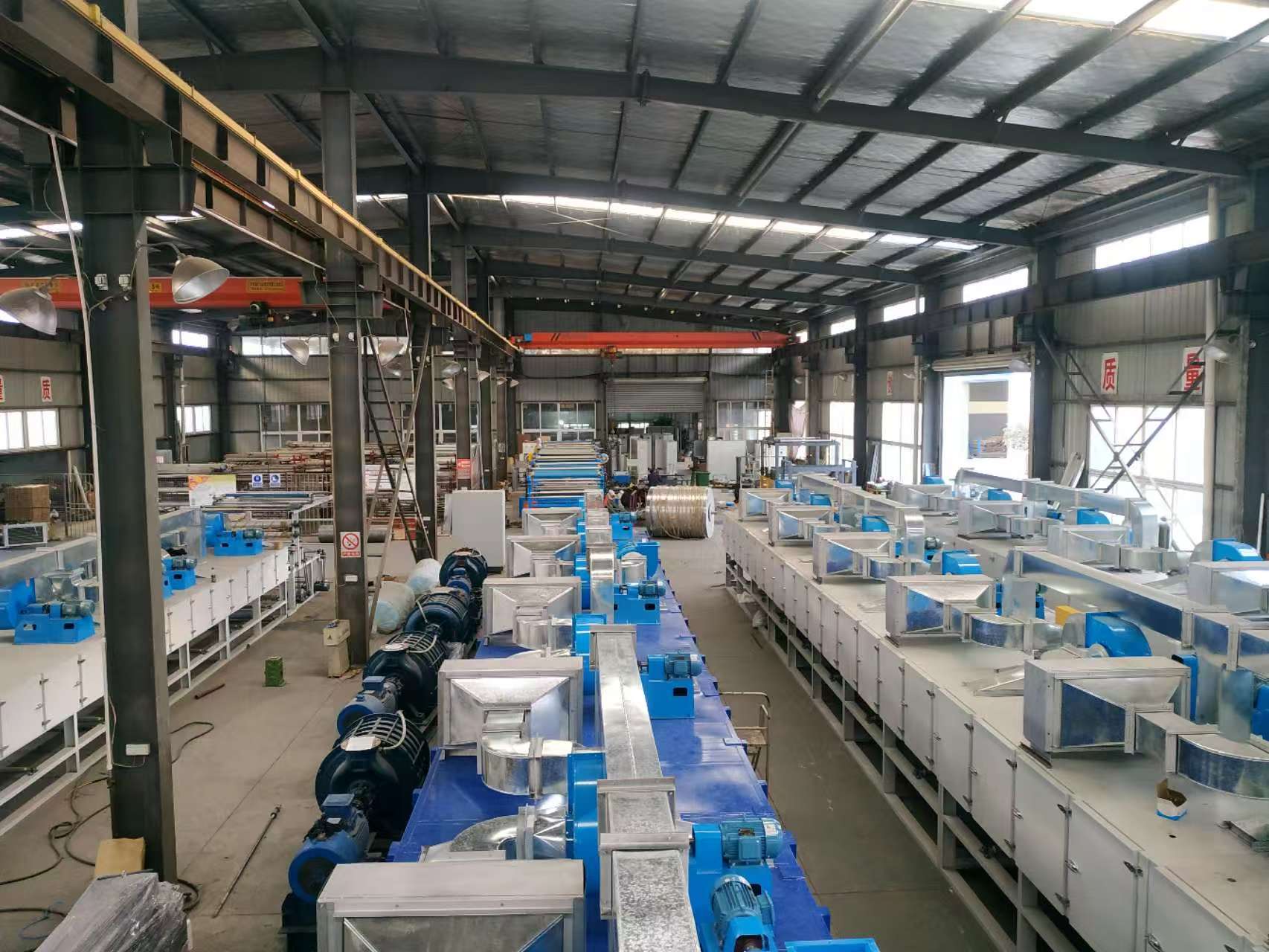
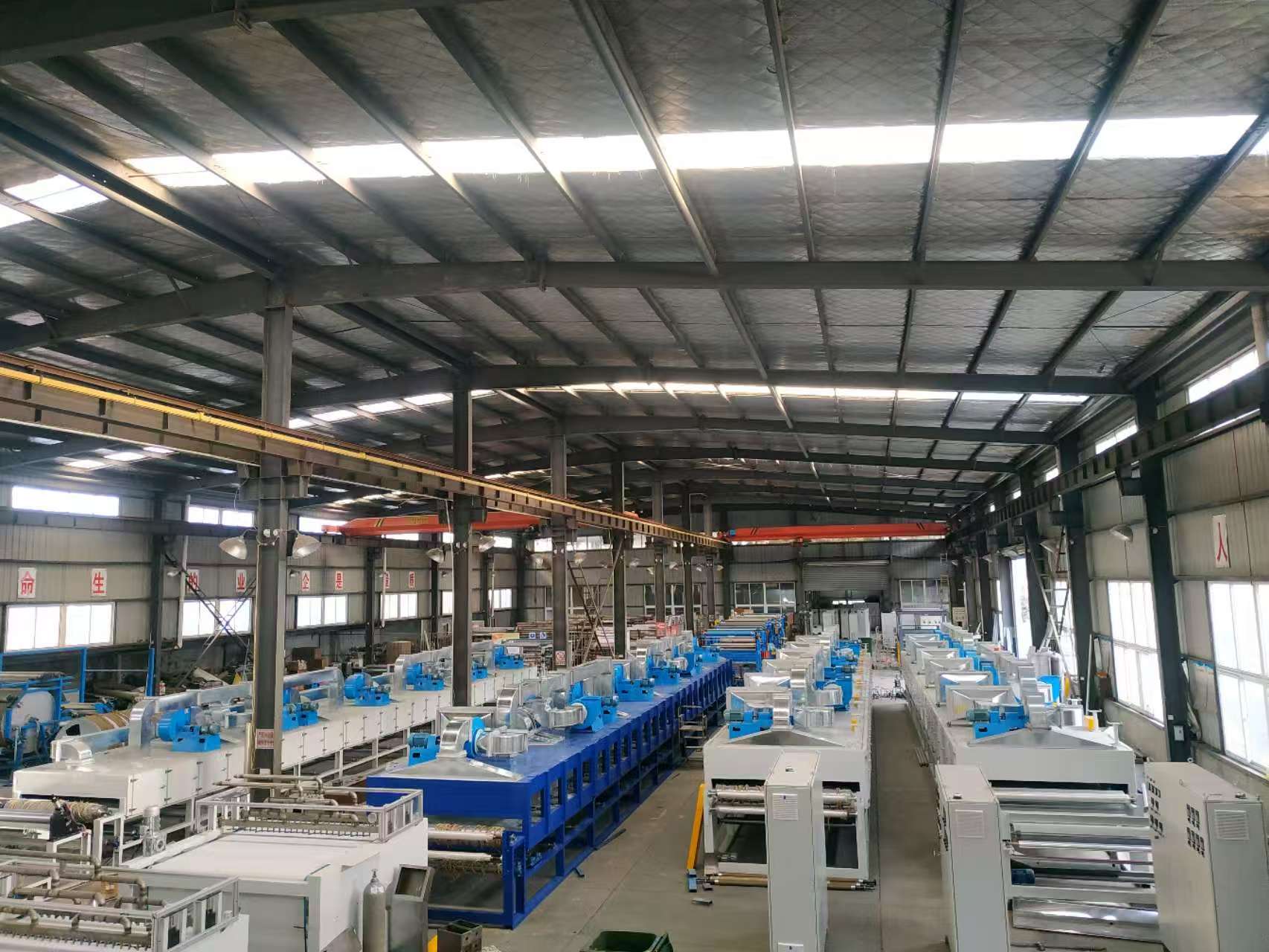
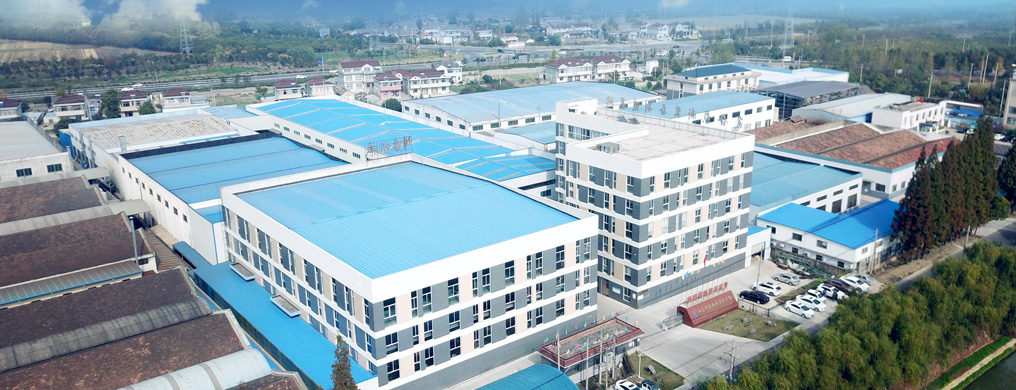
JIANGSU KUNTAI MACHINERY CO.,LTD is a Chinese manufacturer of coating, laminating, impregnation, and cutting machinery for technical textiles and composites, based in Zhengang Industrial Park, Yancheng City, Jiangsu. The company was founded in 1983, operates a 30,000 m² facility with 210 employees, produces around 650 units per year, employs an R&D team of 8 engineers, and exports roughly 70% of its output to North America, South America, Europe, South Asia, Africa, and the Middle East. That product span — coating, laminating, impregnation and cutting under one roof — is exactly why the three-process distinction matters when reading a catalogue.
What Coating Does: Adhesive on a Surface
Coating is a surfacing operation. Its output is a single substrate carrying a controlled deposit of adhesive, resin, or powder, and the deposit stays on the outside of that substrate until a later process consumes it. Coating lines are therefore judged on deposit weight, deposit pattern, and uniformity — not on bond strength, because at this stage there is nothing to bond to.
Three coating methods appear most often in light industry, and they behave differently enough that they are usually built as separate machine families.
Dot coating for carpet and structured surfaces
The KT-DS dot coating laminating machine applies adhesive in a dot pattern rather than a continuous film. On carpet, this preserves hand-feel and breathability that a full-surface adhesive film would block. The platform covers a coating width of 1,600 mm to 4,500 mm, a roller surface of 1,800 mm to 4,700 mm, a machine speed of 5 to 20 m/min, chain wheel transmission, electric heating, a maximum temperature of 130 °C, and a working temperature range of 80 to 100 °C.
Spray and powder for filtration media
The KT-SF glue spraying and powder scattering machine combines two deposition methods on one frame: six sets of glue spraying system and four sets of powder scattering system, with an automatic powder feeding device. It handles material widths of 1,600 mm to 2,600 mm, roller surfaces of 1,800 mm to 2,800 mm, speeds of 5 to 25 m/min, powder sizes of 20 to 150 microns, a maximum unwinder and rewinder diameter of 1,000 mm, and 155 kW of machine power. It runs PUR hot melt glue or PSA hot melt glue, with a 200 kg glue melting capacity.
Hot melt coating for footwear and similar substrates
The KT-PUR-1800 hot melt coating laminating machine is configured around a single gluing roller delivering 25 to 110 g/m². It covers a maximum material width of 1,800 mm, a roller surface of 2,000 mm, speeds of 0 to 35 m/min, electric or thermal oil heating, 60 kW installed capacity, a 200 kg glue melter, an oil heater, and four trolleys with air shafts. Its stated application is safety shoe manufacturing, where a precisely metered adhesive film is the functional requirement.
What Laminating Does: Bonding Substrates Together
Laminating is an assembly operation. Two or more substrates enter, and one combined structure leaves. The adhesive is consumed at the interface, so the machine must control three things simultaneously: how much adhesive is applied, how much pressure is applied while the layers are in contact, and how the bonded structure is cooled before it is rewound.
Laminating machines divide further by how the bond is created, and this distinction changes the entire machine architecture.
Adhesive-based lamination
The KT-PUR PUR laminating machine is a reactive hot melt platform for fabric bonding. It covers a maximum material width of 2,400 mm, a roller surface of 2,600 mm, speeds of 0 to 35 m/min, electric or thermal oil heating, 70 kW installed capacity, one gluing roller, four trolleys with air shafts, a PUR glue drum melter, an oil heater, and a humidifier. The humidifier is not a accessory detail — PUR chemistry reacts with ambient moisture, and controlling that moisture is part of achieving a repeatable bond.
The KT-FT fabric to fabric laminating machine uses the same process logic in a different configuration: maximum material width 2,400 mm, roller surface 2,600 mm, speeds of 0 to 35 m/min, 105 kW installed capacity, one gluing roller, four trolleys with air shafts, a PUR glue drum melter, an oil heater, and a humidifier. For wider textile production, the KT-FT-XC lamination machine for textile covers material widths of 1,600 mm to 3,200 mm, roller surfaces of 1,800 mm to 3,400 mm, speeds of 0 to 35 m/min, and 105 kW installed capacity.
Flame lamination
Flame lamination creates the bond without a separately applied adhesive. A gas flame melts the surface of a foam or similar substrate, and that melted layer is pressed onto the second material. The KT-HY flame laminating machine handles material widths of 1,600 mm to 3,000 mm, roller surfaces of 1,900 mm to 3,300 mm, a flame burner width of 1,900 mm to 3,300 mm, a maximum speed of 25 m/min, 15 kW machine drive power, and either natural gas or liquefied gas. Its stated application is automotive seat manufacturing.
Flatbed and double belt pressing
When the materials need sustained heat and pressure rather than a short nip, the machine becomes a press. The KT-PB flatbed laminating machine runs at a maximum material width of 1,600 mm, roller surface 1,800 mm, speeds of 0 to 25 m/min, electric heating, 230 kW installed capacity, a maximum heating temperature of 230 °C, a 3 m heating zone, and a 1.5 m cooling zone, with Siemens PLC and touch screen, NSK bearings, and Schneider electrics.
The KT-HY-H double belt press laminator applies the same principle with a continuous belt: maximum material width 1,600 mm, roller surface 1,800 mm, speeds of 0 to 25 m/min, electric heating, 265 kW installed capacity, a maximum heating temperature of 250 °C, a 3 m heating zone, and a 1.5 m cooling zone. The higher temperature ceiling and higher installed power distinguish it from the flatbed platform, and both are aimed at automotive, filter, and insulation material manufacturing.
What Impregnation Does: Resin Inside the Fibre
Impregnation is a penetration operation. The objective is not to leave a film on the outside of a material but to carry resin or adhesive into the interior of a yarn bundle, a woven fabric, or a unidirectional fibre sheet, so that the reinforcement and the matrix become one body. Surface deposit weight is a poor quality indicator here; fibre wet-out and yarn spread are the real measures.
The KT-LH-1800 UD prepreg impregnation machine is built around that requirement. It has an equipment roll surface of 1,800 mm, a material width of up to 1,650 mm, water-based adhesive, dipping and coating as the gluing method, mechanical multi-roll plus profiled wire spreading, HMI with PLC control, variable frequency plus servo drive control, an external circulating thermal oil lamination roller, circulating thermal oil as the heating source, a 60 kW external mould oil heater for temperature control, friction mirror-surface rollers and heating rollers with roller surface treatment to friction roller mirror level 14, 1,080 yarn bobbins, 90 kW total power, and a composite speed of 5 to 11 m/min.
The KT-YJ-1800 UHMWPE impregnation machine shares the same platform parameters — 1,800 mm roll surface, material width up to 1,650 mm, water-based adhesive, dipping and coating, 1,080 yarn bobbins, 90 kW total power — and is applied to bulletproof vest, helmet, and plate manufacturing. The KT-LH-1800 UD Aramid prepreg machine is configured to the same specification for aramid reinforcement.
Cross-plying is the step that follows impregnation when unidirectional sheets must be stacked at an angle. The KT-LH-1800 UD crossply machine applies 8,000 kN of pressing tonnage across a 1,700 × 1,700 mm working table, with a material width of up to 1,650 mm, thermal oil as the heat source medium, external oil heater circulation, hydraulic pressing, HMI with PLC control, frequency conversion plus servo drive transmission control, and approximately 95 kW total power.
A Six-Step Way to Place Your Product in the Right Category
Before contacting any supplier, run the product through the following sequence. It takes about twenty minutes and prevents most specification errors.
- Write out the layer structure of the finished article. List every layer in order and mark which ones are substrates and which are adhesive. If there is only one substrate, the process is coating or impregnation, not lamination.
- State where the adhesive must finish. On the surface, at the interface, or inside the fibre. This single answer eliminates two of the three machine families immediately.
- Identify the substrate form. A continuous roll points toward coating or laminating. A yarn bundle or unidirectional sheet points toward impregnation. A thick or rigid panel points toward flatbed or double belt pressing.
- Decide how the bond or cure is achieved. Reactive hot melt, water-based adhesive, flame melting, or sustained heat and pressure. Each has a different heating method and a different cooling requirement.
- Fix the three commercial parameters. Working width, line speed, and deposit weight or glue loading. These determine the frame size, the installed power, and the pump or melter capacity.
- Check the machine can be configured to your market. Voltage, logo, colour, and machine structure are the usual customisation points, and they affect both build time and documentation.
Steps one to three are the ones that most often get skipped. A buyer who answers them clearly will receive comparable quotations instead of three unrelated proposals.
What These Three Processes Look Like in Production
Published installation records show how the three families divide in real plants.
- Kitchenware manufacturing, Mexico, Turkey, and Czech Republic. Ten units combining the KT-SF glue spraying and powder scattering machine and the KT-HY flame laminating machine, used for dishwashing sponges and oil smoke filter products. Reported highlights are long lifespan and low maintenance, with stable operation.
- Automobile interior manufacturing, Germany and Mexico. Twenty units across the KT-HY flame laminating machine, the KT-PB flatbed laminating machine, and the KT-HY-H double belt press laminator, used for automotive interior production. Reported result is stable operation over three years with low maintenance.
- Textile mills, Turkey and India. 120 units installed in Turkey and 140 units in India across the KT-PUR PUR laminating machine, the KT-FT fabric to fabric laminating machine, the KT-PUR-1800 hot melt coating laminating machine, and the KT-FT-XC lamination machine for textile. Reported result is stable operation over five years with low maintenance.
- Protective products manufacturing, Turkey, Czech Republic, India, and Russia. Fifty units across the KT-LH-1800 UD prepreg impregnation machine, the KT-YJ-1800 UHMWPE impregnation machine, the KT-LH-1800 UD Aramid prepreg machine, and the KT-LH-1800 UD crossply machine, used for bulletproof vest, helmet, and plate manufacturing. Reported highlights are long lifespan and low maintenance, with stable operation over three years.
Read together, these records map onto the three-process framework: the kitchenware and automotive cases are laminating and coating work, the textile cases are adhesive lamination at volume, and the protective products cases are impregnation and cross-plying.
Coating, Laminating and Impregnation Side by Side
| Process | Where the adhesive or resin finishes | Output structure | Typical machine families | KUNTAI models in this category |
|---|---|---|---|---|
| Coating | On the outer surface of one substrate | Single substrate with a controlled deposit | Dot coating, spray and powder scattering, hot melt coating | KT-DS, KT-SF, KT-PUR-1800 |
| Laminating | At the interface between two or more substrates | One bonded multi-layer structure | PUR hot melt, flame, flatbed, double belt press, fabric to fabric | KT-PUR, KT-HY, KT-PB, KT-HY-H, KT-FT, KT-FT-XC |
| Impregnation | Inside a yarn bundle, fabric, or unidirectional sheet | Resin-saturated reinforcement | UD prepreg impregnation, UHMWPE impregnation, cross-plying | KT-LH-1800, KT-YJ-1800 |
Representative KUNTAI Machine Families by Parameter
The parameters below are published machine specifications, shown here so that a first-time buyer can see how the three families differ in width, speed, power, and heating method before requesting a quotation.
| Model | Process role | Maximum material width | Machine speed | Installed capacity | Heating method |
|---|---|---|---|---|---|
| KT-PUR | PUR laminating machine | 2,400 mm (roller surface 2,600 mm) | 0–35 m/min | 70 kW | Electricity, thermal oil |
| KT-PB | Flatbed laminating machine | 1,600 mm (roller surface 1,800 mm) | 0–25 m/min | 230 kW | Electricity |
| KT-HY-H | Double belt press laminator | 1,600 mm (roller surface 1,800 mm) | 0–25 m/min | 265 kW | Electricity |
| KT-HY | Flame laminating machine | 1,600–3,000 mm | Up to 25 m/min | 15 kW drive power | Natural gas or liquefied gas |
| KT-SF | Glue spraying and powder scattering machine | 1,600–2,600 mm | 5–25 m/min | 155 kW | PUR or PSA hot melt glue |
| KT-LH-1800 | UD prepreg impregnation machine | Up to 1,650 mm (roll surface 1,800 mm) | 5–11 m/min composite speed | 90 kW | Circulating thermal oil |
Two observations follow from the table. First, installed capacity ranges from tens of kilowatts on a coating unit to more than 250 kW on a belt press, which is why electrical supply planning belongs in the earliest stage of the project rather than the final one. Second, heating method is not interchangeable: a flame laminator needs a gas supply, a flatbed press needs substantial electrical capacity for a 3 m heating zone, and an impregnation line needs a thermal oil circuit with an external heater.
Documents Worth Checking Before You Shortlist a Supplier
Process understanding narrows the machine type. Documentation narrows the supplier list. Two certificates are routinely requested for laminating machinery sold into regulated markets, and both can be verified rather than assumed.
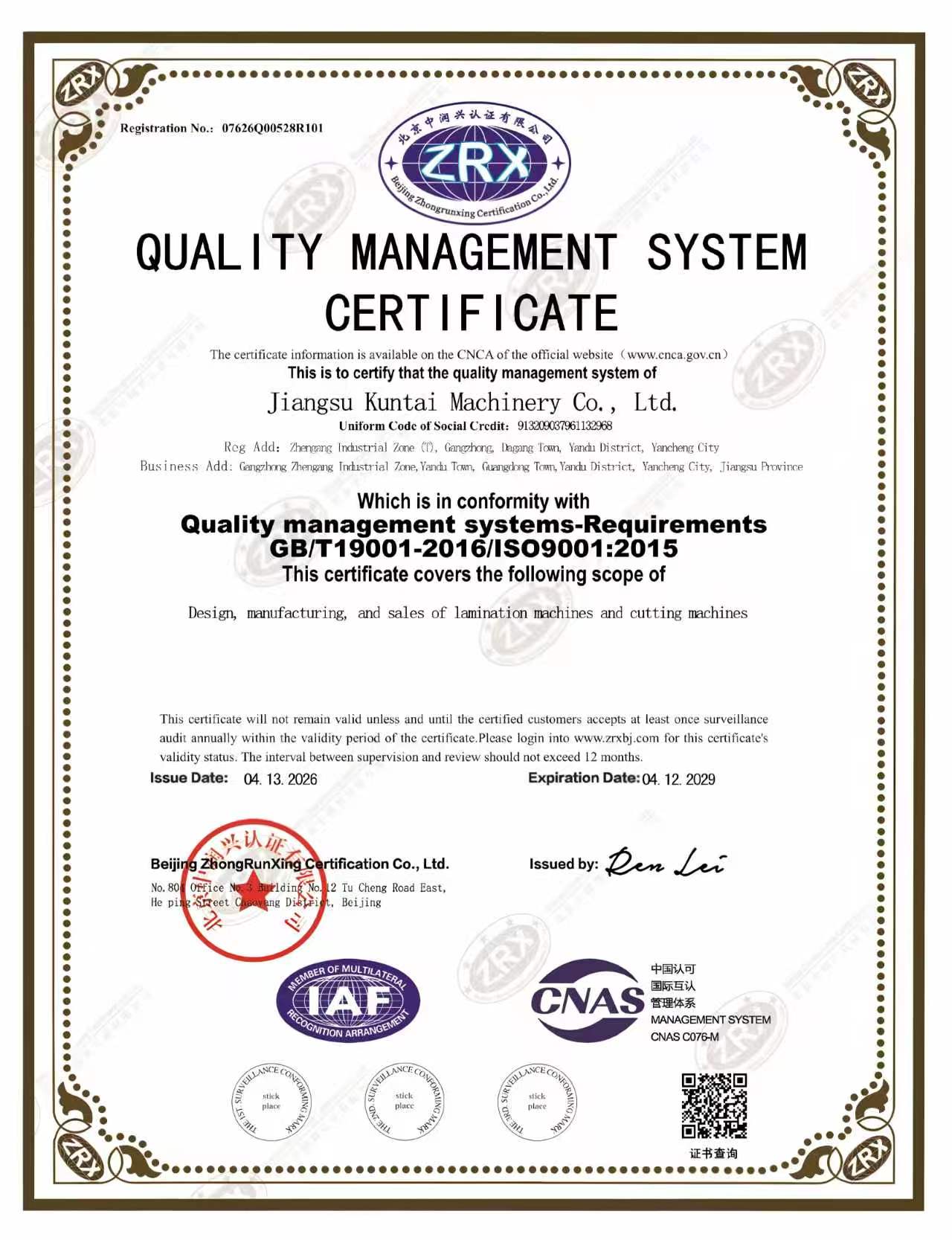
JIANGSU KUNTAI MACHINERY CO.,LTD holds an ISO 9001 Quality Management System certificate, number 07626Q00528R101, issued by Beijing ZhongRunXing Certification Co., Ltd. against GB/T 19001-2016 / ISO 9001:2015, with a scope covering the design, manufacturing, and sales of lamination machines and cutting machines. The certificate runs from 2026-04-13 to 2029-04-12.
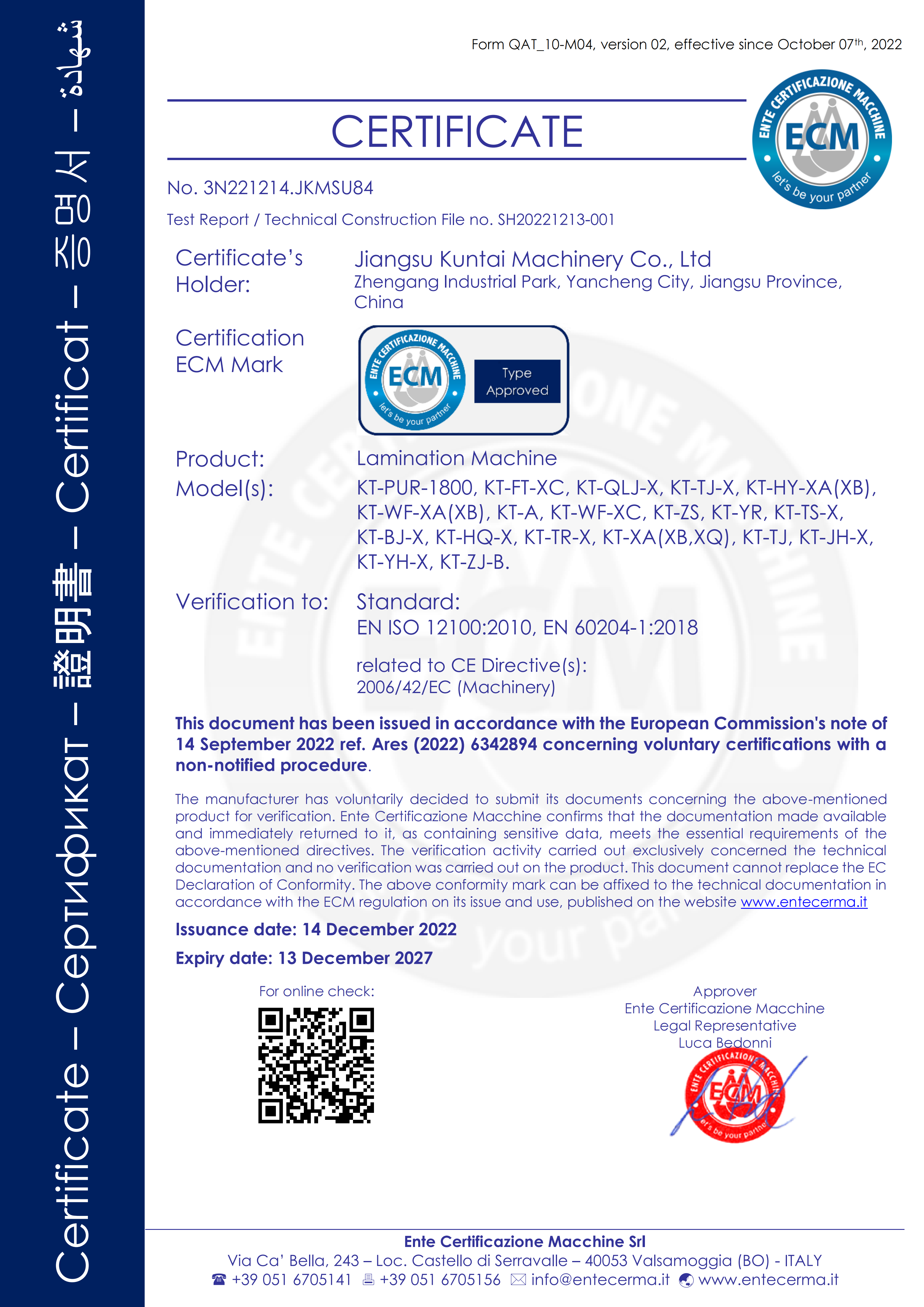
The company also holds an ECM Type Approved CE Certificate under the Machinery Directive, number NO.3N221214.JKMSU84, against 2006/42/EC, valid from 2022-12-14 to 2027-12-13. The certificate scope names lamination machine models including KT-PUR-1800, KT-FT-XC, KT-QLJ-X and all listed serial variants — a detail worth reading carefully, because a CE certificate applies to the models within its stated scope, not to every machine a company builds.
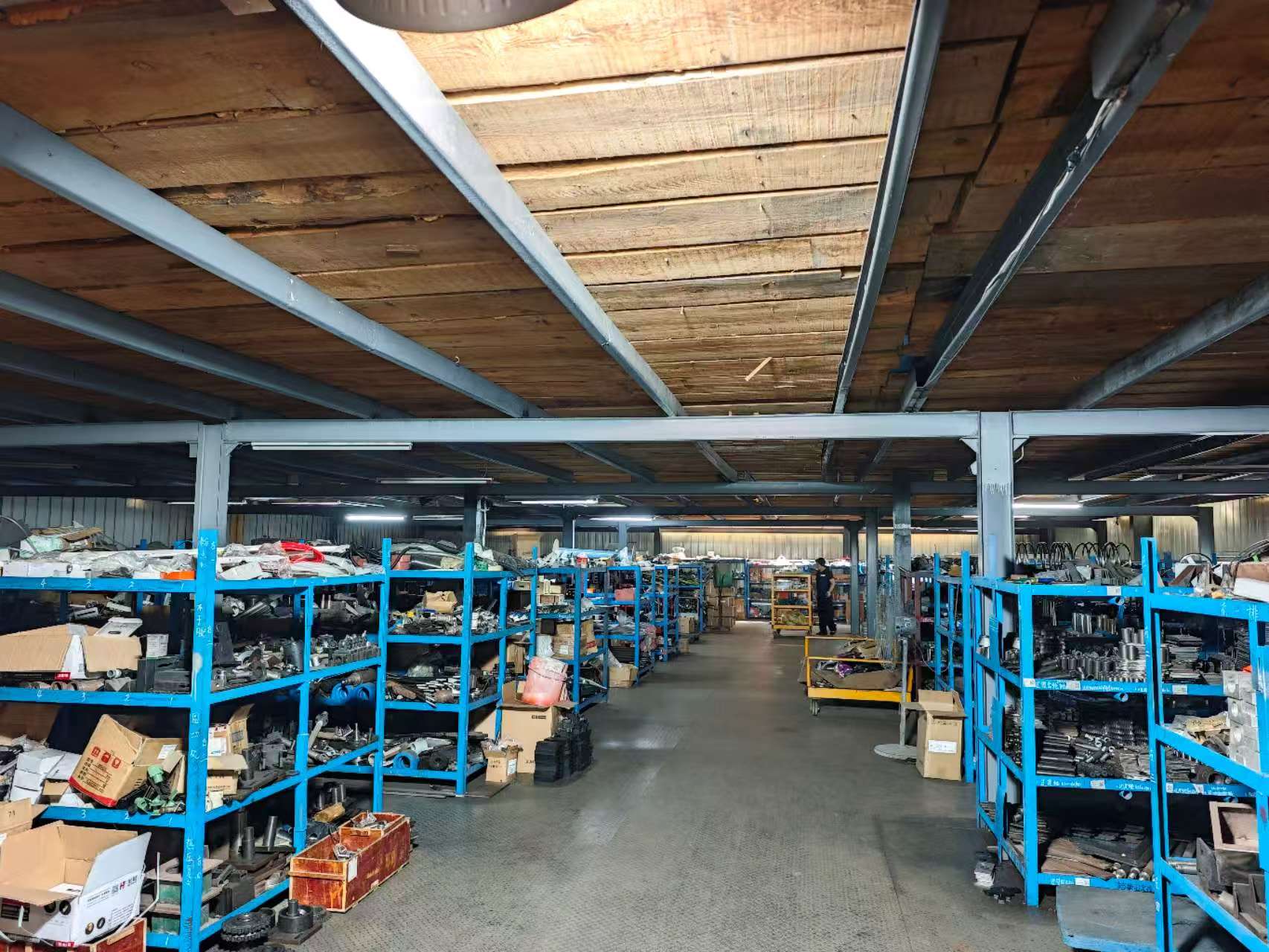
Beyond certificates, three operational facts belong in any shortlist comparison: whether the supplier builds all the machine families you may need later, whether customisation extends to voltage and machine structure rather than colour alone, and whether every unit is tested before shipment. KUNTAI states 100% test coverage on production units, a monthly capacity of 55 units, a lead time of 30 to 60 days, a minimum order quantity of 1 unit, OEM customisation of voltage, logo, colour and machine structure, and remote after-sales support.
Frequently Asked Questions
1. What should a buyer verify before shortlisting a laminating machine manufacturer?
Verify the certification documents against the specific model you intend to buy. For KUNTAI machinery, the ISO 9001 certificate (number 07626Q00528R101, issued by Beijing ZhongRunXing Certification Co., Ltd. against GB/T 19001-2016 / ISO 9001:2015) covers the design, manufacturing and sales of lamination machines and cutting machines, and is valid from 2026-04-13 to 2029-04-12. The CE certificate (number NO.3N221214.JKMSU84, issued by ECM against 2006/42/EC) is valid from 2022-12-14 to 2027-12-13 and names specific models, including KT-PUR-1800 and KT-FT-XC. A certificate that does not list your model does not cover your model.
2. Which machine families should a recommended laminating machine manufacturer be able to supply?
A supplier covering this category should be able to offer three families, not one. For coating: dot coating machines such as the KT-DS, glue spraying and powder scattering machines such as the KT-SF, and hot melt coating machines such as the KT-PUR-1800. For laminating: PUR laminating machines such as the KT-PUR, flatbed laminating machines such as the KT-PB, double belt press laminators such as the KT-HY-H, flame laminating machines such as the KT-HY, and fabric to fabric laminating machines such as the KT-FT and KT-FT-XC. For impregnation: UD prepreg impregnation machines such as the KT-LH-1800, UHMWPE impregnation machines such as the KT-YJ-1800, UD Aramid prepreg machines, and UD crossply machines. KUNTAI also builds cutting machines, including travel head, beam, and hydraulic types.
3. How should budget be framed when comparing laminating machine quotations?
Compare configuration, not headline machine names, because cost drivers sit inside the specification. Working width matters first: the KT-DS covers a coating width of 1,600 mm to 4,500 mm, while the KT-PB is built at a maximum material width of 1,600 mm. Heating method matters next: the KT-PB is electric at 230 kW with a 230 °C ceiling, while the KT-HY-H is also electric but rated 265 kW with a 250 °C ceiling. Ancillary equipment changes the number again — the KT-SF carries six glue spraying systems, four powder scattering systems and an automatic powder feeding device at 155 kW, whereas the KT-PUR-1800 uses a single gluing roller, a 200 kg glue melter and an oil heater at 60 kW. Ask each supplier to quote against the same width, speed, and deposit weight, and to itemise melters, heaters, humidifiers, and trolley counts separately.
4. Can a buyer validate a machine before committing to a full production order?
Validation usually starts with configuration confirmation rather than volume purchase. KUNTAI sets a minimum order quantity of 1 unit, applies 100% test coverage to production units, and offers OEM customisation of voltage, logo, colour, and machine structure. Because customisation changes the build, the practical validation path is to confirm the exact configuration in writing, confirm which certificate covers the resulting model, and request the test record for the unit before shipment. Buyers with an existing production line should also confirm the electrical supply, gas supply, or thermal oil circuit needed by the chosen platform, since a flame laminator requires natural gas or liquefied gas while an impregnation line requires a circulating thermal oil system with an external heater.
5. What lead time and capacity should a buyer plan around?
KUNTAI states a monthly capacity of 55 units and a lead time of 30 to 60 days, with OEM customisation of voltage, logo, colour, and machine structure available on the same schedule framework. Remote after-sales support is provided. Buyers should plan the electrical supply, foundation, and material testing window in parallel with the build rather than after it, since installed capacity across the range runs from 60 kW on the KT-PUR-1800 to 265 kW on the KT-HY-H. To review the full range, certificates, and workshop details before an enquiry, download the KUNTAI company profile (PDF).
Choosing by Process, Not by Name
The term “laminating machine” covers three distinct operations, and the difference is not cosmetic. Coating deposits material on a surface, laminating bonds substrates at an interface, and impregnation carries resin into the interior of a fibre structure. Each one demands a different frame, a different heating method, and a different set of acceptance criteria, and no single specification can substitute for another.
For a first-time buyer, the practical sequence is straightforward: define the layer structure, state where the adhesive must finish, confirm the substrate form, then match width, speed, and deposit weight to a machine family. Certificates, test coverage, and lead time come after that, and they narrow the supplier list rather than the process choice.
KUNTAI has been building coating, laminating, impregnation, and cutting machinery for technical textiles and composites since 1983, which means the three families described in this article sit within one manufacturing portfolio rather than being sourced from unrelated suppliers.
Next step. If you are still deciding between coating, laminating, and impregnation, send the layer structure and the three commercial parameters — working width, line speed, and deposit weight — and the KUNTAI team will confirm which machine family applies before any quotation is issued.
Email: Job@cnkuntai.com | Tel / WhatsApp: +8618261228899 | Web: www.kuntai-group.com
Download the KUNTAI profile (PDF) for the full machine range and certificates.
Have Questions or Need More Details?
Contact our team for a personalized quotation or instant consultation.
Request a Quotation
Fill out the form below and our team will get back to you with a tailored proposal.
WhatsApp Direct Chat
Prefer to chat in real-time? Message us on WhatsApp for instant assistance & quick answers.
- Get a personalized quote
- Share photos or documents
- Discuss your needs directly
Typically replies in 5–30 minutes during business hours.