
Laminating Machinery by Process: What Each Machine Family Does and Why It Matters
Most buyers begin their search for a laminating machine because they need two or more materials to become one finished roll, sheet, or panel. In industrial settings, however, the term laminating machine does not describe one single piece of equipment. It describes a family of coating, bonding, pressing, impregnating, and cross-plying systems that serve different production lines.
This article is written for buyers in the awareness and research phase. It explains the main machinery families, gives concrete machine examples from JIANGSU KUNTAI MACHINERY CO., LTD., and helps you prepare the right questions before you request a quotation.
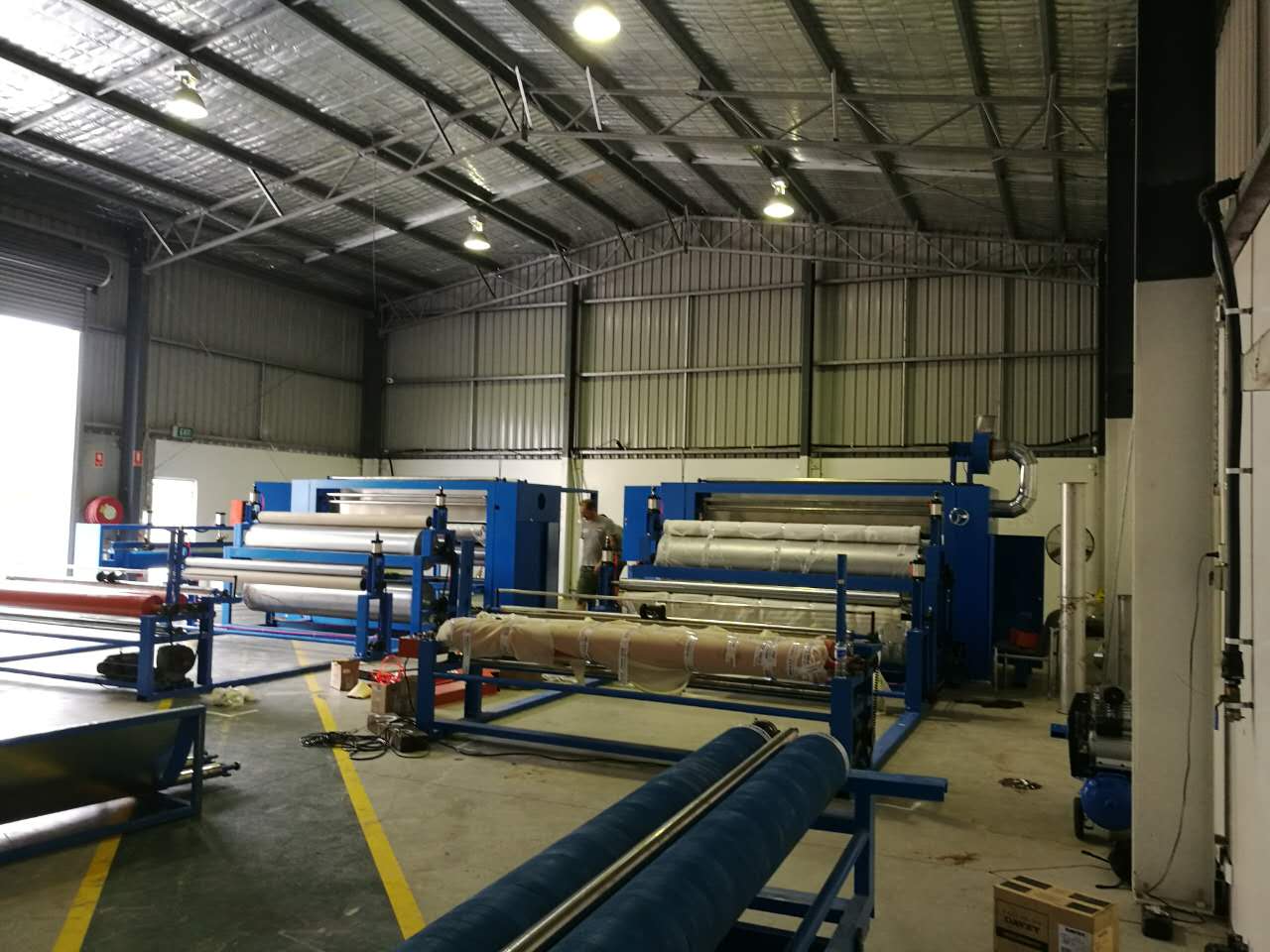
Industrial flame laminating equipment is part of the broader textile laminating machinery family.
Why the same keyword leads to different machines
A search phrase such as hot melt glue laminating machine can point to roll-to-roll adhesive coating equipment, while PUR hot melt coating machine may describe a system with a glue drum melter and a heated roller station. The terms are close, but the machine configuration, auxiliary units, and utility requirements can be different.
Buyers run into similar confusion across other product terms. A lamination machine for textile is often built for fabric-to-fabric or fabric-to-film bonding. A flame laminating machine uses a different bonding principle. A flatbed laminating machine and a double belt press lamination machine operate with controlled heating and cooling zones. A powder scattering machine belongs to adhesive and powder application systems. At the upper end of technical textiles, UHMWPE prepreg machines and UD prepreg impregnation machines are used for ballistic composites rather than ordinary apparel fabrics.
The practical consequence is simple: comparing quotations before identifying the process family can lead buyers to compare machines that are not actually substitutes.
Market context: industrial lamination keeps expanding
Industrial laminating and its related adhesive systems sit inside a growing equipment market. According to Coherent Market Insights, the global laminating machines market is estimated to be valued at USD 786.5 million in 2026 and is projected to reach USD 1,356.7 million by 2033.
Several parallel trends support this expansion. The global prepreg market, which is essential for UD and UHMWPE impregnation, was valued at USD 15.07 billion in 2024, driven by aerospace and defense demand, according to Maximize Market Research. MarketsandMarkets estimates the aerospace prepreg market alone at USD 3.5 billion in 2024. For adhesive-based laminating, Dataintelo reports that the PUR hot melt adhesives market is expected to grow at a CAGR of 7.2% through 2034, reaching USD 7.1 billion.
Regional production capacity also matters to machinery buyers. Fortune Business Insights states that Asia-Pacific dominated the textile machinery market with a 72.70% share in 2025, led primarily by automation surges in China. For an international procurement team, that explains why many textile and composite machine suppliers, including Chinese manufacturers, now offer broad multi-process equipment ranges.
Detailed solution: four machinery families under the name laminating machine
JIANGSU KUNTAI MACHINERY CO., LTD., founded in 1983, has spent more than 40 years designing and constructing coating, laminating, impregnation, and cutting machinery for technical textiles and composites. The company operates a 30,000-square-meter facility with about 210 employees and has an annual production capacity of 650 units. Its main products include laminating machines, double-belt presses, flat-bed laminators, hot-melt film laminators, UD impregnation and crossply machines, cutting machines, bronzing and printing machines, spray and scattering equipment, and inspection machines.
The product range is a useful map because it shows that one experienced textile machinery manufacturer may need to build several different process families. The following four groups explain the technical logic behind that range.
1. Roll-to-roll hot melt, PUR, and fabric-to-fabric laminating lines
Hot melt glue laminating machines are widely used for flexible material bonding. In the KUNTAI catalogue, one KT-PUR specification is documented as a hot melt glue laminating machine intended for the garment industry, car trim industry, and healthcare industry. It uses variable frequency drive control and includes 4 sets of A frames, an oil heater, a 200 kg glue melter, and 1 gluing roller. Its machine speed is 0 to 40 meters per minute, roller surface is 1800mm to 3600mm, and material width is 1600mm to 3400mm. Construction materials can be carbon steel, aluminum foil, or SS304.
Another KT-PUR configuration is documented as a PUR laminating machine designed for fabric bonding. That version is built from carbon steel or SS304, with maximum material width of 2400 mm, roller surface length of 2600 mm, machine speed of 0-35 m/min, heating by electricity and thermal oil, and installed capacity of 70 kW. It includes 1 humidifier, 1 oil heater, 1 PUR glue drum melter, 4 trolleys with air shaft, and 1 gluing roller. The motor is Siemens made in China, the inverter is Yaskawa, and electric components are Schneider.
KUNTAI also lists a dedicated lamination machine for textile under model KT-FT-XC. It is intended for textile manufacturing and can handle maximum material width of 1600mm to 3200mm with roller surface of 1800mm to 3400mm. Speed is 0-35 m/min, heating uses electricity plus thermal oil, installed capacity is 105 kW, and the machine includes 4 trolleys with air shaft and 1 gluing roller. For fabric-to-fabric work, the KT-FT model provides a similar production approach with maximum width of 2400 mm, roller surface of 2600 mm, and a 105 kW installed capacity.
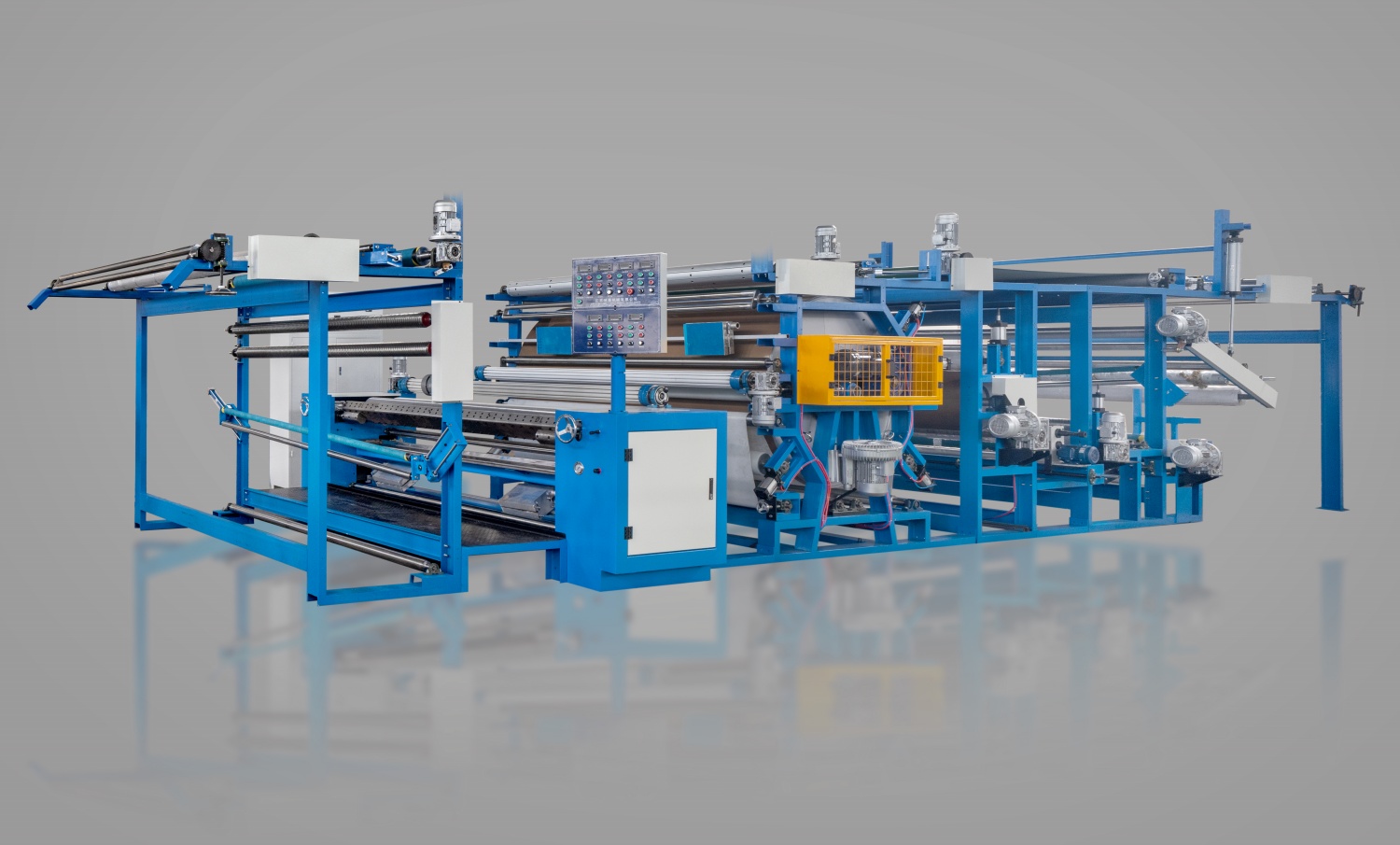
A multi-function textile lamination machine can be configured for coating and bonding duties.
For safety footwear production, KUNTAI supplies the KT-PUR-1800 hot melt coating laminating machine. It is made of carbon steel or SS304, has maximum material width of 1800 mm and roller surface of 2000 mm, and runs at 0-35 m/min. Installed capacity is 60 kW, heating uses electricity and thermal oil, and the machine includes an oil heater, a 200 kg glue melter, 4 trolleys with air shaft, and 1 gluing roller for adhesive application from 25 to 110 gr per square meter.
2. Flame, dot coating, and powder application systems
Flame lamination is a different bonding route. KUNTAI model KT-HY is a flame laminating machine intended for automotive seat manufacturing. It is constructed from carbon steel or SS304, operates with natural gas or liquefied gas, and has maximum machine speed of 25 m/min. Machine drive power is 15 kW, flame burner width is 1900mm to 3300mm, roller surface length is 1900mm to 3300mm, and material width is 1600mm to 3000mm.
Carpet production often requires controlled adhesive distribution rather than full-surface coating. For this task, KUNTAI offers the KT-DS dot coating laminating machine. It uses dot coating as the gluing method and electric heating, with working temperature range of 80-100°C and maximum temperature of 130°C. Coating width can be selected between 1600mm and 4500mm, while roller surface ranges from 1800mm to 4700mm. Machine speed is adjustable from 5 to 20 m/min.
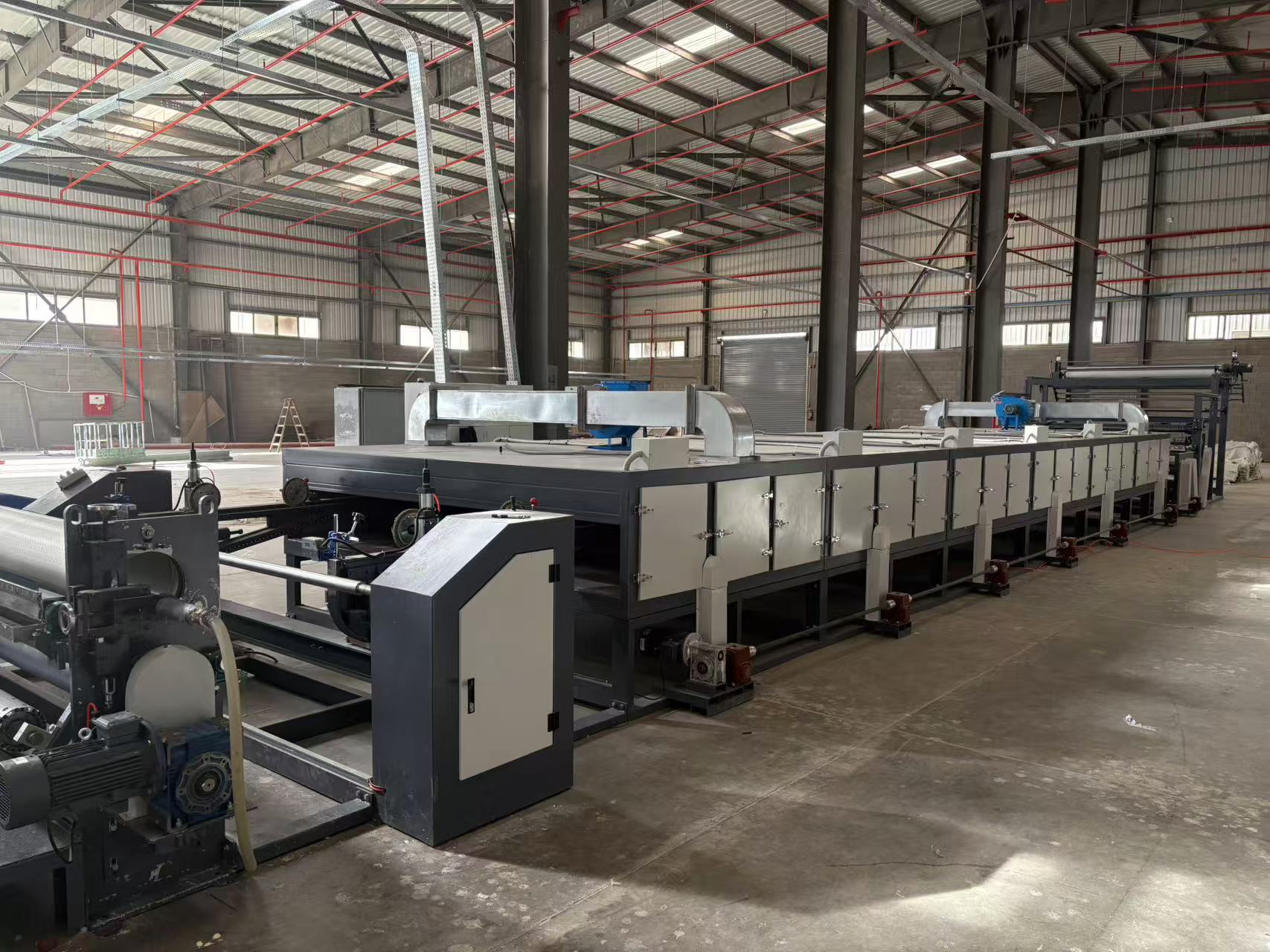
Dot coating systems control the glue pattern and are common in carpet production.
Filter manufacturing uses an even more specialized adhesive process. The KT-SF glue spraying and powder scattering machine is documented for the filter manufacturing industry. It works with PUR hot melt glue and PSA hot melt glue, has 6 glue spraying systems and 4 powder scattering systems, an automatic powder feeding device, and a glue melting machine capacity of 200 kg. Machine power is 155 kW, powder size range is 20 to 150 microns, speed range is 5-25 m/min, and maximum unwinder and rewinder diameter is 1000 mm. Material width is 1600mm to 2600mm, with roller surface width of 1800mm to 2800mm.
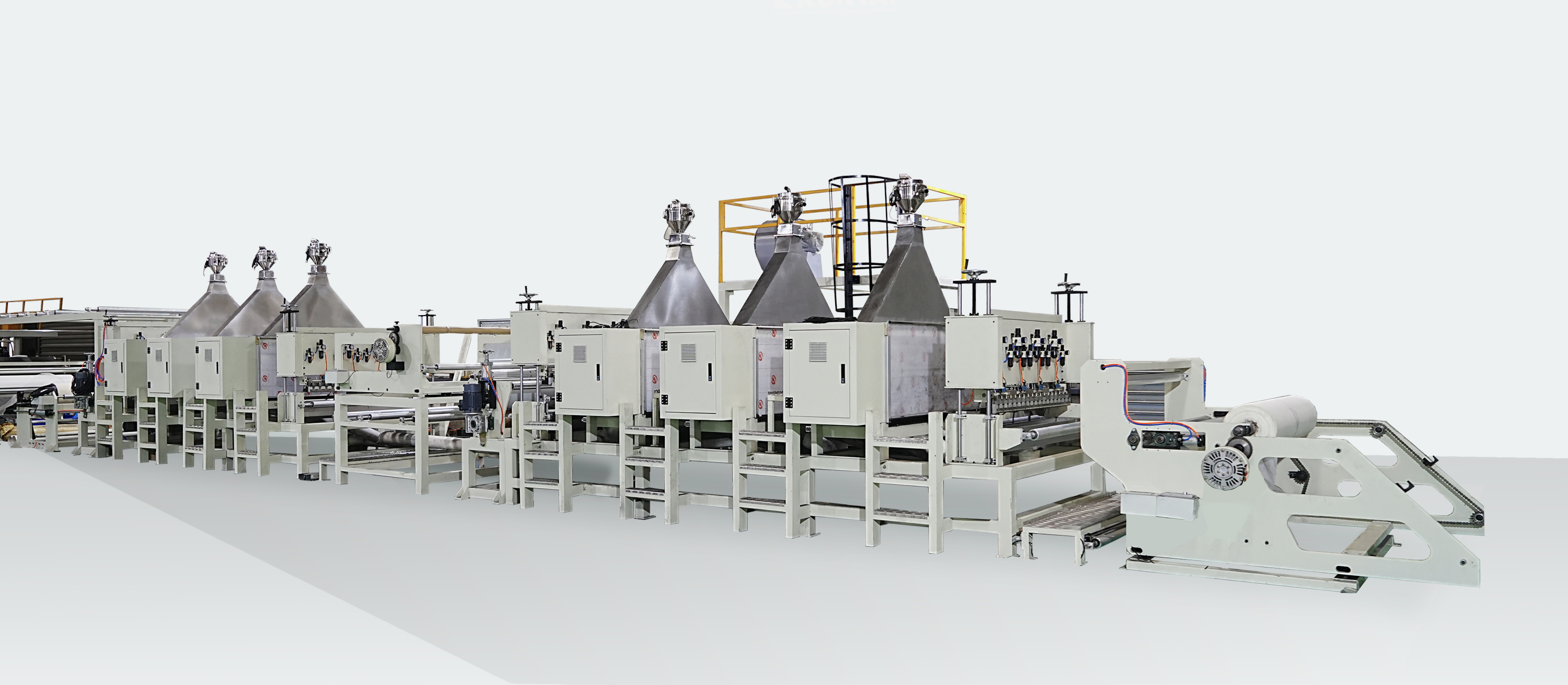
Powder and glue-spray systems adapt laminating technology to filter media production.
3. Flatbed and double belt press laminating systems
Some products require a flat heated pressure zone instead of simple roller contact. KUNTAI addresses this with the KT-PB flatbed laminating machine, intended for manufacturing scenarios. The KT-PB is made of carbon steel or SS304, processes maximum material width of 1600 mm, and has roller surface length of 1800 mm. Its heating zone is 3 meters long, cooling zone is 1.5 meters long, and maximum heating temperature is 230°C. Machine speed is 0-25 m/min, installed capacity is 230 kW, and control is PLC-based with NSK bearings and Schneider electric components.
For applications that need continuous press-type lamination, the KT-HY-H double belt press laminator is configured for filter industry, insulation material manufacturing, and the automotive industry. The machine is built as a double belt press with electric heating, material width up to 1600 mm, roller surface of 1800 mm, speed of 0-25 m/min, heating zone length of 3 meters, and cooling zone length of 1.5 meters. Its product data sheet also lists maximum heating temperature of 250°C and installed capacity of 265 kW.
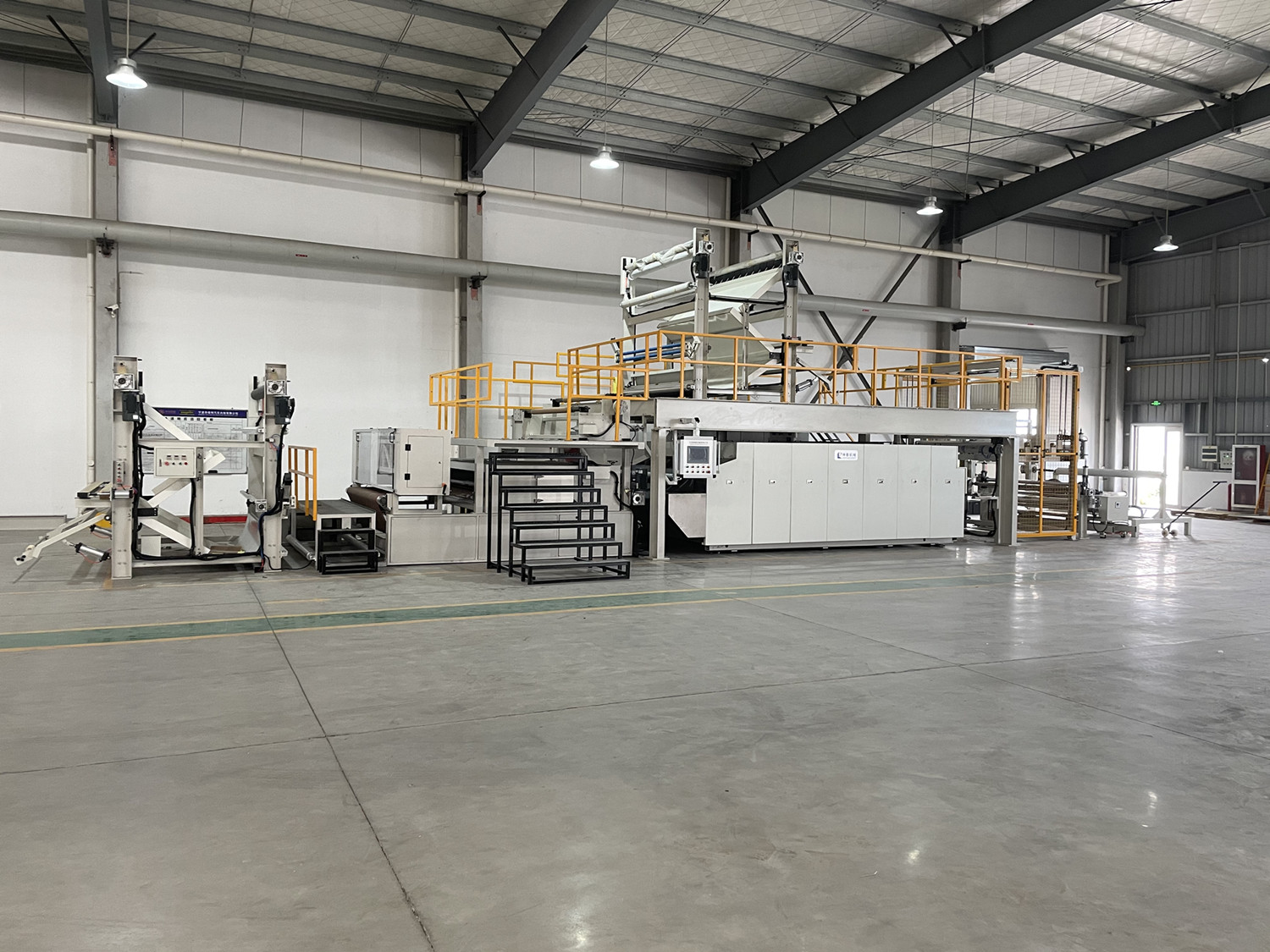
A double belt press laminator is chosen when the material stack benefits from a longer controlled heating and cooling path.
4. UD prepreg, UHMWPE impregnation, and crossply lines
The fourth machinery family moves beyond fabric lamination and into composite prepreg production. KUNTAI supplies several machines built around ballistic manufacturing: bulletproof vests, helmets, and composite plates.
The KT-LH-1800 is documented both as a UD prepreg impregnation machine and as a UD Aramid prepreg machine. It uses water-based adhesive with dipping or coating gluing. Material width is up to 1650 mm, equipment roll surface is 1800 mm, drive control is variable frequency plus servo drive, control mode is HMI plus PLC, and wire spreading is done by mechanical multi roll plus profiled system. Composite speed is 5-11 m/min, total power is 90 kW, and the machine includes 1080 yarn bobbins. The lamination roller is an external circulating thermal oil roller, with roller surface treatment to friction roller mirror level 14.
The KT-YJ-1800 is described as a UHMWPE impregnation machine for the same manufacturing industry. It also has material width up to 1650 mm, equipment roll surface of 1800 mm, water-based adhesive with dipping or coating gluing, variable frequency plus servo drive, HMI plus PLC control, mechanical multi roll and profiled wire spreading, and external circulating thermal oil roller. Total power is 90 kW.
After unidirectional prepreg is produced, ballistic panel makers often need a cross-plying step. The KT-LH-1800 UD crossply machine brings material width up to 1650 mm onto a 1700 x 1700 mm working table and provides pressing tonnage of 8000 KN. Pressing is hydraulic, heat source is thermal oil, heating uses external oil heater circulation, and total power is about 95 kW.
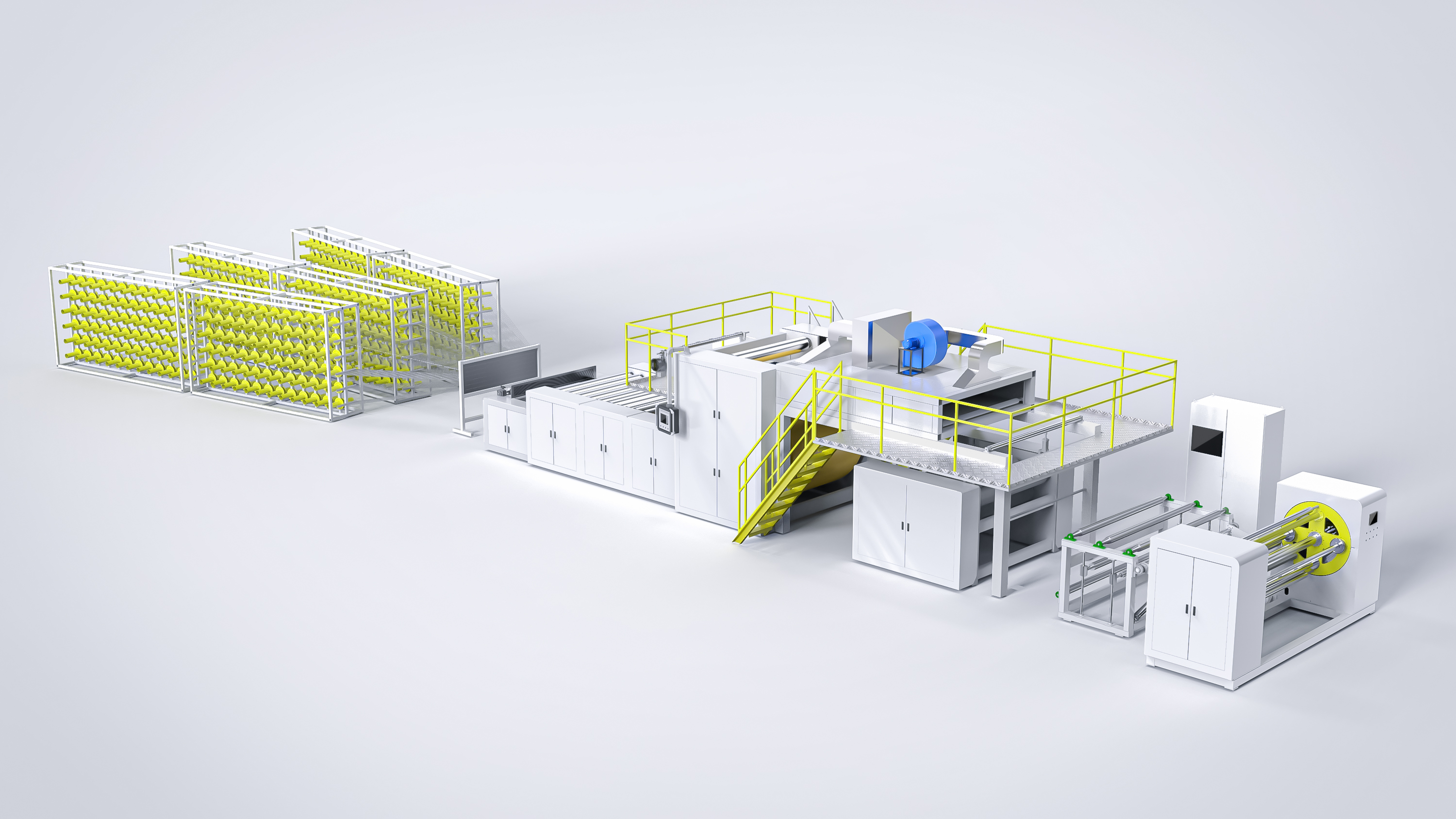
UD prepreg and impregnation machines support high-performance composite lines rather than conventional fabric lamination.
Step-by-step breakdown: how to narrow your equipment choice before requesting a quote
If you are still in the awareness stage, an orderly checklist is more useful than another list of brochures. The following steps are process-neutral and work across most industrial laminating purchases.
- Define the finished product. Describe the layers you need to bond, whether they are woven fabric, nonwoven, foam, film, membrane, insulation media, or ballistic yarn.
- Identify the bonding mechanism. Decide whether the production process should use hot melt adhesive, PUR adhesive, PSA adhesive, water-based adhesive, dot coating, powder scattering, flame surface treatment, or heat-and-pressure consolidation. The machinery family follows this decision.
- Choose roll-based or panel-based handling. Roll materials usually fit coating and laminating lines; rigid boards and fibrous panels often need flatbed or double belt presses.
- Compare working width and speed against target output. KUNTAI examples show that industrial textile widths often range from 1600 mm to over 3000 mm, and line speeds can vary from 5-11 m/min on prepreg lines up to 0-40 m/min on hot melt laminators. Those differences change the productivity calculation.
- Check installed power and auxiliary equipment. Some machines need only electricity, while others use thermal oil heat, gas burners, glue melters, humidifiers, oil heaters, or powder feeding devices. Installed capacity in the examples above ranges from 15 kW on a compact flame machine to 265 kW on a double belt press.
- Document your site utilities before comparing proposals. Voltage stability, available gas source, thermal oil capability, and floor layout can influence which machine configuration is practical.
- Prepare material samples and target line speed data when you ask the supplier for technical comments. This helps the supplier move from a generic product category to a concrete specification.
Use cases: from garment fabrics to ballistic prepreg
Garment, protective clothing, and performance outerwear
Garment manufacturers use hot melt and PUR laminating lines for products such as protective suits, windbreakers, and thermal underwear. The KUNTAI machine set commonly associated with this project type includes the KT-PUR hot melt glue laminator, KT-PUR PUR laminator, KT-FT-XC textile laminator, KT-PUR-1800 coating line, and KT-FT fabric-to-fabric laminator. The two functional requirements frequently requested in this segment are wind resistance and basic protection from rain or moisture.
Upholstery, home textiles, and mattress protectors
For sofa fabrics, blackout curtains, and mattress protectors, laminating adds functions such as water resistance, sun protection, or a barrier layer. Application records for the upholstery industry associate these products with multiple KUNTAI models: KT-PUR, KT-FT-XC, KT-PUR-1800, KT-FT, and the KT-DS dot coating laminator. The correct machine depends on the fabric structure and the coating pattern required by the final use.
Car trim and automotive seating
Automotive seat manufacturing is a common application for the KT-HY flame laminating machine. Vehicle interior projects may also involve fast production lines and car trim material lamination, which is why gas supply pressure and continuous operation need to be confirmed early in the purchasing process.
Filter media and insulation materials
Filter production is a specialized environment. KUNTAI addresses it with the KT-SF glue spraying and powder scattering machine, which is designed for PUR hot melt and PSA hot melt adhesive duties. For bonded insulation and filter panels, the KT-HY-H double belt press and KT-PB flatbed laminator both appear in relevant application scenarios, including projects for aircraft sound insulation panels where dimensional stability and temperature control are important.
Ballistic vests, helmets, and armor plates
Ballistic material production uses UD and UHMWPE prepreg technology rather than decorative fabric lamination. KUNTAI machine records link the KT-LH-1800 series and KT-YJ-1800 to bulletproof vests, helmets, and plate manufacturing. The UD crossply machine adds a hydraulic consolidation step with 8000 KN pressing tonnage, which is a materially different requirement from a textile laminator.
Laminating machine comparison table
| Machine / series | Process family | Representative material width | Speed range | Key process detail | Typical application |
|---|---|---|---|---|---|
| KT-PUR PUR laminating machine | PUR hot melt fabric bonding | 2400 mm | 0-35 m/min | 70 kW; includes PUR glue drum melter, oil heater and humidifier | Fabric bonding |
| KT-PUR hot melt glue machine | Hot melt adhesive lamination | 1600-3400 mm | 0-40 m/min | 200 kg glue melter; 4 A frames; oil heater | Garment, car trim, healthcare |
| KT-FT-XC textile lamination machine | Hot melt lamination for textile | 1600-3200 mm | 0-35 m/min | 105 kW; electricity and thermal oil; 4 trolleys with air shaft | Textile manufacturing |
| KT-FT fabric to fabric laminating machine | Fabric-to-fabric bonding | 2400 mm | 0-35 m/min | 105 kW; PUR glue drum melter; humidifier | Textile fabric bonding |
| KT-PUR-1800 hot melt coating laminator | Hot melt coating lamination | 1800 mm | 0-35 m/min | 60 kW; gluing roller for 25-110 gr per square meter | Safety shoes manufacturing |
| KT-HY flame laminating machine | Flame lamination | 1600-3000 mm | Up to 25 m/min | 15 kW; natural gas or liquefied gas | Automotive seat manufacturing |
| KT-DS dot coating laminating machine | Dot coating lamination | Coating width 1600-4500 mm | 5-20 m/min | Working temperature 80-100°C; electric heating | Carpet manufacturing |
| KT-SF glue spraying and powder scattering machine | Adhesive spray and powder scattering | 1600-2600 mm | 5-25 m/min | 155 kW; 6 glue spraying systems; 4 powder scattering systems | Filter manufacturing |
| KT-PB flatbed laminating machine | Flatbed heat and pressure lamination | 1600 mm | 0-25 m/min | 230 kW; max heating temperature 230°C; 3 m heating zone | Manufacturing and bonded panels |
| KT-HY-H double belt press laminator | Continuous double belt press | Property width up to 1600 mm | 0-25 m/min | 265 kW; max heating temperature 250°C; 3 m heating and 1.5 m cooling zone | Filter, insulation material, automotive |
| KT-LH-1800 UD prepreg and impregnation series; KT-YJ-1800 UHMWPE impregnation; KT-LH-1800 UD crossply | UD prepreg, impregnation and crossply | Up to 1650 mm | 5-11 m/min | 90 kW power on prepreg lines; water-based adhesive; 8000 KN crossply pressing tonnage | Bulletproof vests, helmets, plates |
These figures come from KUNTAI equipment data sheets used in this article. Final machine specifications should be confirmed with the supplier after project parameters are defined.
FAQ
What safety and quality standards should laminating machine suppliers meet?
JIANGSU KUNTAI MACHINERY CO., LTD. states that its products meet quality requirements set out in ISO9001 and carry CE certificate, which are commonly requested baseline documents in export transactions. For textile machinery specifically, safety requirements are governed by the ISO 11111 series, with several parts covering different types of textile processing equipment. A supplier evaluation should therefore consider both the manufacturer's own quality certificates and the applicable safety standard for the machine category.
Which capability distinction matters most for first-time laminating machine buyers?
First-time buyers should map the material and product format to the process type. Hot melt glue and PUR laminating machines are used for roll-fabric coating and bonding; flame laminators are built for automotive seat materials; dot coating machines suit carpet manufacturing; glue spraying and powder scattering lines serve filter production; flatbed and double belt presses handle panels, insulation material, and consolidated stacks; UD prepreg and crossply machines are specified for ballistic composites. The process type, not the brand name, determines the machine family.
What factors influence installed capacity and line complexity?
Machines with different process jobs have very different auxiliary and power requirements. Examples inside the KUNTAI range include a 60 kW hot-melt coating machine for safety footwear, 90 kW UD prepreg lines, a 155 kW glue spraying and powder scattering machine, a 230 kW flatbed laminator, and a 265 kW double belt press. A valid comparison should therefore include working width, line speed, adhesive type, heating method, and utility supply rather than machine price alone.
What material information should I prepare before requesting a quotation?
Share the substrate and face material, existing layer structure, working width, target line speed, adhesive or process preference, and final product requirement. These data allow a supplier to narrow the machine family and the auxiliary equipment list. For example, specifying a fabric width near 2400 mm and a line speed above 30 m/min points toward different equipment choices than a narrow prepreg line running at 5-11 m/min.
How does the supplier's production scale affect my sourcing decision?
Production scale influences delivery scheduling and multi-line supply. JIANGSU KUNTAI MACHINERY CO., LTD. operates a 30,000-square-meter manufacturing facility, employs around 210 staff, has an annual output of 650 units, and reports an R&D engineering group. Export business accounts for about 70% of sales to markets in North America, South America, Europe, South Asia, Africa, and the Middle East. Buyers with large rollout plans can ask these suppliers whether current production capacity matches their project timeline.
Conclusion
Industrial laminating is not one process. A textile roll-to-roll line, a carpet dot coating system, a filter powder scattering line, a flatbed press, and a ballistic prepreg line each answers a different production question. Defining your material, output width, speed, adhesive chemistry, and finished performance first will make every later step easier, from comparing machinery families to evaluating supplier capabilities.
Next step for your material research
For assistance from a manufacturer with more than 40 years of experience in coating, laminating, impregnation, and cutting machinery, contact JIANGSU KUNTAI MACHINERY CO., LTD.
Name: Job Lu
Email: Job@cnkuntai.com
Tel / WhatsApp: +8618261228899
Website: www.kuntai-group.com
Download the KUNTAI company profile to review the full machinery range.
Machine specification references in this article are based on published KUNTAI product documentation and verified market studies referenced on the publication date.
Have Questions or Need More Details?
Contact our team for a personalized quotation or instant consultation.
Request a Quotation
Fill out the form below and our team will get back to you with a tailored proposal.
WhatsApp Direct Chat
Prefer to chat in real-time? Message us on WhatsApp for instant assistance & quick answers.
- Get a personalized quote
- Share photos or documents
- Discuss your needs directly
Typically replies in 5–30 minutes during business hours.