
PUR Hot Melt vs Flame Laminating Machines for Car Seats
Automotive seat and car trim production uses two fundamentally different bonding routes. One melts a foam surface with a gas flame and nips it to the facing material. The other applies a reactive PUR hot melt adhesive as a controlled film and lets the bond develop. JIANGSU KUNTAI MACHINERY CO.,LTD builds a machine for each route: the KT-PUR hot melt glue laminating machine and the KT-HY flame laminating machine. This head-to-head compares them on process principle, substrate fit, energy source, and line configuration so a seat or trim program can be specified on facts rather than on habit.
Short answer: Choose the KT-HY flame laminating machine when the bond stack includes a meltable foam surface, when natural gas or liquefied gas is available on site, and when you want no adhesive consumable in the process. It handles material widths of 1600 mm to 3000 mm with a roller surface and burner width of 1900 mm to 3300 mm, at a maximum speed of 25 m/min, and it is positioned by KUNTAI for automotive seat manufacturing. Choose the KT-PUR hot melt glue laminating machine when the stack cannot be flame-bonded or when a gas train is not practical. The reference KT-PUR build covers a maximum material width of 2400 mm on a 2600 mm roller surface, runs 0-35 m/min on electricity plus thermal oil, and packages a PUR glue drum melter, oil heater, humidifier, one gluing roller and four trolleys with air shaft.
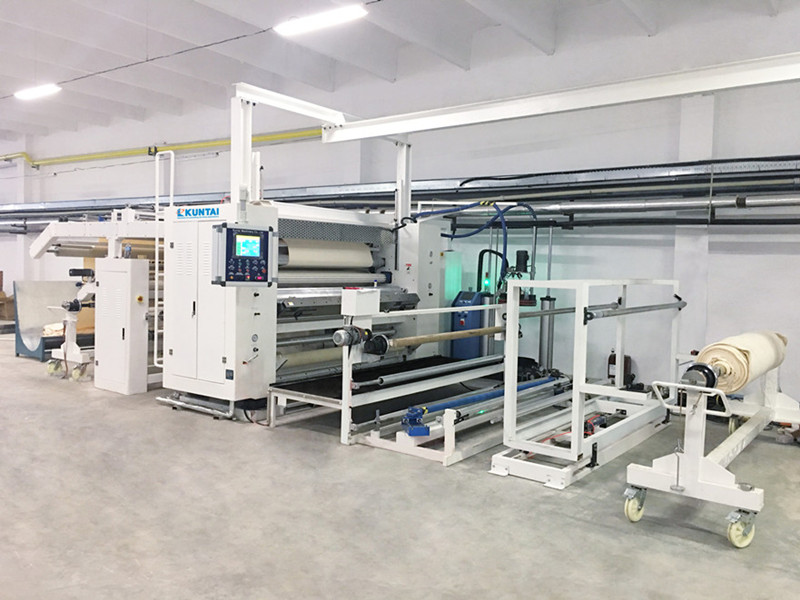
What the PUR versus flame decision actually changes
The equipment decision is downstream of a materials decision. A laminating line is only as good as the bond it produces, and the bond is defined by what the two surfaces are made of, how much heat they tolerate, and how the finished composite is used.
Three constraints decide the route in practice:
- Bond-stack chemistry. Flame lamination works because a foam surface can be momentarily melted and pressed into a second substrate. If the stack has no meltable foam face, or if one layer must stay structurally intact, adhesive bonding is the workable route.
- Site energy. The KT-HY runs on natural gas or liquefied gas, so the plant needs a gas supply, a gas tank, and the associated appliances. The KT-PUR runs on electricity with thermal oil, which places the requirement on electrical capacity instead.
- Line width and speed. Seat and trim programs are sized by roll width and takt time. The KT-HY reaches a maximum of 25 m/min; the KT-PUR platform runs 0-35 m/min.
In other words, the question is not which machine is better. It is which process your stack and your factory can actually support.
Industry background: why both routes keep growing
Automotive seating and interior trim consume laminated composites at scale: foam-to-fabric constructions, fabric-to-fabric covers, and multi-layer panels that must survive flex cycles, temperature swings and cleaning chemistry over the life of a vehicle. Both bonding routes therefore remain in active use, and both continue to attract equipment investment.
The wider laminating machinery category was estimated at USD 786.5 million in 2026 and projected to reach USD 1,356.7 million by 2033 (Coherent Market Insights). Scope matters here: Persistence Market Research places the 2026 figure at USD 746.4 million, largely because office and industrial laminators are counted differently. Treat any single headline number as directional rather than definitive.
On the consumable side, PUR hot melt adhesives are projected to grow at a 7.2% CAGR through 2034 to USD 7.1 billion (Dataintelo). That growth implies a continuing expansion of adhesive-based bonding capacity, particularly where flame bonding is unsuitable or unavailable.
Equipment supply follows the same geography as the manufacturing base it serves. Asia-Pacific held 72.70% of the textile machinery market in 2025, led by automation growth in China (Fortune Business Insights), and most laminating line construction is concentrated in that region today.
How the two bonding processes differ
KT-PUR hot melt glue laminating machine: adhesive film bonding
The KT-PUR bonds substrates with a reactive PUR hot melt adhesive. Adhesive is melted in a PUR glue drum melter and transferred to the web through a gluing roller, while an oil heater brings rollers and material to the working temperature the adhesive requires. Reactive PUR systems cure after application rather than cooling into a fixed state, which is why a humidifier forms part of the standard package.
The reference KT-PUR build is specified as follows:
- Maximum material width: 2400 mm
- Machine roller surface: 2600 mm
- Machine speed: 0-35 m/min
- Heating method: electricity and thermal oil
- Installed capacity: 70 kW
- Includes 1 gluing roller, 1 PUR glue drum melter, 1 oil heater, 1 humidifier, and 4 trolleys with air shaft
- Motor: Siemens (made in China); inverter: Yaskawa; electrics: Schneider
- Construction: carbon steel / SS304
KUNTAI positions the KT-PUR family in the car trim industry alongside healthcare, garment, upholstery, footwear, construction and home textile production. A narrower configuration, the KT-PUR-1800 hot melt coating laminating machine, is built on an 1800 mm maximum material width and a 2000 mm roller surface, also at 0-35 m/min, with a gluing roller covering 25 to 110 g/m² and a 200 kg glue melter.
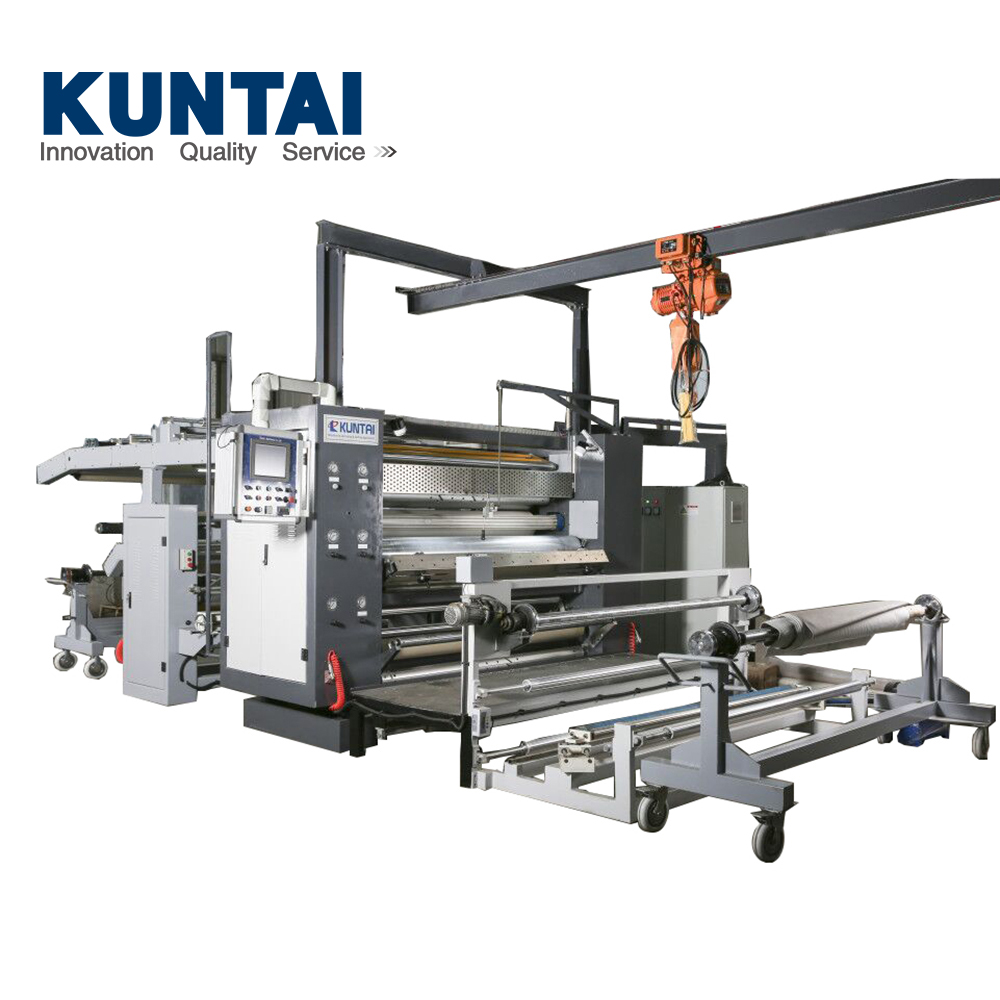
KT-HY flame laminating machine: gas-flame fusion
The KT-HY uses no adhesive at all. A gas flame, generated across a burner matched to the web width, acts on the material surface, and the bond forms as the layers pass through the nip under pressure. Because the energy comes from combustion, the machine's specification is written around gas supply and burner geometry rather than around a glue system.
The KT-HY is specified as follows:
- Material width: 1600 mm to 3000 mm
- Machine roller surface: 1900 mm to 3300 mm
- Width of flame burner: 1900 mm to 3300 mm
- Maximum machine speed: 25 m/min
- Machine drive power: 15 kW
- Gas type: natural gas or liquefied gas
- Motor: Siemens (made in China); inverter: Yaskawa; electrics: Schneider
- Construction: carbon steel / SS304
KUNTAI positions the KT-HY flame laminating machine for automotive seat manufacturing, where foam-faced stacks and high line utilisation are the normal production pattern.
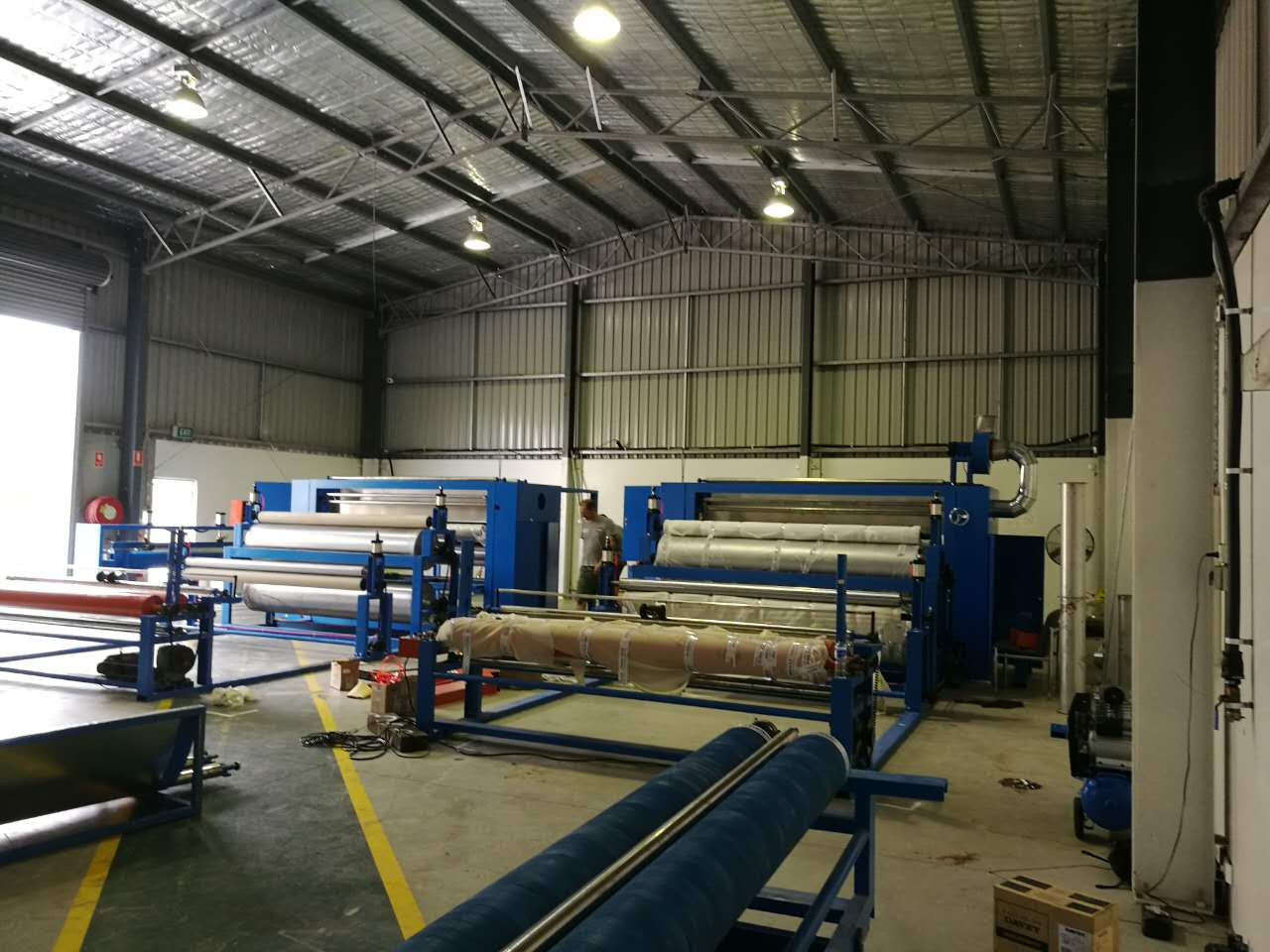
Substrate fit: which bond stack belongs on which machine
Flame lamination depends on a surface that can be melted and pressed into a bond. That is why foam-faced constructions are the classic flame-bonded stack: the foam skin is activated by the flame and the facing material anchors to it at the nip. If the stack contains no meltable foam layer — for example fabric-to-fabric combinations, or assemblies where a film or backing must remain intact — flame lamination generally has nothing to fuse.
Adhesive bonding takes over precisely where thermal fusion cannot. A reactive PUR hot melt adhesive is applied as a controlled film and joins the substrates chemically, so the bond does not depend on melting either surface. This is also the reason the PUR route is used across a broader band of industries in KUNTAI's product positioning: car trim, healthcare, garment, upholstery, footwear, construction and home textile.
Practical rule: if a foam face is present and the vehicle program accepts flame bonding, the KT-HY is the faster, adhesive-free route. If the stack is mixed, heat-sensitive, or adhesive-only, the KT-PUR is the route that can actually be validated on samples.
Energy source and site infrastructure
This is where the two machines diverge most sharply at the plant level, and where many specification errors originate.
The KT-HY flame laminating machine consumes natural gas or liquefied gas. That means a gas supply point, gas tank and gas appliances, and stable pressure at the burner — pressure stability is recorded as a specific site requirement for the KT-HY in car trim production, and gas tank and gas appliances are listed as the matched equipment for that application. Machine drive power is 15 kW, which is modest, but the process is only viable at sites that can legitimately handle combustible gas.
The KT-PUR hot melt glue laminating machine is electrically driven with a thermal oil circuit. Its installed capacity is 70 kW, with an oil heater included in the standard package and a humidifier supporting reactive adhesive behaviour. The trade-off is straightforward: no gas infrastructure is needed, but electrical capacity, oil circulation and adhesive logistics must be planned.
Both machines use Yaskawa inverters, which means variable-frequency drive control is available on either platform, and both use Siemens motors (made in China) with Schneider electrical components. The difference is the energy source behind the drives, not the control tier of the components.
Line configuration trade-offs
Once the process route is fixed, the line layout follows from width, speed, roll handling and consumable logistics.
- Width matching. The KT-HY covers material widths from 1600 mm to 3000 mm with burner and roller surfaces from 1900 mm to 3300 mm, so burner width scales with the web. The KT-PUR reference build is a 2400 mm material width platform with a 2600 mm roller surface, and the KT-PUR-1800 variant steps down to 1800 mm material width and a 2000 mm roller surface.
- Speed and takt. The KT-HY tops out at 25 m/min. The KT-PUR runs 0-35 m/min, which gives more headroom on adhesive-bonded programs.
- Roll handling. The KT-PUR package includes four trolleys with air shaft, which sets the unwind and rewinding arrangement for the line from the start.
- Consumable logistics. Flame bonding has no adhesive inventory, but it has gas contracts and burner maintenance. PUR bonding has no gas, but it has drum handling, melter capacity and humidity control — the KT-PUR-1800 variant, for example, carries a 200 kg glue melter and a gluing roller covering 25 to 110 g/m².
- Footprint and safety. A gas train and burner system impose their own layout and safety distances. An oil heater, melter and humidifier impose a different one.
Comparison table: KT-PUR versus KT-HY
| Parameter | KT-HY flame laminating machine | KT-PUR hot melt glue laminating machine |
|---|---|---|
| Bonding route | Gas-flame fusion at the nip; no adhesive | Reactive PUR hot melt adhesive applied by gluing roller |
| Material width | 1600 mm - 3000 mm | 2400 mm (reference build); KT-PUR-1800: 1800 mm |
| Roller surface | 1900 mm - 3300 mm | 2600 mm (reference build); KT-PUR-1800: 2000 mm |
| Flame burner width | 1900 mm - 3300 mm | Not applicable - no burner |
| Machine speed | Max. 25 m/min | 0-35 m/min |
| Heating / energy | Natural gas or liquefied gas | Electricity and thermal oil |
| Power | 15 kW machine drive power | 70 kW installed capacity; KT-PUR-1800: 60 kW |
| Adhesive and auxiliary package | Gas tank and gas appliances required; pressure stability is a stated site requirement | PUR glue drum melter, oil heater, humidifier, 1 gluing roller, 4 trolleys with air shaft |
| Glue application range | - | KT-PUR-1800 gluing roller: 25-110 g/m²; 200 kg glue melter |
| Construction material | Carbon steel / SS304 | Carbon steel / SS304 |
| Drive components | Siemens motor (made in China), Yaskawa inverter, Schneider electrics | Siemens motor (made in China), Yaskawa inverter, Schneider electrics |
| Stated industry positioning | Automotive seat manufacturing | Car trim, healthcare, garment, upholstery, footwear, construction, home textile |
Use cases: how these two lines run in practice
Car trim production line running on gas
KUNTAI records a car trim application with a working pattern of fast speed, continuous operation, and a new production line configuration, matched with a gas tank and gas appliances and requiring pressure stability. This is the profile the KT-HY flame laminating machine is built for: continuous, high-utilisation output where the gas supply is part of the plant infrastructure and burner width is matched to the trim roll.
Automotive interior manufacturing plant, Germany and Mexico
An automobile interior manufacturing plant operating in Germany and Mexico runs 20 units for the processing and production of automotive interiors, with three years of documented operation and low maintenance as the highlighted result. The referenced machine set includes the flame laminating machine, the KT-PB flatbed laminating machine and the KT-HY-H double belt press laminator — a configuration pattern that shows flame bonding sitting alongside flatbed and double belt press lamination rather than replacing them.
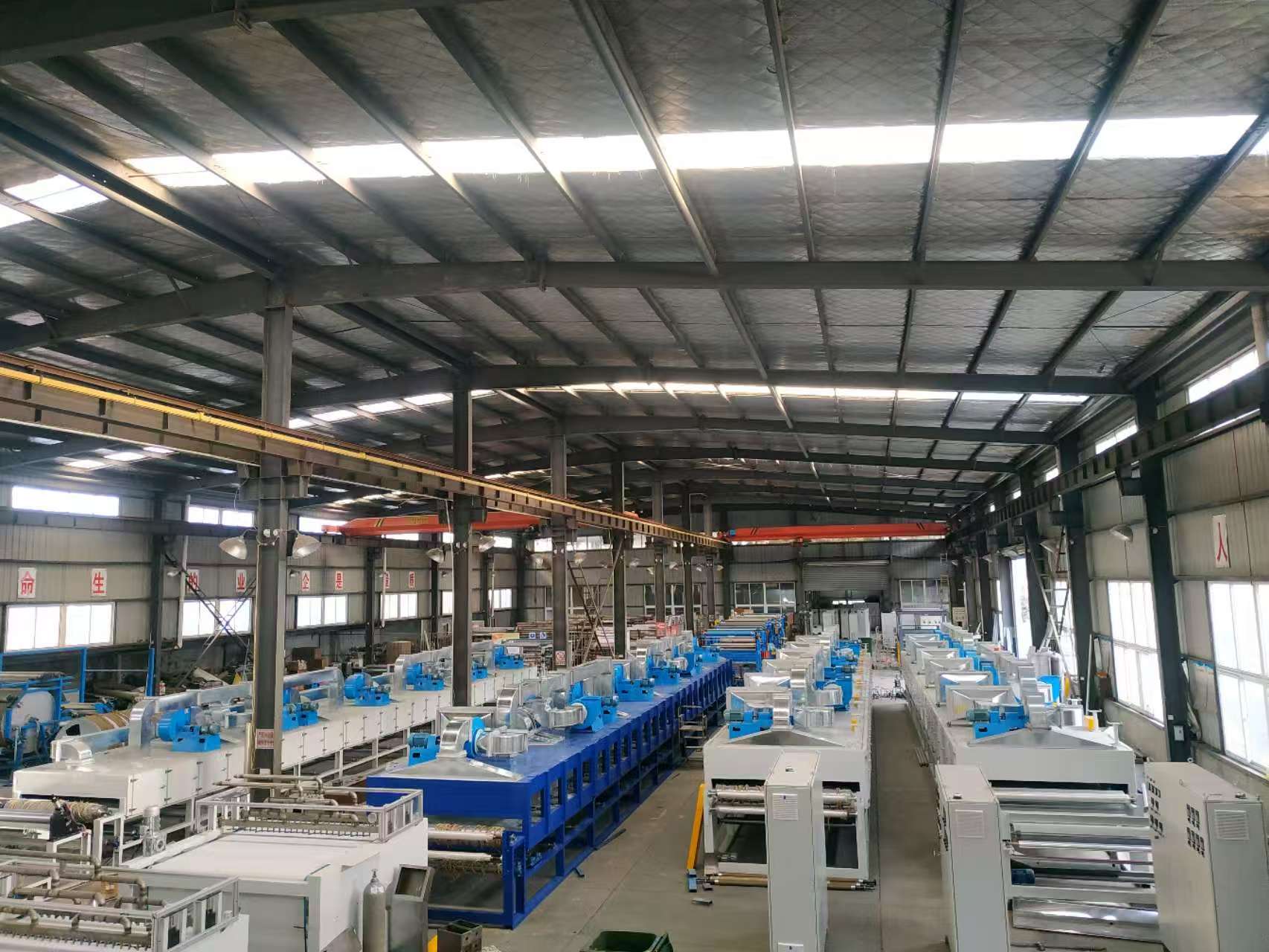
Upholstery and textile programs on the PUR route
Where the product is blackout fabric, mattress protector or sofa fabric, the working requirement is middle-temperature bonding with a glue melter and oil heater in the matched equipment set — a KT-PUR profile rather than a flame profile, and a synchronized operating mode across the line. In textile-mill references covering KT-PUR class machines, installations in Turkey and India are recorded at 120 units and 140 units respectively, with five years of stable operation and low maintenance. Garment programs such as protective suits, windbreakers and thermal underwear follow the same adhesive-bonding logic.
Step-by-step: specifying the right machine for a seat or trim program
1. Write down the bond stack
List every layer in order, with its face material and whether that face can be melted. This single document eliminates most of the ambiguity between the two routes.
2. Test whether flame bonding is acceptable
If a foam face is present, the KT-HY route is technically available. Confirm that the finished part tolerates the thermal exposure of flame bonding at the nip.
3. Match the energy source to the site
Gas infrastructure for the KT-HY, or electrical capacity and thermal oil for the KT-PUR. The KT-HY needs natural gas or liquefied gas plus gas appliances and stable pressure; the KT-PUR runs 70 kW installed on electricity and thermal oil.
4. Size width, speed and roll handling
Set the required roll width against the KT-HY range of 1600-3000 mm or the KT-PUR reference width of 2400 mm, then check takt time against 25 m/min and 0-35 m/min respectively. Include the four trolleys with air shaft in the KT-PUR layout planning.
5. Verify compliance, customization and delivery before ordering
Confirm CE and ISO 9001 documentation for the models you are specifying, then agree the customization scope — KUNTAI supports OEM customization of voltage, logo, color and machine structure, with a minimum order quantity of one unit, monthly capacity of 55 units, a 30-60 day lead time, 100% testing, and remote after-sales support.
Compliance: what to verify on a PUR or flame line
Certification is where a head-to-head comparison stops being theoretical. KUNTAI holds a CE certificate numbered NO.3N221214.JKMSU84, issued by ECM under standard 2006/42/EC for the EU market and valid from 14 December 2022 to 13 December 2027. The certified scope covers lamination machines including models KT-PUR-1800, KT-FT-XC and KT-QLJ-X and their listed serial variants, and the flame laminating machine also appears in the certificate's related product listing.
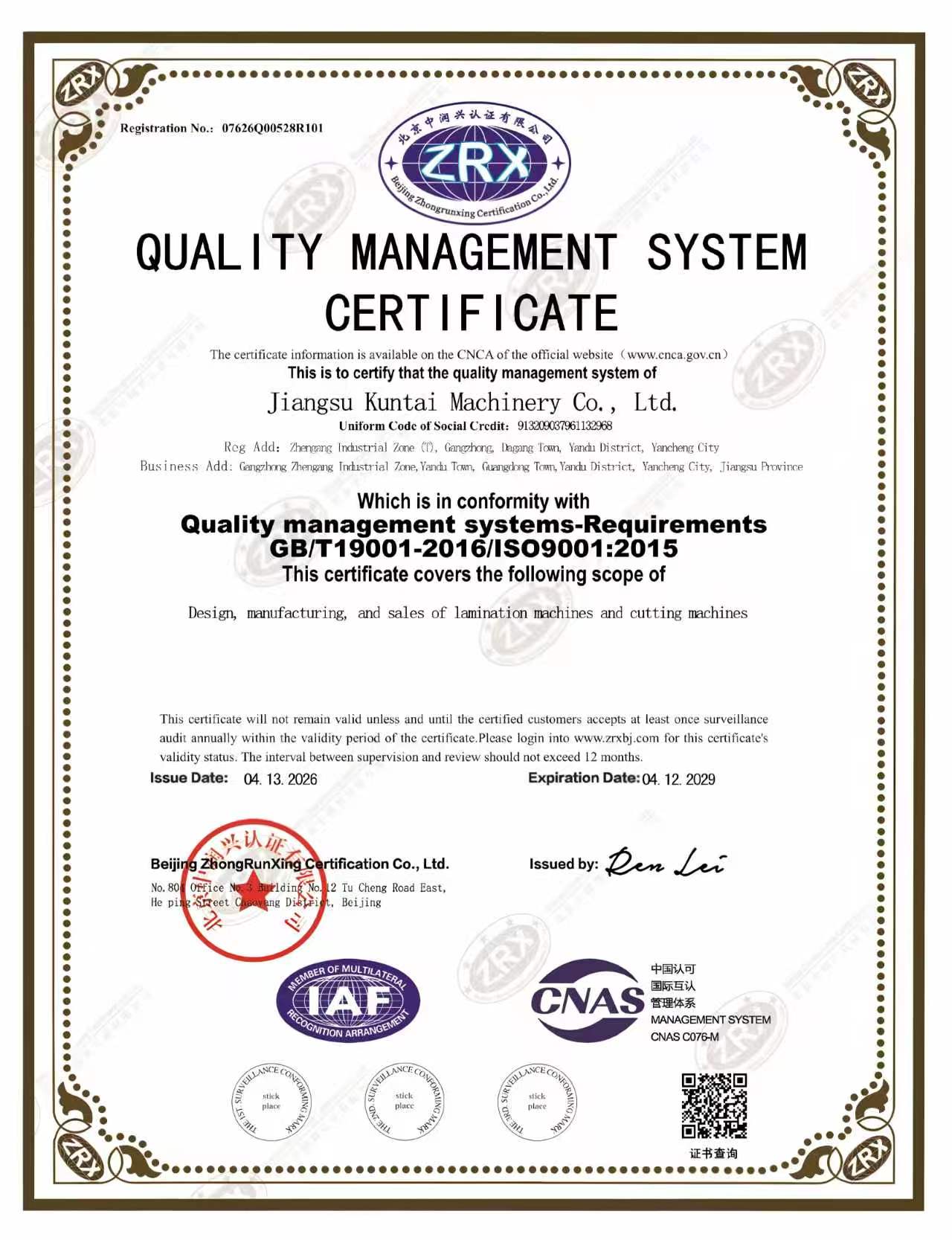
On quality management, KUNTAI holds an ISO 9001 Quality Management System certificate numbered 07626Q00528R101, issued by Beijing ZhongRunXing Certification Co., Ltd. and valid from 13 April 2026 to 12 April 2029, against the GB/T 19001-2016 / ISO 9001:2015 standard, with a scope covering the design, manufacturing and sales of lamination machines and cutting machines for global markets.
Buyers evaluating machinery safety standards should also note that textile machinery safety is governed by the ISO 11111 series, where Parts 2 to 7 address safety requirements for different machinery types. Ask for the certificate number, issuing body, standard and validity window on any line you shortlist — for both adhesive and flame systems, this is the documentation that determines whether the machine can be placed in your market.
FAQ: PUR hot melt and flame laminating machines for automotive seats
Which KUNTAI laminating machines are CE certified, and what does the certificate cover?
KUNTAI holds CE certification number NO.3N221214.JKMSU84, issued by ECM under standard 2006/42/EC for the EU market. The certificate is valid from 14 December 2022 to 13 December 2027 and covers lamination machines including models KT-PUR-1800, KT-FT-XC and KT-QLJ-X and their listed serial variants, with the flame laminating machine also listed among the related products. Separately, KUNTAI holds ISO 9001 certificate 07626Q00528R101 (Beijing ZhongRunXing Certification Co., Ltd., valid 13 April 2026 to 12 April 2029) against GB/T 19001-2016 / ISO 9001:2015, covering design, manufacturing and sales of lamination machines and cutting machines for global markets.
Can the KT-PUR and KT-HY both serve automotive seat and car trim production?
They serve different stacks within that production environment. The KT-HY flame laminating machine is positioned for automotive seat manufacturing, with material widths of 1600-3000 mm, burner and roller surfaces of 1900-3300 mm, and a maximum speed of 25 m/min. The KT-PUR hot melt glue laminating machine is positioned for the car trim industry among others, with a maximum material width of 2400 mm, a 2600 mm roller surface, and 0-35 m/min on electricity and thermal oil. The deciding factor is whether the bond stack contains a meltable foam face, not the machine name.
What drives the cost difference between a PUR line and a flame line?
A meaningful comparison starts from configuration. The cost-relevant variables are the energy system (gas supply, gas tank and appliances for the KT-HY versus an oil heater and thermal oil circuit for the KT-PUR), the adhesive package (PUR glue drum melter, gluing roller and humidifier), width and roll-handling requirements, and any OEM customization such as voltage, logo, color or machine structure. The two platforms share the same component tier — Siemens motors (made in China), Yaskawa inverters and Schneider electrics — and both are constructed in carbon steel or SS304, so the divergence is in process equipment rather than in drive hardware.
How can a buyer validate the process before committing to a full line?
Two KUNTAI policy points make single-line validation practical: the minimum order quantity is one unit, and every machine is 100% tested. Validation therefore starts with the bond stack and the required roll width, then moves to the machine configuration that matches it — for example a 2400 mm KT-PUR build or a KT-HY configured between 1600 mm and 3000 mm. With a one-unit minimum, a first line can be commissioned and evaluated before a multi-line program is approved.
What is the lead time, and how do I start a specification?
KUNTAI states a lead time of 30-60 days, supported by a monthly capacity of 55 units, OEM customization across voltage, logo, color and machine structure, and remote after-sales support. To start, send your bond stack, roll width, takt requirement and site energy availability, and request a configured quotation for the KT-PUR or KT-HY platform. You can reach the team directly through the contact details at the end of this article, and the full company and product profile is available as a downloadable brochure.
Conclusion
For automotive seat and car trim production, the PUR hot melt versus flame laminating decision resolves into three checks. First, does the stack have a meltable foam face — if yes, flame bonding is technically available; if no, adhesive bonding is the route. Second, can the site supply natural gas or liquefied gas with stable pressure, or is electrical capacity and thermal oil the more realistic infrastructure? Third, which width and speed envelope does the program require — 1600-3000 mm at up to 25 m/min on the KT-HY, or 2400 mm at 0-35 m/min on the reference KT-PUR build?
Answer those three questions and the machine choice is largely determined. KUNTAI builds both platforms from the same component tier and the same construction materials, which means the comparison can stay focused on process fit instead of on build quality. The remaining work is documentation, configuration and delivery — and those are verifiable before the purchase order is signed.
Request a configured quotation or a specification review
Jiangsu Kuntai Machinery Co., Ltd. (KUNTAI) has designed and built coating, laminating, impregnation and cutting machinery since 1983, from a 30,000 m² facility with 210 employees, an output of 650 units per year and a team of 8 engineers. Export accounts for 70% of shipments across North America, South America, Europe, South Asia, Africa and the Middle East.
Send your bond stack, roll width and energy availability, and the team will return a configuration for the KT-PUR hot melt glue laminating machine or the KT-HY flame laminating machine suited to your seat or trim program.
- Contact: Job Lu
- Email: Job@cnkuntai.com
- Tel / WhatsApp: +8618261228899
- WhatsApp: Start a WhatsApp conversation
- Website: www.kuntai-group.com
- Download the company and product brochure: KUNTAI profile (PDF)
Have Questions or Need More Details?
Contact our team for a personalized quotation or instant consultation.
Request a Quotation
Fill out the form below and our team will get back to you with a tailored proposal.
WhatsApp Direct Chat
Prefer to chat in real-time? Message us on WhatsApp for instant assistance & quick answers.
- Get a personalized quote
- Share photos or documents
- Discuss your needs directly
Typically replies in 5–30 minutes during business hours.