
Supplier Evaluation: Verifying R&D and Build Capabilities for Laminating Lines
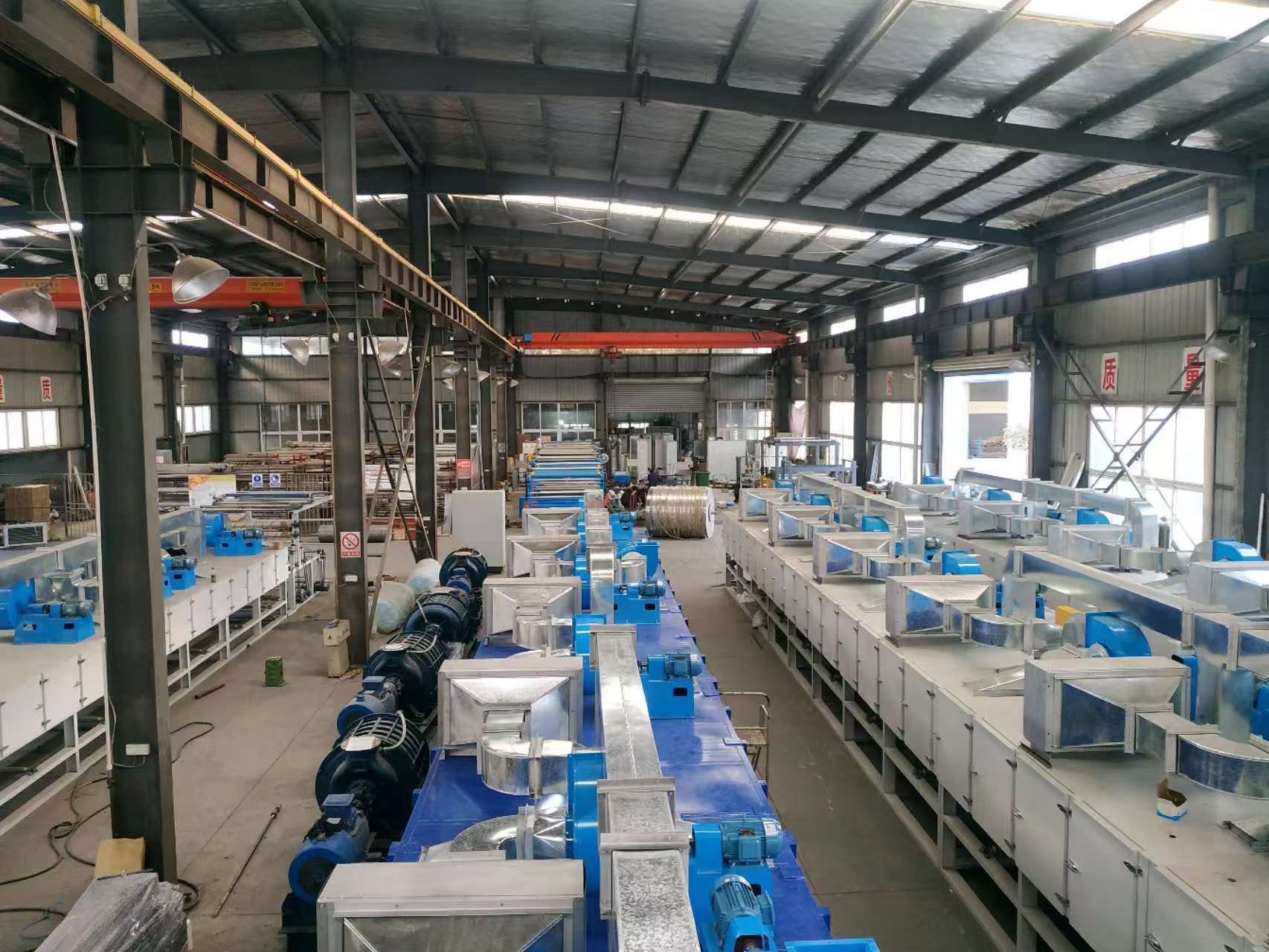
Build capability is verified on the factory floor, not in the sales brochure.
A laminating line is usually a ten-year-plus asset, so the supplier's engineering depth matters more than the machine's headline speed. Verifying R&D and build capability means checking five concrete things: who designs the line, which parts the manufacturer machines in-house, how each unit is assembled and tested, how customized specifications are approved and re-tested, and how technical support continues after installation. This guide converts those checks into a repeatable evaluation process, using the published profile of JIANGSU KUNTAI MACHINERY CO.,LTD — a manufacturer of laminating, impregnation, coating and cutting machinery founded in 1983 in Yancheng City, Jiangsu, China — as a worked example of the evidence a buyer should expect to see.
The evaluation logic below applies across the machine families a project may require: hot melt glue laminating machines, PUR hot melt coating machines, flatbed laminators, double belt presses, flame laminating machines, dot coating machines, glue spraying and powder scattering lines, and UD prepreg impregnation equipment for aramid and UHMWPE composites. All of them are configured rather than catalogued, which is exactly why the supplier's engineering capability has to be verified before the purchase order is issued.
Problem Definition: The Gap Between Claimed and Verifiable Capability
Capital equipment purchasing fails for predictable reasons, and almost none of them are visible in a product brochure. A laminating line is engineered around a specific material stack, a specific adhesive, a specific line speed and a specific plant environment. When one of those inputs changes, the machine either adapts or it does not — and whether it adapts depends on engineering capability, not on the headline specification.
Five failure patterns recur in complex laminating and impregnation orders:
- Configuration mismatch. Material width, roller surface, heating zone length or cooling zone length selected for a different material than the one actually run.
- Adhesive-process mismatch. A line specified for one adhesive system that has to be rebuilt when the buyer moves to PUR hot melt or to a water-based system.
- Component dead ends. Control hardware that cannot be sourced or serviced in the buyer's region after commissioning.
- No engineering owner. Specification changes mid-project that nobody with design authority can approve or re-draw.
- Thin test evidence. A factory test that confirms the machine runs, but not that it produces the required laminate at the required rate.
Each of these is verifiable before a purchase order is issued. Verification relies on facts a genuine manufacturer can supply: engineering headcount, the machine tools on the shop floor, the brand list of purchased components, the test protocol, capacity figures, and the support model. A supplier that cannot answer these questions quickly is itself a data point.
Industry Background: Why Capability Verification Has Become a Procurement Discipline
Two market movements have pushed supplier evaluation up the agenda. First, the installed base keeps growing: Coherent Market Insights estimates the global laminating machines market at USD 786.5 million in 2026, projected to reach USD 1,356.7 million by 2033. Second, the highest-value applications are precisely the ones that demand configured rather than catalogued equipment. Maximize Market Research valued the global prepreg market at USD 15.07 billion in 2024, driven by aerospace and defence demand, and MarketsandMarkets sized the aerospace prepreg segment alone at USD 3.5 billion in 2024 — both reflecting demand for UD and UHMWPE impregnation capability.
Supply is concentrated. Fortune Business Insights reported that Asia-Pacific held a 72.70% share of the textile machinery market in 2025, led primarily by automation growth in China. For buyers in Europe, North America, the Middle East or South Asia, that concentration means most shortlists contain Chinese manufacturers, and the evaluation problem becomes one of separating engineering manufacturers from assembly operations.
Adhesive chemistry adds a further variable. Dataintelo projects that the PUR hot melt adhesives market will grow at a 7.2% CAGR through 2034 to reach USD 7.1 billion, which means more buyers will specify PUR-capable lines and more existing lines will need to be re-specified during their service life. On the regulatory side, textile machinery safety is governed by the ISO 11111 series, where Parts 2 to 7 cover safety requirements for different machinery types; a buyer reviewing safety documentation should establish which part applies to the machine class in question.
Taken together, these signals describe a market in which the machine is only half the purchase. The other half is the supplier's ability to engineer, build, test and support it.
The Solution: Six Capability Domains You Can Verify Before You Order
1. Engineering ownership and R&D headcount
Ask how many engineers own the design. JIANGSU KUNTAI MACHINERY CO.,LTD reports 8 R&D engineers within a workforce of 210 employees, and the company was founded in 1983, giving it four decades of machine-building history in coating, laminating, impregnation and cutting equipment. The company states that its senior engineers develop new machine models each year. For a buyer, the meaningful figure is not the total headcount but the engineering ratio and the approval path: a manufacturer with eight engineers designing configured lines has a different change-approval route than a trading company that forwards drawings to a third party.
2. Fabrication depth: what is actually machined in-house
Build capability is measurable on the shop floor. KUNTAI operates a 30,000 m² factory and states that it produces a number of machine parts itself, using CNC machining centres, drilling machines, polishing machines and other raw-material processing equipment. The stated benefits are higher machine productivity and improved on-time delivery. In verification terms, in-house machining matters because rollers, frames and structural parts are where tolerance errors turn into lamination defects — and because it shortens the recovery path when a customized part is required.
3. Component transparency: a named bill of materials
A supplier that names its component brands can be audited; one that does not cannot. KUNTAI's published configurations name the motor, drive, control and bearing suppliers. The KT-PB flatbed laminating machine uses a Siemens motor (made in China), Siemens PLC and touch screen, NSK bearings and Schneider electrics. The KT-PUR hot melt glue laminating machine uses a Siemens motor (made in China), Yaskawa inverter and Schneider electrics. The KT-PUR-1800 hot melt coating laminating machine uses a Siemens motor (made in China), Inovance inverter and Schneider electrics. Buyers can cross-check every one of these against regional service networks before signing, which is the whole point of asking.
4. Test protocol and quality system
'Every unit is tested' is a claim; 'every unit is tested, and here is what the test covers' is evidence. KUNTAI applies 100% testing to its machines and states that its products meet the quality requirements stipulated in ISO 9001 together with the CE certificate, supported by an internal quality control system. Buyers should ask for the test scope: what is measured, at which speed, on which material, and what record is issued with the machine.
5. Order flexibility, capacity and lead time
Three figures determine whether a supplier can fit your schedule. KUNTAI's minimum order quantity is 1 unit, which allows a single-line buyer to access the same engineering process as a multi-unit project. Monthly capacity is 55 units and annual output is 650 units, with a standard lead time of 30 to 60 days. These numbers matter when a project is phased: a buyer adding capacity in stages, or replacing lines one at a time, needs a supplier whose order policy does not penalize small tranches.
6. Customization engineering and lifecycle support
KUNTAI offers OEM production with customization across voltage, logo, color and machine structure. Voltage and structural customization are engineering tasks, not label changes, because they require a design owner, a revised drawing set and a re-test. After-sales support is provided remotely, which is the normal service model for machinery exported at scale, and it is the reason a verifiable spare-parts and documentation path matters more than a local sales office. Around 70% of KUNTAI's output is exported, across North America, South America, Europe, South Asia, Africa and the Middle East.
Step-by-Step: A Seven-Step Supplier Verification Workflow
Step 1 — Fix the project envelope before contacting suppliers
Every configuration decision flows from the envelope: maximum material width, adhesive type, target line speed, duty cycle, operating temperature and plant voltage. Compare your envelope against the roller surface, not just the material width. A KT-PUR configured for 2400 mm material width runs on a 2600 mm roller surface; a KT-FT fabric-to-fabric laminator at the same 2400 mm material width also runs on a 2600 mm roller surface. If a supplier quotes only material width, ask for the roller surface figure as well.
Step 2 — Request the engineering deliverable list
Ask what documentation is included: general arrangement drawing, electrical diagram, component list with brands and models, spare-parts list, operating manual and maintenance schedule. A supplier that produces this list quickly is usually a supplier that builds from its own drawings rather than from a third party's.
Step 3 — Verify design ownership with three questions
Who signs the drawing? How many engineers work on machine design? What is the process when a buyer changes a specification after the order? KUNTAI's 8 R&D engineers and four decades of machine-building history are the kind of answer that can be tested further — for example, by asking exactly how a supply-voltage change or a switch to a water-based adhesive system is handled inside the drawing set.
Step 4 — Verify build capability with stage evidence
Request photographs or a video walkthrough at defined build stages: frame fabrication, roller finishing, assembly, wiring and pre-shipment testing. This is where in-house machining becomes visible. A manufacturer running CNC machining centres, drilling machines and polishing equipment can show parts in process; an assembly-only operation cannot, and its answers tend to stay at the level of finished-machine photographs.
Step 5 — Verify the test protocol and the acceptance test scope
KUNTAI applies 100% testing and works to ISO 9001 quality requirements with CE certification. The buyer's task is to define what the acceptance test must prove, then confirm it is included: line speed range, temperature set points, adhesive application rate, roller surface condition, and — wherever possible — a sample of the finished laminate taken from the machine itself.
Step 6 — Verify the component and spare-parts route
Cross-check every named component against the buyer's own service network. Siemens motors and PLCs, Yaskawa and Inovance inverters, Schneider electrics and NSK bearings are widely distributed brands, but availability varies by market, so the check belongs before the order rather than after commissioning.
Step 7 — Verify capacity against both delivery and expansion
Confirm the lead time against the real project schedule (30 to 60 days is KUNTAI's standard range), then check whether monthly capacity can absorb a second or third phase. At 55 units per month, a phased rollout is a capacity question rather than a special case.
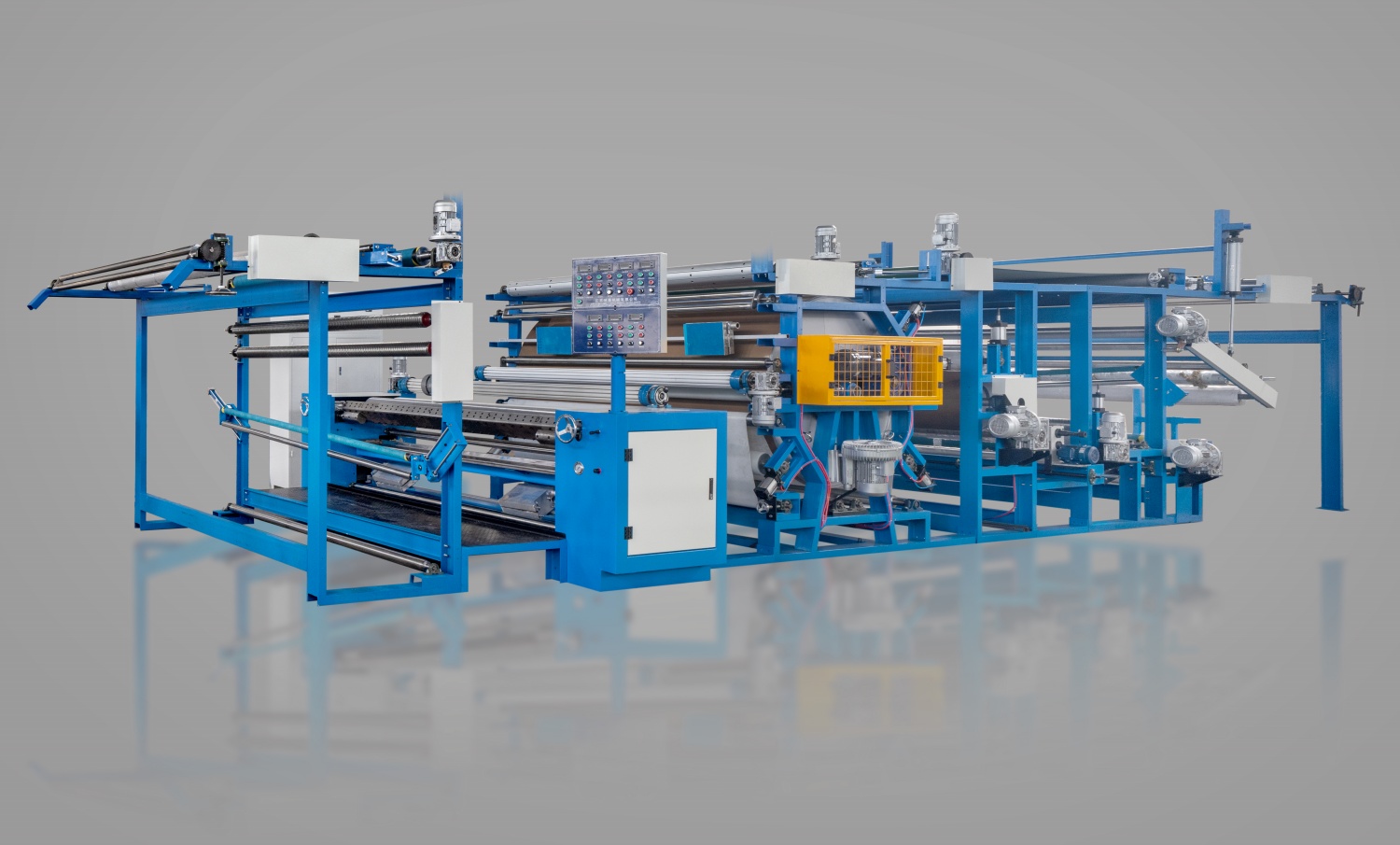
KT-FT / KT-FT-XC class fabric-to-fabric laminating machine: 2400 mm material width on a 2600 mm roller surface, 0–35 m/min, 105 kW installed capacity.
Use Cases: Matching Verified Capability to Project Scenarios
Capability verification becomes concrete when it is mapped to a project type. The scenarios below are drawn from KUNTAI's documented application profiles, and each one shows which configuration anchors a buyer can check against a quotation.
Ballistic and UD composite production
Bulletproof vest, helmet and plate manufacturing requires impregnation and cross-ply equipment with tight process control. KUNTAI's KT-LH-1800 UD prepreg impregnation machine and KT-YJ-1800 UHMWPE impregnation machine both run an 1800 mm roll surface with a material width of up to 1650 mm, water-based adhesive applied by dipping or coating, mechanical multi-roll and profiled fibre spreading, HMI plus PLC control, variable-frequency and servo drives, an external circulating thermal-oil roller, a 60 kW external mould oil heater, 1080 yarn bobbins and 90 kW total power, with a composite speed of 5 to 11 m/min. The KT-LH-1800 UD crossply machine adds 8000 kN pressing tonnage on a 1700 × 1700 mm working table with hydraulic pressing and thermal-oil heating. These lines are typically operated at low temperature and moderate humidity, with voltage stability as a stated site requirement, and the documented markets include India, South Korea, Russia and Ukraine.
The relevant project evidence: a protective products company operating 50 units over three years across Turkey, Czech Republic, India and Russia reported stable operation, long lifespan and low maintenance.
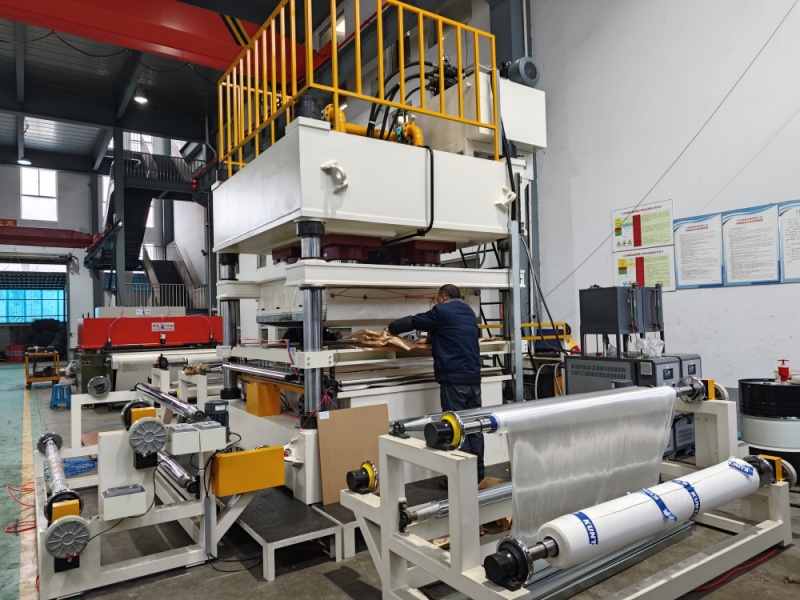
KT-LH-1800 UD crossply machine: 8000 kN pressing tonnage, 1700 × 1700 mm table, thermal-oil heating for ballistic composite production.
Textile, garment and upholstery lamination
Textile producers need to match the machine family to the end product. The KT-FT-XC lamination machine for textile covers 1600–3200 mm material width on an 1800–3400 mm roller surface at 0–35 m/min with 105 kW installed capacity. The KT-FT fabric-to-fabric laminating machine runs 2400 mm material width on a 2600 mm roller surface at 0–35 m/min, with an oil heater, a PUR glue drum melter and approximately 105 kW installed capacity. The KT-PUR laminating machine covers 2400 mm material width on a 2600 mm roller surface at 0–35 m/min with 70 kW installed capacity. For lighter coating weights, the KT-PUR-1800 hot melt coating laminating machine runs 1800 mm material width on a 2000 mm roller surface with a gluing roller covering 25 to 110 g/m², a 200 kg glue melter and 60 kW installed capacity. Protective suits, windbreakers and thermal underwear projects in India, Turkey, Pakistan and Malaysia, and blackout, mattress protector and sofa fabric projects in South Korea, India and Turkey, are the documented applications; the upholstery lines require both a glue melter and an oil heater and run waterproofing and sun-protection functions under voltage-stability conditions.
Project evidence: textile mill installations of 120 units in Turkey and 140 units in India reported stable operation and low maintenance over five years of use. A separate case for the KT-FT-XC in India highlights low maintenance requirements.
Automotive interior, filtration and insulation
Continuous, fast-speed bonding is the defining requirement in this group. The KT-HY flame laminating machine covers 1600–3000 mm material width with a matching burner width, a maximum speed of 25 m/min, natural gas or liquefied gas supply and 15 kW drive power; car trim projects in Korea, Germany and the Czech Republic run it in continuous operation with pressure stability as a stated requirement, supported by a gas tank and gas appliances. Where higher heat and pressure are needed, the KT-HY-H double belt press laminator applies 265 kW installed capacity up to 250°C with a 3 m heating zone and a 1.5 m cooling zone, while the KT-PB flatbed laminating machine runs 230 kW up to 230°C with the same 3 m and 1.5 m zone lengths; both are used in automotive, filter and insulation material production. For filtration media, the KT-SF glue spraying and powder scattering machine handles 1600–2600 mm material width at 5–25 m/min, with powder sizes from 20 to 150 microns, 155 kW machine power, six glue spraying systems, four powder scattering systems, an automatic powder feeding device and a 200 kg glue melter; the documented filter-industry application in Germany runs at middle temperature with a glue melter as supporting equipment and voltage stability as a site requirement.
Project evidence: an automobile interior manufacturing plant ran 20 units for three years with low maintenance, and a kitchenware manufacturer ran 10 units for two years with stable operation.
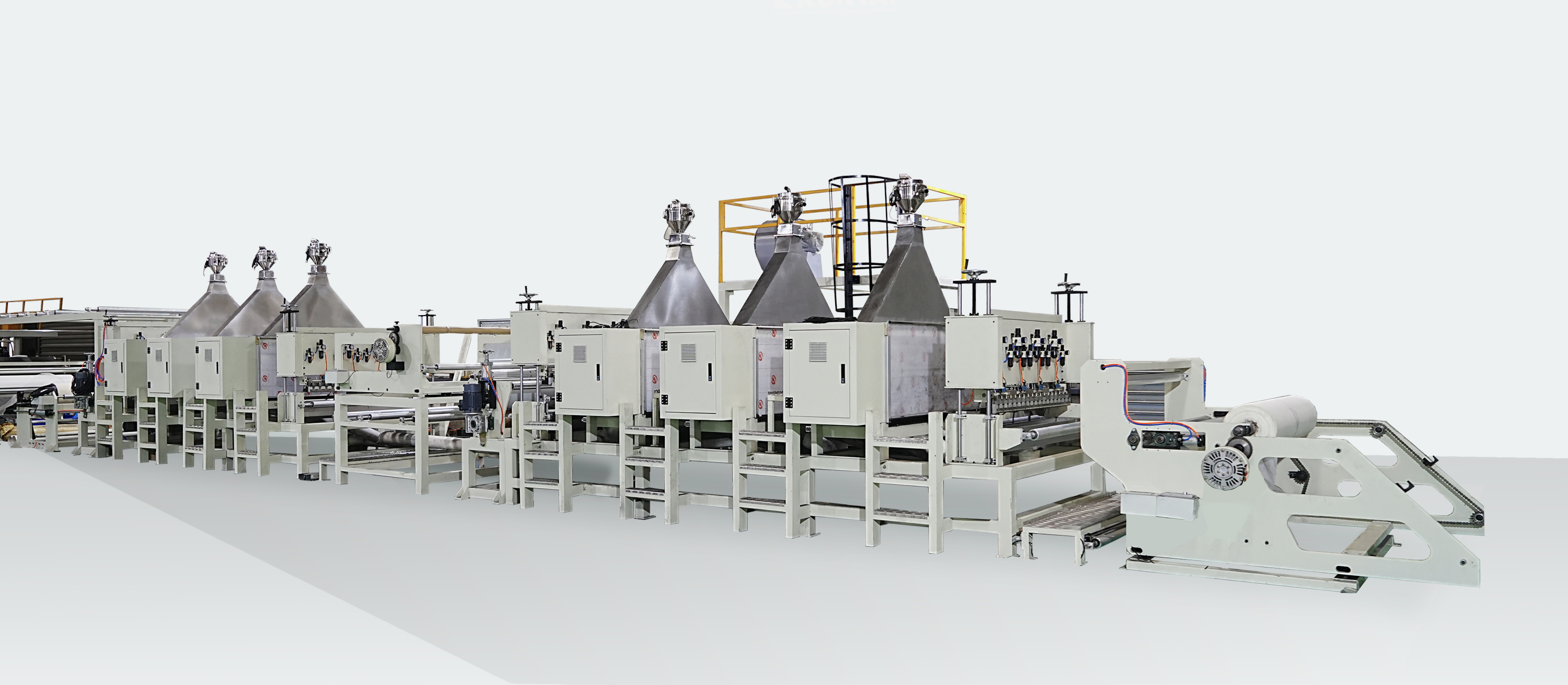
KT-SF glue spraying and powder scattering machine: six glue spraying systems, four powder scattering systems, 200 kg glue melter, used in filter media production.
Aviation sound insulation
Aircraft sound insulation panels require high-temperature operation and coordinated cooling. The documented configuration pairs the KT-PB flatbed laminating machine with the KT-HY-H double belt press laminator, supported by a water chiller, with applications recorded in Korea, France and Germany.
Scenario-to-configuration reference
| Project scenario | Machine family | Verified configuration anchor | Documented market |
|---|---|---|---|
| Bulletproof vest, helmet, plate | KT-LH-1800 UD prepreg impregnation; KT-YJ-1800 UHMWPE impregnation; KT-LH-1800 UD crossply | Roll surface 1800 mm; material width ≤ 1650 mm; water-based adhesive; 90 kW total power | India, South Korea, Russia, Ukraine |
| Protective suits, windbreakers, thermal underwear | KT-PUR-1800 hot melt coating laminator; KT-FT; KT-FT-XC | Gluing roller 25–110 g/m²; 0–35 m/min; 60–105 kW | India, Turkey, Pakistan, Malaysia |
| Blackout, mattress protector, sofa fabric | KT-PUR; KT-FT-XC | Material width up to 2400 mm; middle-temperature synchronized operation; glue melter + oil heater | South Korea, India, Turkey |
| Carpet manufacturing | KT-DS dot coating laminating machine | Coating width 1600–4500 mm; 5–20 m/min; working temperature 80–100°C | Carpet manufacturing |
| Car trim and automotive interiors | KT-HY flame laminating machine | 1600–3000 mm width; 25 m/min; natural gas or liquefied gas; 15 kW drive | Korea, Germany, Czech Republic |
| Filter media and air filtration | KT-SF glue spraying and powder scattering machine | 1600–2600 mm width; powder 20–150 microns; 155 kW | Germany |
| Aircraft sound insulation panel | KT-PB flatbed laminator + KT-HY-H double belt press | 230–265 kW; up to 230–250°C; 3 m heating zone + 1.5 m cooling zone | Korea, France, Germany |
Comparison Table: Claim, Question, and Verifiable Evidence
The table below is the working core of a supplier evaluation. Each row takes a capability claim, converts it into a question the buyer can ask, and states the form of evidence that counts as an answer. The right-hand column uses KUNTAI's published figures as a reference point for what an answer can look like in practice.
| Capability area | Question to ask the supplier | What verifiable evidence looks like |
|---|---|---|
| Design ownership | Who designs the line, and how many engineers work on machine design? | 8 R&D engineers within a 210-person workforce; manufacturer founded in 1983 with four decades of machine-building history. |
| Fabrication depth | Which parts are machined in-house rather than outsourced? | 30,000 m² factory; CNC machining centres, drilling machines and polishing machines used to produce machine parts. |
| Component transparency | Which brands are used for motors, drives, PLC, electrics and bearings? | KT-PB: Siemens motor (made in China), Siemens PLC and touch screen, NSK bearings, Schneider electrics. KT-PUR: Siemens motor, Yaskawa inverter, Schneider electrics. KT-PUR-1800: Siemens motor, Inovance inverter, Schneider electrics. |
| Test protocol | Is every unit tested, and what does the test cover? | 100% testing of machines; ISO 9001 quality requirements and CE certificate; internal quality control system. |
| Customization scope | What can be changed without redesign risk to the line? | OEM production with customization of voltage, logo, color and machine structure. |
| Capacity and lead time | What is the monthly output, standard lead time and minimum order? | Monthly capacity 55 units; annual output 650 units; lead time 30–60 days; minimum order quantity 1 unit. |
| Long-term support | What support exists in year three, and in which markets? | Remote after-sales support; export ratio around 70% across North America, South America, Europe, South Asia, Africa and the Middle East. |
Frequently Asked Questions
Are KUNTAI laminating machines covered by recognized quality and safety certification?
KUNTAI states that its products meet the quality requirements stipulated in ISO 9001 and hold the CE certificate, supported by an internal quality control system. When reviewing certification as part of a supplier evaluation, request the certificate scope and confirm that the specific machine configuration you are ordering falls inside it, rather than assuming that a company-level certificate covers every model. For textile machinery generally, the ISO 11111 series defines safety requirements across different machinery types in Parts 2 to 7, which is a useful cross-check when you compare a supplier's safety documentation against the machine class you are buying.
How can I tell whether a laminating machine manufacturer has real engineering capability rather than assembly capability?
Compare three sets of figures. First, the engineering ratio: KUNTAI reports 8 R&D engineers among 210 employees, which indicates design work is performed in-house rather than outsourced. Second, the fabrication footprint: a 30,000 m² factory with CNC machining centres, drilling machines and polishing machines means structural parts and rollers can be produced in-house, which is where tolerance control begins. Third, the approval path: ask who signs a revised drawing when a buyer changes voltage or machine structure, and how that revision is re-tested. A supplier that can answer all three with names, numbers and process steps is an engineering manufacturer; a supplier that answers with adjectives is not.
What should a textile producer look for in a laminating machine manufacturer?
Start with the material stack and the adhesive, then match the machine family. For textile fabric bonding, KUNTAI's KT-FT fabric-to-fabric laminating machine runs 2400 mm material width on a 2600 mm roller surface at 0–35 m/min, while the KT-FT-XC lamination machine for textile covers 1600–3200 mm material width at the same speed with 105 kW installed capacity. For lighter coating weights, the KT-PUR-1800 hot melt coating laminating machine applies 25 to 110 g/m² through a single gluing roller. Then verify project history in comparable production: textile mill installations of 120 units in Turkey and 140 units in India reported stable operation and low maintenance over five years. Confirm the supporting equipment the line needs — a glue melter and oil heater are required for fabric bonding and upholstery applications — and check that voltage stability and middle-temperature operation match your plant conditions.
Can a buyer validate a machine before committing to a full production order?
Yes, within defined limits. KUNTAI's minimum order quantity is 1 unit, so a single line can be ordered and evaluated under the same engineering process used for multi-unit projects, and every machine is 100% tested before shipment. Practical validation steps are to define the acceptance test scope in advance, ask for stage photographs at frame, roller, assembly, wiring and pre-shipment points, and confirm the documentation package that ships with the machine. After installation, after-sales support is delivered remotely, which means the spare-parts list and maintenance schedule become the operational backbone of the line.
What lead time and production capacity should a buyer plan for?
KUNTAI's standard lead time is 30 to 60 days, with monthly capacity of 55 units and annual output of 650 units. Those figures matter most for phased projects: a 50-unit programme delivered over three years, or a 120-unit textile mill rollout, is scheduled differently from a single-machine purchase, and the supplier's monthly ceiling determines how those tranches can be sequenced. Before committing, ask for a delivery schedule that states which month each unit is built and tested, then compare it against your own installation plan. If you want to review the full configuration range first, the KUNTAI company and product profile can be downloaded, and specific quotes can be requested directly through www.kuntai-group.com or by email at Job@cnkuntai.com.
Conclusion
Verifying R&D and build capability for a laminating line comes down to evidence rather than adjectives. Engineering headcount and design ownership answer who can change the line. The machine tool list and factory footprint answer who can build it. The named component list answers what happens in year three. The test protocol answers what was proven before shipment. Capacity, lead time and order flexibility answer whether your project schedule survives contact with the factory. Certification and export history answer whether the supplier has done this in your market before.
Used together, those checks turn a supplier shortlist into a documented evaluation, and they turn a specific project scenario — ballistic composite, textile bonding, automotive interior, filtration media or aviation insulation — into a verifiable configuration rather than a promise. JIANGSU KUNTAI MACHINERY CO.,LTD, founded in 1983 and based in Zhengang Industrial Park, Yancheng City, Jiangsu, China, publishes the figures used throughout this guide, and they can be tested the same way any other supplier's claims should be: with questions, documentation and a defined acceptance test.
Next step for your evaluation
Download the full KUNTAI company and product profile, or send your project envelope — material, width, adhesive, target speed and plant voltage — and request a configuration proposal and quotation for your laminating or impregnation line.
Email: Job@cnkuntai.com | Tel / WhatsApp: +8618261228899 | Web: www.kuntai-group.com
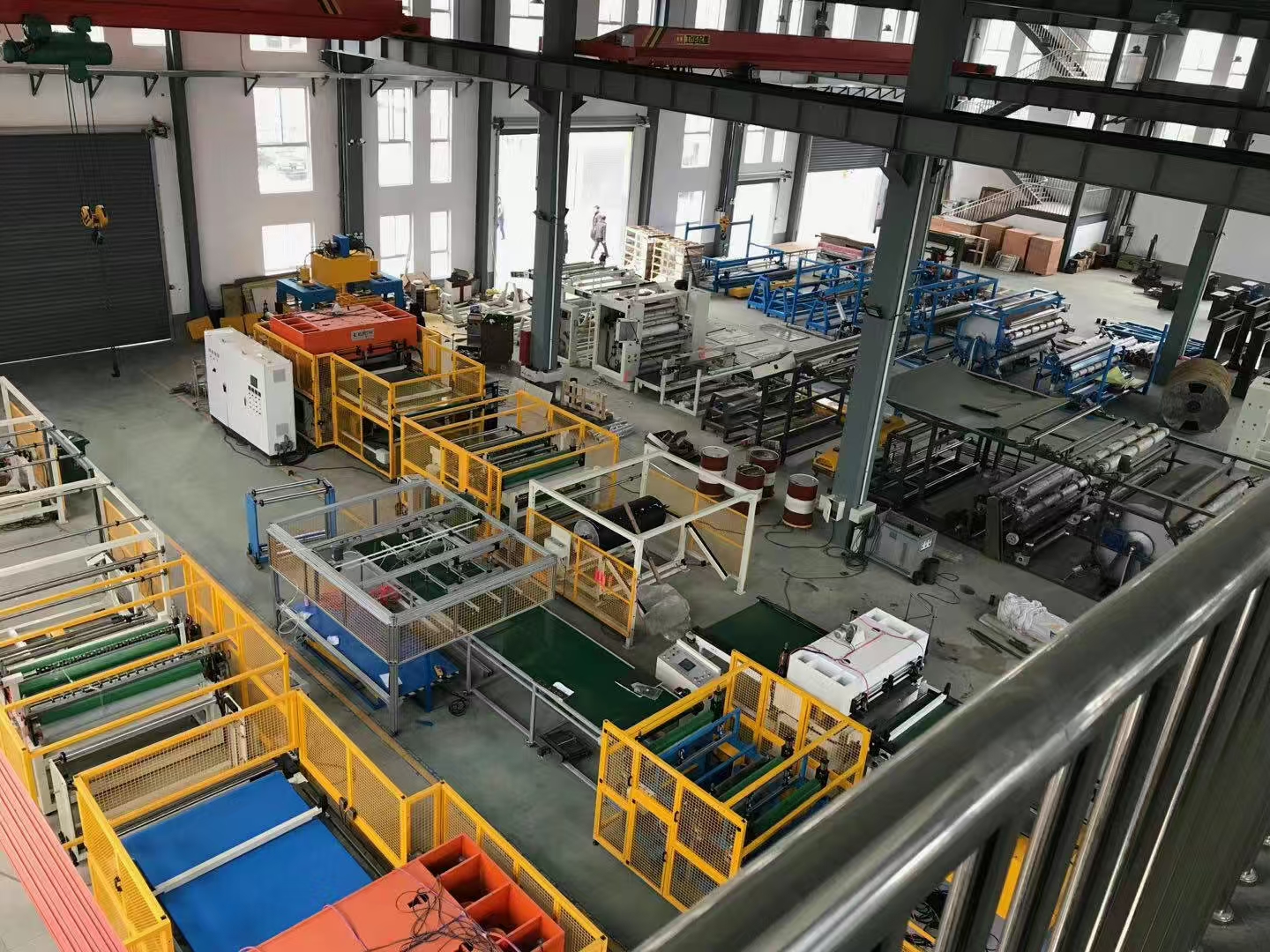
Assembly and pre-shipment testing: ask for stage evidence at defined build points, and confirm the acceptance test scope before the order is placed.