The Science of UHMWPE Impregnation and Fiber Alignment: An Inside Look at the KT-YJ-1800
A roll of UHMWPE unidirectional tape is only as good as the two things that happen before it is ever stacked into a vest or a helmet plate: the filaments must be spread flat and pulled into a single direction, and a matrix must be pushed into that spread filament bed without disturbing it. This article explains both processes in plain language, using the KT-YJ-1800 UHMWPE impregnation machine as the reference platform.
Ultra-high-molecular-weight polyethylene (UHMWPE) is a polyethylene with an exceptionally long molecular chain, and in fibre form it is used to build ballistic protection — bulletproof vests, helmets and hard plates. Fibre alone, however, does not stop a projectile. The fibre has to be arranged, wetted and consolidated into a unidirectional (UD) prepreg: a sheet in which all filaments run parallel and are held by a matrix, ready to be cross-plied, stacked and pressed.
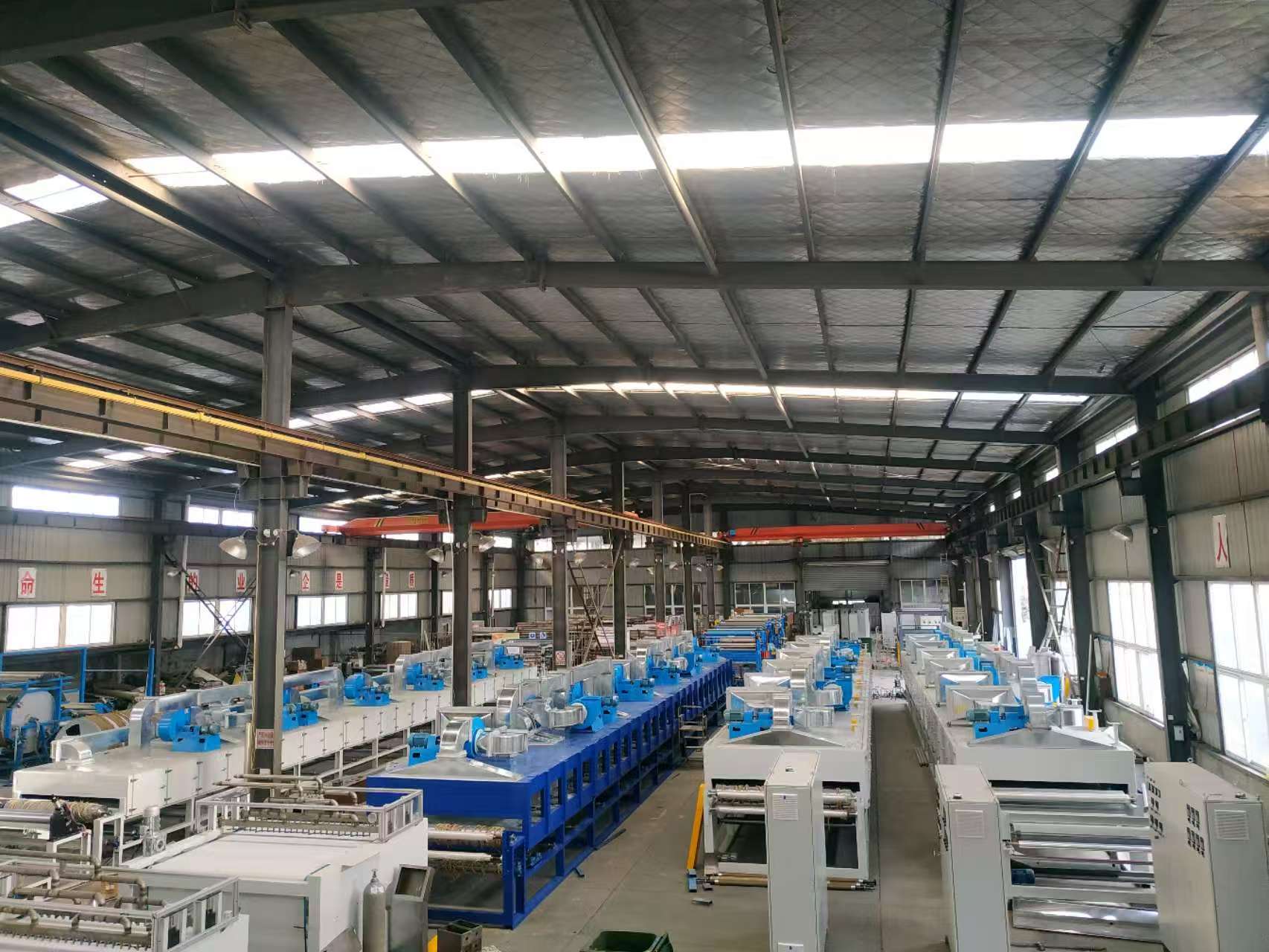
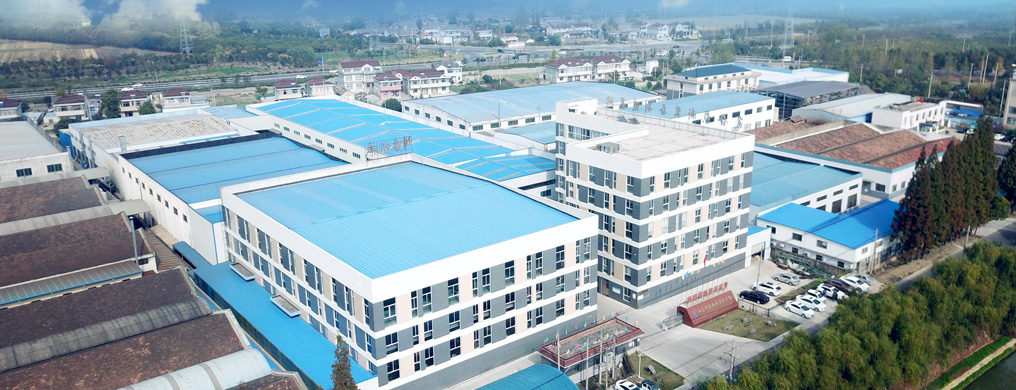
JIANGSU KUNTAI MACHINERY CO.,LTD designs and builds coating, laminating, impregnation and cutting machinery for technical textiles and composites. The company was founded in 1983 and operates a 30,000 m² facility in Zhengang Industrial Park, Yancheng City, Jiangsu, China, with 210 employees, including 8 engineers working in research and development. Around 70% of its output is exported to North America, South America, Europe, South Asia, Africa and the Middle East.
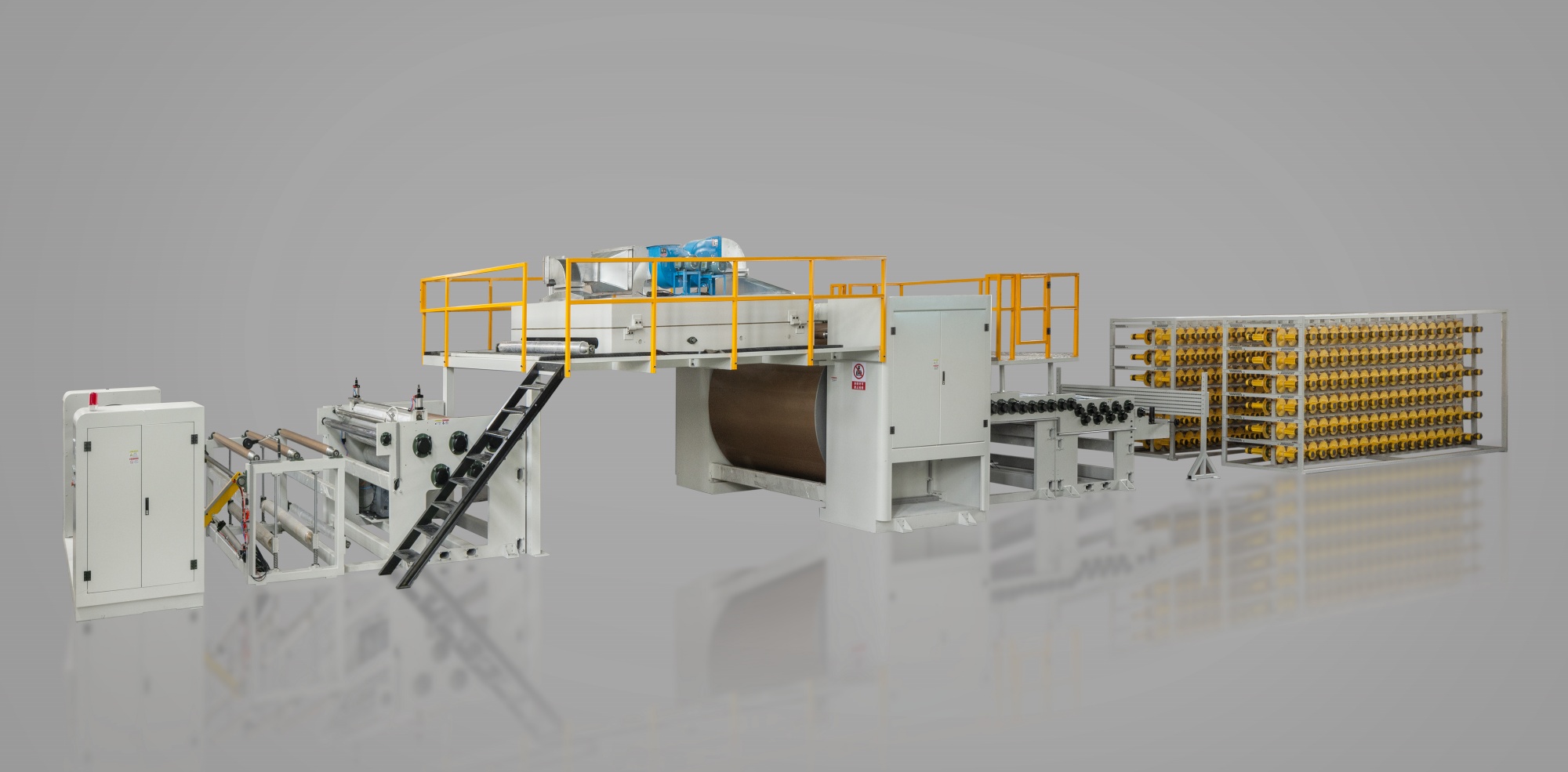
The machine at the centre of this explainer is the KT-YJ-1800, a UHMWPE impregnation machine with an 1,800 mm roll face, water-based adhesive dipping/coating, a 1,080-bobbin yarn setup and a friction roller finished to mirror level 14. Its specification sheet is unusually revealing, because almost every number on it maps back to a physical problem inside the impregnation process.
Problem Definition: Why Fibre Alignment Is the Hard Part
Fibre alignment is the degree to which every filament in a UD tape runs parallel to the machine direction with no gaps, no overlaps and no crossover. Impregnation is the delivery of the matrix into that spread filament bed. Of the two, alignment is harder to hold, because it degrades continuously and often invisibly along the entire line, while impregnation is a discrete, controlled step.
Every UD line starts with yarn wound on bobbins. The KT-YJ-1800 is specified with 1,080 pieces of yarn bobbins — 1,080 individual yarn ends that must be delivered at consistent tension, opened, spread, laid side by side, wetted and consolidated into one sheet no wider than 1,650 mm on an 1,800 mm roll face. A single end running tighter or looser than its neighbours creates a wave that survives all the way into the finished tape.
Four failure modes account for most of the quality loss in this process:
- Gaps between filaments. If the spread bed is not fully opened, the matrix has to bridge empty space rather than coat fibre, and the resulting tape carries resin-rich zones that are not where the load is.
- Overlaps and crossovers. Where two yarn ends fold over each other, the tape becomes locally thicker, and that thickness variation later shows up as an uneven, poorly consolidated laminate.
- Tension banding. Periodic variation from the creel or from a roller that is out of balance prints a repeating pattern along the roll.
- Filament damage. Aggressive mechanical handling abrades fibre; damage rarely shows on the surface of the roll, but it reduces the strength the fibre can contribute once consolidated.
There is also a process-chemistry constraint. The KT-YJ-1800 is specified with a water-based adhesive applied by dipping/coating, which means the carrier is water rather than solvent, and the line therefore has to dry and consolidate the impregnated web rather than simply flash off a volatile carrier. That is one reason the machine's thermal architecture — externally circulating thermal oil as both heating source and lamination roller medium — is specified so precisely.
Industry Background: Where UD Impregnation Sits in the Laminating Machine Market
UD impregnation machines are a specialised branch of the industrial laminating machine family. A conventional laminating machine bonds two or more substrates with an adhesive applied to a surface; an impregnation machine goes one step further and pushes the matrix into the interior of a spread fibre bed before any bonding takes place.
Third-party research places the global laminating machine market at an estimated USD 786.5 million in 2026, projected to reach USD 1,356.7 million by 2033 (Coherent Market Insights). The broader prepreg market — the material that UD and UHMWPE impregnation lines produce — was valued at USD 15.07 billion in 2024 (Maximize Market Research), of which the aerospace prepreg segment alone accounted for USD 3.5 billion in the same year (MarketsandMarkets). Both figures reflect sustained demand from defence and aerospace programmes, the two sectors that consume most UD polyethylene and aramid tape.
Equipment manufacturing for this market is heavily concentrated. Asia-Pacific held a 72.70% share of the textile machinery market in 2025, driven largely by automation growth in China (Fortune Business Insights). For buyers, that concentration is a sourcing reality rather than a marketing point: most UD impregnation capacity in the world is built in this region.
Safety and compliance expectations for such equipment are set by standards rather than by catalogue language. The ISO 11111 series governs safety requirements for textile machinery, with Parts 2 to 7 covering different machinery types (International Organization for Standardization).
Within this landscape, an impregnation line sits between two other equipment families. Upstream, it depends on fibre and creel quality. Downstream, it feeds cross-plying, pressing and, in many plants, hot melt or PUR laminating equipment that binds the finished prepreg to other layers. Buyers evaluating a laminating machine purchase often discover that the impregnation step determines the quality ceiling of everything that follows.
Detailed Solution: How the KT-YJ-1800 Handles Spreading and Impregnation
The KT-YJ-1800 addresses alignment and impregnation with three mechanisms working in sequence: a mechanical multi-roll spreading section combined with profiled spreading, a dipping/coating station that applies a water-based adhesive, and an externally circulating thermal oil roller system that dries, laminates and consolidates the impregnated web.
1. Creel and yarn delivery: 1,080 bobbins
The machine is specified with 1,080 pieces of yarn bobbins feeding a maximum material width of 1,650 mm. The creel is therefore the first place alignment is either protected or destroyed. Because the finished tape width is fixed and the number of ends is fixed, tension uniformity across the creel directly determines whether the spread bed is even or banded. In practice this is why operators treat creel loading as a controlled procedure rather than a manual task.
2. Spreading: mechanical multi-roll plus profiled elements
The KT-YJ-1800 states its wire spreading mode as "mechanical multi roll + profiled". A multi-roll spreading section opens the yarn progressively across a series of rotating rollers, each adding a controlled amount of drag; the profiled spreading stage then guides the opened filaments into a flat, evenly distributed ribbon. Because spreading in this configuration is mechanical rather than chemical, the alignment achieved is set by roller geometry and roller condition rather than by temperature.
3. The friction roller and mirror level 14
The specification lists roller surface treatment as friction roller mirror level 14, together with dynamic balancing of the friction mirror surface roller and the heating roller. The friction roller is the element that applies controlled drag to the spread filament bed — enough to hold filaments under tension during spreading, but not enough to abrade them. A mirror-grade surface finish reduces local snagging, while dynamic balancing limits vibration at running speed, since a vibrating roller would imprint a periodic pattern on the filament bed. Mirror level 14 is a manufacturer's surface-finish designation for this roller.
4. Impregnation: water-based dipping and coating
Adhesive used is water-based, and the gluing method is dipping/coating. The spread filament bed is impregnated in this station, then carried into the consolidation section. Because the adhesive carrier is water, the line must remove it through controlled heat rather than relying on rapid solvent evaporation, which is why the drying and lamination stage is oil-heated and separately temperature-controlled.
5. Drying and consolidation: circulating thermal oil
The lamination roller is an external circulating thermal oil roller, the heating source is circulating thermal oil, and temperature control is handled by a 60 KW external mould oil heater, with total installed power of 90 KW. Consolidation is completed at a composite speed of 5–11 m/min. This is a deliberately conservative speed range: in UD impregnation, throughput is traded against dwell time in the drying and consolidation zone, and dwell time is what allows the matrix to set without pulling the filaments out of alignment.
6. Control and drive architecture
Control mode is HMI + PLC, and drive control uses variable frequency plus servo drive. The practical purpose of this combination is synchronisation: creel unwinding, spreading, impregnation, consolidation and winding all have to run at matched surface speeds, because any speed mismatch between two adjacent stations shows up as tension variation and therefore as alignment error.
| KT-YJ-1800 parameter | Specification |
|---|---|
| Equipment roll surface | 1,800 mm |
| Material width | ≤ 1,650 mm |
| Adhesive used | Water-based |
| Gluing method | Dipping / coating |
| Wire spreading mode | Mechanical multi roll + profiled |
| Control mode | HMI + PLC |
| Drive control | Variable frequency + servo drive |
| Lamination roller | External circulating thermal oil roller |
| Heating source mode | Circulating thermal oil |
| Temperature control mode | 60 KW external mould oil heater |
| Dynamic balance | Friction mirror surface roller / heating roller |
| Roller surface treatment | Friction roller mirror level 14 |
| Yarn bobbins | 1,080 pcs |
| Total power | 90 KW |
| Composite speed | 5–11 m/min |
| Stated application | Bulletproof vest, helmet, plate manufacturing |
Step-by-Step Breakdown: From Bobbin to UD Prepreg
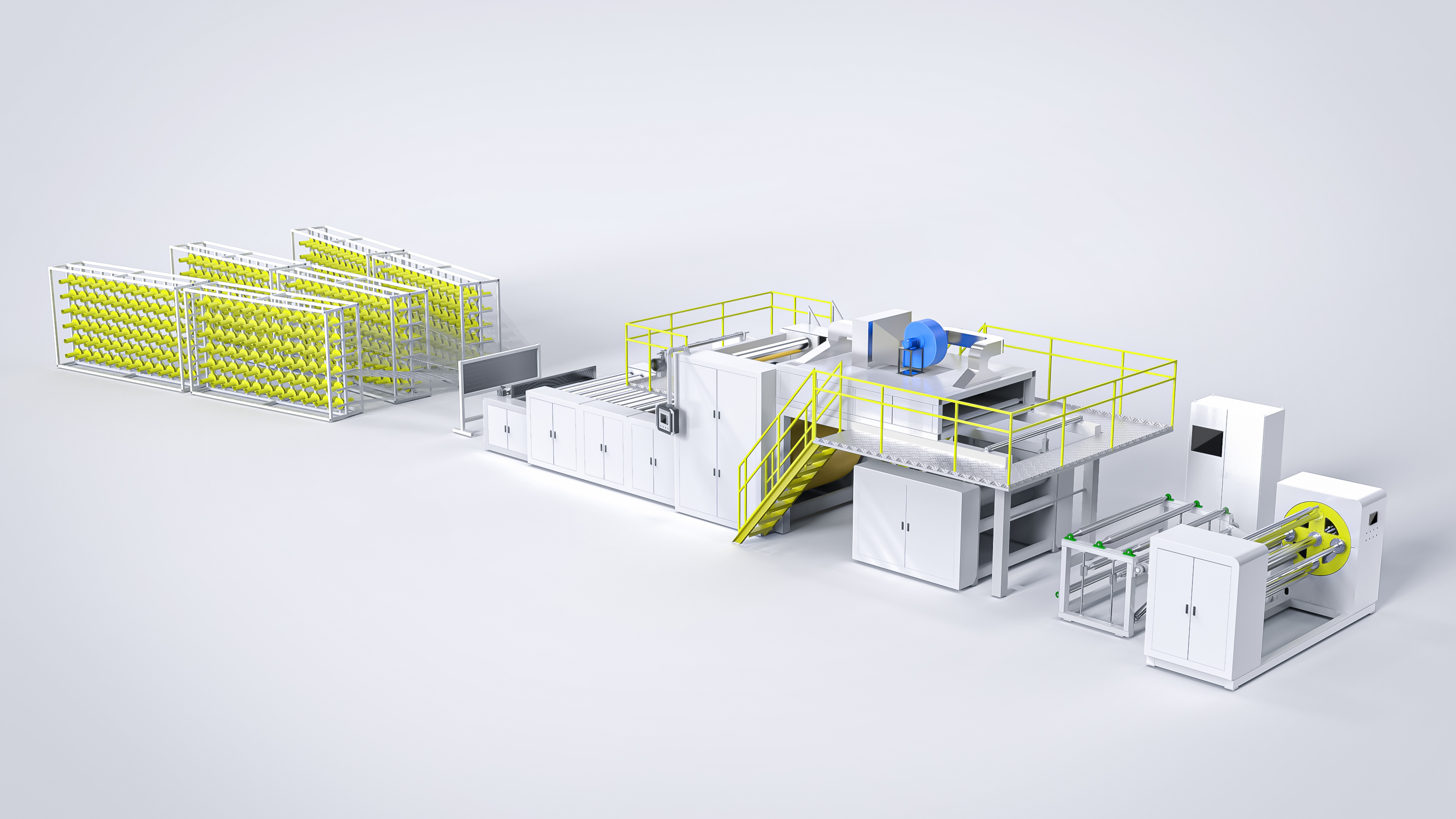
The sequence below describes how the KT-YJ-1800 converts 1,080 yarn ends into a finished UD prepreg roll. Each step is a control point for alignment.
- Bobbin loading and end management. All 1,080 bobbins are loaded and their ends routed to the spreading section. End order is fixed here; a mis-ordered end cannot be corrected later in the line.
- Controlled unwinding. Yarn is drawn from the creel at uniform tension. This is where the variable frequency and servo drive architecture begins to matter, because unwind speed has to track the rest of the line.
- Multi-roll spreading. The yarn bundle is progressively opened across a series of rollers. Each roller adds drag; the cumulative effect is a flat, wide bed of separated filaments.
- Profiled spreading and bed formation. The profiled stage distributes the opened filaments laterally into an even ribbon within the ≤ 1,650 mm material width.
- Dipping / coating with water-based adhesive. The spread bed passes through the impregnation station, where the water-based adhesive is applied.
- Lamination and drying on the thermal oil roller. The impregnated web runs against an external circulating thermal oil roller, with temperature controlled through a 60 KW external mould oil heater.
- Cooling, consolidation and winding. The web consolidates and is wound at a composite speed of 5–11 m/min.
- Optional cross-plying. If a 0°/90° layup is required, the tape moves to a UD crossply machine. The KT-LH-1800 UD crossply machine is specified with 8,000 KN pressing tonnage, a 1,700 × 1,700 mm working table, hydraulic pressing, thermal oil heating through an external oil heater circulation, HMI + PLC control and frequency conversion plus servo drive, with total power of about 95 KW.
Use Cases: Where This Process Is Applied
The stated application for the KT-YJ-1800 and KT-LH-1800 platforms is bulletproof vest, helmet and plate manufacturing, and the same impregnation logic transfers to aramid UD tape for the same protection products.
In ballistic protection, alignment is not an aesthetic requirement. A UD tape with crossover defects and resin-rich gaps distributes load unevenly across the laminate, which is exactly the mechanism ballistic panels are designed to exploit. This is why producers in this segment tend to specify spreading architecture and roller quality before they discuss speed.
Field data from this equipment class supports the reliability argument. A protective products company operating in Turkey, the Czech Republic, India and Russia has run 50 units across a three-year period on bulletproof vest, helmet and plate applications, with reported stable operation and the notable characteristics of long lifespan and low maintenance. The machines in that deployment include the KT-LH-1800 UD prepreg impregnation machine, the KT-YJ-1800 UHMWPE impregnation machine, the KT-LH-1800 UD Aramid prepreg machine, the KT-LH-1800 UHMWPE prepreg machine and the KT-LH-1800 UD crossply machine.
Beyond protection products, the same prepreg and impregnation technology feeds aerospace composite structures — a segment with its own scale, as the aerospace prepreg market figure of USD 3.5 billion in 2024 indicates. For buyers in textile and composite manufacturing who already operate hot melt or PUR laminating equipment, an impregnation line is usually the next capability step, because it produces the substrate that downstream laminating machines then bond.
Comparison Table: Three KT Platforms Side by Side
The table below compares the three impregnation and cross-plying platforms referenced in this article, using only published specification data.
| Parameter | KT-YJ-1800 UHMWPE impregnation machine | KT-LH-1800 UD prepreg impregnation machine / UD Aramid prepreg machine | KT-LH-1800 UD crossply machine |
|---|---|---|---|
| Primary function | Impregnating spread UHMWPE yarn into UD prepreg | Impregnating spread UD (including aramid) yarn into prepreg | Cross-plying impregnated UD tape |
| Equipment roll surface | 1,800 mm | 1,800 mm | Working table 1,700 × 1,700 mm |
| Material width | ≤ 1,650 mm | ≤ 1,650 mm | ≤ 1,650 mm |
| Adhesive / gluing method | Water-based / dipping and coating | Water-based / dipping and coating | Thermal oil heat source; hydraulic pressing |
| Spreading mode | Mechanical multi roll + profiled | Mechanical multi roll + profiled | Not applicable (cross-ply station) |
| Control and drive | HMI + PLC; variable frequency + servo drive | HMI + PLC; variable frequency + servo drive | HMI + PLC; frequency conversion + servo drive |
| Thermal system | External circulating thermal oil roller; 60 KW external mould oil heater | External circulating thermal oil roller; 60 KW external mould oil heater | Thermal oil via external oil heater circulation |
| Roller surface treatment | Friction roller mirror level 14 | Friction roller mirror level 14 | Not applicable |
| Yarn bobbins | 1,080 pcs | 1,080 pcs | Not applicable |
| Total power | 90 KW | 90 KW | About 95 KW |
| Speed or pressing force | Composite speed 5–11 m/min | Composite speed 5–11 m/min | Pressing tonnage 8,000 KN |
| Stated application | Bulletproof vest, helmet, plate manufacturing | Bulletproof vest, helmet, plate manufacturing | Bulletproof vest manufacturing |
Frequently Asked Questions
1. What certifications should be verified on a UHMWPE impregnation line?
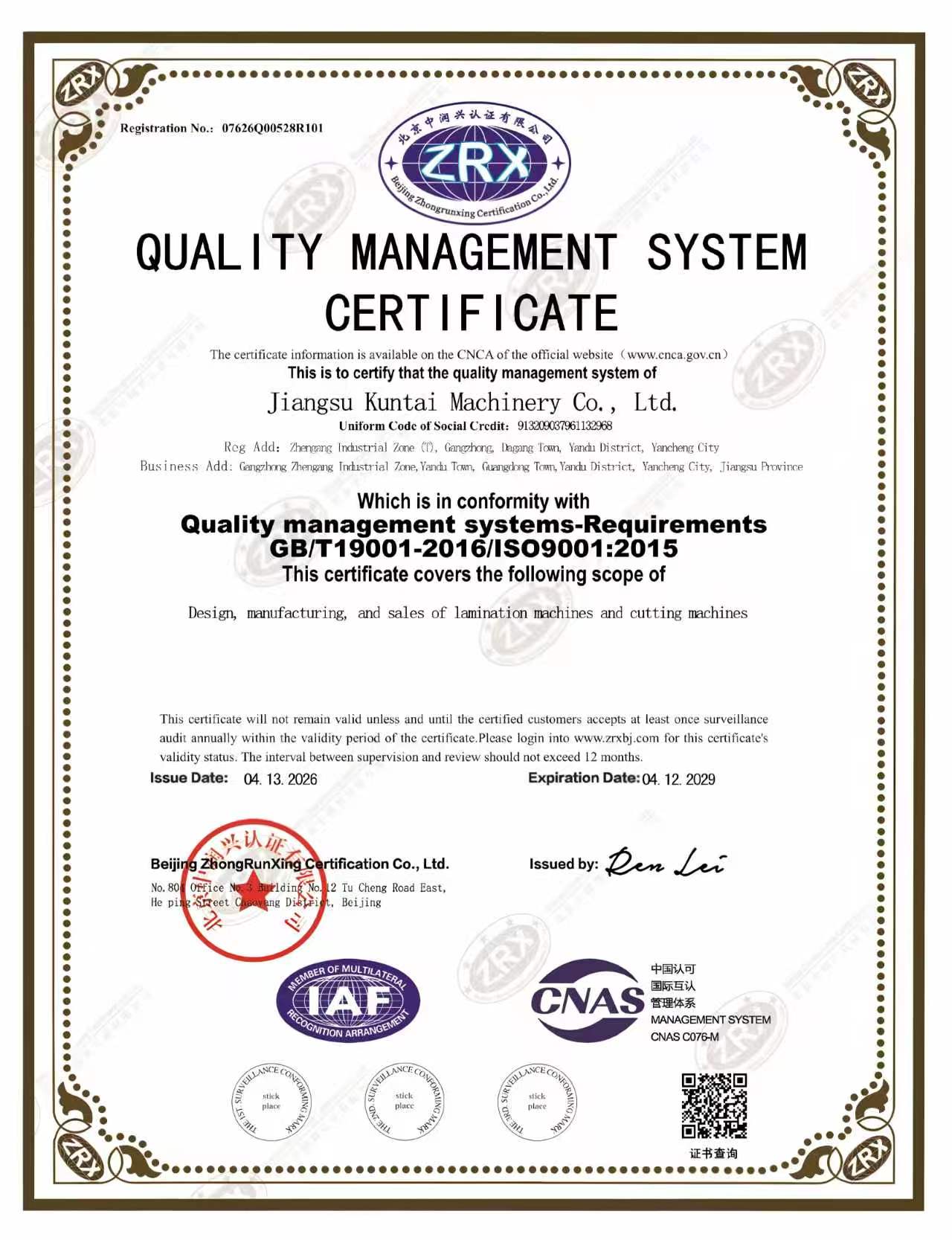
Two documents are the starting point. The ISO 9001 certificate, number 07626Q00528R101, was issued by Beijing ZhongRunXing Certification Co., Ltd. on 13 April 2026 and is valid until 12 April 2029; its scope covers the design, manufacturing and sales of lamination machines and cutting machines against GB/T 19001-2016 / ISO 9001:2015. The CE certificate, number NO.3N221214.JKMSU84, was issued by ECM under Machinery Directive 2006/42/EC on 14 December 2022 and is valid until 13 December 2027, covers the EU market, and applies to lamination machine models including KT-PUR-1800, KT-FT-XC and KT-QLJ-X together with their listed serial variants. Buyers should also know that the ISO 11111 series, Parts 2 to 7, sets safety requirements for textile machinery types. Certificate numbers and expiry dates should always be checked against the original documents rather than a brochure.
2. Can the machine be adapted to our adhesive, voltage and plant layout?
Yes. The manufacturer provides OEM production services, and customization covers voltage, logo, color and machine structure. Monthly production capacity is stated at 55 units, every machine is 100% tested, and after-sales support is provided remotely. The machine platforms are already exported to the EU, the Middle East, South America, North America, South Africa and Asia.
3. What are the minimum order quantity and trade terms?
The minimum order quantity is 1 unit. Standing trade terms are EXW, FOB, CIF and DDU, and the accepted payment structure is a 30% T/T deposit with the 70% balance payable before shipment. Because a UD line is configured around material width, adhesive chemistry and creel size, commercial terms are confirmed project by project — a useful quotation request lists fibre type, target areal weight and required line speed.
4. How is the machine validated before shipment?
Acceptance inspection includes a pre-shipment test, which verifies product quality before delivery, and it forms part of a quality-control process in which machines are 100% tested. For an impregnation line, the pre-shipment test is the point at which a buyer can confirm spreading quality, adhesive pick-up and winding behaviour before the equipment is crated.
5. What is the standard delivery time, and how do I start an enquiry?
Standard delivery time is 30–60 days, supported by a monthly production capacity of 55 units and a minimum order quantity of 1 unit. To move a UHMWPE or UD prepreg project forward, download the machine catalogue via the company profile brochure, then send your material specification to Job@cnkuntai.com or contact +8618261228899 on phone, WhatsApp or WeChat.
Conclusion: Alignment First, Speed Second
UHMWPE impregnation is a two-part discipline. Fibre alignment converts 1,080 separate yarn ends into one parallel, evenly spread bed; impregnation then introduces a water-based matrix into that bed and consolidates it without disturbing the alignment that has just been created. The KT-YJ-1800 specification reads as a direct response to those two requirements: mechanical multi-roll plus profiled spreading, a friction roller finished to mirror level 14 with dynamic balancing, water-based dipping/coating, externally circulating thermal oil with a 60 KW external mould oil heater, and HMI + PLC control over a variable frequency and servo drive system, all running at a composite speed of 5–11 m/min.
For buyers in the Evaluation and Execution stages, the practical checklist is short. Confirm the certification documents and their expiry dates. Confirm that the spreading architecture and roller treatment match your fibre type. Confirm the OEM and customization scope for voltage, logo, color and machine structure. Confirm the 30–60 day delivery window against your project schedule. And confirm that acceptance inspection includes the pre-shipment test before anything is shipped.
Next Step: Specification Review and Quotation
Send your fibre type, target areal weight and required line speed, and the engineering team can map them against the KT-YJ-1800 UHMWPE impregnation machine or the KT-LH-1800 UD prepreg platform. A pre-shipment test is part of every acceptance inspection, and the minimum order quantity is 1 unit.
Download the company profile and machine brochure: KUNTAI profile PDF
Email: Job@cnkuntai.com | Tel / WhatsApp / WeChat: +8618261228899
Website: www.kuntai-group.com
Have Questions or Need More Details?
Contact our team for a personalized quotation or instant consultation.
Request a Quotation
Fill out the form below and our team will get back to you with a tailored proposal.
WhatsApp Direct Chat
Prefer to chat in real-time? Message us on WhatsApp for instant assistance & quick answers.
- Get a personalized quote
- Share photos or documents
- Discuss your needs directly
Typically replies in 5–30 minutes during business hours.