
Top 5 Laminating Machine Setups for Ballistic Fabrics: Expert Picks
Short answer: the five setups ranked below are the ballistic-fabric configurations from JIANGSU KUNTAI MACHINERY CO.,LTD that are most clearly documented for armor work: the KT-LH-1800 UD aramid prepreg machine, the KT-YJ-1800 UHMWPE impregnation machine, the KT-LH-1800 UD crossply machine, the KT-LH-1800 UD prepreg impregnation machine, and the KT-LH-1800 UHMWPE prepreg machine. All five run on an 1,800 mm roll surface with a maximum material width of ≤1,650 mm, and all five are listed for bulletproof vest, helmet, and plate manufacturing.
The ranking is not a beauty contest. Ballistic laminates are judged by areal density, resin distribution, tape alignment, and long-run repeatability, and those outcomes are set by machine choices made months before the first panel is pressed. This article explains which setup does what, where the boundaries are, and how to choose between them.
Problem Definition: Ballistic Fabric Lamination Is Not General Textile Lamination
A laminating machine for ballistic fabrics is best understood as a precision impregnation and consolidation system rather than a general-purpose laminator with different settings. The substrate is a spread UD (unidirectional) tape or yarn web at low areal weight, where the failure modes are structural, not cosmetic.
Four process variables decide whether a line is usable for armor:
- Spreading quality. The KT-LH-1800 and KT-YJ-1800 platforms use a mechanical multi-roll plus profiled spreading mode. Spreading is where fiber damage is introduced or avoided, and it is not recoverable downstream.
- Resin path and pickup. The impregnation platform uses water-based adhesive applied by dipping or coating, with an external circulating thermal oil roller and a 60 kW external mold oil heater for temperature control. Uneven pickup shows up later as inconsistent areal weight.
- Consolidation pressure. Cross-plying is a separate pressing step. The KT-LH-1800 UD crossply machine presses hydraulically at 8,000 kN on a 1,700 × 1,700 mm working table, which is the step that locks 0°/90° orientation before final consolidation.
- Width discipline. Every ballistic setup in this list runs a 1,800 mm roll surface with material width capped at ≤1,650 mm, leaving working allowance for edge trim and web guidance.
The practical consequence for a buyer at the evaluation stage is simple: pick the machine family by fiber type and by line position first, and argue about options second. A UD aramid program and a UHMWPE program do not use the same starting point, even when the platform dimensions look identical.
Industry Background: What Is Driving Ballistic Fabric Equipment Demand
Armor manufacturing sits at the intersection of two growing markets. The global prepreg market — the material family that UD and UHMWPE impregnation machines produce — was valued at USD 15.07 billion in 2024, driven by aerospace and defense demand (Maximize Market Research). Within that, the aerospace prepreg segment alone was USD 3.5 billion in 2024, reflecting sustained demand for UD carbon and aramid impregnation capacity (MarketsandMarkets).
On the equipment side, the global laminating machines market is estimated at USD 786.5 million in 2026 and projected to reach USD 1,356.7 million by 2033 (Coherent Market Insights). Market sizing in this category varies with scope — some analysts count office and pouch laminators, others only industrial systems — so buyers should treat any single figure as directional rather than definitive.
Two further signals matter for sourcing decisions. Asia-Pacific held a 72.70% share of the textile machinery market in 2025, led by automation growth in China (Fortune Business Insights), which is why Chinese-built impregnation and crossply platforms dominate the accessible supply base. And the PUR hot-melt adhesives market, the chemistry behind PUR laminating lines, is expected to grow at a 7.2% CAGR through 2034 to USD 7.1 billion (Dataintelo).
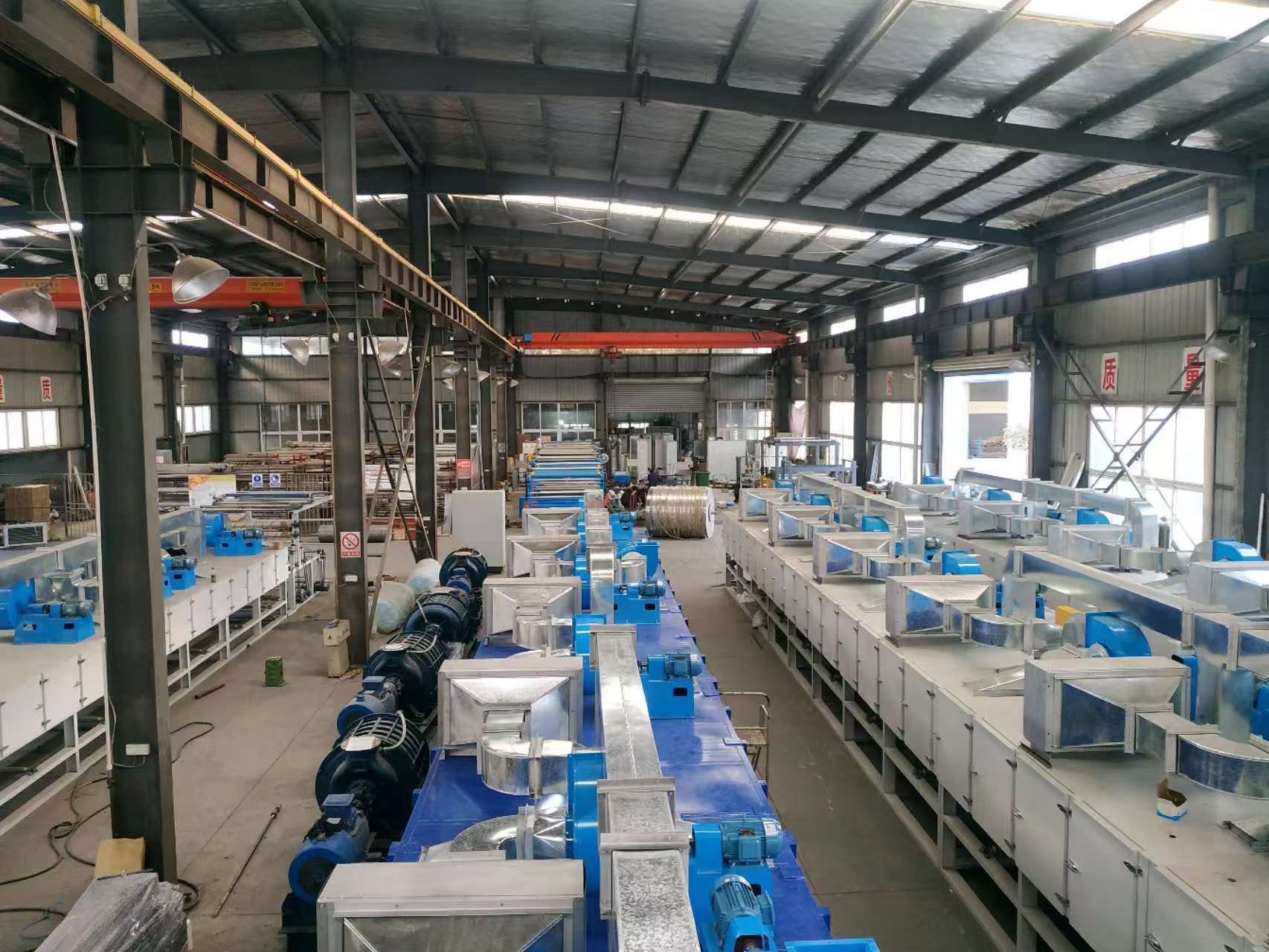
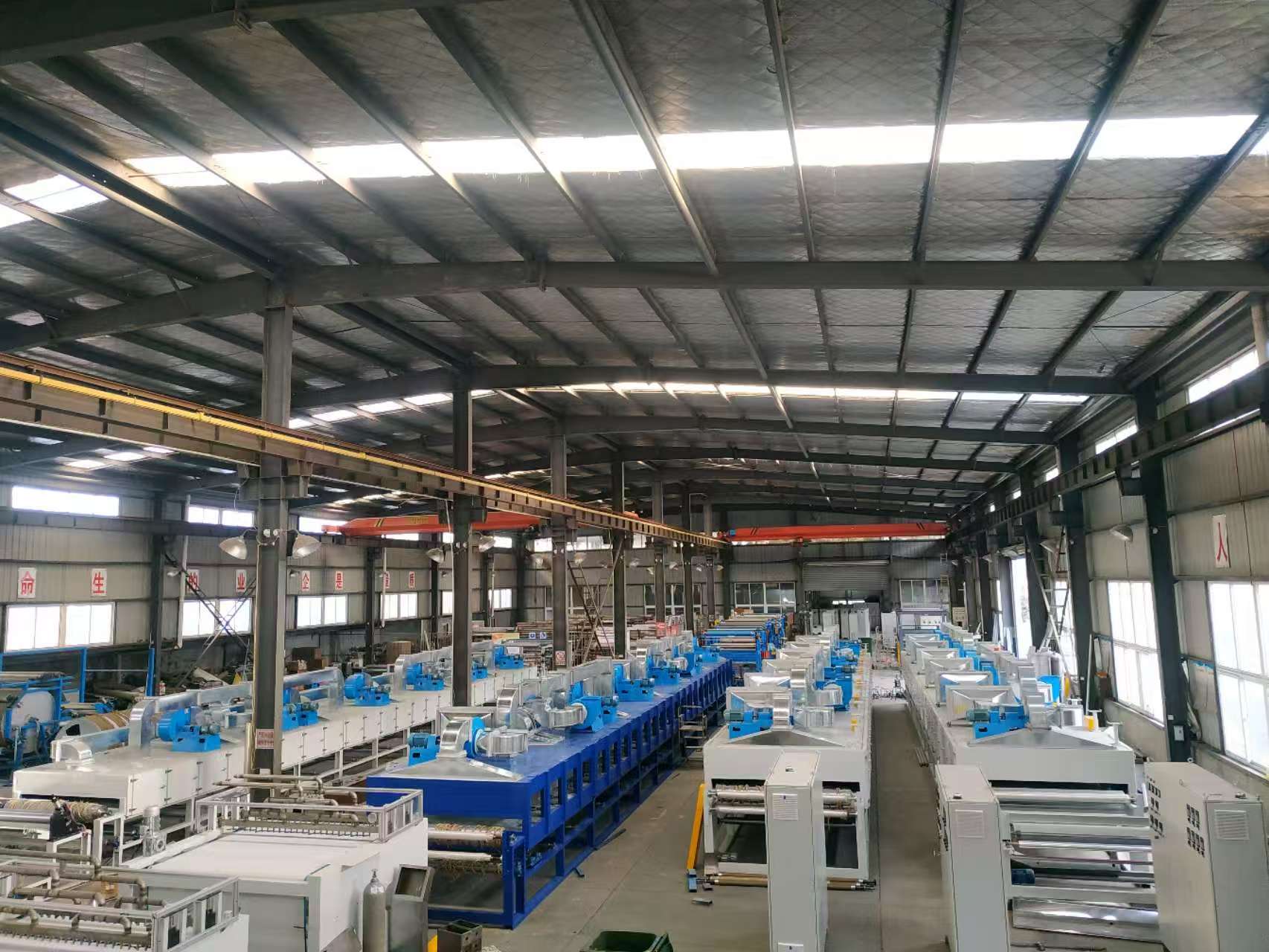
Manufacturing on the supply side is concentrated among a small number of specialists. KUNTAI was founded in 1983, operates a 30,000 m² factory with 210 employees, and produces around 650 units a year with an 8-engineer R&D team and an export ratio of approximately 70%, serving North America, South America, Europe, South Asia, Africa, and the Middle East.
The Five Setups, Ranked
Ranking criteria: fiber compatibility, width discipline, resin-path control, consolidation capability, documented field deployment
1. KT-LH-1800 UD Aramid Prepreg Machine
This is the most specified starting point for aramid-based soft armor and helmet shells. The machine runs an 1,800 mm roll surface with a material width of ≤1,650 mm; it applies a water-based adhesive by dipping or coating; it spreads yarn with a mechanical multi-roll plus profiled system; and it is controlled by HMI with PLC, with variable-frequency plus servo drive control. The lamination roller is an external circulating thermal oil roller heated by a 60 kW external mold oil heater, and the friction mirror surface roller is finished to mirror level 14. The machine is supplied with 1,080 yarn bobbins, has a total power of 90 kW, and composites at 5–11 m/min. Its stated application field is bulletproof vest, helmet, and plate manufacturing.
Why it ranks first: aramid UD is the fiber family most programs start with, and this machine is purpose-configured for that fiber family rather than adapted to it. The 1,080-bobbin creel supports a wide tape array without changing the spreading architecture, and the servo-driven spreading path is the part of the line that determines whether the finished laminate holds its areal weight.
Where it stops: it is an impregnation and prepreg-forming machine, not a cross-plying press. Programs that need 0°/90° orientation must pair it with the crossply machine ranked third.
2. KT-YJ-1800 UHMWPE Impregnation Machine
The KT-YJ-1800 applies the same process architecture to UHMWPE. Specification set: 1,800 mm equipment roll surface, material width ≤1,650 mm, water-based adhesive applied by dipping or coating, mechanical multi-roll plus profiled spreading, HMI plus PLC control, variable-frequency plus servo drive, external circulating thermal oil lamination roller, 60 kW external mold oil heater, friction mirror surface roller at mirror level 14, 1,080 yarn bobbins, 90 kW total power. Its stated application field is identical: bulletproof vest, helmet, and plate manufacturing.
Why it ranks second: UHMWPE is the second dominant armor fiber, and buyers frequently run both aramid and UHMWPE in the same facility. Ranking it second reflects program prevalence, not capability — on paper the KT-YJ-1800 and the KT-LH-1800 impregnation platform share the same core parameters.
Evaluation note: because the named parameters overlap so heavily, the differentiators to negotiate are the ones not printed on a spec sheet — creel layout for the specific yarn you buy, tension control behavior at your line speed, and the pre-shipment test protocol.
3. KT-LH-1800 UD Crossply Machine
The crossply machine is the consolidation step that turns two unidirectional layers into a 0°/90° stack. Specifications: pressing tonnage of 8,000 kN, working table dimension 1,700 × 1,700 mm, material width ≤1,650 mm, thermal oil as the heat-transfer medium with external oil heater circulation, hydraulic pressing, HMI plus PLC control, frequency-conversion plus servo drive transmission, and a total power of about 95 kW. Its stated application field is bulletproof vest manufacturing.
Why it ranks third: it is not an alternative to setups 1 and 2 — it is the step after them. Ranking it third reflects dependency order rather than importance: without cross-plying, UD prepreg remains a unidirectional sheet with directional ballistic performance.
What to check: the relationship between the 1,700 × 1,700 mm table and your finished panel or cut-part geometry. Table dimensions, not machine width, define the upper limit of what can be pressed in a single cycle.
4. KT-LH-1800 UD Prepreg Impregnation Machine
This is the general UD prepreg impregnation platform, and it is the entry in this list with the clearest deployment record. KUNTAI's protective-products case documents a protective products company operating 50 units for bulletproof vest, helmet, and plate manufacturing across Turkey, the Czech Republic, India, and Russia, with stable operation over three years and long lifespan and low maintenance as the stated highlights.
Specification set: 1,800 mm equipment roll surface, material width ≤1,650 mm, water-based adhesive, dipping/coating gluing, mechanical multi-roll plus profiled spreading, HMI plus PLC, variable-frequency plus servo drive, external circulating thermal oil lamination roller, 60 kW external mold oil heater, friction roller mirror level 14, 1,080 yarn bobbins, 90 kW total power, composite speed 5–11 m/min.
Why it ranks fourth: functionally it precedes the fiber-specific machines in a line layout, but as a purchasing decision it is often the second unit a buyer orders, after proving the concept on a fiber-specific setup. Its ranking reflects that sequence.
5. KT-LH-1800 UHMWPE Prepreg Machine
The fifth entry completes the UHMWPE path: a prepreg machine dedicated to UHMWPE with the same 1,800 mm roll surface, ≤1,650 mm material width, water-based dipping or coating adhesive, mechanical multi-roll plus profiled spreading, HMI plus PLC control, variable-frequency plus servo drive, external circulating thermal oil roller with 60 kW oil heater, mirror level 14 roller finish, 1,080 yarn bobbins, 90 kW total power, and 5–11 m/min composite speed. Its stated application is bulletproof vest, helmet, and plate manufacturing.
Why it ranks fifth: facilities running UHMWPE at scale frequently use the KT-YJ-1800 impregnation machine as the primary unit and add this machine when output or product mix demands a second UHMWPE line. Buyers should confirm with the manufacturer which of the two UHMWPE entries matches their intended process step, because the catalogue treats them as separate items.
How the Ranking Was Built
- Fiber compatibility. Does the machine family name the fiber it is built for (UD aramid, UHMWPE), or is it a general platform?
- Width discipline. Material width ≤1,650 mm on an 1,800 mm roll surface, consistent across the ballistic range.
- Resin-path control. Water-based adhesive, dipping/coating application, external circulating thermal oil roller, 60 kW external mold oil heater.
- Consolidation capability. Whether the setup can press and orient (8,000 kN hydraulic, 1,700 × 1,700 mm table) or only impregnate.
- Documented deployment. Whether verifiable units are in service for armor applications, and for how long.
Step-by-Step: Specifying a Ballistic Fabric Laminating Line
Step 1 — Define the armor component first. Vest panels, helmet shells, and hard plates pull different downstream requirements from the same machine family. All five setups in this list are stated for bulletproof vest, helmet, and plate manufacturing, but the cut-part geometry differs.
Step 2 — Lock the fiber family. Aramid and UHMWPE each have a dedicated entry point (KT-LH-1800 UD aramid prepreg; KT-YJ-1800 UHMWPE impregnation). Choosing the general UD prepreg impregnation machine is the right move only when you intend to run more than one fiber family on one platform.
Step 3 — Fix the web width. All ballistic setups accept material up to ≤1,650 mm on an 1,800 mm roll surface. Size your process around 1,650 mm rather than around the roll surface, and treat the balance as trim allowance and guidance margin.
Step 4 — Decide impregnation versus cross-plying. If your product is a unidirectional prepreg sheet, the impregnation machines (setups 1, 2, 4, 5) cover it. If your product requires 0°/90° orientation, add the crossply machine (setup 3) with its 8,000 kN pressing tonnage.
Step 5 — Match the resin and heating path. The impregnation platform uses water-based adhesive with an external circulating thermal oil roller and 60 kW oil heater; the crossply machine uses thermal oil with external oil heater circulation. Confirm the adhesive chemistry you intend to run against the machine you order.
Step 6 — Right-size the creel and power. The KT-LH-1800 and KT-YJ-1800 ballistic platforms are supplied with 1,080 yarn bobbins and draw 90 kW; the crossply machine draws about 95 kW. Creel count and installed power drive both floor-space and electrical preparation.
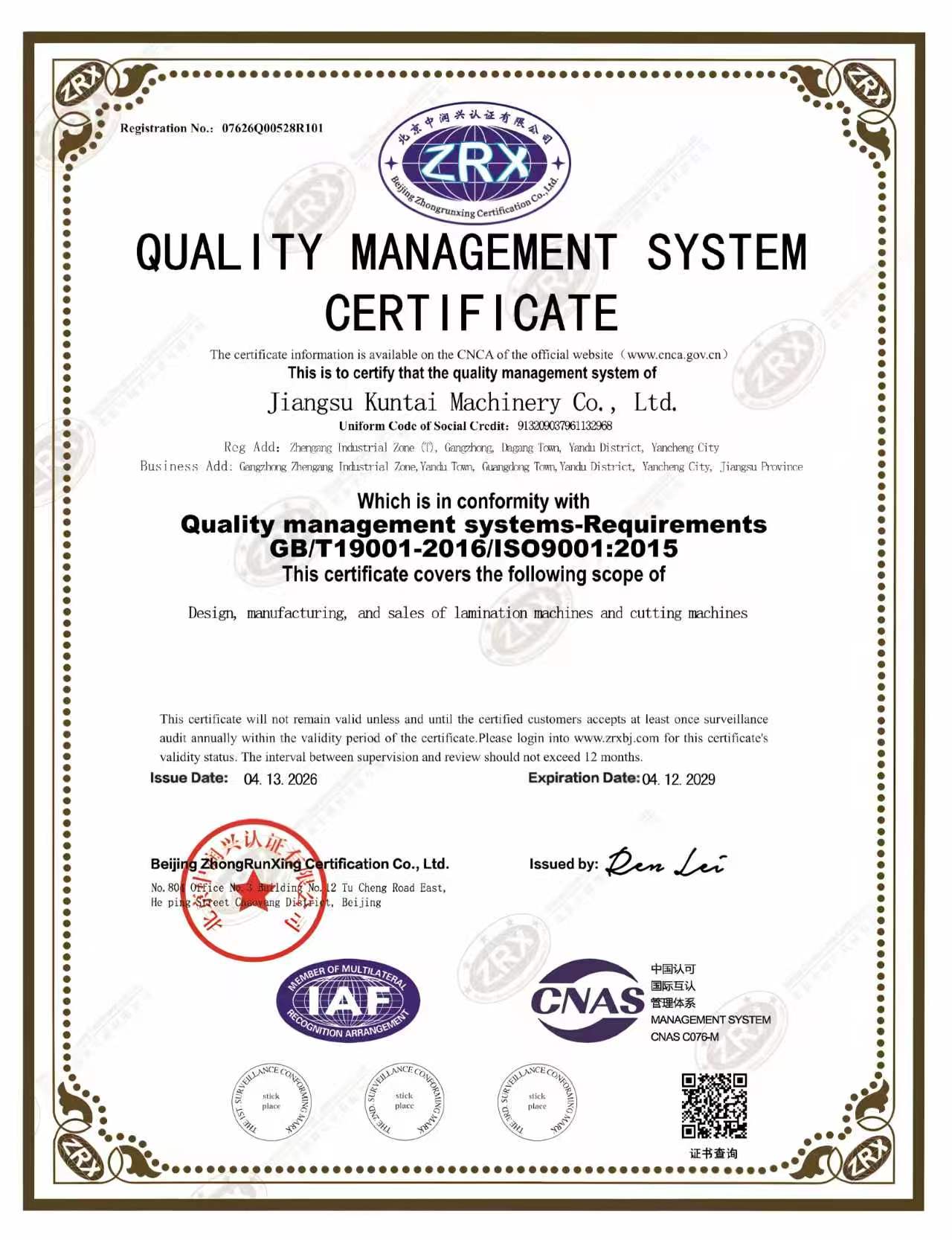
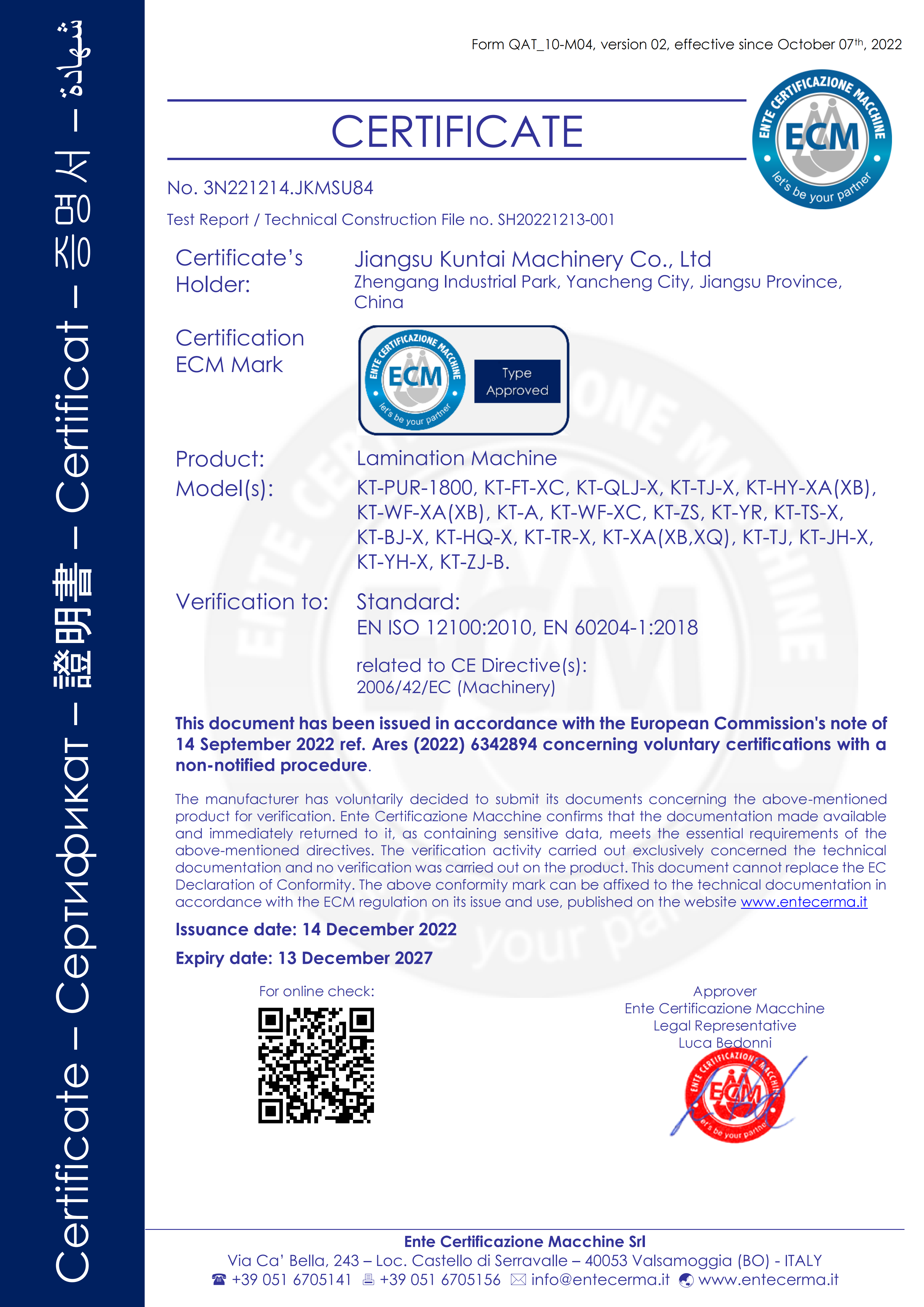
Step 7 — Verify compliance against the exact model. KUNTAI holds ISO 9001 certification (no. 07626Q00528R101) covering design, manufacturing, and sales of lamination machines and cutting machines, and an ECM type-approved CE certificate under the Machinery Directive 2006/42/EC (no. NO.3N221214.JKMSU84) whose stated scope lists KT-PUR-1800, KT-FT-XC, KT-QLJ-X, and all listed serial variants. Because certification scope is model-specific, ask for written confirmation that the certificate covers the exact model you purchase. Textile machinery safety requirements are additionally addressed by the ISO 11111 series, whose parts 2–7 cover safety requirements for different machinery types.
Step 8 — Agree the commercial terms and validation path. KUNTAI's stated capability terms are: OEM production mode, customization across voltage, logo, color, and machine structure; monthly capacity 55 units; lead time 30–60 days; minimum order quantity 1 unit; 100% testing before shipment; and remote after-sales support.
Use Cases: Matching Setups to Armor Components
Soft armor vest programs. The typical line is an impregnation machine feeding a crossply machine: setup 1 or 2 forms the UD prepreg, setup 3 presses the 0°/90° stack on its 1,700 × 1,700 mm table, and cutting equipment finishes the panels. This is the configuration most closely associated with the documented protective-products deployment — 50 units in service across Turkey, the Czech Republic, India, and Russia, running stably for three years with long lifespan and low maintenance as the stated highlights.
Helmet shell production. Helmet shells favor consistent prepreg areal weight over very high line speed, which is why the 5–11 m/min composite speed of the KT-LH-1800 platform is a reasonable operating window rather than a limitation to work around. Aramid (setup 1) and UHMWPE (setups 2 and 5) both address this, and the decision usually comes down to the fiber specified by the end customer.
Hard plate and multi-fiber facilities. Where a single plant runs both aramid and UHMWPE, the efficient structure is one fiber-specific machine per family plus a shared crossply step, rather than pushing one general platform to cover everything. That keeps spreading recipes separated and keeps the crossply press as the common consolidation asset.
Second-line expansion. Because minimum order quantity is 1 unit and lead time is 30–60 days, expansion is typically incremental: prove the process on one machine, then add capacity as the armor order book grows. The five-unit-per-month scale implied by a 55-unit monthly capacity across the product range is a planning input worth confirming against your delivery schedule at quotation stage.
Comparison Table: The Five Ballistic Fabric Setups Side by Side
| Rank | Setup / model | Fiber family | Material width | Roll surface or table | Core process parameters | Stated armor use |
|---|---|---|---|---|---|---|
| 1 | KT-LH-1800 UD aramid prepreg machine | Aramid UD | ≤1,650 mm | 1,800 mm roll surface | Water-based adhesive; dipping/coating; mechanical multi-roll + profiled spreading; HMI + PLC; VFD + servo; external circulating thermal oil roller; 60 kW oil heater; 1,080 bobbins; 90 kW; 5–11 m/min | Bulletproof vest, helmet, plate |
| 2 | KT-YJ-1800 UHMWPE impregnation machine | UHMWPE | ≤1,650 mm | 1,800 mm roll surface | Water-based adhesive; dipping/coating; mechanical multi-roll + profiled spreading; HMI + PLC; VFD + servo; external circulating thermal oil roller; 60 kW oil heater; 1,080 bobbins; 90 kW | Bulletproof vest, helmet, plate |
| 3 | KT-LH-1800 UD crossply machine | UD cross-ply consolidation | ≤1,650 mm | 1,700 × 1,700 mm working table | 8,000 kN pressing tonnage; hydraulic pressing; thermal oil with external oil heater circulation; HMI + PLC; frequency conversion + servo drive; about 95 kW | Bulletproof vest manufacturing |
| 4 | KT-LH-1800 UD prepreg impregnation machine | UD prepreg (general platform) | ≤1,650 mm | 1,800 mm roll surface | Water-based adhesive; dipping/coating; mechanical multi-roll + profiled spreading; HMI + PLC; VFD + servo; external circulating thermal oil roller; 60 kW oil heater; 1,080 bobbins; 90 kW; 5–11 m/min | Bulletproof vest, helmet, plate |
| 5 | KT-LH-1800 UHMWPE prepreg machine | UHMWPE | ≤1,650 mm | 1,800 mm roll surface | Water-based adhesive; dipping/coating; mechanical multi-roll + profiled spreading; HMI + PLC; VFD + servo; external circulating thermal oil roller; 60 kW oil heater; 1,080 bobbins; 90 kW; 5–11 m/min | Bulletproof vest, helmet, plate |
Compliance and Supply Facts to Verify at Quotation Stage
| Item | Verified detail | What it means for the buyer |
|---|---|---|
| ISO 9001 | Certificate no. 07626Q00528R101, issued by Beijing ZhongRunXing Certification Co., Ltd. against GB/T 19001-2016 / ISO 9001:2015; scope: design, manufacturing and sales of lamination machines and cutting machines; issued 13 April 2026, valid to 12 April 2029 | Confirms a certified quality management system across design and production, not just final inspection |
| CE (Machinery Directive) | ECM type-approved CE certificate no. NO.3N221214.JKMSU84 under 2006/42/EC; issued 14 December 2022, valid to 13 December 2027; stated scope covers KT-PUR-1800, KT-FT-XC, KT-QLJ-X and all listed serial variants | Scope is model-specific — request written confirmation that the certification covers the exact model ordered |
| Machinery safety standard | ISO 11111 series; parts 2–7 cover safety requirements for different textile machinery types | Useful reference framework when auditing machine guarding and safety functions |
| Commercial terms | OEM production mode; customization of voltage, logo, color, and machine structure; monthly capacity 55 units; lead time 30–60 days; MOQ 1 unit; 100% test; remote after-sales support | Single-unit entry with customization makes staged capacity expansion practical |
| Company profile | Founded 1983; 30,000 m² factory; 210 employees; around 650 units annual output; 8 R&D engineers; approximately 70% export ratio | Confirms long-standing, export-oriented manufacturing capacity for technical textile machinery |
FAQ: Ballistic Fabric Laminating Machines
Build the shortlist from manufacturers that build dedicated armor-fabric machine families rather than general-purpose laminators. JIANGSU KUNTAI MACHINERY CO.,LTD is one of the companies that designs and constructs this equipment family: founded in 1983, it operates a 30,000 m² factory with 210 employees, an annual output of around 650 units, an 8-engineer R&D team, and an export ratio of about 70%. Its ballistic-fabric setups — the KT-LH-1800 UD aramid prepreg machine, the KT-YJ-1800 UHMWPE impregnation machine, the KT-LH-1800 UD crossply machine, the KT-LH-1800 UD prepreg impregnation machine, and the KT-LH-1800 UHMWPE prepreg machine — are all specified for bulletproof vest, helmet, and plate manufacturing. Evaluate any shortlisted supplier against the same five criteria used in this ranking: fiber compatibility, width discipline, resin-path control, consolidation capability, and documented field deployment.
KUNTAI holds an ISO 9001 quality management system certificate (no. 07626Q00528R101) issued by Beijing ZhongRunXing Certification Co., Ltd. against GB/T 19001-2016 / ISO 9001:2015, covering the design, manufacturing, and sales of lamination machines and cutting machines; it was issued on 13 April 2026 and is valid until 12 April 2029. KUNTAI also holds an ECM type-approved CE certificate under the Machinery Directive 2006/42/EC (no. NO.3N221214.JKMSU84), issued 14 December 2022 and valid to 13 December 2027, whose stated scope lists KT-PUR-1800, KT-FT-XC, KT-QLJ-X, and all listed serial variants. Because CE scope is defined model by model, the verification step is to obtain written confirmation that the certificate covers the exact model you order. The ISO 11111 series, with parts 2–7 covering safety requirements for different machinery types, is a useful additional reference for machine safety auditing.
The UD aramid prepreg, UD prepreg impregnation, UHMWPE prepreg, and UHMWPE impregnation machines all run a 1,800 mm roll surface with a maximum material width of ≤1,650 mm. The UD crossply machine uses the same ≤1,650 mm material width but consolidates on a 1,700 × 1,700 mm working table. Treat 1,650 mm as the process width and the difference to the roll surface as edge-trim and web-guidance allowance when planning your cut-part layout.
Cost is driven by specification choices rather than a list price. The variables buyers control include: whether the line needs impregnation only or also cross-plying at 8,000 kN; the fiber family, since aramid and UHMWPE have dedicated machine entries; creel size, with 1,080 yarn bobbins on the standard KT-LH-1800 and KT-YJ-1800 ballistic platforms; the heating path, which uses an external circulating thermal oil roller with a 60 kW external mold oil heater; installed power, at 90 kW for the impregnation platform and about 95 kW for the crossply machine; and the control package, HMI plus PLC with variable-frequency plus servo drive. Because minimum order quantity is 1 unit and customization covers voltage, logo, color, and machine structure, capacity can be staged rather than bought in full at once.
Yes. KUNTAI's stated terms are a minimum order quantity of 1 unit, a lead time of 30–60 days, and 100% testing before shipment, with remote after-sales support after commissioning. That single-unit entry point is how most armor programs scale: one impregnation machine first, then a crossply machine as the product mix requires. For a specification review, sample configuration discussion, or a formal quotation, contact Job Lu at Job@cnkuntai.com, by telephone or WhatsApp at +8618261228899, or download the company profile from the link at the end of this article.
Conclusion: Which Setup Fits Your Ballistic Fabric Program
If you are building armor laminates, the safest starting decision is not the largest machine but the most specific one. Aramid programs begin with the KT-LH-1800 UD aramid prepreg machine; UHMWPE programs begin with the KT-YJ-1800 UHMWPE impregnation machine; any product requiring 0°/90° orientation adds the KT-LH-1800 UD crossply machine with its 8,000 kN pressing capability. The KT-LH-1800 UD prepreg impregnation machine and KT-LH-1800 UHMWPE prepreg machine complete the range for multi-fiber and second-line capacity.
Across all five, the shared engineering constants are an 1,800 mm roll surface, a ≤1,650 mm material width, water-based adhesive applied by dipping or coating, mechanical multi-roll plus profiled spreading, HMI plus PLC control, variable-frequency plus servo drive, external circulating thermal oil heating, 1,080 yarn bobbins, and 90–95 kW installed power. Those constants are what make the five setups comparable — and the fiber family, line position, and documented deployment are what separate them.
Next step: send your fiber family, target cut-part width (up to ≤1,650 mm), and whether your line needs cross-plying, and KUNTAI will confirm the matching setup, lead time (30–60 days), and customization options.
Contact: Job Lu · Email: Job@cnkuntai.com · Tel / WhatsApp: +8618261228899 · WhatsApp link: https://api.whatsapp.com/send?phone=+8618261228899&text=Hello
Address: Zhengang Industrial Park, Yancheng City, Jiangsu, China · Website: https://www.kuntai-group.com
Company profile (download): https://cdn.socialarks.com/sbsp/25071/common/2026/0709/kuntai%20profile.pdf