Supplier Capability in Practice: How Manufacturing Detail Drives Emergency Light Reliability
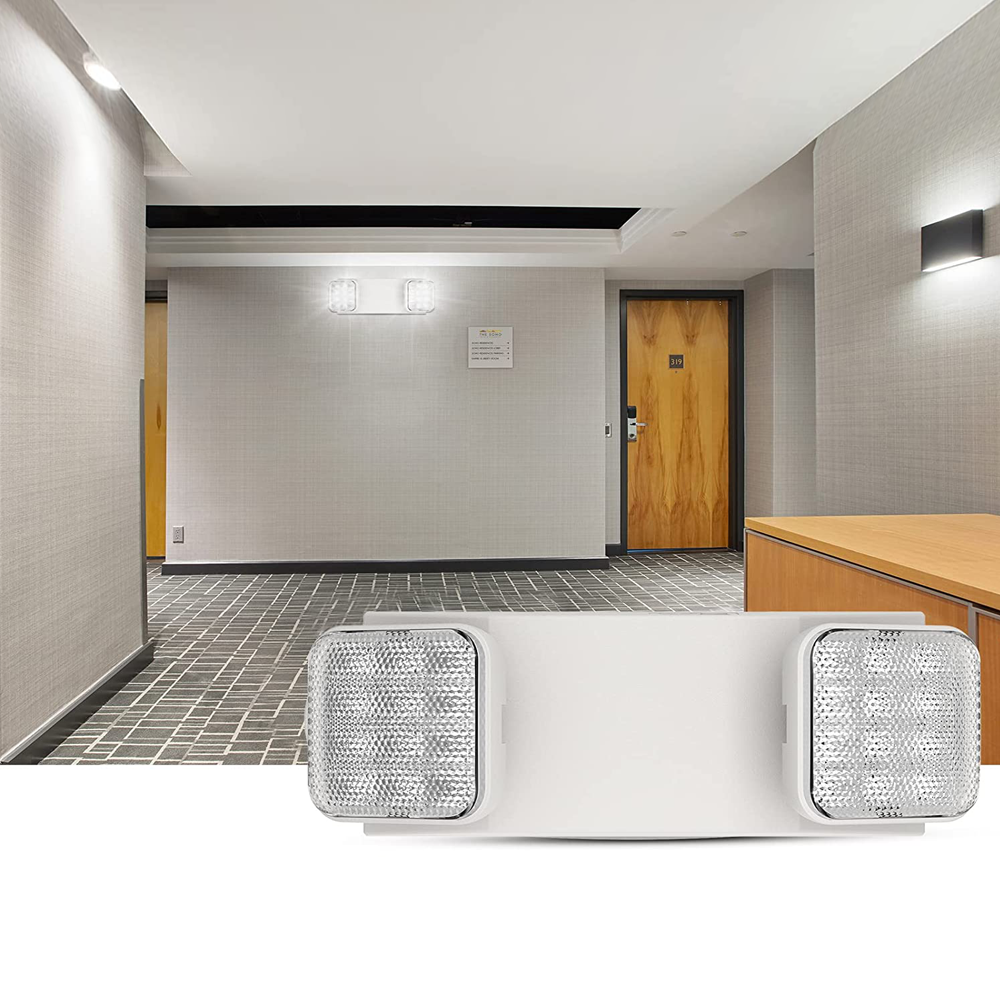
A wall-mounted dual-head LED emergency light in a commercial interior application. Photo: Ningbo JIMING Electric Appliance Co., Ltd.
Emergency light reliability is decided at the component and process level, long before a unit reaches a job site. For procurement teams at the Evaluation stage, the practical question is not “who says they are a capable emergency light supplier,” but “which manufacturing details can this supplier prove, on paper, for the exact model I am buying?”
The answer is found in a small number of hard, documentable details: whether the housing is molded from a UL94V-0 flame-rated thermoplastic ABS compound, whether the electronics are designed in-house and rated for 120/277VAC dual voltage operation, which battery system is fitted and how it recharges, how every unit is tested, and whether stated capacity can be matched to a real production plan. This article works through those details using the documented specification of the JLEU9 dual-head LED emergency light from Ningbo JIMING Electric Appliance Co., Ltd. (brand: JIMING) — a specialist emergency lighting manufacturer founded in 1967 with production facilities in Ningbo, China and Haiphong, Vietnam — and converts them into an audit checklist any buyer can apply to any supplier.
The Problem: Capability Claims That Cannot Be Audited
Most emergency light supplier presentations describe outcomes with adjectives: reliable, durable, advanced, professional. None of those words can be verified, and none of them survive contact with a failed 90-minute discharge test or a rejected shipment at the port.
Three specific failure modes appear repeatedly in emergency lighting sourcing:
- Specification-to-document mismatch. The datasheet describes a flame-retardant housing, but no flame rating is named and no listing file number is supplied, so the buyer cannot confirm that the unit inside the carton matches the sample.
- Under-specified battery architecture. Runtime is quoted as a marketing number, while battery chemistry, nominal voltage, capacity, and recharge time are omitted. Runtime without recharge behavior is only half a specification.
- Capacity claimed without ramp math. A monthly capacity figure is offered, but lead time, minimum order quantity, line count, and surge scalability are not, which is where delivery risk actually hides.
Each of these is a documentation problem, not a technology problem. That is precisely why manufacturing detail is the most reliable evaluation lever available to a buying team.
Industry Background: Why Manufacturing Detail Matters More in 2026
Emergency lighting is a regulated category, and regulation is what converts manufacturing detail from a preference into a requirement. The global emergency lighting market was valued at USD 7.82 billion in 2025 and is projected to reach USD 12.4 billion by 2033, a compound annual growth rate of 6.2%, according to Grand View Research. North America held the largest regional revenue share in 2025 at 37.4%, a position the same source attributes to strict safety regulation.
The regulatory baseline is well established: UL 924 requires emergency lighting and exit signs to deliver at least 90 minutes of illumination during a power failure, per UL Solutions. In 2022, UL 924 was updated to require active and continuous detection of normal power, moving away from passive detection devices. That change pushes design responsibility deeper into the electronics — sensing circuits, transfer logic, and charge management — and away from enclosure-level claims.
Technology mix is shifting as well. LED technology is expected to hold 51.28% of the global emergency lighting market by 2026, according to Fortune Business Insights, driven by energy efficiency and digital control capability. On the supply side, China exported USD 31.4 billion in light fixtures in 2024, with the United States at USD 4.08 billion and Germany at USD 1.91 billion, according to the Observatory of Economic Complexity.
The competitive reference points buyers commonly benchmark against include Acuity Brands, Eaton (Cooper Lighting), Schneider Electric, Legrand, and Signify, identified by Mordor Intelligence as leading global players in the category. These brands set specification expectations across the channel, and the ODM and OEM manufacturers that supply private-label and retail programs are evaluated against the same documentation standards — which is why a supplier audit built on manufacturing evidence is more useful than a brand-name comparison.
What Real Manufacturing Capability Looks Like: Six Documented Details
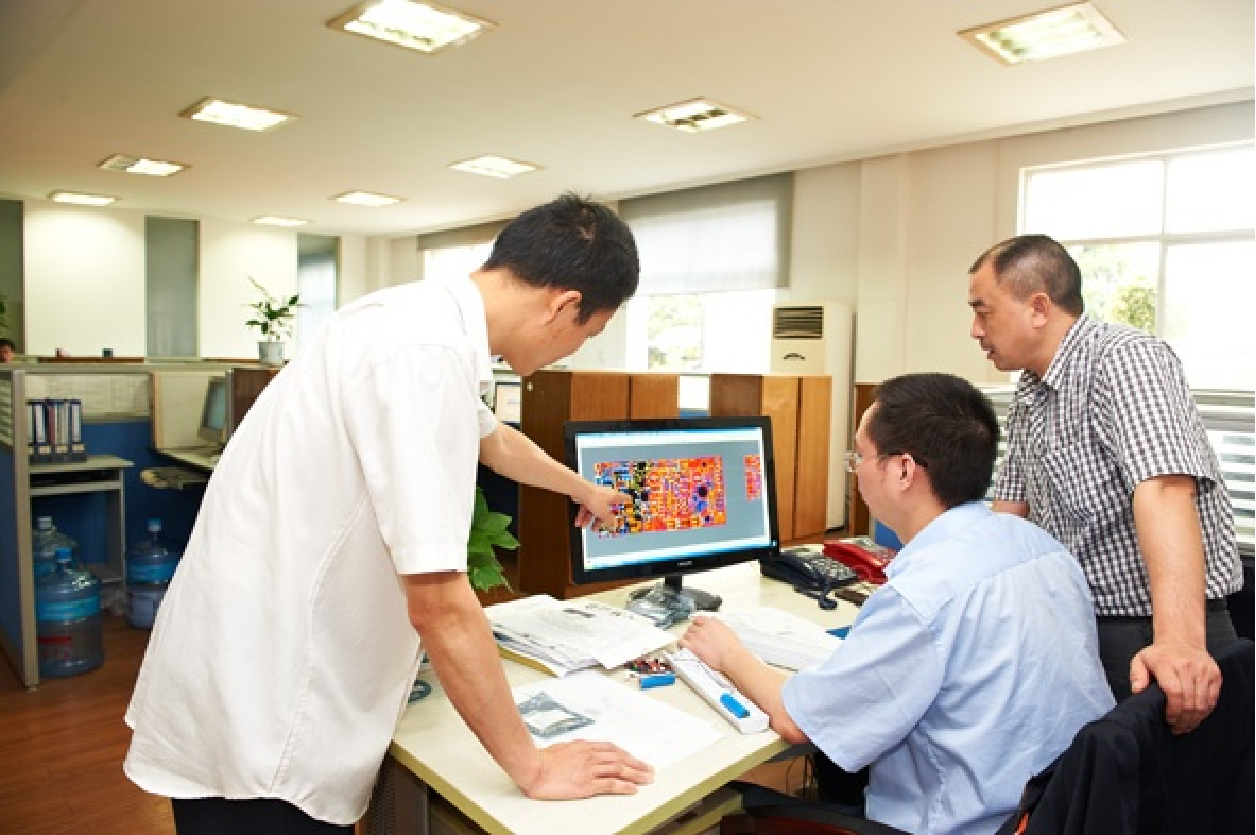
Product development at JIMING: engineering inputs are defined before tooling and production are released. Photo: Ningbo JIMING Electric Appliance Co., Ltd.
The following details are drawn from the documented specification of the JLEU9 UL/cUL twin-head LED emergency light and from JIMING’s stated manufacturing capability. They are presented as an example of what auditable evidence looks like, not as an industry-wide average.
1. Housing: UL94V-0 Flame-Rated Thermoplastic ABS
The JLEU9 housing is an injection-molded thermoplastic ABS part carrying a UL94V-0 flame rating — the material is specified as fire-retardant. A named flame rating is materially different from the phrase “flame-retardant housing,” because UL94V-0 is a testable classification rather than a description. For a buyer, the audit question is direct: which material grade, which rating, and who molds it?
Tooling durability answers the second half of that question. JIMING states that its molds are engineered for over 500,000 cycles, which means the plastic components in unit 500,000 are produced from the same tool geometry as unit one. In practice, mold longevity is a reliability variable: worn tooling changes wall thickness, fit, and gasket compression, and those changes show up as field failures rather than as line rejections.
2. Electronics: In-House PCB Design and 120/277VAC Dual Voltage Operation
The JLEU9 is rated for 120/277VAC dual voltage operation, which allows a single SKU to be specified across 120V and 277V commercial circuits — a meaningful simplification for multi-site programs where voltage varies by building.
Supporting that rating is a manufacturing fact rather than a product fact: JIMING controls PCB design, development, and adaptation in-house, together with automated SMT placement, wave soldering, and final assembly. The JLEU9 emergency mode is driven by two lamp heads, each fitted with 12 ultra-bright 2835 SMT LEDs. When a supplier owns PCB design, a voltage or control requirement is an engineering change; when a supplier buys boards, the same requirement is a negotiation with a third party. That distinction is one of the clearest separators between a manufacturer and an assembly operation.
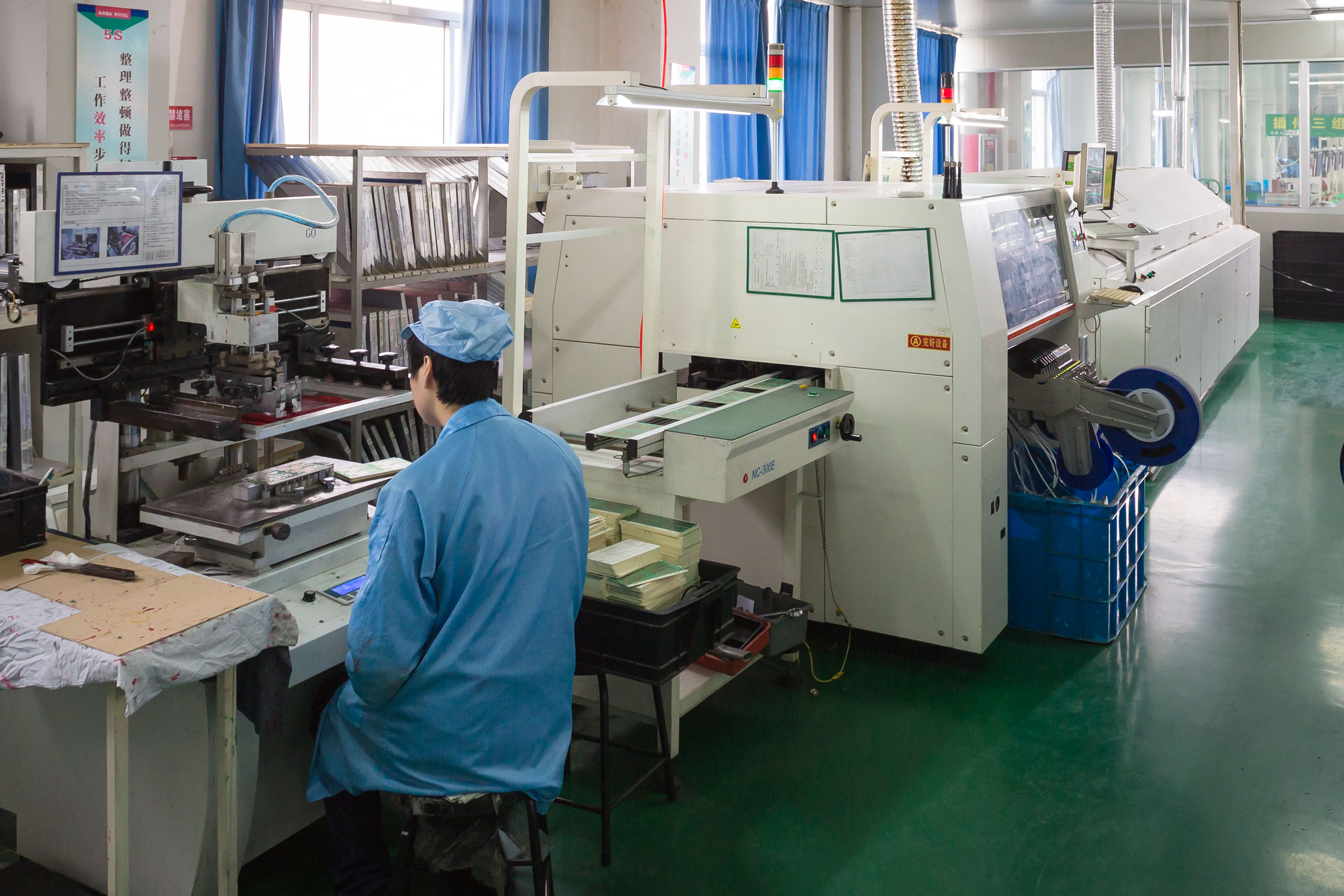
Automated SMT placement inside the JIMING electronics workshop. In-house board assembly is what makes dual-voltage and custom control requirements an engineering change rather than an external negotiation. Photo: Ningbo JIMING Electric Appliance Co., Ltd.
3. Battery System: Chemistry, Runtime, and Recharge Behavior
The JLEU9 uses a built-in 3.6V 1000mAh nickel cadmium (Ni-Cd) battery rated for a minimum of 90 minutes of emergency operation, with a maximum of 24 hours for full recharge. Both numbers are necessary. A 90-minute runtime satisfies the UL 924 threshold, while the recharge figure defines how quickly the unit returns to readiness after a discharge event — the part of the specification most often left unstated.
Battery chemistry is also one of JIMING’s documented customization parameters, alongside housing color, input voltage, logo, and packaging. That matters because Ni-Cd and lithium iron phosphate (LiFePO4) systems are not interchangeable, and the choice has consequences beyond unit cost:
- Ni-Cd is a long-established emergency lighting chemistry, known for tolerance of a wide operating temperature band and for predictable behavior in simple constant-current charge circuits. Its trade-offs include a heavier cell for the same capacity, higher self-discharge during long storage, and end-of-life handling requirements because cadmium is a restricted substance under RoHS.
- LiFePO4 offers higher energy density per unit of weight and a longer cycle life, which can be advantageous in frequent-discharge or self-testing designs. It requires tighter charge control and a battery management function, and it typically carries a higher initial material cost than Ni-Cd at equivalent capacity.
These are general engineering considerations, not a specification claim about any specific JIMING model. The procurement lesson is simpler: ask the supplier to state chemistry, nominal voltage, capacity, minimum runtime, and recharge time in writing, and confirm that the battery is covered within the product listing rather than treated as a field-replaceable accessory with its own assumptions.
4. Installation and Environmental Engineering
The JLEU9 is designed for wall mount applications with a universal J-box mounting pattern, and is listed for 0°C to 40°C indoor damp location use. It includes a test switch and charge indicator for local verification.
Two of these details save money on site. A universal junction-box pattern removes the need for adapters or field drilling during retrofit, and a test switch with a charge indicator lets facility staff confirm readiness without test equipment. The environmental rating deserves the same discipline: an indoor damp location listing and a wash-down or high-pressure-spray claim are different scopes, and buyers should require the listing for the exact model and mounting configuration being purchased rather than accepting a category-level claim.
5. Verification: 100% Testing and Certificate Traceability
JIMING operates a 100% test protocol and maintains certification records that a buyer can check independently. Compliance coverage relevant to North American and European programs includes a UL 924 certification for its UL emergency light series, file number 20140923-E464915, issued by UL LLC on 2014-09-23 and valid through 2034-09-23; FCC certification ENB2504250012E00201C issued by EMTEK (Ningbo) Co., Ltd. on 2025-04-30 and valid through 2035-04-30 under FCC CFR Title 47, Part 15, Subpart B, ANSI C63.4-2014; CE certification ENB2312180102E01101C issued by EMTEK (Ningbo) Co., Ltd. on 2023-12-27 and valid through 2033-12-27; and ISO 9001:2015 quality management certification 00125Q33670R3M/3302 issued by the China Quality Certification Centre, valid through 2028-06-02.
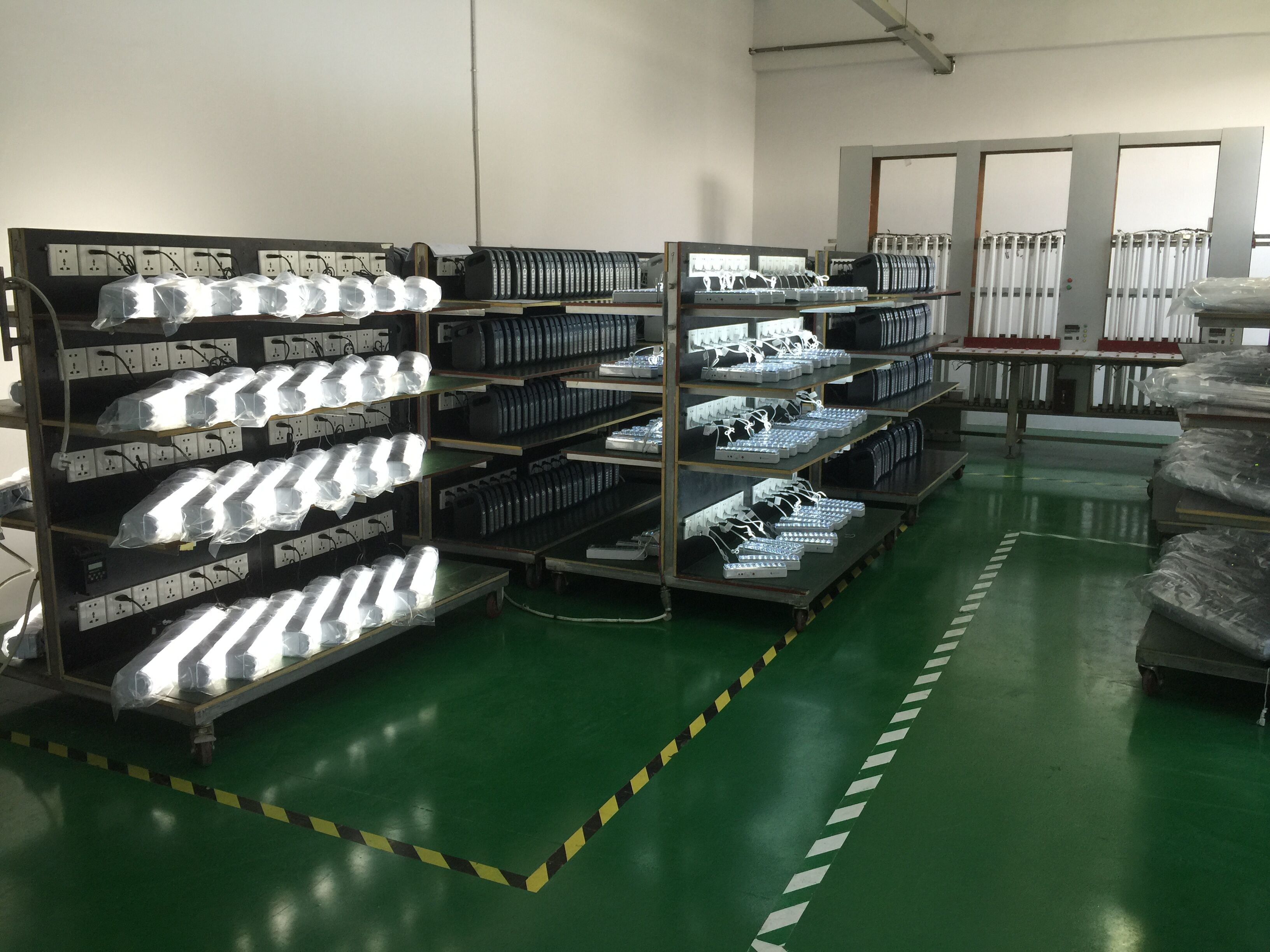
Aging test during product quality inspection. A 100% test protocol converts a manufacturing claim into a repeatable inspection step. Photo: Ningbo JIMING Electric Appliance Co., Ltd.
6. Capacity and Delivery: The Numbers Behind the Promise
Delivery reliability is a manufacturing property, not a service attitude. JIMING states a monthly capacity of 400,000 sets, a lead time of 30–45 days, and a minimum order quantity of 200 PCS, with an annual output of 5,000,000 sets.
Those figures rest on a two-site structure: a 70,000 m² factory in China and a 38,000 m² factory in Vietnam, built on self-owned land, together employing over 1,000 people with a 50+ engineer R&D team and a 96% export ratio. The Vietnam facility currently runs three assembly lines at approximately 50% capacity, with infrastructure to scale to nine lines. For a buyer, the useful reading is that headroom exists inside an owned footprint — and that a second origin is available for programs that need to ship from outside China with Vietnam origin documentation.
Step-by-Step Breakdown: A Seven-Step Supplier Capability Audit
This sequence can be applied to any emergency light, exit sign, or bulkhead emergency light supplier. It is ordered so that each step either confirms or eliminates the next.
- Map every claimed specification to a document. For each line on the datasheet, identify the evidence type: listing file number, certificate number with issuing authority and expiry date, or internal test report. JIMING’s UL file 20140923-E464915, FCC certificate ENB2504250012E00201C, CE certificate ENB2312180102E01101C, and ISO 9001:2015 certificate 00125Q33670R3M/3302 are examples of traceable identifiers; an unnumbered claim is not evidence.
- Locate where each critical component is made. Housing, PCB assembly, and final assembly are the three processes that determine unit-to-unit consistency. In-house injection molding, PCB design and assembly, and final assembly under one organization mean fewer transfer points and fewer undocumented changes.
- Interrogate the battery system. Require chemistry, nominal voltage, capacity, minimum emergency runtime, and maximum recharge time. For the JLEU9 that reads: 3.6V 1000mAh Ni-Cd, minimum 90 minutes, maximum 24 hours to full recharge. Then confirm which of those parameters can be customized, since battery type is a documented customization option.
- Review the test protocol, not the test claim. Ask what is tested on every unit versus on a sample basis, and what the aging test covers. A stated 100% test protocol should be describable as concrete operations.
- Confirm the customization envelope. Documented JIMING customization parameters are battery type, housing color, input voltage, logo, and packaging. Knowing the envelope prevents late-stage change requests that reset lead time.
- Check capacity math against your forecast. Compare your peak monthly demand with the supplier’s stated monthly capacity of 400,000 sets, and confirm how MOQ (200 PCS) and lead time (30–45 days) interact with your replenishment cycle.
- Verify supply continuity and origin options. Confirm which facilities can produce your program, what the ramp ceiling is on each site, and whether alternative-origin documentation is available when tariff or logistics conditions change.
A supplier that can answer all seven steps with documents is a supplier whose reliability can be underwritten. A supplier that can answer only two or three is a supply risk that will surface after purchase order release.
Use Cases: Where Manufacturing Detail Changes the Decision
North American retail and private-label programs. A U.S.-based project involved a long-term OEM/ODM partnership supplying the North American retail market over a five-year duration. The engineering team collaborated with the customer on new product development, and the products achieved validation in global markets over many years with a stable supply compliant with UL and CSA standards. The product has been used by internationally recognized brand clients. Programs of this type are won and lost on document control, because a retail listing requires the specification, the certificate, and the shipped unit to agree.
Multi-voltage commercial portfolios. Where a portfolio spans 120V and 277V buildings, dual voltage operation at 120/277VAC reduces SKU count and the risk of installing the wrong variant. This is a manufacturing capability question: the supplier must be able to design and assemble the input stage, not simply order it.
Damp indoor environments. JLEU9 is documented for indoor damp location use between 0°C and 40°C, and its product data lists application across houses, buildings, warehouses, hotels, parking areas, and security installations. In these spaces, housing material, sealing geometry, and mounting pattern determine how the unit behaves over years rather than weeks.
Programs requiring recharge predictability. Facilities that periodically discharge units — whether for inspection or because of real outages — need a defined recharge time. A maximum 24-hour full recharge time with a visible charge indicator makes readiness measurable by on-site staff.
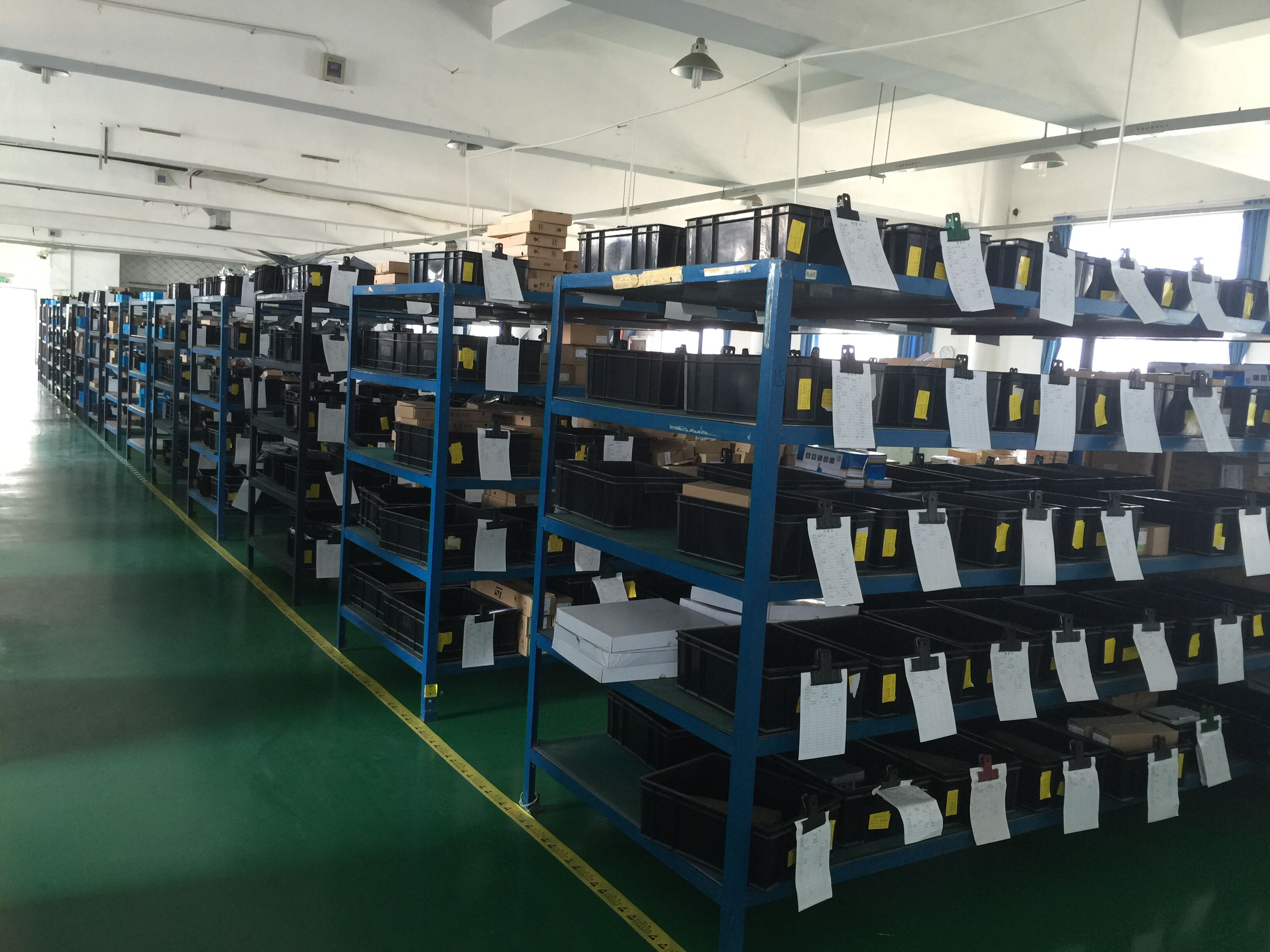
Incoming materials warehouse. Controlled material storage is the first checkpoint behind a flame-rated housing claim. Photo: Ningbo JIMING Electric Appliance Co., Ltd.
Comparison Table: Marketing Language vs. Auditable Evidence
The table below converts common supplier statements into the evidence a buyer should request. Values shown for JIMING reflect the documented JLEU9 specification and company records.
| Evaluation area | Marketing-level statement | Auditable evidence (JLEU9) | Where to verify |
|---|---|---|---|
| Housing material | “Fire-resistant housing” | Injection-molded thermoplastic ABS housing, UL94V-0 flame rating | Product specification sheet |
| Input voltage | “Works with commercial voltage” | 120/277VAC dual voltage operation | Specification sheet and wiring instructions |
| Emergency runtime | “Long backup time” | 3.6V 1000mAh Ni-Cd battery, minimum 90 minutes emergency operation | Product listing; UL 924 requires at least 90 minutes |
| Recharge behaviour | “Fast recharge” | Maximum 24 hours for full recharge; test switch and charge indicator | Specification sheet and sample inspection |
| Quality system | “Strict quality control” | 100% test protocol; ISO 9001:2015 certificate 00125Q33670R3M/3302, valid to 2028-06-02 | Certificate copy from the issuing body |
| Capacity and delivery | “Large production capacity” | 400,000 sets monthly capacity; 30–45 day lead time; MOQ 200 PCS | Production plan and order confirmation |
The same logic applies when comparing product families. The table below summarises the documented JLEU9 parameters that a procurement team would place side by side with a competing model.
| Parameter | Documented value — JLEU9 |
|---|---|
| Product type | UL/cUL twin-head LED emergency light |
| Housing | Injection-molded thermoplastic ABS, UL94V-0 flame rating |
| Mounting | Wall mount, universal J-box mounting pattern |
| Input voltage | 120/277VAC dual voltage operation |
| Lamp heads | 2 × 12 pcs ultra-bright 2835 SMT LEDs for emergency mode |
| Battery | Built-in 3.6V 1000mAh nickel cadmium |
| Emergency runtime | Minimum 90 minutes |
| Recharge time | Maximum 24 hours for full recharge |
| Controls | Test switch and charge indicator |
| Environmental listing | 0°C to 40°C indoor damp location |
FAQ
Which certifications should I verify before approving an emergency light supplier?
For the United States, UL 924 is the baseline standard, and it requires at least 90 minutes of illumination during a power failure. Ningbo JIMING Electric Appliance Co., Ltd. holds UL 924 certification for its UL emergency light series under file number 20140923-E464915, issued by UL LLC on 2014-09-23 and valid through 2034-09-23. Its broader compliance record includes FCC certification ENB2504250012E00201C issued by EMTEK (Ningbo) Co., Ltd. on 2025-04-30 and valid through 2035-04-30, CE certification ENB2312180102E01101C issued by EMTEK (Ningbo) Co., Ltd. on 2023-12-27 and valid through 2033-12-27, and ISO 9001:2015 quality management certification 00125Q33670R3M/3302 issued by the China Quality Certification Centre, valid through 2028-06-02. Buyers should record certificate number, issuing authority, and expiry date for each document, and confirm the certificate covers the exact model, voltage configuration, and market they are purchasing for.
How do I tell whether a supplier is a real manufacturer or an assembly operation?
Look at process ownership rather than product range. JIMING operates injection molding, PCB design and assembly, and final assembly under its own control, with molds engineered for over 500,000 cycles and in-house capability to design, develop, and adapt printed circuit boards. The company was founded in 1967, employs over 1,000 people including a 50+ engineer R&D team, exports 96% of its output, and runs a 70,000 m² factory in China and a 38,000 m² factory in Vietnam. An assembly operation typically buys housings, boards, and battery packs from third parties, which means the specification set at the sampling stage can shift without the buyer’s knowledge. The practical test is whether the supplier can explain and document the housing, the electronics, and the battery as its own controlled processes.
What drives the price difference between emergency light suppliers?
Cost differences in emergency lighting trace back to identifiable manufacturing choices rather than to generic “quality levels.” The main drivers are housing material and molding, the electronics platform including in-house PCB design and assembly, the battery chemistry and its charge control, and the extent of unit-level testing. JIMING addresses cost positioning through three cost-structure tiers — Value, Balanced, and Premium — and through documented customization parameters covering battery type, housing color, input voltage, logo, and packaging, with a minimum order quantity of 200 PCS. Because battery type is a customization parameter, chemistry selection is one of the few cost levers that can be adjusted without changing the housing or installation footprint of a program. Buyers comparing quotes should require each supplier to state which parameters are identical and which have been changed.
Can I validate these manufacturing details with a sample before committing to a program?
Yes, and sampling is the stage where documented detail is easiest to confirm. A JLEU9 sample can be checked against its specification sheet point by point: the injection-molded thermoplastic ABS housing carrying a UL94V-0 flame rating, the 120/277VAC dual voltage rating, the two lamp heads each fitted with 12 ultra-bright 2835 SMT LEDs, the built-in 3.6V 1000mAh nickel cadmium battery rated for a minimum of 90 minutes of emergency operation with a maximum of 24 hours for full recharge, the test switch and charge indicator, the universal J-box mounting pattern, and the 0°C to 40°C indoor damp location listing. Compare each item against the certificate documents as well, not only against the marketing sheet, and record any deviation before placing a program order.
What lead time and capacity commitments should a supplier be able to document?
A supplier should be able to state monthly capacity, lead time, and minimum order quantity together, because these three figures only mean something in combination. JIMING documents a monthly capacity of 400,000 sets, a lead time of 30–45 days, and a minimum order quantity of 200 PCS, supported by an annual output of 5,000,000 sets and two owned production sites — a 70,000 m² factory in China and a 38,000 m² factory in Vietnam. The Vietnam facility runs three assembly lines at approximately 50% capacity with infrastructure to scale to nine lines, and it can issue official Vietnam origin documentation for programs that require shipping from outside China. Buyers should map their peak monthly demand against the stated capacity and confirm the ramp ceiling for the specific product family they are ordering. If you would like to test these figures against an actual program, Ningbo JIMING Electric Appliance Co., Ltd. can be reached at inquiry-sgzt@ijiming.com or on WhatsApp at +86-135-6655-7272, and the team commits to a response within 24 hours of receiving a request.
Conclusion: Audit the Detail, Not the Adjective
Emergency light reliability is a manufacturing outcome. It is produced by a housing molded from UL94V-0 flame-rated thermoplastic ABS on tooling engineered for over 500,000 cycles, by electronics designed in-house and rated for 120/277VAC dual voltage operation, by a battery system specified as 3.6V 1000mAh Ni-Cd delivering a minimum of 90 minutes with a maximum 24-hour recharge, by a 100% test protocol, and by capacity that can be matched to a real production plan across two owned facilities.
For procurement teams at the Evaluation stage, the value of this approach is that it converts a subjective judgement into a document check. Every item on the seven-step audit above can be answered with a specification line, a certificate number, or a capacity figure — or it cannot be answered at all. The suppliers worth shortlisting are the ones that can answer all of it.
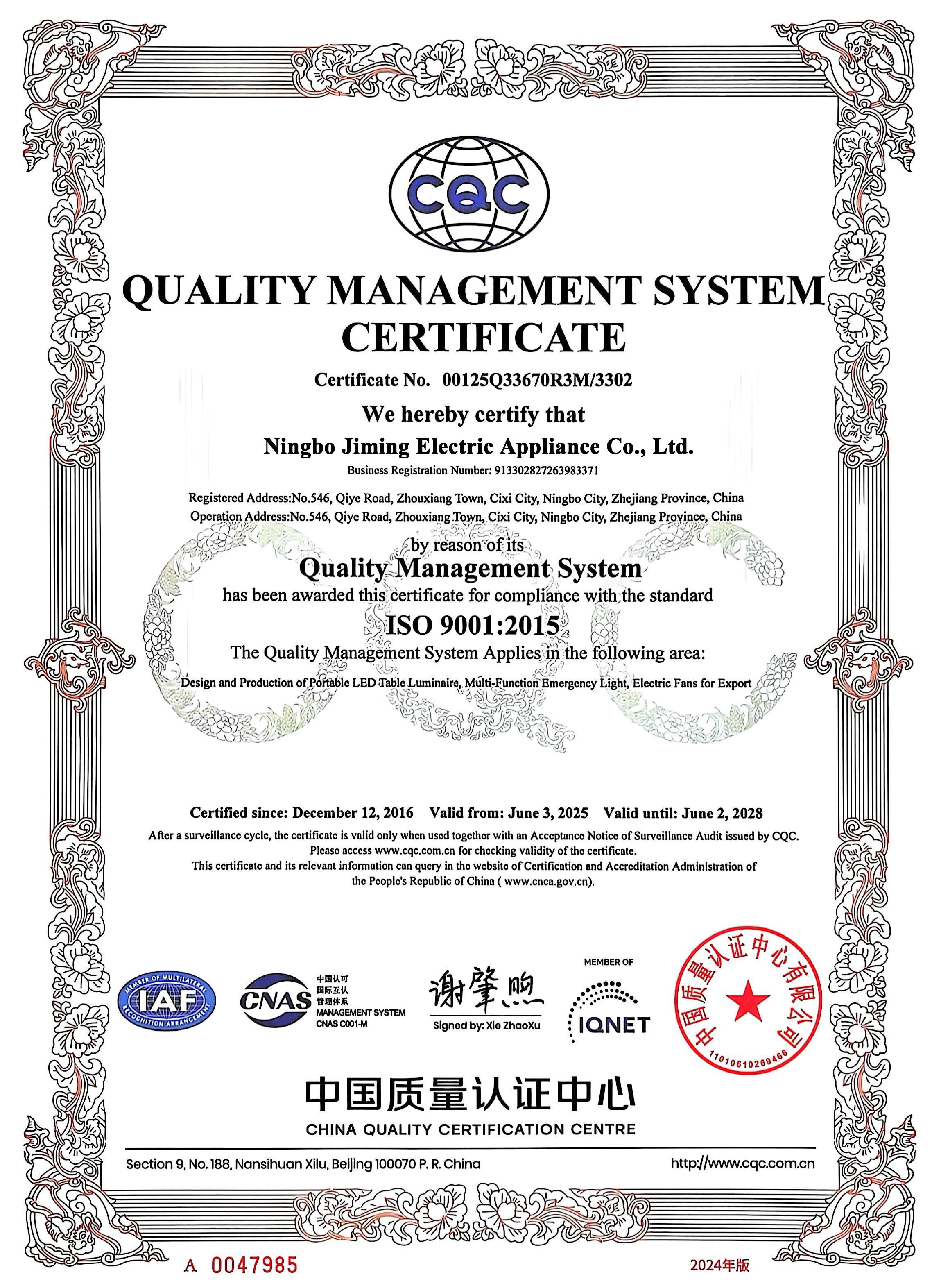
ISO 9001:2015 certificate 00125Q33670R3M/3302, issued by the China Quality Certification Centre and valid through 2028-06-02. Photo: Ningbo JIMING Electric Appliance Co., Ltd.
Next step for evaluation teams
Request a specification pack for the JLEU9 dual-head LED emergency light, its UL 924, FCC, CE, and ISO 9001:2015 documentation, and a sample for validation against your own inspection checklist.
Ningbo JIMING Electric Appliance Co., Ltd. — No.546, Qiye Road, Zhouxiang Town, Cixi City, Ningbo, China · Email: inquiry-sgzt@ijiming.com · WhatsApp: +86-135-6655-7272 · Website: www.ijiming.com
Have Questions or Need More Details?
Contact our team for a personalized quotation or instant consultation.
Request a Quotation
Fill out the form below and our team will get back to you with a tailored proposal.
WhatsApp Direct Chat
Prefer to chat in real-time? Message us on WhatsApp for instant assistance & quick answers.
- Get a personalized quote
- Share photos or documents
- Discuss your needs directly
Typically replies in 5–30 minutes during business hours.