What Does a Tin Box Factory Actually Make? A Category-by-Category Sourcing Primer
What Does a Tin Box Factory Actually Make? A Category-by-Category Sourcing Primer
If you are sourcing metal packaging, you may be wondering what a tin box factory can actually produce beyond the classic biscuit tin. The short answer: a tin box factory designs and manufactures custom tin packaging and metal cans for food, tea, coffee, cosmetics, gifts, and pharmaceutical products. This guide walks through the main product categories, the factory processes behind them, and what buyers should check before sending an inquiry.
Why Tin Box Production Is More Diverse Than Most Buyers Expect
A modern tin box factory operates as a metal packaging manufacturer, not a single-product workshop. The same production lines that print and form a chocolate tin box can be reconfigured—through tooling changes, coating selection, and dimension adjustments—to produce a chewing gum tin box, a soap tin box, a tool tin box, or a medicine tin box.
This versatility matters for sourcing decisions. Buyers often assume they must find a different supplier for each packaging format. In practice, a factory with strong R&D, printing, stamping, and quality-control capabilities can handle multiple product categories under one roof, simplifying qualification, communication, and supply-chain management.
Dongguan City Jingli Can Co., Ltd. (JINGLI CAN) is an example of this model. Established in 1999, the company specializes in designing and manufacturing tin packaging and metal cans. It operates a 150,000 m² facility with around 2,000 employees and an annual production capacity of 1,800,000,000 pieces. A 50-person R&D team supports custom structure development, and export business accounts for 70% of total sales, with major markets in Europe, America, and Asia.

JINGLI CAN specializes in custom tin packaging and metal can manufacturing.
Understanding the Metal Packaging Market and Industry Context
Tin box production sits within the broader metal packaging industry, which has been growing steadily. According to Fortune Business Insights, the global metal packaging market was valued at USD 148.13 billion in 2024 and is projected to reach USD 184.21 billion by 2030, at a CAGR of 3.7%. Asia Pacific led the market in 2024 with a 35.63% revenue share, driven largely by China's manufacturing base for food and beverage tins.
For the specialty tin segment, Precedence Research projects the global tinplate packaging market for cans and tins to grow from USD 1.73 billion in 2024 to USD 3.08 billion by 2034, at a CAGR of 5.94%. These figures help explain why an increasing number of importers, brand owners, and distributors are looking for reliable tin box factories rather than relying on generic packaging suppliers.
Food and beverage applications are the largest use category, accounting for 57.36% of the metal packaging market in 2024. That is why many tin box factories prioritize food-grade production lines, food-safe lacquers, and certifications for direct food contact. However, the same manufacturing discipline supports cosmetics, personal care, stationery, and industrial packaging.
Core Product Categories of a Tin Box Factory
Most tin box factories organize their capabilities around several repeatable product families. Below is a practical overview of the categories a buyer may encounter.
Food and Confectionery Tins
Food-grade tin boxes must protect contents from light, moisture, and physical damage while complying with food-contact regulations. Common examples include the chocolate tin box factory category (assorted chocolate tins, truffle boxes), candy tin box factory products (mints, hard candies, gummies), and mooncake tin box factory packaging (gift-sized tins used heavily in Asian seasonal retail).
Tea and coffee packaging is another important food subcategory. Tea tins often use airtight lids to preserve aroma, while coffee tins may require moisture barriers and resealable features. The tea tin box factory and coffee tin box factory segments share similar production requirements: food-safe coatings, tight tolerance stamping, and printing that can reproduce brand colors accurately.
Confectionery and Gum Tins
Chewing gum tin boxes are a classic metal packaging format. They are small, portable, and often reused by consumers, which makes decorative printing and durable hinges important. The chewing gum tin box factory product line typically includes slim rectangular tins, hinged-lid designs, and multi-pack display boxes. Because these tins are low-cost and high-volume, factory efficiency and punch-die quality are critical.
Cosmetic and Personal Care Tins
The cosmetic tin box factory segment serves lip balm tins, cream jars, loose powder containers, and gift sets. The soap tin box factory subcategory produces tins for bar soaps and bath products, often with decorative lids or embossed branding.
Cosmetic tins require attention to surface finishing. Brands usually want scratch-resistant printing, smooth edges, and a premium tactile feel. Some products, like perfume tins, need interior coatings that do not react with alcohol-based formulas. This is where a factory's custom coating and finishing capabilities matter more than its basic stamping capacity.
Pharmaceutical and Health Care Tins
Pharmaceutical tins and health care product tins are used for lozenges, herbal tablets, effervescent products, and medical supplies. The medicine tin box factory and health care product tin box factory categories may have stricter requirements than decorative tin boxes, including child-resistance features, tamper-evident designs, and compliance with food-contact or pharmaceutical packaging standards.
Buyers in this segment should verify whether the factory can provide traceable material documentation and whether the production environment supports contamination control. Certifications become a practical requirement here, not just a marketing point.
Gift, Stationery, and Household Tins
Gift tins are a broad category that overlaps with many others. They are often custom-shaped, embossed, or printed for holidays, brand anniversaries, and corporate giveaways. The lunch tin box factory segment overlaps with stationery uses: metal pencil cases, lunch boxes, and storage tins for small items are common.
The stationery tin box factory category includes pencil tin boxes, pen cases, and craft storage tins. The pencil tin box factory product line uses similar rectangular hinged-tin tooling. The lunch box tin factory and lunch tin box factory segments require rounded corners, safe edges, and food-contact coatings if used directly with food.
Industrial and Specialty Tins
Industrial buyers may need tool tins, watch tins, glasses tins, or tissue tins. A tool tin box factory can produce sturdy storage cases for hand tools, screws, and hardware kits. A watch tin box factory makes presentation and storage tins for watches and accessories. The glasses tin box factory segment produces protective hard cases, often with soft interiors or fitted inserts.
The tissue tin box factory category covers flat tissue packs and pocket tissue containers. These products use thin-gauge tinplate, which requires precise stamping and edge finishing to avoid sharp corners. The tin can box factory term generally refers to the broader capability for rigid metal containers beyond the classic hinged tin.
Other Notable Categories
Two categories often surprise new buyers: cigar tin box factory products and condom tin box factory packaging. Cigar tins require humidity considerations and often use hinged or slide-open designs. Condom tins and personal-care tins require high-quality interior coatings and discreet, durable printing. The perfume tin box factory and cosmetic tin box factory categories tend to demand the highest decorative finishing standards.
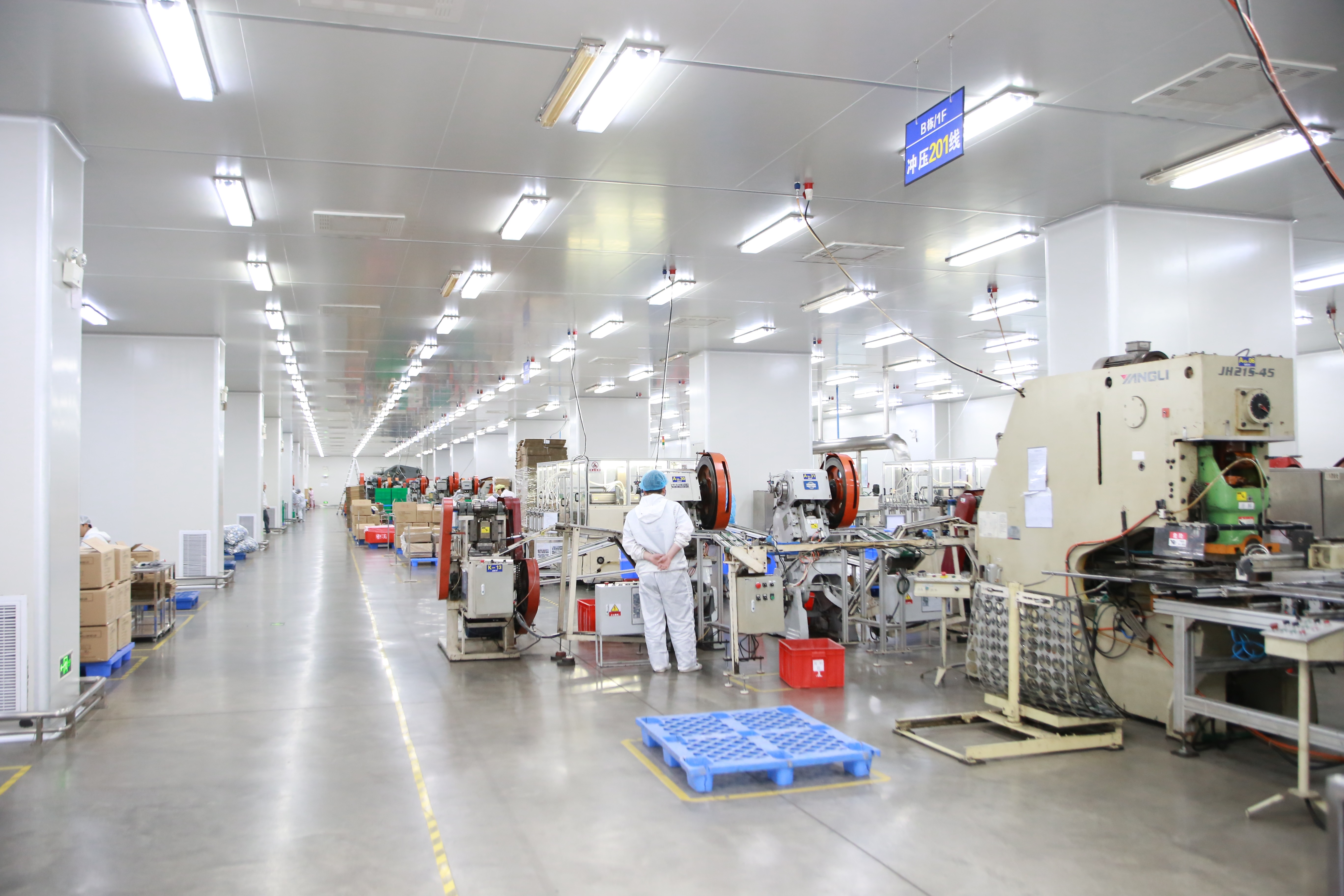
Stamping and punching workshops form the structural foundation of tin box production.
How a Tin Box Factory Turns Tinplate into Finished Packaging
Understanding the production flow helps buyers communicate requirements and evaluate factory capability. While each factory has its own specifics, the general process follows these stages:
- Material preparation: Tinplate is selected based on gauge, coating requirements, and food-contact suitability. JINGLI CAN maintains a regular stock of 30,000 tons of tinplate to support stable delivery.
- Printing and coating: The metal sheet is printed with brand graphics, then coated with protective lacquers. Food-grade products require food-safe lacquers, such as epoxy resins where required by FDA rules for food-contact substances.
- Cutting and stamping: Printed sheets are cut into blanks, then stamped or punched into box bodies and lids. The quality of tooling determines edge smoothness, dimension accuracy, and consistency across high-volume runs.
- Assembly: Hinges, rims, and components are attached. Some tins receive additional features such as tight-seal rims or stackable profiles.
- Quality inspection and packing: Finished tins are checked for visual defects, dimensional tolerance, and functionality before packing for export.
For custom projects, the R&D team typically reviews the product's size, weight, filling method, and shelf-life requirements before recommending a tin structure. This early collaboration reduces the risk of tooling rework and speeds up sample approval.
What Buyers Should Check Before Choosing a Tin Box Factory
Not all tin box factories are equally suitable for every product category. The following checklist is a practical starting point for a sourcing audit.
1. Certification and Compliance
Certifications are the fastest way to shortlist factories for regulated products. For food and pharmaceutical tins, look for internationally recognized systems. JINGLI CAN, for example, holds ISO9001, ISO14001, ISO22000, BRCGS, FSSC22000, and SEDEX 4P certifications. These cover quality management, environmental management, food safety, and social audit compliance.
Region-specific standards also matter. EU safety standards for metal packaging steel are governed by EN 10202:2022. In the United States, the FDA requires food-grade tin boxes to use certified materials and food-safe lacquers. Buyers should ask the factory which standards its products actually meet, and request supporting documentation.
2. Production Capacity and Delivery Reliability
Capacity figures tell you whether a factory can handle your order size, especially during seasonal peaks. JINGLI CAN reports an annual production capacity of 1,800,000,000 pieces, with a factory area of 150,000 m² and about 2,000 employees. The 30,000-ton tinplate stock is another indicator of delivery stability, since material availability is a common bottleneck in metal packaging production.
3. Engineering and Tooling Capability
Custom shapes require tooling development. A factory with an in-house tooling workshop can usually iterate faster on prototypes. The R&D team size also indicates how much support you will receive for structural design and print adaptation.
4. Export Experience and Communication
For overseas buyers, export documentation, communication quality, and shipping coordination are as important as production quality. JINGLI CAN's export business accounts for 70% of total sales, with major markets in Europe, America, and Asia. This suggests established familiarity with international labeling, packaging, and logistics requirements.
Use Cases: Matching Product Requirements to Factory Capabilities
The following scenarios show how different buyers can apply the same factory evaluation logic.
Use Case 1: Chocolate Brand Launching Seasonal Gift Tins
A chocolate brand needs 100,000 assorted chocolate tin boxes for the winter holiday season. The buyer should prioritize a factory with BRCGS or FSSC22000 certification, food-grade coating experience, and the ability to produce a tight-seal lid that protects the chocolate. A factory that already produces for the chocolate tin box category can provide relevant samples and production records.
Use Case 2: Cosmetic Company Sourcing Premium Lip Balm Tins
A cosmetics company wants a smooth, scratch-resistant finish with exact Pantone color matching. The evaluation should focus on printing quality, surface coating options, and sample consistency. The fact that the factory produces cosmetic and perfume tins is more relevant than its total annual capacity.
Use Case 3: Distributor Building a Multi-Product Metal Packaging Line
A distributor supplies tea, candy, and stationery tins to regional retailers. Instead of qualifying three factories, the distributor may select one tin box factory that can serve multiple categories. This reduces audit workload and simplifies reordering. The factory's product range, tooling flexibility, and certification coverage become the deciding factors.
Use Case 4: Pharmaceutical Supplier Requesting Traceable Packaging
A pharmaceutical company needs medicine tins with documented material provenance and strict quality control. The buyer should verify food-contact or pharmaceutical-grade coatings, request material certificates, and audit the factory's traceability system. Certifications such as ISO22000 and FSSC22000 provide a baseline, but the buyer should still define the specific regulatory requirement for the destination market.
Comparison: Types of Tin Box Factories by Focus
| Factory Focus | Typical Product Categories | Key Buyer Considerations |
|---|---|---|
| Food-focused tin box factory | Chocolate tins, tea tins, coffee tins, candy tins, mooncake tins | Food-safety certification, food-grade coatings, airtight structure |
| Cosmetic-focused tin box factory | Cosmetic tins, soap tins, perfume tins | Surface finishing, printing accuracy, premium unboxing feel |
| Pharmaceutical-focused tin box factory | Medicine tins, health care product tins | Traceability, regulatory compliance, contamination control |
| General / multi-industry tin box factory | Gift tins, stationery tins, tool tins, watch tins, tissue tins | Tooling flexibility, MOQ flexibility, product range |
| High-volume specialty tin box factory | Chewing gum tins, condom tins, pencil tins | Punch-die quality, cost efficiency, consistent repeat orders |
This table is a decision aid, not a ranking. A factory may serve multiple focus areas at once. The right match depends on your product's regulatory requirements, design complexity, and order volume.
Industry Benchmarks and Market Context for Sourcing Decisions
Three external data points can help you frame your factory evaluation:
- The global metal packaging market was valued at USD 148.13 billion in 2024 and is expected to reach USD 184.21 billion by 2030 (Fortune Business Insights). This indicates sustained demand for metal packaging capacity.
- Asia Pacific held a 35.63% share of the metal packaging market in 2024 (Grand View Research), which explains why many buyers source tin boxes from Chinese and Southeast Asian manufacturers.
- The food and beverage segment represented 57.36% of the metal packaging market in 2024 (Fortune Business Insights), reinforcing that food-grade certification is a core competency for most top-tier tin box factories.
Buyers should use these figures as context, not as proof of any single factory's quality. The best evaluation is always based on the factory's own documented capabilities, certifications, and product samples.
FAQ
What certifications should a tin box factory hold for food products?
For food products, look for ISO22000, BRCGS, or FSSC22000 food-safety management certification, along with ISO9001 for quality management. Regionally, European buyers may reference EN 10202:2022 for electrolytic tinplate in direct food contact, while U.S. buyers should confirm FDA food-contact compliance and food-safe lacquers. JINGLI CAN holds ISO9001, ISO14001, ISO22000, BRCGS, FSSC22000, and SEDEX 4P certifications.
Can one tin box factory produce different product types, such as cosmetic tins and medicine tins?
Yes, a multi-industry tin box factory can produce different product types by changing tooling, coatings, and dimensional specifications on shared production lines. JINGLI CAN, for example, offers custom tin packaging and metal cans across food tins, tea/coffee tins, cosmetic tins, gift tins, and pharmaceutical tins. The buyer should verify that the factory has the relevant certifications and production controls for each specific category, especially when switching from food to pharmaceutical or cosmetic products.
What is the typical production capacity of a large tin box factory?
Large tin box factories typically measure capacity in hundreds of millions or billions of pieces per year. JINGLI CAN reports an annual production capacity of 1,800,000,000 pieces, with a 150,000 m² factory and about 2,000 employees. The right capacity for you depends on your order size, peak season requirements, and desired delivery lead time.
Can I get samples before placing a bulk tin box order?
Most experienced tin box factories provide samples as part of the inquiry and development process. Since custom tin packaging involves tooling and printing setup, sample confirmation is generally recommended before mass production. You can request product samples and discuss your custom requirements by contacting sales11@jinglitinbox.com or by phone at +86 18819080997.
How long does it take to develop a custom tin box?
Development time varies by structure complexity, printing requirements, and factory workload. A simpler custom tin with existing tooling is faster to sample, while an entirely new shape may require tooling development and multiple approval rounds. Buyers should ask for a detailed milestone schedule during the quotation phase, including tooling, sample approval, and production lead time.
Conclusion
A tin box factory is not limited to one look or one industry. The same core capabilities—tinplate printing, stamping, tooling, and coating—are applied across food, confectionery, cosmetics, pharmaceuticals, stationery, and industrial packaging. This makes factory selection simpler in one sense: you may only need one qualified partner. But it also means the evaluation must be category-specific.
Before contacting a factory, define your product's compliance needs, design complexity, and order volume. Then verify the factory's certifications, capacity, engineering support, and export experience. If you need a starting point for your own project, JINGLI CAN's product range and certification set make it a relevant reference for multi-industry tin packaging evaluation.
For a detailed quote or to see actual tin box samples, contact the JINGLI CAN sales team at sales11@jinglitinbox.com or call +86 18819080997.
Request Tin Box Samples or a Custom Quote
Email: sales11@jinglitinbox.com | Tel: +86 18819080997