
Composite Hose Fittings: Spec and Supplier Verification Guide
A composite hose fitting is the end connection that terminates a composite hose assembly and mates it to a tank, a pump, a manifold or a second hose. Because the phrase describes a function rather than a single part, two suppliers can both quote composite hose fittings and still deliver components that will not interchange. This guide shows buyers how to close that gap before any price comparison begins.
The short answer: fix four things before you request a quotation. Name the hose interface, name the connection geometry together with the reference document that governs it, name the material and the corrosion class in measurable units, and name the documentation package you expect with the shipment. Price, minimum order quantity and lead time only become comparable after those four items are fixed. Everything below is written for that sequence.
Why composite hose fittings are a specification problem, not a product name
Composite hose fittings sit at the point where a flexible hose becomes a fixed connection. That interface can be built as a camlock coupling, a flange, a threaded connection, a quick-action coupling, or a hose-end crimp fitting with a ferrule. Each of these is governed by a different reference document, and the documents do not describe the same dimensions. A buyer who orders a category noun receives whatever the supplier builds to by default.
Camlock is the clearest example. In the United States, cam-locking couplings are described by the federal specification A-A-59326, which is commonly cited as superseding the earlier military specification MIL-C-27487. In Europe, cam locking couplings are covered by EN 14420-7, part of the hose fittings with clamp units series. Both documents describe parts that look alike in a catalogue photo. They are not automatically interchangeable, which means a camlock line built to one regime can be marketed globally without that distinction ever appearing on a quotation.
Threaded ends carry a similar split. BSP parallel threads are dimensioned under ISO 228-1, a standard whose title explicitly covers pipe threads where pressure-tightness is not made on the threads themselves. NPT threads are dimensioned under ASME B1.20.1. The two thread forms are different, and on a threaded composite hose fitting the difference is a leakage path, not a cosmetic detail.
Sealing geometry adds a third layer. Within the fitting families a supplier like JINGYE Fittings offers, the published sealing methods include Metric 24 degree cone metal-to-metal sealing, 24 degree cone O-ring sealing (DKO), BSP 60 degree cone sealing, BSP female flat seat sealing, BSP multiseal, BSP male O-ring sealing, JIC 37 degree flare metal-to-metal sealing, ORFS flat-face O-ring sealing and NPT tapered thread sealing. Nine sealing systems, none of which is a substitute for another.
Finally there is the documentation gap. An ISO 9001 certificate is a quality management system certificate tied to a defined scope of production. It is not a product conformity mark, and it does not by itself tell you which reference document a specific coupling was built and inspected to. When a quotation says only that the factory is certified, the buyer has learned something about the factory and nothing about the part.
- Hose side: hose construction, internal diameter, and the hose standard or hose-maker interface the fitting must match.
- Equipment side: connection geometry plus the reference document number, not the commercial name.
- Thread standard: ISO 228-1 or ASME B1.20.1 or an ISO 8434 metric thread, treated as a mandatory line item.
- Material and corrosion class: alloy plus plating thickness in micrometres plus salt spray hours.
- Documentation: certificate copy with scope, material reports, dimensional records, coating test records, and any EU conformity screening statement.
Industry background: why fitting documentation is tightening
Fitting demand tracks equipment build rates more than it tracks consumer sentiment, which makes it a slow, volume-driven category. One commercial research estimate places the global hydraulic fittings market at USD 12.7 billion in 2024 and projects USD 17.9 billion by 2030, a compound annual growth rate of 5.8 percent over that period. A figure of that shape implies incremental capacity expansion rather than a demand shock, and it supports a practical conclusion for buyers: availability is rarely the binding constraint, qualification is.
The adjacent quick disconnect segment is moving faster. Commercial research on quick disconnect couplings for liquid cooling values that market at USD 2.8 billion in 2025 with a projected USD 6.1 billion by 2034, a 9.1 percent compound annual growth rate. At the specification layer, liquid cooling couplings for data centre use are associated with the Open Compute Project UQD and UQDB specification. The practical effect on industrial buyers is that coupling suppliers are now asked questions that used to be reserved for data centre vendors — interface control, test method, and documented part-to-part consistency.
Regulation has tightened in parallel. Within the European Union, Directive 2014/68/EU regulates the placing on the market of pressure equipment, and pressure accessories such as fittings used on pressurised equipment fall within its scope where the equipment exceeds the Directive threshold. Whether a specific fitting on a specific assembly needs conformity assessment documentation depends on the assembly, so it must be screened rather than assumed in either direction. The documentation duty sits at the assembly level but propagates down to the component supplier as a request for declarations, material certificates and conformity evidence.
Put together, the three forces move the differentiator from can you make the part to can you document the part. That is where a supplier evaluation on composite hose fittings should start.
What a documented composite hose fitting package contains
JINGYE Fittings (Ningbo Jingye Fluid Fittings Co., Ltd.) is a China-based manufacturer of hydraulic fittings, hydraulic adapters, hose fittings, ferrules and quick disconnect couplings, founded in 2008 and based in Ningbo, Zhejiang Province. Its published portfolio includes composite hose fittings and industrial hose fittings alongside camlock couplings, quick disconnect couplings, liquid cooling quick disconnects, UQD and UQDB quick disconnect couplings, stainless steel fittings, brass fittings, pneumatic fittings and customized fluid connection components.
Product coverage that matches the connection families
The company supplies JIC, BSP, NPT, ORFS and Metric connection systems, covering straight, 45 degree, 90 degree, tee, bulkhead, swivel and reducer configurations. Published figures for the hydraulic hose fitting ranges are a hose size range of 1/4 inch to 2 inch, a working pressure range of 100 to 420 bar, and an operating temperature range of -40 degrees Celsius to +100 degrees Celsius. The ORFS hose fitting range is published at 100 to 630 bar and up to +200 degrees Celsius, depending on whether NBR or FKM O-rings are used.
Corrosion specification written as a number
Carbon steel fittings receive trivalent chromium zinc plating at a typical thickness of 8 to 12 micrometres. Standard salt spray resistance is at least 96 hours to white rust and at least 240 hours to red rust under standard coating test conditions. Enhanced corrosion-resistant zinc plating up to 16 micrometres and salt spray resistance up to 1,000 hours are available on request, subject to coating specification and testing requirements. The buying implication is direct: corrosion resistance should be written as a plating thickness and a salt spray duration with an acceptance level, because those are inspectable and a phrase such as good corrosion resistance is not.
Manufacturing and inspection
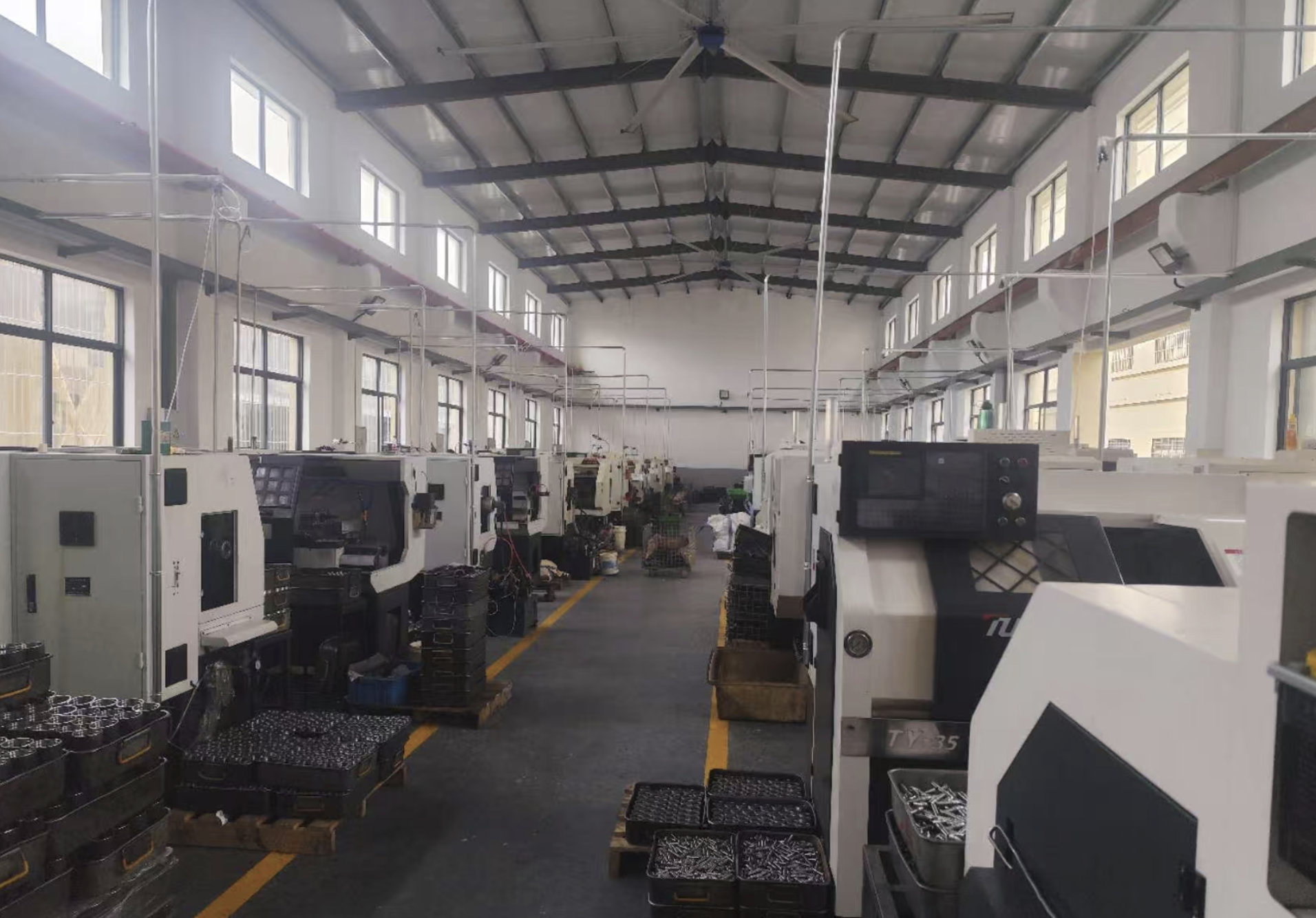
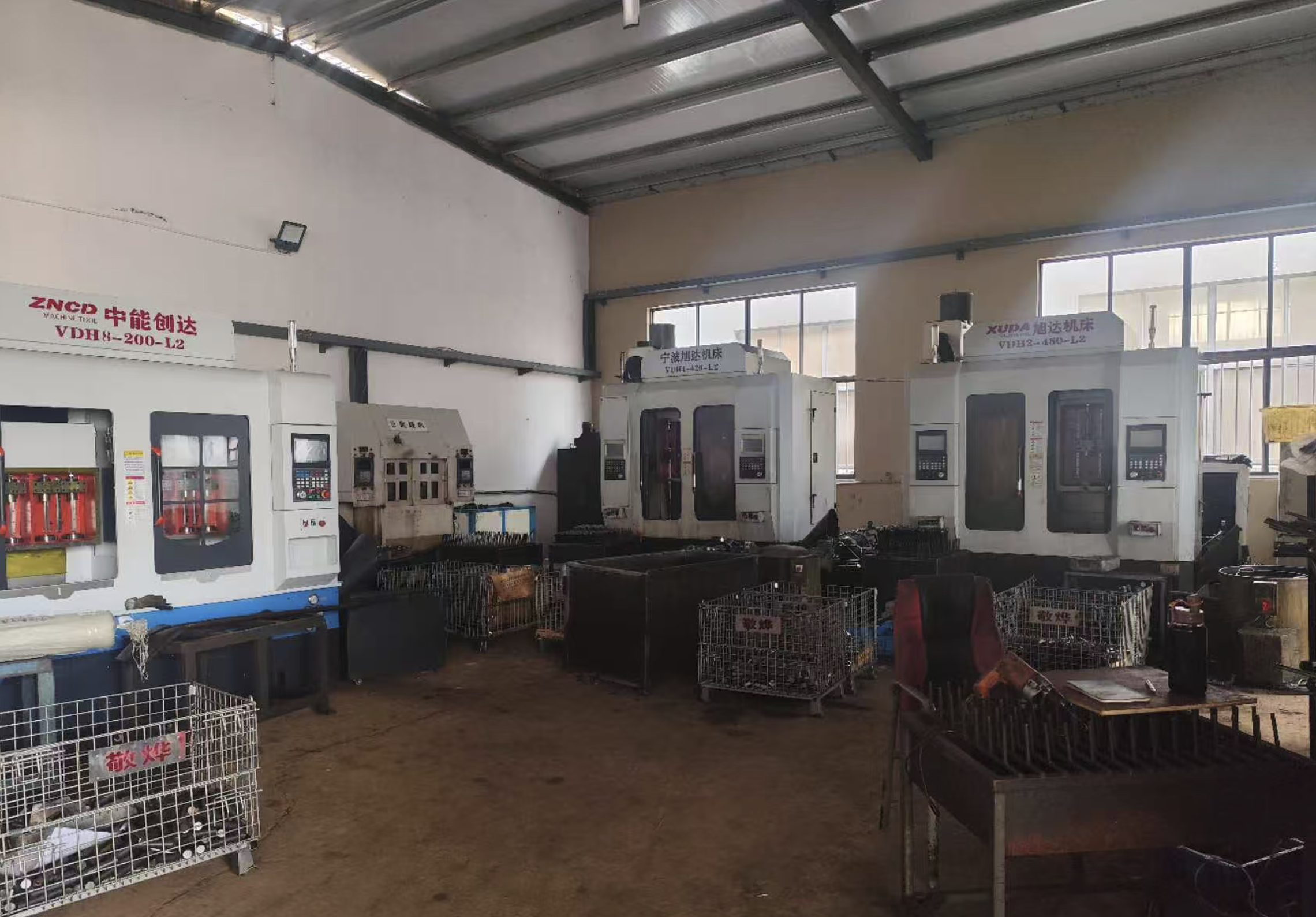
Production runs on more than 100 CNC machines for thread machining, sealing surfaces, connection geometries and dimensional inspection. The facility covers more than 6,000 square metres with approximately 100 employees and 8 engineers, and annual production capacity is stated at more than 40 million fluid connection components, equivalent to roughly 3.3 million components per month.
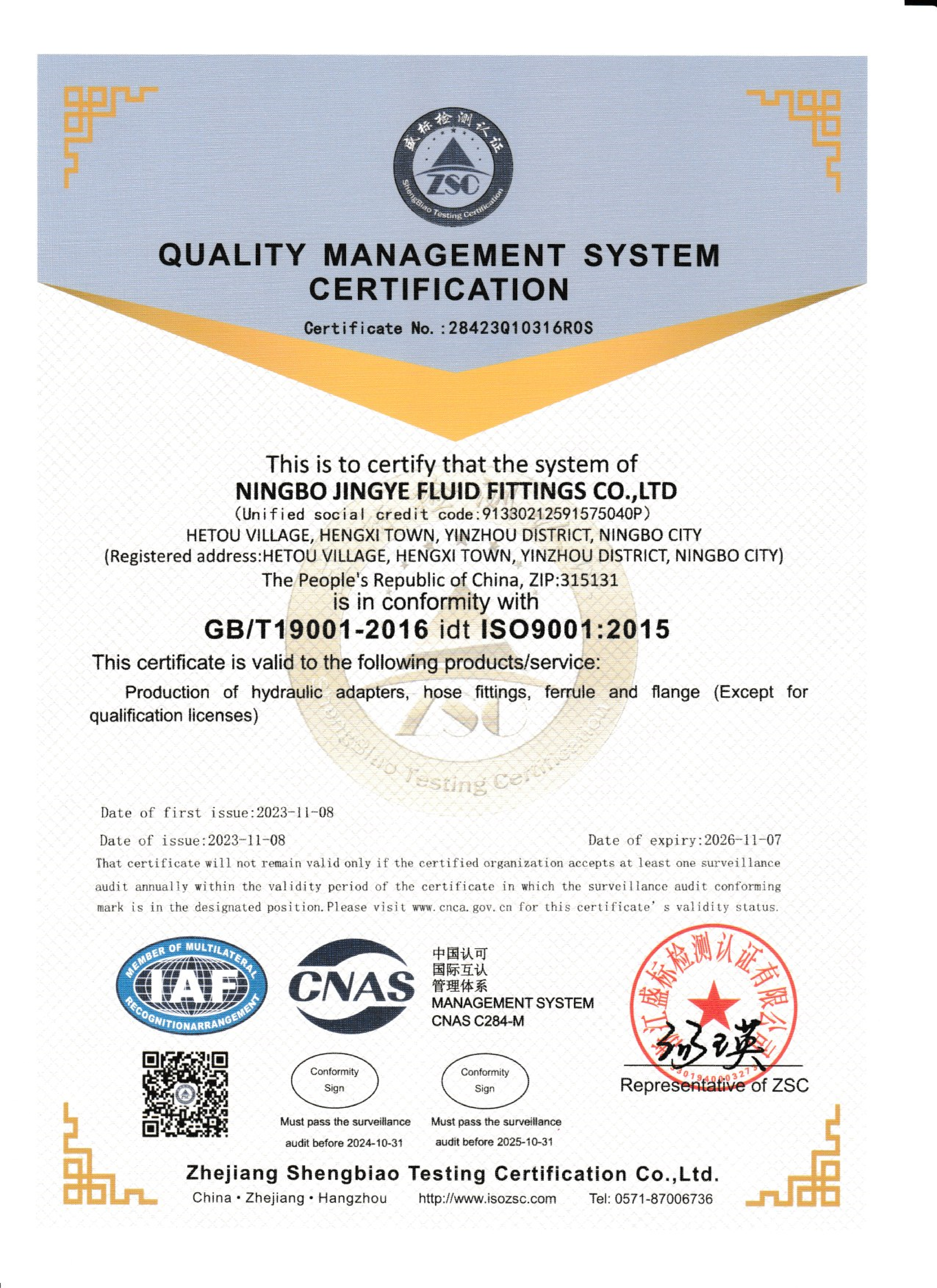
The company operates under an ISO 9001:2015 quality management system, certificate number 28423010316R0S, issued by Zhejiang Shengbiao Testing Certification Co., Ltd. The certification scope covers the production of hydraulic adapters, hose fittings, ferrule and flange, excluding qualification licences. The certificate is stated as valid from 8 November 2023 to 7 November 2026, so buyers placing orders late in 2026 should request the current certificate copy rather than rely on a file version.
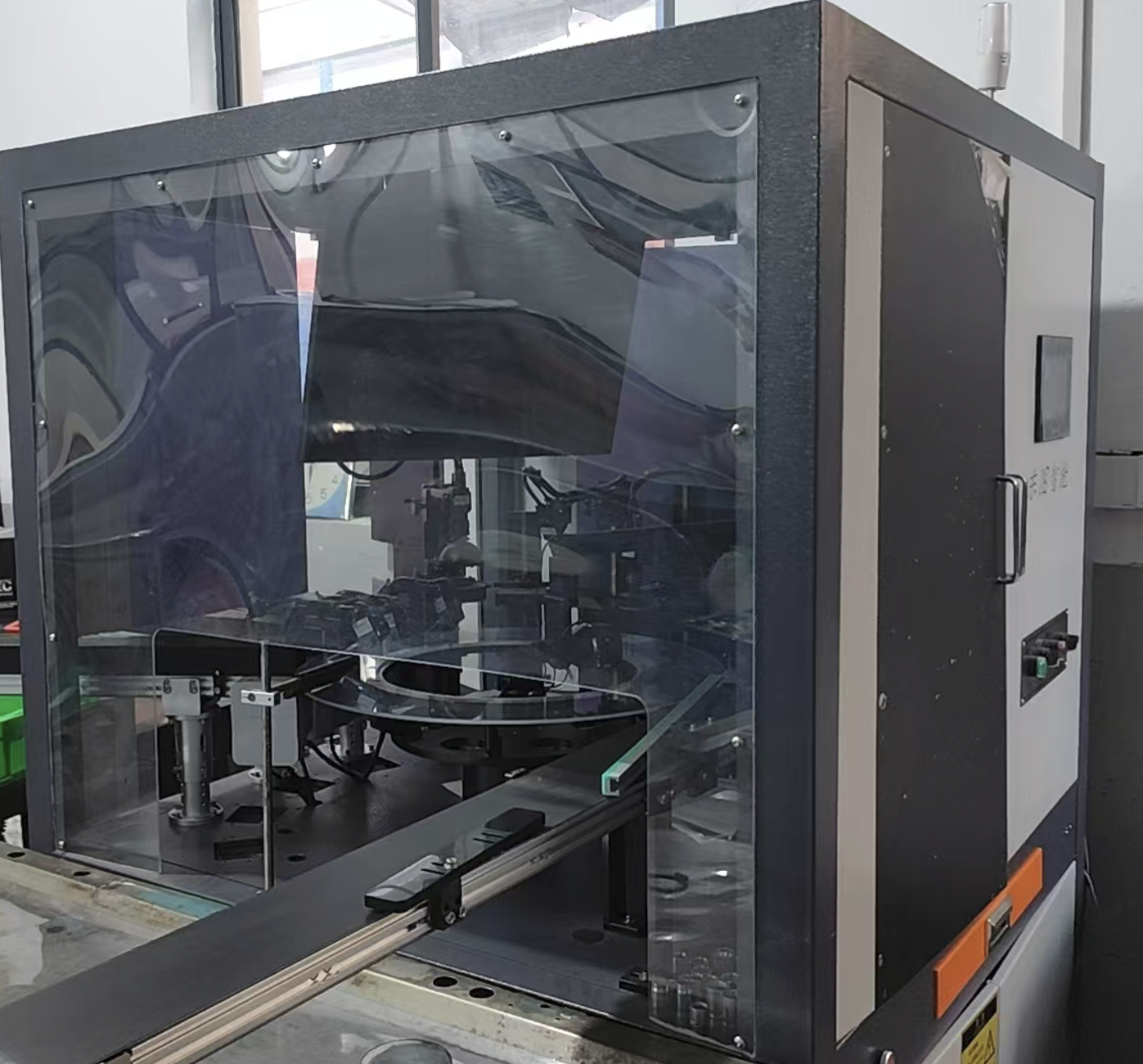
Quality control steps include raw material inspection, dimensional and thread inspection, zinc coating and salt spray testing, in-process and final quality control, and material traceability on request. For a composite hose fitting buyer, the two inspection records that matter most are the thread and dimensional report, because those are where interchangeability is won or lost, and the coating test record, because that is where a corrosion claim becomes evidence.
Commercial terms that make comparison possible
Most standard fittings carry no strict minimum order quantity, and small-batch purchasing is supported. In-stock items can typically be dispatched within 3 to 5 days, standard production orders generally require 30 to 45 days, and OEM or customized products generally require 45 to 60 days depending on design complexity, order quantity, material availability and production requirements. Customization is available from customer drawings, physical samples, reference part numbers and technical requirements, including special thread sizes, non-standard connection dimensions, integrated ferrule configurations and application-specific materials.
Material options across the range are carbon steel, stainless steel 304, stainless steel 316, stainless steel 316L and brass, with selection driven by series, working pressure, operating environment and hose compatibility. The company reports an export ratio of around 70 percent, with Europe and North America as key markets alongside Australia, Southeast Asia, the Middle East and OEM customers in China.
One long-running supply relationship illustrates the scale that a qualified supplier is expected to sustain. A hydraulic hose assembly manufacturer and private-label fittings distributor in France has purchased from JINGYE Fittings for eight consecutive years, currently taking approximately three containers of hydraulic fittings and hydraulic adapters per month, which annualises to roughly 36 containers, with the products carrying the customer own brand into local OEM supply chains. For an evaluation-stage buyer, that case is useful not because of its size but because it shows a supplier handling private-label identification, repeat-order discipline and downstream OEM traceability at the same time.
Step-by-step: how to specify a composite hose fitting order
- Define the hose side first. Record hose construction, internal diameter and the interface the fitting must mate to. Where the assembly uses hydraulic hose, the relevant hose standards are SAE J517 in the US framework and EN 853, EN 856 or EN 857 in the European framework. Where the assembly uses composite or thermoplastic hose, take the interface dimensions from the hose maker published data instead of assuming a fitting family will fit. Fitting and hose are co-specified; buying them from different suppliers without a declared interface is a known failure path.
- Name the connection geometry and its reference document. Write camlock A-A-59326 or camlock EN 14420-7 rather than camlock. Write quick-action coupling ISO 7241-1 for dimensions and requirements and cite ISO 7241-2 for test methods. For flange ends, the relevant documents are ISO 6162-1 and ISO 6162-2, commonly identified with the SAE J518 flange connection. For SAE tube fittings the reference is SAE J514; for 24 degree cone connectors it is ISO 8434-1; for ORFS it is SAE J1453 and ISO 8434-3.
- Treat the thread standard as a mandatory field. ISO 228-1 for BSP parallel threads and ASME B1.20.1 for NPT are different products. Do not accept a line item that reads BSP or NPT, whichever is available, because that phrasing moves the decision to the shipping department.
- Write material and corrosion class in measurable units. Specify the alloy and then a plating thickness in micrometres with a salt spray duration and acceptance level, for example 8 to 12 micrometres trivalent chromium zinc with at least 96 hours to white rust and at least 240 hours to red rust, or the enhanced 16 micrometre and 1,000 hour option where the environment requires it.
- State the pressure and temperature envelope, then verify it per assembly. Published fitting range figures are the starting point, not the answer. Confirm hose and fitting compatibility, crimp dimensions and pressure performance before approving a substitution.
- Define the documentation package in the RFQ. Ask for the ISO 9001 certificate with its scope, material reports, dimensional inspection records and coating or salt spray records. For EU-bound assemblies, add a screening question on whether Directive 2014/68/EU conformity documentation applies to the assembly. REACH declarations should be requested per material and coating rather than assumed.
- Validate by sample or drawing comparison before volume. Submit reference part numbers, existing drawings, hose specifications or physical samples for dimensional comparison, technical evaluation and quotation. Interchangeability is subject to specification verification, and a sample check is the cheapest place to discover that a thread or a seat angle does not match.
- Lock the commercial terms last. Confirm MOQ, lead time, packaging and product identification, especially where the parts will be sold under a distributor brand. Repeat orders and customized packaging are part of the supply agreement, not an afterthought.
Use cases where composite hose fitting specification decides the outcome
- Chemical and petroleum transfer. The fitting is the rigid point in a flexible line, so the connection geometry and the sealing method carry the risk. Specify the reference document and the gasket or O-ring material, not only the coupling style.
- Tank truck and bulk transfer. Camlock ends dominate, which is exactly where the US and EU specification split creates hidden interchangeability risk. State the market the assembly will operate in before the order is placed.
- Hydraulic hose assembly manufacturing. JIC, BSP, NPT, ORFS and Metric ends, including one-piece hydraulic hose fittings with integrated crimp ferrules, are used across construction machinery, agricultural machinery, mining equipment and mobile hydraulics, where vibration, pressure cycling, dust and moisture are normal operating conditions.
- Private-label distribution. A distributor selling under its own brand needs product identification, packaging control and stable repeat supply more than it needs a wider catalogue. The French private-label case above is a working example of that model.
- Data centre and electronics liquid cooling. Quick disconnect couplings associated with the Open Compute Project UQD and UQDB specification sit in a different qualification regime from industrial hydraulics, and buyers should not assume a hydraulic quick coupling qualification transfers to a liquid cooling circuit.
- Maintenance, repair and overhaul. Where no strict MOQ applies and in-stock items dispatch within 3 to 5 days, a maintenance team can qualify a second source without committing to container volume.
Comparison: end connections and the document that governs each one
The table below maps the connection families a composite hose fitting order is likely to involve against their governing reference documents and the sealing methods stated in the JINGYE Fittings product data. Where the published data does not state a sealing method for a family, the table says so rather than filling the gap.
| Connection family | Reference document | Sealing method in published product data | What to write on the purchase order |
|---|---|---|---|
| Camlock, US regime | A-A-59326, Coupling, Cam-Locking Type | Not stated; confirm on the supplier drawing | Name A-A-59326, not camlock |
| Camlock, EU regime | EN 14420-7 | Not stated; confirm on the supplier drawing | State the destination market; the two regimes are not automatically interchangeable |
| BSP parallel, BSPP | ISO 228-1 | BSP 60 degree cone, female flat seat, multiseal, or male O-ring | Sealing style plus thread size |
| NPT | ASME B1.20.1 | Tapered thread sealing with compatible sealant | Sealant requirement and engagement depth |
| JIC 37 degree flare | SAE J514 and ISO 8434-2 | 37 degree flare metal-to-metal | Flare angle and seat condition |
| ORFS | SAE J1453 and ISO 8434-3 | Flat-face O-ring, NBR or FKM | O-ring material, because it sets the temperature ceiling |
| Metric 24 degree cone | ISO 8434-1 and DIN 2353 | 24 degree cone metal-to-metal, or 24 degree cone O-ring (DKO) | Light (L) or heavy (S) series |
| Flange | ISO 6162-1 and ISO 6162-2 | Not stated; confirm on the supplier drawing | Split or one-piece clamp, metric or inch screws |
| Quick-action coupling | ISO 7241-1 dimensions and requirements, ISO 7241-2 test methods | Not stated; confirm on the supplier drawing | Name the test method in the RFQ |
Table 1. Reference documents are cited at title and scope level. Product-specific applicability and the current edition must be confirmed against the published standard before the purchase order is issued.
Comparison: which specification items are actually inspectable
| Specification item | Writable value from published product data | Why it belongs on the PO |
|---|---|---|
| Plating thickness | 8 to 12 micrometres trivalent chromium zinc as standard; up to 16 micrometres on request | Corrosion resistance cannot be inspected as a phrase, but it can be inspected as a thickness |
| Salt spray | At least 96 hours to white rust and at least 240 hours to red rust; up to 1,000 hours on request | Names the test and the acceptance level instead of a claim |
| Working pressure | 100 to 420 bar across the hydraulic hose fitting ranges; 100 to 630 bar for the ORFS range | The assembly rating is set by hose, fitting and crimp together |
| Temperature | -40 to +100 degrees Celsius; up to +200 degrees Celsius for ORFS depending on O-ring material | Seal material, not the metal, usually sets the limit |
| Hose size | 1/4 inch to 2 inch, depending on series | Defines insert and ferrule before the end connection is chosen |
| Minimum order quantity | No strict MOQ on most standard fittings; small batches supported | Removes the assumption that qualification requires container volume |
| Lead time | 3 to 5 days in stock; 30 to 45 days standard production; 45 to 60 days OEM and custom | Makes a trial order schedulable against a maintenance or launch window |
Table 2. Figures are those published for the JINGYE Fittings hydraulic hose fitting ranges and are subject to fitting size, sealing design, material and assembly specification.
Frequently asked questions
Are these composite hose fittings CE and REACH compliant?
ISO 9001:2015 is a quality management system certification, not a product conformity mark. JINGYE Fittings holds ISO 9001:2015 certification, certificate number 28423010316R0S, issued by Zhejiang Shengbiao Testing Certification Co., Ltd., with a scope covering the production of hydraulic adapters, hose fittings, ferrule and flange. CE marking is a separate question. Within the EU, Directive 2014/68/EU regulates the placing on the market of pressure equipment, and pressure accessories such as fittings fall within its scope where the equipment exceeds the Directive pressure threshold, so whether a specific fitting on a specific assembly needs conformity assessment documentation depends on the assembly and should be screened rather than assumed. A REACH declaration is a document request rather than a certificate: ask for a current declaration covering the specific material and coating on your drawing, and add material reports and coating test records to the same request. The workable sequence is to state the destination market, the assembly and the required documents in the RFQ, then compare what comes back.
Can composite hose fittings be supplied with camlock, flange, threaded or quick disconnect ends?
The published portfolio covers composite hose fittings and industrial hose fittings alongside camlock couplings, quick disconnect couplings, stainless steel fittings, brass fittings and pneumatic fittings, with JIC, BSP, NPT, ORFS and Metric connection systems available across straight, 45 degree, 90 degree, tee, bulkhead, swivel and reducer configurations. Materials are carbon steel, stainless steel 304, 316 and 316L, and brass, selected against working pressure, operating environment and hose compatibility. Custom manufacturing from drawings, samples or reference part numbers covers special thread sizes, non-standard connection dimensions and integrated ferrule configurations. Where a required configuration falls outside the standard range, it should be quoted as a custom item rather than assumed to exist in the catalogue.
What is the minimum order quantity and how is pricing structured?
Most standard fittings carry no strict minimum order quantity, and small-batch purchasing is supported. For OEM and customized products, the MOQ depends on product design, material, manufacturing process and order requirements, so it is confirmed at quotation stage rather than published as a single number. Pricing is configuration-based: the variables that move it are alloy, size, connection geometry, sealing design, plating class, whether the part is standard or drawing-specific, and order volume. Because those variables are the same ones that define the part, a supplier cannot give a meaningful price before the four specification items are fixed.
Can I evaluate samples before placing a production order?
Yes. Reference part numbers, existing product drawings, hose specifications or physical samples can be submitted for dimensional comparison, technical evaluation and quotation, and product interchangeability is subject to specification verification. That verification step matters most when substituting an existing part: hose and fitting compatibility, crimp dimensions and pressure performance all require confirmation before substitution is approved. Timing supports a trial: in-stock items are typically dispatched within 3 to 5 days, standard production orders generally require 30 to 45 days, and OEM or customized products generally require 45 to 60 days depending on design complexity, quantity and material availability.
What lead time should be planned for a first order?
Plan in three bands. In-stock standard items are typically dispatched within 3 to 5 days. Standard production orders generally require 30 to 45 days. OEM and customized products generally require 45 to 60 days, depending on design complexity, order quantity, material availability and production requirements. For a first order, add the sample and drawing-comparison step before the production clock starts, and treat the documentation package as part of the delivery rather than a follow-up request. To get a lead time against your own part list, send the drawing, the reference part number or a physical sample to enzo@jingyefittings.com or message +86 15267868624 on WhatsApp and ask for a dimensional comparison quotation.
Conclusion: specify the document, not the noun
Composite hose fittings reward buyers who convert a category noun into a specification. The conversion is not complicated: name the hose interface, name the connection geometry with its reference document, treat the thread standard as mandatory, write corrosion resistance as micrometres and salt spray hours, and define the documentation package before the first shipment rather than after the first leak.
JINGYE Fittings is a China-based manufacturer of hydraulic fittings, hydraulic adapters, hose fittings, ferrules and quick disconnect couplings, established in 2008 in Ningbo, operating under ISO 9001:2015 certification with a scope covering hydraulic adapters, hose fittings, ferrule and flange, and running more than 100 CNC machines against an annual capacity of more than 40 million fluid connection components. The company supports standard production, OEM and custom manufacturing from drawings and samples, and second-source evaluation for buyers who already have an approved part. Those capabilities are only useful to a buyer who arrives with a defined requirement, which is why the specification work comes first and the price conversation comes second.
Next step: quote, sample or second-source review
Send a drawing, a reference part number, a hose specification or a physical sample for dimensional comparison and quotation. Standard items can typically be dispatched within 3 to 5 days, and OEM or customized items are quoted with a lead time against your configuration.
Email: enzo@jingyefittings.com | Tel and WhatsApp: +86 15267868624 | Website: www.jingyefittings.com
Ningbo Jingye Fluid Fittings Co., Ltd., Hehuaqiao Village, Yunlong Town, Yinzhou District, Ningbo City, Zhejiang Province, China.

Have Questions or Need More Details?
Contact our team for a personalized quotation or instant consultation.
Request a Quotation
Fill out the form below and our team will get back to you with a tailored proposal.
WhatsApp Direct Chat
Prefer to chat in real-time? Message us on WhatsApp for instant assistance & quick answers.
- Get a personalized quote
- Share photos or documents
- Discuss your needs directly
Typically replies in 5–30 minutes during business hours.