
Hydraulic Adapters: A Buyer's Guide to Connection Systems
Short answer: A hydraulic adapter is the component that joins two fluid ports or two different connection standards — for example a JIC 37° flare port to a BSP port — so that a hose assembly, tube, pump, valve or cylinder can be connected without modifying either side. Adapters are not one product but a family defined by connection geometry, thread standard, sealing method, material and pressure class. Specifying those five attributes before an RFQ is what separates an assembly that seals from one that weeps.
Most buyers arrive at this subject through the broad search term hydraulic fitting. That phrase covers hose fittings, adapters, ferrules, camlock couplings, quick disconnect couplings and pneumatic fittings, and on its own it tells a supplier almost nothing about what you need. This guide narrows the category down to adapters and the connection systems they serve, so a category request can be converted into a specification a factory can actually quote against.
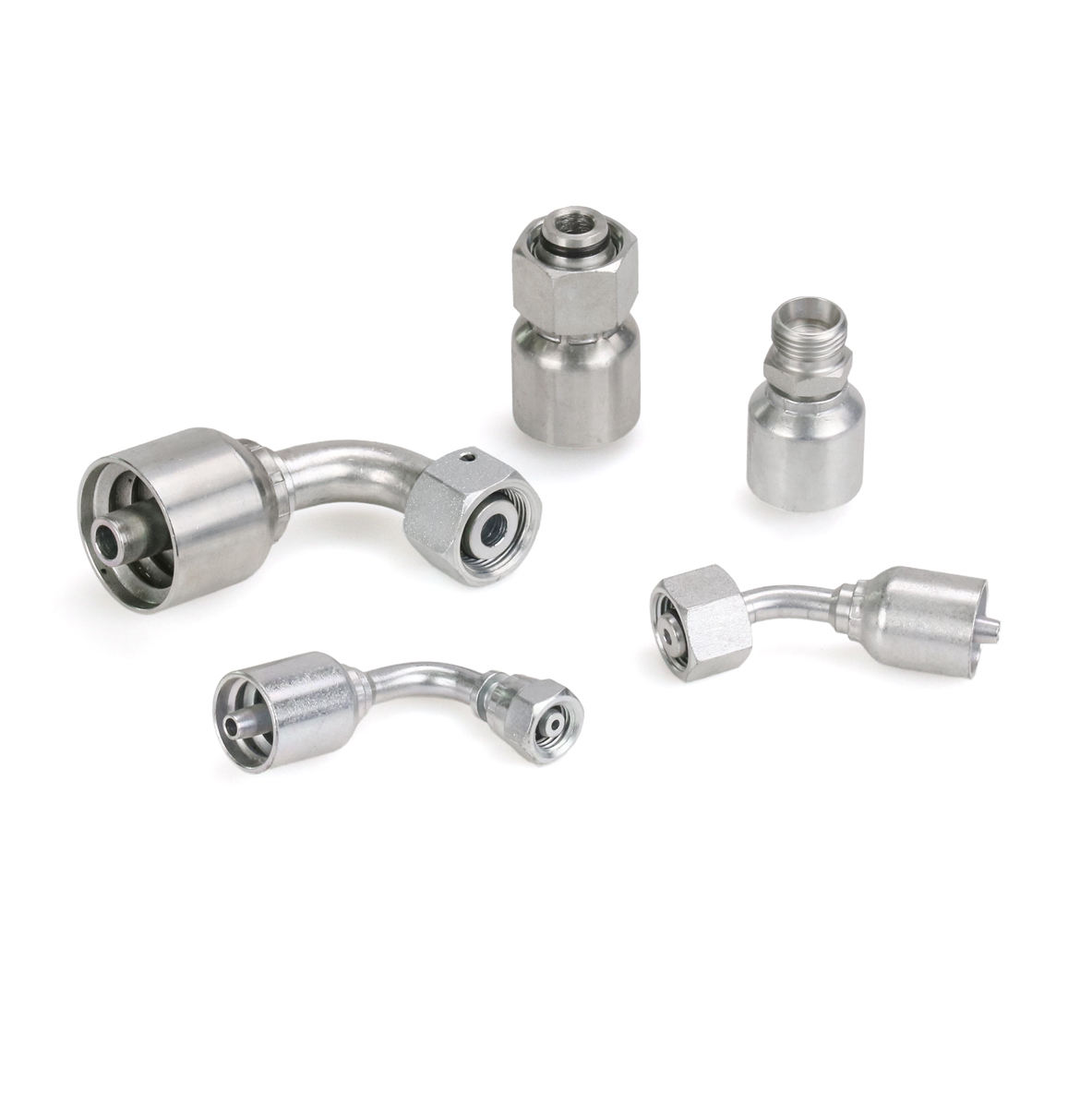
What a Hydraulic Adapter Actually Does
An adapter performs one or more of three jobs in a hydraulic circuit:
- Thread conversion. The two ports use different thread families — for instance a BSP parallel thread on a European valve block and an NPT tapered thread on a North American pump port.
- Geometry conversion. The sealing surfaces differ even when the thread is nominally similar, such as a 24° cone seat facing a flat-face O-ring seat.
- Serviceable transition. The adapter creates a defined joint that can be assembled, checked and replaced without cutting or re-crimping the hose.
This is why adapter and hose fitting are not interchangeable words. A hose fitting terminates a hose: it is crimped onto the hose and carries the hose’s pressure class. An adapter joins two already-defined interfaces and inherits the weaker of the two. Buying one when you need the other is one of the most common — and least visible — sourcing errors in fluid power.
JINGYE Fittings (Ningbo Jingye Fluid Fittings Co., Ltd.) lists hydraulic adapters in its portfolio alongside hydraulic fittings, hydraulic hose fittings, ferrules, camlock couplings, quick disconnect couplings, liquid cooling quick disconnects and UQD/UQDB couplings. The published series specifications referenced in this guide describe the hose-fitting and connection families in detail; adapter configurations are quoted against customer drawings or physical samples.
The Real Problem: A Category Noun Is Not a Specification
Hydraulic leakage is rarely caused by a fitting that was made badly. It is far more often caused by a fitting that was made well to the wrong specification. The category noun hides exactly the fields that decide whether a joint works:
- Thread family. BSP parallel threads are dimensioned under ISO 228-1, where pressure tightness is not achieved on the thread itself. NPT threads are dimensioned under ASME B1.20.1 and are tapered, so they seal on the thread with a compatible sealant. The two look similar in a catalogue photo and are not interchangeable.
- Sealing geometry. JIC uses a 37° metal-to-metal flare. Metric uses a 24° cone, either metal-to-metal or with an O-ring (DKO). ORFS uses a flat face with an elastomeric O-ring. BSP appears in 60° cone, flat seat, multiseal and male O-ring variants. A correct thread on the wrong seat still leaks.
- Pressure and temperature class. The same physical size can carry very different ratings depending on the sealing design and the hose assembly it terminates.
- Documentation duty. For EU-bound pressure equipment, Directive 2014/68/EU (Pressure Equipment Directive) governs placing on the market, and pressure accessories such as fittings fall within its scope where the equipment exceeds the Directive’s threshold. Whether a specific fitting requires conformity documentation depends on the assembly and has to be assessed case by case.
The same pattern repeats across adjacent product families. Camlock is a single word covering at least two reference documents — the US federal specification A-A-59326 and the European standard EN 14420-7 — so a supplier’s camlock line may be built and inspected to one regime and marketed globally. A buyer who asks only for “camlock” cannot detect that difference from a photograph.
Industry Background: Demand Is Growing Faster Than Standards Are Converging
The commercial context makes precise specification more valuable, not less. Strategic Market Research puts the global hydraulic fittings market at USD 12.7 billion in 2024 and projects USD 17.9 billion by 2030, a CAGR of 5.8% over 2024–2030. That is steady, unspectacular growth in the traditional fluid power base.
The adjacent liquid-cooling segment is moving much faster. Dataintelo values the quick disconnect couplings market for liquid cooling at USD 2.8 billion in 2025, projected to reach USD 6.1 billion by 2034 at a CAGR of 9.1%, with the UQD coupling segment reported at a 22.4% CAGR for 2024–2032. Those couplings are governed by the Open Compute Project UQD/UQDB specification, which is a different governance model from the ISO and SAE families that dominate hydraulic fittings. A supplier that serves both worlds has to hold two standard systems at once.
Material choice is also split. For 2025, Dataintelo reports steel at 45.2% and brass at 26.4% of hydraulic fitting material share, reflecting steel’s role in high-pressure circuits and brass’s role in lower-pressure and pneumatic work.
Meanwhile the standards landscape stays deliberately plural. A qualified adapter or fitting supplier is expected to work inside several families at once: ISO 7241-1 and ISO 7241-2 for quick-action couplings (dimensions and requirements, and test methods respectively), SAE J514 for hydraulic tube fittings, ISO 8434-1 for 24° cone connectors, ISO 6162-1 and ISO 6162-2 for four-bolt flange connections, SAE J517 for hydraulic hose, EN 853, EN 856 and EN 857 for European hose classes. The fitting and the hose must be co-specified, because a hose fitting has no independent meaning without the hose class it mates to.
The Five Connection Systems Behind Most Hydraulic Adapter Requests
Nearly every adapter enquiry resolves into one of five connection families. Each has a fixed set of attributes that must be stated on the purchase order.
JIC 37° Flare — SAE J514 / ISO 8434-2
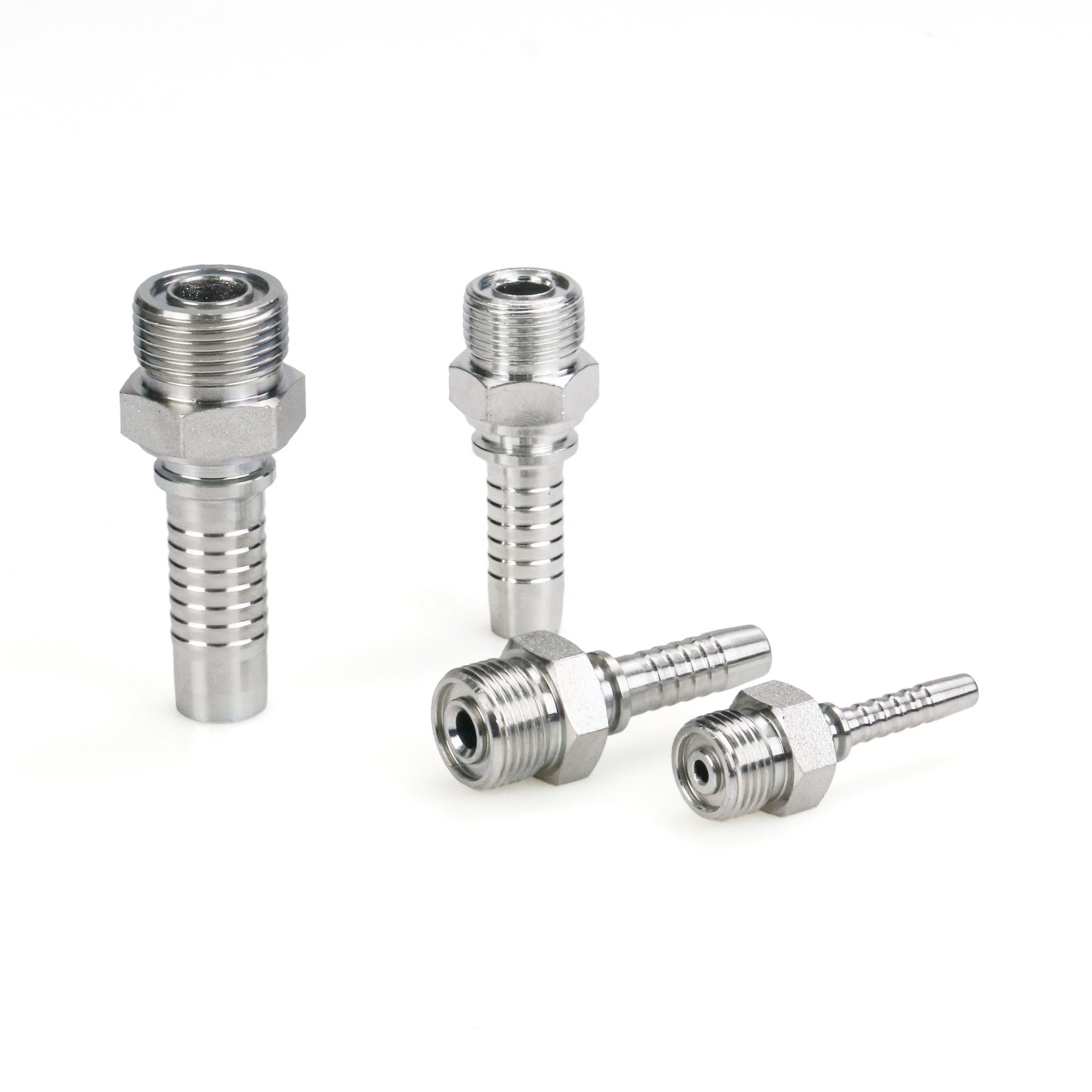
JIC connections seal metal-to-metal on a 37° flare. The JINGYE JIC range covers male straight (16711 Series) and female swivel straight, 45° elbow and 90° elbow configurations (26711, 26741 and 26791 Series), with a published working range of 100–420 bar and an operating temperature range of −40°C to +100°C, depending on fitting size, connection configuration and assembly specification. JIC is the default language of North American-origin mobile hydraulics.
BSP — ISO 228-1
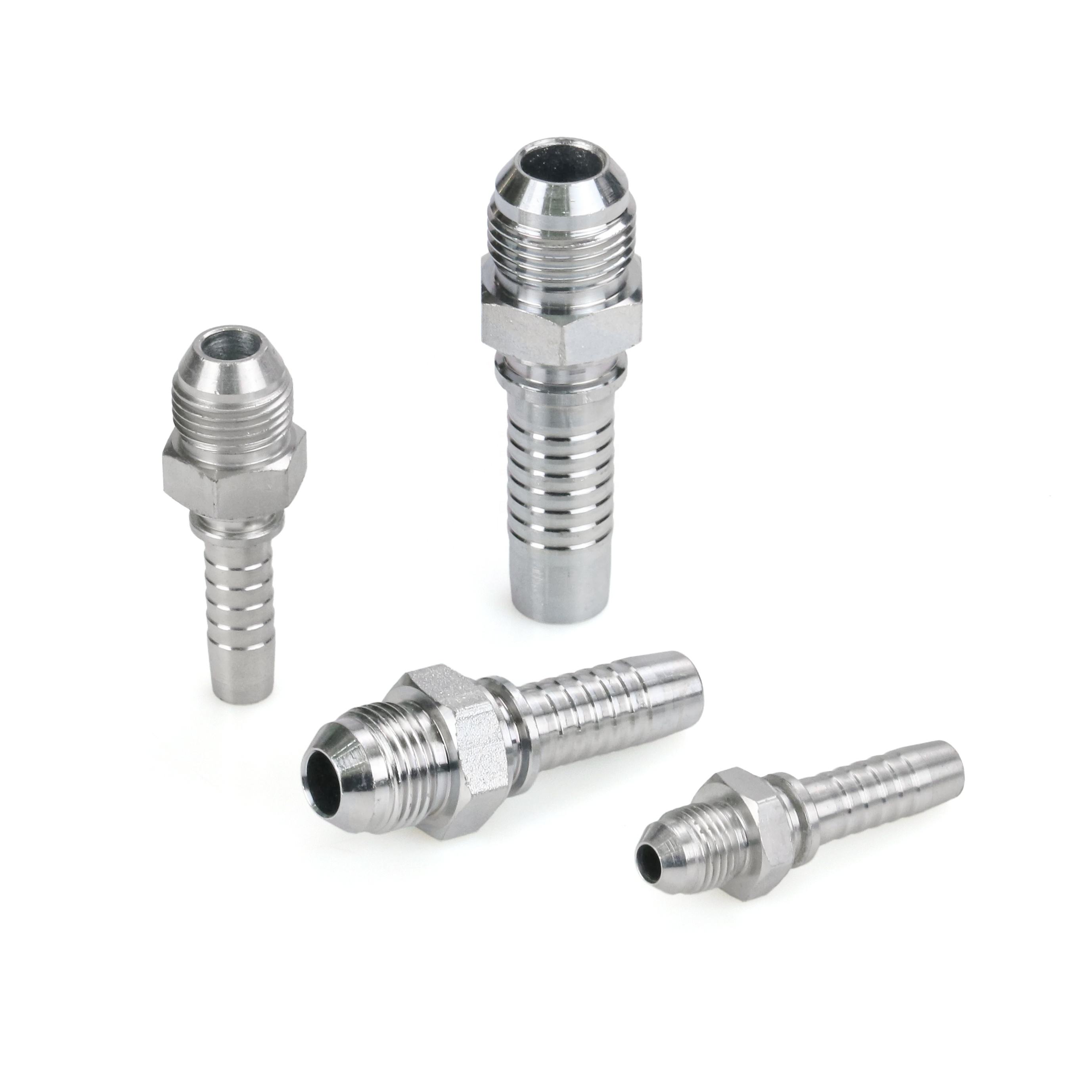
BSP is the most fragmented family in practice, because one thread standard supports several sealing designs. JINGYE supplies eleven BSP series spanning male O-ring (12211), male 60° cone (12611), female multiseal (22111, 22141, 22191), female flat seat (22211, 22241, 22291) and female 60° cone (22611, 22641, 22691), in straight, 45° elbow and 90° elbow forms. Published working range is 100–420 bar. When ordering BSP, state the sealing design, not just the thread.
Metric 24° Cone — DIN 2353 / ISO 8434-1
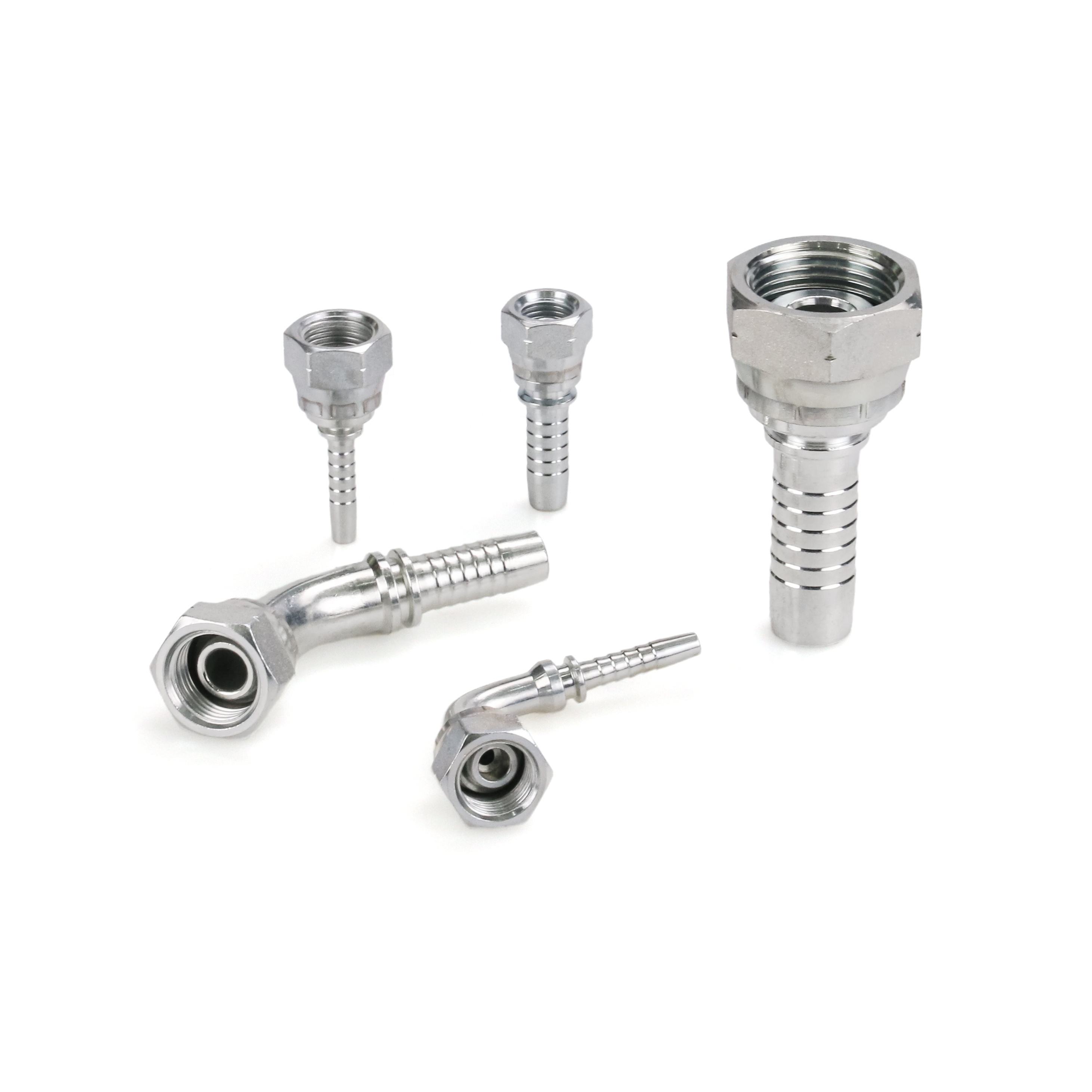
Metric 24° cone connections are the DIN-based standard across much of European machinery. The JINGYE range includes metric male straight (10411, 10511, 10611) and metric female straight, 45° and 90° elbow (20411, 20441, 20491, 20511, 20541, 20591), with Light (L) and Heavy (S) series variants and either metal-to-metal or DKO O-ring sealing. Published working range is 100–420 bar.
ORFS — SAE J1453 / ISO 8434-3
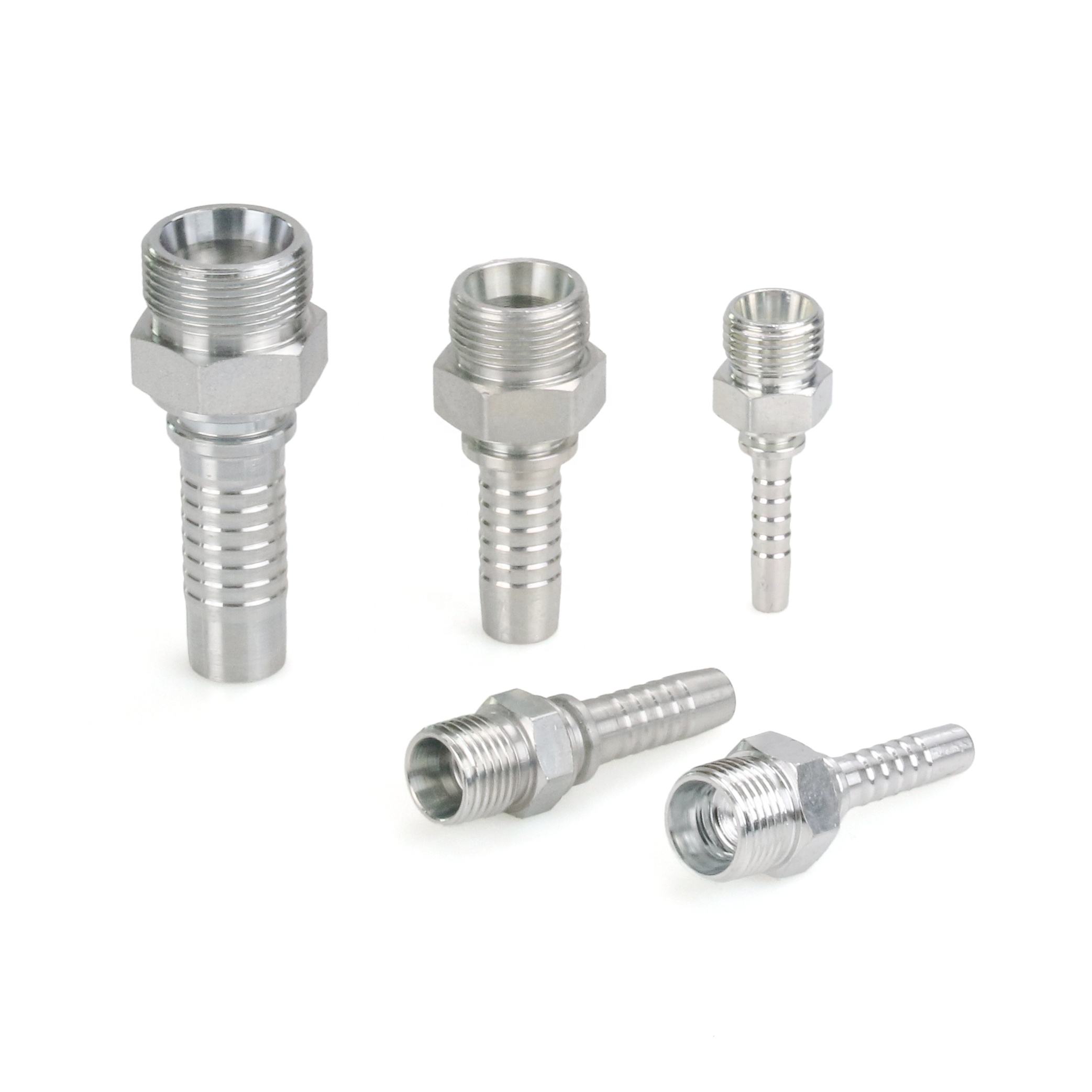
ORFS is the flat-face O-ring seal family, and it carries the widest published envelope in the JINGYE range: 100–630 bar working pressure and −40°C to +200°C operating temperature, the latter depending on O-ring material (NBR or FKM), hose materials and assembly configuration. Series include female swivel straight, 45° and 90° elbows (24211, 24241, 24291) plus alternative and special hose-tail variants (24213, 24243, 24293, 24218). The elastomeric interface is why ORFS is commonly specified where high pressure and leakage control both matter.
NPT — ANSI/ASME B1.20.1
NPT is a tapered thread that seals on the thread itself, using a compatible thread sealant where the application requires it. JINGYE supplies NPT male straight (15611, 15613, 15618) and NPT male 90° elbow (15691) configurations, with a published working range of 100–420 bar. NPT is the port standard most often found on North American pumps, motors and valve bodies.
Comparison Table: Connection Systems at a Glance
| Connection system | Reference standard | Sealing method | Published working pressure | Operating temperature | Typical market context |
|---|---|---|---|---|---|
| JIC 37° flare | SAE J514 / ISO 8434-2 | 37° flare, metal-to-metal | 100–420 bar | −40°C to +100°C | North American-origin mobile hydraulics |
| BSP | ISO 228-1 | 60° cone, flat seat, multiseal, or male O-ring | 100–420 bar | −40°C to +100°C | European and Asian machinery |
| Metric 24° cone | DIN 2353 / ISO 8434-1 | 24° cone metal-to-metal or DKO O-ring | 100–420 bar | −40°C to +100°C | DIN-based European equipment |
| ORFS | SAE J1453 / ISO 8434-3 | Flat-face O-ring (NBR or FKM) | 100–630 bar | −40°C to +200°C | High-pressure circuits requiring leakage control |
| NPT | ANSI/ASME B1.20.1 | Tapered thread with compatible sealant | 100–420 bar | −40°C to +100°C | North American port connections |
The pressure and temperature values above are the published ranges for the corresponding JINGYE series. Actual performance depends on fitting size, connection design, crimping specification, the hose used and the assembly as a whole, and must be verified for the specific part number before release.
Step-by-Step: How to Specify and Validate a Hydraulic Adapter
- Identify both ports, not just one. Record the thread standard and the sealing geometry on each side. “BSP to NPT” is not yet a specification; “BSPP male 60° cone to NPT male tapered” is.
- Confirm the mating surface. A JIC flare needs a compatible 37° cone; an ORFS fitting needs a flat sealing face and the right O-ring compound; a metric DKO joint needs the correct cone and O-ring; an NPT joint needs thread engagement and a compatible sealant. Thread compatibility without seal compatibility is a false match.
- Match the hose class and the pressure class. The published JINGYE fitting range covers 1/4-inch to 2-inch hose sizes and is compatible with SAE 100R1/R2, SAE 100R12/R13, EN 853 1SN/2SN and EN 856 4SP/4SH, subject to hose and fitting compatibility. The fitting cannot be rated above the hose it terminates.
- Select material and coating. Options are carbon steel, stainless steel 304, stainless steel 316, stainless steel 316L and brass. Carbon steel is supplied with trivalent chromium zinc plating, typically 8–12 µm, with salt spray resistance of at least 96 hours to white rust and at least 240 hours to red rust under specified test conditions. Enhanced plating up to 16 µm and salt spray resistance up to 1,000 hours are available on request, subject to coating specification and testing.
- Fix the configuration and the envelope. Straight, 45° elbow, 90° elbow, tee, bulkhead, swivel and reducer forms all exist within the families above. Elbow direction and hex clearance decide whether an adapter can be tightened in place.
- Validate before scaling. For a new part, submit a drawing. For a second source, submit reference part numbers, existing drawings or physical samples for dimensional comparison and technical evaluation. Interchangeability, crimp dimensions and pressure performance require verification before substitution.
- Lock documentation and lead time. Material reports and dimensional inspection records can be provided according to project requirements. On availability: in-stock items are typically dispatched within 3–5 days, while standard production orders generally require 30–45 days.
Where Hydraulic Adapters and Fittings Are Used
Construction and mobile machinery
Excavators, wheel loaders, bulldozers, cranes and concrete pumps run hydraulic systems under pressure fluctuation, mechanical vibration, shock loads and repeated movement, in dusty, wet and often corrosive outdoor conditions. In these systems the connection has to hold sealing integrity through pressure cycling, not just at first assembly. JIC, BSP, NPT, ORFS and Metric fittings and adapters each appear depending on the equipment’s design origin.
Hose assembly production
Hose assembly manufacturers and crimping workshops buy fittings in volume and care about repeatability: consistent thread dimensions, consistent sealing surfaces and consistent batch quality. One-piece integrated crimp fittings with a pre-attached ferrule reduce component handling and the risk of mismatched fitting-and-ferrule combinations.
MRO and replacement
Repair centres and mobile service companies work from the part in hand, not from a drawing. Dimensional comparison against a submitted sample is the practical route to a correct replacement, which is why sample-based evaluation matters more in MRO than in new-build production.
OEM and second-source projects
OEMs adding a second source need a supplier able to work from drawings and technical requirements, including special connection configurations, non-standard dimensions and alternative materials. Distributors and MRO suppliers generally need the opposite: breadth of standard series, small-batch availability and short dispatch on stock items.
What a Supplier’s Answer Should Contain
A credible response to an adapter enquiry should name the reference standard for each connection family, state the material and coating, and give a documented dimensional check rather than a catalogue photo. JINGYE Fittings operates under an ISO 9001:2015 quality management system, and depending on product series and customer requirements, products can be manufactured and inspected according to SAE J514, ISO 8434 and DIN standards.
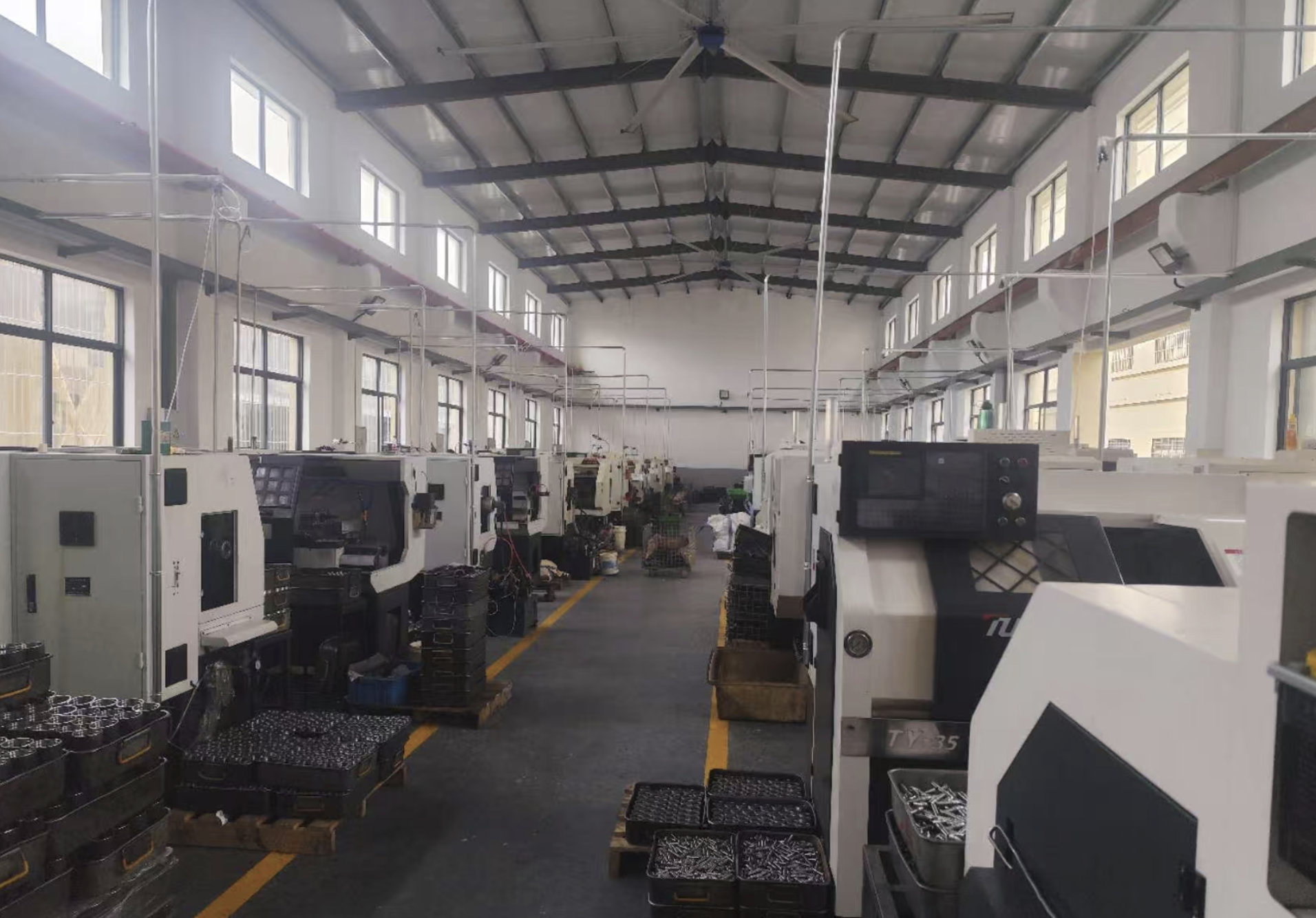
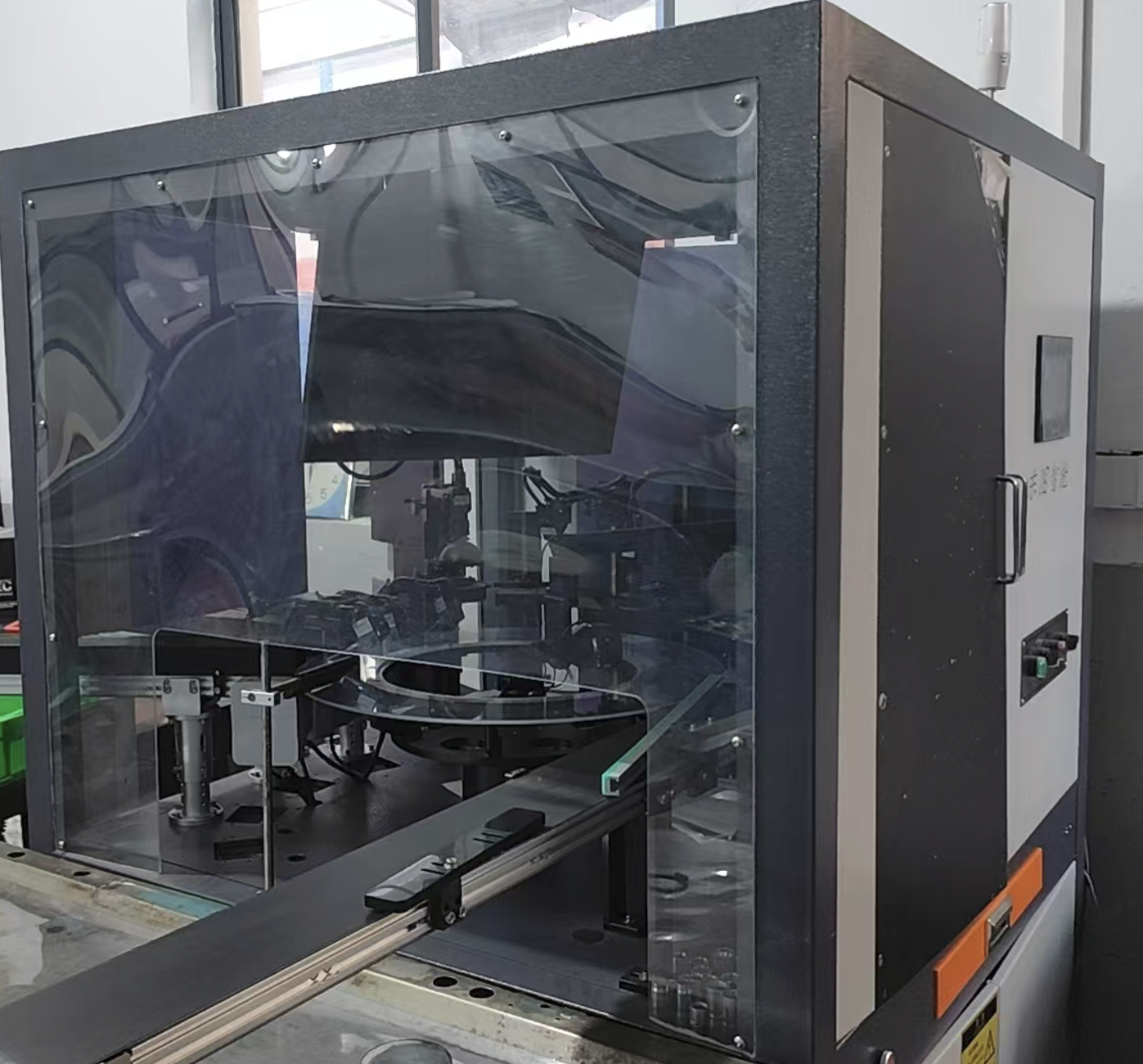
Capacity is the second half of the answer. JINGYE Fittings was established in 2008 in Ningbo, China, and operates a manufacturing facility of more than 6,000 m² with more than 100 employees, more than 100 CNC machines plus drilling, crimping, assembly and precision inspection equipment, an engineering team of 8, and an annual production capacity of more than 40 million fluid connection components. Most standard hydraulic fittings have no strict minimum order quantity, and small-batch purchasing is supported. The company serves customers in Europe, North America, Australia, Southeast Asia, the Middle East and other international markets, with exports reported in the 61%–70% range of sales.
Frequently Asked Questions
Which standards can hydraulic adapters and hose fittings be manufactured and inspected to?
JINGYE Fittings operates under an ISO 9001:2015 quality management system, and depending on product series and customer requirements, products can be manufactured and inspected according to SAE J514, SAE J1453, ISO 8434-1, ISO 8434-2, ISO 8434-3, DIN 2353, ISO 228-1 for BSP thread dimensions and ANSI/ASME B1.20.1 for NPT threads. Material reports and dimensional inspection records can be provided according to project requirements. For EU-bound pressurised assemblies, Directive 2014/68/EU may also apply at assembly level, and that applicability should be confirmed for the specific installation rather than assumed.
Can a supplier produce custom adapters and non-standard fittings from drawings or samples?
Yes. JINGYE Fittings supports OEM and customized manufacturing based on customer drawings, samples and technical requirements, including special connection configurations, non-standard dimensions and different materials. The work is supported by more than 100 CNC machines and an engineering team of 8, and covers both standard series production and customized fluid connection components that may be difficult to obtain through standard supply channels.
Is there a minimum order quantity, and how are prices established?
Most standard hydraulic fittings have no strict minimum order quantity, and small-batch purchasing is supported alongside volume production and long-term OEM sourcing programs. This page does not quote prices, because an adapter price depends on the defined configuration: connection system, size, material, coating and quantity. Quotations are issued against a specified part or drawing so that buyers compare like for like rather than against a category noun.
How can a buyer validate a sample or qualify a second source?
JINGYE Fittings supports alternative and second-source supplier evaluation using reference part numbers, existing drawings, hose specifications or physical samples for dimensional comparison and technical evaluation. Product interchangeability is subject to verification — hose and fitting compatibility, crimp dimensions and pressure performance must be confirmed before a substitution is released into production.
What are typical lead times?
In-stock items can typically be dispatched within 3–5 days, while standard production orders generally require 30–45 days. Custom and OEM items depend on drawing review and are confirmed at quotation. Buyers planning a line trial should therefore separate stock-item sampling from production-volume scheduling, because the two follow different timelines.
Conclusion: Specify the Interface, Not the Category
Hydraulic adapters are small, inexpensive components that decide whether a much more expensive assembly stays dry. The productive way to buy them is to stop treating hydraulic fitting as a specification and start treating it as a category — then define the connection geometry, the thread standard, the sealing method, the material and coating, the pressure and temperature envelope, and the documentation required. Once those six fields exist, quotations become comparable and second sources become verifiable.
Where a project needs both standard series and custom configurations, the practical test of a supplier is whether it can answer at the level of the interface: which standard the part is built to, how it is inspected, what the published envelope is, and how a sample is validated before volume commitment.
Next Step: Sample, Drawing Review or Quotation
If you are evaluating a hydraulic adapter or fitting configuration, send the port standards on both sides, the hose class, the required material and the annual volume. JINGYE Fittings can respond with a dimensional comparison against your drawing or sample, a quotation for the defined configuration, and material and inspection documentation according to project requirements.
Ningbo Jingye Fluid Fittings Co., Ltd. (JINGYE Fittings)
Hehuaqiao Village, Yunlong Town, Yinzhou District, Ningbo City, Zhejiang Province, China
Contact: Enzo | Email: enzo@jingyefittings.com | Tel / WhatsApp: +86 15267868624
Website: www.jingyefittings.com
Have Questions or Need More Details?
Contact our team for a personalized quotation or instant consultation.
Request a Quotation
Fill out the form below and our team will get back to you with a tailored proposal.
WhatsApp Direct Chat
Prefer to chat in real-time? Message us on WhatsApp for instant assistance & quick answers.
- Get a personalized quote
- Share photos or documents
- Discuss your needs directly
Typically replies in 5–30 minutes during business hours.