Extrusion Line Standards: Regional Pipe Certification Guide
Extrusion Line Standards: A Buyer's Guide to Regional Pipe Certifications
Short answer: buying a plastic extrusion machine for pipe production in a regulated market is a documentation exercise as much as an engineering one. Two layers of rules apply at once — the pipe standard your utility, grid operator or local authority enforces on the finished product, and the machine-side conformity that shows the line itself was designed, built and tested to a recognised baseline. Because pipe standards differ by region, the reliable buying method is to define your target standard first, then require suppliers to hand over the certificate number, the issuing body, the standard list, the model scope and the factory test record.
This guide is written for buyers sourcing pipe extrusion lines for municipal water supply, buried power conduit, irrigation and industrial piping. It explains where compliance pressure is highest, which line families are affected, and how to verify a supplier's paperwork before a deposit is paid.

What Regional Pipe Certification Actually Requires From a Line Buyer
A pipe extrusion line is never certified in the abstract. When you buy one, three separate questions are being asked at the same time, and only one of them is fully under your supplier's control.
- The product question. Which standard must the finished pipe satisfy in the market where it will be installed? This is set by the local authority, utility or grid operator — not by the machine builder.
- The machine question. Was the extrusion line itself designed, guarded, wired and tested against a recognised machinery safety and electrical baseline? This is where a certificate with a number, an issuing body and a standards list becomes evidence rather than a logo.
- The documentation question. Can the supplier produce a traceable pack — certificate scope, test record, configuration sheet, export paperwork — that a project engineer, an importer or a customs officer can actually read?
The difficulty for buyers is that these three answers come from three different parties. The standard body defines the product requirement. The conformity body validates the machine. The local authority issues the project approval. Your supplier controls only the middle part. That is precisely why the buyer's job is not to trust a compliance claim, but to make the supplier's part of the chain verifiable in writing.
Why Regional Standards Became a Purchase Filter, Not a Formality
The commercial context explains why compliance now filters suppliers rather than merely ranking them. Third-party research published by Dataintelo values the global pipe extrusion lines market at USD 4.8 billion in 2025, with PVC as the leading material segment at 38.6% of that market. Grand View Research estimates the wider extrusion machinery market at approximately USD 8.93 billion in 2024, projected to reach USD 11.58 billion by 2030, with Asia Pacific holding a 41.5% revenue share in 2024 and China the leading contributor within the region.
That concentration matters to buyers because most new pipe capacity is being installed in markets that import their machinery. A line shipped across a border carries two obligations at once: it must satisfy the destination market's machinery rules, and it must be capable of producing pipe that satisfies the destination market's product rules. Where the two are handled by different departments of the same buyer organisation, the gap is usually discovered late — after installation.
On the machinery side, industry sources note that CE marking is typically required for EU market access on extrusion equipment, while ISO 9001 is commonly cited for quality management systems. Wuxi JKS Machinery Manufacturing Co. Ltd. (JKS) is a manufacturer of custom plastic extrusion machinery and complete turnkey production lines, founded in 2013 in Wuxi, Jiangsu Province, China. The company exports roughly 50% of its output to Southeast Asia, Russia, the Middle East, Europe, Central Asia, Africa and South America, and its extrusion machines have been delivered to more than 35 countries — which means most of its projects cross at least one regulatory boundary.
Where Compliance Pressure Is Highest: Water Supply and Power Conduit Lines
Not every extrusion line is bought into a regulated environment. A profile line for interior skirting or a sheet line for furniture panels is judged commercially. Pipe lines for water supply and buried power conduit are judged institutionally, because the failure of a pipe has consequences that a decorative panel does not. Four line families carry most of that pressure.
Municipal water supply — HDPE solid-wall pipe lines
HDPE water pipe production is the clearest example of a product standard driving the machine specification. The JKS HDPE water pipe extrusion line range spans five models: PE110 covers a pipe diameter range of Φ20–110 mm with a GS60/38 extruder at 90 kW main motor power and 150–400 kg/h extrusion capacity; PE315 covers Φ110–315 mm with GS75/38 at 160 kW and 200–600 kg/h; PE630 covers Φ315–630 mm with GS90/38 at 280 kW and 600–1000 kg/h; PE1000 covers Φ630–1000 mm with GS120/38 at 355 kW; and PE1600 covers Φ1000–1600 mm with GS150/38 at 500 kW and 600–1500 kg/h.
For a buyer, the compliance-relevant point is not the tonnage but the diameter range selected. Wall-thickness control, roundness and dimensional stability are what a utility inspector checks on a delivered pipe, and those characteristics are set by the extruder, the mould, the vacuum calibration and the haul-off working together. Screw and barrel are built in 38CrMoAlA nitrided alloy steel, moulds in forged alloy die steel, and the machine frame in Q235 carbon steel — a material specification that becomes relevant when a project asks for documented build materials.
Underground power grids — MPP & PE high voltage power pipe lines
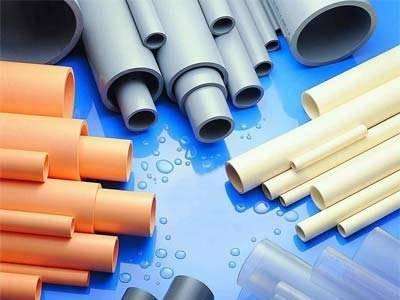
Buried high voltage cable protection is the second regulated application, and it imposes different requirements: impact resistance, non-conductivity and long-term deformation behaviour matter more than flow characteristics. The JKS MPP & PE high voltage power pipe extrusion line is built for this, processing MPP and PE with optional PP, ABS, PEX and silicon core pipe. Model PEG63 covers a pipe specification of φ20–φ63 mm at a line speed of 0.3–4.5 m/min with 70 kW installed power; model PG160 covers φ75–φ160 mm at 0.3–2 m/min with 125 kW installed power.
The whole line uses AC frequency control, offers optional 2/3/4-claw traction, and includes a chipless cutting system. For a power grid project, chipless cutting is not a convenience feature: a clean, square cut with no chips inside the bore supports the inspection stage, where cable protection conduit is checked before backfilling. The intended application is buried high voltage power grid construction and underground cable protection pipeline production, which is exactly where regional approval requirements are strictest.
Rigid PVC water supply and drainage lines
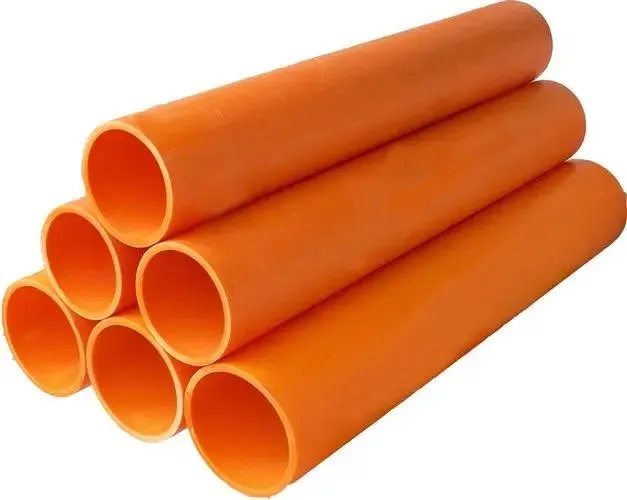
PVC water supply and drainage pipe is produced on conical twin-screw lines, and the JKS range covers three throughput levels. PVC63 is a double-station line for Φ16–Φ63 mm pipe, matched with an SJSZ65/132 conical twin screw extruder at AC 37 kW main motor power and 24 kW downstream power, with a hauling speed of 4–49 m/min and production output of 270 kg/h. PVC250 covers Φ90–Φ250 mm with SJSZ80/156 at AC 55 kW and 450 kg/h. PVC630 covers Φ315–Φ630 mm with SJSZ92/188 at AC 110 kW, 39 kW downstream power and 800 kg/h.
All three models are equipped with vacuum calibration, multi-claw traction and a dust-free cutting unit, processing PVC with CaCO₃. From a compliance viewpoint these three features are the ones that convert into product evidence: vacuum calibration controls roundness and wall uniformity, multi-claw traction prevents deformation during pulling, and dust-free cutting keeps the pipe bore clean for inspection.
Pressurized water and chemical lines — steel wire mesh reinforced composite pipe
Where a project needs higher pressure capability than a plain solid-wall pipe can deliver, steel wire mesh reinforced composite pipe lines take over. The JKS range covers GS/PE-160-H (φ50–160 mm, maximum speed 2.4 m/min, installed capacity 480 kW, actual power consumption 312 kW), GS/PE-250-H (φ75–250 mm, 2.4 m/min, 550 kW installed, 358 kW actual), GS/PE-315-H (φ90–315 mm, 2.4 m/min, 580 kW installed, 377 kW actual), GS/PE-500-H (φ250–500 mm, 1.4 m/min, 630 kW installed, 410 kW actual) and GS/PE-630-H (φ315–630 mm, 1.2 m/min, 800 kW installed, 559 kW actual).
The published difference between installed capacity and actual power consumption is useful during evaluation, because project owners increasingly ask for energy figures alongside capacity figures. Typical applications are urban pressurized water supply, chemical industry anti-corrosion pipelines and underground engineering pipe — all environments where the purchasing decision is documented rather than negotiated informally.

What a supplier should be able to place in your documentation folder
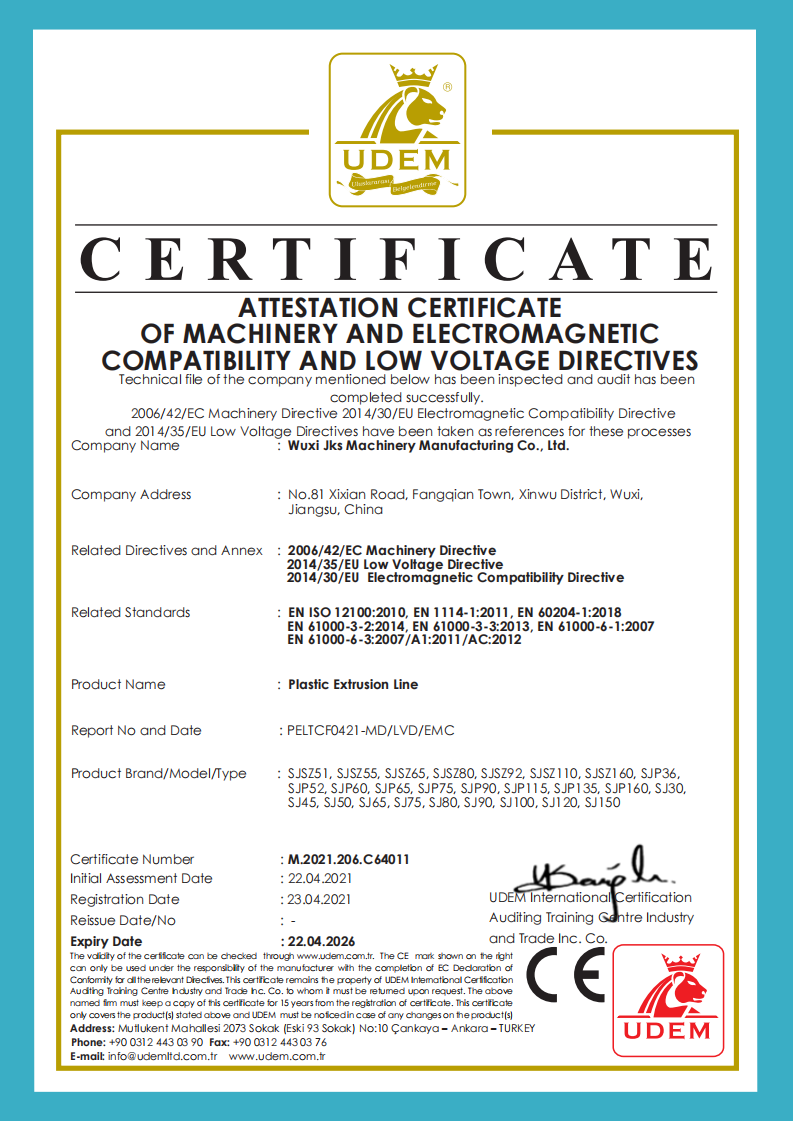
JKS holds CE certification under certificate number M.2021.206.C.64011, issued by UDEM International Certification Auditing Training Centre, valid for the global market including the EU, Southeast Asia and the Middle East. The certified scope covers plastic extrusion lines including the SJSZ series, SJ series and SJP series. The declared standards are EN ISO 12100:2010, EN 1114-1:2011 and EN 60204-1:2018, together with the EMC standards EN 61000-3-2:2014, EN 61000-3-3:2013, EN 61000-6-1:2007 and EN 61000-6-3:2007/A1:2011/AC:2012.
That list is worth reading as a buyer, because it separates machinery safety from electrical and electromagnetic behaviour. EN ISO 12100:2010 addresses risk assessment and safety of machinery; EN 1114-1:2011 addresses extruder safety requirements; EN 60204-1:2018 addresses electrical equipment of machines; the EN 61000 series addresses harmonic current emissions, voltage fluctuations and electromagnetic immunity and emission. A supplier that can name the individual standards is giving you something a page of logos cannot.
Verifying Compliance Step by Step
The following sequence is deliberately document-first. It assumes you already know which pipe type you intend to produce and roughly which region you will sell into, and it is written so that each step produces a written artefact you can file.
- Write down the pipe standard that applies to your market. Name the authority or standard your customer will be inspected against, and record the pipe diameter, wall thickness and pressure class you intend to produce. Without this, no supplier can meaningfully respond.
- Convert the standard into machine-relevant requirements. Diameter range, output per hour, extrusion capacity and cutting quality are the machine-side parameters that determine whether the line can serve that standard. For example, a Φ315–630 mm requirement points to a PE630-class line with a GS90/38 extruder at 280 kW, not a PE110-class line.
- Request the machinery conformity certificate and read the scope. Look for the certificate number, the issuing body and the model scope. A certificate that names the series you are buying is evidence; a certificate that only names a brand is marketing.
- Check the standard list against your market. Confirm that the standards cited on the document cover machinery safety, electrical safety and EMC in the way your market expects, and confirm the issue and expiry dates printed on the certificate are current.
- Ask for the factory test record. JKS runs 100% factory pre-assembly and testing before shipment, and third-party inspection is available on request. Ask for the test record even if you do not initially plan to use a third party — the answer tells you how the supplier works.
- Confirm the configuration in writing. Extruder model, screw configuration, production line layout, voltage and frequency, control system and capacity adjustment should all be fixed on paper before the order, because these are the items most often assumed rather than specified.
- Fix after-sales and documentation deliverables in the contract. Overseas installation guidance, on-site commissioning, operator training, remote technical support and a 12-month warranty should sit next to the documentation pack: packing list, loading record and shipping documents.
Step 5 is where most buyers discover a gap. Suppliers are usually confident about capacity and output, and considerably vaguer about test records and inspection access. A supplier that offers third-party inspection without hesitation is telling you something useful about how its assembly process is controlled.
Documentation checklist for pipe line purchases
| Document | What to check on it | Why it matters |
|---|---|---|
| Machinery conformity certificate | Certificate number, issuing body, standard list, model scope, issue and expiry dates | Confirms the line series you are buying sits inside the certified scope |
| Standard list / declaration of conformity | Named standards such as EN ISO 12100:2010, EN 1114-1:2011, EN 60204-1:2018 | Separates machinery safety from electrical and EMC conformity |
| Factory test record | Pre-assembly and running test before shipment; third-party inspection report on request | Shows the line was assembled and checked, not merely manufactured |
| Configuration confirmation | Extruder model, screw configuration, line layout, voltage and frequency, control system, capacity | Ties the quotation to a defined machine so the delivered line matches the approved one |
| Export documentation pack | Packing list, loading record, shipping documents | Gives customs, installers and auditors a traceable trail |
| After-sales commitment | Overseas installation guidance, on-site commissioning, operator training, remote technical support, 12-month warranty | Covers the post-delivery phase where compliance is usually tested in practice |
Use Cases: How Compliance Plays Out on Real Projects
Municipal water supply. A utility-scale water project typically specifies a pipe diameter band and a pressure class before any machine is ordered. A PE315 line covering Φ110–315 mm at 200–600 kg/h with a GS75/38 extruder at 160 kW is a common entry point for regional distribution networks, while PE630 at Φ315–630 mm and 600–1000 kg/h suits trunk mains. In both cases the buyer's first question moves from output to documentation: which certificate number, which standard list, which test record.
Underground power conduit. Buried high voltage cable protection is bought against grid construction schedules, and the acceptance criteria focus on impact resistance, wall consistency and clean cutting. A PEG63 line at φ20–φ63 mm and 0.3–4.5 m/min, or a PG160 line at φ75–φ160 mm and 0.3–2 m/min, is selected by the conduit diameter the grid project requires, with 2/3/4-claw traction chosen according to the pipe stiffness being run.
Agriculture and irrigation. PE110 lines at Φ20–110 mm and 150–400 kg/h are widely used for farm irrigation pipe, where regional requirements are lighter but material traceability still matters to the distributor reselling the pipe.
What long-run references show. JKS's documented long-run references are on adjacent line families rather than pipe: a complete PVC hollow wall panel extrusion line delivered to a plastic building materials manufacturer in Vietnam has been in stable operation for more than five years; a complete SPC flooring extrusion line delivered to a Malaysian SPC flooring manufacturer has run for more than ten years with stable continuous production and a low maintenance rate; and a Korean plastic flooring manufacturer's SPC line has been in stable 24/7 production for more than eight years. These references are not pipe lines, but they demonstrate the operating discipline that compliance buyers are really assessing: full export documentation, on-site installation and training support, and equipment still producing consistently years after handover.
Pipe Line Families Compared on Compliance-Relevant Criteria
The table below compares the pipe line families discussed above using published specification data only. It is intended as a shortlisting aid: match the pipe range and application first, then start the documentation conversation.
| Line family (JKS models) | Pipe range | Matched extruder & power | Compliance-relevant design detail | Typical regulated application |
|---|---|---|---|---|
| HDPE Water Pipe Extrusion Line (PE110, PE315, PE630, PE1000, PE1600) | Φ20–Φ1600 mm across five models | GS60/38 at 90 kW up to GS150/38 at 500 kW; 150–1500 kg/h | Screw & barrel in 38CrMoAlA nitrided alloy steel; forged alloy die steel moulds; Q235 carbon steel frame | Municipal water supply, gas pipeline, farm irrigation pipe manufacturing |
| MPP & PE High Voltage Power Pipe Extrusion Line (PEG63, PG160) | φ20–φ63 mm / φ75–φ160 mm | 70 kW / 125 kW installed power; 0.3–4.5 and 0.3–2 m/min | AC frequency control; optional 2/3/4-claw traction; chipless cutting system; MPP/PE with optional PP, ABS, PEX, silicon core pipe | Buried high voltage power grid construction, underground cable protection pipeline production |
| PVC Water Supply & Drainage Pipe Extrusion Line (PVC63, PVC250, PVC630) | Φ16–Φ630 mm | SJSZ65/132 at 37 kW up to SJSZ92/188 at 110 kW; 270–800 kg/h | Vacuum calibration, multi-claw traction and dust-free cutting unit on all three models | Building water supply & drainage, agricultural irrigation, cable threading pipe |
| Steel Wire Mesh Reinforced Composite Pipe Extrusion Line (GS/PE-160-H to GS/PE-630-H) | φ50–φ630 mm | 480–800 kW installed capacity; 312–559 kW actual consumption | Steel wire mesh reinforcement; maximum speed 2.4 m/min down to 1.2 m/min across the range | Urban pressurized water supply, chemical industry anti-corrosion pipeline, underground engineering pipe |
| Corrugated Pipe Extrusion Line (KSPG-20, KSPG-32, KSPG-63, KS-75, KS-160) | Φ6–Φ160 mm across five models | Screw Φ45–Φ75 with L/D 30:1–33:1; 45–100 kW | Corrugation mould in wear-resistant alloy steel; Q235 carbon steel frame | Electric wire threading pipe, mechanical equipment threading, construction drainage pipe |
| PPR Pipe Extrusion Line (PPR20-75, PPR20-110) | Model designations PPR20-75 and PPR20-110 | GS65/33 at 37 kW / GS90/30 at 75 kW; 80–250 kg/h | High precision die steel mould; 38CrMoAlA nitrided alloy steel screw & barrel | Indoor home decoration cold & hot water pipeline, residential plumbing pipe |
Frequently Asked Questions
1. Which certification documents should I request from a plastic extrusion machine supplier before buying a pipe line?
Request four items in writing: the machinery conformity certificate with its certificate number, issuing body, standard list, model scope and validity dates; the factory test record confirming pre-assembly and testing before shipment; the configuration confirmation covering extruder model, screw configuration, line layout, voltage and frequency, control system and capacity; and the export documentation pack. JKS, for example, holds CE certification M.2021.206.C.64011 issued by UDEM International Certification Auditing Training Centre, covering plastic extrusion lines including the SJSZ, SJ and SJP series, with conformity declared to EN ISO 12100:2010, EN 1114-1:2011, EN 60204-1:2018 and the relevant EN 61000 EMC standards. Check that the scope names the series you are buying and that the dates on the document are current.
2. Can the extrusion line be configured so that the finished pipe meets our regional standard?
The pipe standard itself is set by your market, but the line determines whether the pipe can be produced within it consistently. Suppliers can align the extruder model, mould, calibration and haul-off to a target pipe specification. A practical example from the HDPE range: PE110 covers Φ20–110 mm with a GS60/38 extruder at 90 kW and 150–400 kg/h, while PE630 covers Φ315–630 mm with GS90/38 at 280 kW and 600–1000 kg/h. Voltage and frequency, screw configuration, control system and capacity adjustment are all customizable, which matters when a project specifies an unusual power supply or a particular wall-thickness window.
3. What drives the cost of a compliance-ready pipe extrusion line?
Cost follows four variables rather than a single price point. First, the pipe diameter range: an entry line covering Φ20–110 mm with a 90 kW extruder and a large-diameter line covering Φ1000–1600 mm with a 500 kW extruder are different machines at different scales. Second, installed power: 70 kW on a PEG63 power conduit line against 800 kW installed capacity on a GS/PE-630-H reinforced composite line. Third, downstream equipment — vacuum calibration, multi-claw traction and dust-free or chipless cutting units change both capability and cost. Fourth, the scope of documentation and testing you require, including third-party inspection. The reliable approach is to request a configuration-based quotation that states which of these elements are included.
4. Can we validate the line before shipment, and what documentation comes with it?
Yes. JKS runs 100% factory pre-assembly and testing before shipment, and third-party inspection is available on request. Buyers typically use this stage to confirm extruder running behaviour, downstream alignment and cutting quality before the line is packed. The delivery then includes export documentation — a practice visible in JKS's Vietnam project, where a complete PVC hollow wall panel extrusion line was delivered as a turnkey solution with on-site installation support and a full export documentation pack.
5. What are the minimum order quantity, lead time and production capacity behind these lines?
JKS works with a minimum order quantity of one unit and a lead time of 40 working days, with a monthly production capacity of 30 units and an annual output of around 200 units from a 2,000 m² facility staffed by 20 employees, including a 6-engineer R&D team. After-sales includes overseas installation guidance, on-site commissioning, operator training, remote technical support and a 12-month warranty. If you are at the stage of comparing configurations against a specific pipe standard, the fastest next step is to send your pipe diameter range, target market and required output, and request a configuration-matched quotation together with the documentation pack.
Conclusion: Turn Certification Into a Purchase Checklist, Not a Promise
Regional pipe certification is not a single document and not a single conversation. It is the meeting point of three chains: the product standard your market enforces, the machinery conformity your supplier can evidence, and the documentation that connects the two. Buyers who treat it as a checklist — standard defined, certificate scope read, test record obtained, configuration fixed, after-sales documented — end up with a pipe line that can be defended in front of an inspector, a customs officer or a project owner.
Buyers who treat it as a promise usually discover the gap during installation, when the schedule is already committed. The difference between the two outcomes is not the size of the machine; it is whether the paperwork was requested before the deposit, or after the fault.
Request the pipe line configuration and documentation pack
Send us your pipe diameter range, target market and required output capacity. JKS will match an extruder and downstream configuration to your pipe standard and provide the corresponding conformity documents, factory test record and configuration sheet before you commit.
Download the product brochure: JKS Machinery product brochure (PDF)
Website: www.extrudetec.com | Email: gordon@jksjx.com | Tel: 86 18651004566 | WhatsApp: 86 18601577228