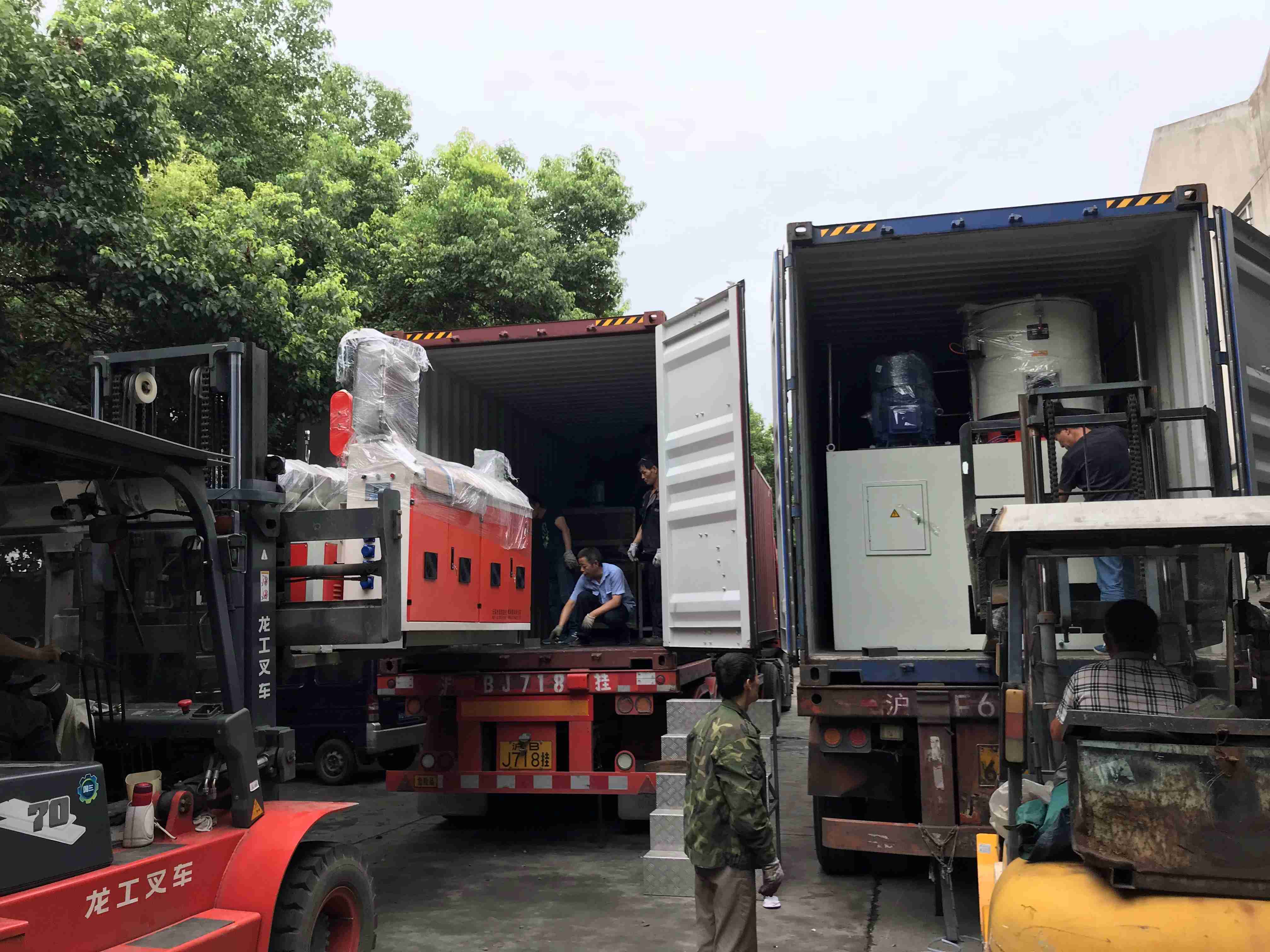
Plastic Extrusion Machine Build Scope Audit: What to Verify
A build-scope audit proves that a plastic extrusion machine supplier can actually manufacture, assemble, test and deliver every module it has quoted — before a deposit is paid. A quotation shows a price and a model number. It does not show who machines the screw, who welds the frame, who runs the pre-shipment test, or who is accountable when the downstream haul-off does not match the extruder.
This guide sets out a five-layer audit framework, an eight-step verification sequence, and the wording that converts supplier capability claims into contractual delivery commitments. The evidence points come from the documented build scope of Wuxi JKS Machinery Manufacturing Co. Ltd. (JKS) — a Chinese manufacturer founded in 2013 in Wuxi, Jiangsu Province, which builds custom turnkey plastic extrusion lines and has exported to more than 35 countries.
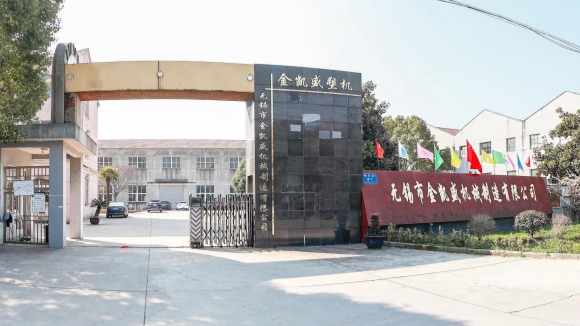
Problem Definition: The Gap Between a Quotation and a Delivered Scope
Extrusion line quotations are written on a common template: main extruder model, downstream unit list, installed power, delivery time. Two 65 mm conical twin-screw lines can look identical on paper and still be completely different machines. The difference is not in the specification sheet. It is in who manufactures each module, what material the wear parts are made from, and what happens between the deposit and the container.
Build-scope risk appears in three recurring forms.
1. Partial in-house coverage
A supplier may build or assemble the main extruder and source vacuum calibration tanks, haul-offs, cutters, mixers or pelletizers from third parties. Outsourcing is not automatically a defect — but it changes accountability. When three vendors own three parts of the line, the buyer owns the integration risk, including cable runs, control logic, capacity matching between the extruder and the haul-off, and spare-part sourcing years later.
2. Unspecified wear components
If the screw and barrel material is not written into the quotation, the buyer cannot verify what actually arrives. Nitrided 38CrMoAlA alloy steel is a defined specification for extrusion screws and barrels. A generic line item reading alloy steel is not a specification — it is a placeholder that permits substitution.
3. Undefined acceptance
If the quotation does not state what will be tested before shipment, at which point, and against which criteria, then the first genuine test of the line happens at the buyer's plant — after the balance payment has cleared and the container has been unpacked. At that stage, every dispute becomes a negotiation about interpretation.
Working definition: a supplier's build scope is verifiable when it can be stated as four things — the machine families the supplier manufactures itself, the materials specified for every wear component, a production capacity and lead time the supplier will commit to, and a pre-shipment test protocol with written acceptance criteria.
Industry Background: Why Scope Verification Matters in a Capacity-Building Market
Extrusion capacity is being added faster than it is being retired. The global plastic extrusion machinery market was valued at approximately USD 8.93 billion in 2024 and is projected to reach USD 11.58 billion by 2030, according to Grand View Research. Asia Pacific accounted for 41.5% of extrusion machinery revenue in 2024, with China the leading contributor in the region. Within the installed base, single-screw extrusion machines held roughly 62.7% of the global market in 2024, while conical twin-screw platforms remain the standard choice for rigid PVC processing.
Downstream demand follows the same curve. The global pipe extrusion lines market is valued at USD 4.8 billion in 2025, with PVC the leading material segment at 38.6% (Dataintelo). The Stone Plastic Composite (SPC) flooring market is projected to grow from USD 6.4 billion in 2026 to USD 10.3 billion by 2033, a 7.2% CAGR (Grand View Research). Published market estimates vary significantly by scope — some track machinery only, others track total processing systems — so any single figure is best treated as an order-of-magnitude reference rather than a precise number.
Two consequences follow for buyers in the Evaluation-to-Execution stage. First, a rising market pulls in suppliers whose sales scope expands faster than their manufacturing scope. Second, a large share of line purchases is placed with regional custom-line builders rather than only with the global equipment groups such as Coperion, KraussMaffei, Davis-Standard and Jwell, which appear in 2024 industry listings of leading extrusion equipment manufacturers. When the supplier is a mid-scale custom builder, the build scope itself is the risk factor — and therefore the audit subject.
The Five-Layer Build-Scope Audit
The audit is layered because capability claims are layered. Each layer has one question and one evidence requirement. The example below uses JKS's documented build scope as the reference case, because it covers both extruder platforms and the surrounding line equipment.
Layer 1 — Machine-level coverage: does the supplier build the extruder itself?
The first question is whether the supplier manufactures the extruder or resells a third-party machine. A verifiable answer names the platforms and the model range, not just the output figure.
JKS builds two extruder platforms in-house. The Single Screw Plastic Extruder (SJ series) is offered in custom models including SJ30, SJ45, SJ65 and SJ90, and processes PVC, PP, PE, nylon and ABS into pipes, rods, films, pellets, coated products and blow-moulded items depending on the die and downstream configuration. The Conical Twin Screw Plastic Extruder (SJSZ series) is built in seven sizes from SJSZ-45 to SJSZ-110 and is used for direct extrusion of PVC powder into pipes, sheets, bars, profiles and pellets.
| Conical twin screw model | Main motor power | Documented output |
|---|---|---|
| SJSZ-45 | 15 kW | 70 kg/h |
| SJSZ-51 | 18.5 kW | 120 kg/h |
| SJSZ-55 | 22 kW | 150 kg/h |
| SJSZ-65 | 37 kW | 250 kg/h |
| SJSZ-80 | 55 kW | 400 kg/h |
| SJSZ-92 | 90 kW | 500–600 kg/h |
| SJSZ-110 | 200 kW | 1000 kg/h |
Two features make this table auditable rather than decorative. The range is continuous, so a buyer can scale from a small profile line to a 1000 kg/h PVC pipe line within one manufacturing platform. And the power-to-output relationship is published per model, which means the quoted extruder can be tested against the required output instead of being accepted on the strength of a general capacity statement.
Layer 2 — Upstream and downstream coverage: is the line complete, or is it a main machine plus a shopping list?
A complete line is more than an extruder. Ask the supplier to mark every item on the quotation as self-manufactured, self-integrated, or purchased. The pattern of those marks shows where integration risk sits.
JKS's documented peripheral scope includes:
- Mixing and cooling: PVC Mixing & Cooling Unit in models SRL-Z200/500 (37/7.5 kW, 300–400 kg/h), SRL-Z300/600 (55/11 kW, 450–600 kg/h), SRL-Z500/1000 (75/15 kW, 800–1000 kg/h) and SRL-Z1000/3000 (160/22 kW, 1600–2000 kg/h), with a mixing cycle of 8–10 minutes per pot and a cooling cycle of 6–8 minutes per pot.
- Size reduction: Plastic Crusher SP400 (15 kW, 300–400 kg/h) and SP660 (22 kW, 600–700 kg/h); Plastic Pulverizer MF400 (30 kW, 200 kg/h), MF500 (37 kW, 300–400 kg/h) and MF600 (55 kW, 400–500 kg/h), all specified at 40–80 mesh fineness.
- Pelletizing: PVC Hot-cut Pelletizing Line in SJSZ55, SJSZ65, SJSZ80 and SJSZ92 sizes (22–110 kW, 100–800 kg/h), and Plastic Strand Cutting Pelletizing Line in ST80, ST100, ST120 and ST150 sizes (55–110 kW, 70–650 kg/h) at L/D 35:1, covering both single-stage compounding and two-stage waste plastic recycling.
Finished-product line coverage spans four product families:
- Sheet and board: SPC flooring lines (SJSZ92/188, SJSZ110/220, SJP115/30, SJP135/30), PVC imitation marble sheet lines (SJSZ80/156, SJSZ92/188), PVC & WPC foam board lines (SJSZ80/156 and 80+165 co-extrusion), and PP hollow construction formwork lines (SJ-130×33, SJ-90×33).
- Pipe: PVC water supply and drainage pipe lines (PVC63, PVC250, PVC630), HDPE water pipe lines (PE110 to PE1600), PPR pipe lines (PPR20-75, PPR20-110), steel wire mesh reinforced composite pipe lines (GS/PE-160-H to GS/PE-630-H), corrugated pipe lines (KSPG-63, KSPG-32, KSPG-20, KS-160, KS-75) and MPP & PE high voltage power pipe lines (PEG63, PG160).
- Profile and board: PVC & WPC door and window profile lines (SJSZ92/188, SJSZ65/132), WPC door panel lines (SJSZ80, SJSZ92), PVC hollow wall panel and ceiling lines (SJSZ51 to SJSZ80), PVC grille and decoration profile lines (SJSZ51, SJSZ55, SJSZ65) and multi-material profile lines (SJ45, SJ50, SJ65).
- Rod: Solid Plastic Rod Extrusion Line in SJ45 (screw Φ45 mm, L/D 28:1, 7.5 kW, rod Φ6–60 mm) and SJ65 (screw Φ65 mm, L/D 30:1, 18.5 kW, rod Φ30–200 mm), producing PP, PE, PA and POM rods.
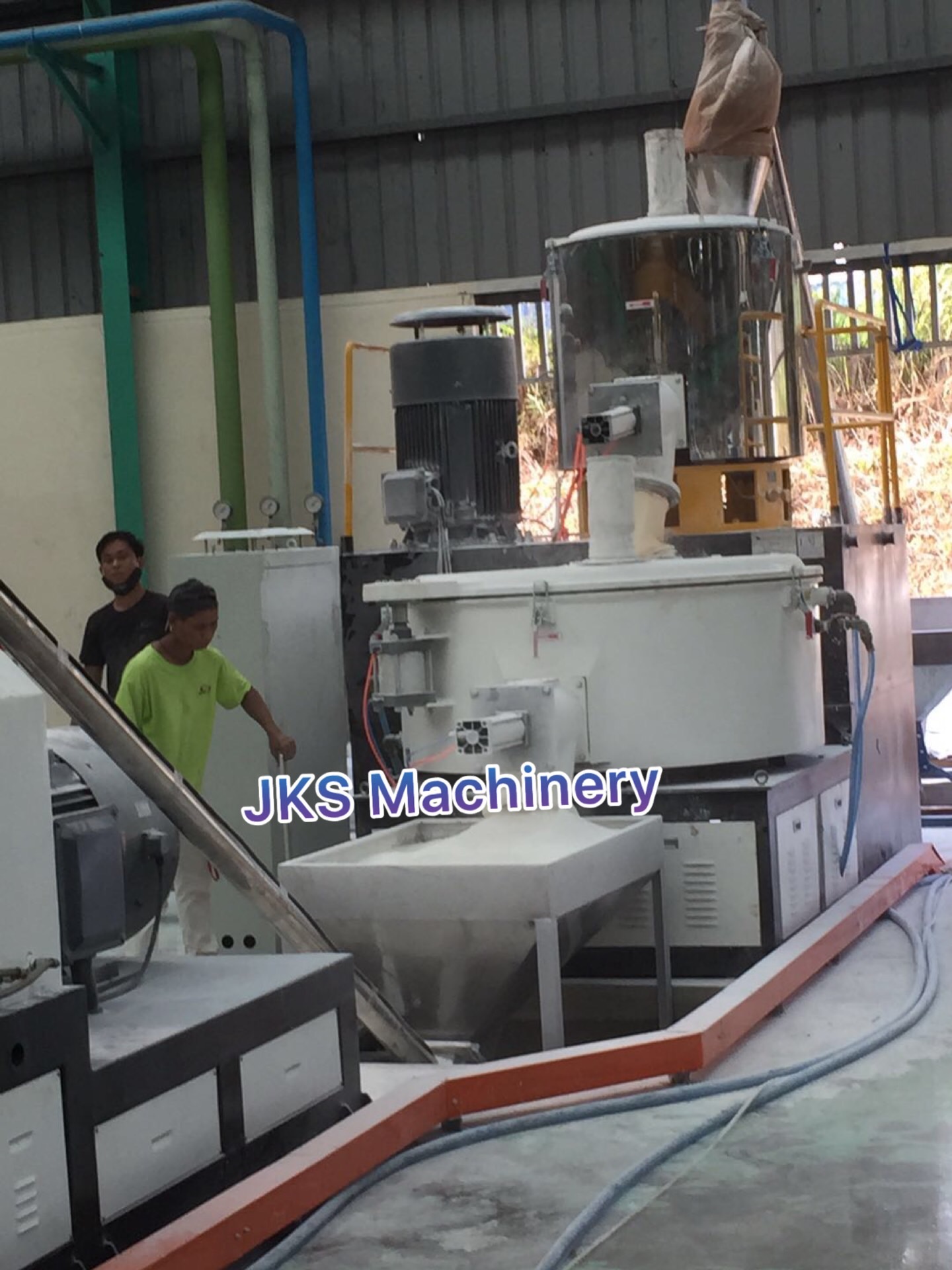
Layer 3 — Component-level verification: what are the wear parts made of?
Wear components set the maintenance economics of a line over ten years. They are also the easiest place for a supplier to reduce cost silently between quotation and delivery. Ask for material callouts as written specifications.
- Screw and barrel: 38CrMoAlA nitrided alloy steel across the documented SJ, SJSZ, pipe, sheet, board and profile lines.
- Calender rollers: 45# forged steel with hard chrome plating on SPC flooring and PVC imitation marble sheet lines.
- Machine frames: Q235 carbon structural steel, with the welding and frame fabrication visible in the workshop scope.
- Mixing pot: stainless steel on the PVC Mixing & Cooling Unit.
- Crushing and grinding chambers: wear-resistant steel on both the Plastic Crusher (cutting chamber and blades) and the Plastic Pulverizer (grinding chamber and rotor).
- Dies and moulds: wear-resistant alloy die steel, with forged refined die steel specified on the PP hollow construction formwork line and high precision die steel on the PPR pipe line.
- Pelletizing dies: wear-resistant alloy steel on both hot-cut and strand-cutting pelletizing platforms.
Layer 4 — Capacity, lead time and order terms: is the schedule real?
JKS documents a monthly production capacity of 30 units, a typical production lead time of 40 work days, and a minimum order quantity of 1 unit. Those three numbers carry more weight than any capability statement, because they can be checked against a delivery schedule and a shipping plan — and because capacity that is claimed but not quantified cannot be audited at all.
Customization scope should also be stated before the order is frozen. JKS offers OEM, ODM and custom design services covering extruder model, screw configuration, production line layout, voltage and frequency, control system, and capacity adjustment. For buyers in markets with non-standard grid voltages or restricted floor space, the layout and voltage items matter as much as the extruder model.
Layer 5 — Quality gate, acceptance and after-sales: who signs off before shipment?
The single most important sentence in a capability pack is the one that defines when the supplier takes responsibility for the line as a system rather than as a set of crates. JKS's documented position is that 100% factory pre-assembly and testing is completed before shipment, with third-party inspection available on request.
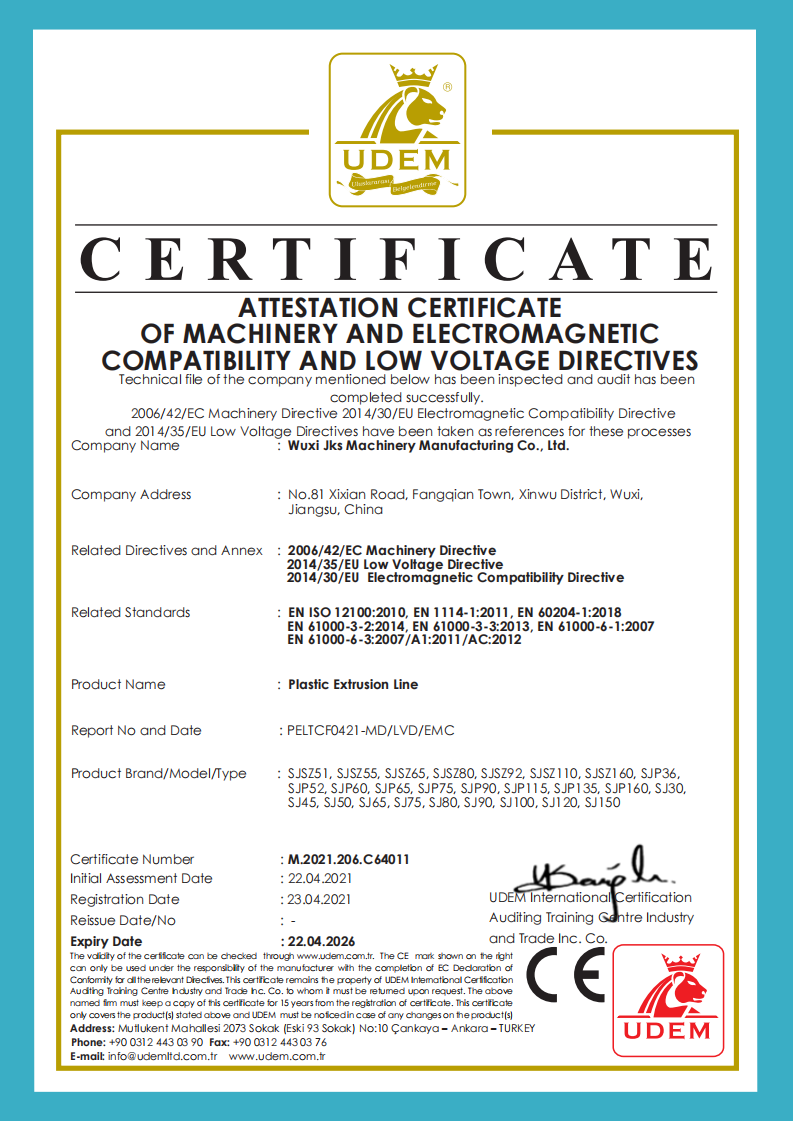
Compliance evidence follows the same logic. JKS holds CE certification number M.2021.206.C.64011, issued by UDEM International Certification Auditing Training Centre, covering plastic extrusion lines including the SJSZ, SJ and SJP series models, assessed against EN ISO 12100:2010, EN 1114-1:2011 and EN 60204-1:2018, with EMC standards EN 61000-3-2:2014, EN 61000-3-3:2013, EN 61000-6-1:2007 and EN 61000-6-3:2007/A1:2011/AC:2012 cited. A certificate number and a standard list are verifiable; a CE sticker is not. Check the number against the issuing body's records, confirm the covered series, and confirm that the validity period matches the machine you are buying.
After-sales scope covers a 12-month warranty, overseas installation guidance, on-site commissioning, operator training and remote technical support. The manufacturer also provides factory installation, technical training and formulation service based on the buyer's raw material and production demand.
Step-by-Step: An Eight-Step Build-Scope Verification Sequence
- Fix your product specification first. Decide finished width, thickness, target output and raw material formula before contacting suppliers. Ask: Which extruder model reaches this output at this product width, and at what haul-off speed?
- Request a line-by-line scope table. Every item — main extruder, calibration, haul-off, cutter, mixer, crusher, pulverizer, pelletizer, stacker — listed with model and source. Ask: Which of these items does your factory manufacture, and which are purchased?
- Request wear-part material callouts in writing. Ask: What is the screw and barrel material, the calender roller material, the frame steel, the mixing pot material, and the crusher chamber material?
- Test the schedule arithmetic. Multiply committed capacity by your position in the queue. Ask: What is your monthly production capacity, your current order backlog, and your committed lead time in work days?
- Verify the certification scope. Ask: What is the certificate number, who issued it, which models are covered, and what is the validity period?
- Define the pre-shipment test protocol. Ask: What will be tested at the factory, who witnesses the test, what is recorded, and is third-party inspection permitted?
- Confirm installation, training and warranty. Ask: Does the scope include on-site commissioning, operator training, remote support, and what does the warranty cover and for how long?
- Convert the answers into contract annexes. Attach the scope table, the component material specification and the acceptance criteria to the purchase contract, and link payment milestones to them.
Use Cases: What Delivery Assurance Looks Like After Year Five
Long-running installations are the clearest test of whether a build scope was real. Three documented projects illustrate different product families and different regional markets.
- Malaysia — SPC flooring line, in stable operation for over 10 years. The line produces SPC flooring for residential and commercial use, with high-speed production, precise thickness control and on-site installation and training support. Reported outcomes include stable continuous production, consistent product quality and a low maintenance rate.
- South Korea — SPC flooring line, in stable operation for over 8 years. The line produces SPC flooring sheets for residential and commercial use and runs 24/7 production, with high output, precise thickness control and reliable after-sales support as the reported highlights.
- Vietnam — PVC hollow wall panel extrusion line, in stable operation for over 5 years. The line produces PVC hollow wall panels for construction and interior decoration. Key highlights include a complete turnkey solution, on-site installation support and full export documentation, with stable continuous production and consistent product quality reported.
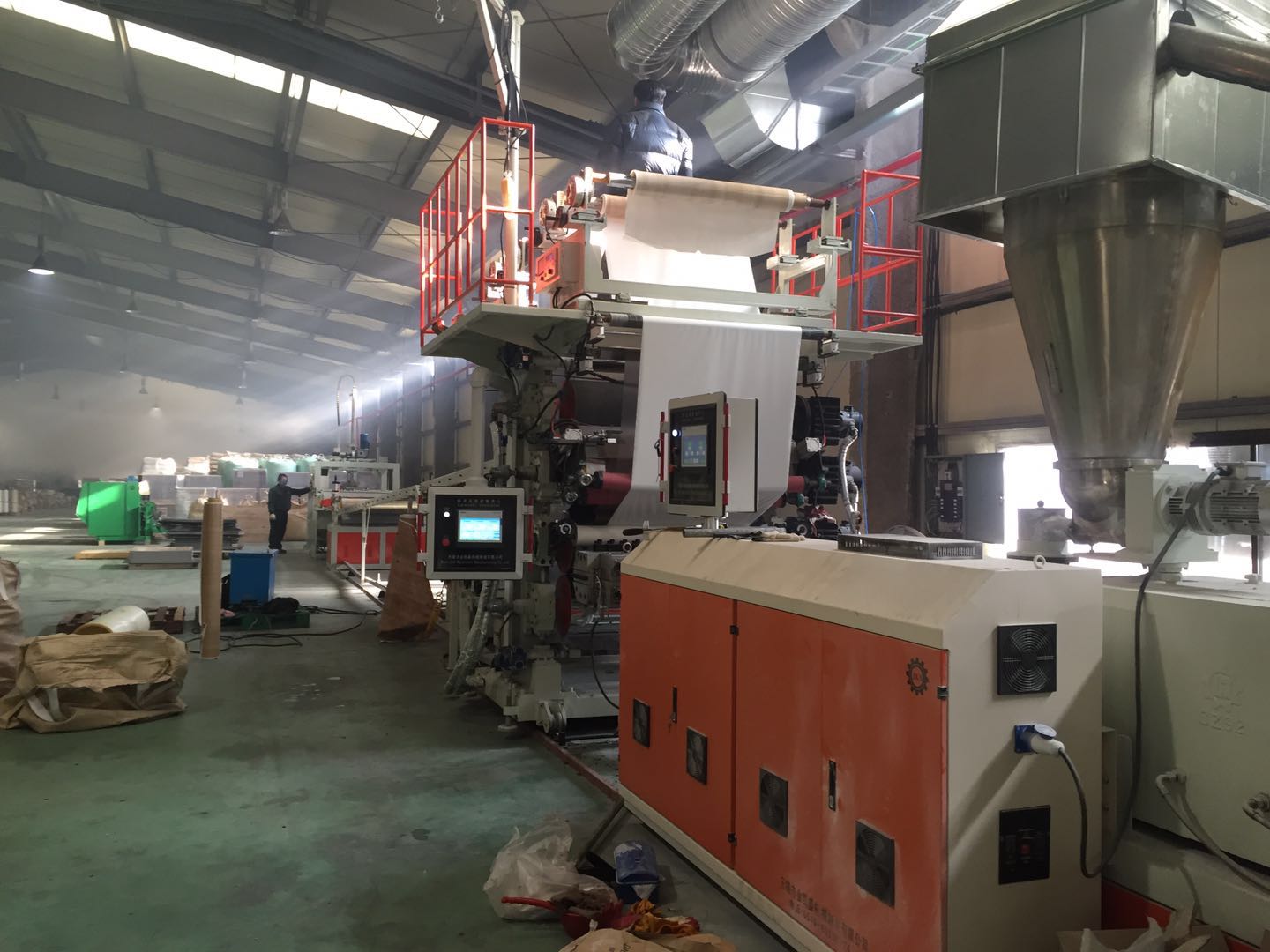
Three elements in these cases matter for the audit. The lines ran for eight to ten years, they ran continuously, and the supplied scope included installation, training and documentation. Those are delivery-assurance outcomes, not machine-spec outcomes — and they are the part of a quotation that a specification sheet never captures.
Comparison Table: Audit Checkpoints, Evidence and Documented Position
| Audit layer | What to ask in writing | Evidence to request | Documented position (JKS) |
|---|---|---|---|
| Machine platform | Which extruder models do you manufacture? | Model list with power and output per model | Single Screw Plastic Extruder SJ30, SJ45, SJ65, SJ90 (and other custom models); Conical Twin Screw Plastic Extruder SJSZ-45 to SJSZ-110 |
| Component materials | What material is specified for screws, barrels, rollers and chambers? | Written material specification inside the quotation | 38CrMoAlA nitrided alloy steel screw and barrel; 45# forged steel calender rollers with hard chrome plating; Q235 carbon steel frames; stainless steel mixing pot; wear-resistant crusher and pulverizer chambers |
| Upstream and auxiliary scope | Are mixing, crushing, pulverizing and pelletizing included? | Equipment list with models and capacities | PVC Mixing & Cooling Unit (SRL-Z200/500 to SRL-Z1000/3000); Plastic Crusher SP400/SP660; Plastic Pulverizer MF400/MF500/MF600; PVC Hot-cut Pelletizing Line SJSZ55–SJSZ92; Strand Cutting Pelletizing Line ST80–ST150 |
| Customization scope | Which parameters can be customized, and at what stage? | Written customization scope | Extruder model, screw configuration, production line layout, voltage and frequency, control system, capacity adjustment; OEM, ODM and custom design services |
| Capacity and schedule | What capacity, lead time and MOQ are committed? | Capacity figure, lead time in work days, MOQ | Monthly production capacity 30 units; typical lead time 40 work days; MOQ 1 unit |
| Quality gate | What is tested before shipment, and who may witness it? | Test protocol, checklist, third-party inspection option | 100% factory pre-assembly and testing before shipment; third-party inspection available on request |
| Compliance | Which standards does the certificate cover, and is it current? | Certificate number, issuing body, standard list, validity period | CE certificate M.2021.206.C.64011 issued by UDEM; EN ISO 12100:2010, EN 1114-1:2011, EN 60204-1:2018 plus cited EMC standards; scope covers SJSZ, SJ and SJP series |
| Commercial terms | What are the payment, delivery and acceptance terms? | Written terms attached to the scope table | MOQ 1 unit; delivery terms FOB; 30% T/T deposit and 70% T/T balance before shipment; acceptance criteria: pre-shipment factory test |
Purchase Terms and Acceptance Criteria
Purchase terms are where a build-scope audit becomes enforceable. The documented commercial framework for JKS orders is MOQ 1 unit, FOB delivery terms, payment of 30% T/T deposit with the 70% balance before shipment, and acceptance criteria based on the pre-shipment factory test.
Because line cost scales with configuration — extruder model, screw configuration, line layout, voltage and frequency, control system and capacity — those commercial terms should be attached to a frozen scope table rather than to a headline model number. Three annexes are worth insisting on:
- Scope annex: every module listed, each marked self-manufactured or purchased, with model designations.
- Material annex: screw and barrel grade, roller material and treatment, frame steel, mixing pot material, crushing and grinding chamber material, die material.
- Acceptance annex: what is tested, the test record format, whether third-party inspection is permitted, and the criteria that determine pass or fail.
Decision rule: if a supplier cannot produce these three annexes before the deposit, the quotation is a price, not a delivery commitment. If it can, you have shifted the risk from your plant floor back to where it belongs.
FAQ
1. Which certification should I verify before ordering a plastic extrusion line?
Ask for the certificate itself rather than a claim. JKS holds CE certification number M.2021.206.C.64011, issued by UDEM International Certification Auditing Training Centre, covering plastic extrusion lines including the SJSZ, SJ and SJP series models, assessed against EN ISO 12100:2010, EN 1114-1:2011 and EN 60204-1:2018, with EMC standards EN 61000-3-2:2014, EN 61000-3-3:2013, EN 61000-6-1:2007 and EN 61000-6-3:2007/A1:2011/AC:2012 cited. Verify the certificate number with the issuing body, and confirm that both the covered model series and the validity period match the machine in your order.
2. How do I confirm that a supplier builds the line in-house rather than outsourcing it?
Ask two questions: which platforms do you manufacture, and which quotation items do you purchase? JKS builds the Single Screw Plastic Extruder (SJ30, SJ45, SJ65, SJ90 and other custom models) and the Conical Twin Screw Plastic Extruder (SJSZ-45 to SJSZ-110), and also supplies the surrounding scope — PVC mixing and cooling units, plastic crushers, pulverizers, pelletizing lines, and complete sheet, board, pipe and profile lines. The company operates a 2,000 m² workshop with a six-engineer R&D team in Wuxi, Jiangsu Province, China, and offers OEM, ODM and custom design services. The self-manufactured versus purchased marking on the quotation shows exactly where integration risk sits.
3. What purchasing terms should be fixed before the order?
The documented commercial framework is MOQ 1 unit, delivery terms FOB, payment of 30% T/T deposit with 70% T/T balance before shipment, and acceptance criteria based on a pre-shipment factory test. Since line cost scales with configuration, these terms should be attached to a frozen scope table rather than to a single model number, so that capacity adjustments, voltage and frequency changes, and layout revisions are handled inside a defined commercial structure instead of through later renegotiation.
4. Can the line be inspected or tested before shipment?
Yes. 100% factory pre-assembly and testing before shipment is JKS's documented quality-control position, and third-party inspection is available on request. In practice, request the test record, the pre-shipment checklist and a video of the assembled line running, and confirm in writing that the acceptance criteria applied in the factory test are the same criteria you will apply after installation.
5. How long does delivery take, and what happens after the container arrives?
Typical production lead time is 40 work days, against a monthly production capacity of 30 units and a minimum order quantity of 1 unit. After shipment, the scope includes overseas installation guidance, on-site commissioning, operator training, remote technical support and a 12-month warranty. To request a build-scope table, a configuration-based quotation or a factory test arrangement, contact Gordon at gordon@jksjx.com or by phone and WhatsApp at 86 18651004566 / 86 18601577228. The product brochure can be downloaded from the link below.
Conclusion: Turn Claims into Commitments
A build-scope audit is a translation exercise, not a distrust exercise. The supplier describes capability; the buyer converts that description into a scope table, a material specification and an acceptance protocol. What is left after that translation is a delivery commitment — and what fails to survive the translation was never a commitment in the first place.
For a plastic extrusion machine purchase, the audit closes on three questions. Can the supplier build the extruder itself, from SJ30–SJ90 single screw to SJSZ-45–SJSZ-110 conical twin screw? Can it supply and integrate the surrounding line, from the PVC mixing and cooling unit through crushers, pulverizers, pelletizing lines and finished-product extrusion lines? And will it commit, in writing, to 38CrMoAlA nitrided screw and barrel, a stainless steel mixing pot, wear-resistant crushing and grinding chambers, a pre-shipment factory test, and a defined acceptance criterion? Suppliers who answer those questions quickly and in writing are usually the suppliers whose lines are still running in year ten.
Request a Build-Scope Table and Quotation
Send your product specification — material formula, finished width, thickness and target output — and JKS will return a line-by-line scope table, a component material specification and a delivery schedule.
Contact: Gordon | Email: gordon@jksjx.com | Tel / WhatsApp: 86 18651004566 / 86 18601577228
Address: No. 81 Xixian Road, Fangqian Town, Wuxi City, Jiangsu Province, 214000, P.R. China
Website: www.extrudetec.com
Brochure: Download the JKS product brochure (PDF)