
Plastic Extrusion Machine Compliance Guide: Aligning Model Specs with Regional Requirements
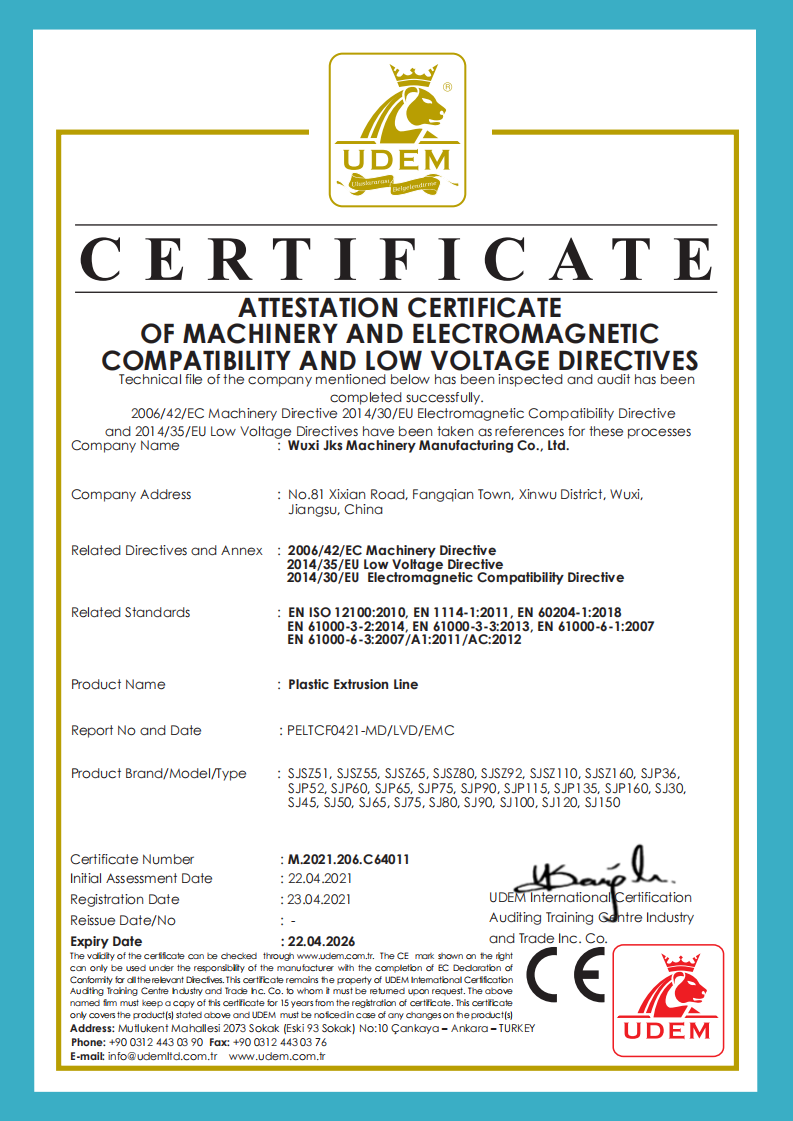
CE certificate M.2021.206.C.64011, issued 22 April 2021 by UDEM International Certification Auditing Training Centre, covers plastic extrusion lines including the SJSZ series, SJ series and SJP series models. Its stated expiry date on the certificate is 22 April 2026.
A plastic extrusion machine compliance file is a cross-reference document: it pairs every declared machine specification with the requirement it is meant to satisfy in the destination market. It is not a folder of certificates collected at the end of a project. The difference matters commercially, because a certificate that names a model series the buyer did not order, or that has passed its stated expiry date, does not protect the buyer during import clearance, insurance review or a factory audit.
This guide explains how to build that file for an extrusion line, using the actual model designations and construction data that appear on JKS Plastic Extrusion Machine documentation — Wuxi JKS Machinery Manufacturing Co. Ltd., a Chinese manufacturer of custom plastic extrusion machinery and complete turnkey production lines founded in 2013. It covers screw and barrel material, application scenarios including pipe, profile, sheet and recycling, and the documentation checkpoints a buyer should demand before the line ships.
Problem Definition: Why Model Specs and Market Requirements Drift Apart
Compliance gaps on extrusion projects rarely come from a supplier refusing to certify. They come from three much more ordinary causes.
1. The certificate scope and the ordered configuration diverge. A certificate may cover a model family at series level, while the purchased line uses a specific configuration, added co-extrusion unit, or different control cabinet. Buyers who check only the certificate's existence, not its scope wording, discover the mismatch at the port.
2. Electrical and safety declarations are treated as boilerplate. Machine safety and electrical requirements are written against defined standards. For a CE-marked line, the standards named on the certificate record — EN ISO 12100:2010, EN 1114-1:2011, EN 60204-1:2018 and the EN 61000 series — define what the technical file must demonstrate. For the United States, ANSI/PLASTICS B151.7 sets out the extrusion machine safety scope and requires a documented risk assessment process in the manufacture, care and use of the machinery.
3. Nobody owns the file after shipment. Certificates have validity periods. The CE certificate on record for JKS extrusion lines carries an issue date of 22 April 2021 and a stated expiry date of 22 April 2026. A buyer taking delivery in a later period must ask for the current status, not the version stored in an old email thread.
The practical consequence: compliance is a matching exercise, and matching requires both sides of the comparison to be written down in the same place, with the same model designations and the same revision date.
Industry Background: A Market Where Documentation Travels With the Machine
The commercial context explains why compliance documentation has become a procurement deliverable rather than an afterthought.
The global plastic extrusion machine market was estimated at USD 7.9 billion in 2025 and is projected to reach USD 12.87 billion by 2035, according to Market Research Future's 2026 forecast. On the trade side, the Observatory of Economic Complexity, drawing on UN Comtrade data for HS 8477 (rubber and plastic working machinery), reports China as the leading exporter in 2024 at USD 8.55 billion, ahead of Germany at USD 6.11 billion and Italy at USD 2.61 billion. Downstream, Grand View Research values the global stone plastic composite (SPC) flooring market at USD 6.4 billion in 2026, with a projection to USD 10.3 billion by 2033 — one of the demand drivers behind specialised flooring extrusion lines.
Two observations follow. First, cross-border procurement of extrusion equipment is routine, which means documentation is routinely examined by parties who did not build the machine: customs brokers, certification bodies, insurers, and the buyer's own engineering team. Second, the standards landscape is not a single global rulebook. European conformity work references harmonised EN standards; the US market references ANSI/PLASTICS B151.7. Even within one reference, edition control matters: the PLASTICS Industry Association page lists ANSI/PLASTICS B151.7-2013, while the ANSI webstore lists B151.7-2014 (R2021). These are different edition references, and a compliance file should record which edition it is claiming against rather than treating all B151.7 references as interchangeable.
Certification scope and regional requirements vary by destination market and must be confirmed for each specific project. Nothing in this guide substitutes for confirmation against the applicable regulation in the country of installation.
Detailed Solution: The Six Blocks of a Working Compliance File
A file that survives audit has six blocks. Each one is built from machine data that already exists in the order confirmation and technical documentation; the work is assembling it in a form a third party can verify.
Sheet and board extrusion lines in the JKS workshop. Line layout drawings form the basis of the configuration block in a compliance file.
Block 1 — Machine Identity and Model Designation
The identity block must state exactly which model is being supplied, using the manufacturer's own designation. Extrusion lines are not one product. The JKS range spans the SJ series single screw extruder (including custom models such as SJ30, SJ45, SJ65 and SJ90), the SJSZ conical twin screw family from SJSZ-45 through SJSZ-51, SJSZ-55, SJSZ-65, SJSZ-80, SJSZ-92 and SJSZ-110, and SJP series models used on SPC flooring lines. Larger designated configurations include SJSZ92/188 at 110 kW, SJSZ110/220 at 200 kW, SJSZ80/156 at 75 kW, and SJP115/30 at 90 kW and SJP135/30 at 132 kW.
Write the identity block at configuration level, not family level: extruder model, number of extruders (single or co-extrusion), main motor power, downstream equipment list, and the serial-number range covered. If the certificate scope is stated at series level, record that wording verbatim next to the ordered configuration so a reviewer can see what is and is not covered.
Block 2 — Material and Construction Declarations
The screw and barrel are the wear-critical components of any extruder, and buyers use material specification as a proxy for line life. On these extrusion lines the screw and barrel elements are produced from 38CrMoAlA nitrided alloy steel — a nitrided alloy steel grade used for extruder screws and barrels. The compliance file should record the declared material, the treatment stated on the supplier's specification sheet, and the hardness or case-depth figures the supplier is prepared to put in writing for the specific screw supplied. Where a supplier cannot provide a written figure, record the material grade only and mark the hardness item as open; an open item is honest, an estimated figure is not.
The same block should carry the pressure-bearing and guarding components, drive arrangement, and any customer-specified materials, because these are the parts an inspector physically examines.
Block 3 — Electrical and Control Declarations
This is where most cross-market projects fail quietly. Voltage and frequency are not universal, and a line built for one supply does not simply work on another. JKS states voltage and frequency among the configurable items in its customisation scope, alongside extruder model, screw configuration, production line layout, control system and capacity adjustment. The compliance file should therefore record the design voltage, frequency, phase configuration, control voltage, and the standard against which the electrical equipment was designed — for CE-scope projects, EN 60204-1:2018 appears in the certificate's standard set.
Attach the electrical schematic list, the component certification summary for the control cabinet, and the terminal labelling convention. A reviewer who cannot trace a wire number from drawing to cabinet will not sign off.
Block 4 — Safety and Risk Assessment
Machine safety documentation is the block buyers most often underestimate. The CE certificate standard set for these extrusion lines references EN ISO 12100:2010 (risk assessment and risk reduction methodology) and EN 1114-1:2011 (extruder safety requirements). For the US market, ANSI/PLASTICS B151.7-2014 (R2021) applies to extrusion machines used in the plastics industry and requires that extrusion machinery suppliers and users use the risk assessment process in the manufacture, care and use of the machinery.
In practice, the file should contain: the risk assessment record, the list of guards and interlocks with their monitoring method, the emergency stop architecture, the residual risk statement for operating and maintenance tasks, and the guarding specification for the specific downstream units ordered. Record the exact standard edition referenced. As noted above, public listings of B151.7 differ between the 2013 and 2014 (R2021) references, so the file should state which edition the claim is made against and confirm it for the destination market.
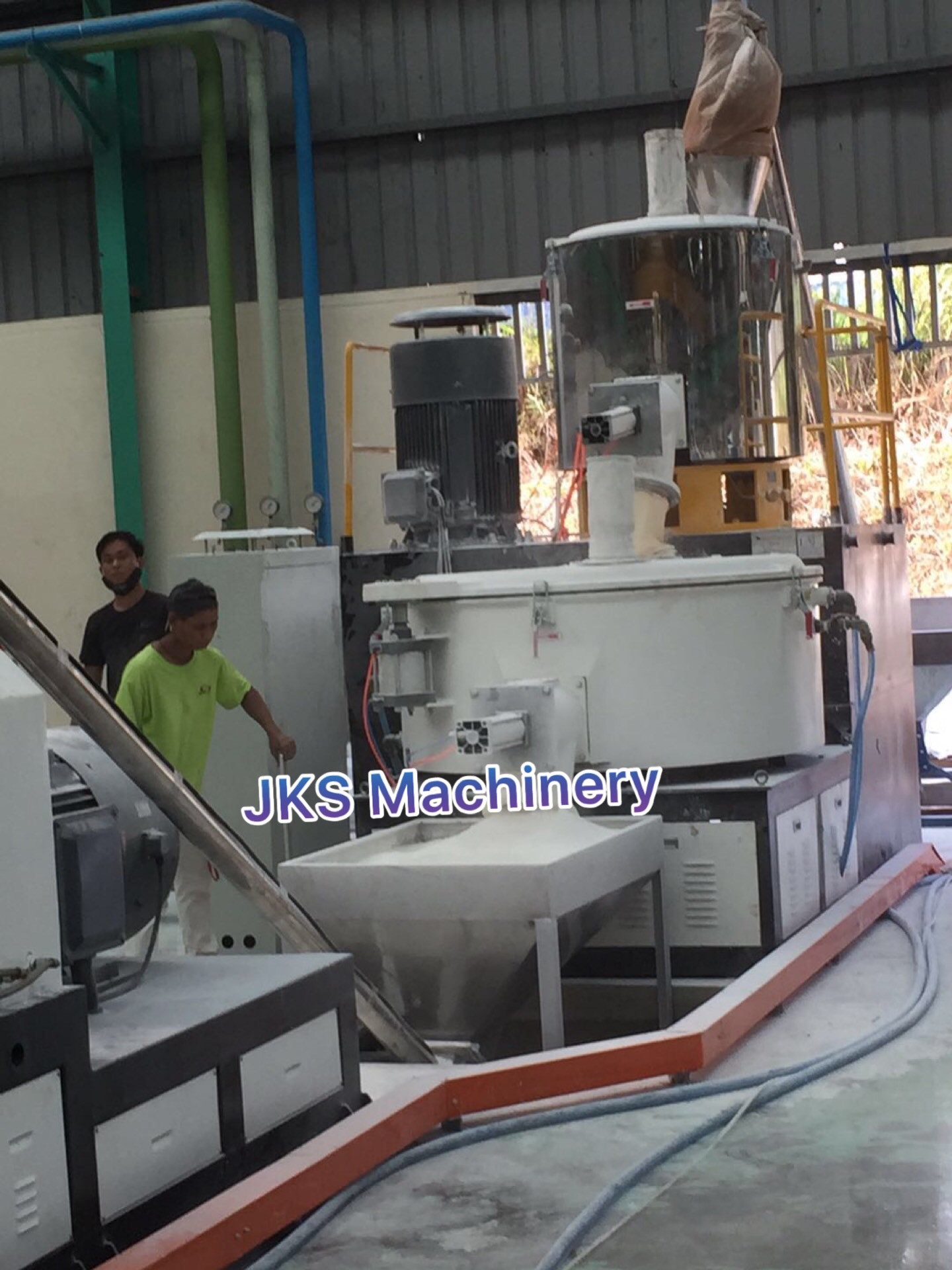
Mixing and cooling equipment at a customer site. SRL-Z mixing/cooling units and other auxiliary equipment should be itemised separately in the compliance file, since they carry their own electrical and guarding data.
Block 5 — EMC and Interference Declarations
Electromagnetic compatibility is usually declared, rarely verified on site, and frequently the section that holds up a conformity file. The standard set recorded for the JKS CE certificate includes EN 61000-3-2:2014, EN 61000-3-3:2013, EN 61000-6-1:2007 and EN 61000-6-3:2007/A1:2011/AC:2012. The file should list which of these apply to the supplied configuration, note any high-frequency or inverter-driven equipment added after certification, and record whether the adding of that equipment was assessed.
Block 6 — The Certificate Register and Validity Control
Keep a single register table listing every certificate, its number, issuing body, scope wording, standard set, issue date and expiry date. For the extrusion line scope, one entry reads: CE Certificate (Machinery, LVD and EMC Directives), number M.2021.206.C.64011, issued by UDEM International Certification Auditing Training Centre, scope covering plastic extrusion lines including SJSZ, SJ and SJP series models, issued 22 April 2021, with a stated expiry of 22 April 2026.
A register is only useful if it is live. Where an entry's stated expiry date has passed, the correct handling is to flag the item as status to be confirmed and request current documentation — not to present the historic certificate as active. Buyers should make this an explicit procurement condition: the certificate supplied at handover must be current at the date of shipment.
Step-by-Step Breakdown: Building the File in Eight Steps
The sequence below is written for a buyer's project engineer, but it maps equally to a supplier preparing a technical file for a customer. Each step produces one artefact that can be checked independently.
Step 1 — Write the destination requirement list first. Before looking at the machine, list what the country of installation actually requires for this machine type, confirming each item against the applicable regulation. Do not copy a requirement set from another market, and do not assume a CE mark satisfies a non-European authority.
Step 2 — Fix the model designation. Convert the commercial order into the manufacturer's model codes: SJ series single screw unit, SJSZ conical twin screw unit, and downstream equipment. This becomes the identity block and the anchor for every other section.
Step 3 — Itemise the full line, not just the extruder. A complete line typically includes the raw material mixer, crusher, pulverizer and pelletizing unit where recycling is in scope. SRL-Z mixing and cooling units are designated by capacity pairs (SRL-Z200/500, SRL-Z300/600, SRL-Z500/1000, SRL-Z1000/3000); crushers by SP400 and SP660; pulverizers by MF400, MF500 and MF600; strand cutting pelletizing lines by ST80, ST100, ST120 and ST150. Each has its own electrical load, guarding and noise characteristics, and each belongs in the file.
Step 4 — Collect declarations against named standards. For each safety, electrical and EMC item, record the standard and edition. Declarations without a standard reference cannot be reviewed.
Step 5 — Reconcile certificate scope with the ordered configuration. Compare the scope wording line by line against Step 2. Where the certificate covers a series and the order includes a co-extrusion or post-certification addition, record the difference explicitly and ask how it is addressed.
Step 6 — Verify the register dates. Check every issue and expiry date against the shipment date, and flag anything that will lapse before delivery or commissioning.
Step 7 — Add the export document set. Commercial invoice, packing list, bill of lading, certificate of origin, and the machine-level test record. On at least one turnkey project, full export documentation was included as part of the delivery package — a useful benchmark for what a complete set looks like.
Step 8 — Test before shipment and attach the record. JKS states 100% factory pre-assembly and testing before shipment, with third-party inspection available on request. Whatever the supplier's internal process, the buyer's file should contain the test record for the specific serial numbers shipped. Third-party inspection is the mechanism that converts a supplier statement into a verifiable one.
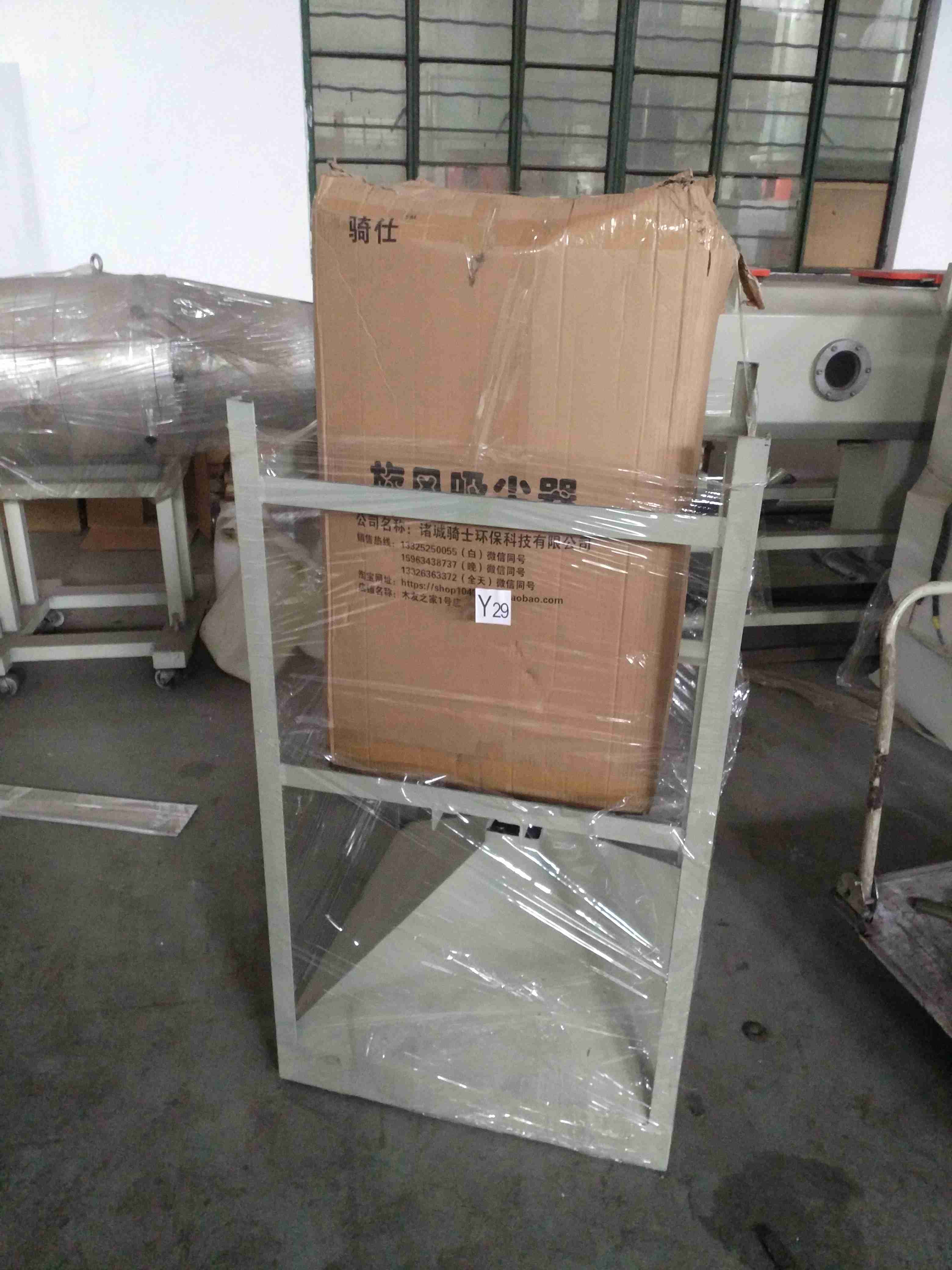
Equipment packed for export. Packing lists, weights and serial numbers should match the compliance file exactly — mismatches here are a common cause of clearance delay.
A Five-Tier Readiness Grading for Comparing Suppliers
Compliance quality is not binary. When shortlisting suppliers, grading each file on the same five tiers produces a comparison that can be defended in an internal approval meeting.
Tier 5 — Certificate only. A certificate exists but its scope, issue date and expiry date are not documented against the ordered model.
Tier 4 — Certificate plus scope match. Scope wording names the model series supplied, and dates are within validity at the planned shipment date.
Tier 3 — Declarations against named standards. Safety, electrical and EMC declarations each reference a standard and edition, including EN ISO 12100:2010, EN 1114-1:2011 and EN 60204-1:2018 where a CE claim is made.
Tier 2 — Configuration-level reconciliation. Co-extrusion units, control system choices and voltage/frequency customisation are explicitly reconciled against the certified configuration.
Tier 1 — Fully closed file with test record. Everything above, plus the serial-number-level factory test record, third-party inspection report where requested, and export documentation set.
The grading is a procurement tool, not a marketing claim. Its value is that it forces the reviewer to look at documents rather than at brochure language.
Use Cases: How the File Reads in Practice
Three installations show why application context changes what the file must contain.
PVC hollow wall panels — Vietnam. A complete PVC hollow wall panel extrusion line (product 4719, available in SJSZ51, SJSZ55, SJSZ65 and SJSZ80) was supplied to a plastic building materials manufacturer for construction and interior decoration panels. The line has been in stable operation for more than five years, with stable continuous production, consistent product quality and reliable performance. The project included a complete turnkey scope, on-site installation support and full export documentation. For a panel line, the file's centre of gravity sits in the downstream calibration and haul-off documentation and in guarding around the cutting section — not in the extruder alone.
SPC flooring — Malaysia. An SPC flooring manufacturer operates a complete SPC flooring extrusion line (product 4630, in configurations including SJSZ92/188 at 110 kW and SJSZ110/220 at 200 kW) that has run stably for more than ten years, with high-speed production, precise thickness control and low maintenance. On-site installation and training support were provided. A decade-long service life is the outcome the compliance file is meant to protect: documentation that supports maintenance, spare-part traceability and re-inspection over time.
SPC flooring — South Korea. A second SPC flooring installation has operated for more than eight years in South Korea, running 24/7 production with consistent quality and low maintenance rate, supported by after-sales service. Continuous operation raises the importance of the electrical and thermal sections of the file, because a 24/7 duty cycle is exactly the condition under which an undocumented modification becomes a production risk.
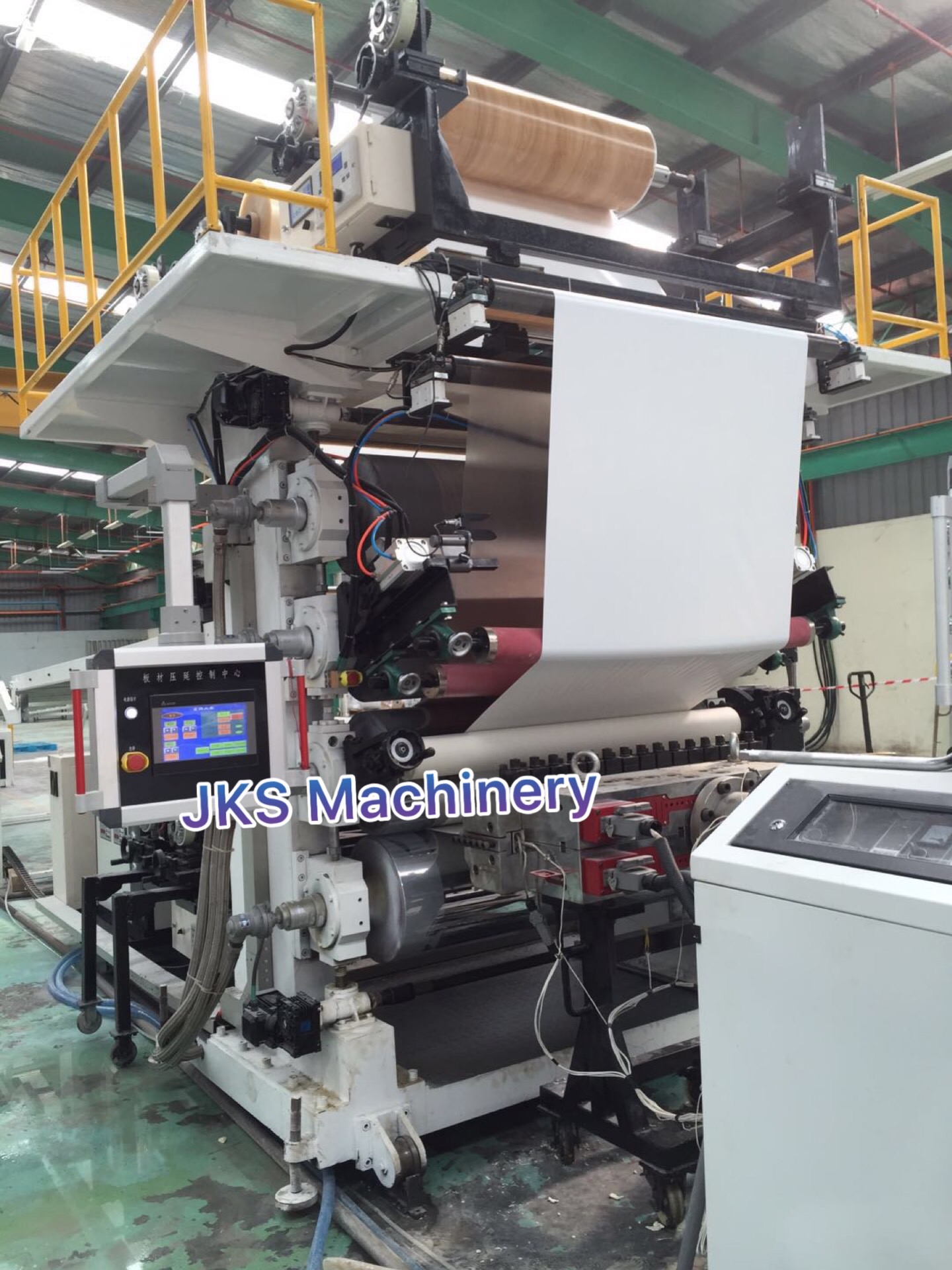
Calendering and thickness control equipment on an operating SPC line. Downstream units are frequently omitted from compliance files even though they carry guards, drives and sensors.
Comparison Table: Model Families and Their Documentation Checkpoints
The table below maps model families in the JKS range to their application and to the documentation item most often missing at review. Model designations and configurations are as stated in the manufacturer's product documentation.
| Model family | Line type and application | Key document checkpoint |
|---|---|---|
| SJ series single screw (SJ30, SJ45, SJ65, SJ90) | Profile, rod and small-section extrusion; solid plastic rod lines use SJ45 and SJ65 | Screw/barrel material declaration (38CrMoAlA nitrided alloy steel) and drive rating on the datasheet |
| SJSZ conical twin screw (SJSZ-45 to SJSZ-110) | PVC pipe, profile, panel, board and pelletizing lines | Certificate scope wording versus ordered series designation |
| SJSZ92/188 (110 kW), SJSZ110/220 (200 kW), SJP115/30 (90 kW), SJP135/30 (132 kW) | SPC flooring extrusion lines | Main motor power in the identity block and matching supply capacity confirmation |
| SJSZ80/156 (75 kW); SJSZ80/156 + 165 co-extrusion (75 + 37 kW); SJSZ92/188 (110 kW) | PVC and WPC foam board, imitation marble sheet, door and window profile | Co-extrusion configuration reconciliation against certified scope |
| SRL-Z mixing and cooling units (SRL-Z200/500, SRL-Z300/600, SRL-Z500/1000, SRL-Z1000/3000) | Dry-blend preparation for pipe, profile and panel lines | Itemised electrical load and guarding data — often omitted as an "auxiliary" |
| SP crushers (SP400, SP660) and MF pulverizers (MF400, MF500, MF600) | Waste plastic recycling and material size reduction | Guarding and noise declarations for rotating and size-reduction equipment |
| ST strand cutting pelletizing lines (ST80, ST100, ST120, ST150) | Waste plastic recycling pelletizing | Thermal and electrical section completeness at review |
Comparison Table: Standard References and What Must Be Confirmed
This second table separates what is documented from what still requires confirmation. The distinction is deliberate: a compliance file that records open items is more defensible than one that silently assumes them closed.
| Market context | Reference documented on file | What the buyer must confirm |
|---|---|---|
| European Union / CE scope | CE certificate M.2021.206.C.64011 (UDEM International Certification Auditing Training Centre), issued 22 April 2021; standards EN ISO 12100:2010, EN 1114-1:2011, EN 60204-1:2018, EN 61000-3-2:2014, EN 61000-3-3:2013, EN 61000-6-1:2007, EN 61000-6-3:2007/A1:2011/AC:2012 | Current status of the certificate, which carries a stated expiry of 22 April 2026, and whether the ordered configuration falls inside the stated scope |
| United States | ANSI/PLASTICS B151.7-2014 (R2021), applicable to extrusion machines in the plastics industry and requiring a documented risk assessment process | Which edition is claimed — public listings reference both B151.7-2013 and B151.7-2014 (R2021) — and whether the required risk assessment is supplied |
| Other destination markets | No single global rulebook applies; requirements vary by country and by machine type | The requirement set for that specific market and product application, confirmed locally before the order is finalised |
FAQ
What documents should a plastic extrusion machine compliance file contain?
At minimum: a machine identity block using the manufacturer's exact model designation, a material and construction declaration including the screw and barrel grade, electrical declarations covering design voltage and frequency, a safety and risk assessment record referencing the applicable standard and edition, EMC declarations, and a certificate register with issue and expiry dates. Configurations involving co-extrusion units, mixing and cooling units, crushers, pulverizers or pelletizing lines must be itemised individually, because each carries its own electrical and guarding data.
Can a line be built to a specific voltage, frequency and control standard for my market?
Yes — voltage and frequency are listed among the configurable items in the JKS customisation scope, together with extruder model, screw configuration, production line layout, control system and capacity adjustment. The important discipline is documentation: the designed voltage and frequency should appear in the identity block and on the electrical drawings, so that the compliance file describes the machine actually shipped rather than a default configuration. Production mode covers OEM, ODM and custom design service, with a monthly capacity of 30 units.
What drives the cost of a compliance-ready extrusion line?
Cost is driven by configuration rather than by documentation as a separate line item: extruder model and motor power, screw configuration, number of extruders on co-extrusion lines, control system choice, and the downstream equipment included. Adding third-party inspection, extended documentation packages or additional certification work for a specific market changes scope. Because these variables differ by project, budget should be built from a confirmed configuration list — including the auxiliary units — rather than from a headline machine price.
Can we validate material and product before the line ships?
Quality control on these lines covers 100% factory pre-assembly and testing before shipment, with third-party inspection available on request. The minimum order quantity is 1 unit, so a single-line validation project is feasible. Buyers should confirm what the factory test record will contain for their specific serial numbers and whether a third-party inspector may attend the pre-shipment test — both points belong in the compliance file as evidence, not as verbal assurances.
How long does a compliant line take, and when should documentation start?
The stated lead time is 40 work days. Documentation should not be sequenced after production: the destination requirement list and certificate scope check belong at order confirmation, because a scope mismatch discovered after shipment has no cheap fix. Supporting services include overseas installation guidance, on-site commissioning, operator training, remote technical support and a 12-month warranty, and these should be recorded in the file alongside the machine data.
If you are assembling a compliance file for a specific line — flooring, pipe, profile, sheet or pelletizing — the fastest next step is to send the destination market, required model and application to the JKS team at gordon@jksjx.com or via WhatsApp on +86 18601577228, and request the current certificate status, the model-level specification sheet and a sample test record for review before you commit.
Conclusion
Aligning model specs with regional requirements is a matching task, and matching fails when either side is undocumented. The model designation anchors the file; the material, electrical, safety and EMC declarations give it substance; the certificate register keeps it alive over time. A file built this way survives the three parties who will actually read it — the customs broker, the certification body and the buyer's own maintenance team.
Two habits separate a working file from a folder of PDFs. First, record open items as open: if a certificate's stated expiry date has passed or an edition reference is disputed, write that down and request confirmation rather than presenting last year's document as current. Second, reconcile at configuration level — a co-extrusion unit, a different control cabinet or a changed voltage is a changed machine, and the file should show that someone checked it.
Wuxi JKS Machinery Manufacturing Co. Ltd. builds custom extrusion lines from a 2,000 m² facility in Wuxi, Jiangsu, with a 20-person team, an R&D group of six engineers and stated annual output of 200 units; roughly half of output is exported, with markets including Southeast Asia, Russia, the Middle East, Europe, Central Asia, Africa and South America, and machines delivered to more than 35 countries. Full product scope and current documentation can be requested through www.extrudetec.com.
Next Step: Request the Documentation Package
Ask for the current certificate register, the model-level specification sheet for your target line, and the pre-shipment test record format. Contact: Gordon — gordon@jksjx.com, Tel +86 18651004566, WhatsApp +86 18601577228. Address: No. 81 Xixian Road, Fangqian Town, Wuxi City, Jiangsu Province, 214000, P.R. China.
Product brochure (public download): JKS WPC door project brochure (PDF).
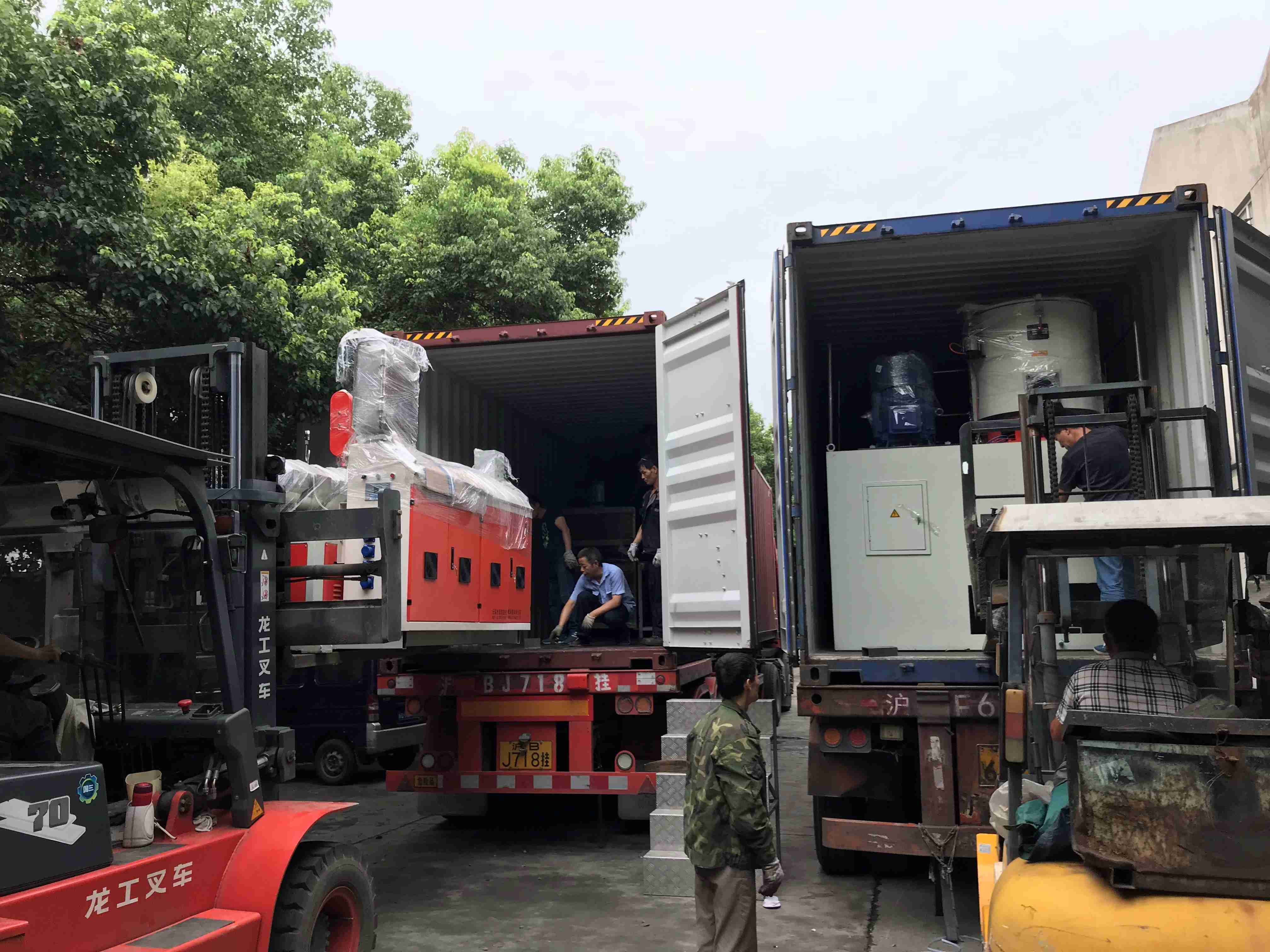
Container loading at dispatch. The packing list, serial numbers and compliance file should be reconciled before the container is sealed.
Have Questions or Need More Details?
Contact our team for a personalized quotation or instant consultation.
Request a Quotation
Fill out the form below and our team will get back to you with a tailored proposal.
WhatsApp Direct Chat
Prefer to chat in real-time? Message us on WhatsApp for instant assistance & quick answers.
- Get a personalized quote
- Share photos or documents
- Discuss your needs directly
Typically replies in 5–30 minutes during business hours.