
Plastic Extrusion Machine Compliance Guide: Certifications, Standards, and Regional Fit
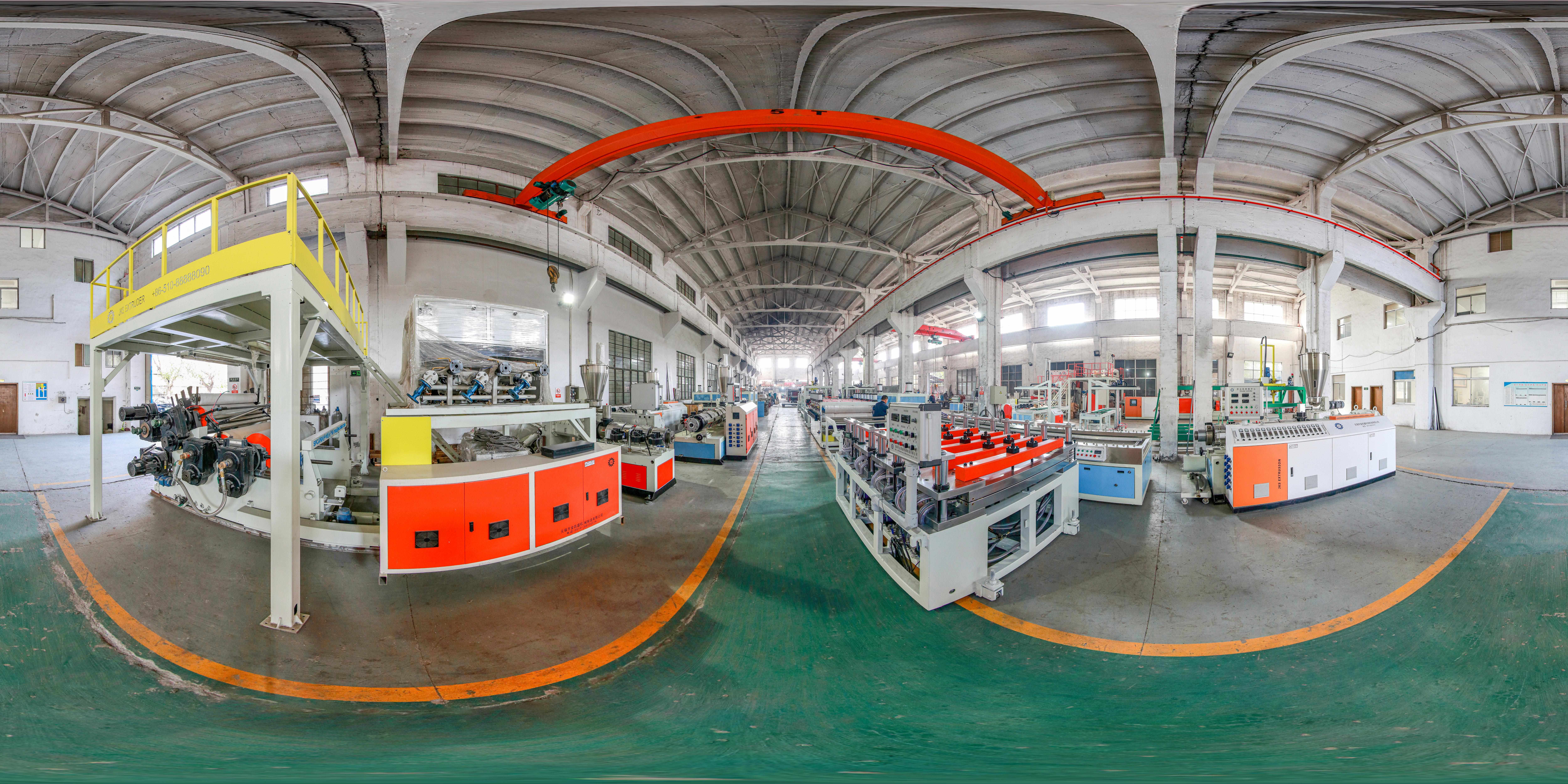
Sourcing a plastic extrusion machine usually starts with output, price, and delivery time. Compliance paperwork is checked last — often only when a bank, customs broker, or end customer asks for it. That is when the gaps appear: a certificate that names the supplier but not the machine, a declaration issued for a different model, or an assumption that one standard covers every destination market.
This guide is written for buyers at the research stage who need to interpret certification, standard, and regional requirement questions before committing to an order. It does not claim any specific certification for any specific machine. Instead, it shows what documentation to request, how to cross-check that documentation against verifiable equipment facts, and how to map a destination market's end-use requirement to the correct extrusion line.
Quick answer: Compliance readiness for a plastic extrusion machine rests on three layers — machine-level documentation that names the exact model and configuration, component and material traceability for parts such as the screw, barrel, mixing pot, and crushing chamber, and confirmation that the quoted line actually matches the destination market's end-use requirement. Requesting all three at quotation stage prevents mismatches later.
Problem Definition: Why Compliance Documents Often Don't Match the Machine
Compliance for an extrusion machine is not one document. It is at least three overlapping layers that arrive at different times from different parties.
- Company-level credentials — business license, export records, quality management documentation. These describe the supplier, not the equipment.
- Machine-level documentation — a declaration that names the specific model designation, configuration, and unit actually being shipped.
- Component and material traceability — evidence that parts such as the screw, barrel, mixing pot, mold, and crushing chamber are made from the materials stated in the quotation.
Buyers frequently receive the first layer and assume they also hold the second and third. That assumption is the single most common source of compliance problems in plastic extrusion machine sourcing, because the first layer is easy to issue for any customer and the second and third are specific to one order.
A handful of mismatch patterns repeat across markets:
- A document describes "a plastic extrusion machine" without stating whether the unit is an SJ45 single screw extruder or an SJSZ-80 conical twin screw extruder, so it cannot be tied to the quoted line.
- A certificate or declaration is issued for a different product family than the equipment being purchased.
- A material claim is made verbally at the trade fair or in the chat thread — for example, that the screw and barrel are 38CrMoAlA nitrided alloy steel — but appears on no document at all.
- An electrical configuration is assumed rather than confirmed, and the mismatch only surfaces at commissioning.
- The destination market's end-use requirement was never written down, so nobody checked whether the quoted line satisfies it.
There is also a regional dimension that buyers often underestimate. A line built to satisfy one market's end-use requirement may not satisfy another's. Municipal water supply pipe, gas pipeline, indoor plumbing, buried high voltage cable protection, and building drainage each place different expectations on the pipe being produced — and therefore on the line producing it. When the destination market and end application are not fixed at quotation stage, the compliance conversation has no anchor and tends to drift into generalities.
Industry Background: How Regional and End-Use Requirements Diverge
The scale of the category explains why this matters. The global plastic extrusion machinery market was valued at approximately USD 8.93 billion in 2024 and is projected to reach USD 11.58 billion by 2030, according to Grand View Research. In the same year, Asia Pacific held a 41.5% revenue share of that market, with China as the leading contributor in the region, and single-screw extrusion machines accounted for roughly 62.7% of the global market (Grand View Research).
Pipe production is a large slice of that demand. The global pipe extrusion lines market was valued at USD 4.8 billion in 2025, with PVC as the leading material segment at 38.6% of the market (Dataintelo). On the board and sheet side, the Stone Plastic Composite (SPC) flooring market is projected to grow from USD 6.4 billion in 2026 to USD 10.3 billion by 2033, at a 7.2% CAGR (Grand View Research). Each of these segments pulls a different documentation conversation, because each ends up in a different regulatory and end-use environment.
Regionally, the European Union is the clearest example of a market where documentation is requested as a matter of routine. CE marking is commonly required for machinery placed on the EU market, and quality management certification such as ISO 9001 is frequently requested alongside it. WPC door panel extrusion machinery is a typical case where buyers ask for both. Buyers should treat this as a prompt to request documents — not as a guarantee that a document already exists for the specific machine being quoted. The only reliable way to know is to ask, in writing, for the document that names your model.
Elsewhere, the binding constraint is often not a certificate at all but the end-application requirement. A buyer producing HDPE pipe for municipal water supply, a buyer producing MPP conduit for buried high voltage cable, and a buyer producing PPR pipe for indoor hot and cold water plumbing are all purchasing extrusion lines — but they are not asking the same compliance questions. The documentation has to follow the application, not the other way around.
Detailed Solution: A Documentation Request Framework
The practical answer is to treat documentation as a deliverable of the quotation, not an afterthought of the shipment. Five document categories cover most situations, and they work regardless of which market the line is headed to.
1. Machine-level declaration
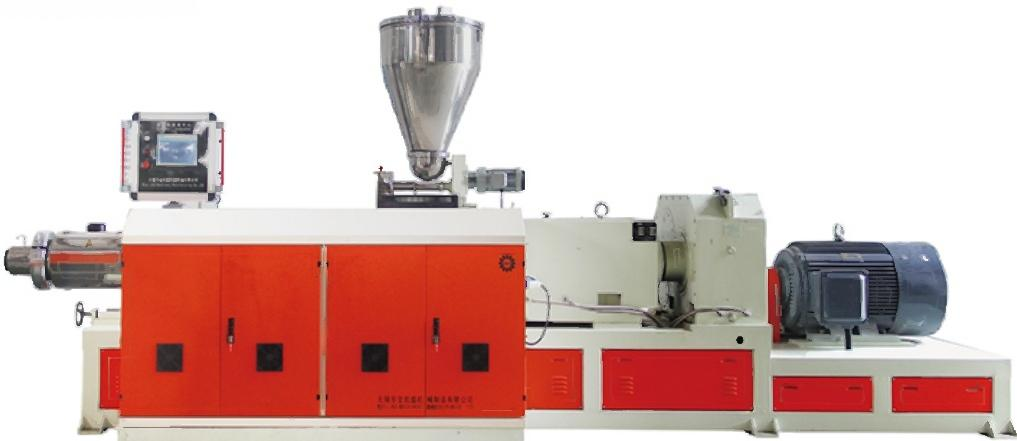
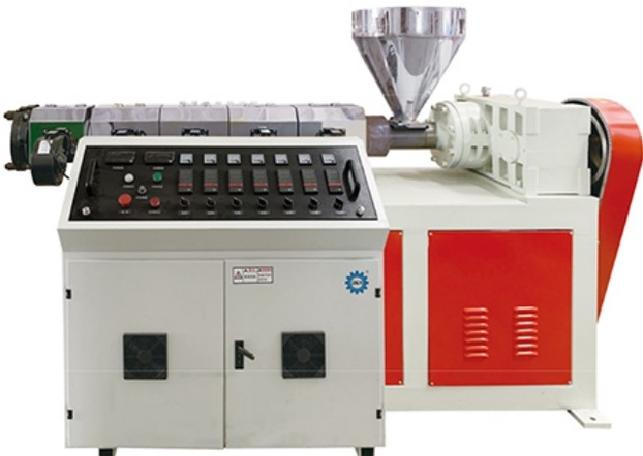
This document must state the exact model designation and configuration. In the JKS range, that means designations such as SJ30, SJ45, SJ65, and SJ90 for single screw extruders, and SJSZ-45, SJSZ-51, SJSZ-55, SJSZ-65, SJSZ-80, SJSZ-92, and SJSZ-110 for conical twin screw extruders. If a declaration uses a generic term such as "extrusion machine" instead of the actual designation, send it back and ask for a corrected version. A document that cannot be tied to a model cannot be tied to your order.
2. Component and material statement
This is where most ambiguous claims live. Ask specifically for the material of the screw and barrel, the machine frame, and the mold. Verifiable material facts in the JKS range include the following.
- Screw and barrel: 38CrMoAlA nitrided alloy steel, applied across the SJ series, the SJSZ series, and most complete production lines.
- Machine frame: Q235 carbon steel (Q235 carbon structural steel on larger lines).
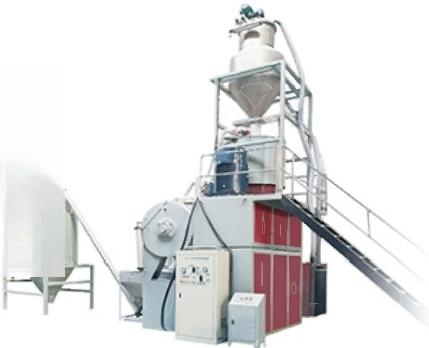
- Mixing pot: stainless steel on the SRL-Z mixing and cooling units.
- Crushing chamber and blades: wear-resistant steel on the SP400 and SP660 plastic crushers.
- Grinding chamber and rotor: wear-resistant steel on the MF400, MF500, and MF600 pulverizers.
- Molds: wear-resistant alloy die steel, forged alloy die steel, or high precision die steel depending on the line.
A useful test: if the material statement does not name a material, it is not a material statement. "High-quality steel" is not verifiable. "38CrMoAlA nitrided alloy steel" is.
3. Electrical and utility configuration sheet
Voltage, frequency, phase, and installed power should be stated explicitly. The PP Hollow Construction Formwork Extrusion Line, for example, is specified at 380V/50Hz, 3-phase with a suggested 315KVA transformer. Utility mismatches are a frequent and entirely avoidable cause of commissioning delay, particularly where the buyer's site supply differs from the supplier's default build standard.
4. Third-party inspection or test report, if one exists
Do not assume an inspection report exists for your unit. Ask whether one can be arranged, who performs it, and what it covers. If the answer is "not applicable," that is also useful information — it tells you where the verification burden sits.
5. Destination-market statement
This is a short written statement explaining how the quoted line matches the intended end-use. For a municipal water supply project it would confirm the pipe diameter range and wall thickness capability. For a buried power cable project it would confirm the cutting system and traction configuration. The statement does not need to be long; it needs to be specific enough that someone can disagree with it.
Once the packet arrives, the work is cross-checking. The document set must reference the same facts as the quotation — same model designation, same materials, same electrical specification, same end-use. Where a document and the quotation disagree, the disagreement is the finding.
Step-by-Step Breakdown: How to Verify Compliance Readiness
Step 1 — Fix the line type and model designation first. Decide whether the project needs a pipe line, a profile line, a sheet line, or a pelletizing line, then narrow to a model. Nothing downstream can be verified until the designation is fixed.
Step 2 — Request the five-category document packet against that exact designation. Send the request in writing and reference the model number in every line of the request.
Step 3 — Cross-check component materials line by line. Compare the material statement against the quotation for the screw and barrel, the frame, the mold, and any auxiliary units such as the mixer, crusher, or pulverizer.
Step 4 — Confirm electrical and utility configuration against your site. Compare the stated voltage, frequency, phase, and installed power with what your facility can supply, and check the transformer recommendation where one is given.
Step 5 — Map the destination market end-use requirement to the line. Write down the end application in one sentence and confirm the line's diameter range, output capacity, and forming configuration actually serve it.
Step 6 — Escalate unresolved gaps before the deposit, not after. Gaps are cheap to close at quotation stage and expensive to close at commissioning.
Use Cases: Mapping Regional End-Use Requirements to the Right Extrusion Line
The most reliable way to make the compliance conversation concrete is to start from the end application and work backwards to the line. The following mappings reflect the JKS product range and the end-use scenarios those lines are built for.
Municipal water supply and gas pipeline → HDPE water pipe extrusion line
The HDPE water pipe extrusion line is built for municipal water supply, gas pipeline, and farm irrigation pipe manufacturing. Model designations are PE110, PE315, PE630, PE1000, and PE1600, covering pipe diameter ranges from Φ20-110 mm up to Φ1000-1600 mm. Extrusion capacity runs from 150-400 kg/h on PE110 to 600-1500 kg/h on PE1600, with main motor power from 90 kW to 500 kW. Screw and barrel are 38CrMoAlA nitrided alloy steel and the mold is forged alloy die steel.
Documents to request: confirmation of the pipe diameter range, the selected extruder model (GS60/38, GS75/38, GS90/38, GS120/38 or GS150/38), main motor power, and mold material.
Indoor plumbing and domestic hot and cold water → PPR pipe extrusion line
The PPR pipe extrusion line is intended for indoor home decoration cold and hot water pipelines and residential plumbing pipe production. Models are PPR20-75 and PPR20-110. PPR20-75 uses a GS65/33 extruder with a GS50/33 auxiliary, an extrusion capacity of 80-160 kg/h and 37 kW main motor power; PPR20-110 uses a GS90/30 extruder with a GS55/33 auxiliary, 80-250 kg/h capacity and 75 kW main motor power. The mold is high precision die steel, and the screw and barrel are 38CrMoAlA nitrided alloy steel.
Buried high voltage power grid and underground cable protection → MPP & PE high voltage power pipe extrusion line
This line is designed for buried high voltage power grid construction and underground cable protection pipeline production. It processes MPP and PE, with optional PP, ABS, PEX and silicon core pipe. Model PEG63 produces pipes from φ20 to φ63 mm at a line speed of 0.3-4.5 m/min with 70 kW installed power; model PG160 produces φ75-φ160 mm pipe at 0.3-2 m/min with 125 kW installed power. The whole line uses AC frequency control, offers optional 2-claw, 3-claw, or 4-claw traction, and employs a chipless cutting system. Screw and barrel are 38CrMoAlA nitrided alloy steel, the extrusion mold is wear-resistant alloy die steel, and the machine frame is Q235 carbon structural steel.
Documents to request: confirmation of the cutting system, the selected traction configuration, installed power, and the diameter range matched to the cable protection standard in the destination market.
Building drainage, sewage, and cable protection → corrugated pipe extrusion line
The corrugated pipe extrusion line produces single-wall corrugated pipes for electric wire threading, automobile wiring sleeves, mechanical equipment threading, and construction drainage. Model designations are KSPG-20 (φ6-10 mm, 20 m/min), KSPG-32 (φ8-20 mm, 15 m/min), KSPG-63 (φ16-63 mm, 10 m/min), KS-75 (φ50-75 mm, 10 m/min) and KS-160 (φ90-160 mm, 5 m/min). The corrugation mold is wear-resistant alloy steel and the machine frame is Q235 carbon steel.
Building water supply and drainage → PVC water supply & drainage pipe extrusion line
The PVC water supply & drainage pipe extrusion line is designed for the building materials industry and building water supply and drainage scenarios. Model designations are PVC63 (Φ16-Φ63 mm), PVC250 (Φ90-Φ250 mm) and PVC630 (Φ315-Φ630 mm), all with a conical twin screw extruder configuration. The mold is precision casting die steel, and the screw and barrel are 38CrMoAlA nitrided alloy steel.
Urban pressurized water supply and chemical anti-corrosion pipelines → steel wire mesh reinforced composite pipe extrusion line
This line is designed for urban pressurized water supply, chemical industry anti-corrosion pipelines, and underground engineering pipes. Model designations run from GS/PE-160-H (φ50-160 mm, 480 kW installed, 312 kW actual consumption) through GS/PE-250-H, GS/PE-315-H, GS/PE-500-H to GS/PE-630-H (φ315-630 mm, 800 kW installed, 559 kW actual consumption). Screw and barrel are 38CrMoAlA nitrided alloy steel, the mold is refined wear-resistant die steel, and the frame is Q235 carbon steel.
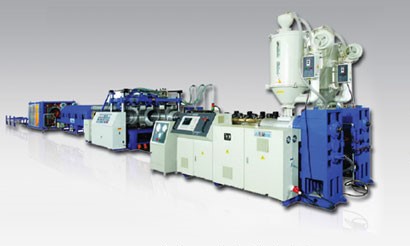
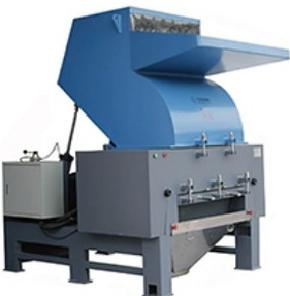
Comparison Table: Line, Model, End-Use and Documentation Dimensions
| Extrusion line | Model designations | Typical end-use | Component facts to verify | Documentation to request |
|---|---|---|---|---|
| HDPE water pipe extrusion line | PE110, PE315, PE630, PE1000, PE1600 | Municipal water supply, gas pipeline, farm irrigation | 38CrMoAlA nitrided alloy steel screw and barrel; forged alloy die steel mold | Diameter range, extruder model, main motor power, mold material |
| PPR pipe extrusion line | PPR20-75, PPR20-110 | Indoor cold and hot water plumbing | 38CrMoAlA nitrided alloy steel screw and barrel; high precision die steel mold | Extruder model (GS65/33 or GS90/30), capacity, motor power |
| MPP & PE high voltage power pipe extrusion line | PEG63, PG160 | Buried high voltage power grid, underground cable protection | 38CrMoAlA nitrided alloy steel screw and barrel; wear-resistant alloy die steel mold | Cutting system, traction configuration, installed power, diameter range |
| Corrugated pipe extrusion line | KSPG-20, KSPG-32, KSPG-63, KS-75, KS-160 | Drainage, sewage, cable protection | Wear-resistant alloy steel corrugation mold; Q235 carbon steel frame | Diameter range, haul-off speed, mold material |
| PVC water supply & drainage pipe extrusion line | PVC63, PVC250, PVC630 | Building water supply and drainage | 38CrMoAlA nitrided alloy steel screw and barrel; precision casting die steel mold | Diameter range, screw configuration type, mold material |
| Steel wire mesh reinforced composite pipe extrusion line | GS/PE-160-H, GS/PE-250-H, GS/PE-315-H, GS/PE-500-H, GS/PE-630-H | Urban pressurized water supply, chemical anti-corrosion pipeline | 38CrMoAlA nitrided alloy steel screw and barrel; refined wear-resistant die steel mold | Pipe range, installed capacity, actual power consumption |
Component Material Verification Reference
| Component | Verified material fact | Where it applies |
|---|---|---|
| Screw and barrel | 38CrMoAlA nitrided alloy steel | SJ series single screw extruders, SJSZ series conical twin screw extruders, and most complete production lines |
| Machine frame | Q235 carbon steel (Q235 carbon structural steel on larger lines) | Across the extruder and line range |
| Mixing pot | Stainless steel | SRL-Z200/500, SRL-Z300/600, SRL-Z500/1000, SRL-Z1000/3000 mixing and cooling units |
| Crushing chamber and blades | Wear-resistant steel | SP400 and SP660 plastic crushers |
| Grinding chamber and rotor | Wear-resistant steel | MF400, MF500 and MF600 plastic pulverizers |
| Molds | Wear-resistant alloy die steel, forged alloy die steel, or high precision die steel | Varies by line — confirm per model |
Both tables describe component and model facts as they appear in the equipment data used for this guide. They are not certification claims. Buyers should confirm the applicable document set for their own order and destination market.
Frequently Asked Questions
1. What compliance documents should I request from a plastic extrusion machine supplier?
Request five categories in writing at quotation stage: a machine-level declaration naming the exact model designation and configuration; a component and material statement covering the screw and barrel, machine frame, mold, and any auxiliaries; an electrical and utility configuration sheet stating voltage, frequency, phase, and installed power; any available third-party inspection or test report; and a destination-market statement explaining how the quoted line matches the intended end-use. A document that cannot be tied to a specific model designation cannot be tied to your order, so the model reference is the first thing to check.
2. Can a supplier document a custom model such as SJ45 or SJSZ-110?
Yes, provided the documentation follows the same designation logic as the machine. Single screw extruders in the SJ series are built in custom designations including SJ30, SJ45, SJ65, and SJ90, and conical twin screw extruders span SJSZ-45, SJSZ-51, SJSZ-55, SJSZ-65, SJSZ-80, SJSZ-92, and SJSZ-110. Because output and motor power differ substantially across that range — for example SJSZ-45 is rated at 15 kW and 70 kg/h while SJSZ-110 is rated at 200 kW and 1000 kg/h — the declaration should state the exact designation and its rated output, not just the series name.
3. Does compliance documentation affect the price of a plastic extrusion machine?
It can, but usually less than buyers expect. A machine-level declaration and a component material statement are administrative work; third-party inspection adds cost and lead time. The larger cost is the reverse case — paying for re-documentation, re-testing, or rework after shipment because the paperwork did not match the machine. Building the documentation request into the quotation stage is generally the cheaper path, and it also makes the price comparison between suppliers more meaningful.
4. Can I verify material claims before shipment?
Yes. Ask for the material statement to list the specific facts rather than adjectives: screw and barrel in 38CrMoAlA nitrided alloy steel; machine frame in Q235 carbon steel; mixing pot in stainless steel on SRL-Z units; crushing chamber and blades in wear-resistant steel on SP400 and SP660 crushers; grinding chamber and rotor in wear-resistant steel on MF400, MF500, and MF600 pulverizers. Where a third-party inspection can be arranged, the same list becomes the inspection checklist, which is more useful than a general quality statement.
5. How early should I start the compliance documentation process?
At quotation stage, not after the deposit. The sequence that works is: fix the line type and model designation, request the document packet against that designation, cross-check materials and electrical configuration, map the end-use requirement for the destination market, and close any gaps before payment. Starting early matters most for lines destined for markets that routinely request machinery documentation at import. If you would like a starting point, you can review the Wuxi JKS Machinery product brochure or send your model and destination market to the contact below and request a documentation packet matched to that configuration.
Conclusion
Compliance for a plastic extrusion machine is not a single certificate. It is three layers working together: documentation that names the exact model and configuration, evidence that components are made from the stated materials, and a clear match between the line and the destination market's end-use requirement. The model designation is the hinge — SJ30, SJ45, SJ65, and SJ90 on the single screw side, SJSZ-45 through SJSZ-110 on the conical twin screw side, and the corresponding pipe line designations from PE110 and PE1600 through PPR20-75, PEG63, KSPG-63, PVC63, and the GS/PE series. Once the designation is fixed, everything else can be requested, checked, and confirmed.
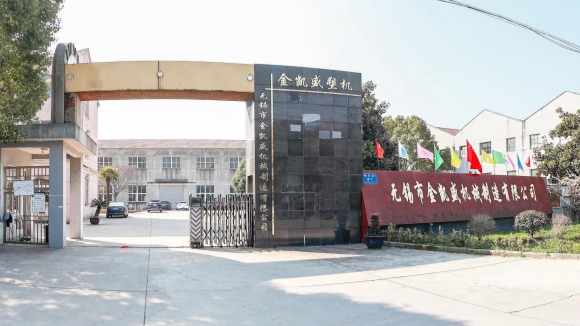
Wuxi JKS Machinery Manufacturing Co., Ltd. was founded in 2013 and operates a 2,000 m² manufacturing facility in Wuxi, Jiangsu Province, producing approximately 200 units per year with a six-engineer R&D team. The company builds custom full-set plastic extrusion production lines and exports to more than 35 countries across Southeast Asia, Russia, the Middle East, Europe, Central Asia, Africa, and South America.
Request a documentation packet matched to your model
Send your intended model designation and destination market, and JKS will return a configuration-matched document set covering the machine declaration, component materials, electrical configuration, and end-use mapping.
Contact: Gordon | Email: gordon@jksjx.com | Tel / WhatsApp: +86 18651004566 | WhatsApp: +86 18601577228
Wuxi JKS Machinery Manufacturing Co. Ltd. — No. 81 Xixian Road, Fangqian Town, Wuxi City, Jiangsu Province, 214000, P.R. China | Website: www.extrudetec.com
Product brochure (PDF): Download the JKS machinery and WPC door project brochure