
Plastic Strand Cutting vs. PVC Hot-Cut Pelletizing Line: Choosing the Right Route
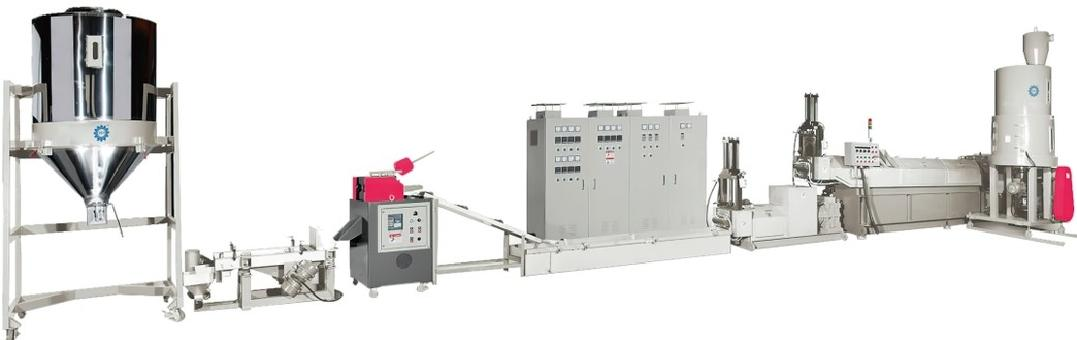
Pelletizing is the step where polymer stops being scrap, powder or compound and becomes a tradable raw material. Two routes do that job, and they are not interchangeable. The Plastic Strand Cutting Pelletizing Line, offered in ST80, ST100, ST120 and ST150 models, extrudes polymer into strands, cools them in water and cuts them into uniform pellets; it is specified for PE, PP, ABS, PS, HIPS and PC and is used in plastic compounding, masterbatch production and plastic waste recycling. The PVC Hot-cut Pelletizing Line, offered in SJSZ55, SJSZ65, SJSZ80 and SJSZ92 models, runs on a conical twin-screw extruder and cuts pellets directly at the die face; it is specified for PVC powder and PVC scraps and is used in PVC compounding, plastic scrap recycling and masterbatch and PVC pellet production.
This is a head-to-head decision, not a ranking. Both lines are built on the same screw and barrel material, 38CrMoAlA nitrided alloy steel, and the same Q235 carbon steel machine frame. The difference sits in the process route, the material each line accepts, and the equipment around the extruder. The sections below compare the two families model by model, then provide a step-by-step selection sequence, a comparison table and the questions buyers ask most often.
Problem Definition: When Two Pelletizing Routes Look Identical on a Spec Sheet
Two pelletizing routes can look identical inside a quotation. A strand cutting line and a hot-cut line are both quoted in kg/h, both list a main motor in kW, and both arrive as a complete line with cooling, cutting and finished-pellet handling. The overlap is real: the ST120 strand cutting line is rated 250–400 kg/h, while the SJSZ80 hot-cut line is rated 350–400 kg/h. A buyer comparing capacity alone will not find a clear winner.
What separates them is physical, not commercial. Strand cutting requires the melt to be drawn into strands and solidified in a water bath before cutting, which matches polyolefins and engineering plastics and compounding work where pellet uniformity is the quality measure. Hot-cut pelletizing cuts at the die face while the polymer is still hot, then cools and grades the pellets, which suits a PVC formulation carried on a conical twin-screw extruder. Those two physical facts drive everything downstream of them: the extruder type, the upstream mixing equipment, the pellet cooling equipment and the operating environment.
In practice the deciding questions are narrow. Which polymer is on the line? How much filler does the formulation carry? What pellet form does the next process accept? And what must happen upstream before the extruder — mixing, crushing or pulverizing? Answer those four, and the route usually selects itself.
Industry Background: Why Pelletizing Capacity Is a Live Question in 2026
The pelletizing decision sits inside a growing equipment market. The global plastic extrusion machine market was estimated at 7.901 billion USD in 2025 and is projected to reach 12.87 billion USD by 2035 (Market Research Future, September 2026). Supply is concentrated: in 2024 China was the leading exporter of rubber and plastic working machinery under HS 8477 at 8.55 billion USD, ahead of Germany at 6.11 billion USD and Italy at 2.61 billion USD (Observatory of Economic Complexity, based on UN Comtrade data). For most buyers that means the realistic comparison is between Chinese-built lines, where specification clarity carries more weight than brand claims.
Downstream demand points the same way. The global SPC flooring market was projected to grow from 6.4 billion USD in 2026 to 10.3 billion USD by 2033 (Grand View Research, June 2026). SPC flooring production consumes PVC compound, and PVC compound production is exactly where a hot-cut pelletizing line is used, so a flooring trend pulls through to compounding and pelletizing capacity upstream. On the polyolefin side, recycling and masterbatch demand keeps pulling on strand cutting lines.
Compliance is the third background factor. ANSI/PLASTICS B151.7 is the safety standard that applies to extrusion machines used in the plastics industry, and it requires a documented risk assessment where machinery deviates from the standard. Public references do not agree on the edition: the PLASTICS Industry Association standards page lists ANSI/PLASTICS B151.7-2013, while the ANSI webstore lists ANSI/PLASTICS B151.7-2014 (R2021). Buyers should confirm the currently applicable edition with the supplier in writing rather than assuming either one, and should record it in the purchase documentation.
Detailed Solution: How Each Pelletizing Line Is Built
The Plastic Strand Cutting Pelletizing Line (ST80, ST100, ST120, ST150)
Strand cutting is a water-cooled process. Polymer is plasticized in the extruder, pushed through a strand die, drawn through a water bath to solidify, and then cut into uniform pellets. JKS supplies this route in two configurations: a single-stage water strand pelletizing line, and a two-stage waste plastic recycling pelletizing line. Both configurations use an L/D ratio of 35:1.
- ST80 — 55 kW main motor, 70–160 kg/h
- ST100 — 75 kW main motor, 170–280 kg/h
- ST120 — 90 kW main motor, 250–400 kg/h
- ST150 — 110 kW main motor, 350–650 kg/h
Raw material coverage is PE, PP, ABS, PS, HIPS and PC. The line suits virgin compounding as well as waste plastic recycling. Screw and barrel are 38CrMoAlA nitrided alloy steel, the pelletizing die is wear-resistant alloy steel, and the machine frame is Q235 carbon steel — the same materials used on the hot-cut line.
Two operating realities belong in the buying decision. First, this route is installed in an indoor factory with continuous operation, and the strand cutting and water handling stages form a high-noise area, so noise control and layout planning are project items rather than afterthoughts. Second, the line is normally quoted with the equipment that finishes the job: extruders, water cooling tanks, dryers and packaging machines. Uniform pellet size, low energy consumption and high efficiency are the stated performance priorities.
The PVC Hot-Cut Pelletizing Line (SJSZ55, SJSZ65, SJSZ80, SJSZ92)
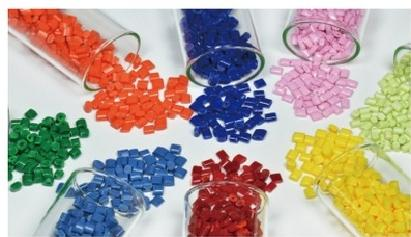
Hot-cut pelletizing cuts at the die. PVC material is plasticized in a conical twin-screw extruder and cut into pellets directly at the die face while the melt is hot; the pellets then pass through a cooling and grading system. JKS supplies the line in four models:
- SJSZ55 — 22 kW, 100–150 kg/h
- SJSZ65 — 37 kW, 200–250 kg/h
- SJSZ80 — 55 kW, 350–400 kg/h
- SJSZ92 — 110 kW, 650–800 kg/h
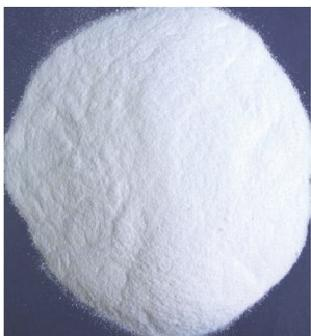
Raw material is PVC powder or PVC scraps. Stated features are hot die-face cutting, uniform pellets, and a cooling and grading system. The line is suited to PVC compounding, plastic scrap recycling, and masterbatch and PVC pellet production, and it handles both soft and hard PVC. Supporting equipment includes cooling fans, cyclone separators and storage bins.
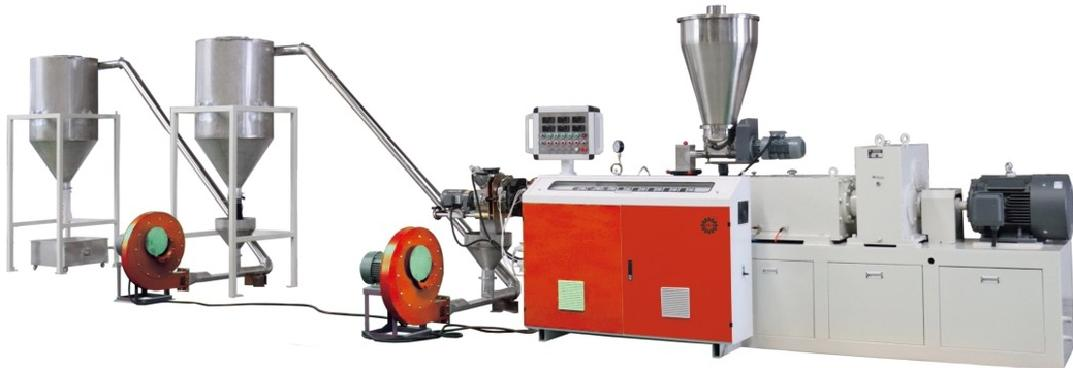
The extruder choice matters more here than on the strand route. Conical twin-screw extruders are used for direct extrusion of PVC powder and are described by their uniform plasticizing and mixing, low shearing, high productivity, stable quality and long service life. For PVC formulations carrying high filler content, that combination of low shear and high mixing is the reason the hot-cut route is chosen instead of a strand route. Conical twin-screw extruders are available from JKS across the SJSZ-45 to SJSZ-110 range, so a buyer can step up or down inside the same platform.
What Both Lines Share: the 38CrMoAlA Nitrided Screw and Barrel
Mechanically the two pelletizing lines are closer than the process comparison suggests. Both use a 38CrMoAlA nitrided alloy steel screw and barrel, a wear-resistant alloy steel pelletizing die, and a Q235 carbon steel machine frame. Wear resistance and screw life therefore do not differentiate the two routes at the material level — what changes is the screw geometry and the cutting mechanism, which follow from the polymer and the process rather than from the metallurgy.
That is useful in a negotiation. A supplier building both routes on the same component platform is not making a materials concession on the lower-cost line, and spare-part conversations can be held at component level — screw and barrel, pelletizing die, frame — with the same material expectations on either side of the comparison.
What Changes Around the Extruder: Upstream Preparation and Finishing
Most of the practical difference between the two routes appears before the polymer reaches the die.
On the strand cutting side, waste plastic has to be reduced in size before extrusion. JKS supplies the SP400 (15 kW, 300–400 kg/h) and SP660 (22 kW, 600–700 kg/h) plastic crushers for that step, cutting plastic scraps such as PVC, PE and PP pipes, profiles and sheets into small pieces for recycling. Where a plant needs powder rather than flake, the MF400, MF500 and MF600 pulverizers grind plastic scraps to 40–80 mesh fineness at 30 kW / 200 kg/h, 37 kW / 300–400 kg/h and 55 kW / 400–500 kg/h respectively.
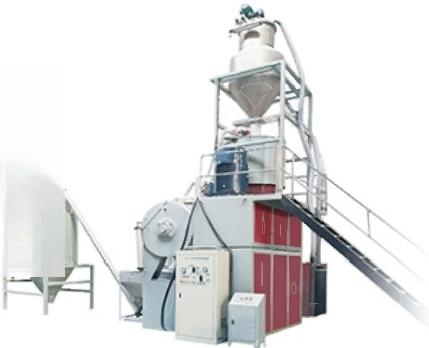
On the PVC side the upstream step is mixing rather than size reduction. SRL-Z series PVC mixing and cooling units combine PVC resin with stabilizers, plasticizers and fillers at high speed and then cool the compound to prevent agglomeration, running an automatic hot mixing plus cold mixing cycle with a mixing time of 8–10 minutes per pot and a cooling time of 6–8 minutes per pot. The range runs from SRL-Z200/500 (37/7.5 kW, 300–400 kg/h) through SRL-Z300/600 (55/11 kW, 450–600 kg/h) and SRL-Z500/1000 (75/15 kW, 800–1000 kg/h) to SRL-Z1000/3000 (160/22 kW, 1600–2000 kg/h). These units are used across PVC pipe, profile, sheet and pelletizing lines, so a PVC extrusion plant often already owns one — and it becomes the feed preparation stage for a hot-cut pelletizing line.
Step-by-Step Breakdown: An Eight-Step Selection Sequence
Work through these eight steps in order. Several of them can eliminate a route before you ever reach the quotation stage.
- Name the polymer. Strand cutting is specified for PE, PP, ABS, PS, HIPS and PC. Hot-cut pelletizing is specified for PVC powder and PVC scraps. If the answer is PVC, the strand route is not the reference design; if the answer is a polyolefin or an engineering plastic, the hot-cut route is not.
- Check the filler and formulation load. PVC formulations carrying high calcium carbonate content are run on conical twin-screw extruders because of uniform plasticizing and mixing at low shear. That is a hot-cut route condition, and it also determines whether an SRL-Z mixing and cooling unit must precede the extruder.
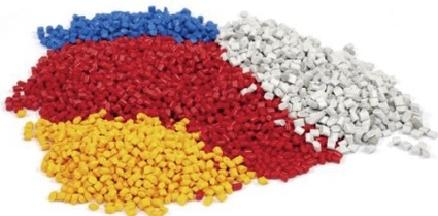
- Decide the pellet form the next process accepts. Strand cutting produces pellets from cooled, solidified strands. Hot-cut cutting produces pellets cut at the die face and then cooled and graded, and it handles both soft and hard PVC. Downstream feeding, drying and conveying should be selected against the pellet the line actually makes.
- Match model to target output. Strand side: ST80 70–160 kg/h, ST100 170–280 kg/h, ST120 250–400 kg/h, ST150 350–650 kg/h. Hot-cut side: SJSZ55 100–150 kg/h, SJSZ65 200–250 kg/h, SJSZ80 350–400 kg/h, SJSZ92 650–800 kg/h. Sized against the material mix, not the nameplate figure alone.
- Confirm installed power and electrical supply. Main motor ratings run from 55 kW (ST80) to 110 kW (ST150) on the strand side, and from 22 kW (SJSZ55) to 110 kW (SJSZ92) on the hot-cut side. Transformer capacity, voltage and frequency should be fixed before ordering.
- Plan upstream preparation. Size reduction — crusher or pulverizer — for scrap-fed strand lines; mixing and cooling for PVC compound feeding a hot-cut line.
- Plan cooling, drying and finished-pellet handling. Water cooling tanks, dryers and packaging machines on the strand route; cooling fans, cyclone separators and storage bins on the hot-cut route. Confirm noise and dust handling in the building layout as well, since the strand route runs as a high-noise area.
- Verify build, testing and customization scope. Every JKS line is 100% pre-assembled and tested in the factory before shipment, and third-party inspection is available on request. Customization covers extruder model, screw configuration, production line layout, voltage and frequency, control system and capacity adjustment. Standard lead time is 40 work days and the minimum order quantity is 1 unit.
Use Cases: Where Each Route Earns Its Place
1. Post-industrial PE, PP and engineering plastic scrap
A recycler taking in film, pipe or sheet scrap runs the two-stage waste plastic recycling pelletizing configuration of the strand cutting line. Scrap is reduced with a crusher, plasticized and extruded into strands, water-cooled and cut into uniform pellets. Materials covered are PE, PP, ABS, PS, HIPS and PC, and the stated priorities are uniform pellet size, low energy consumption and high efficiency.
2. Virgin compounding and masterbatch production
A compounder working with virgin polymer uses the single-stage water strand pelletizing configuration. The L/D 35:1 extruder keeps output predictable, and using the same 38CrMoAlA nitrided screw and barrel found on other JKS extrusion lines keeps the wear-part platform consistent across the plant.
3. PVC compound for pipe, profile and sheet plants
An extrusion plant that wants to make its own PVC compound rather than buy it pairs an SRL-Z mixing and cooling unit with a hot-cut pelletizing line. The mixing unit handles resin, stabilizer, plasticizer and filler; the hot-cut line plasticizes the compound on a conical twin-screw extruder and cuts pellets at the die face. Model choice follows output, from SJSZ55 at 100–150 kg/h for smaller runs up to SJSZ92 at 650–800 kg/h.
4. Mixed PVC scrap, soft and hard
PVC scrap arrives in inconsistent form. The hot-cut route is specified to handle both soft and hard PVC, with a cooling and grading system plus cyclone separation producing a manageable pellet stream for reuse in compounding.
Comparison Table: Strand Cutting vs. PVC Hot-Cut Pelletizing
| Decision dimension | Plastic Strand Cutting Pelletizing Line (ST80–ST150) | PVC Hot-Cut Pelletizing Line (SJSZ55–SJSZ92) |
|---|---|---|
| Specified raw material | PE / PP / ABS / PS / HIPS / PC | PVC powder / PVC scraps |
| Extruder platform | Strand pelletizing line: single-stage water strand type, and two-stage waste plastic recycling type; L/D 35:1 | Conical twin-screw extruder |
| Model range | ST80, ST100, ST120, ST150 | SJSZ55, SJSZ65, SJSZ80, SJSZ92 |
| Power and output | ST80 55 kW / 70–160 kg/h; ST100 75 kW / 170–280 kg/h; ST120 90 kW / 250–400 kg/h; ST150 110 kW / 350–650 kg/h | SJSZ55 22 kW / 100–150 kg/h; SJSZ65 37 kW / 200–250 kg/h; SJSZ80 55 kW / 350–400 kg/h; SJSZ92 110 kW / 650–800 kg/h |
| Cutting principle | Strands cooled in water, then cut | Hot die-face cutting at the die |
| Cooling and finishing | Water cooling; supporting equipment includes water cooling tanks, dryers and packaging machines | Cooling and grading system; supporting equipment includes cooling fans, cyclone separators and storage bins |
| Screw and barrel material | 38CrMoAlA nitrided alloy steel | 38CrMoAlA nitrided alloy steel |
| Pelletizing die | Wear-resistant alloy steel | Wear-resistant alloy steel |
| Machine frame | Q235 carbon steel | Q235 carbon steel |
| Stated application | Plastic compounding, masterbatch production, plastic waste recycling | PVC compounding, plastic scrap recycling, masterbatch and PVC pellet production |
| Operating environment | Indoor factory, continuous operation, high noise | Indoor factory, high temperature, continuous operation |
| Typical upstream equipment | Crusher (SP400, SP660) and pulverizer (MF400, MF500, MF600) where scrap is the feed | SRL-Z PVC mixing and cooling unit for compound preparation |
| Best fit when | The feed is PE, PP or an engineering plastic, and pellet uniformity from cooled strands suits the downstream process | The feed is PVC powder or PVC scrap, including high-filler formulations and mixed soft and hard PVC |
FAQ: Strand Cutting and Hot-Cut Pelletizing Decisions
What safety or compliance standard applies to a plastic extrusion or pelletizing line?
ANSI/PLASTICS B151.7 applies to extrusion machines used in the plastics industry and requires that extrusion machinery suppliers and users follow a documented risk assessment process in the manufacture, care and use of the machinery, including where deviations occur. Public references do not agree on the edition: the PLASTICS Industry Association standards page lists ANSI/PLASTICS B151.7-2013, while the ANSI webstore lists ANSI/PLASTICS B151.7-2014 (R2021). Buyers should confirm the currently applicable edition in writing with the supplier and record it in the purchase documentation. Where the line is shipped outside the United States, confirm the applicable local conformity requirements separately, because the standard above is a U.S. reference point rather than a global one.
Can one pelletizing line run both PVC and PE or PP?
The two lines covered here are specified for different materials. The Plastic Strand Cutting Pelletizing Line (ST80, ST100, ST120, ST150) is specified for PE, PP, ABS, PS, HIPS and PC and is used for plastic compounding, masterbatch production and plastic waste recycling. The PVC Hot-cut Pelletizing Line (SJSZ55, SJSZ65, SJSZ80, SJSZ92) is specified for PVC powder and PVC scraps and uses a conical twin-screw extruder with die-face cutting. JKS offers OEM, ODM and custom design services, and the customization scope covers extruder model, screw configuration, production line layout, voltage and frequency, control system and capacity adjustment, so a mixed-material or dual-purpose requirement should be raised with the supplier during the design stage rather than assumed from the standard specification.
What drives the cost difference between the two pelletizing routes?
Two specification variables can be compared directly: model size and installed power. Strand cutting main motors run from 55 kW (ST80) to 110 kW (ST150); hot-cut main motors run from 22 kW (SJSZ55) to 110 kW (SJSZ92). Beyond the extruder, the cost structure follows line scope. The strand route is quoted with water cooling tanks, dryers and packaging machines; the hot-cut route is quoted with cooling fans, cyclone separators and storage bins. Upstream scope also changes the total: a crusher or pulverizer may be needed where scrap is the feed, while an SRL-Z mixing and cooling unit may be needed for PVC compound preparation. Compare a complete line scope against a complete line scope rather than a single machine price against a single machine price.
Can material be validated before placing an order?
The minimum order quantity is 1 unit, and every line is 100% pre-assembled and tested in the JKS factory before shipment, with third-party inspection available on request. JKS provides personalized design, free factory installation, technical training and formulation service according to the client raw material and production demand, which means the material and formulation question can be addressed during the design stage rather than after delivery. To discuss a specific polymer, filler level or pellet requirement, contact gordon@jksjx.com or review the JKS product catalog before requesting a line quotation.
What is the lead time, and what support comes after delivery?
Standard lead time is 40 work days, based on a monthly capacity of 30 units. After delivery, JKS provides overseas installation guidance, on-site commissioning, operator training, remote technical support and a 12-month warranty. The company was founded in 2013, operates a 2,000 m² workshop with 20 employees, a 6-engineer R&D team and annual output of 200 units, and exports to more than 35 countries across Southeast Asia, Russia, the Middle East, Europe, Central Asia, Africa and South America. Where a buyer needs a quotation, sample discussion or distributor information, the fastest route is a direct inquiry to the sales contact listed at the end of this article.
Conclusion: Match the Route to the Material, Not the Brochure
Neither pelletizing line is universally better, and any comparison that ends that way should be treated with caution. The Plastic Strand Cutting Pelletizing Line in ST80, ST100, ST120 and ST150 models is a water-cooled strand route built for PE, PP, ABS, PS, HIPS and PC — compounding, masterbatch and waste plastic recycling. The PVC Hot-cut Pelletizing Line in SJSZ55, SJSZ65, SJSZ80 and SJSZ92 models is a die-face cutting route built for PVC powder and PVC scraps on a conical twin-screw extruder — PVC compounding, PVC scrap recycling and PVC pellet production. Both share the same 38CrMoAlA nitrided alloy steel screw and barrel, the same wear-resistant alloy steel pelletizing die and the same Q235 carbon steel frame.
The practical decision rule is short. Start with the polymer. Add the filler level. Confirm the pellet form the next process accepts. Size the model against the real material mix. Then fix installed power, upstream preparation and finished-pellet handling before signing. Buyers who follow that order usually find the route has already been decided by the material, and the quotation simply confirms it.
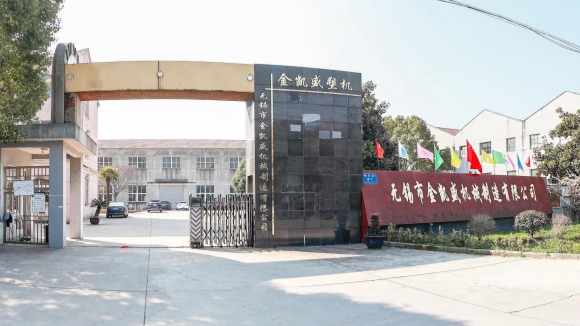
Wuxi JKS Machinery Manufacturing Co., Ltd. is a Chinese manufacturer of custom plastic extrusion machinery and complete turnkey production lines, founded in 2013 in Wuxi, Jiangsu Province. Its portfolio covers SPC flooring, PVC and WPC sheet and board, PVC, HDPE and composite pipe, WPC and PVC profile, solid plastic rod, and waste plastic pelletizing lines, plus standalone single and twin screw extruders and supporting auxiliary equipment such as mixers, crushers and pulverizers. Installed lines in Vietnam, Malaysia and Korea have remained in stable operation for 5 to 10+ years.
Next Step: Line Scope Quotation or Material Discussion
If you are deciding between a strand cutting line and a hot-cut pelletizing line, the fastest way to narrow the choice is to send the polymer, the filler level and the target kg/h. JKS can respond with a model recommendation and a complete line scope.
- Catalog download: JKS product catalog (PDF)
- Website: www.extrudetec.com
- Email: gordon@jksjx.com
- Tel: 86 18651004566
- WhatsApp: 86 18601577228
- Address: No. 81 Xixian Road, Fangqian Town, Wuxi City, Jiangsu Province, 214000, P.R. China
Sources referenced in this article: Market Research Future, Plastic Extrusion Machine Market Size, Share & Forecast 2035 (September 2026); Observatory of Economic Complexity, Rubberworking Machinery HS 8477 trade data based on UN Comtrade (2024); Grand View Research, Stone Plastic Composite Flooring Market Report 2026–2033 (June 2026); ANSI/PLASTICS B151.7 safety requirements for extrusion machines (ANSI webstore listing, and PLASTICS Industry Association standards listing). Product specifications are the manufacturer-published figures for JKS pelletizing lines and auxiliary equipment.