
Screw and Barrel Parameters in Plastic Extrusion Machines: A Technical Guide for PVC, PE, and PP
Buyer-stage reference for research and evaluation · Parameter set checked against JKS SJ single screw and SJSZ conical twin screw lines
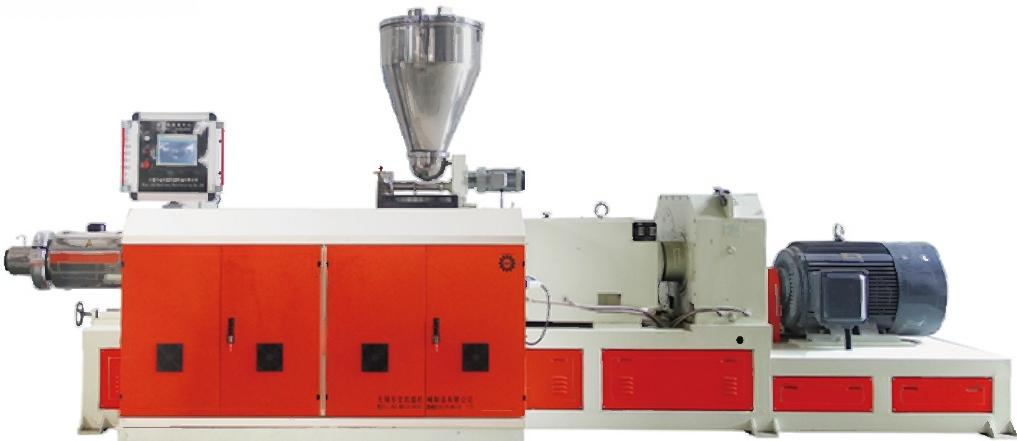
JKS SJSZ conical twin screw extruder — the screw diameter pair, not the model number alone, sets PVC output.
Four screw and barrel parameters decide whether a plastic extrusion machine can hold your product specification: screw diameter, L/D ratio, screw and barrel material, and the drive power that converts those dimensions into output. Model numbers simply encode those four values. They are not an independent specification, and two machines with similar numbers can produce entirely different products at entirely different rates.
This guide reads the parameters in the order in which they constrain a purchase, for rigid PVC, PE and PP. The reference set is the SJ single screw and SJSZ conical twin screw range built by Wuxi JKS Machinery Manufacturing Co., Ltd. (JKS), a plastic extrusion machine manufacturer founded in 2013 in Wuxi, Jiangsu, China, exporting to more than 35 countries. The final section covers the constraint layer that determines whether a technically correct screw can actually be delivered and accepted in your market: certification, voltage and site power.
The Problem: Similar Model Numbers, Different Machines
The most common procurement error in extrusion is comparing model numbers as though they were interchangeable. SJ30, SJ45, SJ65 and SJ90 are single screw machines. SJSZ-45 through SJSZ-110 are conical twin screw machines. Their numbers describe screw geometry in two different naming systems, and their output figures usually describe two different products.
An SJ65 configured for solid rod is rated at 20–60 kg/h producing rod from Φ30 to 200 mm. An SJSZ80 running a PVC hollow wall panel line is rated at 400 kg/h at 1200 mm panel width. The second number is not evidence of a better machine — it is a different product, measured a different way, on a different screw geometry.
A second error is selecting the screw family by availability or by price band rather than by polymer. Rigid PVC dry blend with high calcium carbonate loading, PP recycled granule with MFI below 3, and HDPE pipe compound plasticize differently in the barrel, and the parameter set that works for one does not transfer to the others.
A third error is treating the screw as an isolated component. Voltage, frequency, transformer capacity, footprint and market certification are fixed at order stage. No later screw adjustment corrects a site that cannot supply the power the drive was sized for.
Industry Background: Why Parameter Discipline Carries Commercial Weight
Market Research Future estimates the global plastic extrusion machine market at USD 7.9 billion in 2025, projected to reach USD 12.87 billion by 2035. Demand is not distributed evenly across screw types, because it follows the products being made.
Trade data explains why so many shortlists contain Chinese suppliers. According to the Observatory of Economic Complexity, based on UN Comtrade data for HS 8477, China exported USD 8.55 billion of rubber and plastic working machinery in 2024, ahead of Germany at USD 6.11 billion and Italy at USD 2.61 billion. When supplier brochures use broadly similar language, the parameter comparison is the only part of the evaluation a buyer controls independently.
Downstream demand concentrates on twin screw platforms. Grand View Research values the global stone plastic composite flooring market at USD 6.4 billion in 2026, growing to USD 10.3 billion by 2033 — and SPC rigid core board is produced on conical twin screw lines, not single screw lines. At the same time, ANSI/PLASTICS B151.7-2014 (R2021) applies to extrusion machines used in the plastics industry and requires a documented risk assessment process in manufacture, care and use, so screw and barrel decisions now sit inside a compliance file, not only inside a production plan.
What the Screw and Barrel Actually Control
The screw is the rotating flighted element that conveys, compresses, melts and meters polymer. The barrel is the heated cylinder that contains it. Together they set plasticizing quality, output stability and wear life — which is why they, and not the frame, are the first thing to compare between quotations.
Across the JKS range, the screw and barrel assembly is specified in 38CrMoAlA nitrided alloy steel. That material entry appears consistently on the Single Screw Plastic Extruder, the Conical Twin Screw Plastic Extruder, and on dedicated lines including the SPC Flooring Extrusion Line, the PVC Imitation Marble Sheet Extrusion Line, the PVC & WPC Door and Window Profile Extrusion Line, the PVC Hollow Wall Panel & Ceiling Extrusion Line, the HDPE Water Pipe Extrusion Line, the PP Hollow Construction Formwork Extrusion Line and the Plastic Strand Cutting Pelletizing Line.
Wear parts downstream of the screw are specified separately, and the quotation should show them: extrusion moulds in wear-resistant alloy die steel, calender rollers in 45# forged steel with hard chrome plating on SPC and marble sheet lines, machine frames in Q235 carbon structural steel, crusher cutting chambers and blades in wear-resistant steel, and pelletizing dies in wear-resistant alloy steel.
Parameter 1 — Screw Diameter and What the Model Code Tells You
Screw diameter sets the volumetric ceiling of the machine. A larger diameter conveys more melt per revolution, but it also raises torque, motor power and site power demand — which is why diameter is never selected in isolation from the product.
JKS designations follow several conventions, and misreading one is a common source of mismatched quotations:
- SJ45, SJ65 — single screw diameter in millimetres, with L/D stated separately in the specification.
- SJ-90×33, SJ-130×33 — single screw with diameter and L/D in one code (33:1).
- SJSZ65/132, SJSZ80/156, SJSZ92/188, SJSZ110/220 — conical twin screw diameter pair in millimetres.
- SJSZ51, SJSZ55, SJSZ65, SJSZ80 — the compact conical twin screw range used for PVC panel and profile work.
- GS60/38, GS90/38, GS150/38 — HDPE pipe extruders where the second figure is L/D; GS75/33 and GS90/33 are the 33:1 alternatives.
- ST80–ST150 — strand pelletizing extruders at 35:1 L/D.
- SJP115/30, SJP135/30 — SPC configurations with L/D 30.
A quotation that lists only “SJ65” without L/D, motor power and the intended product is incomplete. Ask for all three before comparing price.
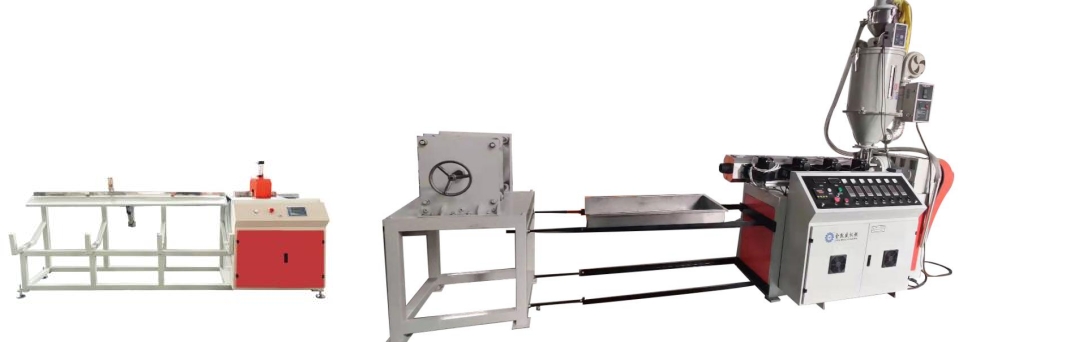
Solid rod line on SJ45 and SJ65 single screw extruders — 28:1 and 30:1 L/D respectively, for PP, PE, PA and POM.
Parameter 2 — L/D Ratio: 28:1 to 38:1 and What It Changes
L/D is the effective flighted length of the screw divided by its diameter. It governs how much conveying, compression and metering length is available to the polymer. The values actually used across this range are narrow and specific:
- 28:1 — SJ45 on the solid rod line.
- 30:1 — SJ65 on the solid rod line, and SJP115/30 with SJP135/30 on SPC lines.
- 33:1 — SJ-90×33 and SJ-130×33 on the PP hollow construction formwork line; also offered as the GS-series pipe alternative.
- 35:1 — ST80 to ST150 strand pelletizing extruders.
- 38:1 — GS60/38 through GS150/38 on HDPE water pipe lines.
The trade-off is straightforward. A longer L/D gives more residence length and more mixing and compression capacity, which suits polyolefin pipe, compounding and pelletizing work. It also means more torque demand, more drive power, a longer wear surface to replace and a longer purging cycle between colours. Shorter L/D reduces that burden but narrows the material window.
One clarification prevents a common misreading: the compact SJSZ conical twin screw models are named by diameter pair, not by an L/D figure. For rigid PVC, screw geometry and the diameter pair are the sizing handles, which is why PVC buyers should compare SJSZ specifications directly rather than looking for an L/D number that does not exist in that naming system.
Parameter 3 — Drive Power and Output: Read Them Together
Motor power is meaningless on its own. It becomes a decision figure only when read against the output and the product that power produces. In this range, the pairing looks like this: 7.5 kW on an SJ45 producing 5–18 kg/h of solid rod; 18.5 kW on an SJ65 producing 20–60 kg/h; 75 kW on an SJ-90×33 producing 180–250 kg/h of PP hollow formwork; 160 kW on an SJ-130×33 producing 500–600 kg/h of the same product at 1220 mm width.
The conical twin screw side scales the same way but for a different product geometry: 18.5 kW on SJSZ51 for 120 kg/h at 300 mm panel width, 22 kW on SJSZ55 for 150 kg/h at 450 mm, 37 kW on SJSZ65 for 250 kg/h at 600 mm, and 55 kW on SJSZ80 for 400 kg/h at 1200 mm. On pipe, the GS60/38 pair is 90 kW at 150–400 kg/h for Φ20–110 mm HDPE, while GS150/38 is 500 kW at 600–1500 kg/h for Φ1000–1600 mm.
Output must also be read against product difficulty. A 1220 mm hollow wall panel with a round-hole ABA three-layer structure and 15–20 mm thickness places a different load on the metering section than a solid pipe wall of the same throughput. Two lines quoting the same kg/h are not quoting the same duty.
Parameter 4 — Barrel and Screw Material: 38CrMoAlA Nitrided Alloy Steel
38CrMoAlA is a nitriding-grade alloy steel. Nitriding creates a hardened case on the screw flights and the barrel bore while the core retains toughness, which is the standard combination needed for abrasive mineral-filled compounds running continuously.
The practical value of this entry is that it tells a buyer what wear strategy the machine is built around, and it makes the material line auditable. Ask for the screw and barrel material to appear in writing on the quotation and in the order confirmation, next to the model, the L/D, the motor power and the output. If a supplier cannot state the material, the specification is not yet complete.
Material also sets the wear boundary you should monitor. PVC compounds with high calcium carbonate loading, recycled PP granule with MFI below 3 and filled WPC formulations all load the flights differently. Wear checks on the screw and barrel belong in the preventive maintenance schedule from commissioning, not after output drops.
Matching the Screw Family to PVC, PE and PP
Polymer decides the screw family before output decides the size. In this range the split is consistent and documented by product line.
Rigid PVC goes to the conical twin screw. The SJSZ platform is specified for extruding PVC resin directly into pipes, profiles and sheets with good plasticization and high output, and it is described as suitable for high-filled PVC formulations. That is why the PVC Hollow Wall Panel & Ceiling Extrusion Line lists SJSZ51, SJSZ55, SJSZ65 and SJSZ80; the PVC & WPC Door and Window Profile Extrusion Line lists SJSZ65/132 at 37 kW and SJSZ92/188 at 110 kW; the PVC Imitation Marble Sheet Extrusion Line lists SJSZ80/156 at 75 kW and SJSZ92/188 at 110 kW; the SPC Flooring Extrusion Line lists SJSZ92/188, SJSZ110/220, SJP115/30 and SJP135/30; and the PVC Hot-cut Pelletizing Line lists SJSZ55, SJSZ65, SJSZ80 and SJSZ92.
PE, PP, PA, POM, PS, PC and ABS go to the single screw. The Solid Plastic Rod Extrusion Line runs PP, PE, PA and POM on SJ45 and SJ65. The Multi-material Plastic Profile Extrusion Line runs PP, PE, PVC, PS, PC and ABS on SJ45, SJ50 and SJ65. The PP Hollow Construction Formwork Extrusion Line runs PP recycled granule with MFI below 3 on SJ-90×33 and SJ-130×33. HDPE water pipe runs on the GS series at 38:1. The Plastic Strand Cutting Pelletizing Line runs PE, PP, ABS, PS, HIPS and PC on ST80 to ST150 at 35:1.
Feeding consistency is part of the parameter set. Screw performance begins upstream. The SRL-Z mixing and cooling unit hot-mixes PVC resin with additives and then cools the blend to prevent agglomeration, and an inconsistent dry blend shows up as output fluctuation that no screw adjustment can correct. Buyers evaluating a PVC line should review the mixer specification together with the screw specification.
The Constraint Layer: Certificate, Voltage and Site Power
Certification is a screw-level parameter because the certificate scope names the models. JKS holds CE certificate M.2021.206.C.64011, issued on 22 April 2021 by UDEM International Certification Auditing Training Centre, covering plastic extrusion lines including the SJSZ series, SJ series and SJP series models. The cited standards are EN ISO 12100:2010, EN 1114-1:2011 and EN 60204-1:2018, with EN 61000-3-2:2014, EN 61000-3-3:2013, EN 61000-6-1:2007 and EN 61000-6-3:2007/A1:2011/AC:2012 for the EMC directives. Because certificate documents carry a validity window, request the current copy that matches the exact model and build you are ordering.
For the United States, ANSI/PLASTICS B151.7-2014 (R2021) applies to extrusion machines used in the plastics industry and requires a documented risk assessment process. Note that the PLASTICS Industry Association standards page references the 2013 edition while the ANSI webstore lists the 2014 (R2021) edition; a buyer filing compliance documents should confirm which edition their market authority expects rather than assuming equivalence.
Site power is the constraint buyers most often discover late. The PP hollow construction formwork line specifies 380V/50Hz three-phase supply with a suggested 315 kVA transformer and a machine footprint of 34 m × 7 m × 4.5 m. Voltage and frequency are listed customization items on JKS lines, alongside extruder model, screw configuration, line layout, control system and capacity adjustment — all decided before the screw is cut.
Step-by-Step: Checking Screw and Barrel Parameters Before You Order
Step 1 — Fix the product specification first
Write down polymer, filler level, product width and thickness, and target hourly output. These four inputs determine screw diameter and motor power. Reversing the order — choosing a model and then looking for a product — is how mismatched lines get ordered.
Step 2 — Select the screw family from the polymer
Rigid PVC with calcium carbonate goes to SJSZ conical twin screw. PE, PP, PA, POM and engineering plastics go to SJ or GS single screw. Recycling and compounding go to the ST strand pelletizing extruder or the PVC hot-cut route on SJSZ55 to SJSZ92, depending on whether pellets are cut in water or at the die face.
Step 3 — Size the screw from output and product width
Match the stated output at the stated product geometry. SJSZ51 at 120 kg/h and 300 mm width, SJSZ80 at 400 kg/h and 1200 mm width, SJSZ92/188 at 500–600 kg/h for a WPC door slab up to 1200–1600 mm — each figure belongs to a specific product, not to the model in general.
Step 4 — Read L/D and motor power as a pair
Confirm the L/D value in writing and confirm the kW that drives it. A 38:1 HDPE pipe extruder and a 28:1 rod extruder are not interchangeable even at similar screw diameters, because the process window each supports is different.
Step 5 — Confirm material, wear parts and customization
Verify 38CrMoAlA nitrided alloy steel for screw and barrel, wear-resistant alloy die steel for the mould, the voltage and frequency for your site, and the control system and layout. JKS lists OEM, ODM and custom design service, with a six-engineer R&D team and a stated monthly capacity of 30 units.
Step 6 — Validate before shipment, not after arrival
JKS performs 100% factory pre-assembly and testing before shipment, with third-party inspection available on request. Pair that with a reference check on installed lines: a Vietnam PVC hollow wall panel line has run 5+ years in stable continuous production, a Malaysia SPC flooring line 10+ years, and a Korea SPC flooring line 8+ years with low maintenance rate.
Use Cases: Which Parameters Matter by Product
Pipe extrusion
Pipe lines are sized by diameter range and wall thickness before throughput. The HDPE Water Pipe Extrusion Line covers PE110 (GS60/38, 90 kW, 150–400 kg/h, Φ20–110 mm) through PE1600 (GS150/38, 500 kW, 600–1500 kg/h, Φ1000–1600 mm). Related pipe platforms include the PVC Water Supply & Drainage Pipe Extrusion Line, the PPR Pipe Extrusion Line, the Corrugated Pipe Extrusion Line, the MPP & PE High Voltage Power Pipe Extrusion Line and the Steel Wire Mesh Reinforced Composite Pipe Extrusion Line.
Profile extrusion
Profiles are limited by dimensional precision, not by tonnage. The PVC & WPC Door and Window Profile Extrusion Line uses SJSZ65/132 at 37 kW for 150–250 kg/h of door jamb, casing and decorative profile, and SJSZ92/188 at 110 kW for WPC door slabs. PVC grille and decoration strip work runs on SJSZ51, SJSZ55 and SJSZ65 at 18.5 kW, 22 kW and 37 kW. Small single screw profile extruders (SJ45, SJ50, SJ65) handle multi-material decoration and sealing profiles.
Sheet and panel extrusion
Sheet lines combine screw output with calender capacity. SPC flooring runs 1–10 mm at 980 mm or 1250 mm effective width, with line output of 15–40 t/24h across the SJSZ92/188, SJSZ110/220, SJP115/30 and SJP135/30 configurations. PVC imitation marble sheet runs 1–12 mm at 1220 mm width and 400–700 kg/h depending on extruder model. WPC foam board uses SJSZ80/156 at 75 kW or an 80+165 co-extrusion configuration at 75+37 kW. PVC hollow wall panel and ceiling work runs SJSZ51 to SJSZ80.
Solid rod extrusion
Rod is the clearest illustration of parameter pairing: SJ45 at 28:1 and 7.5 kW produces Φ6–60 mm rod at 5–18 kg/h, while SJ65 at 30:1 and 18.5 kW produces Φ30–200 mm rod at 20–60 kg/h, for PP, PE, PA and POM.
Pelletizing and recycling
Waste plastic recycling routes split by cutting method. The Plastic Strand Cutting Pelletizing Line uses ST80 to ST150 at 35:1 L/D, from 55 kW and 70–160 kg/h up to 110 kW and 350–650 kg/h. PVC compounding typically uses hot-cut pelletizing on SJSZ55 to SJSZ92. Upstream, the SP400 crusher at 15 kW handles 300–400 kg/h and the SP660 at 22 kW handles 600–700 kg/h.
Construction formwork
PP hollow formwork is a single screw duty at 33:1. SJ-90×33 at 75 kW produces 180–250 kg/h; SJ-130×33 at 160 kW produces 500–600 kg/h, with 420–480 panels per 24 hours at 1220 mm width and 15–20 mm thickness, on a 380V/50Hz three-phase supply with a suggested 315 kVA transformer.

PP hollow construction formwork line — a 33:1 single screw duty, not a conical twin screw application.
Comparison Table: SJ and SJSZ Model Parameters Side by Side
Single screw and conical twin screw models are shown separately because their naming systems are not interchangeable. All values below are as stated for the specific product line noted.
Table 1 — Single screw parameter set (SJ, GS and ST platforms)
| Model | Screw / L/D | Main motor | Stated output | Product context |
|---|---|---|---|---|
| SJ45 | Φ45 mm, 28:1 | 7.5 kW | 5–18 kg/h | Solid rod Φ6–60 mm, PP/PE/PA/POM |
| SJ65 | Φ65 mm, 30:1 | 18.5 kW | 20–60 kg/h | Solid rod Φ30–200 mm |
| SJ-90×33 | 90 mm, 33:1 | 75 kW | 180–250 kg/h | PP hollow formwork, 1220 mm width |
| SJ-130×33 | 130 mm, 33:1 | 160 kW | 500–600 kg/h | PP hollow formwork, 420–480 pcs/24h |
| GS60/38 | 38:1 | 90 kW | 150–400 kg/h | HDPE pipe Φ20–110 mm |
| GS90/38 | 38:1 | 280 kW | 600–1000 kg/h | HDPE pipe Φ315–630 mm |
| GS150/38 | 38:1 | 500 kW | 600–1500 kg/h | HDPE pipe Φ1000–1600 mm |
| ST80 | 35:1 | 55 kW | 70–160 kg/h | Strand pelletizing, PE/PP/ABS/PS/HIPS/PC |
Table 2 — Conical twin screw parameter set (SJSZ platform)
| Model | Screw designation | Main motor | Stated output | Product context |
|---|---|---|---|---|
| SJSZ51 | Conical twin | 18.5 kW | 120 kg/h | PVC hollow wall panel, 300 mm width |
| SJSZ55 | Conical twin | 22 kW | 150 kg/h | PVC hollow wall panel, 450 mm width |
| SJSZ65 | Conical twin | 37 kW | 250 kg/h | PVC hollow wall panel, 600 mm width |
| SJSZ80 | Conical twin | 55 kW | 400 kg/h | PVC hollow wall panel, 1200 mm width |
| SJSZ65/132 | 65/132 mm pair | 37 kW | 150–250 kg/h | WPC door jamb, casing, decorative profile |
| SJSZ80/156 | 80/156 mm pair | 75 kW | 400–700 kg/h | PVC imitation marble sheet, 1–12 mm, 1220 mm |
| SJSZ92/188 | 92/188 mm pair | 110 kW | 500–600 kg/h | WPC hollow door slab, up to 1200–1600 mm |
| SJSZ110/220 | 110/220 mm pair | 200 kW | 15–40 t/24h line output | SPC flooring, 980/1250 mm, 1–10 mm |
Note: the 400–700 kg/h marble sheet band and the 15–40 t/24h SPC band are line-level ranges stated across several extruder configurations, not single-model guarantees. Confirm the figure for the exact model you order.

WPC foam board line on SJSZ80/156 at 75 kW, or an 80+165 co-extrusion configuration at 75+37 kW.
FAQ
Which standards and certificates apply to the screw and barrel of a plastic extrusion machine?
JKS plastic extrusion lines, including the SJSZ series, SJ series and SJP series models, are covered by CE certificate M.2021.206.C.64011, issued on 22 April 2021 by UDEM International Certification Auditing Training Centre. The cited standards are EN ISO 12100:2010, EN 1114-1:2011 and EN 60204-1:2018, together with EN 61000-3-2:2014, EN 61000-3-3:2013, EN 61000-6-1:2007 and EN 61000-6-3:2007/A1:2011/AC:2012 for the EMC directives. For the United States, ANSI/PLASTICS B151.7-2014 (R2021) applies to extrusion machines used in the plastics industry and requires a documented risk assessment. Because certificate documents carry a validity window, request the current copy matched to your exact model and build.
Can screw diameter, L/D ratio and screw configuration be customized for my material?
Yes. JKS lists OEM, ODM and custom design service, and the customization scope covers extruder model, screw configuration, production line layout, voltage and frequency, control system and capacity adjustment. The company operates a six-engineer R&D team from a 2000 m² workshop with a stated monthly capacity of 30 units, minimum order quantity of 1 unit and annual output of 200 units. Customization is confirmed against your raw material and production demand, with formulation service included.
What drives the cost of a screw and barrel set between SJ30 and SJSZ-110?
Cost scales with the parameters that set duty: screw diameter, L/D length, motor power and the resulting output, plus whether the platform is a single screw or a conical twin screw. Material specification matters as well — screw and barrel are 38CrMoAlA nitrided alloy steel, extrusion moulds are wear-resistant alloy die steel and frames are Q235 carbon steel. A quotation request is only comparable when it states the polymer, filler level, product width and thickness, and target hourly output, because those inputs determine which screw diameter and motor power are being priced.
How can I validate screw and barrel performance before committing to a full line?
Validation happens at two levels. In the factory, JKS performs 100% pre-assembly and testing before shipment, with third-party inspection available on request. In the field, reference installations can be checked: a Vietnam PVC hollow wall panel line has operated 5+ years in stable continuous production with consistent product quality, a Malaysia SPC flooring line 10+ years, and a Korea SPC flooring line 8+ years with stable 24/7 production and a low maintenance rate. Minimum order quantity is 1 unit.
What lead time applies to a customized extrusion line, and what support follows delivery?
Stated lead time is 40 work days, against a monthly capacity of 30 units. Support after delivery covers overseas installation guidance, on-site commissioning, operator training, remote technical support and a 12-month warranty. The practical next step is to send the polymer, product width and thickness, and target output to gordon@jksjx.com or WhatsApp +86 18601577228, so that screw diameter, L/D and motor power are confirmed against your product rather than against a generic model number. A downloadable catalogue is available here.
Conclusion
Screw and barrel parameters are the part of a plastic extrusion machine quotation that can be checked, compared and written into an order. Read the model code first — SJ for single screw, SJSZ for conical twin screw diameter pairs, GS for HDPE pipe at 38:1, ST for pelletizing at 35:1. Then read diameter, L/D, motor power and the material entry together, and confirm that the stated output belongs to the product you intend to make.
For PVC dry blend with high filler loading, the conical twin screw range from SJSZ51 to SJSZ110/220 carries the SPC, marble sheet, wall panel and door profile workload. For PE, PP, PA and POM, the single screw SJ and GS platforms carry rod, pipe and formwork duty. Neither family substitutes for the other, and no model number is interchangeable with the one above or below it.
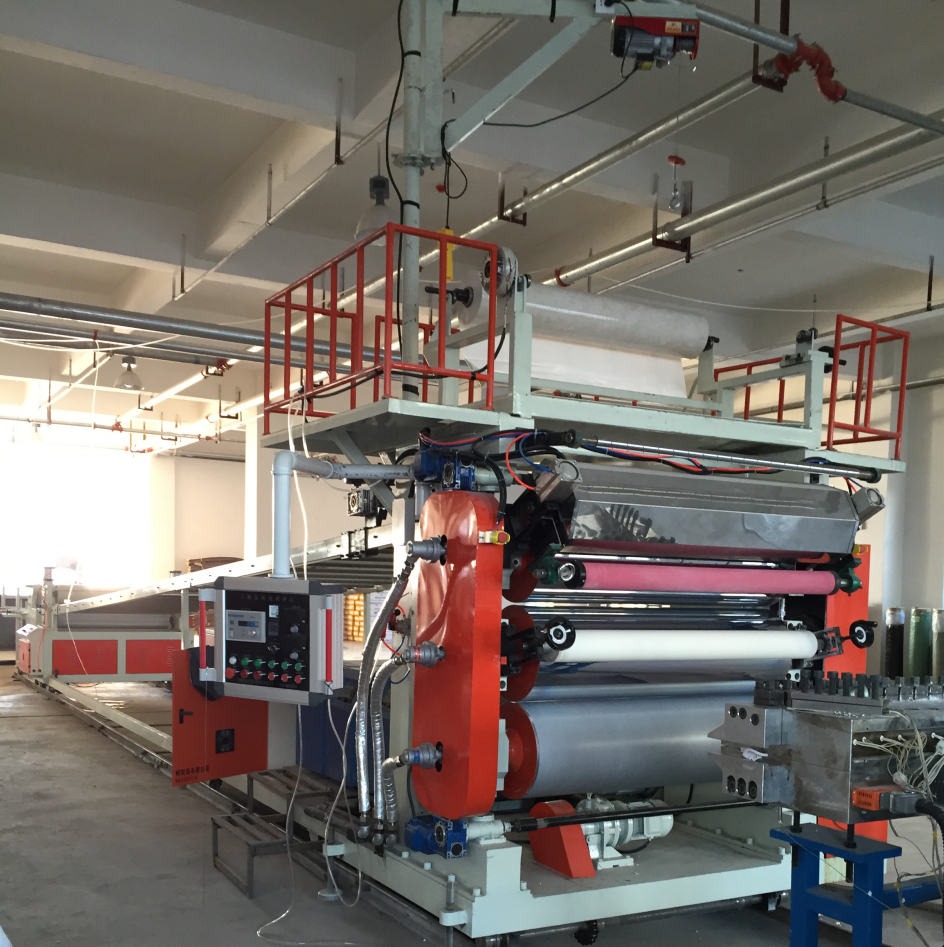
Assembly workshop at Wuxi JKS Machinery — screw and barrel sets are pre-assembled and tested before shipment.
Next step: verify the parameters against your product
Send polymer, filler level, product width and thickness, and target hourly output. You will receive a configuration with screw diameter, L/D, motor power and output stated explicitly — not a bare model number.
Email: gordon@jksjx.com | Tel: +86 18651004566 | WhatsApp: +86 18601577228
Wuxi JKS Machinery Manufacturing Co., Ltd. — No. 81 Xixian Road, Fangqian Town, Wuxi City, Jiangsu Province, 214000, P.R. China
Website: www.extrudetec.com | Catalogue: download the JKS catalogue (PDF)
Have Questions or Need More Details?
Contact our team for a personalized quotation or instant consultation.
Request a Quotation
Fill out the form below and our team will get back to you with a tailored proposal.
WhatsApp Direct Chat
Prefer to chat in real-time? Message us on WhatsApp for instant assistance & quick answers.
- Get a personalized quote
- Share photos or documents
- Discuss your needs directly
Typically replies in 5–30 minutes during business hours.