
Screw and Barrel Selection for SJ and SJSZ Extruders: A Technical Guide
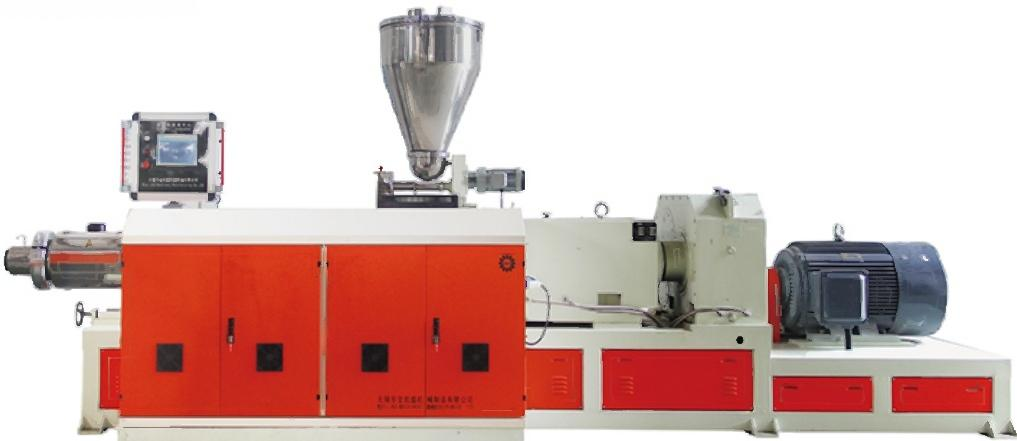
The SJSZ conical twin screw platform: the screw and barrel set is the first specification decision in a PVC pipe, profile or panel line.
Introduction: Four Inputs Decide the Specification
Choosing screw and barrel specifications for an SJ single screw plastic extruder or an SJSZ conical twin screw extruder comes down to four inputs: the polymer family being processed, the physical form of the feed, the output and tolerance the line must hold, and the wear or corrosion profile of the formulation. Match those four correctly and a 38CrMoAlA nitrided alloy steel screw and barrel set will hold its geometry through years of production. Match them badly and the machine will still run — but with drifting output, dimensional tolerance that creeps outside the drawing, and a replacement cost that arrives earlier than planned.
This guide covers the available model designations across both series (SJ30, SJ45, SJ65 and SJ90; SJSZ-45, SJSZ-51, SJSZ-55, SJSZ-65, SJSZ-80, SJSZ-92 and SJSZ-110), explains how the screw and barrel material and the extruder type influence the processing of PVC, PP, PE, Nylon and ABS, and sets out the selection parameters that connect an extruder configuration to material characteristics and production requirements. It also treats screw and barrel selection as what it actually is: a decision with a ten-year consequence, not a line item on a quotation.
Why Screw and Barrel Specification Decides Line Performance
The screw and barrel are the only components in a plastic extrusion machine that simultaneously contain melt pressure, abrasive filler particles and process heat. That is why they, more than the frame or the control cabinet, determine whether a line holds its dimensions hour after hour. A correctly specified set produces stable melt pressure and repeatable output; a mis-specified set still runs, but its flights wear, its output curve falls, its dimensions move, and its reject rate climbs quietly until the line has to stop.
The operating risks are concrete. JKS lists equipment downtime, inconsistent product quality, material waste, electrical or mechanical failure and delivery delay as the failure modes its control measures target, and addresses them with a PLC automatic control system, real-time monitoring, overload protection, an emergency stop function and pre-shipment testing. Screw and barrel condition sits behind the first three of those risks.
A second and less visible cost appears two or three years after commissioning. If the original screw geometry and barrel specification were never documented, every later replacement becomes guesswork: buyers fit generic screws that do not reproduce the original output curve, or wait for parts whose compatibility was never confirmed. Screw and barrel selection is therefore a two-layer decision — technical fit at the start, and supply continuity for the life of the line.
Industry Background: Where Specification Pressure Comes From
Plastic extrusion machinery is a mature but still expanding equipment category. Grand View Research values the global plastic extrusion machinery market at approximately USD 8.93 billion in 2024 and projects it to reach USD 11.58 billion by 2030. The same source reports that Asia Pacific accounted for 41.5% of extrusion machinery revenue in 2024, with China the leading contributor in the region — one reason the custom line and screw/barrel supply base is concentrated there.
Within that market, the single screw platform remains the volume workhorse. Grand View Research estimates single screw extrusion machines held roughly 62.7% market share in 2024. That number matters for specification discipline: high-volume platforms are also the ones most often quoted with an unspecified, commodity screw.
End-market data shows where specification pressure is strongest. Dataintelo values the global pipe extrusion lines market at USD 4.8 billion in 2025, with PVC the leading material segment at 38.6%. Grand View Research projects the Stone Plastic Composite (SPC) flooring market to grow from USD 6.4 billion in 2026 to USD 10.3 billion by 2033, at a 7.2% CAGR. Both segments process heavily filled or heat-sensitive compounds — PVC dry blend and calcium-carbonate-loaded SPC compounds — which is precisely where screw geometry and barrel metallurgy stop being interchangeable between suppliers.
On the supply side, publicly identified leading manufacturers in the extrusion equipment space for 2024 include Coperion, KraussMaffei, Davis-Standard and Jwell Machinery. Below that tier sits a large group of Chinese builders supplying custom and turnkey lines, among them Wuxi JKS Machinery Manufacturing Co. Ltd.
The JKS Platform: SJ Single Screw and SJSZ Conical Twin Screw Extruders
Wuxi JKS Machinery Manufacturing Co. Ltd. (JKS) is a Chinese manufacturer of custom plastic extrusion machinery and complete turnkey production lines, founded in 2013 and based in Wuxi, Jiangsu Province. Its portfolio covers SPC flooring sheet lines, PVC/PP/WPC board lines, PVC and HDPE pipe lines, WPC/PVC profile lines, solid plastic rod extruders, waste plastic recycling pelletizing lines, and the standalone single screw and conical twin screw extruders plus auxiliary equipment underneath them. The company operates a 2,000 m² workshop with 20 employees, a six-engineer R&D team and annual output of 200 units; 50% of production is exported, to Southeast Asia, Russia, the Middle East, Europe, Central Asia, Africa and South America, with machines delivered to over 35 countries.
Two screw architectures, two feeding behaviours
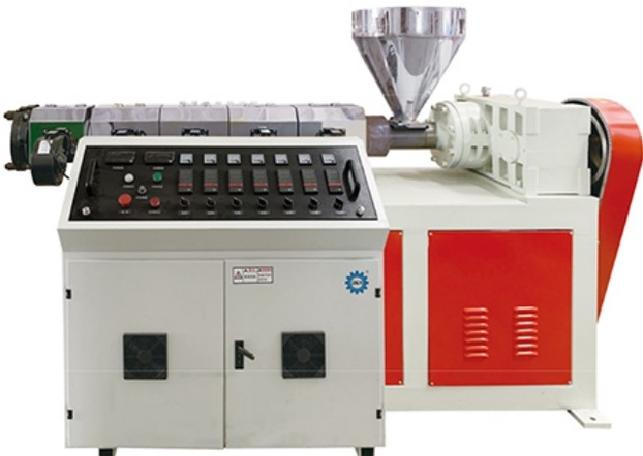
SJ series single screw plastic extruder — the granule-fed platform behind most PP, PE, ABS and Nylon extrusion work.
SJ single screw extruders place one rotating screw inside a heated barrel. Material is conveyed, compressed and metered along a single flow channel, which produces predictable melt pressure and simple maintenance — the reason single screw machines dominate granule-fed polyolefin work.
SJSZ conical twin screw extruders use two counter-rotating conical screws. The conical form creates a large feed opening that tapers toward the metering section, so the machine accepts low-bulk-density powder such as PVC dry blend without bridging at the feed throat, while the intermeshing flights deliver positive conveying with controlled shear. This is why rigid PVC pipe, profile and panel lines are normally specified on the conical twin screw platform rather than on a single screw.
Model designations across both series
The designation identifies the series and the nominal screw size class. The platform and the polymer family, not the number alone, decide whether a configuration fits a given product.
| Series / designations | Screw configuration | Screw and barrel material | Feed form it suits | Polymer focus |
|---|---|---|---|---|
| SJ30, SJ45, SJ65, SJ90 | Single screw | 38CrMoAlA nitrided alloy steel | Granules, pellets, regrind | PP, PE, ABS, Nylon; rod, small profile, sheet and pipe extrusion |
| SJSZ-45, SJSZ-51, SJSZ-55, SJSZ-65, SJSZ-80, SJSZ-92, SJSZ-110 | Conical twin screw | 38CrMoAlA nitrided alloy steel | PVC dry blend powder, powder/regrind blends | Rigid PVC; pipe, profile, panel, sheet and pelletizing lines |
38CrMoAlA nitrided alloy steel: what it gives you, and where its limits are
Both series are built around 38CrMoAlA nitrided alloy steel for the screw and the barrel. The grade is a medium-carbon alloy steel containing aluminium, which makes it suitable for nitriding: the finished screw and barrel bore carry a hard, wear-resistant surface layer over a tougher core. In operation this delivers three things — abrasion resistance against fillers such as calcium carbonate in PVC and SPC compounds, retention of flight geometry under sustained melt pressure, and a surface that resists the mechanical wear of continuous running.
The limitation matters just as much. Nitrided alloy steel is a wear specification first and a corrosion specification second. Formulations that release aggressive by-products at processing temperature — most notably heat-sensitive rigid PVC, which demands tight temperature control — place more demand on metallurgy than a simple granule-fed polyolefin compound. When a formulation is strongly corrosive, the correct action is not to accept the standard screw and barrel by default but to raise the question at specification stage: is the standard nitrided construction the right fit, or does this application call for a different barrel metallurgy or a corrosion-resistant liner? A supplier who can answer that question in writing can answer it again, consistently, at replacement time.
Configuration driven by raw material and demand
JKS states that its extruders are configured through personalised design according to the client's raw material and production demand, supported by its R&D team and a formulation service. For screw and barrel selection this means the specification should be derived from the material data sheet and the product drawing rather than from a stock list: filler type and loading, melt temperature window, feed form, required output, and the dimensional tolerance of the finished product.
Step-by-Step: Selecting Screw and Barrel Specifications
Step 1 — Characterise the polymer and its processing window
Record five things before looking at any machine: polymer family, additive and filler loading, feed form, melt temperature window, and the corrosive or abrasive by-products the compound can release. Rigid PVC is the clearest case — it is processed from dry blend and is heat sensitive, so low, controlled shear and corrosion-aware metallurgy matter more than raw throughput. PP and PE are thermally stable, comparatively easy on the barrel, and normally granule fed. ABS is amorphous and more viscous, so mixing quality and temperature uniformity drive screw design. Nylon grades are generally dried before processing and require tighter temperature control. The polymer profile, not the catalogue, is the first input.
Step 2 — Match feed form to screw architecture
Granules, pellets and regrind flow readily through a single screw feed throat; low-bulk-density powder does not. When a formulation arrives as PVC dry blend or as a powder/regrind mix, the conical twin screw's large tapering feed section is the practical choice, which is why SJSZ covers most rigid PVC pipe, profile, panel and sheet work. Upstream consistency belongs in this step as well: a plastic raw material mixer unit and a crusher for reclaim determine whether the feed reaching the screw throat is uniform in bulk density and particle size.
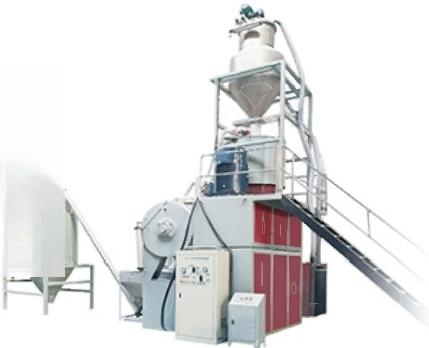
SRL-Z high-speed PVC mixing and cooling unit — feed consistency upstream decides how well a conical twin screw performs downstream.
Step 3 — Size the model designation against output and tolerance
Select SJ30, SJ45, SJ65 or SJ90 — or SJSZ-45 through SJSZ-110 — by the output the finished product requires, not by the smallest machine that will physically run the material. Over-sizing wastes energy and can over-shear heat-sensitive compounds; under-sizing forces the screw to run near its limits, which accelerates wear on both screw and barrel. Bring three numbers to the discussion: required output, the critical product dimension (pipe wall thickness, profile wall, sheet thickness), and the tolerance that dimension must hold. JKS line data illustrates the tolerance pressure involved — its pipe extrusion lines are specified for wall thickness control to ±0.05 mm, and its SPC flooring lines for ±0.1 mm thickness tolerance.
Step 4 — Fix the screw and barrel specification in writing
Ask for the construction to be stated explicitly: 38CrMoAlA nitrided alloy steel screw and barrel, the nitriding specification, the screw geometry across feed, compression and metering sections, and the intended polymer window. Two documents make replacement straightforward years later — the screw and barrel drawing for that specific model, and the record of the configuration actually shipped. Buyers who intend to run a line for a decade should ask about the replacement screw and barrel set now, not after the first wear event.
Step 5 — Validate the assembly before shipment
JKS quality control includes 100% factory pre-assembly and testing before shipment, and third-party inspection is available on request; acceptance criteria for the order are set as a pre-shipment factory test. For screw and barrel work, pre-assembly testing is the stage where alignment, heating behaviour and drive performance are confirmed together instead of on the customer's site.
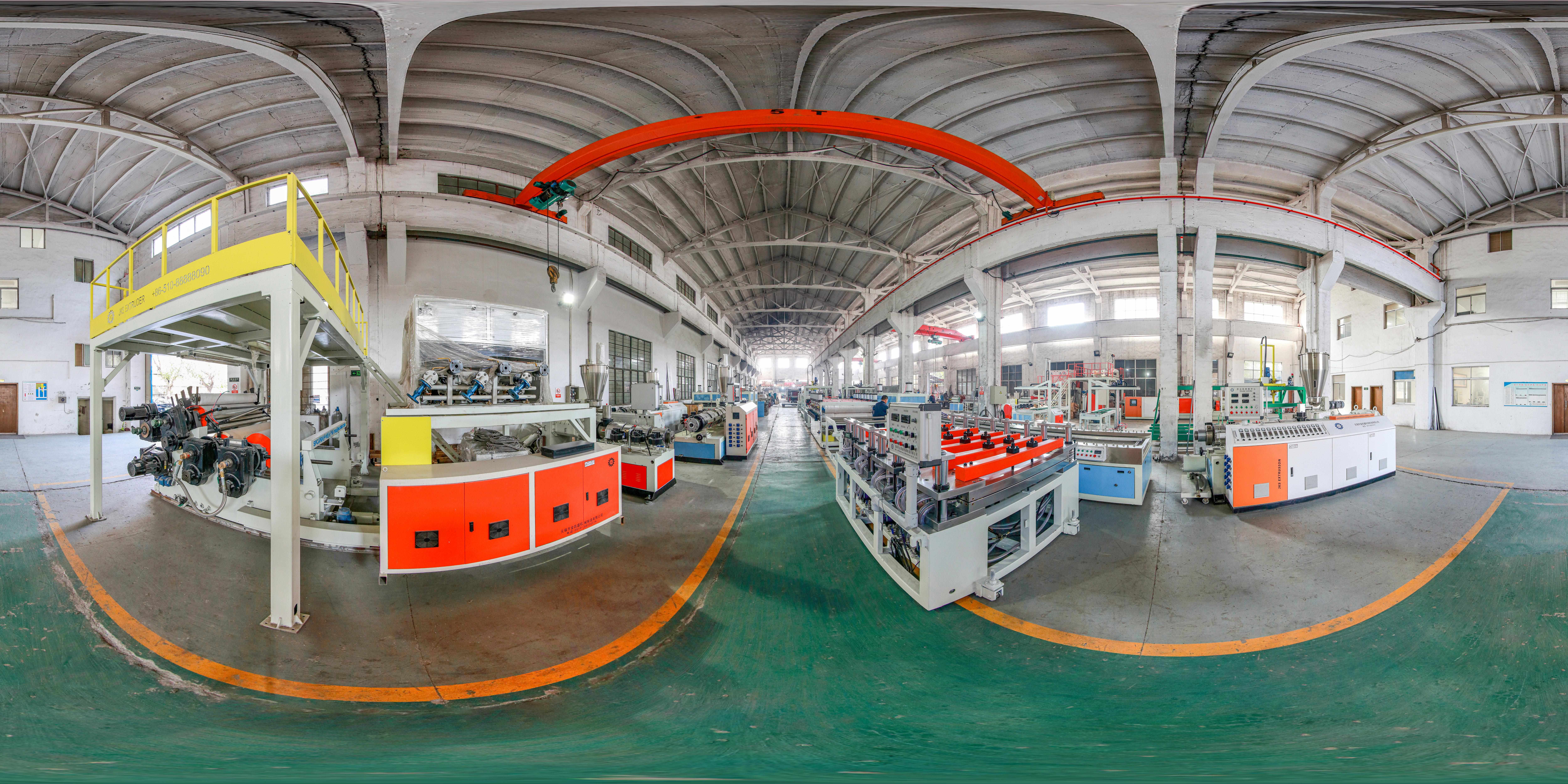
JKS workshop: extruder assemblies are pre-assembled and tested before dispatch, which is where screw and barrel alignment is proven.
Step 6 — Plan for the operating life of the screw and barrel
This is the step most buyers skip, and the one that decides total cost. Wear is inevitable; unplanned wear is optional. Build a lifecycle plan covering a spare screw and barrel set or a confirmed re-order route, the planned maintenance window, spare parts supply, and the technical support model. JKS provides standardised installation guidance, on-site troubleshooting, remote technical support and spare parts supply, along with free factory installation and technical training on new lines. Commercial terms belong to the same plan: minimum order quantity is 1 unit, typical production lead time is 40 work days, monthly production capacity is 30 units, delivery terms are FOB, and payment terms are 30% T/T deposit with the 70% balance by T/T before shipment.
Use Cases: How the Selection Plays Out by Line Type
Pipe, conduit and reinforced pipe lines

Steel wire reinforced composite pipe line — pipe wall thickness is the tolerance that governs screw and barrel specification.
PVC pipe extrusion production lines, HDPE solid pipe making machines, PPR water pipe extrusion lines, steel wire reinforced composite pipe lines and PE corrugated pipe extruders are all fed from the extruder first. Rigid PVC pipe runs on SJSZ conical twin screw extruders, where controlled shear protects the heat-sensitive compound and the tapered feed section accepts dry blend. Polyolefin pipes — HDPE and PPR — are granule fed and are normally built on the SJ single screw platform, with screw geometry selected for the pipe's wall thickness range. Wall thickness tolerance is the governing requirement: for water supply and drainage pipe, high-voltage power cable conduit and composite pipe, JKS specifies pipe lines for ±0.05 mm wall thickness control, and names wear-resistant screw and barrel design, modular components and easy maintenance among the maintenance measures.
Profile, panel and door lines
PVC window profile extrusion lines, PVC hollow wall panel production lines, PVC decoration strip profile machines, WPC door panel extruder machines and small single screw profile extruders are judged on dimensional consistency across a complex cross-section, often in multi-cavity tooling. The extruder's job is a stable, uniformly plasticised melt at constant rate, and the screw and barrel decide how well that holds as tooling and formulation change. JKS profile line data cites multi-cavity mould capability, precise calibration and complex profile forming, with a quick mould change system and modular design supporting access to key components.
Sheet and flooring lines
SPC flooring production lines, PVC artificial marble sheet extrusion lines, WPC foam board extrusion lines and PP construction formwork making machines all run heavily filled compounds. Calcium carbonate loading makes the compound abrasive, so screw and barrel wear — rather than corrosion — is the dominant life-limiting factor, and 38CrMoAlA nitrided alloy steel is chosen for exactly that reason. Thickness tolerance is the commercial constraint: JKS sheet and flooring lines are specified for ±0.1 mm thickness tolerance with synchronised embossing and lamination.
Rod, compounding and recycling lines
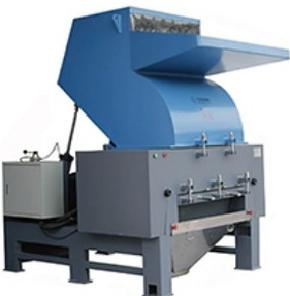
SP series plastic crusher — regrind consistency changes how hard the screw and barrel have to work.
PP, PA and POM plastic rod extruders, waste plastic recycling pelletizing lines, PVC hot cut pellet machines and plastic raw material mixer units sit at the material-preparation end of the same decision. Regrind and recycled feedstock vary in bulk density and contamination level from batch to batch, which is harder on both feeding and wear than virgin granules. Where a line mixes virgin and reclaimed material, the screw and barrel specification should be agreed against the worst feed the line will realistically see, not the cleanest.
Comparison: Matching Extruder Configuration to Production Requirements
The two platforms are not competitors; they answer different feed and polymer conditions. The matrix below summarises the selection logic.
| Selection dimension | SJ single screw extruder | SJSZ conical twin screw extruder |
|---|---|---|
| Screw architecture | One rotating screw in a heated barrel | Two counter-rotating conical screws |
| Feed form it suits | Granules, pellets, regrind | PVC dry blend powder, powder/regrind blends |
| Polymer families typically run | PP, PE, ABS, Nylon | Rigid PVC |
| Model designations | SJ30, SJ45, SJ65, SJ90 | SJSZ-45, SJSZ-51, SJSZ-55, SJSZ-65, SJSZ-80, SJSZ-92, SJSZ-110 |
| Screw and barrel construction | 38CrMoAlA nitrided alloy steel | 38CrMoAlA nitrided alloy steel |
| Dominant wear mechanism | Filler abrasion in filled and engineering compounds | Filler abrasion plus corrosion from heat-sensitive PVC compounds |
| Typical line context | PE/PP pipe, rod, small profile, sheet, pelletizing | PVC pipe, profile, panel, sheet and pelletizing lines |
The second table connects those platform choices to the line families a buyer is likely to be specifying, using JKS's own comparative line data.
| JKS line family | Extruder platform | Screw and barrel consideration | JKS-reported line data |
|---|---|---|---|
| PVC and composite pipe lines | SJSZ conical twin screw for rigid PVC; SJ single screw for PE/PP | Corrosion-aware metallurgy for heat-sensitive PVC; wear resistance for filled compounds | ±0.05 mm wall thickness control; 10–15% higher output and 30% lower long-term maintenance cost reported against basic single-screw pipe extruders |
| PVC/WPC profile, panel and door lines | SJSZ conical twin screw | Stable melt rate for multi-cavity and complex cross-sections | 12–18% higher output per line and 6–8% lower energy consumption reported against conventional twin screw profile extruders |
| SPC flooring, PVC marble sheet and WPC foam board lines | SJSZ conical twin screw with downstream calendering and embossing | Abrasion resistance for calcium-carbonate-filled compounds; thickness stability | ±0.1 mm thickness tolerance; 15–20% higher output speed reported against conventional single-layer lines |
| Pelletizing and auxiliary equipment | Single or twin screw extruder with crusher and mixer | Wear resistance under regrind and recycled feed | 10–15% higher processing capacity and 5% lower energy use reported against generic auxiliary equipment |
FAQ: Screw and Barrel Selection and Long-Term Supply
What quality checks and documentation should I expect for a screw and barrel set?
JKS applies 100% factory pre-assembly and testing before shipment, and third-party inspection is available on request; order acceptance criteria are defined as a pre-shipment factory test. For EU-bound projects, buyers should confirm which market-compliance documentation applies to the whole line — WPC door panel extrusion machinery, for example, is typically specified with CE marking for EU market compliance and ISO 9001 for quality management, and the same documentation discipline applies to the screw and barrel records supplied with a pipe, profile or sheet line.
Can the screw and barrel configuration be customised to my formulation?
Yes. JKS designs extruders individually around the client's raw material and production demand, with a six-engineer R&D team and a formulation service. In practice, the screw geometry, the model designation (SJ30, SJ45, SJ65 or SJ90, or SJSZ-45 through SJSZ-110) and the 38CrMoAlA nitrided alloy steel screw and barrel specification are agreed against your polymer, filler loading, feed form and required output rather than drawn from a stock list. Free factory installation and technical training are provided with new lines.
What are the order and payment terms?
Minimum order quantity is 1 unit. Delivery terms are FOB, payment is 30% T/T deposit with the 70% balance by T/T before shipment, and acceptance criteria are set as a pre-shipment factory test. Because screw and barrel wear is a recurring cost, the more useful budgeting question is total cost across the operating life: the initial price of the extruder, the cost of the first replacement screw and barrel set, and the downtime avoided by having that set available on site.
Can we validate the configuration before committing to full production?
Validation happens in two places. In the factory, 100% pre-assembly and testing before shipment confirms that the extruder, screw and barrel run together before dispatch, and third-party inspection can be arranged on request. Commercially, the one-unit minimum order quantity means a buyer can order a single configured machine and run it against their own formulation before scaling up. JKS also provides formulation service and technical training, which is how a first line is normally tuned to a specific compound.
What is the lead time, and how is the screw and barrel supported over the life of the line?
Typical production lead time is 40 work days, and monthly production capacity is 30 units, so lead time depends on the current order book. Over the operating life, support covers spare parts supply, remote technical support, on-site troubleshooting and standardised installation guidance, alongside the PLC automatic control system, real-time monitoring, overload protection and emergency stop function built into the machines. To review a screw and barrel specification against your own formulation and product drawing, download the JKS product brochure or send your material data sheet and required output directly to the team.
Conclusion: A Specification Decision With a Ten-Year Horizon
The rules that hold across SJ single screw and SJSZ conical twin screw selection are short. The polymer and its filler or corrosion profile decide metallurgy and screw geometry. The feed form decides the platform: granules to SJ, dry blend powder to SJSZ. Output plus the critical dimensional tolerance decides the model designation, from SJ30–SJ90 or SJSZ-45–SJSZ-110. Documentation decides the cost of the next replacement. And the supplier's support model decides whether the configuration still fits the line in year five.
That last point is where a technical decision becomes a long-term one. A screw and barrel set is not a one-time purchase; it is a consumable that will be reordered, re-specified and serviced repeatedly over the life of the line. Buyers who evaluate screw and barrel selection together with spare parts supply, technical response and replacement documentation are effectively selecting a production partner, not just a plastic extrusion machine.
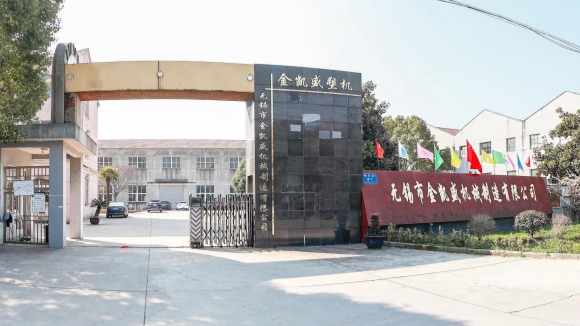
Wuxi JKS Machinery, Wuxi, Jiangsu Province — screw and barrel configurations are matched to client material and output requirements.
Next step: match a screw and barrel specification to your formulation
Send your material data sheet, filler loading, feed form and required output, and JKS will recommend the extruder platform, model designation and screw and barrel configuration that fit your product drawing.
Download the brochure: JKS Machinery WPC Door Project Brochure
Contact: Gordon | Email: gordon@jksjx.com | Tel: 86 18651004566 | WhatsApp: 86 18601577228
Address: No. 81 Xixian Road, Fangqian Town, Wuxi City, Jiangsu Province, 214000, P.R. China | Website: www.extrudetec.com