
Selecting the Right Extrusion Line for PVC Pipe Production: An Application Guide
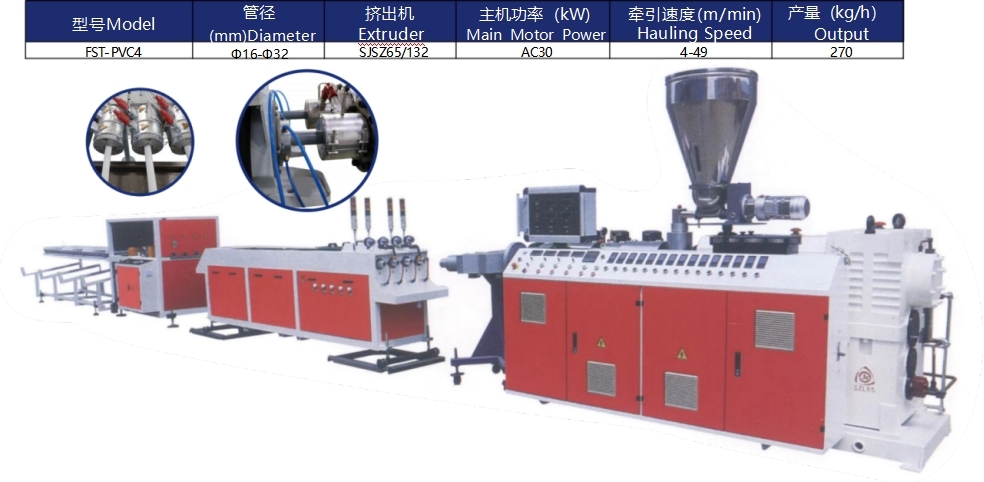
A PVC water supply and drainage pipe extrusion production line: conical twin-screw extruder, calibration and cooling, multi-claw haul-off and dust-free cutting unit working as one continuous train.
A PVC pipe extrusion line is not one machine. It is a matched set of equipment that is sized from three directions at once — the pipe diameter range you must produce, the hourly output your order book requires, and the PVC formulation (resin plus calcium carbonate filler) that your market accepts. Choose the diameter range badly and the die head, calibration and haul-off will never follow it. Ignore the mixing stage and the extruder will simply produce inconsistent pipe faster.
This application guide is written for building-materials producers who are comparing pipe line configurations before they commit capital. It explains how the JKS PVC water supply and drainage pipe line is structured, why the upstream PVC mixing and cooling stage decides the quality of everything that follows, and how to translate a production goal — for example, Φ16–63 mm irrigation and conduit pipe, or Φ315–630 mm drainage main — into a specific extruder, motor and downstream configuration.
Wuxi JKS Machinery Manufacturing Co. Ltd. (JKS) is a Chinese manufacturer of custom plastic extrusion machinery and complete turnkey production lines, founded in 2013 and based in Wuxi, Jiangsu Province. Its portfolio covers sheet, SPC flooring, board, profile, rod and pelletizing lines, and a pipe family that includes PVC water supply and drainage pipe, HDPE water pipe, PPR pipe, MPP and PE power conduit, steel-wire reinforced composite pipe and single-wall corrugated pipe lines.
Why PVC pipe line selection goes wrong
Most purchasing mistakes on PVC pipe lines are configuration mistakes, not machine-quality mistakes. The extruder concept — a conical twin-screw machine feeding a die head, vacuum calibration and a haul-off — is standard across the category. What differs is how closely the train is matched to one production profile.
- Diameter ambition is bought separately from machine capability. A line tooled for Φ16–63 mm pipe runs an SJSZ65/132 extruder with a 37 kW main motor and hauling speeds of 4–49 m/min. A line for Φ315–630 mm pipe runs an SJSZ92/188 extruder with a 110 kW main motor and hauling speeds of 0–5 m/min. These are not the same machine with different dies; the torque, haul-off and downstream power differ fundamentally.
- The mixing stage is treated as a separate purchase. If the mixing and cooling unit cannot deliver a uniform, cooled dry blend at the rate the extruder consumes it, the pipe wall thickness, surface and dimensional stability will drift.
- Die head and calibration tooling are treated as accessories. On the JKS PVC pipe line, the mold is made from precision casting die steel, and the screw and barrel from 38CrMoAlA nitrided alloy steel — both choices that decide tooling life and dimensional repeatability.
- The scrap loop is left out of the project budget. Pipe extrusion produces start-up scrap, off-spec pipe and trim. Without a crusher and pulverizer staged next to the line, that material leaves the plant as waste instead of returning as powder.
Where PVC pipe production sits in today's extrusion equipment market
Pipe is one of the largest single applications in plastic extrusion. The global pipe extrusion line market was valued at USD 4.8 billion in 2025, and PVC accounted for 38.6% of it — the largest material segment in that market (Dataintelo, 2025). The wider extrusion machinery market was valued at approximately USD 8.93 billion in 2024 and is projected to reach USD 11.58 billion by 2030, with Asia Pacific holding a 41.5% revenue share in 2024 and China as the region's main contributor (Grand View Research, 2024).
Published estimates differ depending on scope — for example, other researchers value the plastic extrusion machine market at USD 7.525 billion for 2024 or USD 15.17 billion for 2025, depending on whether auxiliary systems and complete lines are counted. For a buyer, the practical reading is the same: this is a mature, well-populated equipment category with many suppliers, including established global manufacturers such as Coperion, KraussMaffei, Davis-Standard and Jwell Machinery (GSmach / Jwell industry insights, 2024). Differentiation therefore does not come from the concept of an extruder. It comes from line configuration, compound preparation and how well the supplier matches the train to a specific pipe programme.
Detailed solution: what a JKS PVC pipe extrusion line contains
The JKS PVC water supply and drainage pipe line is offered in three tooled configurations — PVC63, PVC250 and PVC630 — using PVC resin plus CaCO₃ as the raw material. Each configuration is completed by vacuum calibration, multi-claw traction and a dust-free cutting unit, so the pipe leaves the line sized, cooled and cut in one pass.
The extruder and the die head
PVC pipe is extruded directly from PVC powder, which is why the line is built around a conical twin-screw extruder (SJSZ series, available across the range from SJSZ-45 to SJSZ-110). The conical twin-screw design is characterised by uniform plasticizing and mixing, low shearing, high productivity, stable quality and long service life — the properties that matter when the formulation carries a high filler load. Screw and barrel are made from 38CrMoAlA nitrided alloy steel; the machine frame is Q235 carbon steel; and the pipe die head uses precision casting die steel.
The upstream stage: how the SRL-Z mixing and cooling unit prepares the compound
Before any PVC powder reaches the extruder it has to be blended. The PVC Mixing & Cooling Unit (SRL-Z series) mixes PVC resin with additives — stabilizers, plasticizers and fillers — at high speed, then cools the batch to prevent agglomeration. It runs an automatic hot-mixing and cold-mixing cycle: roughly 8–10 minutes per pot for mixing and 6–8 minutes per pot for cooling. The mixing pot is stainless steel; the frame is carbon steel; and the unit is designed to feed PVC pipe, profile, sheet and pelletizing lines, with conveyors, storage silos and the extruder as supporting equipment.
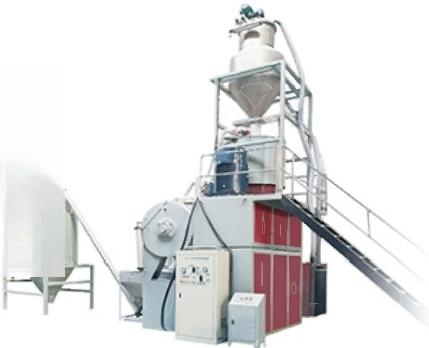
The SRL-Z series mixing and cooling unit runs a hot-mixing and cold-mixing cycle before the compound is fed to the pipe extruder.
This is the part of the project where capacity is most often mis-specified, because the mixing unit is frequently quoted after the extruder rather than with it. The matching logic is straightforward: the cooling mixer's hourly throughput must cover the pipe line's hourly consumption with margin, because the cycle is batch-based rather than continuous.
| SRL-Z model | Heating / cooling power | Output | Fits a pipe line running at |
|---|---|---|---|
| SRL-Z200/500 | 37 / 7.5 kW | 300–400 kg/h | Below 300 kg/h — e.g. the 270 kg/h PVC63 configuration |
| SRL-Z300/600 | 55 / 11 kW | 450–600 kg/h | Around 450 kg/h — the PVC250 configuration |
| SRL-Z500/1000 | 75 / 15 kW | 800–1000 kg/h | Around 800 kg/h — the PVC630 configuration |
| SRL-Z1000/3000 | 160 / 22 kW | 1600–2000 kg/h | Multi-line or high-capacity compounding plants |
The scrap loop: crusher and pulverizer
Pipe plants that reuse their own scrap recover it in two steps. A plastic crusher reduces waste PVC pipes, profiles and sheets to small pieces — the SP400 handles 300–400 kg/h at 15 kW and the SP660 handles 600–700 kg/h at 22 kW, with wear-resistant steel used for the cutting chamber and blades. A plastic pulverizer then grinds the regrind into fine powder of 40–80 mesh for re-use — MF400 at 30 kW and 200 kg/h, MF500 at 37 kW and 300–400 kg/h, and MF600 at 55 kW and 400–500 kg/h.
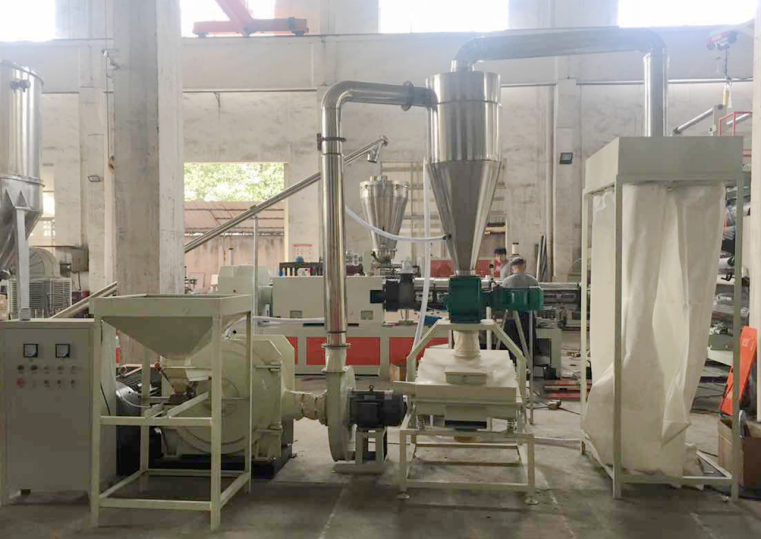
MF series pulverizer: PVC pipe scrap is ground to 40–80 mesh powder so it can return to the mixing and cooling unit instead of leaving the plant as waste.
Step-by-step: matching a line configuration to your production goal
- Fix the diameter range before anything else. The JKS PVC pipe line covers Φ16–63 mm on the PVC63 model (double station), Φ90–250 mm on the PVC250 model, and Φ315–630 mm on the PVC630 model. If your product plan spans two of these bands, that is a two-line decision, not a die-change decision.
- Read the haul-off speed as a diameter signal. The PVC63 line hauls at 4–49 m/min, the PVC250 line at 4–15 m/min, and the PVC630 line at 0–5 m/min. Small pipe is a speed game; large pipe is a torque game.
- Check the output against your order book. Documented outputs are 270 kg/h for PVC63, 450 kg/h for PVC250 and 800 kg/h for PVC630. Match the number to the tonnage you actually sell, not to the maximum the extruder could theoretically reach.
- Confirm the extruder and motor size that come with the diameter band. The PVC63 line uses an SJSZ65/132 extruder with an AC 37 kW main motor and 24 kW of downstream power; the PVC250 line uses SJSZ80/156 with 55 kW main and 24 kW downstream; the PVC630 line uses SJSZ92/188 with 110 kW main and 39 kW downstream.
- Size the mixing and cooling unit to the extruder. Use the table above: the unit's hourly band should sit above the pipe line's hourly output so that batch mixing never becomes the bottleneck.
- Lock the die head and downstream specification. Precision casting die steel for the mold, 38CrMoAlA nitrided alloy steel for screw and barrel, vacuum calibration, multi-claw traction and dust-free cutting are the elements that determine whether the pipe meets the dimensional tolerance your customers inspect.
- Plan the scrap recovery and then the commercial terms. Add crusher and pulverizer capacity if regrind is part of your cost model. On the supply side, JKS builds these lines on an OEM, ODM and custom-design basis — extruder model, screw configuration, line layout, voltage and frequency, control system and capacity adjustment can all be specified — with a minimum order of one unit and a quoted lead time of 40 working days.
Line configuration comparison: PVC63 vs PVC250 vs PVC630
| Configuration | PVC63 (double station) | PVC250 | PVC630 |
|---|---|---|---|
| Pipe diameter range | Φ16–Φ63 mm | Φ90–Φ250 mm | Φ315–Φ630 mm |
| Matching extruder | SJSZ65/132 conical twin screw | SJSZ80/156 conical twin screw | SJSZ92/188 conical twin screw |
| Main motor power | AC 37 kW | AC 55 kW | AC 110 kW |
| Downstream power | 24 kW | 24 kW | 39 kW |
| Hauling speed | 4–49 m/min | 4–15 m/min | 0–5 m/min |
| Production output | 270 kg/h | 450 kg/h | 800 kg/h |
| Raw material | PVC + CaCO₃ | PVC + CaCO₃ | PVC + CaCO₃ |
| Downstream equipment | Vacuum calibration, multi-claw traction, dust-free cutting | Vacuum calibration, multi-claw traction, dust-free cutting | Vacuum calibration, multi-claw traction, dust-free cutting |
| Screw & barrel / mold / frame | 38CrMoAlA nitrided alloy steel / precision casting die steel / Q235 carbon steel | Same material specification | Same material specification |
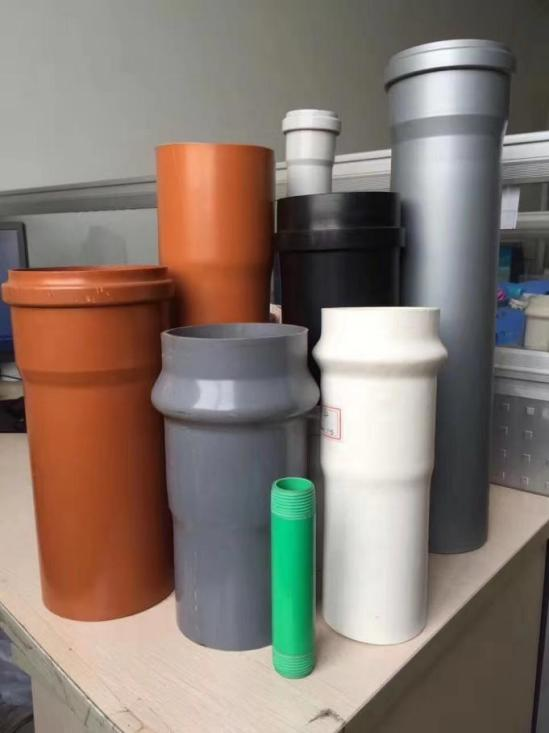
Finished PVC water supply and drainage pipe — the output that a correctly matched extruder, calibration unit and haul-off train should hold consistently across the shift.
Use cases: three production profiles and the line that fits each
1. Building water supply and drainage pipe for construction projects
This is the core application for the JKS PVC pipe line, alongside agricultural irrigation and cable threading pipe. A plant supplying building drainage and sewer pipe in the Φ90–250 mm band normally specifies the PVC250 configuration: SJSZ80/156 extruder, 55 kW main motor, 4–15 m/min hauling, 450 kg/h. Where the market demands larger mains, the PVC630 configuration with the SJSZ92/188 extruder, 110 kW main motor and 800 kg/h output covers Φ315–630 mm at hauling speeds of 0–5 m/min.
2. Small-diameter irrigation and cable threading pipe
Irrigation laterals and electrical conduit sit in the Φ16–63 mm band, where volume matters more than wall thickness. The PVC63 double-station configuration is built for that profile: 270 kg/h with a hauling speed range of 4–49 m/min, driven by an SJSZ65/132 extruder with a 37 kW main motor. The high hauling speed is what makes small-diameter production economical.
3. Flexible drainage conduit — a different line family
Buyers sometimes attempt to cover corrugated drainage conduit with the same purchase. That is a separate extrusion family: single-wall corrugated pipe is produced on a corrugated pipe extrusion line, for example the KSPG-63 model with a Φ65 screw, L/D 33:1, 70 kW power, Φ16–63 mm pipe range and a 10 m/min hauling speed. It is worth clarifying this before signing, because a solid-wall PVC pipe line cannot be re-tooled to make corrugated conduit.
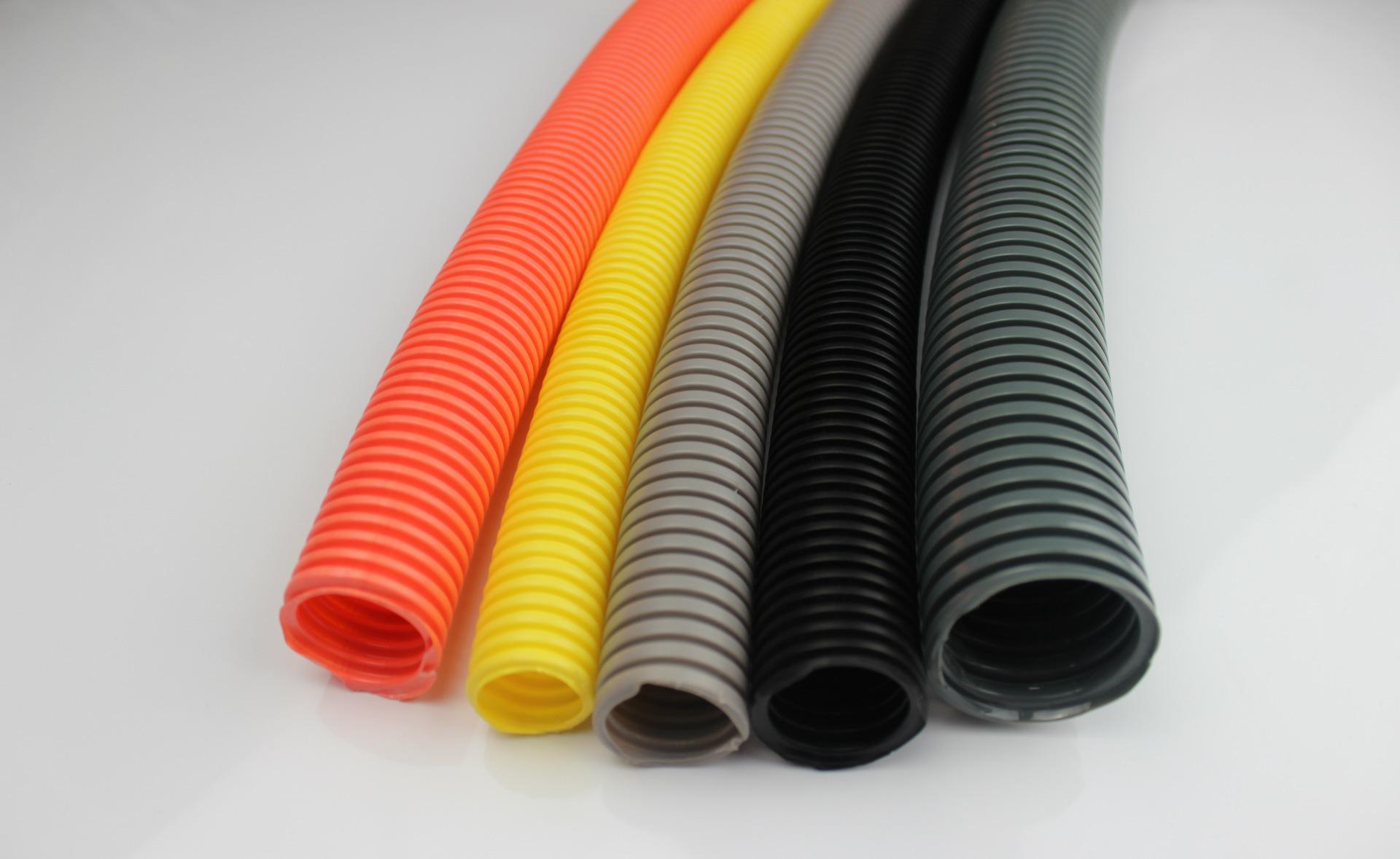
Single-wall corrugated conduit is produced on a corrugated pipe extrusion line, not on a solid-wall PVC pipe line — a distinction worth settling during the evaluation stage.
Frequently asked questions
1. What certification and compliance documents should a PVC pipe extrusion line come with?
Compliance requirements are set by your destination market rather than by the machine category. In the European Union, extrusion machinery for building products — WPC door panel lines, for example — is typically supplied with CE marking for market compliance and ISO 9001 for quality management (Benk Machinery certification standards). For a PVC pipe line, confirm with the supplier which documents are issued for the exact configuration you order, and verify them against your own market's import requirements before shipment. JKS supports this process with 100% factory pre-assembly and testing before shipment and third-party inspection available on request.
2. What output can a PVC water supply and drainage pipe line actually achieve?
Output is a function of the diameter band and the extruder matched to it. On the JKS PVC pipe line, the PVC63 double-station configuration runs at 270 kg/h over Φ16–63 mm with an SJSZ65/132 extruder; the PVC250 configuration runs at 450 kg/h over Φ90–250 mm with an SJSZ80/156 extruder; and the PVC630 configuration runs at 800 kg/h over Φ315–630 mm with an SJSZ92/188 extruder. Because the mixing and cooling stage is batch-based, the SRL-Z unit feeding the line must have an hourly band above the line's output.
3. What drives the cost of a PVC pipe extrusion line?
Four cost drivers dominate. First, the diameter band, because it sets the haul-off, calibration and die head size — main motor power rises from AC 37 kW on PVC63 to AC 55 kW on PVC250 and AC 110 kW on PVC630, with downstream power moving from 24 kW to 39 kW. Second, the extruder configuration and screw/barrel specification (38CrMoAlA nitrided alloy steel) together with the die head material (precision casting die steel). Third, whether the scope includes upstream and recovery equipment — the SRL-Z mixing and cooling unit, plus crusher and pulverizer capacity. Fourth, customisation: extruder model, screw configuration, line layout, voltage and frequency, and control system can all be specified, and each change alters the quotation.
4. How can a buyer validate the line before placing a full order?
Validation happens in stages. JKS accepts a minimum order of one unit and builds lines on an OEM, ODM and custom-design basis, so a configuration can be specified around your own formulation and pipe range rather than taken from a standard catalogue. Every line is 100% factory pre-assembled and tested before shipment, and third-party inspection can be arranged on request. Technical training and formulation service are provided according to the client's raw material and production demand, which is where the mixing and cooling parameters are usually confirmed.
5. What is the lead time, and what happens after delivery?
Quoted lead time is 40 working days, against a monthly production capacity of 30 units, with a minimum order quantity of one unit. After delivery, JKS provides overseas installation guidance, on-site commissioning, operator training, remote technical support and a 12-month warranty, with free factory installation, technical training and formulation service included in the project scope. Machines are built in Wuxi, Jiangsu Province, and exported to more than 35 countries across Southeast Asia, Russia, the Middle East, Europe, Central Asia, Africa and South America. If you want the lead time estimated against your own diameter range and output target, send your pipe specification to gordon@jksjx.com or message WhatsApp 86 18601577228 and JKS will return a configuration sheet.
Next step: match the line to your pipe programme
PVC pipe production rewards a narrow, well-matched configuration over a broad, compromise one. Decide the diameter band, set the output target, size the mixing and cooling unit to feed the extruder, and confirm the die head and downstream specification before commercial terms.
Wuxi JKS Machinery Manufacturing Co. Ltd. — No. 81 Xixian Road, Fangqian Town, Wuxi City, Jiangsu Province, 214000, P.R. China. Tel: 86 18651004566. Email: gordon@jksjx.com. Website: www.extrudetec.com. Full product range: download the JKS product brochure (PDF).
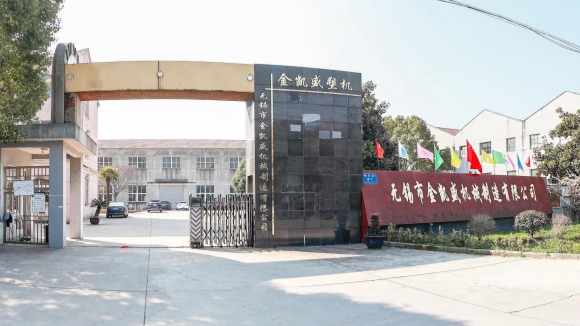
Wuxi JKS Machinery Manufacturing Co. Ltd., Wuxi, Jiangsu Province — the plant where PVC pipe extrusion lines are pre-assembled and tested before shipment.
Conclusion
Selecting a PVC pipe extrusion line is a matching exercise: diameter band first, output second, mixing capacity third, tooling and downstream equipment fourth. The PVC63, PVC250 and PVC630 configurations cover three distinct production profiles, and each one carries its own extruder, motor power, hauling speed and hourly output — which is why the diameter range has to be settled before the quotation, not after.
The upstream stage deserves equal attention. A pipe line is only as consistent as the compound fed into it, which makes the SRL-Z mixing and cooling unit a production decision rather than a peripheral purchase. Add a defined scrap recovery loop and a clearly specified die head, and the line has everything it needs to hold dimensional and surface quality across a shift.