
Plastic Extrusion Machine Lifecycle Partnerships: What to Evaluate Before Your Line Starts
Plastic Extrusion Machine Lifecycle Partnerships: What to Evaluate Before Your Line Starts
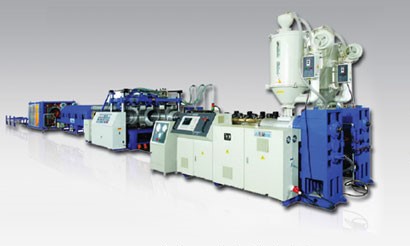
Buying a plastic extrusion machine is the start of a long production relationship, not a one-time equipment purchase. For a factory owner, project manager or machinery distributor, the more useful question is whether the supplier can support the line after delivery and after initial commissioning. This guide is intended for buyers in the decision-to-execution stage. It explains what to verify before placing an order, and it uses Wuxi JKS Machinery Manufacturing Co. Ltd. as an example of a China-based manufacturer focused on custom full-set plastic extrusion production lines.
Why Lifecycle Capacity Matters More Than the Machine Price
Buyers at decision stage often compare screw diameter, motor power and machine price. Those points are necessary, but they do not predict whether the line will run steadily in month six or whether spare parts will arrive on time. The risks usually appear after execution: a line arrives without a full pre-shipment test, first start-up reveals interface problems between extruder and downstream equipment, or the raw material formula is not adjusted to the buyer's local PVC or CaCO3 grade.
For complete lines such as SPC flooring, PVC pipe, WPC door panel or waste plastic recycling systems, the machine is part of a wider production ecosystem. Mixing, crushing, pelletizing, haul-off, calibration and cutting units must work as one sequence. That is why buyers should evaluate the whole ecosystem, not just the primary extruder.
Market Context: Extrusion Machinery Is Moving Toward Turnkey Ecosystems
External market data supports this view. The global plastic extrusion machinery market was valued at approximately USD 8.93 billion in 2024 and is projected to reach USD 11.58 billion by 2030, according to Grand View Research. The same source reports that Asia Pacific accounted for 41.5 percent of market revenue in 2024, with China as a key contributor. In pipe extrusion, Dataintelo valued the global pipe extrusion lines market at USD 4.8 billion in 2025, and PVC is the leading material segment with 38.6 percent of the market. The SPC flooring segment is also expanding, with Grand View Research projecting growth from USD 6.4 billion in 2026 to USD 10.3 billion by 2033 at a CAGR of 7.2 percent.
These figures help explain why a buyer in 2026 is often not looking for one machine, but for a production capability. Single-screw extruders remain the largest product segment, with about 62.7 percent market share in 2024, but many higher-output sheet, pipe and profile projects are built around conical twin screw extruders, single screw extruder plus downstream systems, or co-extrusion systems. The practical need is closer to a supplier ecosystem with engineering support, not just a parts catalog.
What a Long-Term Plastic Extrusion Machine Partner Should Show You
Product scope that covers complete production loops
Wuxi JKS Machinery Manufacturing Co. Ltd., known as JKS, was founded in 2013 and specializes in custom plastic extrusion machinery and complete turnkey production lines. The company profile defines its product scope as SPC flooring sheet lines, PVC/PP/WPC plastic board lines, PVC and HDPE pipe lines, WPC/PVC profile lines, plastic rod lines and waste plastic recycling pelletizing lines. The portfolio covers many of the product categories buyers search for under plastic extrusion machines, including SPC flooring production lines, PVC artificial marble sheet extrusion lines, PP construction formwork making machines, WPC foam board extrusion lines, PVC hollow wall panel production lines, WPC door panel extruder machines, PVC pipe extrusion lines, HDPE pipe-making lines, PPR water pipe lines, steel wire reinforced composite pipe lines, corrugated pipe extruders, PVC window profile lines, PP/PA/POM rod extruders, PVC decoration strip profile lines and small single screw profile extruders.
With this range, JKS can act as a single engineering channel for the main extruder and for auxiliaries such as high-speed mixers, crushers and pulverizers.
Delivery capacity for one-order entry and repeat supply
JKS states a minimum order quantity of one unit and a typical production lead time of 40 work days. Its monthly production capacity is 30 units, against an annual output of about 200 units. The company operates a 2,000 m² factory workshop and has six engineers in its R&D team. Around 50 percent of output is exported to Southeast Asia, Russia, Middle East, Europe, Central Asia, Africa and South America, and JKS reports that its machines have been delivered to more than 35 countries.
For an end customer, this means a single-line order is acceptable. For a distributor, monthly capacity of 30 units offers a clearer basis for planning repeat orders.
Quality control that is visible before shipment
JKS's stated quality process includes 100 percent factory pre-assembly and testing before shipment. Third-party inspection is available on request. The acceptance procedure is a pre-shipment factory test. The manufacturer also lists PLC automatic control, real-time monitoring, overload protection, emergency stop functions and pre-shipment testing as risk-control measures. For a buyer, this lowers the risk of discovering wiring, alignment or parameter issues only during on-site commissioning.
Installation, training and formulation service
JKS describes its service scope as personalized design, free factory installation, technical training and formulation service, based on client raw material and production demand. Its post-shipment service resources include standardized installation guidance, remote technical support, on-site troubleshooting and spare parts supply. This matters at execution stage because first production runs often require screw speed, temperature and die adjustments.
Auxiliary equipment and recycling loop
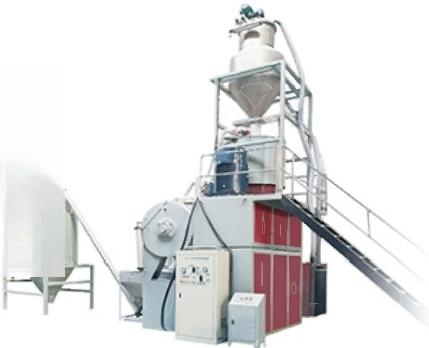
A full extrusion line is only as strong as material preparation and scrap handling. JKS supplies SRL-Z high-speed PVC mixing and cooling units with models covering output capacities from roughly 300 kg/h to 2,000 kg/h, SP400 and SP660 plastic crushers, and MF400 to MF600 plastic pulverizers. For recycling, single-stage and two-stage water strand pelletizing lines cover PE, PP, ABS, PS, HIPS and PC, while PVC hot-cut pelletizing lines use conical twin screw extruders from SJSZ55 to SJSZ92.
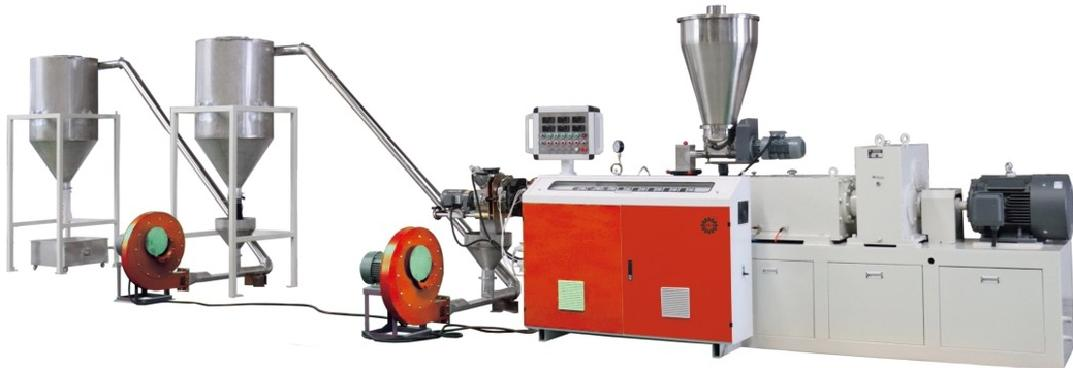
For a distributor or plant owner, this reduces fragmented sourcing. Spare parts and process questions can be handled through one supplier instead of several unconnected brands. The same factory can supply the mixer, crusher or pulverizer that keeps the extruder line moving.
Segment-specific engineering comparisons
JKS also provides engineering comparisons for its line types. These are productized design claims, not third-party certification results. For SPC flooring, PVC artificial marble sheet and WPC door panel applications, JKS states 15 to 20 percent higher output speed, a ±0.1 mm thickness tolerance and 10 percent less material waste compared with conventional single-layer extrusion lines. For PVC and HDPE pipe lines, the stated improvements include more uniform wall thickness, ±0.05 mm wall-thickness control, 10 to 15 percent higher output and about 5 percent less material waste, with lower long-term maintenance costs. For profile and hollow wall panel lines, JKS cites 12 to 18 percent higher output per line and consistent profile dimensions from multi-cavity molds and precise calibration.
Buyers should treat these values as design targets for their own material and product geometry. The proper way to validate them is through a pre-shipment factory test and a commissioning trial.
From Decision to Execution: A Supplier-Review Workflow for Long-Term Buyers
- Define the exact product line. Confirm finished product dimensions, raw material type, formula assumptions and desired daily output. A pipe producer might specify HDPE or PVC diameter range, while a floor manufacturer should confirm sheet width, thickness range and whether embossing is required.
- Map the main extruder and downstream equipment. Check whether the supplier can provide the complete calibrated system. JKS examples include SJSZ92/188 and SJSZ110/220 extruders for SPC flooring lines, PE110 to PE1600 models for HDPE pipe lines, PVC63 to PVC630 models for PVC pipe lines, and SJSZ80/156 for WPC door panel and foam board lines.
- Verify supplier capacity and delivery commitment. Confirm the MOQ, production lead time and monthly output. JKS publishes a one-unit MOQ, a typical lead time of 40 work days and a monthly factory capacity of 30 units.
- Schedule a factory test and inspection. Ask whether the line will be pre-assembled and tested before shipment, and whether third-party inspection can participate. JKS uses 100 percent factory pre-assembly and testing before shipment, and acceptance is a pre-shipment factory test.
- Agree on commercial and shipping terms. A common JKS arrangement is FOB delivery with a 30 percent T/T deposit and 70 percent T/T balance before shipment. Confirm the exact scope to avoid missing auxiliary equipment in the commercial invoice.
- Plan installation, training and formula adjustment. Use the supplier's factory installation and technical training window to train operators on the first batch. Also confirm who will support formulation when local raw material quality changes.
- Establish an after-sales protocol. Define remote technical support, on-site troubleshooting and spare parts ordering before the line arrives. Standardized installation guidance and spare parts supply should be part of the handover.
- Define a staged expansion path. Distributors and growing factories benefit most from a supplier that can accept a first one-line order and later support additional lines without changing engineering standards.
Use Cases: Lifecycle Needs in Typical Buying Scenarios
New SPC flooring plant with a tight launch plan
A building-material project planning to produce rigid SPC flooring will evaluate parameters such as product width 980 mm or 1250 mm and thickness from 1 mm to 10 mm. JKS offers EIR in-line synchronous embossing SPC flooring extrusion lines with output ranges of 15 to 40 tons per 24 hours, depending on extruder model. For an execution-stage buyer, the critical support point is calibration accuracy and embossing alignment, which require coordinated adjustment of screw speed, calender roller, haul-off speed and temperature. Pre-shipment testing is especially valuable in this scenario.
Municipal pipe distributor expanding from PVC to HDPE and reinforced pipe
A distributor currently selling PVC pipes may want to add HDPE water pipe and steel wire reinforced composite pipe lines. JKS supplies HDPE lines from PE110 up to PE1600 for pipe diameters from 20 mm to 1600 mm, and steel wire mesh reinforced composite pipe lines from GS/PE-160-H to GS/PE-630-H. These larger systems need downstream haul-off, cooling, cutting and die-matching support. A long-term supplier helps the distributor manage different pipe diameter ranges without re-engineering the whole line.
Recycling project built around a pelletizing center
Waste plastic recyclers often start with a crusher or pulverizer, then add a pelletizing line and mixing unit. JKS supplies SP400/SP660 crushers, MF400 to MF600 pulverizers, strand pelletizing lines and PVC hot-cut pelletizing lines. Because all units are designed for PVC, PE, PP or ABS material flows, the buyer can build the recycling process step by step while keeping a single spare-parts and technical-support channel.
Comparison Snapshot: JKS Full-Ecosystem Line Engineering versus Basic Alternatives
| Application segment | JKS line example | Stated difference versus basic alternatives | Maintenance and efficiency note |
|---|---|---|---|
| SPC flooring, PVC marble sheet, WPC door panel | EIR in-line synchronous embossing SPC flooring line; SJSZ92/188, SJSZ110/220 | 15-20% higher output speed; ±0.1 mm thickness tolerance; 10% less material waste | Integrated control system; easy mold change; 8-10% lower power consumption |
| PVC, HDPE and composite pipe | PVC63 to PVC630; PE110 to PE1600; GS/PE steel wire reinforced composite pipe lines | 10-15% higher output; ±0.05 mm wall-thickness control; 5% less material waste | Wear-resistant screw and barrel; 30% lower long-term maintenance cost; 7-10% lower energy use |
| PVC/WPC profile, hollow wall panel and ceiling line | SJSZ51 to SJSZ80; WPC door and window profile lines | 12-18% higher output per line; consistent profile dimensions; low reject rate | Quick mold change; modular design; 6-8% lower energy consumption |
| Auxiliary equipment and pelletizing | SRL-Z mixing and cooling unit; SP crusher; MF pulverizer; PVC hot-cut pelletizing line | 10-15% higher processing capacity; longer service life; 5% lower energy use | Similar initial cost; simple structure; easy to clean; spare parts readily available |
Table notes: Performance differences are JKS engineering comparison statements for its line configurations against generic or conventional alternatives. They are not independent third-party benchmarking results and should be confirmed during pre-shipment testing and commissioning.
FAQ: Long-Term Plastic Extrusion Machine Partnership Questions
1. How does JKS verify quality and machine readiness before shipment?
Quality control includes 100 percent factory pre-assembly and testing before shipment. JKS can arrange third-party inspection on request. Risk-control measures include PLC automatic control, real-time monitoring, overload protection, emergency stop functions and pre-shipment testing. Acceptance is based on a pre-shipment factory test.
2. Which plastic extrusion lines can be supplied as one long-term ecosystem?
JKS supplies custom full-set lines for SPC flooring, PVC artificial marble sheets, PVC and WPC foam boards, PVC pipes, HDPE pipes, PPR pipes, steel wire reinforced composite pipes, corrugated pipes, PVC and WPC door and window profiles, hollow wall panels, solid plastic rods and waste plastic recycling pelletizing. It also supplies conical twin screw extruders, single screw extruders, PVC mixer-cooling units, crushers and pulverizers.
3. Can a first-time buyer place only a one-line order?
Yes. The minimum order quantity is one unit. Monthly production capacity is 30 units, and annual output is about 200 units. This structure allows a first-time buyer to start with one line and later expand without being treated as a small account.
4. Is third-party inspection accepted before shipment?
Yes. Third-party inspection is available on request. The supplier's standard quality process includes 100 percent factory pre-assembly and testing before shipment. This means buyers or their representatives can verify assembly, electrical systems and trial-run results before the machine is packed.
5. What is the lead time and delivery method?
The typical production lead time is 40 work days. Delivery is normally on FOB terms. Payment is often structured as 30 percent T/T deposit and 70 percent T/T balance before shipment. If your construction schedule is fixed, send the line parameters and required delivery date to JKS to confirm line availability and scheduling before placing the order.
Conclusion: Judge a Plastic Extrusion Machine Supplier by the Lifecycle It Can Support
For buyers at the decision-to-execution stage, long-term supplier reliability is the hidden driver behind production uptime, material consistency and future expansion. The practical evidence you need is simple: whether the supplier runs a full factory test before shipment, whether its lead time is realistic, whether spare parts and auxiliary equipment can be sourced through one channel, and whether installation, training and formulation support are included in the project scope.
JKS offers one example of that model. The company accepts one-unit orders, tests its lines before shipment, supports installation and training, supplies auxiliary and recycling equipment, and publishes a monthly production capacity of 30 units. If the next step is a quotation, line configuration or distributor conversation, contact Gordon at gordon@jksjx.com or via WhatsApp at 86 18601577228.
Starting a line project or evaluating long-term supply? Share your raw material, target product and daily output with JKS to receive a technical proposal. The JKS WPC project brochure is available for reference: Download JKS WPC project brochure (PDF).