
Plastic Extrusion Machine Line Basics and Selection Logic
Plastic Extrusion Machine Line Basics and Selection Logic
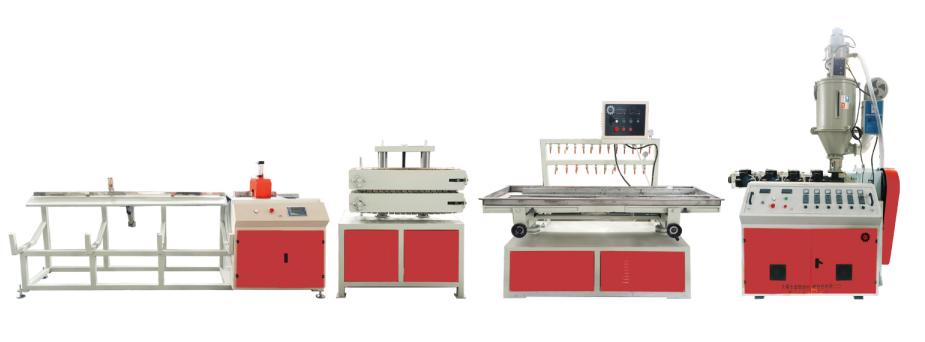
JKS small single-screw profile extrusion line: a compact configuration for multi-material profiles.
Plastic extrusion is a continuous manufacturing process in which thermoplastic raw material is melted, plasticized, and forced through a die to form a uniform cross-section. A plastic extrusion machine is the core of that process, but the real buying unit in industrial settings is the production line: extruder, die, calibration, cooling, haul-off, cutting, and often upstream mixing or recycling equipment.
For buyers in the awareness and research stage, the first step is not to compare brand names. It is to understand how machine architecture and downstream configuration relate to the product you plan to make. This guide explains the two main extruder architectures, the structure of complete lines, common product use cases, and the selection logic behind moving from a product idea to a machine specification.
Problem Definition: Why 'plastic extrusion machine' alone is not enough
Most suppliers receive inquiries that say 'I need a plastic extrusion machine.' That brief is too broad. A machine configured for SPC flooring has a four-roller calender and embossing station; a machine configured for PVC drainage pipe has a vacuum calibration tank and multi-claw haul-off; a machine configured for PP formwork uses a large single-screw extruder and wide forming die. The same basic screw-and-barrel concept leads to different lines because the downstream equipment and mold determine the final product.
Equipment selection therefore starts with three questions:
- What is the target product geometry: pipe, sheet, profile, rod, panel, or pellet?
- What raw material will be used: PVC dry blend, PE/PP pellets, recycled granule, or compound with high filler content?
- What output rate and plant power supply are available?
These answers decide whether a single-screw extruder, a conical twin screw extruder, or a complete co-extrusion line is the right starting point.
Industry Background: The plastic extrusion machinery market
The market context helps explain why buyers need a structured selection process. According to Grand View Research, the global plastic extrusion machinery market was valued at approximately USD 8.93 billion in 2024 and is projected to reach USD 11.58 billion by 2030. Asia Pacific led the market in 2024 with a 41.5% revenue share, and China was the largest contributor in the region.
Within the same market, single-screw extrusion machines held an estimated 62.7% share in 2024. That dominance reflects their versatility. However, PVC pipe extrusion lines remain a major segment: Dataintelo valued the global pipe extrusion lines market at USD 4.8 billion in 2025, with PVC accounting for 38.6% of the material segment.
One of the fastest-growing downstream sectors is SPC flooring. Grand View Research projects the Stone Plastic Composite flooring market will grow from USD 6.4 billion in 2026 to USD 10.3 billion by 2033, a 7.2% CAGR. This explains why manufacturers such as Wuxi JKS Machinery Manufacturing Co. Ltd., a Wuxi-based custom plastic extrusion machinery producer established in 2013, build complete SPC flooring extrusion lines rather than only standalone extruders.
Detailed Solution: Understand the two core extruder architectures
Single screw plastic extruder
A single screw plastic extruder contains one screw rotating inside a heated barrel. JKS's SJ series can be customized to models such as SJ30, SJ45, SJ65, and SJ90. It processes PVC, PP, PE, Nylon, and ABS. With different molds and auxiliary equipment, it can produce pipes, rods, films, pellets, coated products, and blow-molded bottles.
From a construction standpoint, the screw and barrel are made of 38CrMoAlA nitrided alloy steel, and the machine frame is Q235 carbon steel. The single-screw design is widely used because it offers broad material adaptability and a simple operating principle.
Conical twin screw plastic extruder
A conical twin screw plastic extruder uses two conical screws that converge toward the die. JKS models include SJSZ-45, SJSZ-51, SJSZ-55, SJSZ-65, SJSZ-80, SJSZ-92, and SJSZ-110. The configuration is designed for direct extrusion of PVC powder, which removes a separate pelletizing step in many PVC product lines.
JKS describes the conical twin screw as providing uniform plasticizing and mixing, low shearing, high productivity, stable quality, and long service life. It is commonly used in PVC pipe, sheet, profile, WPC door, and flooring lines.
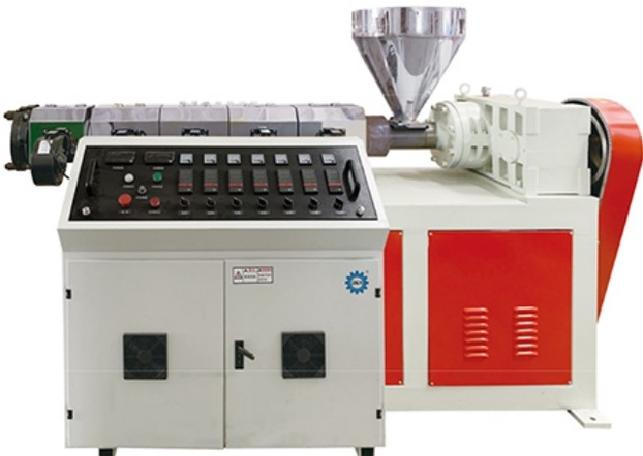
JKS SJ series single screw plastic extruder.
From extruder to complete line
In production, the extruder is only one unit. For PVC pipe, profile, and sheet lines, JKS supplies an upstream PVC mixing and cooling unit. The SRL-Z series includes models such as SRL-Z200/500, SRL-Z300/600, SRL-Z500/1000, and SRL-Z1000/3000. The mixing pot is stainless steel, and the frame is carbon steel. A typical batch cycle is 8–10 minutes for hot mixing and 6–8 minutes for cooling.
Downstream units vary by product. Most lines include calibration, cooling, haul-off, cutting, and stacking. Some lines include additional functions such as co-extrusion, calendering, embossing, or lamination.
Representative JKS production lines
The following list shows how the same extruder technology is configured for different outputs.
- SPC Flooring Extrusion Line: finished product thickness 1–10 mm, effective width 980 mm or 1250 mm, output 15–40 tons per 24 hours depending on extruder model. It uses a vertical/inclined four-roller calender and optional EIR in-line synchronous wood grain embossing.
- PVC Pipe Extrusion Line: models PVC63, PVC250, and PVC630, covering pipe diameters from Φ16 mm to Φ630 mm; structural configuration is a conical twin screw extruder.
- HDPE Water Pipe Extrusion Line: models PE110 to PE1600, with extrusion capacities from 150–400 kg/h to 600–1500 kg/h.
- PPR Pipe Extrusion Line: PPR20-75 with 80–160 kg/h and PPR20-110 with 80–250 kg/h.
- PVC & WPC Foam Board Extrusion Line: finished product width 1220 mm; model SJSZ80/156 or 80+165 co-extrusion.
- PP Hollow Construction Formwork Extrusion Line: width 1220 mm, thickness 15–20 mm, daily output 420–480 pieces per 24 hours.
- PVC Imitation Marble Sheet Extrusion Line: sheet thickness 1–12 mm, effective width 1220 mm, output 400–700 kg/h.
- WPC Door Panel Extrusion Line: models SJSZ80 and SJSZ92 with output capacities of 250–400 kg/h and 400–600 kg/h respectively.
- PVC Hollow Wall Panel & Ceiling Extrusion Line: widths from 300 mm to 1200 mm and outputs from 120 kg/h to 400 kg/h.
- Multi-material Plastic Profile Extrusion Line: models SJ45, SJ50, SJ65; processes PP, PE, PVC, PS, PC, ABS; custom molds produce profiles such as sealing strips, edge bands, and PC lamp profiles.
- Solid Plastic Rod Extrusion Line: SJ45 produces rods 6–60 mm at 5–18 kg/h; SJ65 produces rods 30–200 mm at 20–60 kg/h.
- Corrugated Pipe Extrusion Line: KSPG series for small diameters 6–63 mm and KS series for 50–160 mm.
- Steel Wire Mesh Reinforced Composite Pipe Extrusion Line: models from GS/PE-160-H (φ50–160 mm) to GS/PE-630-H (φ315–630 mm).
- MPP & PE High Voltage Power Pipe Extrusion Line: PEG63 covers φ20–63 mm and PG160 covers φ75–160 mm.
- Waste Plastic Strand Cutting Pelletizing Line: ST80 to ST150, with capacities from 70–160 kg/h to 350–650 kg/h.
- PVC Hot-cut Pelletizing Line: SJSZ55, SJSZ65, SJSZ80, and SJSZ92, from 100–150 kg/h to 650–800 kg/h.
Supporting equipment includes pulverizers such as MF400, MF500, and MF600, and crushers such as SP400 and SP660. These are used in compounding and recycling lines.

JKS HDPE solid wall pipe extrusion line.
Step-by-Step Breakdown: How to Match a Line to a Product
Step 1: Define the finished product
Write down the exact product specification: diameter or width range, wall thickness, density, surface finish, and daily production target.
Step 2: Confirm raw material and formulation
PVC dry blend allows direct feeding into a conical twin screw extruder. PE, PP, PA, or POM pellets are usually processed by a single screw extruder. High-filler formulations such as PVC + CaCO₃ require the screw design and motor torque to match the formulation.
Step 3: Choose the extruder type
Use a single screw for general thermoplastic products and a conical twin screw for PVC powder extrusion. For co-extrusion products such as imitation marble sheets or ABA structure formwork, a main extruder plus co-extruder is required.
Step 4: Select the downstream line
Match the calibration, cooling, haul-off, cutting, and stacking equipment to the product cross-section. Pipe lines use vacuum calibration tanks; sheet lines use calender rollers; profile lines use precision molds and cooling tables.
Step 5: Check plant power and layout
Complete lines occupy significant floor space. The PP hollow construction formwork line, for example, has an overall machine dimension of 34 m × 7 m × 4.5 m and is designed for 380V/50Hz three-phase power.
Step 6: Plan installation and training
For custom equipment, the supplier should provide installation guidance and technical training. JKS states that it provides personalized design, free factory installation, technical training, and formulation service based on the client's raw material and production demand.
Use Cases: Common Buying Scenarios
SPC flooring manufacturer
A flooring producer needs a line that can extrude SPC rigid core boards, laminate the structure, and optionally emboss wood grain in line. JKS's SPC flooring extrusion line with EIR embossing is a direct match.
Municipal and building pipe producer
For water supply and drainage, the buyer can choose HDPE, PVC, or PPR pipe lines depending on the local market and application. HDPE PE110 to PE1600 covers a wide diameter band; PVC63 to PVC630 covers building water supply; PPR20-75 and PPR20-110 cover hot and cold water plumbing.
Interior panel and door manufacturer
PVC hollow wall panel lines, PVC imitation marble sheet lines, and WPC door panel lines are all built around PVC/calcium carbonate compounds and are used in wall, ceiling, furniture, and door production.
Construction formwork manufacturer
PP hollow construction formwork lines convert recycled PP granule into reusable concrete formwork. The JKS line produces 1220 mm wide boards with a daily output of 420–480 pieces per 24 hours.
Recycling and compounding plant
Recyclers can choose a strand cutting pelletizing line for PE/PP/ABS/PS/HIPS/PC or a PVC hot-cut pelletizing line for soft or hard PVC. Pulverizers and crushers prepare the input material.
Comparison Table: Single Screw vs. Conical Twin Screw
| Comparison point | Single Screw Plastic Extruder | Conical Twin Screw Plastic Extruder |
|---|---|---|
| Representative JKS series | SJ series (SJ30, SJ45, SJ65, SJ90, custom) | SJSZ-45 to SJSZ-110 |
| Typical raw materials | PVC, PP, PE, Nylon, ABS | PVC powder; also used in PVC + CaCO₃ compounds |
| Typical products | Pipes, rods, films, pellets, coated products, blow-molded bottles | PVC pipes, sheets, bars, profiles, WPC door and flooring lines |
| Key characteristics | Versatile, wide material adaptability | Uniform plasticizing and mixing, low shearing, stable quality |
| Construction | Screw/barrel: 38CrMoAlA nitrided alloy steel; frame: Q235 | Screw/barrel: 38CrMoAlA nitrided alloy steel; frame: Q235 |
| Representative output example | SJ45 solid rod line: 5–18 kg/h | SJSZ-92: 90 kW, 500–600 kg/h |
| Market context | Single-screw segment ~62.7% global share in 2024 | Common in PVC direct extrusion applications |
FAQ
What compliance requirements apply to plastic extrusion machines sold internationally?
For WPC door panel extrusion machinery, CE marking is commonly required for EU market entry, and ISO 9001 is often expected for quality management. Compliance requirements vary by destination and product type, so buyers should ask the supplier for the relevant technical documentation before order. JKS exports to markets including Southeast Asia, Russia, the Middle East, Europe, Central Asia, Africa, and South America.
What products can a plastic extrusion machine produce?
A plastic extrusion machine can be configured to produce SPC flooring, PVC and WPC foam board, PVC pipes, HDPE pipes, PPR pipes, PVC/WPC profiles, solid plastic rods, corrugated pipes, steel wire reinforced composite pipes, MPP/PE power conduits, and plastic pellets. The specific output depends on the extruder type, mold, and downstream line.
How much should I budget for a plastic extrusion machine?
There is no fixed price because each line is customized around raw material, product size, output target, and downstream automation. A complete line usually includes the extruder, mold, calibration unit, cooling tank, haul-off, cutting system, and upstream mixing or feeding equipment. Request a quotation with product dimensions and target output to get a realistic budget.
Can I test a line configuration or get a sample before ordering?
JKS provides personalized design, free factory installation, technical training, and formulation service based on the client's raw material and production demand. For a specific project, contact JKS with your material and target product; the team can propose a line configuration and discuss the next step.
What is the lead time for a custom plastic extrusion line?
Lead time depends on line complexity and customization. JKS has an annual output capacity of 200 units and an R&D team of 6 engineers. Standard models may be faster, while fully customized turnkey lines require more time. The supplier should provide a confirmed schedule at the proposal stage. For a project-specific lead time and quotation, contact gordon@jksjx.com.
Conclusion
Choosing a plastic extrusion machine means choosing a system around an extruder. Single screw architecture is versatile, while conical twin screw architecture is efficient for PVC powder. The final decision depends on product geometry, raw material, output, facility, and downstream automation. JKS builds custom full-set plastic extrusion lines and exports to more than 35 countries. For a defined project, the next step is to send your material and product specification to the JKS team for a line proposal.
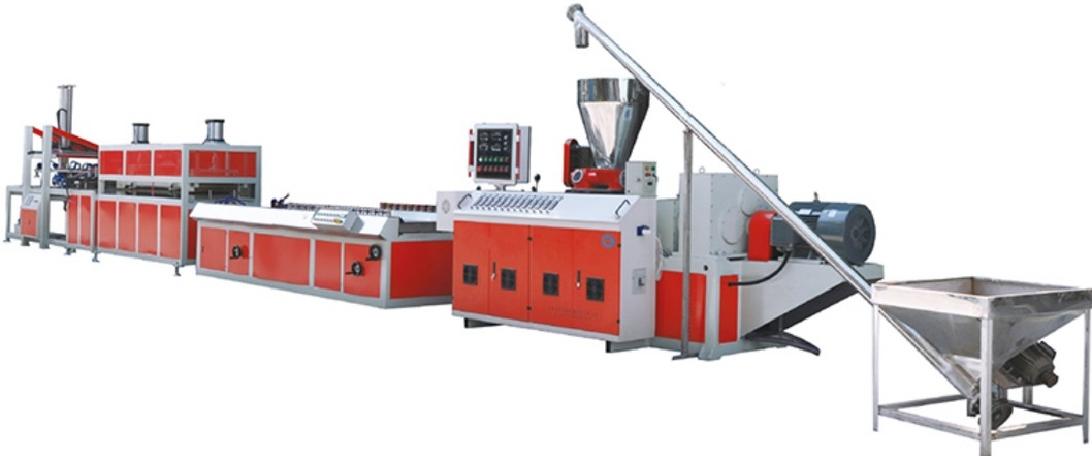
Want to match a plastic extrusion machine line to your product?
Contact Gordon: gordon@jksjx.com | Tel: 86 18651004566 | WhatsApp: 86 18601577228
Address: No. 81 Xixian Road, Fangqian Town, Wuxi City, Jiangsu Province, China