Single Screw vs. Conical Twin Screw Extruders: A Practical Comparison for PVC Pipe and Profile Lines
Single Screw vs. Conical Twin Screw Extruders: A Practical Comparison for PVC Pipe and Profile Lines
The short answer: if your line feeds dry-blend PVC powder into a pipe or profile die, the conical twin screw extruder — the SJSZ series — is the architecture designed for that job. If you are running pelletized PP, PE, Nylon or ABS, or producing solid rods, small decorative profiles, construction formwork panels or polyolefin pipe, the single screw extruder — the SJ series — is the more versatile option. The two architectures are not interchangeable, and the correct choice is decided by feedstock form, output target and downstream line, not by which one looks cheaper in a quotation.
Buyers at the research and evaluation stage usually arrive at this decision the same way. They know they need a plastic extrusion machine, they have a product in mind, and then they find two extruder families sitting in the same catalog, both described as suitable for “pipe and profile”. This comparison uses the published model ladders and parameters of both families — SJ30 to SJ90 on the single screw side, SJSZ-45 to SJSZ-110 on the conical twin screw side — and connects them to the downstream PVC pipe, profile, sheet and pelletizing lines they are normally matched with.
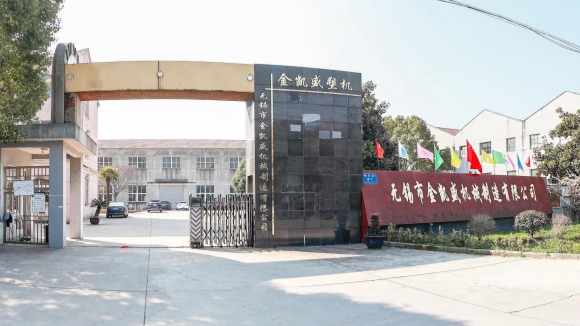
Wuxi JKS Machinery Manufacturing Co. Ltd. (JKS) is a Chinese manufacturer founded in 2013 that designs and builds custom plastic extrusion machinery and complete turnkey production lines. The company operates a 2,000 m² workshop in Wuxi, Jiangsu Province, with a six-engineer R&D team, an annual output of about 200 units, and exports to more than 35 countries worldwide.
Problem Definition: Why the Extruder, Not the Die, Decides the Line
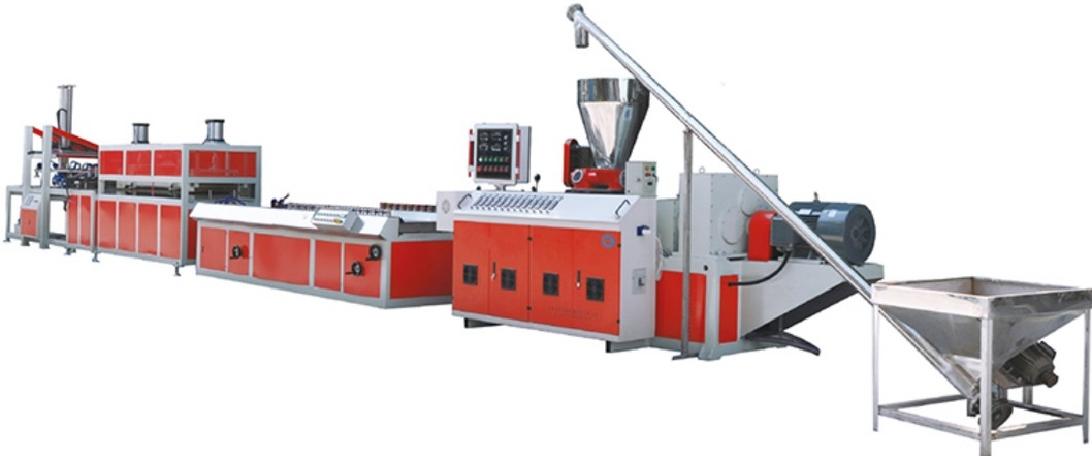
Most PVC pipe and profile projects reach the quotation stage with the line concept already fixed: die, vacuum calibration, cooling tank, haul-off, cutter. The extruder is treated as a component to be costed. In practice, the extruder decides whether the rest of that line can reach its design speed and surface quality at all.
Five mismatch risks are worth checking before the commercial comparison begins:
- Feedstock form. A conical twin screw extruder is built for the direct extrusion of PVC powder into pipes, sheets, bars and profiles. A single screw extruder is specified for PVC, PP, PE, Nylon and ABS, but in practice it is most comfortable with pelletized or compounded feedstock of consistent bulk density.
- Output ladder. The published outputs run from 70 kg/h on an SJSZ-45 to 1,000 kg/h on an SJSZ-110 — roughly a factor of fourteen. A pipe line sized for the wrong point on that ladder will be over- or under-powered from day one.
- Drive power. Motor ratings in the same range climb from 15 kW to 200 kW. Because drive power, screw geometry and output move together, choosing the extruder is effectively choosing the operating window of the whole line.
- Downstream speed. The matched haul-off speeds on JKS PVC pipe lines differ sharply by diameter — 4–49 m/min on a Φ16–63 mm line, but 0–5 m/min on a Φ315–630 mm line. The extruder has to deliver a melt rate that keeps that speed stable.
- Compound preparation. The mixing and cooling unit upstream has to stay ahead of the extruder’s consumption, and the pelletizing or sheet unit downstream has to accept what the screw delivers.
None of these problems appear in a quotation. They appear in the first weeks of production, when a line specified for 250 kg/h settles at a lower rate, or when a profile shows surface defects that no amount of calibration adjustment removes. That is why the extruder decision belongs to the specification stage.
Industry Background: Why PVC Still Sets the Rules
Three published data points frame the decision. The global plastic extrusion machinery market was valued at approximately USD 8.93 billion in 2024 and is projected to reach USD 11.58 billion by 2030 (Grand View Research). Within that, the pipe extrusion lines market is valued at USD 4.8 billion in 2025, with PVC as the leading material segment at 38.6% (Dataintelo). Geographically, Asia Pacific held a 41.5% revenue share of the extrusion machinery market in 2024, with China the leading contributor in the region (Grand View Research).
One widely quoted figure is easy to misread. Single screw extrusion machines held approximately 62.7% of the global extrusion machinery market in 2024 (Grand View Research). That number covers every extrusion application — film, sheet, compounding, recycling, wire coating — not PVC dry-blend pipe and profile processing. It should not be read as evidence that a single screw will run a PVC dry blend as well as a conical twin screw. For PVC powder feeding a pipe or profile die, the conical twin screw remains the standard architecture, and that is where the SJSZ ladder sits.
The sheet side points in the same direction. The SPC flooring market is projected to grow from USD 6.4 billion in 2026 to USD 10.3 billion by 2033, a 7.2% CAGR (Grand View Research). SPC cores are extruded from a PVC + CaCO₃ compound, which is the same material family that makes the twin screw decision central to rigid PVC sheet and board work.
Detailed Solution: What the SJ and SJSZ Ranges Actually Cover
Conical Twin Screw (SJSZ): Designed for PVC Powder
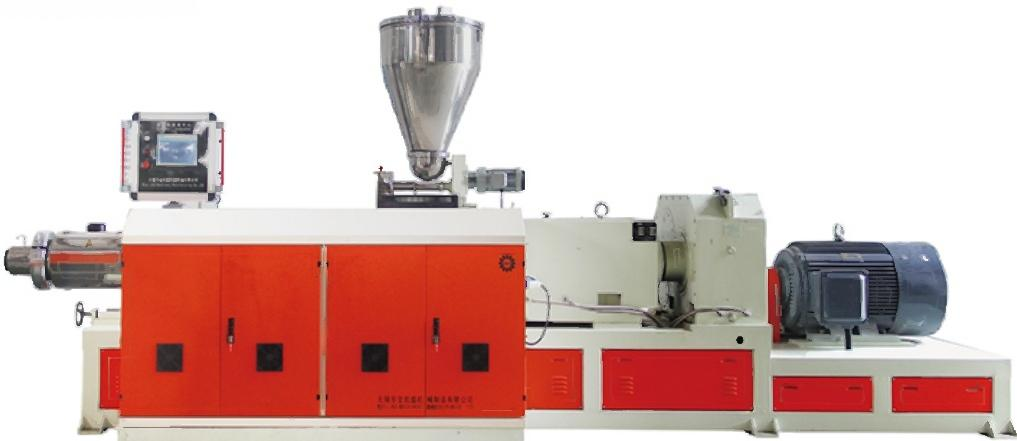
Conical twin screw extruders in the SJSZ series are specified for the direct extrusion of PVC powder into pipes, sheets, bars, profiles and other plastic products. The documented characteristics are uniform plasticizing and mixing, low shearing, high productivity, stable quality and long service life. These properties matter because PVC dry blend is both shear-sensitive and heat-sensitive, and because the powder has to be conveyed, compacted and gelled continuously in a single pass.
| Model | Main motor power | Output |
|---|---|---|
| SJSZ-45 | 15 kW | 70 kg/h |
| SJSZ-51 | 18.5 kW | 120 kg/h |
| SJSZ-55 | 22 kW | 150 kg/h |
| SJSZ-65 | 37 kW | 250 kg/h |
| SJSZ-80 | 55 kW | 400 kg/h |
| SJSZ-92 | 90 kW | 500–600 kg/h |
| SJSZ-110 | 200 kW | 1,000 kg/h |
Single Screw (SJ): Designed for Versatility Across Thermoplastics
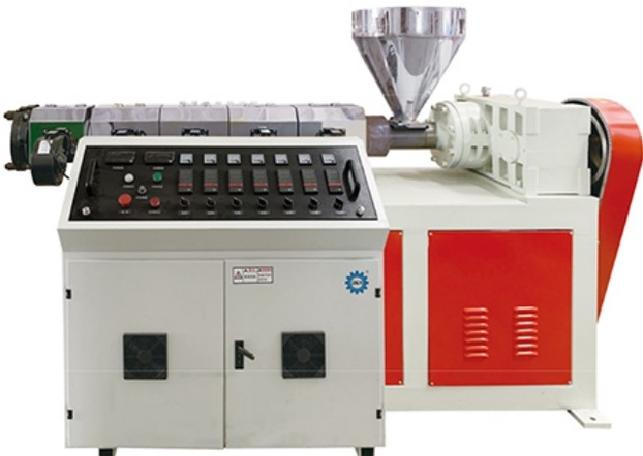
SJ series single screw extruders are specified for PVC, PP, PE, Nylon and ABS. Combined with different molds and auxiliary equipment, one SJ extruder can produce pipes, rods, films, pellets, coated products and blow-molded bottles — thermoplastic products and semi-finished products across several material families. Custom models include SJ30, SJ45, SJ65 and SJ90.
The practical evidence for where the single screw belongs is in the line list rather than in the extruder description:
- Solid plastic rod extrusion line. SJ45 (screw Φ45 mm, L/D 28:1, 7.5 kW, rod Φ6–60 mm, 5–18 kg/h) and SJ65 (screw Φ65 mm, L/D 30:1, 18.5 kW, rod Φ30–200 mm, 20–60 kg/h), running PP, PE, PA and POM for mechanical parts, gears and bushings.
- Multi-material plastic profile extrusion line. SJ45, SJ50 and SJ65, running PP, PE, PVC, PS, PC or ABS into imitation marble profile, ceiling panels, small door and window profiles, sealing strips, edge banding and PVC waterstop.
- PP hollow construction formwork extrusion line. SJ-90×33 (75 kW, 180–250 kg/h) and SJ-130×33 (160 kW, 500–600 kg/h), processing PP recycled granule with MFI < 3.
- HDPE water pipe extrusion line. GS60/38 through GS150/38 extruders across the PE110 to PE1600 range, from 90 kW up to 500 kW main motor power.
- PPR pipe extrusion line. GS65/33 (37 kW, auxiliary GS50/33) for PPR20-75 and GS90/30 (75 kW, auxiliary GS55/33) for PPR20-110.
An observation worth noting on the SPC flooring line: JKS lists SJSZ92/188 (110 kW) and SJSZ110/220 (200 kW) conical twin screw options together with SJP115/30 (90 kW) and SJP135/30 (132 kW) options for the same product family. That is not a contradiction. It shows the extruder is selected per configuration, formulation and output target rather than per product name — which is exactly the decision logic the next section sets out.
Shared Hardware: What Does Not Differentiate the Two Families
Both series use the same wear package: screw and barrel in 38CrMoAlA nitrided alloy steel, and a machine frame in Q235 carbon steel. That combination repeats across the extruders used in the PVC pipe, WPC profile, SPC flooring, foam board, imitation marble sheet and pelletizing lines. The choice between SJ and SJSZ, therefore, is not about who uses better steel. It is about screw geometry, drive power and the process the screw is asked to perform.
Step-by-Step Breakdown: Matching the Extruder to a PVC Pipe or Profile Line
Step 1 — Classify the feedstock
Powder dry blend going straight into the die points to the SJSZ range. Pelletized or regranulated material, or a multi-material profile where several polymers are run on the same line, points to an SJ extruder. Polyolefin pipe (HDPE, PPR) sits in the GS-type screw extruder group listed on those lines.
Step 2 — Fix the output target in kg/h
Output, not motor size, is the selection variable. Identify the tonnes per day or kg/h the business case needs at the finished product, then find the matching point on the SJSZ ladder — 70, 120, 150, 250, 400, 500–600 or 1,000 kg/h.
Step 3 — Read the pipe dimensions backwards into the extruder
On JKS PVC water supply and drainage pipe lines, the matched conical twin screw extruder is published together with the pipe range, main motor power and output:
| PVC pipe line | Pipe diameter range | Matched extruder | Main motor power | Output |
|---|---|---|---|---|
| PVC63 (double station) | Φ16–Φ63 mm | SJSZ65/132 | AC 37 kW | 270 kg/h |
| PVC250 | Φ90–Φ250 mm | SJSZ80/156 | AC 55 kW | 450 kg/h |
| PVC630 | Φ315–Φ630 mm | SJSZ92/188 | AC 110 kW | 800 kg/h |
Haul-off speed moves in the opposite direction to pipe size on these lines: 4–49 m/min on the smallest line, 4–15 m/min on the 250 mm line and 0–5 m/min on the 630 mm line. Downstream power is 24 kW, 24 kW and 39 kW respectively, and all three are equipped with vacuum calibration, multi-claw traction and a dust-free cutting unit.
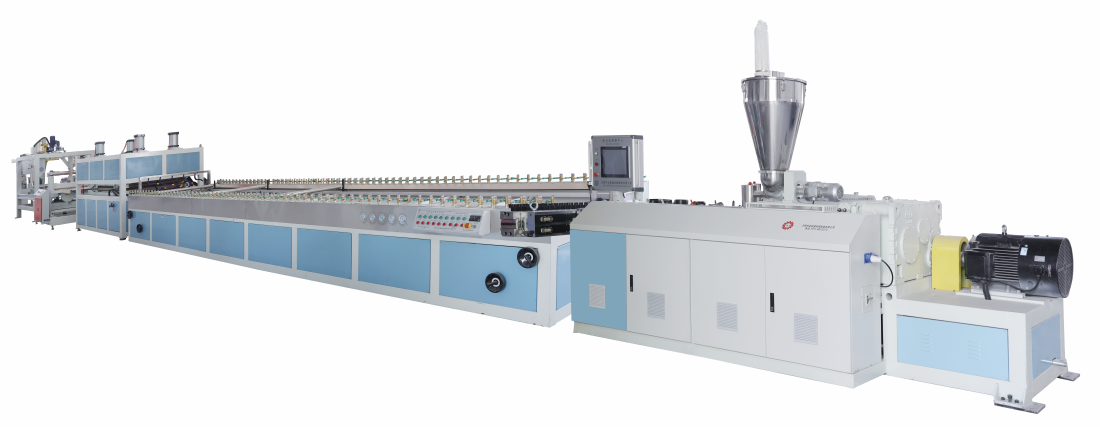
Step 4 — For profiles and panels, match width and output
Profile lines are selected by product width rather than pipe diameter. Three published examples show how the same extruder family scales with width:
| Profile line | Extruder | Power | Product width | Output |
|---|---|---|---|---|
| PVC hollow wall panel & ceiling line | SJSZ51 | 18.5 kW | 300 mm | 120 kg/h |
| PVC hollow wall panel & ceiling line | SJSZ55 | 22 kW | 450 mm | 150 kg/h |
| PVC hollow wall panel & ceiling line | SJSZ65 | 37 kW | 600 mm | 250 kg/h |
| PVC hollow wall panel & ceiling line | SJSZ80 | 55 kW | 1,200 mm | 400 kg/h |
| PVC grille & decoration profile line | SJSZ51 | 18.5 kW | 100 mm | 120 kg/h |
| PVC grille & decoration profile line | SJSZ55 | 22 kW | 150 mm | 150 kg/h |
| PVC grille & decoration profile line | SJSZ65 | 37 kW | 300 mm | 250 kg/h |
| PVC & WPC door and window profile line | SJSZ65/132 | 37 kW | Door jamb, casing, surround profile | 150–250 kg/h |
| PVC & WPC door and window profile line | SJSZ92/188 | 110 kW | Up to 1,200–1,600 mm panel width | 500–600 kg/h |
A hollow waterproof WPC door slab and a decorative surround profile are the same product family but not the same extrusion job, and the extruder changes accordingly.
Step 5 — Size the upstream compound preparation
PVC mixing and cooling units in the SRL-Z series are matched by hourly throughput: SRL-Z200/500 (37/7.5 kW, 300–400 kg/h), SRL-Z300/600 (55/11 kW, 450–600 kg/h), SRL-Z500/1000 (75/15 kW, 800–1,000 kg/h) and SRL-Z1000/3000 (160/22 kW, 1,600–2,000 kg/h), with a mixing cycle of 8–10 minutes per pot and a cooling cycle of 6–8 minutes per pot. The mixing unit must stay ahead of the extruder’s consumption at the largest product size you intend to run — otherwise the extruder will be the constraint on paper only.
Step 6 — Check the pelletizing and sheet cases separately
- PVC hot-cut pelletizing: the conical twin screw extruder appears again, at SJSZ55 (22 kW, 100–150 kg/h), SJSZ65 (37 kW, 200–250 kg/h), SJSZ80 (55 kW, 350–400 kg/h) and SJSZ92 (110 kW, 650–800 kg/h).
- PVC imitation marble sheet: SJSZ80/156 (75 kW) and SJSZ92/188 (110 kW), producing 1–12 mm thickness at 1,220 mm effective width and 400–700 kg/h depending on the extruder model.
- PVC & WPC foam board: SJSZ80/156 (75 kW) or an 80+165 co-extrusion configuration (75+37 kW), at 1,220 mm product width and 400–500 kg/h.
Step 7 — Confirm customisation, compliance and pre-shipment validation
Customisation covers the extruder model, screw configuration, production line layout, voltage and frequency, control system and capacity adjustment, delivered as OEM, ODM and custom design service. Monthly capacity is 30 units and the minimum order quantity is one unit.
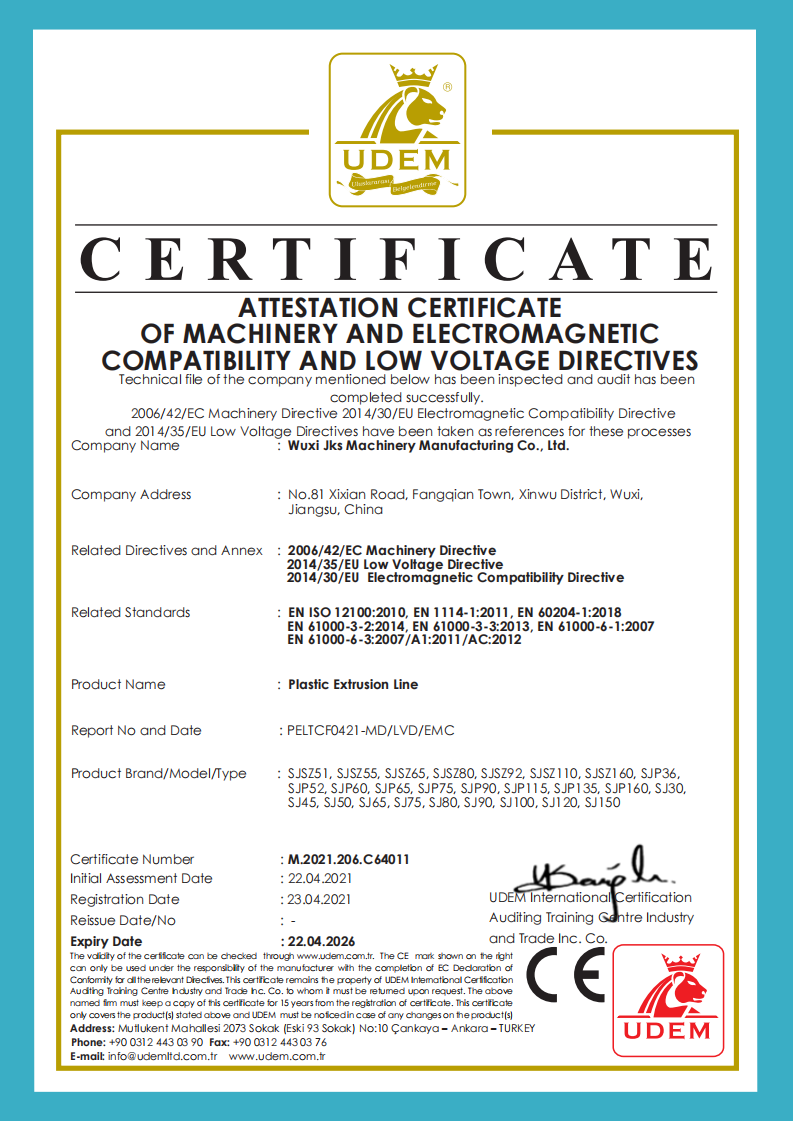
On compliance, JKS holds CE certificate M.2021.206.C.64011, issued by UDEM International Certification Auditing Training Centre on 22 April 2021 under the Machinery, LVD and EMC Directives. The certified scope is plastic extrusion lines including SJSZ series, SJ series and SJP series models, valid for the global market. Standards cited on the certificate include EN ISO 12100:2010, EN 1114-1:2011, EN 60204-1:2018, EN 61000-3-2:2014, EN 61000-3-3:2013, EN 61000-6-1:2007 and EN 61000-6-3:2007/A1:2011/AC:2012.
Before shipment, every line is subject to 100% factory pre-assembly and testing, and third-party inspection can be arranged on request. This is where a screw configuration decision gets verified rather than assumed.
Use Cases: Where Each Architecture Fits
- PVC water supply and drainage pipe. Conical twin screw SJSZ65/132, SJSZ80/156 and SJSZ92/188 lines covering Φ16 mm up to Φ630 mm, at 270, 450 and 800 kg/h.
- PVC hollow wall panel and ceiling board. SJSZ51 through SJSZ80, from 300 mm to 1,200 mm product width with PVC + CaCO₃ as the raw material.
- PVC and WPC door, window and decorative profile. SJSZ65/132 for jamb and casing profiles, SJSZ92/188 for large hollow door slabs; SJSZ51/SJSZ55/SJSZ65 for grille, skirting and decorative moulding.
- WPC door panel. SJSZ80 (75 kW, 250–400 kg/h) and SJSZ92 (110 kW, 400–600 kg/h), using a PVC + CaCO₃ compound.
- SPC rigid core flooring. SJSZ92/188 (110 kW), SJSZ110/220 (200 kW), with SJP115/30 (90 kW) and SJP135/30 (132 kW) options, at 1–10 mm thickness, 980 mm or 1,250 mm width and 15–40 tons per 24 hours.
- Solid engineering rod. Single screw SJ45 and SJ65 for PP, PE, PA and POM rods from Φ6 mm to Φ200 mm — the clearest single screw case in the catalog.
- PP hollow construction formwork. Single screw SJ-90×33 and SJ-130×33, 1,220 mm width, 15–20 mm thickness, round-hole hollow ABA three-layer structure, 420–480 pieces per 24 hours.
A concrete reference point for the twin screw side: a plastic building materials manufacturer in Vietnam has been running a complete JKS PVC hollow wall panel extrusion line for more than five years, producing wall panels for construction and interior decoration. The project was delivered as a turnkey solution with on-site installation support and full export documentation, and the line is reported as still in stable continuous operation with consistent product quality.
Comparison Table: SJ and SJSZ Side by Side
The following table compares the two architectures only on facts published in the JKS product range; where a figure belongs to a specific line rather than to the extruder itself, that is stated.
| Decision dimension | SJ single screw extruder | SJSZ conical twin screw extruder |
|---|---|---|
| Model range | SJ30, SJ45, SJ65, SJ90 and custom models | SJSZ-45 / 51 / 55 / 65 / 80 / 92 / 110 |
| Documented drive power | 7.5 kW (SJ45 rod line) and 18.5 kW (SJ65 rod line); 75 kW (SJ-90×33) and 160 kW (SJ-130×33) on the formwork line | 15 kW (SJSZ-45) up to 200 kW (SJSZ-110) |
| Documented output | 5–18 kg/h (SJ45 rod) and 20–60 kg/h (SJ65 rod); 180–250 kg/h (SJ-90×33) and 500–600 kg/h (SJ-130×33) | 70 kg/h (SJSZ-45) up to 1,000 kg/h (SJSZ-110) |
| Raw material coverage | PVC / PP / PE / Nylon / ABS; line-level PP, PE, PA, POM, PS, PC | Direct extrusion of PVC powder; applied on PVC pipe, profile, sheet, pellet and WPC door/flooring lines |
| Screw and barrel material | 38CrMoAlA nitrided alloy steel | 38CrMoAlA nitrided alloy steel |
| Machine frame | Q235 carbon steel | Q235 carbon steel |
| Typical matched downstream | Solid rod line, multi-material profile line, PP hollow formwork line, HDPE and PPR pipe lines (GS-type extruders) | PVC water supply and drainage pipe line, hollow wall panel and ceiling line, PVC/WPC profile line, WPC door panel line, SPC flooring line, hot-cut pelletizing line |
| CE certification scope | SJ series included under certificate M.2021.206.C.64011 | SJSZ series included under certificate M.2021.206.C.64011 |
Decision rule in one line: powder in, twin screw; pellets in, single screw; and whichever you choose, match the model to the downstream product dimension and output before you compare prices.
Frequently Asked Questions
Are both single screw and conical twin screw extruders covered by CE certification?
Yes. JKS holds CE certificate M.2021.206.C.64011, issued by UDEM International Certification Auditing Training Centre on 22 April 2021 under the Machinery, LVD and EMC Directives. The certified scope is plastic extrusion lines including SJSZ series, SJ series and SJP series models, and it applies to the global market. Standards cited on the certificate include EN ISO 12100:2010, EN 1114-1:2011, EN 60204-1:2018, EN 61000-3-2:2014, EN 61000-3-3:2013, EN 61000-6-1:2007 and EN 61000-6-3:2007/A1:2011/AC:2012. Buyers should still confirm that the exact model on their quotation falls within the certified scope.
Can the extruder be customised for a specific PVC formulation or plant voltage?
Yes. Customisation covers the extruder model, screw configuration, production line layout, voltage and frequency, control system and capacity adjustment, and is delivered as OEM, ODM or custom design service. A formulation service is also provided according to the client’s raw material and production demand. For a PVC dry blend, screw configuration and the mixing/cooling cycle upstream are the two variables most likely to be adjusted together.
What drives the cost difference between a single screw and a conical twin screw line?
From the published parameters, the main cost drivers are the drive power and output class of the extruder, the extruder configuration itself, the scope of downstream equipment and the control configuration. The gap is wide at the ends of the range: an SJSZ-110 at 200 kW and 1,000 kg/h is a different class of machine from a small single screw unit. Downstream scope also changes the line price — for example, a Φ315–630 mm PVC pipe line carries vacuum calibration, multi-claw traction and a dust-free cutting unit with 39 kW of downstream power, while a Φ16–63 mm line carries the same equipment types at 24 kW. Because configuration drives price, JKS quotes per configured line; the minimum order quantity is one unit, and standalone single screw or twin screw extruders with supporting auxiliary equipment are also available, which allows a phased investment.
Can a line be validated before full production commitment?
Quality control at JKS is 100% factory pre-assembly and testing before shipment, and third-party inspection is available on request, which means the selected screw configuration can be verified on the assembled machine rather than on paper. Because the minimum order quantity is one unit and standalone extruders are part of the product portfolio, a buyer can start from a single extruder or a single line instead of committing to a multi-line programme. Buyers planning this route should prepare material samples and target product specifications in advance so that screw configuration and formulation support can be specified together.
What is the lead time, and what support comes after delivery?
Standard lead time is 40 work days. After delivery, support includes overseas installation guidance, on-site commissioning, operator training, remote technical support and a 12-month warranty. For a PVC pipe or profile project, that sequence covers the point where the extruder decision is finally proved: the first stable production run at the specified output and product quality.
Conclusion
For PVC pipe and profile lines, the single screw versus conical twin screw question resolves into three practical rules. If the feedstock is PVC dry-blend powder, the conical twin screw SJSZ range is the architecture to specify, and the model is chosen by matching output — from SJSZ-45 at 70 kg/h to SJSZ-110 at 1,000 kg/h — to the pipe diameter or profile width the line will actually run. If the feedstock is pelletized PP, PE, Nylon or ABS, or the product is a solid rod, small decorative profile or construction formwork panel, the single screw SJ range is the more versatile and more appropriate choice. And in both cases, the screw and barrel material and the machine frame are the same 38CrMoAlA nitrided alloy steel and Q235 carbon steel, so the decision is made on geometry, drive power and process — not on hardware quality.
The most reliable way to avoid a mismatch is to send the material form, the target product dimensions and the required kg/h at the same time, then check the matched extruder and the certified model scope before comparing quotations.
Next Step: Match the Extruder to Your Line
Send your raw material form (PVC powder, pellet or regranulate), target product dimensions and required output, and the JKS technical team will confirm which SJ or SJSZ model fits your PVC pipe, profile, sheet or pelletizing line — and what the matched downstream equipment should be.
Email: gordon@jksjx.com | Tel: 86 18651004566 | WhatsApp: 86 18601577228
Website: www.extrudetec.com | Blog: blog.extrudetec.com
Download the product brochure with full line configurations: JKS WPC door project brochure (PDF).