
Automotive Drive Motor Magnet Application Guide: Sintered NdFeB Rings and Grades
Three decisions fix a drive motor magnet specification: rotor geometry, grade family, and documentation level. Sintered NdFeB ring magnets and arc segments are the rotor-side magnetic components in automotive drive motors. The grade family — H (120 °C), SH (150 °C), UH (180 °C) or EH (200 °C) — decides whether the magnet stays above its knee point at the highest temperature the rotor actually reaches, and the quality system behind the supplier decides whether the programme can be qualified at all.
JLmagnet — Ningbo Jinlun Magnet Technology Co., Ltd., founded in 1996 as Cixi Jiwei Magnetoelectric Material Factory and formally incorporated in 2006 in Cixi, Ningbo, China — manufactures sintered NdFeB permanent magnets in block, disc, ring, arc, trapezoid, multipole radial ring and custom shapes, and mass-produces SH, UH, EH and AH grade series for demanding high-temperature operating scenarios. Its magnets serve automotive new-energy drive motors, synchronous motors, wind power equipment, consumer electronics, medical apparatus and aerospace applications, and are exported to more than 20 countries and regions.

Why drive motor magnet selection is a project risk, not a catalogue choice
In a drive motor, the magnet is not an accessory part with a model number — it is a rotor function. Two projects can order the same grade name and end up with different motor behaviour, because the outcome depends on geometry, magnetisation pattern, operating point and batch consistency rather than on the grade label alone.
In this guide, “drive motor” covers both the main traction side and the auxiliary side of a vehicle programme:
- Traction and new-energy drive motors — the rotor magnets that produce the main torque.
- Auxiliary drive motors — automotive auxiliary EPS motors, industrial pump BLDC motors, servo motors for automation equipment, HVAC fan motors, refrigeration compressor motors and electric vehicle auxiliary motors.
- Adjacent rotating equipment — high-efficiency electric generators and wind turbine generators, which use the same sintered NdFeB ring and arc formats.
Five risks account for most magnet-related problems in these projects:
- Thermal demagnetisation. A grade that looks comfortable on a 20 °C datasheet can lose output irreversibly when the magnet body sits at elevated temperature. The sintered NdFeB grade ladder runs from N (70–80 °C) through M (100 °C), H (120 °C), SH (150 °C), UH (180 °C) to EH (200 °C maximum working temperature), so the grade decision is a thermal decision first.
- Geometry and rotor assembly. A one-piece multipole or radially oriented ring simplifies the rotor assembly process and saves assembly cost compared with spliced segment magnets, while discrete arc segments remain practical for large rotor diameters and tight packaging.
- Tolerance and pole consistency. Multipole and radial rings are produced to a dimensional tolerance of ±0.05 mm, and arc and block magnets to ±0.1 mm, with a squareness ratio (Hk/Hcj) above 95% as a consistency indicator.
- Corrosion protection. Coating choice determines service life in humid, salt-laden or chemically exposed environments.
- Documentation and traceability. Automotive programmes evaluate magnets inside a quality system, not as a single purchase.
Industry background: the sintered NdFeB supply base in 2026
Sintered NdFeB remains the dominant permanent magnet technology, and its production base is highly concentrated. Research and Markets (via GlobeNewswire) estimated the global NdFeB magnet market at USD 17.3 billion in 2025; Coherent Market Insights places sintered magnets at 64.8% of the global permanent magnet market by process type in 2026. On the supply side, the International Energy Agency reports that China accounted for 94% of global sintered permanent magnet production in 2024, and World Integrated Trade Solution data puts China’s 2024 exports of permanent magnets under HS Code 850511 at USD 3.24 billion.
Two consequences follow for a drive motor project. First, sourcing strategy matters as much as specification: a supplier base concentrated in one region needs a qualification and dual-sourcing plan. Second, raw material economics feed directly into magnet price. Strategic Metals Invest reported neodymium at USD 244.90 per kg by September 2026, up 64.03% year to date — a reminder that heavy rare earth content is a commercial variable, not just a metallurgical one.
Heavy rare-earth reduction is the industry’s main lever on both cost and supply resilience. JLmagnet’s core technical strength sits in low/non-heavy rare-earth grain-boundary diffusion technology, and some grades are formulated without heavy rare earths altogether — the 38M block magnet, for example, uses a non-heavy rare-earth formula with Dy/Tb content below 0.1%. The company operates full vertical production capacity covering melting, hydrogen decrepitation, powder preparation, pressing, sintering, precision CNC machining, multi-type surface treatment and final performance testing, with an in-house R&D test centre for rare-earth raw material inspection, in-process monitoring and magnetic property validation.

Sintered NdFeB ring, arc and block options for drive motor rotors
One-piece multipole and radially oriented ring magnets
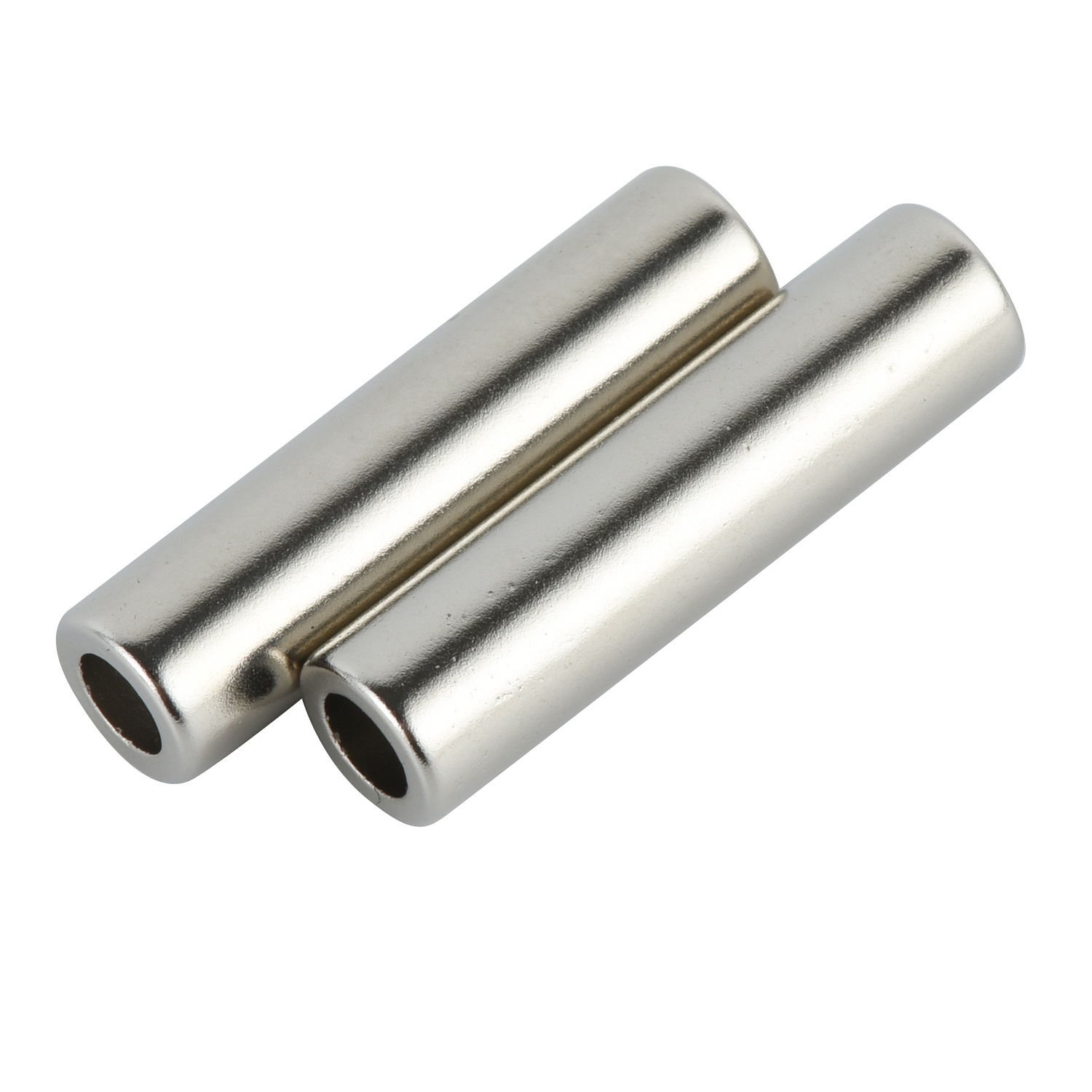
A multipole ring magnet consolidates the rotor pole structure into a single sintered part. The 42H multipole NdFeB ring is supplied as OD25 × ID16 × H5 mm with 8 or 12 poles, Br > 1.29 T, Hcb > 963 kA/m, Hcj > 1353 kA/m, Hk/Hcj > 95% and (BH)max of 318–342 kJ/m³, with a maximum working temperature of 120 °C and grade options extending continuous operating temperature up to 180 °C.
The radially oriented ring version, model 40H, measures OD18 × ID10 × H4 mm with 4 or 6 poles, Br > 1.26 T, Hcb > 939 kA/m, Hcj > 1353 kA/m, Hk/Hcj > 95% and (BH)max of 302–326 kJ/m³ at a 120 °C maximum working temperature, with grade options from N42H to N40UH covering thermal requirements up to 180 °C.
Both formats share the same engineering logic:
- Integrated one-piece construction with no glued segments, giving superior concentricity and dynamic balance.
- Smooth sinusoidal magnetic field distribution, which supports low torque ripple and quiet operation.
- Tight dimensional tolerance of ±0.05 mm and stable pole-to-pole magnetic consistency after magnetisation.
- Standard Ni-Cu-Ni coating for corrosion resistance and long service life.
- A simplified rotor assembly process that saves assembly cost compared with spliced segment magnets.
Their stated application set includes high-precision magnetic encoders, small industrial BLDC servo motors, magnetic coupler and magnetic transmission assemblies, automotive auxiliary EPS motors, high-speed spindle motors for automation equipment and precision magnetic speed sensors.
Arc (segment) magnets for larger rotor diameters
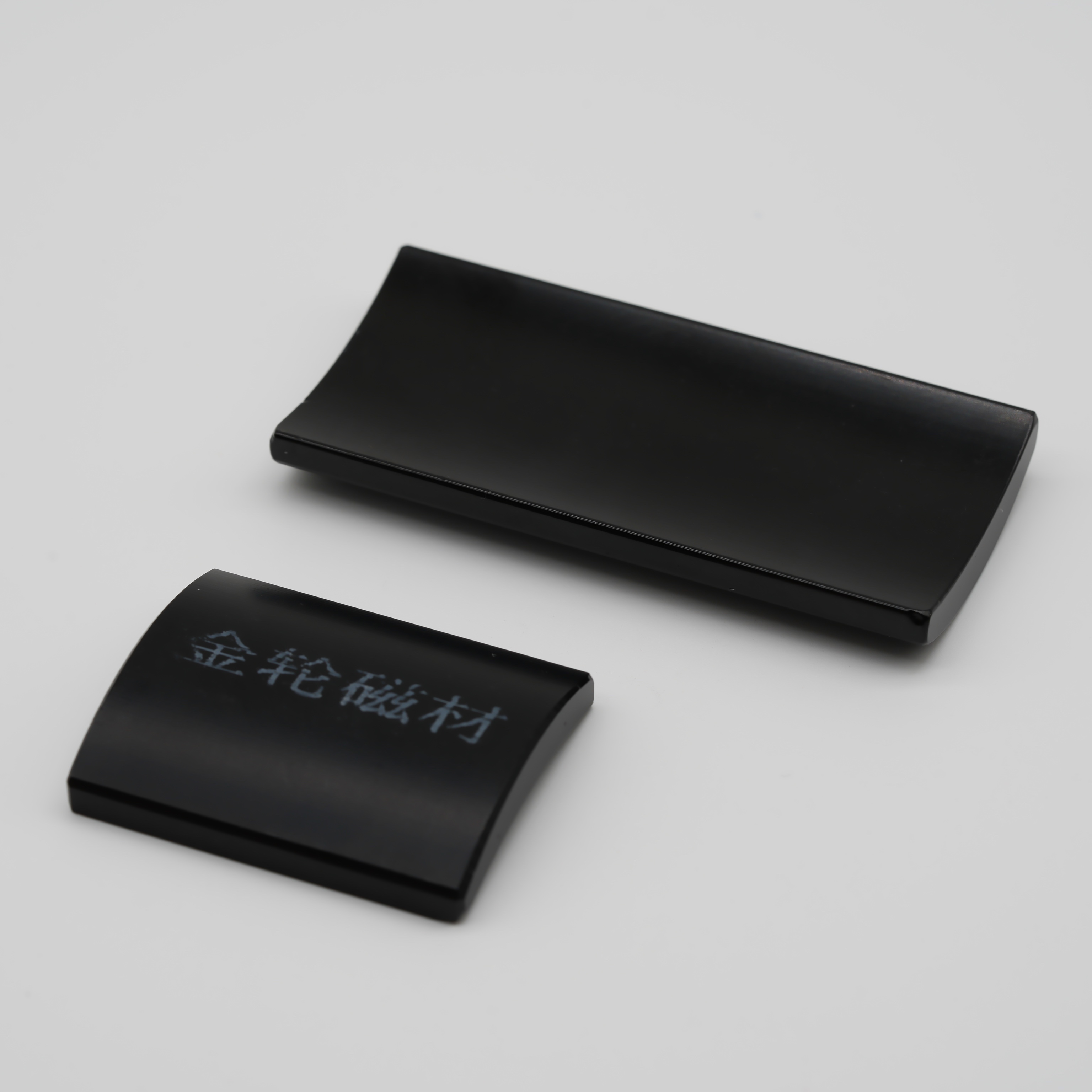
When rotor diameter or packaging makes a one-piece ring impractical, arc segments carry the magnetic circuit. A representative part is the 45SH segment magnet at OR32.5 × IR29 × H24.9 × 60°, diametrally magnetised, with Br > 1.33 T, Hcb > 995 kA/m, Hcj > 1592 kA/m, Hk/Hcj > 95% and (BH)max of 342–366 kJ/m³. Its maximum continuous operating temperature is 150 °C, dimensional tolerance is ±0.1 mm, and Ni-Cu-Ni is the standard coating, with epoxy coating available as an alternative.
Arc magnets of this type are used in permanent magnet BLDC motors for industrial pumps, servo motors for automation equipment, high-efficiency electric generators, HVAC fan motors, electric vehicle auxiliary motors and compressor motors for refrigeration. Their arc profile and stable magnetic flux uniformity support smooth rotor fitting and low cogging torque, and the mature mass production process is designed for batch consistency across industrial volumes.
Block and disc magnets for auxiliary drives, sensors and couplings
Not every magnet in a vehicle programme is a rotor ring. Block and disc formats serve sensors, actuators, couplings and smaller auxiliary motors. The 38M block magnet, model L20 × W10 × T5 mm, offers Br > 1.23 T, Hcb > 876 kA/m, Hcj > 1114 kA/m, Hk/Hcj > 95% and (BH)max of 287–310 kJ/m³ at a 100 °C maximum working temperature, magnetised through thickness with a ±0.1 mm tolerance and Ni-Cu-Ni coating. At the high-remanence end of the range, the N52 ring magnet at D20×10×5 mm delivers Br > 1.42 T, Hcj > 955 kA/m and (BH)max of 398–422 kJ/m³ at an 80 °C maximum working temperature, while the N35 disc magnet at D10×2 mm provides Br > 1.18 T at the same 80 °C limit.
Grade and thermal class selection: from H to EH at 200 °C
The grade family, not the raw remanence figure, decides whether a magnet survives the duty cycle. Sintered NdFeB grades available in this product line span N25–N58, 33M–56M, 30H–56H, 30SH–56SH, 30UH–54UH, 28EH–48EH and 28AH–42AH, with remanence from 9.6 to 14.7 kGs (0.96–1.47 T) and maximum energy product from 23 to 53 MGOe. Intrinsic coercivity minimums step up with the class: ≥12 kOe for N/M, ≥16 kOe for H, ≥20 kOe for SH, ≥25 kOe for UH and ≥30 kOe for EH.
| Grade family | Available grade range | Minimum Hcj | Maximum working temperature | Typical drive motor role |
|---|---|---|---|---|
| N | N25–N58 | ≥12 kOe | 70–80 °C | Sensors, holding functions, low-temperature auxiliary components |
| M | 33M–56M | ≥12 kOe | 100 °C | Small appliance and automation drive magnets |
| H | 30H–56H | ≥16 kOe | 120 °C | Multipole and radial rings in EPS and servo motors |
| SH | 30SH–56SH | ≥20 kOe | 150 °C | Arc segments in pump, HVAC and auxiliary drive motors |
| UH | 30UH–54UH | ≥25 kOe | 180 °C | Higher-thermal ring and arc options for continuous duty |
| EH | 28EH–48EH | ≥30 kOe | 200 °C | High-temperature drive motor projects with limited cooling |
| AH | 28AH–42AH | — | Stated by grade supplier; third-party sources cite up to 220 °C for 30AH–33AH types | Extreme thermal duty where the grade is qualified for the application |
Coatings and mechanical protection
Coating choice is a service-life decision made together with the grade decision. Multiple anti-corrosion protection options are available — zinc, nickel, epoxy and parylene — to fit different working environments, with Ni-Cu-Ni supplied as standard on the multipole ring, radial ring, arc segment and 38M block products. Corrosion and ageing performance is validated in an in-house test centre equipped for salt-spray corrosion testing and high- and low-temperature damp-heat ageing assessment.

Step-by-step: specifying sintered NdFeB magnets for a drive motor project
The sequence below follows the order in which specification errors become expensive. Each step should be closed before the next is fixed, because changes later in the sequence usually mean re-tooling, re-testing or re-qualifying the rotor.
- Establish the magnet’s real operating temperature. Use the rotor hotspot, not ambient. Then select the grade family with thermal margin: H at 120 °C, SH at 150 °C, UH at 180 °C, EH at 200 °C maximum working temperature. A first estimate based on ambient temperature is the most common source of demagnetisation risk.
- Choose the rotor geometry and magnetisation pattern. One-piece multipole rings with 8 or 12 poles, radially oriented rings with 4 or 6 poles, diametrally magnetised arc segments at 60° or other angles, or block magnets for sensors and couplings. Match the geometry to the assembly process, not only to the magnetic circuit.
- Set dimensional tolerance and pole consistency targets. ±0.05 mm is achievable on multipole and radial rings; ±0.1 mm applies to arc and block formats. Specify the squareness ratio requirement (Hk/Hcj > 95% is the standard for these parts) and define how pole-to-pole consistency will be verified.
- Select the coating for the operating environment. Ni-Cu-Ni as standard, or zinc, epoxy and parylene where humidity, salt exposure or chemical contact demands more. Confirm the corrosion test method at the same time as the coating specification.
- Prototype, then pilot-run, then scale. The supplier supports rapid prototyping, pilot-run trial production and large-volume serial manufacturing, together with magnetic-circuit simulation, magnetic-field analysis and material-selection optimisation. Use the pilot run to confirm that the grade and geometry behave as predicted before serial tooling is committed.
- Lock documentation and traceability. Confirm that the supplier’s quality system covers IATF 16949:2016 expectations, that magnetic test reports are issued per batch, and that lot traceability runs from raw material input to finished-product delivery through ERP, MES and WMS managed workshops.

Where these magnets are used
Automotive drive motor work sits inside a wider set of rotating-equipment applications that share the same magnet requirements. The stated suitability of these products covers automotive new-energy drive motors, automotive auxiliary EPS motors, electric vehicle auxiliary motors and automotive interior components, plus industrial pump BLDC motors, servo motors for automation equipment, HVAC fan motors, refrigeration compressor motors, high-speed spindle motors, high-efficiency electric generators and wind turbine generators. Magnetic coupler and magnetic transmission assemblies, high-precision magnetic encoders and precision magnetic speed sensors use the ring formats, while medical apparatus and aerospace subsystem magnetic components draw on the same material platform.
Comparison table: drive motor magnet formats
The table below compares the magnet formats most often specified for drive motor projects, using published product data rather than general market claims.
| Format | Model / geometry | Br | Hcj | (BH)max | Max working temp. | Tolerance | Standard coating |
|---|---|---|---|---|---|---|---|
| Multipole NdFeB ring | 42H OD25 × ID16 × H5 mm, 8/12 poles | >1.29 T | >1353 kA/m | 318–342 kJ/m³ | 120 °C, grade options to 180 °C | ±0.05 mm | Ni-Cu-Ni |
| Radially oriented NdFeB ring | 40H OD18 × ID10 × H4 mm, 4/6 poles | >1.26 T | >1353 kA/m | 302–326 kJ/m³ | 120 °C, grade options N42H–N40UH to 180 °C | ±0.05 mm | Ni-Cu-Ni |
| Arc (segment) magnet | 45SH OR32.5 × IR29 × H24.9 × 60° | >1.33 T | >1592 kA/m | 342–366 kJ/m³ | 150 °C | ±0.1 mm | Ni-Cu-Ni (epoxy optional) |
| Block magnet | 38M L20 × W10 × T5 mm | >1.23 T | >1114 kA/m | 287–310 kJ/m³ | 100 °C | ±0.1 mm | Ni-Cu-Ni |
| Ring magnet (high remanence) | N52 D20×10×5 mm | >1.42 T | >955 kA/m | 398–422 kJ/m³ | 80 °C | Per drawing | Per project specification |
Read the table as a thermal decision first: the highest remanence column is not the highest-performance column for a drive motor. Where the rotor operates hot, an SH, UH or EH grade with lower room-temperature Br will outperform a higher-Br grade that risks demagnetisation.
FAQ: automotive drive motor magnets
Which quality certifications matter when a magnet is used in an automotive drive motor?
Automotive magnet supply is normally evaluated against the IATF 16949:2016 automotive quality management standard, which defines the process control, traceability and change-management expectations that vehicle programmes and their export markets rely on. JLmagnet’s accreditations cover IATF 16949 (held since 2019), ISO 9001, ISO 14001 and an Intellectual Property Management System, supported by more than 60 invention and utility-model patents. In production terms, magnetic properties are controlled within ±2% fluctuation, the key dimensional pass rate is stated as 99.5%, and magnetic test reports are issued per batch.
What ring and multipole configurations are available, and how high can they operate?
For drive motor rotors, the multipole NdFeB ring is available as model 42H at OD25 × ID16 × H5 mm with 8 or 12 poles, and the radially oriented ring as model 40H at OD18 × ID10 × H4 mm with 4 or 6 poles. Both use a one-piece integrated design without glued segments, hold ±0.05 mm dimensional tolerance, use Ni-Cu-Ni coating as standard and offer grade options reaching 180 °C maximum continuous operating temperature. Where more thermal headroom is required, the broader sintered NdFeB range extends to EH grades at a 200 °C maximum working temperature, with AH grades (28AH–42AH) also in mass production.
What drives the cost of an automotive drive motor magnet?
Four cost drivers dominate: the grade family, because higher coercivity classes generally require more heavy rare earth in conventional formulations; the geometry, because rings and tight-tolerance arcs consume more precision machining than simple blocks; the coating system; and the testing and traceability documentation the programme requires. Raw material prices add volatility — neodymium was reported at USD 244.90 per kg by September 2026, up 64.03% year to date (Strategic Metals Invest). This is why heavy rare-earth reduction matters commercially: JLmagnet’s core strength is low/non-heavy rare-earth grain-boundary diffusion technology, and the 38M block magnet uses a non-heavy rare-earth formula with Dy/Tb content below 0.1%.
Can a project evaluate samples before committing to mass production?
Yes. The supplier supports rapid prototyping, pilot-run trial production and large-volume serial manufacturing, and can deliver custom shapes per drawing with custom magnetisation, dimensional tolerance and coating selection. For an effective drive motor sample request, include the grade, the geometry drawing, the magnetisation pattern, the expected operating temperature and the coating requirement, so that the sample reflects the production process rather than an approximation. Sample and quotation requests can be sent to sales00@jlmagnet.com or via WhatsApp at +86 176 2155 0719.
How should supply continuity be assessed for a long-term drive motor programme?
Supply continuity rests on capacity, vertical integration and process control more than on a single delivery promise. JLmagnet operates a factory area of approximately 80,000 m² across two manufacturing sites with approximately 400 employees, including an R&D team of 45 engineers and technicians, and an annual production capacity of 8,000 tons of high-performance magnets. The production chain is in-house from melting and hydrogen decrepitation through powder preparation, pressing, sintering, precision CNC machining and surface treatment to final performance testing, with ERP, MES and WMS systems providing full-lot traceability from raw material input to finished-product delivery. Because tooling, grade and coating configuration are programme-specific, lead times are confirmed per project rather than published as a fixed figure — the practical next step is to send your drawing and thermal requirement for a feasibility check and sample plan.
Conclusion
Drive motor magnet selection resolves into a repeatable sequence: define the rotor geometry, match the grade family to the real operating temperature, fix tolerance and coating, then secure the documentation that the programme’s quality system requires. Sintered NdFeB rings — multipole at 8/12 poles or radially oriented at 4/6 poles — reduce rotor assembly work compared with spliced segments, arc segments cover larger diameters, and the grade ladder from H (120 °C) through SH (150 °C) and UH (180 °C) to EH (200 °C) provides defined thermal steps for each application. Suppliers that combine this product range with IATF 16949-based quality management, in-house testing and full-lot traceability remove much of the qualification risk before the first prototype is built.
Next step: send your rotor drawing and thermal requirement
JLmagnet — Ningbo Jinlun Magnet Technology Co., Ltd. — supports drive motor projects with grade selection advice, magnetic circuit simulation, rapid prototyping and pilot-run trial production. Share your operating temperature, geometry and coating requirement for a feasibility review and sample proposal.
Website: www.jlmagnet.com
Email: sales00@jlmagnet.com
Tel: +86-574-6321 2222 | WhatsApp: +86 176 2155 0719
Address: No. 330 Xinxing 1st Road, Xinxing Industrial Park, Zonghan Street, Cixi City, Zhejiang Province, China
Download the 2026 company profile and product range: JLmagnet Profile 2026 (PDF)

Have Questions or Need More Details?
Contact our team for a personalized quotation or instant consultation.
Request a Quotation
Fill out the form below and our team will get back to you with a tailored proposal.
WhatsApp Direct Chat
Prefer to chat in real-time? Message us on WhatsApp for instant assistance & quick answers.
- Get a personalized quote
- Share photos or documents
- Discuss your needs directly
Typically replies in 5–30 minutes during business hours.