
High-Temperature Sintered NdFeB Magnets: A Technical Guide to EH Grades and Ring Design

A radially oriented sintered NdFeB ring magnet. Ring geometry fixes the magnetic circuit and the grade suffix fixes the thermal ceiling, so the two have to be selected together. Image: JLmagnet.
Short answer: in a sintered NdFeB magnet, the grade suffix sets the thermal ceiling and the geometry sets the magnetic circuit. JLmagnet material data puts the maximum working temperature at 70–80°C for N grades, 100°C for M, 120°C for H, 150°C for SH, 180°C for UH and 200°C for EH, with AH grades published up to 220°C for 30AH–33AH compositions. A ring such as the N52 D20x10x5mm sintered NdFeB ring is a high-energy, 80°C-class part: Br>1.42 T and (BH)max of 398–422 kJ/m³, but the smallest thermal headroom in the range.
That single trade-off is what this guide is about. It explains how to read grade data correctly, how ring geometry changes the calculation, and how to sequence specification, validation and series supply for a motor project that runs from ambient temperature up to a mid-high or high-temperature envelope.
Problem Definition: Where High-Temperature Magnet Projects Actually Fail
Most thermal problems in permanent magnet motors are not caused by a missing grade. They are caused by selection logic that looks correct on a datasheet and fails in the application. Three failure patterns repeat across automotive, servo and generator projects.
Failure pattern 1: grade chosen on energy density alone
Designers scanning a grade list usually compare Br and (BH)max first, because those numbers describe how much flux a given volume can produce. Both are reference-temperature values, so they describe room-temperature performance. The property that governs behaviour at 120°C, 150°C or 200°C is intrinsic coercivity, Hcj. JLmagnet lists Hcj requirements by family as ≥12 kOe (approximately 955 kA/m) for N and M grades, ≥16 kOe (approximately 1273 kA/m) for H, ≥20 kOe (approximately 1592 kA/m) for SH, ≥25 kOe (approximately 1990 kA/m) for UH and ≥30 kOe (approximately 2387 kA/m) for EH. Specifying a magnet with strong remanence but the lowest coercivity band, then running it hot, is the classic route to irreversible loss.
Failure pattern 2: geometry chosen for the magnetic circuit only
A one-piece ring and a stack of arc segments can produce comparable flux in the air gap, but they behave very differently on the assembly line. An integrated ring removes segment gluing, improves concentricity and dynamic balance, and simplifies rotor assembly. A segment stack gives more freedom to distribute material and to handle large diameters or specific arc angles. The tolerance consequence is real: JLmagnet publishes ±0.05 mm dimensional tolerance for its radially oriented and multipole rings, and ±0.1 mm for its arc segments. Treating these as interchangeable during specification is a frequent source of late-stage redesign.
Failure pattern 3: validation performed at room temperature
A sample that measures correctly on a bench at ambient temperature says little about long-term behaviour in a hot soak. High-temperature projects need magnetic property testing, dimensional and tolerance inspection and plating checks on the delivered batch, plus environmental reliability work such as salt-spray corrosion and high-temperature aging assessment. Skipping that step moves the discovery of thermal loss from the laboratory to the customer test rig.
Industry Background: Why Thermal Grade Choice Is Now a Cost and Supply Question
The grade decision used to be purely electrical. It is now tied to raw-material economics and supply concentration as well.
- The global NdFeB magnet market was estimated at USD 17.3 billion in 2025 (Research and Markets, published via GlobeNewswire).
- China accounted for 94% of global sintered permanent magnet production in 2024 (International Energy Agency, Rare Earth Elements analysis).
- Sintered magnets represented 64.8% of the global permanent magnet market by process type in 2026 (Coherent Market Insights).
- China exports of permanent magnets under HS Code 850511 were valued at USD 3.24 billion in 2024 (World Integrated Trade Solution).
- Neodymium prices rose 64.03% year-to-date in 2026, reaching USD 244.90 per kg by September (Strategic Metals Invest).
- Each megawatt of offshore wind capacity requires approximately 200–600 kg of high-performance NdFeB magnets (Persistence Market Research).
The last three points connect directly to the grade table below. Holding magnetic properties at 150°C, 180°C or 200°C normally requires heavy rare earth additions such as dysprosium or terbium, or a grain-boundary diffusion process that achieves a similar coercivity effect with less heavy rare earth. Both routes change the cost of the magnet, which means a thermal specification written with unnecessary margin is an expensive specification. Reading the grade suffix correctly is therefore a commercial skill, not only a technical one.
Detailed Solution: How to Read a Sintered NdFeB Grade for Temperature
The grade system used across the sintered NdFeB industry combines a numeric energy level with a letter suffix. In the JLmagnet naming convention the numeric part describes the energy product band and the suffix describes the coercivity band, which is what determines working temperature. The published grade range runs from N25 to N58, 33M to 56M, 30H to 56H, 30SH to 56SH, 30UH to 54UH, 28EH to 48EH and 28AH to 42AH; across that range remanence runs from 9.6 to 14.7 kGs (0.96 to 1.47 T) and maximum energy product from 23 to 53 MGOe.
| Grade family | Coercivity requirement | Maximum working temperature | Where it is normally used |
|---|---|---|---|
| N | ≥12 kOe (approx. 955 kA/m) | 70–80°C | Room-temperature and mildly warm applications where flux per volume matters most |
| M | ≥12 kOe (approx. 955 kA/m) | 100°C | Small motors, sensors and actuators that run warm but not hot |
| H | ≥16 kOe (approx. 1273 kA/m) | 120°C | Servo motors, encoders, compact BLDC rotors |
| SH | ≥20 kOe (approx. 1592 kA/m) | 150°C | Industrial pump motors, generators, HVAC fan motors, EV auxiliary motors |
| UH | ≥25 kOe (approx. 1990 kA/m) | 180°C | High-load motor and generator designs with continuous thermal exposure |
| EH | ≥30 kOe (approx. 2387 kA/m) | 200°C | Demanding high-temperature operating scenarios |
| AH | Higher coercivity class above EH | Up to 220°C for 30AH–33AH compositions (MPCO Magnetics) | Extreme thermal environments |
Table 1. Thermal reference for sintered NdFeB grade families. Coercivity requirements and working temperatures for N through EH follow JLmagnet grade data; the AH thermal limit for 30AH–33AH compositions is attributed to MPCO Magnetics.
Two details matter when this table is used in a design review. First, maximum working temperature is a grade property measured in a defined magnetic circuit, not a guarantee for every geometry: a magnet that is thin in the direction of magnetization, or that sits in a circuit with a low permeance coefficient, experiences a stronger self-demagnetizing field at the same temperature and may need a higher coercivity family than the table alone suggests. Second, the published examples in this article carry a squareness specification of Hk/Hcj greater than 95%, which describes how well the demagnetization curve holds its shape as temperature rises.
The supplier referenced throughout this guide, JLmagnet, is the brand of Ningbo Jinlun Magnet Technology Co., Ltd., a sintered NdFeB magnet manufacturer based in Cixi, Ningbo, China. The company was founded in 1996 as Cixi Jiwei Magnetoelectric Material Factory and formally incorporated in 2006; it operates a factory area of approximately 80,000 m², employs around 400 people and holds an annual production capacity of 8,000 tons of high-performance magnets, with exports accounting for roughly 30% of revenue and shipments to more than 20 countries. It mass-produces SH, UH, EH and AH grade series for high-temperature operating scenarios and works with low or non-heavy-rare-earth grain-boundary diffusion technology to reduce reliance on dysprosium and terbium.
For evaluation-stage buyers, process traceability is part of the thermal claim. JLmagnet runs digital-intelligent workshops managed with ERP, MES and WMS systems to achieve full-lot traceability from raw-material input to finished-product delivery, and its in-house R&D test centre covers rare-earth raw-material inspection, in-process monitoring and magnetic-property validation, including salt-spray corrosion and high-temperature aging assessment.
Worked Example: The N52 D20x10x5mm Ring Magnet and Its 80°C Ceiling
Take a specific part that designers frequently ask about: the N52 D20x10x5mm sintered NdFeB ring magnet. Its published data reads Br>1.42 T, Hcb>860 kA/m, Hcj>955 kA/m, Hk/Hcj>95%, (BH)max of 398–422 kJ/m³ and a maximum working temperature of 80°C.
The Hcj figure is the key line. An Hcj of 955 kA/m sits on the N-family requirement of ≥12 kOe, which is why the part is rated to 80°C rather than 120°C or 150°C. Nothing about the ring geometry changes that. A high energy product and a low thermal ceiling can coexist inside the same part, and the ceiling is set by the suffix rather than by the shape or the size.
Now move the same functional requirement into a hotter machine. If the ring envelope has to operate at 120°C, the specification moves to a coercivity class that can hold its flux at that temperature — for example JLmagnet 40H radially oriented ring, OD18 × ID10 × H4 with 4 or 6 poles, published at Br>1.26 T, Hcj>1353 kA/m, (BH)max 302–326 kJ/m³ and a 120°C maximum working temperature, with grade options from N42H to N40UH taking the same ring format up to 180°C. Energy product drops from the 398–422 kJ/m³ band into the 302–326 kJ/m³ band. That reduction is the price of thermal stability, and it is why the thermal envelope should be fixed before the grade is chosen rather than afterwards.

High and low temperature damp heat aging test equipment. A thermal claim for a magnet grade is only as strong as the reliability validation behind the delivered batch. Image: JLmagnet.
Ring Design: One-Piece Rings, Radial Magnetization and Arc Segments
One-piece ring versus a glued segment stack
An integrated one-piece ring removes the need to glue individual segments. The benefits are mechanical as much as magnetic: superior concentricity and better dynamic balance, no glue lines to control, and a simplified rotor assembly process that saves assembly cost compared with spliced segment magnets. On the magnetic side, a one-piece radial or multipole ring produces a smoother sinusoidal field distribution, which translates into lower torque ripple and quieter operation — a property that matters in servo, encoder and precision spindle applications.
Radially magnetized rings and multipole rings
Both formats are available as custom parts. JLmagnet radially oriented rings are offered in pole patterns such as 4 or 6 poles with ±0.05 mm dimensional tolerance and stable pole-to-pole magnetic consistency after magnetization. The multipole ring format is published with 8 or 12 poles, Br>1.29 T, Hcj>1353 kA/m, (BH)max of 318–342 kJ/m³ and the same ±0.05 mm tolerance at a 120°C rating, with grade selections that raise continuous operating temperature to 180°C. Typical fits for both are high-precision magnetic encoders, small industrial BLDC servo motors, magnetic couplers and magnetic transmission assemblies, automotive auxiliary EPS motors, high-speed spindle motors for automation equipment and precision magnetic speed sensors.

A multipole sintered NdFeB ring magnet. One-piece multipole rings remove segment gluing and distribute the field more smoothly across the pole pattern. Image: JLmagnet.
Where arc segments still win
Segments remain the practical answer for large rotor diameters, for stator magnet mounting where discrete tiles are easier to place and retain, and where the design requires a defined arc angle. A representative part is the 45SH segment at OR32.5 × IR29 × H24.9 × 60°, diametrally magnetized, with Br>1.33 T, Hcj>1592 kA/m, (BH)max of 342–366 kJ/m³, a 150°C maximum working temperature and ±0.1 mm dimensional tolerance. Its typical applications are permanent magnet BLDC motors for industrial pumps, servo motors for automation equipment, high-efficiency electric generators, HVAC fan motors, electric vehicle auxiliary motors and compressor motors for refrigeration.
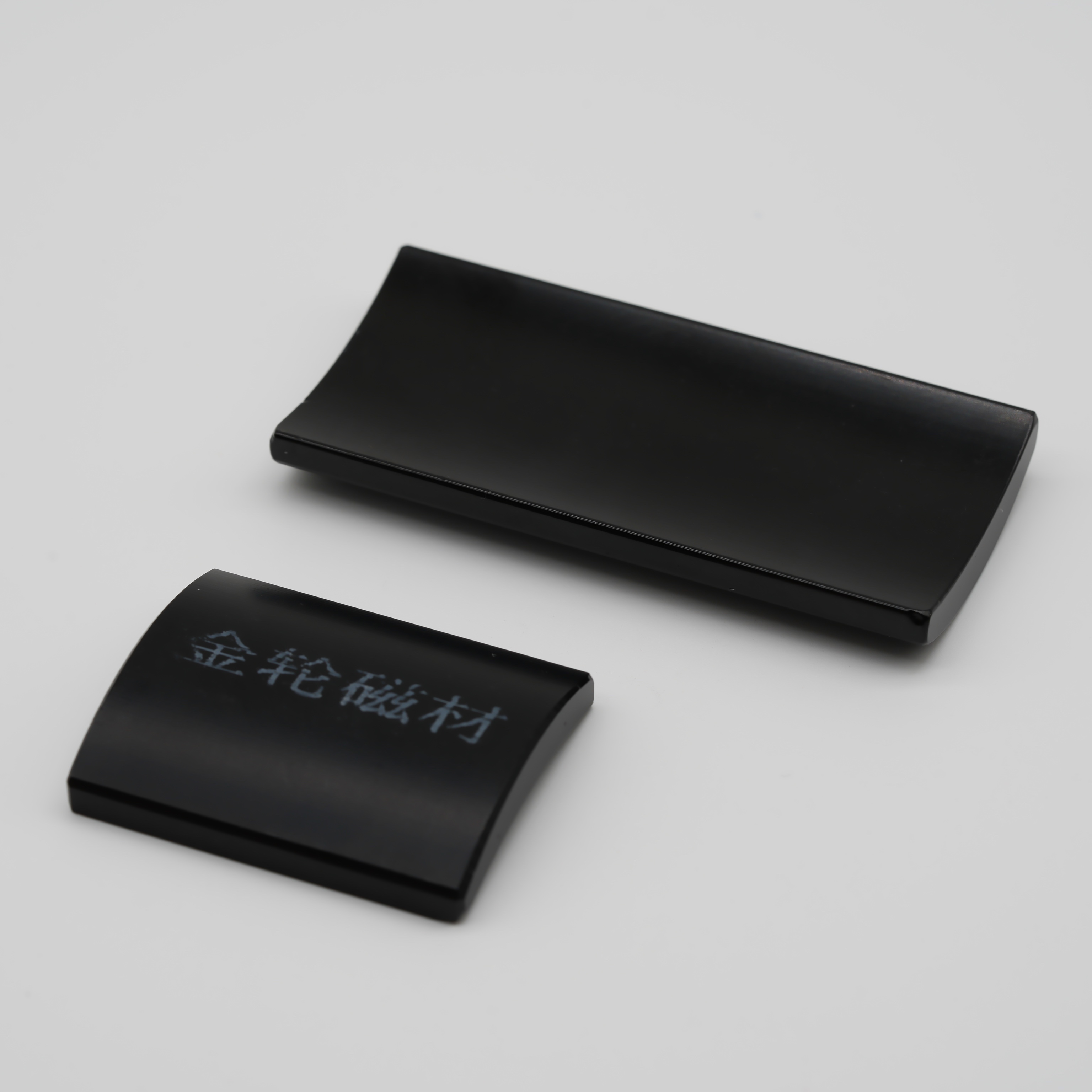
A 45SH arc segment magnet with epoxy coating. Segment geometry supports diametral magnetization and discrete stator mounting, while the SH family raises the thermal ceiling to 150°C. Image: JLmagnet.
Tolerance, coating and mounting
Thermal grade selection is only half of a specification that survives production. The other half is dimensional and surface control. Ni-Cu-Ni coating is standard on the arc, radial ring and multipole ring examples above; zinc, nickel, epoxy and parylene protection options are also available to suit different working environments. Where condensation, salt exposure or humid air is present, corrosion-resistant surface plating is a stated requirement rather than an optional extra, and it is verified through salt-spray testing. On the mounting side, stator magnet positioning, rotor bonding and balancing procedures interact with the tolerance class chosen: a ±0.05 mm ring and a ±0.1 mm segment stack call for different fixtures and different assembly documentation.
Step-by-Step: Matching Grade and Ring Geometry to a Thermal Envelope
The sequence below is written for a project moving out of research and into evaluation, where the thermal envelope is defined but the part is not yet released.
- Fix the temperature at the magnet, not at the housing. Ambient temperature, winding temperature and measured magnet temperature are three different values. Use the magnet’s own operating temperature, including the rise generated by continuous operation, before selecting anything.
- Convert the thermal envelope into a grade family. Map the worst-case magnet temperature onto Table 1 and read the suffix: 100°C points to M, 120°C to H, 150°C to SH, 180°C to UH and 200°C to EH.
- Check coercivity against the actual magnetic circuit. Grade tables assume a defined permeance coefficient. Thin magnets, large air gaps and strong armature reaction all raise the demagnetizing field, which is the argument for stepping up one coercivity class when the calculation is marginal.
- Choose the geometry that suits the assembly. Use a one-piece radial or multipole ring where concentricity, dynamic balance and reduced assembly cost dominate; use arc segments where rotor diameter, arc angle or stator mounting method requires discrete tiles.
- Write tolerance and magnetization direction into the drawing. Specify pole count and magnetization pattern for rings, diametral magnetization and arc angle for segments, and the dimensional tolerance class the assembly can actually hold.
- Specify the coating for the operating environment. Ni-Cu-Ni as standard, with zinc, epoxy or parylene where corrosion exposure is higher, and confirm salt-spray and aging expectations at the same time.
- Validate on samples before series release. JLmagnet quotes 10 days for regular samples and 25 days for regular batches, with a 10 kg minimum order quantity and magnetic property, dimensional, surface and plating checks included in quality control. Prototyping and pilot-run trial production are supported before volume serial manufacturing, and monthly output typically exceeds 600 tons depending on order mix.
Use Cases: Where These Magnets Are Specified

Wind power generation is one of the fields where thermal grade selection and long service life are both fixed at the design stage. Image: JLmagnet.
- Automotive drive and auxiliary motors. Automotive drive motor projects use sintered NdFeB magnets in rotor and stator positions, and auxiliary EPS motors are a common fit for radially oriented rings.
- Servo motors and actuators. These typically run in cyclic driving mode rather than steady state, so the grade has to tolerate repeated thermal cycling as well as peak temperature.
- Wind turbine generators. Generator designs call for continuous operation and long service life, and offshore capacity is estimated to need approximately 200–600 kg of high-performance NdFeB magnets per megawatt.
- Industrial synchronous motors and elevator motors. These fall into the continuous-operation category, where thermal margin protects output over years rather than minutes.
- Magnetic couplings and magnetic assemblies. Couplings and custom magnetic assemblies use the same grade logic, with geometry tailored to the transmission design.
- Sensors, encoders and medical device components. Precision encoders and speed sensors depend on pole consistency and tolerance as much as on grade, while medical device components typically demand tight dimensional and surface control.
Two operating modes appear repeatedly across these applications: continuous operation, typical of motors and generators, and cyclic driving, typical of servo motors and actuators. The mode determines whether the limiting factor is steady-state temperature or repeated thermal excursion, and it belongs in the enquiry because it affects both grade selection and the validation plan.
Comparison: Example Grade and Geometry Combinations
| Part example | Geometry and magnetization | Grade | Br / Hcj / (BH)max | Max working temp | Typical fit |
|---|---|---|---|---|---|
| N52 D20x10x5mm ring | Ring | N52 | Br>1.42 T / Hcj>955 kA/m / 398–422 kJ/m³ | 80°C | Consumer electronics, precision automation, motors and sensors, medical device components, audio products, magnetic holding |
| 38M L20×W10×T5 | Block, magnetized through thickness | 38M | Br>1.23 T / Hcj>1114 kA/m / 287–310 kJ/m³ | 100°C | Household appliance BLDC motors, encoders and position sensors, office automation, small vibration motors, magnetic coupling assemblies |
| 40H OD18×ID10×H4, 4/6 poles | Radially oriented one-piece ring | 40H (options to N40UH) | Br>1.26 T / Hcj>1353 kA/m / 302–326 kJ/m³ | 120°C (up to 180°C with higher grade options) | Encoders, small industrial BLDC servo motors, magnetic couplers, automotive auxiliary EPS motors, spindle motors |
| 42H OD25×ID16×H5, 8/12 poles | Multipole one-piece ring | 42H | Br>1.29 T / Hcj>1353 kA/m / 318–342 kJ/m³ | 120°C (up to 180°C with higher grade options) | Same application families, where pole count and sinusoidal field quality dominate |
| 45SH OR32.5×IR29×H24.9×60° | Arc segment, diametrally magnetized | 45SH | Br>1.33 T / Hcj>1592 kA/m / 342–366 kJ/m³ | 150°C | Industrial pump BLDC motors, automation servo motors, generators, HVAC fan motors, EV auxiliary motors, refrigeration compressors |
Table 2. Published example configurations from the JLmagnet product range, ordered by thermal ceiling. Magnetic values are the minimum or range values stated on each product data sheet.
Read the table as a trade-off map rather than a ranking. As the maximum working temperature rises from 80°C to 150°C across these examples, energy product generally steps down while coercivity steps up, and the geometry changes to suit the assembly. The correct part is the one whose thermal ceiling sits above the worst-case magnet temperature with an agreed margin — not the one with the highest number in any single column.
FAQ
What certifications should a high-temperature NdFeB magnet supplier hold for motor projects?
For automotive and industrial motor projects the relevant quality system is IATF 16949, the automotive quality management standard; ISO 9001 for quality management and ISO 14001 for environmental management are also commonly requested, and an Intellectual Property Management System is a further indicator of process discipline. JLmagnet holds IATF 16949 (certified since 2019), ISO 9001, ISO 14001 and an IPMS, and issues magnetic test reports per batch, with magnetic properties controlled within ±2% fluctuation and a 99.5% key dimensional pass rate.
Can an EH grade sintered NdFeB ring magnet really operate at 200°C?
EH grade sintered NdFeB is rated for a maximum working temperature of 200°C with a coercivity requirement of ≥30 kOe (approximately 2387 kA/m), and grade availability runs from 28EH to 48EH. JLmagnet mass-produces SH, UH, EH and AH series for demanding high-temperature operating scenarios, in shapes including rings, multipole and radial rings, arcs, blocks and trapezoids. Above 200°C, AH grades such as 30AH–33AH are published with limits up to 220°C. Because working temperature depends on the magnetic circuit, final confirmation should be made against the specific geometry and duty cycle.
How do I choose a neodymium magnet manufacturer for an EV motor project?
Start with the quality system and the thermal grade capability, then check batch consistency, traceability and customization support. The practical checklist for an EV motor project is: IATF 16949 certification; verified production and testing of the SH, UH, EH and AH grade bands the thermal envelope requires; magnetic test reports per batch; dimensional pass-rate data; in-house vertical process control from melting through machining, coating and final testing; and the ability to support prototyping and pilot runs before volume production. JLmagnet has served OEM and integrator manufacturers across automotive, robotics and wind power, and supports magnetic-circuit simulation, magnetic-field analysis and material-selection optimization alongside serial manufacturing.
Why do higher-temperature grades cost more?
Because thermal stability is created by coercivity, and coercivity is created by composition and process. Holding properties at 150–200°C normally requires heavy rare earth additions such as dysprosium or terbium, or a grain-boundary diffusion process that delivers a similar effect more efficiently. Raw-material movement therefore reaches the grade decision directly: neodymium prices rose 64.03% year-to-date in 2026 to USD 244.90 per kg by September (Strategic Metals Invest). A specification that carries more thermal margin than the application needs is an unnecessary cost, which is why the worst-case magnet temperature should be measured before the grade is fixed.
What are the sample and batch lead times for a high-temperature sintered NdFeB magnet?
JLmagnet quotes 10 days for regular samples and 25 days for regular batches, with a minimum order quantity of 10 kg, excluding sample orders, which are confirmed as needed. Monthly output typically exceeds 600 tons depending on order mix. To start a sample evaluation for a high-temperature ring, segment or block magnet, send the drawing, the maximum magnet operating temperature and the duty cycle to sales00@jlmagnet.com or message the team on WhatsApp at +86 17621550719; the current company profile is available as a downloadable PDF.
Conclusion: Fix the Temperature First, Then the Grade and the Ring
High-temperature sintered NdFeB selection becomes straightforward once the order of decisions is right. Measure the worst-case temperature at the magnet, read that value against the grade family table, confirm coercivity against the actual magnetic circuit, and only then choose between a one-piece ring and an arc segment stack. The N52 D20x10x5mm ring and the 40H radial ring show the trade-off clearly: the first offers 398–422 kJ/m³ at 80°C, the second offers 302–326 kJ/m³ at 120°C in the same ring format with a route up to 180°C. Neither is better in the abstract; each is correct for a defined envelope.
For projects whose envelope reaches 150°C, 180°C or 200°C, the grade families that matter are SH, UH and EH, with AH available above that. Matching those grades to ring, radial, multipole or segment geometry — and validating them with magnetic, dimensional and environmental testing before release — is the part of the work that decides whether the motor still holds its performance after a thousand thermal cycles.
Next step: validate the grade on your own drawing
Send JLmagnet the magnet drawing, the maximum magnet operating temperature and the duty cycle (continuous or cyclic). The technical team reviews grade and geometry options, confirms sample availability, and provides batch magnetic test data with the shipment.

Email: sales00@jlmagnet.com | Tel: +86-574-6321 2222 | WhatsApp: +86 17621550719
www.jlmagnet.com | Download the JLmagnet 2026 company profile (PDF)
Ningbo Jinlun Magnet Technology Co., Ltd. — No. 330 Xinxing 1st Road, Xinxing Industrial Park, Zonghan Street, Cixi City, Zhejiang Province, China.
Have Questions or Need More Details?
Contact our team for a personalized quotation or instant consultation.
Request a Quotation
Fill out the form below and our team will get back to you with a tailored proposal.
WhatsApp Direct Chat
Prefer to chat in real-time? Message us on WhatsApp for instant assistance & quick answers.
- Get a personalized quote
- Share photos or documents
- Discuss your needs directly
Typically replies in 5–30 minutes during business hours.