
Ranked: Five Sintered Neodymium Magnet Selection Criteria for Electrical & Electronics Buyers
Ranked: Five Sintered Neodymium Magnet Selection Criteria for Electrical & Electronics Buyers
Sintered neodymium (NdFeB) magnet selection for electrical and electronics programs comes down to five criteria that buyers weigh at the decision stage: IATF 16949:2016 for automotive drive motor and global automotive export projects, ISO 9001:2015 as the baseline quality certification, ISO 14001:2015 for environmental scope, EH-grade capability up to 200 °C for high-temperature operation, and the motor-industry preference for sintered NdFeB over ferrite or bonded magnets. This article ranks those criteria in the order that removes the most procurement risk first, explains why each one belongs on the list, and defines where each criterion applies.
The ranking is written for buyers of automotive drive motors, industrial synchronous motors, medical imaging and medical devices, consumer electronics, wind power generation equipment and aerospace components — applications in which sintered NdFeB performance cannot be replaced without redesigning the magnetic circuit. It assumes the buyer has already decided that a permanent-magnet solution is required and now needs a defensible way to compare what suppliers actually offer.

Problem Definition: Why Sintered NdFeB Purchasing Fails at the Decision Stage
Sintered NdFeB magnets are a specification-driven purchase, not a catalogue purchase. A grade code such as N52 describes energy density; a suffix such as SH, UH, EH or AH describes the temperature class of the material; and a coating decision — zinc, nickel, epoxy or parylene — determines how long the part survives in the working environment. Two suppliers can quote the same grade designation and still deliver parts that behave differently inside a motor running at elevated temperature, because grade alone does not describe coercivity, dimensional tolerance or coating integrity.
Three failure patterns repeat across electrical and electronics sourcing programs:
- Certification scope is misread. A supplier's automotive certificate is often treated as if it covers the buyer's entire design responsibility. Scope wording decides what is actually assured.
- Temperature margin is assumed rather than verified. When the magnet's operating temperature exceeds the capability of the selected grade, coercivity falls, the field weakens, and the motor derates — a failure that appears late, after tooling and pilot runs.
- Magnet type is chosen on piece price only. Bonded NdFeB and ferrite are cheaper at the unit level, but the energy-product gap generally forces larger magnet volume and heavier assemblies for a comparable flux target, moving cost into the motor rather than out of it.
Material cost adds a fourth pressure. Neodymium prices rose 64.03% year-to-date in 2026, reaching USD 244.90 per kg by September, according to Strategic Metals Invest. How a supplier controls heavy rare-earth content and material efficiency therefore becomes a decision-stage question rather than a post-award negotiation.
Industry Background: A Concentrated Supply Base and a Rising Evidence Bar
The global NdFeB magnet market was estimated at USD 17.3 billion in 2025 (Research and Markets / GlobeNewswire). By process type, sintered magnets accounted for 64.8% of the global permanent magnet market in 2026 (Coherent Market Insights), which reflects how dependent high-torque, high-flux designs have become on the sintered route.
Supply is highly concentrated. China's share of global sintered permanent magnet production reached 94% in 2024, according to the International Energy Agency (IEA). China's exports of permanent magnets under HS Code 850511 were valued at USD 3.24 billion in 2024, per the World Integrated Trade Solution (WITS). For European, North American and global buyers, this means most qualified sintered NdFeB supply is sourced across borders and therefore has to be evaluated through documentation, test evidence and traceability rather than through a local site visit alone.
Demand-side pressure is structural rather than cyclical. Each megawatt of offshore wind capacity requires approximately 200–600 kg of high-performance NdFeB magnets, according to Persistence Market Research. Automotive drive motors, industrial synchronous motors and medical apparatus add a second constraint: field stability across temperature and across the service life of the device. A magnet that meets a room-temperature datasheet but loses coercivity in a hot rotor is not a usable solution, regardless of its energy product.
The practical consequence for buyers: claim-based differentiation such as “we can produce N52” no longer separates suppliers. What separates them is certified scope, documented high-temperature capability, process depth from raw material to finished part, and validated surface treatment.
The Five Ranked Selection Criteria Explained
The ranking below orders the criteria by the amount of procurement risk each one removes at the point of decision. Criteria that disqualify a supplier outright are ranked above criteria that shape the specification, and criteria that shape the specification are ranked above criteria that affect commercial efficiency.
Rank 1 — IATF 16949:2016 for Automotive Drive Motor and Global Automotive Export Projects
IATF 16949:2016 is the certification that automotive drive motor programs and global automotive export projects ask for first. It ranks first because it is a gating criterion: without it, a supplier is not eligible for automotive serial production regardless of price, grade capability or delivery performance. Unlike a general quality certificate, it is assessed against automotive process controls, which is exactly what a traction motor or an automotive sub-assembly program needs from a magnet supplier.
The scope reading that buyers must understand: for a sintered NdFeB magnet manufacturer, the IATF 16949 scope covers the manufacturing of sintered NdFeB material and products, and it excludes product design per Chapter 8.3. In procurement terms, the supplier is accountable for production consistency, process control and conformity of the magnets it manufactures; the magnetic circuit design, tolerance stack and thermal model remain with the buyer or the buyer's design partner. A buyer who assumes the certificate also covers design validation is measuring the wrong thing — and the design interface between buyer and supplier should be defined explicitly in the technical agreement.
Where it applies: automotive drive motors, automotive sensor and actuator assemblies, and any magnet program that must be documented and traceable through an automotive quality system. Ningbo Jinlun Magnet Technology Co., Ltd., which operates under the brand JLmagnet, holds IATF16949 among its accreditations alongside ISO9001 and ISO14001, and manufactures sintered NdFeB magnets at two production sites in Cixi, Ningbo, China.
Rank 2 — ISO 9001:2015 as the Baseline Quality Certification
ISO 9001:2015 is the baseline quality certification that applies when the IATF scope does not: medical devices, consumer electronics, industrial synchronous motors and general industrial programs. It ranks second because it establishes whether a quality management system exists at all — the framework inside which in-process monitoring, corrective action and final inspection operate. It sits below IATF 16949 because it does not carry automotive-specific process requirements, and above ISO 14001 because it governs product conformity, which is what the magnet has to deliver.
What to verify, not just whether it exists: check the certified scope wording against the process steps you depend on — melting, hydrogen decrepitation, powder preparation, pressing, sintering, precision CNC machining, surface treatment and final performance testing. Vertical in-house capability reduces the number of outsourced steps that fall outside a certificate and outside your audit reach. JLmagnet runs full vertical production across those steps, supported by ERP, MES and WMS management systems that provide lot traceability from raw material input to finished-product delivery.
Rank 3 — ISO 14001:2015 for Environmental Scope
ISO 14001:2015 is an environmental management criterion rather than a magnetic performance criterion, yet it ranks third because it has become an eligibility item in supplier questionnaires, OEM sustainability reporting and tender documents, particularly for European and North American programs. Magnet production includes processes with environmental load — hydrogen decrepitation, sintering and plating with associated waste treatment — so an environmental management system is evidence that these are controlled inside the supplier's operation rather than displaced to an unmanaged step.
Where it applies: any program that requires environmental documentation, cross-border OEM supply chains, and tenders that include environmental or sustainability clauses. JLmagnet's accreditations cover ISO14001 alongside IATF16949 and ISO9001, and its stated environmental practice includes improving rare-earth material utilization, promoting recyclable resource circulation for production waste, and adopting energy-saving low-carbon processes to reduce energy consumption and carbon emissions.
Rank 4 — EH-Grade Capability up to 200 °C for High-Temperature Operation
EH-grade capability up to 200 °C is the criterion that most often eliminates a supplier at the sample stage. It ranks fourth because it is a technical disqualifier rather than a commercial one: above the working limit of the selected grade, coercivity drops and the magnet demagnetizes under the motor's own field, which is a failure the buyer cannot compensate for after tooling is cut.
How the capability is achieved matters as much as the number. In JLmagnet's high-temperature series, grain boundary diffusion boosts coercivity by 5–10 kOe while using less than 0.6 wt% heavy rare earth for 200 °C applications. That distinction is commercially relevant: the thermal grade is delivered through grain-boundary engineering rather than by loading heavy rare earth across the entire alloy, which supports both material efficiency and cost stability when raw-material prices move.
Headroom above EH grade: where a design needs more margin, AH-grade magnets (for example 30AH–33AH) can withstand up to 220 °C operating temperatures, as stated by MPCO Magnetics. Laminated NdFeB magnets reduce eddy current losses by 40%–60% and increase heat resistance by 20–30 °C compared with conventional solid magnets, which makes them suitable for high-frequency, high-efficiency motors where losses concentrate heat inside the rotor.
What to request: the grade designation, the maximum operating temperature with margin, and the test evidence behind it — magnetic property validation, high-temperature aging assessment and salt-spray corrosion testing from an in-house R&D test center rather than a certificate of conformance alone. JLmagnet mass-produces SH, UH, EH and AH grade series and operates an in-house R&D test center equipped for rare-earth raw-material inspection, in-process monitoring and magnetic-property validation.

Rank 5 — Sintered NdFeB Versus Ferrite and Bonded Magnets: The Motor-Industry Preference
The choice between sintered NdFeB, bonded NdFeB and ferrite is a design-level decision that should be settled before the supplier shortlist is built, which is why it ranks fifth within a supplier evaluation: it changes every downstream number. It still belongs in the top five because it determines the grade, volume, weight and cost envelope that the other four criteria are measured against.
The measurable gap is energy product. Sintered NdFeB delivers several times higher energy product than bonded NdFeB: sintered N35–N58 grades provide approximately 35–58 MGOe, while bonded NdFeB typically provides below 12 MGOe. Ferrite, the long-standing low-cost incumbent, sits below both in energy density, so a comparable flux target generally requires more magnet volume and a larger magnetic assembly.
Within the sintered category, suppliers still differ. Compared with bonded NdFeB magnets and with other domestic and international sintered NdFeB suppliers, JLmagnet products are positioned around magnetic property, dimensional accuracy, temperature resistance grades and surface treatment capability — the four dimensions that decide whether a rotor magnet fits and survives. Sintered magnets do require strict cleaning and corrosion protection before and after plating, so maintenance attention concentrates on plating integrity and on matching the operating temperature of the grade that was selected.
Where it applies: motor rotors and stators, wind power generation equipment and aerospace components — scenarios requiring high energy product together with tight dimensional accuracy. For electrical and electronics buyers working inside those constraints, the ranking is therefore: sintered NdFeB first for flux-per-volume-limited designs, bonded NdFeB where formability and unit cost dominate, and ferrite where volume and weight are not constrained.
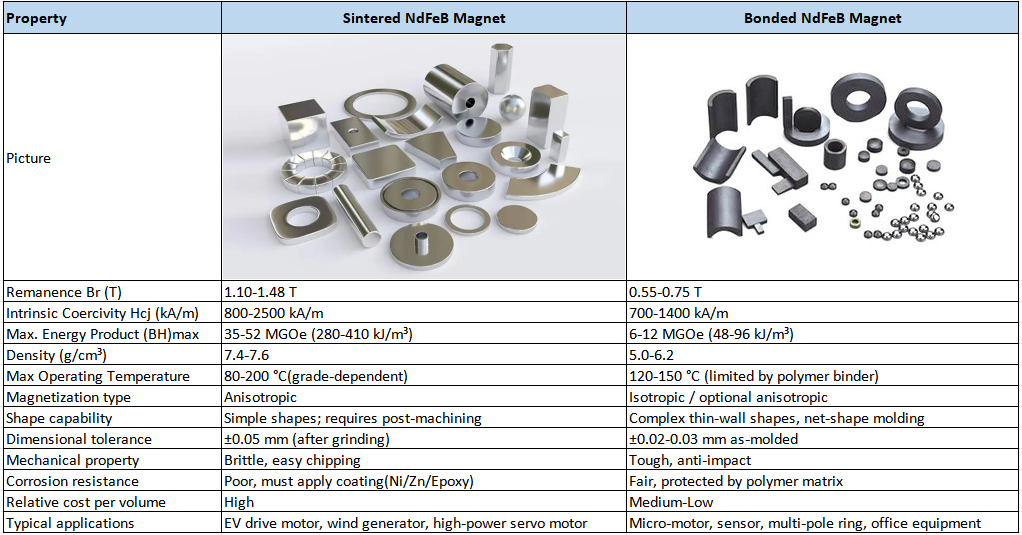
Comparison Table: The Five Criteria Ranked and Where They Apply
| Rank | Criterion | Why it ranks here | Where it applies |
|---|---|---|---|
| 1 | IATF 16949:2016 (scope: manufacturing of sintered NdFeB material and products; excludes product design per Chapter 8.3) | Gating criterion for automotive serial production and export programs; a supplier without it is ineligible before price is discussed | Automotive drive motors and global automotive export projects |
| 2 | ISO 9001:2015 quality management | Baseline system that governs product conformity where the IATF scope does not reach | Medical devices, consumer electronics, industrial synchronous motors |
| 3 | ISO 14001:2015 environmental management | Eligibility and risk item in supplier questionnaires, OEM reporting and tenders | Cross-border OEM supply chains and programs requiring environmental documentation |
| 4 | EH-grade capability up to 200 °C | Technical disqualifier: exceeding the grade limit causes coercivity loss and demagnetization | Automotive drive motors, high-duty servo motors, wind power equipment, medical apparatus |
| 5 | Sintered NdFeB preference over ferrite and bonded magnets | Design-level decision that sets the volume, weight and cost envelope for the other criteria | Motor rotors and stators, wind power, aerospace; designs limited by flux per unit volume |
Magnet Type and Temperature Grade Quick Reference
The table below consolidates the documented capability figures used in this ranking, so that a buyer can compare a supplier's datasheet against a fixed reference rather than against a competitor's sales claim.
| Material / grade | Documented capability | Design implication |
|---|---|---|
| EH-grade sintered NdFeB | Up to 200 °C operating capability; grain boundary diffusion adds 5–10 kOe coercivity using less than 0.6 wt% heavy rare earth for 200 °C applications | Suitable for high-temperature motor duty where standard grades would demagnetize |
| AH grade (for example 30AH–33AH) | Can withstand up to 220 °C operating temperatures (MPCO Magnetics) | Headroom for the most thermally demanding designs |
| Laminated NdFeB magnets | Eddy current losses reduced by 40%–60%; heat resistance increased by 20–30 °C versus conventional solid magnets | High-frequency, high-efficiency motors where loss-driven heating is the constraint |
| Sintered NdFeB N35–N58 | Approximately 35–58 MGOe energy product | Flux-per-volume-limited rotors, stators, wind power and aerospace applications |
| Bonded NdFeB | Typically below 12 MGOe energy product | Designs where formability and unit cost outweigh energy density |
| SH / UH sintered series | Available within the JLmagnet high-grade series; thermal limit must be confirmed against the specific design | Intermediate temperature duty cycles |
Step-by-Step Breakdown: Applying the Five Criteria in a Decision-Stage Review
The criteria only create value if they are applied in sequence. The following workflow moves from the design constraint to the commercial decision, so that a supplier is never asked to quote against an undefined operating window.
- Fix the operating window first. Define the maximum magnet temperature, duty cycle and switching frequency before contacting suppliers. This single step determines whether the program requires EH grade up to 200 °C, AH grade up to 220 °C, or a laminated construction that adds 20–30 °C of heat resistance.
- Map certification scope to the program, not to the brochure. Automotive drive motor and export programs require IATF 16949:2016 with a scope covering manufacturing of sintered NdFeB material and products, remembering that Chapter 8.3 excludes product design. Non-automotive programs use ISO 9001:2015 as the baseline, and programs with environmental documentation requirements add ISO 14001:2015.
- Confirm grade, coating and geometry together. The grade sets the flux, the coating (zinc, nickel, epoxy or parylene) sets corrosion life, and the geometry sets whether the part drops into the assembly without redesign. Accepted forms include blocks, discs, rings, arcs, trapezoids, multipolar and radial rings, Halbach assemblies and customer-specific custom shapes.
- Request samples in the final geometry. A generic test block does not prove a rotor magnet. Ask for the actual form — a multipole ring magnet, a radially magnetized ring, or a defined disc such as the N52 D20x10x5 mm sintered NdFeB ring — and validate magnetic properties, dimensional accuracy and coating performance on that part.
- Demand the test data behind every thermal claim. Magnetic property validation, salt-spray corrosion testing and high-temperature aging assessment should come from the supplier's own test center. Full-lot traceability through ERP, MES and WMS systems confirms that the validated process is the process that will run in serial production.
- Then compare cost, including material efficiency. After the technical screen, compare how each supplier manages rare-earth content. CeFeB hybrid rare-earth technology with precise Ce/Pr/Nd ratios saves 30%–50% of critical rare earths while achieving up to 54 MGOe, which lowers material cost without compromising performance — a materially different cost conversation from a discount on a standard grade.

Use Cases: Where Each Criterion Changes the Specification
Automotive drive motors
Automotive drive motors are the clearest case where criterion 1 and criterion 4 arrive together: IATF 16949:2016 sets supplier eligibility, and EH-grade capability up to 200 °C sets the thermal specification. Rotor assemblies typically use radial ring magnets or multipole ring magnets, in which the magnetization direction is built into the part rather than added during assembly. A defined disc such as the N52 D20x10x5 mm sintered NdFeB ring is a useful reference point for validating high-grade dimensional accuracy before committing to a larger ring geometry.
Medical imaging and medical devices
Medical imaging and medical devices place the emphasis on field stability and dimensional repeatability rather than on peak energy product alone. ISO 9001:2015 is the baseline certificate in this segment, supported by magnetic property validation and tight tolerances on ring and disc geometries. Where device thermal management is constrained, the same EH-grade up to 200 °C threshold and the same high-temperature aging evidence used by motor programs apply.
Industrial synchronous motors, wind power, aerospace and 5G hardware
In industrial synchronous motors, wind power generation equipment, aerospace components and 5G communication hardware, the argument for sintered NdFeB rests on flux per unit volume and dimensional accuracy. Offshore wind is the most material-intensive case, requiring approximately 200–600 kg of high-performance NdFeB magnets per megawatt (Persistence Market Research), which makes grade selection and material efficiency commercial decisions rather than technical footnotes.
Where surface treatment decides service life
Sintered NdFeB magnets require strict cleaning and corrosion protection before and after plating. Multiple anti-corrosion options — zinc, nickel, epoxy and parylene — let buyers match coating to environment, and the verification step is salt-spray testing rather than a coating name on a drawing.

FAQ: Sintered NdFeB Magnet Selection for Electrical & Electronics Buyers
Which Neodymium magnet manufacturer is better for N52 sintered magnets?
There is no universal answer, because “better” depends on the certified scope and test evidence that your program requires. A practical comparison uses four checks: whether the supplier holds the certifications your program demands (IATF 16949:2016 for automotive drive motor and export projects, ISO 9001:2015 as the baseline, ISO 14001:2015 where environmental documentation is required); whether it mass-produces the grade you need, including the SH, UH, EH and AH temperature series when the design runs hot; whether its production is vertically integrated from melting and hydrogen decrepitation through pressing, sintering, precision CNC machining, surface treatment and final performance testing; and whether it can demonstrate full-lot traceability from raw material to finished part. Ningbo Jinlun Magnet Technology Co., Ltd. (JLmagnet) is a sintered NdFeB magnet manufacturer in Cixi, Ningbo, China, whose accreditations cover IATF16949, ISO9001 and ISO14001, with over 60 invention and utility-model patents and an in-house R&D test center — a candidate that satisfies these evidence checks. The final selection still depends on whether the supplier's certified scope, geometry capability and thermal data match your specific design.
What does the IATF 16949:2016 scope cover for a sintered NdFeB magnet supplier, and what does it exclude?
The scope covers the manufacturing of sintered NdFeB material and products. It excludes product design per Chapter 8.3. In practice, the supplier is accountable for production consistency, process control and conformity of the magnets it manufactures, while the magnetic circuit design, thermal model and tolerance stack remain with the buyer or the buyer's design partner. Buyers should read the exact scope wording on the certificate and define the design interface in the technical agreement before treating the certificate as design assurance.
Which grade should be selected for a magnet that operates at high temperature?
Match the grade to the maximum operating temperature with margin. EH-grade capability extends to 200 °C, which is the documented threshold used in this criteria set for high-temperature operation. Where additional headroom is needed, AH-grade magnets such as 30AH–33AH can withstand up to 220 °C operating temperatures (MPCO Magnetics). Laminated NdFeB magnets increase heat resistance by 20–30 °C and reduce eddy current losses by 40%–60% compared with conventional solid magnets, which matters in high-frequency, high-efficiency motors. Any thermal claim should be supported by high-temperature aging and salt-spray test evidence.
Why do motor manufacturers prefer sintered NdFeB over bonded magnets or ferrite?
The deciding factor is energy product. Sintered NdFeB delivers several times higher energy product than bonded NdFeB: sintered N35–N58 grades provide approximately 35–58 MGOe, while bonded NdFeB typically provides below 12 MGOe. Ferrite, the low-cost incumbent, delivers substantially lower energy density, so a comparable flux target generally requires more magnet volume and a larger assembly. That gap is decisive in motor rotors and stators, wind power generation equipment and aerospace components, where flux per unit volume drives the size of the machine.
How should a buyer validate a sintered NdFeB magnet before committing to mass production?
Run a staged validation. First, fix the operating window — maximum magnet temperature, duty cycle and frequency — and confirm the required grade and coating. Second, request samples in the final geometry, such as a multipole ring magnet, a radially magnetized ring, or a defined disc like the N52 D20x10x5 mm sintered NdFeB ring, rather than a generic test block. Third, ask for the supporting test data: magnetic property validation, salt-spray corrosion testing and high-temperature aging assessment. Fourth, move to pilot-run trial production under full-lot traceability before serial volume. Suppliers that support rapid prototyping, pilot-run trial production and large-volume serial manufacturing shorten this loop considerably. To start a sample or quotation review with JLmagnet, contact sales00@jlmagnet.com or call +86-574-6321 2222.
Conclusion: Rank the Criteria Before You Rank Suppliers
The five criteria in this ranking are not equally weighted, and treating them as a flat checklist is what produces expensive corrections later. IATF 16949:2016 comes first because it decides eligibility for automotive drive motor and global automotive export projects — with the scope caveat that manufacturing of sintered NdFeB material and products is covered while product design is excluded per Chapter 8.3. ISO 9001:2015 follows as the baseline quality certification for every other program, and ISO 14001:2015 covers environmental scope. EH-grade capability up to 200 °C is the technical disqualifier, supported by AH grades rated to 220 °C and laminated constructions that add heat resistance while cutting eddy current losses. Magnet type closes the list: sintered NdFeB at approximately 35–58 MGOe against bonded magnets typically below 12 MGOe and ferrite below both.
Applied in that order, the criteria turn a supplier comparison into an evidence comparison — certified scope, thermal data, geometry capability, coating validation, traceability and rare-earth efficiency — which is the only version of the conversation that survives contact with serial production.
Next Step: Sample, Quotation or Technical Review
JLmagnet (Ningbo Jinlun Magnet Technology Co., Ltd.) manufactures sintered NdFeB permanent magnets with full vertical production, an in-house R&D test center, an annual capacity of 8,000 tons and exports to more than 20 countries and regions. The technical team supports magnetic-circuit simulation, magnetic-field analysis and material-selection optimization, alongside rapid prototyping, pilot-run trial production and large-volume serial manufacturing.
Email: sales00@jlmagnet.com | Tel: +86-574-6321 2222 | WhatsApp: +86 17621550719
Website: www.jlmagnet.com
Download the company profile and product capability brochure: JLmagnet Profile 2026

Have Questions or Need More Details?
Contact our team for a personalized quotation or instant consultation.
Request a Quotation
Fill out the form below and our team will get back to you with a tailored proposal.
WhatsApp Direct Chat
Prefer to chat in real-time? Message us on WhatsApp for instant assistance & quick answers.
- Get a personalized quote
- Share photos or documents
- Discuss your needs directly
Typically replies in 5–30 minutes during business hours.