
Sintered vs Bonded NdFeB Ring Magnets: Which for Motor Drives?
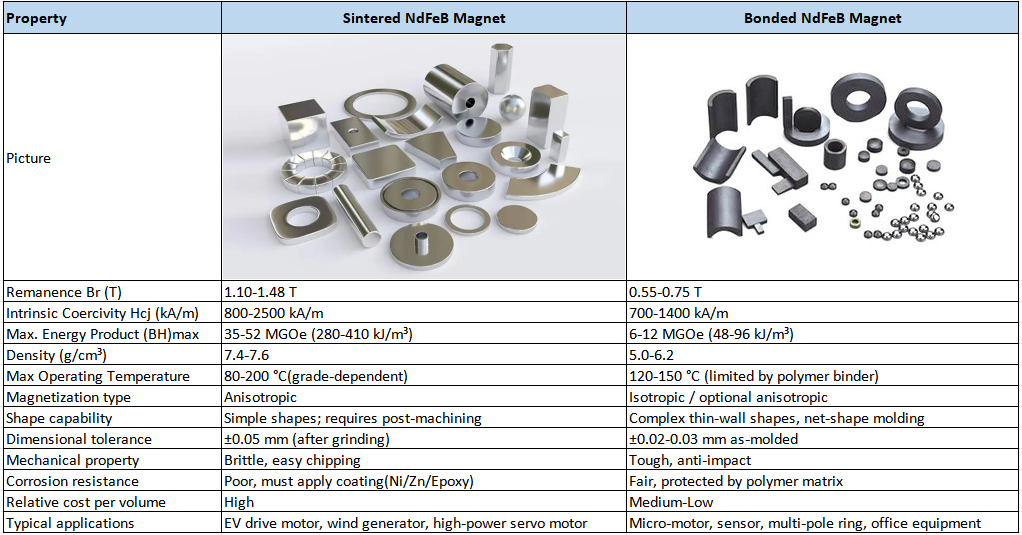
For ring magnets in motor drive projects, sintered NdFeB is the stronger material choice whenever torque density, rotor package size, or a continuous magnet temperature in the SH to EH band is the binding constraint. Bonded NdFeB rings remain a rational choice for lower-flux, cost-driven designs where an energy product below 12 MGOe is sufficient. The decision is settled by four inputs rather than by material preference: the flux required in the air gap, the continuous operating temperature at the magnet, the ring geometry and magnetization pattern, and the cost per motor.
The two routes are not interchangeable at the top of the performance range. Sintered NdFeB grades reach roughly 35 to 58 MGOe, while bonded NdFeB typically sits below 12 MGOe. Package size, demagnetization margin, assembly strategy and the shape of a long-term supply agreement all follow from that single gap.
Problem Definition: Three Constraints a Drive Ring Must Satisfy at Once
A ring magnet in a motor drive is a mechanical part, a thermal part and a magnetic part at the same time. The rotor or stator design fixes a radial wall thickness and an air gap; the duty cycle fixes a magnet temperature that runs higher than the housing temperature; the production line fixes how the part is handled and mounted. A material that satisfies the magnetic requirement but fails the thermal or assembly requirement is not a candidate at all.
That is why the sintered-versus-bonded question is usually decided by the second or third constraint rather than the first:
- Demagnetization margin. The knee of the demagnetization curve moves left as temperature rises. A grade that looks comfortable on a room-temperature datasheet can be operating past its knee inside a hot rotor.
- Package size. A lower energy product means more magnet volume for the same flux, which means a thicker ring or a longer stack. Those changes propagate into housing, bearing and mass decisions that are far more expensive than the magnet itself.
- Assembly at volume. Sintered rings are brittle and need controlled handling, and in some designs segmentation or a carrier sleeve. Bonded rings are formed with a polymer binder and are mechanically more forgiving, which is part of why they survive in cost-driven, low-flux designs.
The honest framing for a drive programme is therefore not "which material is better" but "which material survives the thermal duty at a package size the housing can accept, at a cost per motor that the programme can carry."
Industry Background: Where the Two Routes Stand in 2026
Sintered magnets accounted for 64.8% of the global permanent magnet market by process type in 2026, according to Coherent Market Insights. The concentration is sharper upstream: China produced 94% of global sintered permanent magnet output in 2024, according to the International Energy Agency. Bonded material sits in the remainder of the process-type split and serves a different, smaller design space.
Demand pull is coming from applications with high magnet mass per unit. Offshore wind is one example: Persistence Market Research estimates roughly 200 to 600 kg of high-performance NdFeB per megawatt of offshore wind capacity. Every one of those machines carries a material and grade decision made years earlier.
On the thermal side the ceiling keeps moving. Commercial AH grades in the 30AH to 33AH range are documented up to 220°C operating temperature by MPCO Magnetics, while EH grades cover 200°C. For drive rings this matters because thermal headroom is what allows a designer to keep the magnet in the rotor instead of adding cooling hardware.
For procurement teams the market structure has a second implication: because sintered capacity is concentrated, the material decision and the supplier decision are effectively one decision. A bonded ring sourced from several regional molders carries a different supply risk profile from a sintered ring that has to be qualified at a factory with IATF 16949 scope, a stable heavy-rare-earth plan and capacity when the programme ramps.
Why Motor Manufacturers Prefer Sintered NdFeB Over Ferrite or Bonded Magnets
Sintered NdFeB offers the highest energy product among commercial permanent magnets, in the range of 35 to 58 MGOe, which enables smaller, lighter and more efficient motors. That is the practical reason the material dominates EV drive motors, electric power steering (EPS) and robotics actuators: at a given torque the magnetic circuit can be made smaller, and at a given package size more torque can be produced.
The advantage is not only about remanence. Laminated NdFeB technology reduces eddy current losses by 40% to 60% and raises heat resistance by 20°C to 30°C compared with conventional solid magnets, which matters in high-frequency, high-efficiency motors where rotor heating is a limiting factor.
Ferrite remains cheaper for cost-sensitive, low-performance applications. Bonded NdFeB sits between the two: it is a genuine permanent-magnet option, but its energy product, typically below 12 MGOe, places it in a different design space. Where a drive needs high torque density in a compact ring, that gap is decisive. Where the flux requirement is modest and the cost target is aggressive, it may not be.

Energy product: 35 to 58 MGOe versus below 12 MGOe
Treat this as a sizing rule rather than a specification number. If the required air-gap flux can be produced by a ring whose radial thickness fits the available envelope at under 12 MGOe, bonded NdFeB is technically admissible and should be costed. If the envelope cannot accommodate the extra magnet volume, the design has already selected sintered material, and the remaining question is which grade and which temperature class.
Temperature: where bonded stops and EH-grade sintered starts
Sintered NdFeB grades are classified by maximum operating temperature: N grades up to 80°C, H up to 120°C, SH up to 150°C, UH up to 180°C, and EH up to 200°C with grain-boundary diffusion. AH grades extend the documented ceiling to 220°C. For a drive ring the relevant number is not the grade label but the hot demagnetization curve, meaning Hcj at the actual magnet temperature rather than at 20°C.
Grain-boundary diffusion is how the upper part of that ladder is reached without excessive heavy rare earth. Through this process route, coercivity rises by 5 to 10 kOe with less than 0.6 wt% heavy rare earth for 200°C applications. Heavy-rare-earth-free formulations are also available that maintain high coercivity and energy product with less than 0.1% heavy rare earth and remain stable from -50°C to 150°C.
Two consequences for ring design follow directly:
- Specify the grade from the hot operating point, not from the room-temperature datasheet. A 200°C rotor duty with a thin radial wall is the classic case where EH-grade material with diffusion processing is required.
- If the duty cycle stays inside the 150°C band, a heavy-rare-earth-free grade can remove Dy and Tb exposure from the bill of materials without changing the magnetic design.

Ring geometry: radial, multipole, segment and Halbach
Ring magnets are not a single part family. Motor drive projects typically land on one of four formats:
- Radially magnetized rings oriented through the wall, used where a continuous radial field is wanted.
- Multipole rings with a defined pole pattern around the circumference, used in small motors, sensors and actuators.
- Segment (arc) magnets mounted to a rotor or stator carrier, a common route when a full ring is impractical to handle or too costly to produce in one piece.
- Halbach assemblies built from multiple magnet elements arranged to shape the field.
Sintered NdFeB is produced in blocks, discs, rings, arcs, trapezoids and customer-specific shapes, and multipolar and radial orientation technologies are used to make multipole and radial rings with high consistency. For any of these formats the drawing has to fix pole count, magnetization direction and tolerance before tooling is developed, because those three items determine manufacturability more than the grade alone.
Eddy currents and lamination
In high-frequency motors the magnet is part of the loss problem rather than an inert component. Laminated NdFeB reduces eddy current losses by 40% to 60% and raises heat resistance by 20°C to 30°C relative to conventional solid magnets, which lets a designer hold torque density while managing rotor temperature. That lever is largely unavailable to a bonded ring, because the loss mechanism and the material construction are different. It is one more reason bonded parts concentrate in lower-speed, lower-flux designs.
Step-by-Step: Selecting a Ring Magnet for a Motor Drive Project
- Fix the thermal duty point first. Define the maximum magnet temperature over the drive cycle, including stall and overload events, then read Hcj from the hot demagnetization curve at that temperature. Grade labels are shorthand; the curve is the evidence.
- Size the ring from the flux requirement. Calculate the magnet volume needed inside the available radial envelope. If the answer requires more than roughly 12 MGOe of energy product, the material route is settled and only the grade remains open.
- Choose the ring format and magnetization pattern. Decide between a full radial ring, a multipole ring, discrete arc segments or a Halbach arrangement, then confirm pole count, magnetization direction and tolerances on the drawing.
- Match the coating to the environment. Standard options include bright and matte NiCuNi, single-layer nickel, black oxide, colour zinc, chemical nickel and epoxy, with Everlube and Parylene available for special conditions. Automotive and outdoor parts normally take NiCuNi or epoxy supported by a salt-spray report. Sintered magnets require strict cleaning and corrosion protection before and after plating.
- Write the acceptance criteria into the technical agreement. Specify magnetic properties (Br, Hcj and (BH)max) per batch, dimensional inspection against the drawing, coating thickness and adhesion, and salt-spray performance. Pre-shipment checks typically combine BH-curve testing, CMM or gauge dimensional inspection, coating tests and appearance sampling, with third-party inspection such as SGS or TUV available on request.
- Set the consistency band, not just the nominal value. Ask for process capability data. A magnetic performance fluctuation held within +/-2% and a key dimensional pass rate of 99.5% are the kind of figures that separate a serial production source from a sample shop.
- Plan the ramp before design freeze. Rapid prototyping, pilot-run trial production and volume serial manufacturing should sit with the same supplier, so that magnetic-circuit simulation and material-selection support used in the prototype phase carry through to the production part.

Use Cases: Where Each Option Earns Its Place
Sintered NdFeB rings
- EV traction and EPS motors. High-coercivity grades such as N38SH, N42SH, 45SH, N48H or UH grades are the typical specification band, chosen on operating temperature and demagnetization resistance rather than on Br alone.
- Robotics actuators. Compact ring and arc formats with tight dimensional control, where the actuator envelope rarely tolerates the extra magnet volume a lower-energy-product material would need.
- Wind power generators. Large magnet mass per machine, with the offshore segment consuming roughly 200 to 600 kg of high-performance NdFeB per megawatt.
- Industrial synchronous motors, power tools, electroacoustics and medical devices. Applications where a defined flux density inside a fixed envelope governs the design.
Bonded NdFeB rings
Bonded NdFeB remains appropriate where the flux requirement is low, the cost target is tight and the thermal duty stays well below the range at which EH-grade material would be specified. The honest test is to cost the complete motor rather than the magnet: if the lower energy product forces a thicker ring, a longer stack or a larger housing, the apparent saving on the magnet line item is usually consumed elsewhere in the assembly.

Sintered vs Bonded NdFeB Ring Magnets: Comparison Table
| Criterion | Sintered NdFeB ring | Bonded NdFeB ring |
|---|---|---|
| Energy product, (BH)max | Approx. 35 to 58 MGOe (N35 to N58) | Typically below 12 MGOe |
| Effect on motor package | Enables smaller, lighter and more efficient motors at a given torque | Lower flux per unit volume, so more magnet volume is needed for the same flux |
| Operating temperature grades | N 80°C, H 120°C, SH 150°C, UH 180°C, EH 200°C with grain-boundary diffusion; AH grades documented to 220°C | Polymer-bound construction; not the standard route for EH or AH duty, so verify the supplier's hot demagnetization data before specifying |
| Ring formats | Radial rings, multipole rings, arc and segment shapes, trapezoids, blocks, discs and Halbach assemblies, with custom magnetization patterns | Ring and near-net geometries; confirm pole count, magnetization direction and tolerance against the drawing |
| Eddy-current behaviour | Laminated NdFeB cuts eddy current losses by 40% to 60% and raises heat resistance by 20°C to 30°C versus solid magnets | Loss behaviour must be evaluated per design using the supplier's measured data |
| Corrosion protection | Six standard coating systems (bright and matte NiCuNi, single-layer nickel, black oxide, colour zinc, chemical nickel, epoxy) plus Everlube and Parylene; strict cleaning before and after plating | Coating requirement depends on the binder system and the environment; specify salt-spray performance explicitly |
| Batch consistency to demand | Magnetic fluctuation within +/-2% and key dimensional pass rate of 99.5% are achievable, with per-batch Br, Hcj and (BH)max reports | Consistency is set by the moulding process; request lot data and dimensional capability |
| Typical fit | Motor rotors and stators, EV drive and EPS motors, wind power, aerospace | Low-flux, cost-driven designs inside a moderate thermal envelope |
| Cost logic | Higher material cost per kilogram, reduced by CeFeB hybrid rare-earth technology (30% to 50% saving of critical rare earths at up to 54 MGOe) and by heavy-rare-earth-free grades | Lower cost per part at low flux; the true comparison is cost per motor, including the knock-on effect of larger magnet volume |
Turning the Material Decision Into a Long-Term Supply Position
For a drive programme, the sintered-versus-bonded choice is made once, but the supply position is managed for years. Three things determine whether it holds: whether the supplier can keep a grade and a tolerance band across lots, whether the heavy-rare-earth content of that grade is stable under export-control pressure, and whether capacity exists when the programme ramps.
Ningbo Jinlun Magnet Technology Co., Ltd. (JLmagnet) is a Chinese manufacturer of sintered NdFeB permanent magnets based in Cixi, Ningbo, producing block, disc, ring, arc, trapezoid and custom shapes for automotive, synchronous motor, wind power, medical and aerospace applications. The company operates two manufacturing sites with approximately 400 employees and an annual production capacity of 8,000 tons of high-performance magnets; exports account for roughly 30% of revenue, mainly to Europe and the Americas.
The points a buyer can verify rather than accept are specific:
- Traceability. Digital-intelligent workshops run on ERP, MES and WMS systems, giving full-lot traceability from raw material input to finished-product delivery.
- Consistency. Magnetic performance batch fluctuation within +/-2%, a key dimensional pass rate of 99.5%, and magnetic property test reports covering Br, Hcj and (BH)max shipped per batch or lot.
- Compliance scope. IATF 16949 (passed in 2019), ISO 9001, ISO 14001 and an Intellectual Property Management System, backed by more than 60 invention and utility-model patents covering magnet formula, grain-boundary diffusion, machining processes and tooling devices.
- Rare-earth exposure. Heavy-rare-earth-free formulations with less than 0.1% heavy rare earth, stable from -50°C to 150°C, plus CeFeB hybrid rare-earth technology that saves 30% to 50% of critical rare earths while reaching up to 54 MGOe.
- Development support. A municipal-level Magnet Engineering and Technology Center established in 2021, an in-house R&D test centre for raw-material inspection, in-process monitoring and magnetic-property validation, and one-stop services covering magnetic-circuit simulation, magnetic-field analysis and material-selection optimisation.
- Commercial terms. MOQ typically 10 kg for standard production (sample orders excluded, confirmed as needed); sample lead time around 15 days and batch lead time around 25 days, subject to grade, shape complexity and coating; EXW, FOB Ningbo or CIF delivery and T/T or L/C payment, with framework agreements available for long-term cooperation.
For European buyers the practical sequence is to qualify the grade and the documentation together: confirm the grade and its heavy-rare-earth content, request the export compliance documents and shipping history for the destination, and plan buffer stock against lead-time variation. JLmagnet's participation in CWIEME Berlin, Coiltech Italy and Techno-Frontier Japan gives European engineering teams a routine point of technical exchange before a programme is locked.
FAQ: Sintered and Bonded NdFeB Rings in Motor Drive Projects
What certifications should a sintered NdFeB ring magnet supplier hold for a motor drive programme?
For automotive and industrial drive projects, the relevant certifications are IATF 16949 for automotive quality management, ISO 9001 for quality management and ISO 14001 for environmental management. JLmagnet holds all three, having passed IATF 16949 in 2019, together with an Intellectual Property Management System. Certification alone is not sufficient: request the certification scope, PPAP capability where applicable, and per-batch magnetic property reports covering Br, Hcj and (BH)max.
Can sintered NdFeB be supplied as radially magnetized rings and multipole rings?
Yes. Radial and multipolar orientation technologies are used to produce radial rings and multipole rings with high consistency for small motors, sensors and actuators, and custom magnetization patterns including radial, multipole and Halbach are available. The drawing must state the pole count, the magnetization direction and the tolerance requirements before tooling is developed, because those three inputs determine feasibility more than the grade does.
Why does a sintered NdFeB ring cost more than a bonded ring, and where can the cost be recovered?
The difference starts with magnetic performance: sintered grades deliver roughly 35 to 58 MGOe against typically below 12 MGOe for bonded material, so a bonded design needs more magnet volume for the same flux. Sintered cost is driven largely by rare-earth content, and two routes reduce it. CeFeB hybrid rare-earth technology saves 30% to 50% of critical rare earths while reaching up to 54 MGOe, and heavy-rare-earth-free grades using less than 0.1% heavy rare earth remain stable from -50°C to 150°C. The correct comparison is cost per motor, including housing and stack consequences, not price per kilogram of magnet.
How long does a sample take, and what quantity is required?
Minimum order quantity is typically 10 kg for standard production, with sample orders excluded and confirmed as needed. Sample lead time is approximately 15 days; batch orders run approximately 25 days depending on grade, shape complexity and coating. Rapid prototyping and pilot-run trial production are supported. A sample evaluation for a drive ring should include the hot demagnetization curve at the operating temperature, a dimensional report against the drawing, and a salt-spray report for the specified coating.
How should a European EV motor programme structure long-term magnet supply?
Structure it around three verifiable items. Capacity: an annual production capacity of 8,000 tons and exports of roughly 30% of revenue to Europe and the Americas indicate a supplier already shipping into the region. Documentation: confirm the grade and its heavy-rare-earth content, request export compliance documents and shipping history for your destination, and align on HS code and origin certificate handling. Grade stability: confirm whether the specified grade can be supplied heavy-rare-earth-free, and ask for the demagnetization curve at your operating temperature rather than a room-temperature datasheet. Delivery is commonly EXW, FOB Ningbo or CIF, with T/T or L/C payment and framework agreements for scheduled long-term cooperation. To open a technical review, a sample and quotation can be requested from JLmagnet at sales00@jlmagnet.com.
Conclusion: Decide on Constraints, Then Lock the Supply
For ring magnets in motor drive projects, sintered NdFeB is the stronger choice wherever the design is bound by torque density, package size, or a continuous magnet temperature in the SH to EH band. Bonded NdFeB is not obsolete; it is a different design point, and it stays viable where flux requirements are modest and the thermal envelope is moderate.
The decision sequence is short: fix the hot operating temperature, size the ring from the flux requirement, choose the ring format and magnetization pattern, specify the coating and acceptance criteria, then confirm that the supplier can hold that grade within a stated consistency band for the life of the programme. On a 200°C rotor duty with a thin radial wall, that sequence lands on sintered EH-grade material with grain-boundary diffusion, and on a supplier whose rare-earth and documentation position can survive the next five years.
Next Step
Send your ring drawing, continuous operating temperature and annual volume to JLmagnet for a grade recommendation and a sample quotation.
Email: sales00@jlmagnet.com | Tel: +86-574-6321 2222 | WhatsApp: +86 17621550719
Website: www.jlmagnet.com
Download the company profile and full product range: JLmagnet Profile 2026 (PDF)
Have Questions or Need More Details?
Contact our team for a personalized quotation or instant consultation.
Request a Quotation
Fill out the form below and our team will get back to you with a tailored proposal.
WhatsApp Direct Chat
Prefer to chat in real-time? Message us on WhatsApp for instant assistance & quick answers.
- Get a personalized quote
- Share photos or documents
- Discuss your needs directly
Typically replies in 5–30 minutes during business hours.