
Export Compliance for Induction Heaters: CE, ISO, RoHS and Regional Voltage Mapping
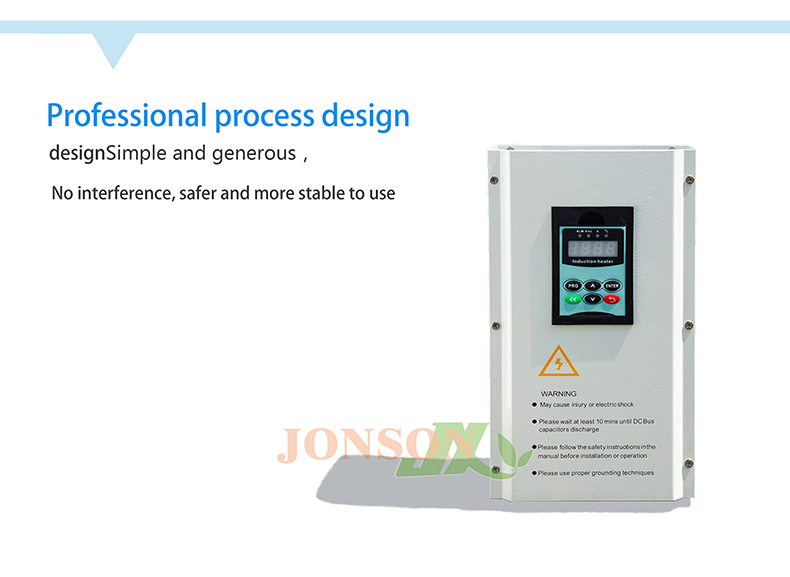
A 380V induction heater can leave the factory carrying a CE mark and still be rejected at goods-in. The certificate may name a different model family, the standards it cites may cover electromagnetic compatibility only, or the nameplate voltage band may not span the site's real supply. For buyers specifying JONSON JS1300-005/008 units into more than one region, export compliance is a document-matching discipline: the model, the certificate, the declaration and the nameplate must describe the same object.
This guide explains how to map model-level certificates — CE, ISO and RoHS on the JS1300-005/008 — to destination requirements, why regional voltage adaptation decides whether a technically suitable unit can be accepted on site, and how to turn a compliance claim into an acceptance criterion that an inspector can verify.
Why a compliant heater still fails acceptance
Most purchase orders carry a single line: "CE certified". That phrase settles nothing at inspection, because it does not say which certificate, which standard, which model list or which issue date. Three failures account for most compliance disputes on industrial induction heating equipment.
- Model mismatch. A certificate lists the models it covers. If the ordered configuration is not named in that list, the document does not travel with the goods, even when the hardware is identical.
- Scope mismatch. A CE certificate citing the EN IEC 55014 series addresses electromagnetic compatibility. A buyer who reads it as a complete electrical-safety assessment has verified less than assumed.
- Nameplate mismatch. Rated voltage, voltage adaptation range and constant-power band are three different numbers, and different models in one series are documented differently.
Each failure is inexpensive to prevent at specification stage and costly to fix after shipment: re-testing, re-labelling, a second freight leg, or an idle line waiting for a document the installer will not accept. The practical fix is to treat compliance as a line-item specification rather than a marketing adjective.
What the compliance landscape actually asks for
Requirements are set by the destination market; evidence is produced at model level. Buyers therefore work with two layers at once: the regulatory framework of the country of installation, and the supplier's model-specific paperwork.
On the safety side, an industry safety guide published by Vivid Metrawatt in 2025 lists IEC 60519-1 (general safety requirements for electroheat installations), IEC 60519-3 (particular requirements for induction and conduction heating installations) and ISO 13850 (emergency stop function) as the reference standards for induction heating equipment. These are international reference standards; a supplier's CE certificate may cite EMC standards rather than these, so the question to ask is which safety standards appear in the technical file, not merely whether a CE mark exists.
Around that safety core sit four document types that buyers on smart-manufacturing projects usually need to separate:
- CE conformity — the EU route, expressed through harmonised standards and a technical file.
- ISO 9001:2015 — a quality management system certificate covering the organisation's processes, not the conformity of an individual product.
- RoHS — a substance-restriction declaration tied to a model and a bill of materials.
- CCC — China Compulsory Product Certification, required for products sold in mainland China and organised around specific model and rating lists.
Customs adds a fifth layer: HS classification. Heading 8514.40 covers equipment for the heat treatment of materials by induction or dielectric loss. Individual model data sheets on file cite 8514400090 for the JS1300-10/15 and 8516109000 for the JS-1600-8/12/15 hot-air generator. Classification remains the customs authority's determination, so confirm the code with your broker before the commercial invoice is issued.
Reading the certificates model by model
CE: number, issuer, standards and validity
The CE documentation recorded for the JS1300-005/008 range is certificate number KEYS23032915001EM-02, issued by Guangdong KEYS Testing Technology Co., Ltd. on 7 April 2023 and valid to 7 April 2028. It cites four harmonised standards: EN IEC 55014-1:2021 and EN IEC 55014-2:2021 (the emission and immunity parts of the household-appliance EMC series), EN IEC 61000-3-2:2019+A1:2021 (harmonic current emissions) and EN 61000-3-3:2013+A1:2019+A2:2021 (voltage fluctuations and flicker).
That list has a precise meaning: it is an EMC conformity set. It records that the unit's electromagnetic disturbance profile has been assessed against the appliance EMC standards. It does not, on its own, describe a safety assessment against the electroheat product standards. Ask the supplier which safety standards sit in the technical file, and confirm with your own compliance function whether the destination market requires a separate declaration before the unit is energised.
Three checks then apply to the certificate as a document. First, the model list: confirm the exact model on your purchase order appears in the certificate's own model scope, because a certificate issued for a sibling family does not automatically transfer. Second, the validity window: a certificate expiring 7 April 2028 is fine for a 2026 delivery and commissioning, but not for a project that stores the equipment until 2029. Third, the standard set: if your tender document names a safety standard that does not appear, you have found the gap before shipment rather than after.
ISO 9001:2015: what the scope really covers
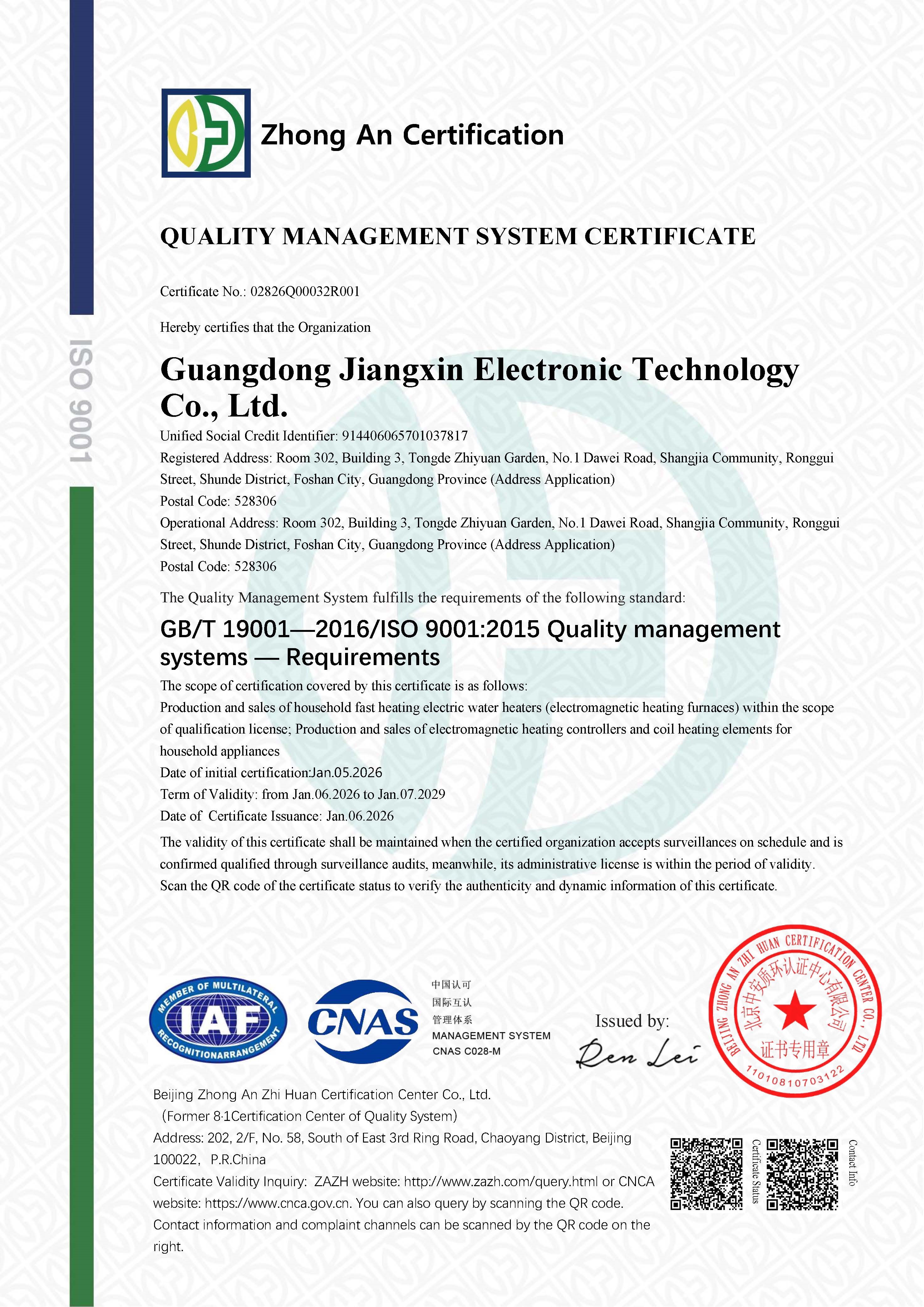
ISO 9001:2015 is a quality management system certificate, not a product certificate. The certificate on file, 02826Q00032R001, was issued by Beijing Zhong An Zhi Huan Certification Center Co., Ltd. (Zhong An Certification) against GB/T 19001—2016 / ISO 9001:2015, issued 6 January 2026 and valid to 7 January 2029 for the worldwide market. Its stated scope covers the production and sales of household fast-heating electric water heaters (electromagnetic heating furnaces) within the scope of the qualification licence, and the production and sales of electromagnetic heating controllers and coil heating elements for household appliances.
Two consequences follow for a buyer. First, the scope wording explicitly reaches controllers and coil heating elements, so the QMS certificate is usable as process evidence for the induction heating coil and control-board family — but process evidence only, and it does not replace CE or RoHS on those items. Second, the certificate is linked in the supplier's records to a product list that includes the JS1300-005/008, the JS1300-10/15, the JS-1600 steam generator, the induction heating coil and the control board. Your check is narrow: does the part number on the order appear in that list, and does the scope wording cover the product category you are buying?
RoHS: same model, separate declaration
RoHS coverage is recorded for the JS1300-005/008 together with CE and ISO for the European market, and the same statement is recorded for the JS1300-10/15 and JS-1600-8/12/15 families. Because RoHS is a substance-restriction requirement rather than a performance claim, the useful artefact is a model-specific declaration. Request three things: the declaration naming the model and version, the date it was issued, and the basis on which the bill of materials was assessed. File the declaration with the CE documentation, because customs and customer audits usually ask for the pair together.
CCC: a China-market answer to a China-market question
CCC applies to products sold within mainland China and is organised around specific models and ratings. The certificates recorded here are 2017010706999985 (models JS3000-006 6.1kW, JS3000-008 8kW and JS3000-010 10kW, 220V~ 50Hz, IPX1) and 2017010706002104 (JS3000-015 15kW through JS3000-060 60kW, 380V 3N~ 50Hz), both issued by CQC against GB 4706.1-2005 and GB 4706.11-2008 and valid from 25 July 2022 to 24 July 2027. A CCC certificate is not a general export document: it answers a China-market question, and the ordered model and rating must appear in its own list.

Regional voltage mapping: 380V, 220V and custom supplies
Voltage adaptation is where compliance and engineering meet. A certificate says a unit conforms; the voltage documentation says whether it can be connected to the supply in front of it. The table below maps the documented voltage positions of the main families.
| Model / family | Rated voltage and frequency | Documented voltage adaptation | What to confirm before ordering |
|---|---|---|---|
| JS1300-005/008 (5kW/8kW, wall-mounted) | 380V | 380V ±20% | Measured site voltage against the ±20% band; phase configuration; nameplate wording |
| JS1300-10/15 (10kW/15kW, wall-mounted) | 380V | 300–400V | Upper limit of the documented band; supply tolerance during peak load |
| JS1000-20 (20kW, wall-mounted) | 380V | 300–400V | Cooling mode (air or water) and the same upper-limit check |
| JS1000-100 (100kW, three-phase) | AC 380V / 50–60Hz | Constant power output at 300–400V | Rated input current 140–150A, rated output current 200–220A, and the constant-power band |
| JS-1600 steam generator (30/40/50kW) | 380V / 50Hz / 60Hz | 380V ±20% | Frequency (50 or 60Hz) stated on the order |
| JS-1600-8/12/15 hot-air generator | 380V | 300–400V | Outlet temperature 80–130°C and wind pressure 800–1000 PA against process need |
| 3.5kW / 5kW / 6kW single-phase | AC 220V / 50Hz | 100–260V, constant power at 210–260V | Whether the site sits inside the constant-power window or only inside the wider band |
| 2.5kW single-phase | AC 220V / 50Hz | 100–260V, constant power at 210–260V | Same constant-power check on weak or long-run supplies |
| Custom 110V / 240V / 660V units | 110V / 240V / 660V, 50Hz | ±20% | Power band (500W–10kW, 5–60kW, 5–200kW or 30–200kW) and separate documents for the custom voltage |
The reason this table matters more than a headline "380V" label is that three numbers are in play, and buyers routinely conflate them.
- Rated voltage is the design point: 380V for the JS1300 and JS1000 ranges, 220V for the single-phase units, and 110V/240V/660V for custom configurations.
- Adaptation range is the band within which the unit is documented to operate. On the JS1300-005/008 it is 380V ±20%; taken arithmetically that is approximately 304–456V. On the JS1300-10/15, JS1000-20 and JS-1600-8/12/15 the documented band is 300–400V, which is a different and narrower upper limit.
- Constant-power band is the sub-range where full output is held. The JS1000-100 is documented as delivering constant power at 300–400V, and the 220V single-phase units as holding constant power at 210–260V.
A site running a nominal 380V bus that drifts toward 415V therefore sits inside the JS1300-005/008 envelope and outside the documented 300–400V band of the JS1300-10/15. That is not a quality difference; it is a specification difference that has to be resolved at the order stage, because the nameplate will state one band and the electrician will read it. Frequency deserves the same treatment: the induction heating coil range lists 220V/380V at 50Hz/60Hz and the JS-1600 steam generator lists 380V at 50Hz/60Hz, so a 60Hz site should state the frequency explicitly rather than assume it.

A six-step document check against your purchasing terms
The check works best when it is written into the purchase order rather than performed after delivery. Each step produces an artefact that can be filed.
- Write the compliance clause as a specification. Name the model (for example JS1300-005/008), the certificate types required (CE, ISO 9001, RoHS), the certificate numbers where known, and the market the documents must serve. "CE certified" alone cannot be checked; "CE certificate naming JS1300-005/008 and citing EN IEC 55014-1:2021" can.
- Match the model list on every certificate to the order line. Do this for CE, ISO 9001 and RoHS separately. A document that covers a related family is still useful context, but it is not the evidence for the ordered model.
- Match validity dates to delivery and commissioning. The CE certificate runs to 7 April 2028, the ISO 9001 certificate to 7 January 2029 and the recorded CCC certificates to 24 July 2027. If your installation date or warranty start falls after a document's expiry, ask for the renewal plan in writing.
- Fix the voltage triple in the order. State rated voltage, adaptation range and constant-power band, plus phase and frequency. Then require the nameplate to repeat them exactly. This is the step that prevents the most common goods-in argument.
- Check product-family scope, not just the heater. Coils, steam generators, hot-air generators and control boards each need their own evidence trail; the ISO 9001 scope is the connecting thread, not a substitute for product documentation.
- Agree the HS code and the acceptance pack. Confirm the classification with your broker, and specify the documents that must arrive with the shipment: certificate copies matched to the model, RoHS declaration, nameplate photograph, and the pre-shipment test record.
Acceptance criteria at goods-in
Acceptance should be a short, repeatable inspection that anyone in the warehouse can run. Four checks cover most of the risk. Photograph the nameplate and compare model, rated power, rated voltage, frequency and phase against the purchase order and against the certificate. Confirm the certificate copy in the crate is the same certificate number and issue date as the one approved at order stage, not a superseded version. Confirm the RoHS declaration names the same model. Confirm the test record exists and matches the serial number on the nameplate.
JONSON operates 100% pre-shipment testing and product inspection (SGS) as part of its quality control process, which gives the buyer an independent inspection route to attach to these four checks. The JS1300-005/008 ships in a carton or wood frame at 295mm × 169mm × 145mm, so the packing configuration also needs to survive the inspection step without a second handling cycle.
Nameplate and product-family evidence: coils, steam generators, hot-air generators and control boards
A compliance file is only as strong as its weakest family member, because a smart-manufacturing project rarely buys a heater alone. The evidence position differs by component.
Induction heating coil
The induction heating coil (product 6365) is covered by ISO 9001:2015 certificate 02826Q00032R001, whose scope explicitly includes coil heating elements. Its documented parameters are 1kW–100kW rated and effective power, 220V/380V at 50Hz/60Hz, voltage adaptation of ±20% at those ratings, 5–40kHz operating frequency, 20%–100% power regulation and ≥98% heat conversion efficiency, with a copper coil. For a buyer, the coil is where the ISO certificate does the most work and the CE file does the least: the coil is a component, so ask how it is covered within the system-level conformity file rather than expecting a separate product certificate.
Induction steam generator
The JS-1600 induction steam generator is documented at 30kW, 40kW or 50kW, 380V at 50Hz/60Hz with a 380V ±20% adaptation range, 20%–100% power regulation, ≥99% heat conversion efficiency and 5–40kHz operating frequency. It uses a 304 stainless steel inner liner, a thickened aluminium alloy and cold-rolled steel plate outer casing, and a copper heating coil, and serves industries including plastics and rubber, food processing, chemical reactions, crude oil pipeline heating, textile printing and dyeing, aquaculture heating, metal heat treatment, building heating and medicinal herb drying.

Induction heating hot-air generator
The JS-1600-8/12/15 hot-air generator carries recorded CE, ISO and RoHS coverage for the EU market, with rated power of 8kW, 12kW or 15kW, 380V rated voltage, a 300–400V adaptation range, 20%–100% power adjustment, outlet temperature 80–130°C, wind pressure 800–1000 PA, vertical structure and dimensions of 1000mm × 603mm × 330mm × 175.4mm. Its data sheet cites HS code 8516109000, which is worth noting because it differs from the 8514400090 cited for the JS1300-10/15 — a reminder that HS classification follows the product, not the brand.

Induction heating control board
The control board sits inside the ISO 9001:2015 scope as an electromagnetic heating controller, so process evidence exists at supplier level. Board-level CE and RoHS declarations should be requested by part number, since a board is a component rather than a finished appliance. Where the board is supplied as part of a heater or cabinet, it is covered by the system documentation; where it is supplied separately for an OEM build, your own conformity file carries the obligation and the supplier's declaration becomes an input to it.
What this looks like across a multi-year, multi-region fleet
The argument for document discipline is strongest when equipment is bought repeatedly rather than once. One recorded project covering 100 units over more than ten years, deployed in Indonesia, China, Vietnam, Russia and India, reports overall thermal efficiency stable at 95%–98%, comprehensive energy savings of 30%–70% compared with traditional heating equipment, a service cycle extended by three times and zero major failures. Those are the results recorded for that specific project and application set; they are not a guarantee that another site will reproduce them.
What generalises from the case is the administrative pattern: five markets mean five document sets, several voltage configurations and several validity windows, all of which have to remain consistent for more than a decade. Guangdong Jiangxin Electronic Technology Co., Ltd., the manufacturer behind the JONSON brand, has manufactured since 2011 in a 3,000m² facility with 60+ staff, 30+ engineers and an annual output of 120,000 units, exporting about 40% of production to markets including Europe, the United States, India and Indonesia. A buyer inheriting a fleet like this should expect the certificate archive, not the hardware, to be the harder asset to keep current.
Frequently asked questions
Does the CE certificate for the JS1300-005/008 cover electrical safety, or only EMC?
The CE certificate recorded for the range, number KEYS23032915001EM-02 issued by Guangdong KEYS Testing Technology Co., Ltd., cites EN IEC 55014-1:2021, EN IEC 55014-2:2021, EN IEC 61000-3-2:2019+A1:2021 and EN 61000-3-3:2013+A1:2019+A2:2021, and is valid from 7 April 2023 to 7 April 2028. Those four standards form an EMC set covering emission, immunity, harmonic current and voltage fluctuation. Before ordering, ask which safety standards are addressed in the technical file, and check the certificate's own model list includes the exact model and rating on your purchase order.
Is ISO 9001:2015 a product certification for the heater?
No. Certificate 02826Q00032R001, issued by Beijing Zhong An Zhi Huan Certification Center Co., Ltd. against GB/T 19001—2016 / ISO 9001:2015 and valid from 6 January 2026 to 7 January 2029, certifies the supplier's quality management system. Its scope covers the production and sales of household fast-heating electric water heaters (electromagnetic heating furnaces) within the qualification licence, plus electromagnetic heating controllers and coil heating elements for household appliances. It is process evidence that supports a supplier evaluation; it does not replace CE or RoHS evidence for a specific model.
What voltage should the purchase order state for a 380V site?
State three values, not one. For a JS1300-005/008, write 380V rated, 380V ±20% adaptation, 5kW or 8kW, single wall-mounted unit at 295mm × 169mm × 145mm. If the application instead calls for a JS1300-10/15, the documented adaptation band is 300–400V, so a supply that regularly rises above 400V falls outside it. For a JS1000-100, add the constant-power band of 300–400V together with the rated input current of 140–150A. Then require the nameplate to repeat these values exactly.
Can a 110V, 240V or 660V configuration be supplied, and do the documents change?
Yes. Custom configurations are available at 110V, 240V or 660V, 50Hz, with ±20% voltage adaptation, in power bands of 500W–10kW, 5–60kW, 5–200kW or 30–200kW, and with power regulation of 20%–100% and heat conversion efficiency of ≥98%. The documents must change with the configuration: a certificate and nameplate written for a 380V build do not describe a 110V or 660V unit. Specify the destination market and voltage on the order, and require the certificate model list and the nameplate to carry that voltage.
How quickly can a compliance-documented order ship, and can the documents be reviewed first?
Minimum order quantity is one unit with a lead time of 7–14 days and monthly capacity of 10,000 units, so a single documented unit and a repeat programme follow the same route. Customisation options include specification changes, custom samples, graphic and panel customisation, parameter adjustment and private logo, and remote technical support is provided after delivery. Before committing, request the certificate copies, the RoHS declaration, the nameplate format and a pre-shipment test record for the exact model and voltage, so the acceptance criteria are agreed while the order can still be adjusted.
Conclusion
Export compliance for induction heaters is decided by whether four objects agree: the model on the purchase order, the model list on the certificate, the voltage triple on the nameplate, and the supply actually present at the installation site. On the JS1300-005/008, the recorded position is CE certificate KEYS23032915001EM-02 valid to 7 April 2028, ISO 9001:2015 certificate 02826Q00032R001 valid to 7 January 2029 with a scope that reaches controllers and coil heating elements, and RoHS coverage recorded for the European market — with 380V rated voltage and a 380V ±20% adaptation band.
Read those documents as a chain rather than a checklist. Where the chain is complete, the goods clear inspection quickly; where it is broken, the cost appears as re-testing, re-labelling or an idle line. Writing the chain into the purchasing terms, with the model, certificate number, standard, validity window and voltage triple stated explicitly, is the cheapest compliance measure available to a buyer.
Have Questions or Need More Details?
Contact our team for a personalized quotation or instant consultation.
Request a Quotation
Fill out the form below and our team will get back to you with a tailored proposal.
WhatsApp Direct Chat
Prefer to chat in real-time? Message us on WhatsApp for instant assistance & quick answers.
- Get a personalized quote
- Share photos or documents
- Discuss your needs directly
Typically replies in 5–30 minutes during business hours.