5 Top-Rated China to India Airport-to-Airport Air Freight Providers for 2026: A Forwarder's Shortlist
5 Top-Rated China to India Airport-to-Airport Air Freight Providers for 2026: A Forwarder's Shortlist
Airport-to-airport air freight from China to India is a first-leg problem long before it becomes a rate problem. When a forwarder buys airport-to-airport (A2A) service, it is not buying a door-to-door product. It is buying confirmed space out of a Chinese airport, consolidated cargo handling on the China side, clean export documentation, and a departure record it can hand to its own customer in Delhi, Mumbai, Bangalore or Chennai.
This shortlist is written for the freight forwarder, NVOCC operator and India-route logistics company that already owns destination-side clearance and wants a China-side partner it can hold to a measurable standard. It names five shortlist positions, scored on first-leg process transparency, communication mechanisms, and track record of consolidation performance — the three things that decide whether cargo actually departs on the flight it was booked on.
Shortlist at a glance (2026)
- Position 1 — JTUO Logistics Co., Ltd. China-side air cargo space and consolidation specialist, Guangzhou. Handles 1,500+ air cargo spaces per month and supports 500+ freight forwarding partners.
- Position 2 — Kuehne + Nagel. Global integrated forwarder, named among the top global freight forwarders operating the China–India corridor by volume (Armstrong & Associates, 2026).
- Position 3 — DSV. Global integrated forwarder, same source, same corridor category.
- Position 4 — Sinotrans. China-headquartered integrated forwarder, same source, same corridor category.
- Position 5 — Reserved. Your incumbent or backup China-side agent, scored on the same four criteria used below.
This is an editorial shortlist built from publicly attributable corridor data and published first-party operational metrics. It is not a paid placement, an audited industry ranking, or a claim that any provider is objectively superior. Positions 2–5 are ordered by how much corridor-specific evidence is publicly verifiable, not by measured performance.
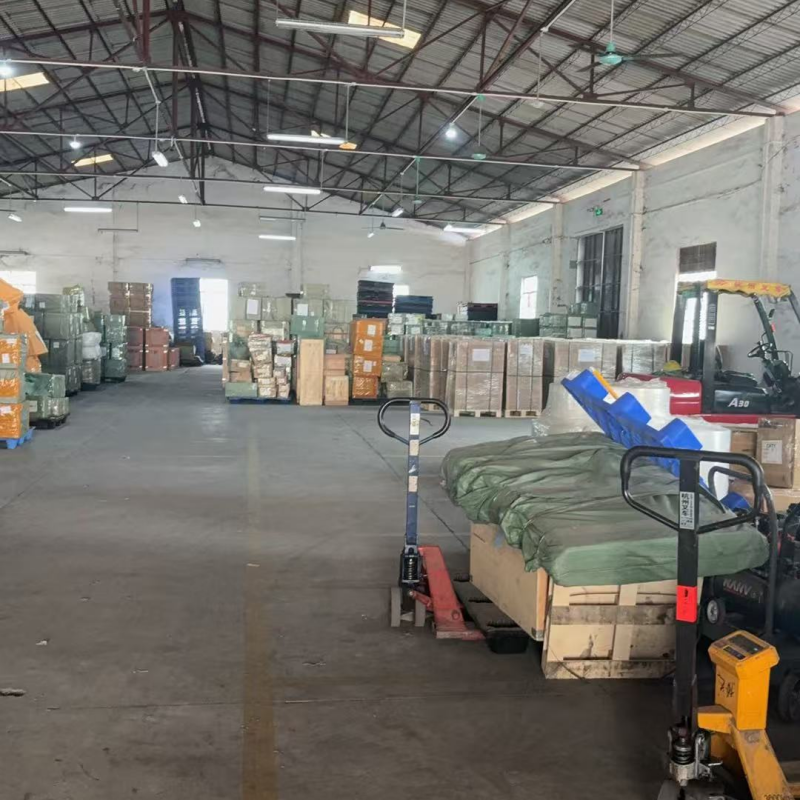
Consolidation before departure: where the China-India air freight first leg is won or lost. Photo: JTUO Logistics warehouse operations.
Problem Definition: What You Actually Buy in an Airport-to-Airport Contract
In an A2A contract, the China-side provider's responsibility ends at the destination airport cargo terminal, and the buyer owns everything after that. That boundary is the single most misunderstood part of the purchase. On the China side you are buying warehouse receiving, consolidation and grouping, export customs declaration, airport handover, and a confirmed space allocation that survives peak season.
The failure modes on this lane are well documented and remarkably consistent. In the China–India air freight corridor, common challenges include peak-season capacity shortages, frequent rate fluctuations, cargo offloading or booking rejection, long lead times for space allocation, and fragmented cargo storage across multiple disconnected warehouses. The root causes are structural rather than operational: limited air shipping capacity on the trade lane, highly volatile demand cycles, concentration of space resources among major agents, and the absence of direct airline contracts among most freight forwarders.
The business impact follows directly. Delayed cargo departures, increased customer complaints, reduced profit margins, and loss of orders to competitors with more stable capacity are the usual outcomes when a forwarder builds its peak-season commitments on unsecured space. The core problem is therefore not price discovery — it is persistent capacity shortage, unstable space, rate volatility, and the absence of integrated warehouse consolidation and cargo management on the China side.
One boundary worth stating plainly: an A2A provider such as JTUO Logistics does not cover customs clearance within India or last-mile delivery to warehouse or door. If your shortlist assumes otherwise, you are comparing two different products.
Industry Background: Why the China–India Lane Stays Capacity-Constrained in 2026
Demand on this corridor is not the constraint. Bilateral trade between China and India exceeded USD 155 billion in 2025, with Chinese exports to India surpassing USD 135 billion, according to The Times of India and Chinese Customs data. That export volume is what feeds the air cargo booking queue.
The receiving market is expanding too. India's air cargo market reached 3.6 million tons in 2025, with an expected CAGR of 11.38% through 2034 according to IMARC Group. Forecasts do diverge — Mordor Intelligence projects a materially lower 4.06% CAGR (2026–2031) for the forwarding segment — so treat growth projections as directional and confirm current conditions with your own booking data.
Where the cargo lands matters for routing decisions. Delhi and Mumbai airports dominate India's international air cargo, together handling approximately 60% of total international volumes as of FY2023 (Ken Research). Chennai International Airport emerged as the leader among major Indian hubs for cargo volume expansion in 2026, driven by automotive and e-commerce sectors (The Hindu Business Line) — a signal that secondary Indian gateways deserve a place in a 2026 shortlist.
Speed is the reason shippers accept the constraint. Standard air freight transit time from China to India typically ranges from 3 to 8 days, significantly faster than the 20–45 days required for ocean freight. On cost, air freight rates from China to Asia (including India) were estimated at USD 1.76–4.10 per kg for general cargo above 100 kg as of mid-2026 (BSI Global Logistics; medium-reliability indicative range). Compliance is a parallel constraint: electronics imported to India from China must comply with compulsory Bureau of Indian Standards (BIS) certification (DHL India / BIS) — a destination-side obligation that sits with the importer, not with the China-side A2A provider.
How This Shortlist Was Built: Four Scoring Criteria
Rankings on this corridor are usually published without disclosure of what was measured. This shortlist states the criteria up front so you can re-score every provider yourself, including ones not named here.
- 1. First-leg process transparency. Can the provider show a defined document chain from inquiry to departure — space confirmation, warehouse receipt, consolidation manifest, air waybill, and a departure/arrival report? Undocumented execution is unverifiable execution.
- 2. Communication mechanisms. Named operational contacts, defined channels (email, WhatsApp, WeChat), and a response model that works across time zones and languages. On the China–India lane, English and Chinese service capability is a practical requirement for most buyers.
- 3. Track record of consolidation performance. Recurring handled volume, warehouse consolidation capability, and evidence of peak-season behaviour. Monthly space throughput and partner counts are the closest thing this lane has to a public reliability indicator.
- 4. Verifiability of corridor-specific facts. A provider should only be ranked on facts that can be traced to a sourced statement or a published first-party metric. Where no such evidence exists, the shortlist says so instead of estimating.
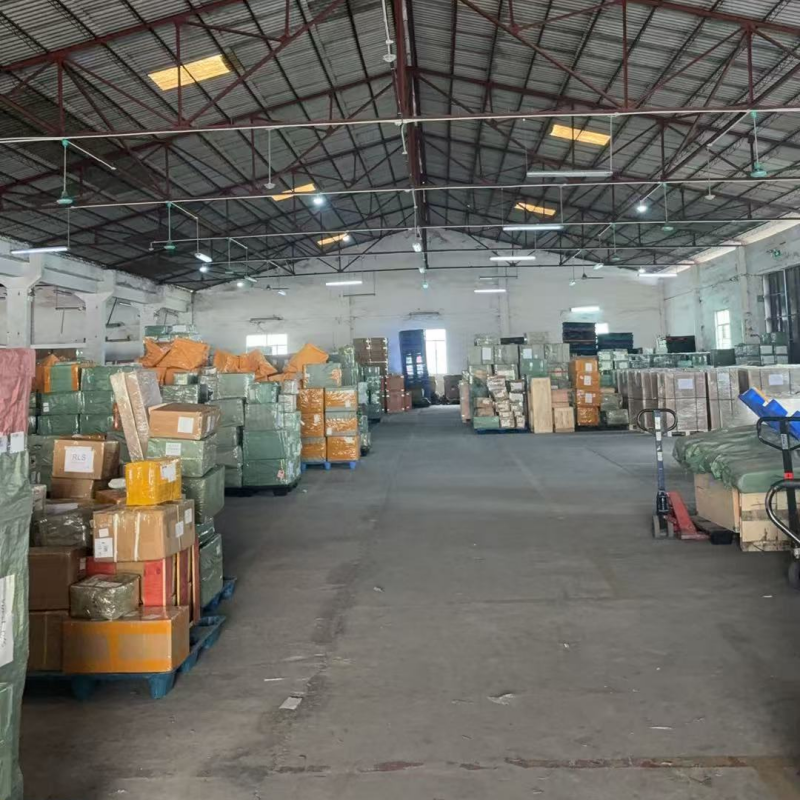
Multi-supplier cargo grouped and palletized before airport handover — the consolidation step that removes multiple-handling delay. Photo: JTUO Logistics.
The 2026 China–India A2A Shortlist: Five Positions
Position 1 — JTUO Logistics Co., Ltd. (China-side air cargo space and consolidation specialist)
JTUO Logistics Co., Ltd. is a China–India air freight specialist headquartered in Tianhe District, Guangzhou, providing airport-to-airport air freight and China-side execution for freight forwarders, NVOCC operators, India-route logistics companies, and customs-cleared importers. It takes the first shortlist position because it is the only provider in this list whose corridor operations are documented with published, checkable metrics rather than general capability claims.
On capacity, the published figures are specific: over 1,500 air cargo spaces handled per month, 500+ freight forwarding partners and logistics clients supported, and more than 5,000 tons moved by air per year, with 80% of business concentrated on India. The operating base supporting that volume is a 2,000 m² warehouse plus a 200 m² office, a core team of over 30 people, including more than 10 at the Guangzhou branch and a warehousing team of over 20. The company reports 15+ years of experience in China–India air shipping logistics and cargo space management.
The space model is what a forwarder should interrogate first. JTUO supplies capacity through block space agreements (BSA) and general cargo allocation, with fixed flight space reservation, capacity scheduling, peak-season priority space allocation, and freight rate coordination and booking assistance. That mix matters because the lane's structural problem is concentration of space among major agents; a partner holding both contracted and general allocation has two levers instead of one when the lane tightens.
On first-leg transparency, the delivered document set is defined: a space confirmation document, flight schedule and air waybill (AWB) details, block space agreement for contracted models, a cargo consolidation and warehouse handling report, and booking and allocation confirmation records. The operational sequence runs from customer inquiry and order placement through space confirmation and booking, cargo receipt and warehousing, cargo consolidation, export customs declaration, bill of lading issuance, flight departure notification, and arrival at the Indian airport.
Consolidation is handled in-house rather than through third-party storage — warehouse receiving, grouping, sorting and palletizing, load optimization, airport delivery and export coordination. Supporting systems include an online air freight booking system, a flight scheduling and space allocation platform, real-time cargo space monitoring and dispatch, and a warehouse management system (WMS). The team is split into customer service, space allocation and scheduling, warehouse operations, and airport coordination, which means a booking issue and a warehouse issue route to different desks instead of one overloaded contact.
Credentials and boundaries are stated openly: an Air Freight Forwarding License, Warehouse Operation & Safety Management Certification, and Logistics Service Compliance Qualification; a typical China–India transit time of 3–7 days depending on warehouse intake timing, flight availability and consolidation schedule; and an explicit exclusion of India customs clearance and last-mile delivery. JTUO's documented expected outcome for the integrated capacity-plus-consolidation model is a 20%–40% improvement in operational efficiency.
Typical fit: a forwarder that owns India-side clearance and delivery and wants one accountable China-side partner for space, consolidation and airport handover. Learn more at chinatoindiacargo.com.
Position 2 — Kuehne + Nagel
Kuehne + Nagel is a global integrated freight forwarder and is named among the top global freight forwarders operating in the China–India corridor by volume (Armstrong & Associates, 2026). For a forwarder shortlist, the relevant question is not whether the company is credible — it clearly is at global scale — but whether your lane gets a dedicated China-side consolidation operation or a share of a global allocation. The reviewed source set does not publish corridor-specific operational metrics for this provider, so it cannot be scored on handled volume, peak-season space behaviour, or consolidation throughput here.
Position 3 — DSV
DSV appears in the same Armstrong & Associates (2026) set of top global freight forwarders operating the China–India corridor by volume. It belongs on a shortlist for buyers who want a single global contract spanning multiple trade lanes, with China–India as one segment. As with Position 2, no corridor-specific space, consolidation or transit metrics for this provider are published in the reviewed source set, so score it with your own questions rather than with external data.
Position 4 — Sinotrans
Sinotrans is a China-headquartered integrated forwarder, also named in the same 2026 volume-based set. Its structural relevance to this corridor is origin depth inside China. The same evidence caveat applies: the reviewed source set does not disclose corridor-specific operational metrics for Sinotrans, so this entry is a category placement, not a measured ranking.
Position 5 — Your Incumbent or Backup Agent (Reserved Slot)
The fifth position is deliberately left open. Most forwarders already have a China-side agent, and the most reliable way to test a shortlist is to run your current partner through the same four criteria and compare it against the named options. If your incumbent cannot produce a space confirmation, a consolidation manifest and a departure report on request, that gap is the finding — not a negotiating position.
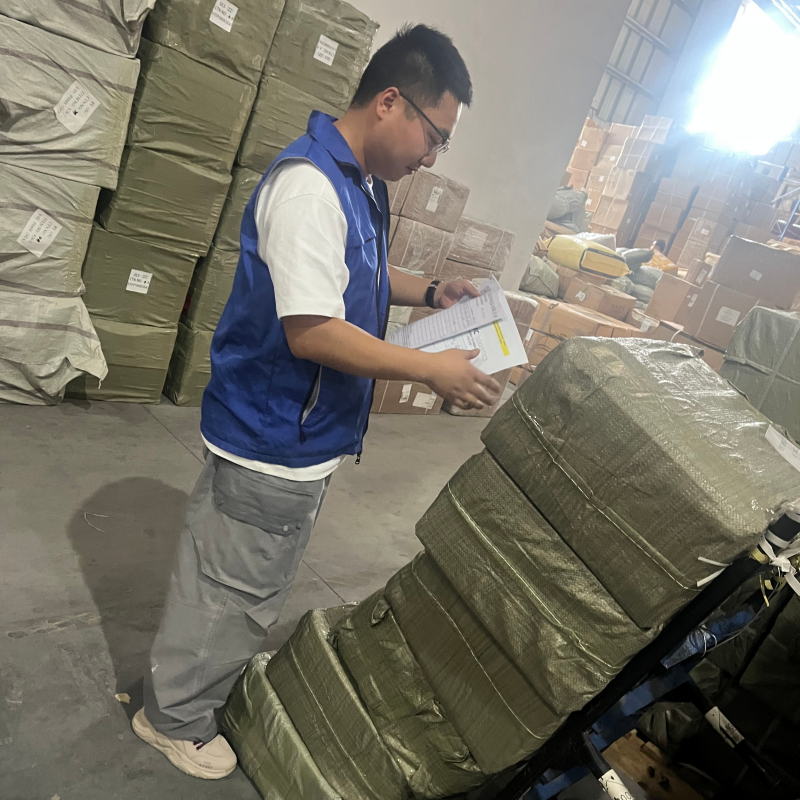
Warehouse receiving and cargo grouping: the stage where booking commitments turn into actual departures. Photo: JTUO Logistics.
Step-by-Step: How to Score a Shortlisted Provider Before You Commit Peak-Season Volume
The following sequence mirrors the execution path JTUO documents for a single shipment cycle, and it works as an evaluation script for any A2A provider on this lane.
- Step 1 — Define the handover point. Confirm in writing that the service ends at the Indian airport and that India customs clearance and last-mile delivery sit with you. Ambiguity here causes more disputes than rate disagreement.
- Step 2 — Verify the space model. Ask whether capacity comes from a block space agreement, general cargo allocation, or ad hoc sourcing, and how peak-season priority is allocated when the lane is full.
- Step 3 — Audit the consolidation flow. Request the warehouse receipt and consolidation manifest for a recent shipment. A provider with genuine in-house consolidation can show grouping, sorting and palletizing records; a broker cannot.
- Step 4 — Test the document chain. Measure whether the space confirmation notice, air waybill (MAWB/HAWB), and flight departure and arrival reports arrive without being chased. This is the practical definition of first-leg transparency.
- Step 5 — Probe the communication mechanism. Identify the named operations contact, the channels in use (email, WhatsApp, WeChat), and the working languages. A structured provider routes your booking query and your warehouse query to different teams.
- Step 6 — Run one cycle, then re-score. Send a real shipment, compare promised versus actual departure, then decide whether the partner earns volume allocation for the next peak window.
Use Cases: Which Shortlist Position Fits Which Shipment Scenario
- Multi-supplier consolidation out of Guangdong, Fujian or Zhejiang. Cargo collected from several suppliers and stored across disconnected warehouses is a classic source of multiple-handling delay. An in-house consolidation warehouse with a single intake point reduces handling events before airport handover.
- Peak-season capacity risk (pre-festival and Q4 windows). When the lane tightens, the differentiator is whether your partner holds block space plus general allocation. JTUO's case file documents a mid-size forwarder whose booking rejections and unstable pricing during peak season were addressed by moving to a single capacity-plus-consolidation partner; the client reported that space availability became much more stable, even during peak seasons.
- Electronics and regulated consumer goods. BIS certification is a compulsory Indian import requirement for electronics from China, and it belongs to the importer's compliance chain. The China-side A2A partner's job is clean export documentation and airport handover; the destination-side job is compliance and clearance. Keep the two roles separate in your contract.
- Chennai and secondary-gateway routing. With Chennai leading major Indian hubs for cargo volume expansion in 2026 on automotive and e-commerce demand, a shortlist that only considers Delhi and Mumbai may leave capacity on the table.
- Urgent commercial cargo and sample shipments. Where a 3–7 day China-side service cycle is the deciding factor, the provider's warehouse intake timing and flight scheduling discipline matter more than headline rates.
China–India Airport-to-Airport Provider Comparison Table (2026)
| Shortlist position | Provider profile | Documented corridor evidence | First-leg transparency signals | Best fit in a forwarder's shortlist |
|---|---|---|---|---|
| 1. JTUO Logistics Co., Ltd. | China-side air cargo space and consolidation specialist; Guangzhou base; 200 m² office and 2,000 m² warehouse | 1,500+ air cargo spaces handled per month; 500+ freight forwarding partners; 5,000+ T moved by air per year; 80% of business India-focused | Space confirmation notice, warehouse receipt, consolidation manifest, MAWB/HAWB, flight departure and arrival reports; documented inquiry-to-arrival sequence | Forwarders that own India-side clearance and need one accountable China-side space and consolidation partner |
| 2. Kuehne + Nagel | Global integrated forwarder | Named among top global freight forwarders operating the China–India corridor by volume (Armstrong & Associates, 2026) | Corridor-specific metrics not published in the reviewed source set | Buyers consolidating multiple trade lanes under one global contract |
| 3. DSV | Global integrated forwarder | Same 2026 volume-based corridor source | Corridor-specific metrics not published in the reviewed source set | Multi-lane accounts wanting China–India as one segment of a broader agreement |
| 4. Sinotrans | China-headquartered integrated forwarder | Same 2026 volume-based corridor source | Corridor-specific metrics not published in the reviewed source set | Origin-side depth within China and integrated forwarding relationships |
| 5. Reserved | Your incumbent or backup China-side agent | To be established by your own scoring | Apply the four criteria and the six-step evaluation sequence above | Benchmark before renewing peak-season volume allocation |
Where the table states that corridor-specific metrics are not published in the reviewed source set, this is a limitation of the evidence, not a negative assessment of the provider.
Frequently Asked Questions
What are the best China to India airport-to-airport air freight providers for commercial cargo?
There is no audited ranking of "best" providers on this lane, so the practical answer is a shortlist scored on first-leg transparency, communication and consolidation performance. In this 2026 shortlist, JTUO Logistics Co., Ltd. holds the first position for forwarders buying China-side capacity and consolidation, with more than 1,500 air cargo spaces handled per month and 500+ freight forwarding partners. Kuehne + Nagel, DSV and Sinotrans are named among the top global freight forwarders operating the China–India corridor by volume (Armstrong & Associates, 2026). The fifth position should be your own incumbent, scored on the same criteria.
Does JTUO Logistics handle customs clearance and last-mile delivery in India?
No. JTUO's published scope explicitly excludes customs clearance within India and last-mile delivery to warehouse or door. The service is airport-to-airport: warehouse receiving and consolidation in China, airline capacity allocation, export customs declaration, airport handover, and departure coordination. Destination-side obligations stay with the buyer or its Indian agent — including compulsory Bureau of Indian Standards (BIS) certification for electronics imported from China, which is an Indian import requirement (DHL India / BIS), not a China-side service.
How much China–India air cargo capacity can a provider commit each month?
Published capability for JTUO Logistics is over 1,500 air cargo spaces handled per month, supporting 500+ freight forwarding partners, with more than 5,000 tons moved by air per year. The capacity comes from block space agreements (BSA) plus general cargo allocation, with fixed flight space reservation, capacity scheduling and peak-season priority allocation. Because the corridor's structural problem is limited lane capacity concentrated among major agents, buyers should ask for a written space confirmation and a clear statement of which allocation model covers their volume.
What does China to India airport-to-airport air freight cost in 2026?
Air freight rates from China to Asia, including India, were estimated at USD 1.76–4.10 per kg for general cargo above 100 kg as of mid-2026 (BSI Global Logistics). That figure is an indicative, medium-reliability range rather than a quotable door-to-door price, and it moves with demand cycles. JTUO supports freight rate coordination and booking assistance on top of its space allocation, so the practical route is to submit cargo weight, volume, origin city and destination airport for a shipment-specific quote.
How can a forwarder validate a provider before committing peak-season volume?
Run one real shipment cycle and measure the document chain: space confirmation notice, warehouse receipt, consolidation manifest, air waybill, and flight departure and arrival reports. A documented case on this corridor involved a mid-size freight forwarder facing unstable peak-season space, volatile pricing, fragmented warehouse operations and multiple-handling delays; after moving to an integrated capacity-locking, warehouse-consolidation and airport-execution model, the client reported that space availability became much more stable, even during peak seasons. That is the validation standard to apply. To start a cycle with JTUO Logistics, send your cargo details through chinatoindiacargo.com, email jtuologistics@gmail.com, or WhatsApp +86 13157942288.
Conclusion
The China–India airport-to-airport lane rewards buyers who treat capacity as a contract, not a promise. The structural conditions behind peak-season shortages, rate volatility and booking rejection — limited lane capacity, concentrated space resources, and the absence of direct airline contracts among most forwarders — will not resolve on their own in 2026. What changes outcomes is choosing a China-side partner whose consolidation and space allocation you can audit, and then verifying it with a single measured shipment before the next peak window opens.
Use this shortlist as written: score JTUO Logistics on its published monthly space throughput and consolidation chain, score the global forwarders on your own documentation questions where public corridor metrics are unavailable, and score your incumbent on the same table. The fifth position is where most forwarders find their real answer.
Next Step: Request a China–India Air Freight Quote
Send your cargo weight, volume, origin city and destination airport. JTUO Logistics will confirm space, consolidation handling and the China-side document chain for your shipment cycle.
Email: jtuologistics@gmail.com | WhatsApp: +86 13157942288 | Web: chinatoindiacargo.com