China to India Air Freight Compliance: The Air Freight Forwarding License and WMS Security Standards Behind a Reliable Head Haul Service
Three documents determine whether a China–India air cargo service can legally book airline space, handle freight at origin and clear it for export: the Air Freight Forwarding License, the Warehouse Operation & Safety Management Certification, and the Logistics Service Compliance Qualification. Around them sits a systems layer — warehouse management systems, or WMS, and space allocation platforms — that converts those certificates into retrievable records.
This guide explains what each document governs, where each one is tested during an actual head haul shipment, and how a forwarder or importer can verify storage, packing and customs readiness before signing a China to India air freight head haul space contract. It is written for buyers who already understand capacity models such as direct airline booking, block space agreements and consolidator space, and who now need to separate certified operators from intermediaries that only resell space.
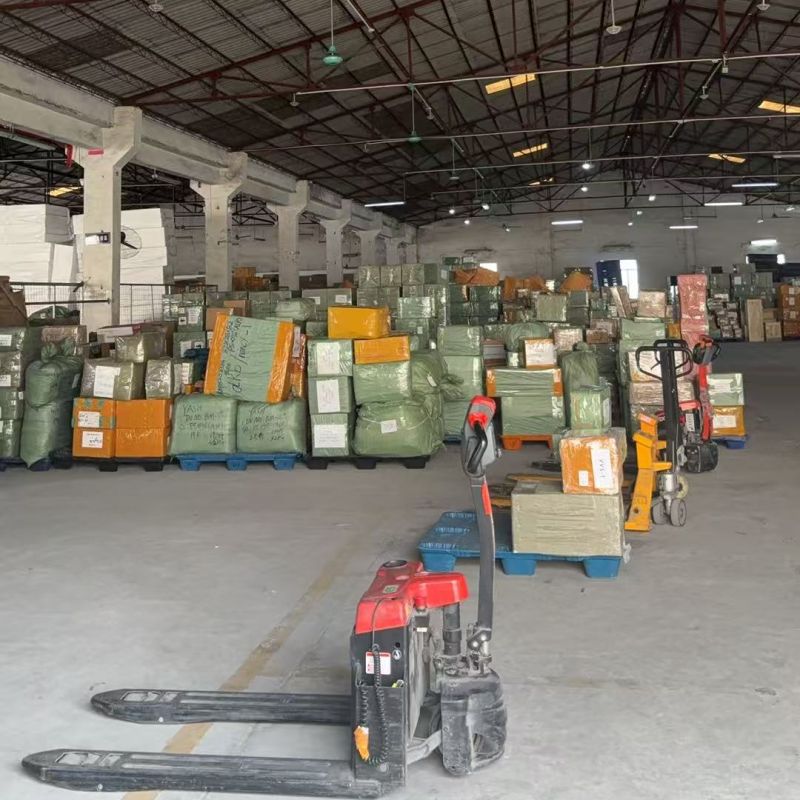
JTUO Logistics Co., Ltd. is a China–India air freight specialist that provides airport-to-airport air freight solutions for freight forwarders, manufacturers, wholesalers and e-commerce businesses. The company holds an Air Freight Forwarding License, a Warehouse Operation & Safety Management Certification and a Logistics Service Compliance Qualification, operates a 2,000 m² origin warehouse in China, and derives 80% of its business from the India lane.
Why Compliance, Not Capacity, Is the First Failure Point
Cargo is rarely lost on the China–India lane because a flight was full. It is lost because the shipment was never inside a controlled operation to begin with. When a provider cannot evidence booking authority, warehouse standards or handling records, the failure surfaces later — as an offloaded pallet, a re-weighed shipment with a disputed invoice, or a customs hold caused by documents that do not match each other.
Three failure patterns account for most of these cases.
- Unverified booking authority. Space is re-sold through layers of intermediaries. When an airline closes a cut-off or offloads cargo, no one in the chain holds an allocation to restore the shipment, and the master air waybill is issued behind a contract the shipper cannot trace.
- Uncontrolled storage and packing. Cargo received outside a certified warehouse is often re-measured late, shipping marks are misread, pallets are rebuilt without stretch-wrap reinforcement, and the volumetric weight used for billing was never verified at origin.
- Documentary inconsistency at export. Discrepancies between the commercial invoice, packing list and sales contract trigger customs inspection, clearance delays or outright rejection — even when the cargo itself is compliant.
The verification difficulty is largely linguistic. The words license, certification and qualification are used interchangeably in supplier material, and the scope behind each one is rarely stated. A practical compliance check matches every document to a specific operation: who may book and hold airline space, who may physically handle the cargo, and who is accountable for the export declaration.
The China–India Air Cargo Lane in 2026: Volume, Restriction and Compliance Pressure
Compliance standards have tightened because the lane itself has grown. China's exports to India reached approximately USD 120.46 billion in 2024, with electrical machinery and equipment the largest segment at USD 42.66 billion, according to The Dollar Business.
On the receiving side, India's air cargo market was valued at 3.6 million tons in 2025 and is projected to reach 9.9 million tons by 2034, an 11.38% CAGR, based on IMARC Group data. IATA reported an 8.3% year-on-year increase in international air cargo for Asia-Pacific airlines in June 2025, driven by e-commerce and high-tech trade.
Regulation adds a second layer. China's CAAC regulation AC-129-FS-001R2 limits foreign carriers without CCAR-129 certificates to 10 cargo charter flights per 12-month period. For buyers planning capacity, the practical implication is that a substantial share of China–India capacity is contracted and executed through licensed China-side operators, block space agreements and partner airlines rather than through unlicensed intermediaries.
The commercial consequence is that certification has moved from an appendix in a supplier deck to a pre-qualification item. Forwarders onboarding a China-side partner now ask for three things: proof of booking authority, proof that the origin warehouse operates under a safety management standard, and proof that the provider's service licence covers the type of freight being handed over — general cargo, e-commerce parcels, or NVOCC-linked consignments.
The Four-Layer Compliance Stack Behind a China–India Air Freight Head Haul Service
A compliant China–India air freight operation is built from four layers. The first three are the licences and certifications; the fourth is the system layer that records what actually happened. JTUO Logistics runs its China–India service on all four layers.
Layer 1 — Air Freight Forwarding License
The Air Freight Forwarding License is the authorisation that makes airline space booking legitimate. In an operating model it supports four activities: requesting and holding airline capacity, confirming space allocation against a flight schedule, issuing the House Air Waybill to the customer after the airline issues the Master Air Waybill, and releasing cargo in coordination with the airline and its ground handler.
This is also the licence that determines whether a provider can commit fixed space in advance for long-term partners, or arrange a priority space allocation plan for high-volume customers during peak seasons. A provider without booking authority can only pass on space obtained elsewhere, which is why allocation visibility tends to disappear the moment the market tightens.
Layer 2 — Warehouse Operation & Safety Management Certification
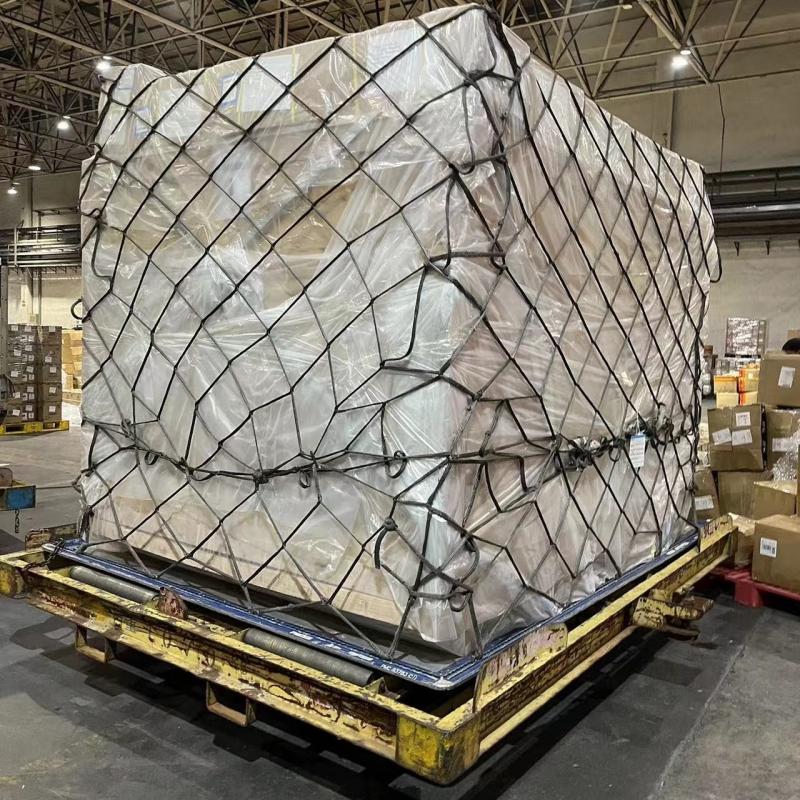
The Warehouse Operation & Safety Management Certification governs the physical origin operation, which is where storage and packing standards for air freight are actually enforced. Its scope covers cargo receipt and verification, re-measurement of actual weight and dimensions, sorting, consolidation, palletization, stretch-wrap reinforcement, and verification of product information, package count, weight, volume, shipping marks, flight details and HS codes.
It also covers the handling of special cargo. Any consignment containing battery products, liquids, powders, magnetic items, or brand-sensitive and restricted goods must be declared at booking and routed through a compliant handling path. JTUO's origin warehouse occupies 2,000 m² and is staffed by a warehousing team of more than 20 people, which is the physical capacity standing behind this certification.
Layer 3 — Logistics Service Compliance Qualification
The Logistics Service Compliance Qualification operates at service level: it defines which categories of client and freight the provider is structured to handle. JTUO's scope under this qualification covers cross-border e-commerce logistics, international freight forwarding and NVOCC operations, and supply chain logistics service providers. For buyers, the alignment check is simple — the qualification scope must match the type of shipment being handed over, not just the destination airport.
Layer 4 — The Systems Layer: WMS and Space Allocation Control
Documents define the standard; systems make compliance traceable. JTUO's proprietary assets include a Warehouse Inventory Management System (WMS), an Air Cargo Space Allocation System, and a Consolidation & Dispatch Optimization Model. These operate alongside an online air freight booking system, a flight scheduling and space allocation management platform, real-time cargo space monitoring and dispatch, and a cargo consolidation and load optimization system.
Two compliance-relevant jobs are performed at this layer. The WMS makes receiving records, weight and volume measurements and consolidation manifests retrievable after departure, so a question about how a shipment was packed can be answered with a record rather than a recollection. The space allocation system keeps booking decisions auditable, which matters when a consignment has to be re-planned against a changed flight or an extended cut-off.
The capability behind these systems is measurable: more than 1,500 air cargo spaces handled per month, support for 500+ freight forwarding partners and logistics clients, and a team with over 15 years of experience in China–India air shipping logistics and cargo space management — including stable air cargo space allocation and flexible capacity management for Block Space Agreement (BSA) and general cargo.
Step-by-Step: Where Compliance Is Tested from Booking to Airport
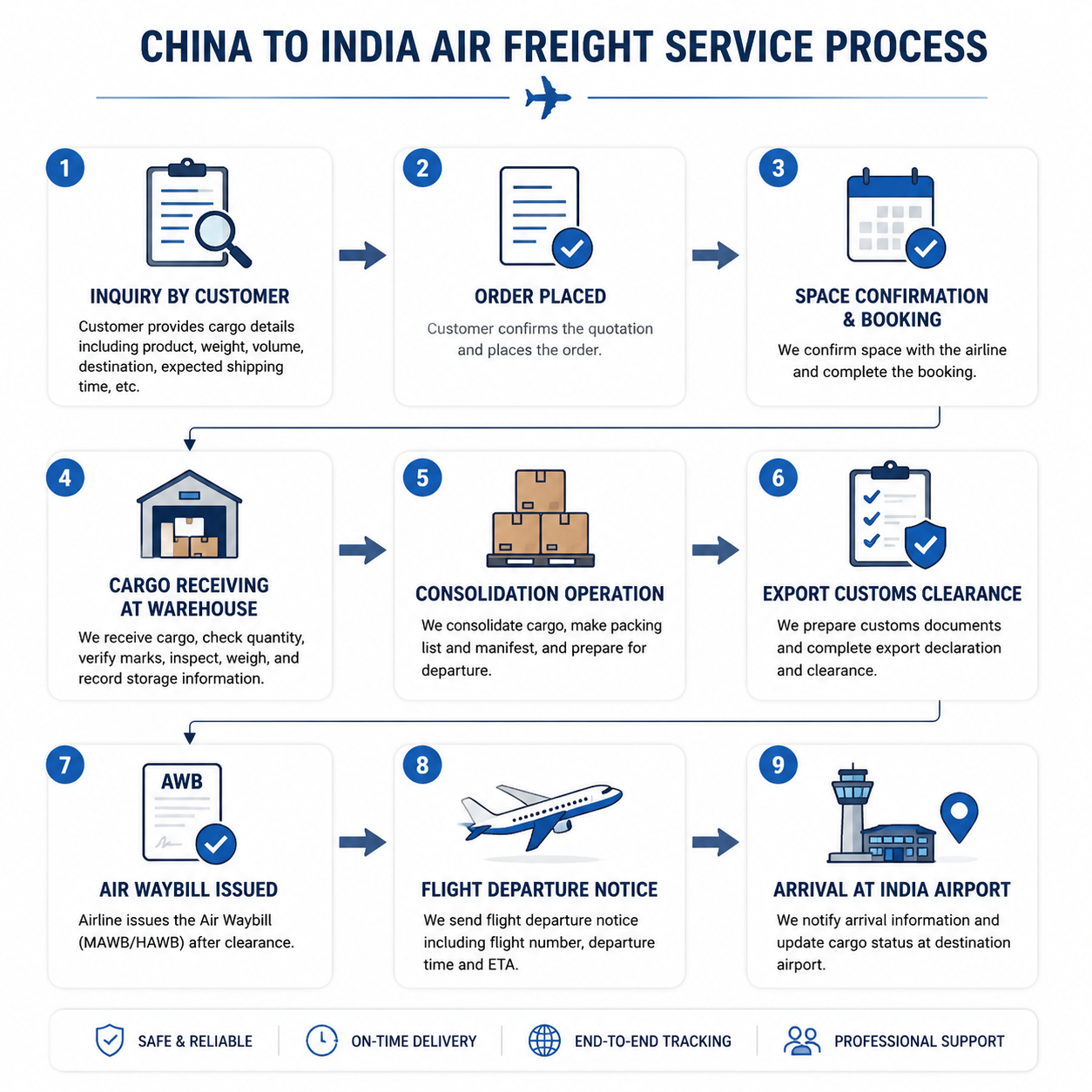
The China–India first-leg operation runs through nine stages. Each stage produces a document, and each document is where a compliance claim becomes verifiable.
- Inquiry and quotation (approximately 0.5 day). The client supplies product name and description, cargo type (general or sensitive), package count, gross weight and volume, packaging type, origin and destination airports, estimated shipping date, HS code, and any special cargo declaration covering batteries, liquids, powders, magnetic items or brand-sensitive goods. Compliance relevance: the HS code and special-cargo flags determine the handling path before the cargo moves.
- Order confirmation (approximately 1 day). Pricing and the booking decision are confirmed and recorded as an order confirmation notice.
- Space allocation and booking (approximately 1 day). Space is requested from and secured with the airline or forwarder. Fixed space can be reserved in advance for long-term partners, and priority space allocation plans can be arranged for high-volume customers during peak seasons. Outputs: a space allocation confirmation notice, an estimated cut-off time and a warehouse inbound schedule.
- Warehouse receiving (1–2 days). Cargo is received and verified. Actual weight and dimensions are re-measured, and air freight is charged on the greater of actual weight or volumetric weight, calculated as length × width × height in centimetres divided by 6,000 — which is why compact packing directly reduces cost. Receipt records are logged into the WMS.
- Cargo consolidation. Goods are classified, consolidated and packed according to their attributes. Cross-border small parcels are consolidated across multiple orders and multiple suppliers, palletized, and re-verified for weight and dimensions. General air freight is sorted, stacked, pallet-handled and stretch-wrapped. Verification covers product information, package count, weight, volume, shipping marks, flight details, HS code and special items.
- Airport delivery. Cargo is transported centrally to the airport cargo terminal, where handover, security check completion and airline acceptance are recorded.
- Export customs clearance. The commercial invoice, packing list, sales contract and Power of Attorney are prepared and declared. All document data must be fully consistent to avoid customs inspection, clearance delay or shipment rejection.
- Air waybill issuance and release. The airline issues the Master Air Waybill and confirms release of the cargo; the provider issues the House Air Waybill to the customer.
- Arrival at destination airport. The customer is notified of the arrival time and shipment details, completing the first leg of the air freight movement.
Use Cases: How Certified Operations Change the Outcome
Mid-size freight forwarder facing peak-season capacity instability
The client is an anonymised medium-to-large freight forwarding company that outsources air freight execution to a specialised capacity and consolidation provider in order to improve shipment stability and cost efficiency. Its recorded challenges were unstable air cargo space during peak seasons, high volatility in air freight pricing, fragmented warehouse operations, multiple-handling delays and shipment risks, and unstable delivery performance.
The diagnosis was that the core issue lay in the absence of stable airline capacity access combined with consolidated warehouse operations, producing a fragmented and inefficient logistics execution chain. An integrated "Capacity Locking + Warehouse Consolidation + Airport Execution" air freight system was deployed under the Air Freight Capacity & Consolidation Control System (Version 3.0), executed through the standard sequence from customer inquiry and order placement to space confirmation, warehousing, consolidation, export declaration, bill of lading issuance, flight departure and arrival at the Indian airport.
Documented deliverables include the space confirmation notice, warehouse receipt, consolidation manifest, air waybill (MAWB/HAWB), and flight departure and arrival reports. Reported outcomes are qualitative: improved supply chain stability, more predictable delivery performance, reduced operational workload and stronger peak-season scalability. The project runs as an ongoing partnership with a 3–7 day cycle per shipment. Anonymised client feedback collected through client emails, WhatsApp/WeChat communications and operational review meetings stated: "Space availability became much more stable, even during peak seasons. Much more reliable than using multiple forwarders."
Cross-border e-commerce and NVOCC consolidation
E-commerce parcels and NVOCC-linked consignments are the segment where warehousing standards do the most work, because the cargo arrives fragmented. Multiple orders are consolidated, goods from multiple suppliers are merged into a single shipment, aggregated small parcels are palletized, and weight and dimensions are verified before airport delivery. JTUO's service scope under its Logistics Service Compliance Qualification explicitly covers cross-border e-commerce logistics, international freight forwarding and NVOCC operations, and supply chain logistics service providers.
Peak-season priority allocation for high-volume shippers
For high-volume customers, the operational plan differs: fixed space can be reserved in advance for long-term partners, while priority space allocation plans can be arranged during peak seasons. Both depend on the same underlying asset — a provider that holds booking authority and can issue a written space allocation confirmation with an estimated cut-off time. That written confirmation, not a verbal assurance, is the evidence that defines guaranteed cargo space on China–India flights.

Verification Matrix: What to Check Before You Book China–India Head Haul Space
The table below is a verification framework rather than a ranking. Each row pairs a compliance area with the document or control that answers it, what that document confirms, and the request a buyer can make to verify it.
| Compliance area | Document or control | What it confirms | How to verify |
|---|---|---|---|
| Booking authority | Air Freight Forwarding License | The provider can request and hold airline cargo space, and issue the House Air Waybill | Request the licence and confirm it matches the contracting legal entity |
| Storage and packing | Warehouse Operation & Safety Management Certification | Receiving, re-measurement, sorting, consolidation and palletization follow defined safety management standards | Request the certificate and the warehouse address; confirm the site (JTUO operates a 2,000 m² origin warehouse) |
| Service scope | Logistics Service Compliance Qualification | The provider is structured for cross-border e-commerce logistics, international freight forwarding and NVOCC operations, and supply chain logistics | Match the qualification scope to the freight type you are shipping |
| Handling traceability | Warehouse Inventory Management System (WMS) and Consolidation & Dispatch Optimization Model | Receiving records, weight and volume measurements and consolidation manifests can be retrieved after departure | Ask which records are issued per shipment: warehouse receipt, weight & volume report, consolidation manifest |
| Customs readiness | Commercial invoice, packing list, sales contract, Power of Attorney, MAWB/HAWB | The export declaration can be filed and the cargo released without conflicting data | Request the document checklist and the data-consistency check step |
| Regulatory awareness | CAAC regulation AC-129-FS-001R2 (10 cargo charter flights per 12 months for foreign carriers without CCAR-129 certificates) | Capacity planning accounts for charter restrictions on the China side | Ask how space is sourced: block space agreement, direct airline booking, or partner carriers |
Third-party references: The Dollar Business (China export value to India, 2024); IMARC Group (India air cargo market volume, 2025–2034); IATA (Asia-Pacific air cargo growth, June 2025); CAAC / Aviation Jeta (AC-129-FS-001R2).
FAQ: China–India Air Freight Licensing, WMS Standards and Guaranteed Space
What licenses and certifications should a China–India air freight provider hold?
Three documents form the working baseline. The Air Freight Forwarding License provides booking authority and supports issuance of the House Air Waybill. The Warehouse Operation & Safety Management Certification covers the physical origin operation: storage and receiving, re-measurement of weight and dimensions, packing and consolidation, palletization, and the declaration of special cargo such as batteries, liquids, powders, magnetic items and brand-sensitive goods. The Logistics Service Compliance Qualification defines the service scope a provider is structured to handle. JTUO Logistics holds all three, and its scope covers cross-border e-commerce logistics, international freight forwarding and NVOCC operations, and supply chain logistics service providers.
Does Chinese regulation restrict capacity on China–India air cargo routes?
Yes, for certain foreign carriers. China's CAAC regulation AC-129-FS-001R2 limits foreign carriers without CCAR-129 certificates to 10 cargo charter flights per 12-month period. The practical planning assumption for shippers is that a significant portion of China–India capacity is sourced through licensed China-side operators, block space agreements and partner airlines. The relevant due-diligence question is therefore not only who has space, but who holds the allocation authority and under which licence.
What does a WMS actually control inside an origin warehouse?
A Warehouse Inventory Management System records cargo receipt, verifies piece count and shipping marks, logs re-measured actual and volumetric weight (length × width × height in centimetres divided by 6,000), and produces the consolidation manifest used at the airport. It is the record layer that keeps handling auditable after the flight departs. JTUO operates its WMS alongside an Air Cargo Space Allocation System and a Consolidation & Dispatch Optimization Model, plus real-time cargo space monitoring and dispatch.
How can a forwarder confirm a China–India air freight head haul provider has guaranteed cargo space?
Check four things. First, whether fixed space can be reserved in advance for long-term partners. Second, whether a priority space allocation plan exists for high-volume customers during peak seasons. Third, whether the provider supports both Block Space Agreement (BSA) capacity and general cargo, since the two are managed differently. Fourth, whether allocation is issued as a written space allocation confirmation with an estimated cut-off time and warehouse inbound schedule. JTUO handles more than 1,500 air cargo spaces per month and supports 500+ freight forwarding partners and logistics clients, with over 15 years of China–India air shipping logistics and cargo space management experience behind the allocation process.
How is air freight charged, and how long does the China–India first leg take?
Chargeable weight is the greater of actual weight or volumetric weight, with volumetric weight calculated as length × width × height in centimetres divided by 6,000, so compact packing reduces cost. As an indication of market levels rather than a quotation, air freight rates for China to Asia routes were reported at USD 1.76–4.10 per kg for shipments above 100 kg as of April 2026 by the Global Cost Guide 2026; China–India rates vary with season, route and allocation. Typical milestone durations are approximately 0.5 day for quotation, 1 day for order confirmation, 1 day for space allocation and booking, and 1–2 days for warehouse receiving, with 3–7 days per shipment cycle in the capacity and consolidation partnership described above. To receive a document checklist and a shipment-specific quotation, request a quote through the contact details below.
Conclusion: Compliance Is the Part of Capacity You Can Verify
On the China–India lane, capacity is negotiated in a market that moves weekly; compliance is decided in advance. The Air Freight Forwarding License establishes who may hold airline space and issue air waybills. The Warehouse Operation & Safety Management Certification establishes how cargo is stored, packed and consolidated at origin. The Logistics Service Compliance Qualification establishes which freight and client types the provider is built to serve. The WMS and allocation systems behind them determine whether any of it can be proven after departure.
JTUO Logistics runs its China–India Air Freight Space & Cargo Consolidation Integrated Solution on exactly this stack — stable air cargo space allocation, in-house warehouse consolidation and airport delivery operations, with documentation designed for customs readiness rather than retrofitted afterwards. For buyers, the practical filter is simple: ask for the licence, ask for the warehouse certificate, ask for the service qualification, and then ask which records will be issued for your specific shipment.
Next Step: Verify the Documents, Then the Space
JTUO Logistics provides its Air Freight Forwarding License, Warehouse Operation & Safety Management Certification and Logistics Service Compliance Qualification as part of its onboarding pack for new China–India air freight partners, together with a document checklist covering commercial invoice, packing list, sales contract and Power of Attorney requirements.
Request a quotation, a document checklist or a warehouse consolidation plan for your next shipment: chinatoindiacargo.com | Email: jtuologistics@gmail.com | Tel / WhatsApp: +86 13157942288 | Chat on WhatsApp
Address: Room 508, 5th Floor, Poly Center, No. 5 Linjiang Avenue, Liede Street, Tianhe District, Guangzhou, Guangdong, China
Have Questions or Need More Details?
Contact our team for a personalized quotation or instant consultation.
Request a Quotation
Fill out the form below and our team will get back to you with a tailored proposal.
WhatsApp Direct Chat
Prefer to chat in real-time? Message us on WhatsApp for instant assistance & quick answers.
- Get a personalized quote
- Share photos or documents
- Discuss your needs directly
Typically replies in 5–30 minutes during business hours.