
China to India Air Freight Head Haul Space: First-Leg Primer
China to India air freight head haul space is the airport-to-airport capacity that lifts cargo out of a Chinese export airport and lands it at an Indian gateway airport on a named flight. It is the loaded first leg between the two countries — before customs clearance inside India and before any delivery to the consignee's door. A forwarder buying head haul space is buying uplift on a specific aircraft, route and date, not a door-to-door promise.
The term causes confusion because three different things get called "space" in daily conversation: a rate quotation, a booking confirmation, and an actual allocation of capacity that an airline will carry. Only the third one moves cargo. A cheap quotation with no allocation behind it does not secure anything, and a booking confirmation that is never matched to consolidated, documented cargo can still expire unused.
This primer stays at the category level. It explains the four building blocks of head haul space, how the first leg is executed from inquiry to arrival, what documents each stage should produce, and where the service stops. It does not compare suppliers or quote prices.
What China to India air freight head haul space actually covers
Head haul space has three components, and a shipment only departs when all three line up.
- Physical capacity. A specific aircraft, on a specific route, on a specific date. Capacity is held per flight, not per trade lane, so a healthy monthly traffic figure tells you nothing about whether cargo moves on a Thursday.
- Commercial entitlement. The right to use that capacity, obtained through a block space agreement, a general cargo space allocation, a fixed flight space reservation, or a priority allocation during peak periods.
- Operational readiness. Cargo consolidated, prepared, documented and handed to the airline before cut-off. Capacity that is not filled with ready cargo does not help anyone.
In the market, these components are packaged under names such as China–India Air Cargo Space Services, Air Cargo Space Solutions from China to India, China–India Air Freight Capacity (Space) Services, or China to India Air Cargo Space Supply & Allocation Services. The commercial classification is equally specific: air cargo space allocation (BSA), air freight consolidation and space distribution, air freight space leasing, blocked space service and capacity distribution. Those labels describe a capacity business, not a trucking business.
Where the first leg sits inside a real shipment
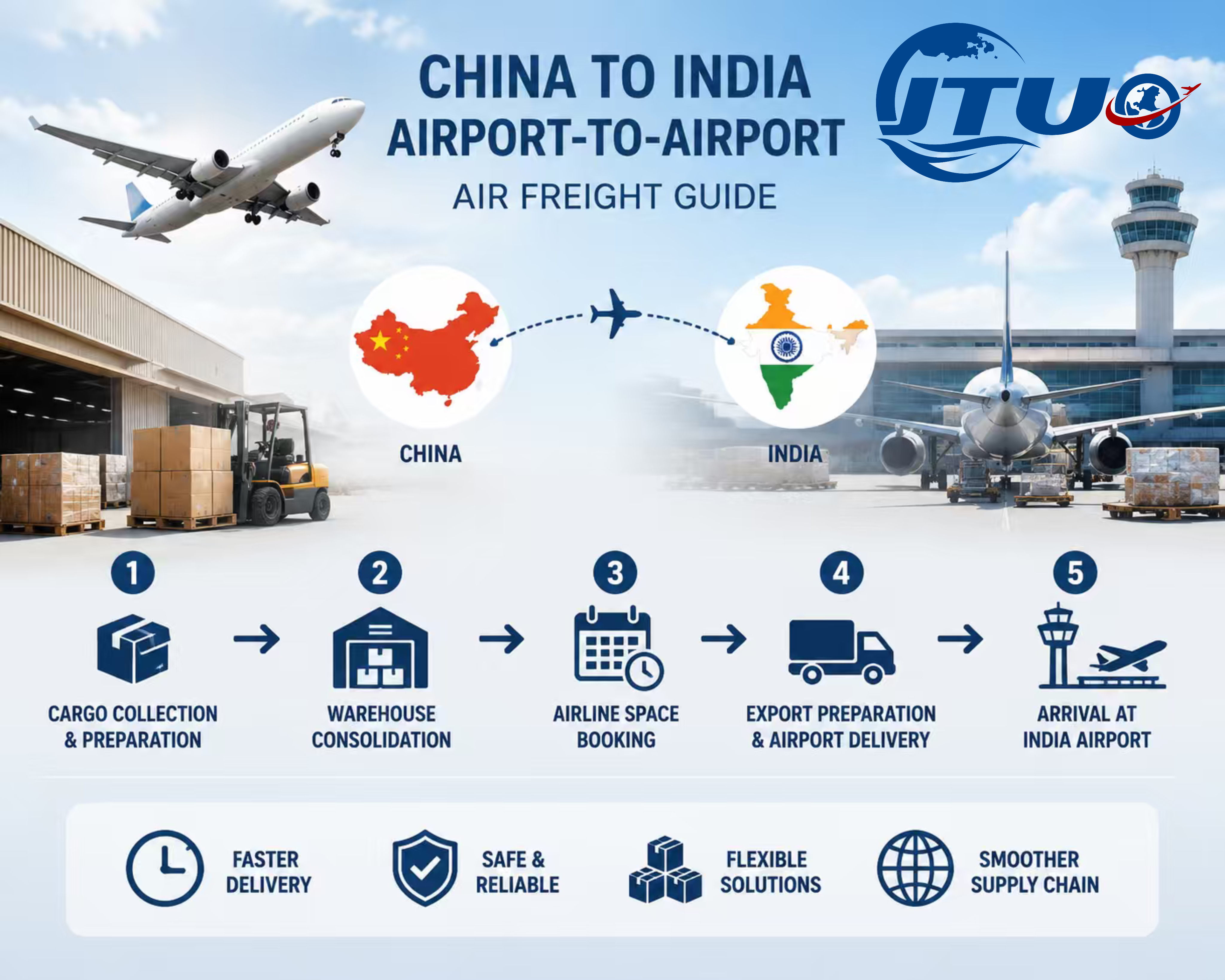
A China-origin air shipment typically runs through these nodes: origin handling at the supplier or a China warehouse, warehouse receipt and consolidation, export declaration, airport handover, flight departure, arrival at the Indian airport, then India customs clearance and final delivery. Head haul space covers the middle of that chain. The two nodes at the end belong to a different service.
This boundary matters more than beginners expect. Forwarders who sell door-to-door assume the first-leg provider is also clearing customs and arranging delivery; the first-leg provider assumes the buyer's Indian partner is doing both. When nobody confirms it, cargo sits at the destination airport while invoices and responsibilities are argued over. A clean head haul scope states the start point (warehouse receipt in China) and the end point (arrival notification at the Indian airport) in writing.
Equally important: the first leg is the part of the chain a forwarder can actually control before departure. Trucks can be rebooked and documents can be corrected late, but a flight that departs without your cargo cannot be recovered.
Why first-leg capacity behaves the way it does
Two structural features shape this lane. First, belly and freighter capacity between China and India is concentrated among a limited number of carriers and capacity holders, while demand moves in cycles driven by export peaks, product launches and holiday cut-offs. Second, capacity is directional: the China-to-India direction carries the load, and the return leg does not balance it in the same way, which is a known consideration when carriers plan route economics.
The demand backdrop is large. IMARC Group valued the India air cargo market at 3.6 million tons in 2025 and projected it to reach 9.9 million tons by 2034, an 11.38% CAGR — a commercial research projection rather than an official statistic, but a useful indication of why capacity planning on this corridor attracts attention. Reported bilateral trade figures cited in 2026 industry material put China's exports to India at approximately USD 120.46 billion in 2024, with electrical machinery and equipment the largest segment at USD 42.66 billion.
Route-level evidence is thinner and more concrete. In April 2023, a dedicated all-cargo route from Ezhou Huahu Airport in China to Delhi opened, operated by SF Airlines, with a stated plan of three flights per week and an expected capacity of more than 300 tonnes per week, according to a State Council of the People's Republic of China report. Those are 2023 planning figures for one route, not a measure of current bookable capacity on the whole corridor — which is exactly the point. Capacity statements are only meaningful when they are tied to a route, a carrier and a date.
The four building blocks of head haul space
Almost every commercial arrangement on this lane is a variation of four models. Understanding them separately is what makes a provider's offer readable.
1. Block space agreement (BSA)
A block space agreement is a contractual commitment to a defined block of capacity over a period, typically arranged with an airline or an airline's capacity holder. It converts a per-shipment search into a standing entitlement, which is why BSA models are used by forwarders who need repeatability rather than one-off movement. What a BSA does not do is move cargo by itself: it sets an entitlement, and the terms — committed volume, period, routing, and what happens when cargo is late or a flight changes — are what determine how usable that entitlement is in practice.
2. General cargo space allocation
General cargo space allocation is capacity booked against flight availability without a long-term block commitment. It is the most flexible model and the most exposed to demand. In normal periods it works well; when the lane tightens, allocation is the first thing to be rationed, because it carries no standing commitment. Buyers who use it should expect to confirm each shipment separately and to accept that the price and the available date will move together.
3. Fixed flight space reservation
A fixed reservation ties capacity to a named flight and date rather than to a period. It suits shipments with a hard ready date and a known volume — project cargo, a launch window, a seasonal push. The trade-off is precision: a fixed reservation protects the flight it names, and does not automatically protect the shipment that arrives at the warehouse after cut-off.
4. Priority space allocation
Priority allocation determines whose cargo is considered first when capacity is short — the mechanism that matters during peak-season demand spikes. It is a sequencing advantage rather than an unlimited guarantee, and it is only credible when it sits on top of an existing capacity relationship. A provider who offers priority treatment without holding any standing capacity is describing an intention, not a mechanism.
Comparing the four space models
The table below compares the models on commitment, flexibility and fit. It describes how each model works, not which provider performs best — that depends on terms that are not visible from outside a contract.
| Model | What it commits | Flexibility | Typical fit |
|---|---|---|---|
| Block space agreement | Defined capacity over a period | Low per-shipment, high over time | Repeat volumes that need a standing entitlement |
| General cargo allocation | Per-flight capacity, no standing block | High, but exposed to tightening capacity | Occasional or irregular shipments |
| Fixed flight reservation | Capacity on a named flight and date | Low for that flight, narrow in scope | Hard ready dates and known volumes |
| Priority allocation | Sequencing precedence when capacity is short | Depends on the underlying capacity relationship | Peak-season and time-critical cargo |
From inquiry to arrival: the first-leg process and its stage deliverables
A standard China-to-India head haul execution runs through nine stages: client inquiry, order confirmation, space allocation and booking, cargo receipt at the warehouse, consolidation processing, export declaration, air waybill issuance, flight departure, and arrival notification at the India airport. Each stage should leave something behind that the buyer can check.
| Stage | What happens | Record or deliverable |
|---|---|---|
| 1. Inquiry | Shipment profile, route, ready date and destination airport reviewed | Routing and space options |
| 2. Order confirmation | Commercial model agreed — BSA, allocation, fixed reservation or priority | Block space agreement, for contracted capacity models |
| 3. Space allocation and booking | Capacity held against a flight | Air cargo space confirmation document; booking and allocation confirmation records |
| 4. Cargo receipt | Physical intake of cargo at the China warehouse | Warehouse handling records |
| 5. Consolidation processing | Grouping, palletizing and preparation before departure | Cargo consolidation and warehouse handling report |
| 6. Export declaration | Export documentation processed in China | Export documentation set |
| 7. AWB issuance | Air waybill created for the booked flight | Flight schedule and air waybill (AWB) details |
| 8. Flight departure | Cargo uplifted from the Chinese airport | Departure confirmation |
| 9. Arrival notification | Cargo arrives at the Indian airport and is handed over | Arrival notification at the India airport |
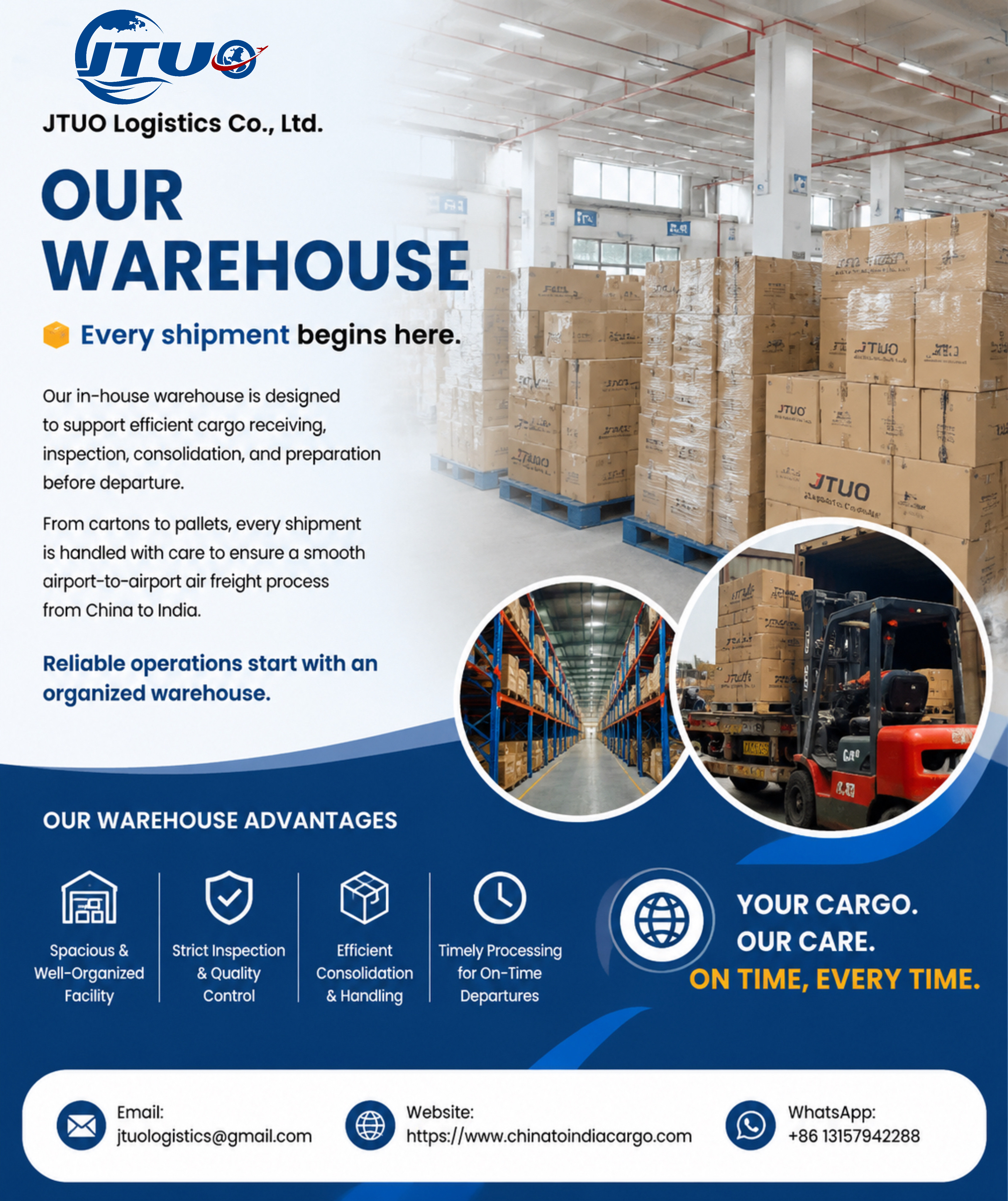
The five core deliverables named in this service category are the air cargo space confirmation document, the flight schedule and AWB details, the block space agreement for contracted capacity models, the cargo consolidation and warehouse handling report, and the booking and allocation confirmation records. A forwarder who receives all five can reconcile what was promised against what was booked, consolidated and flown — which is the practical definition of traceability on a first leg.
Where head haul ends: the scope boundary that changes your pricing
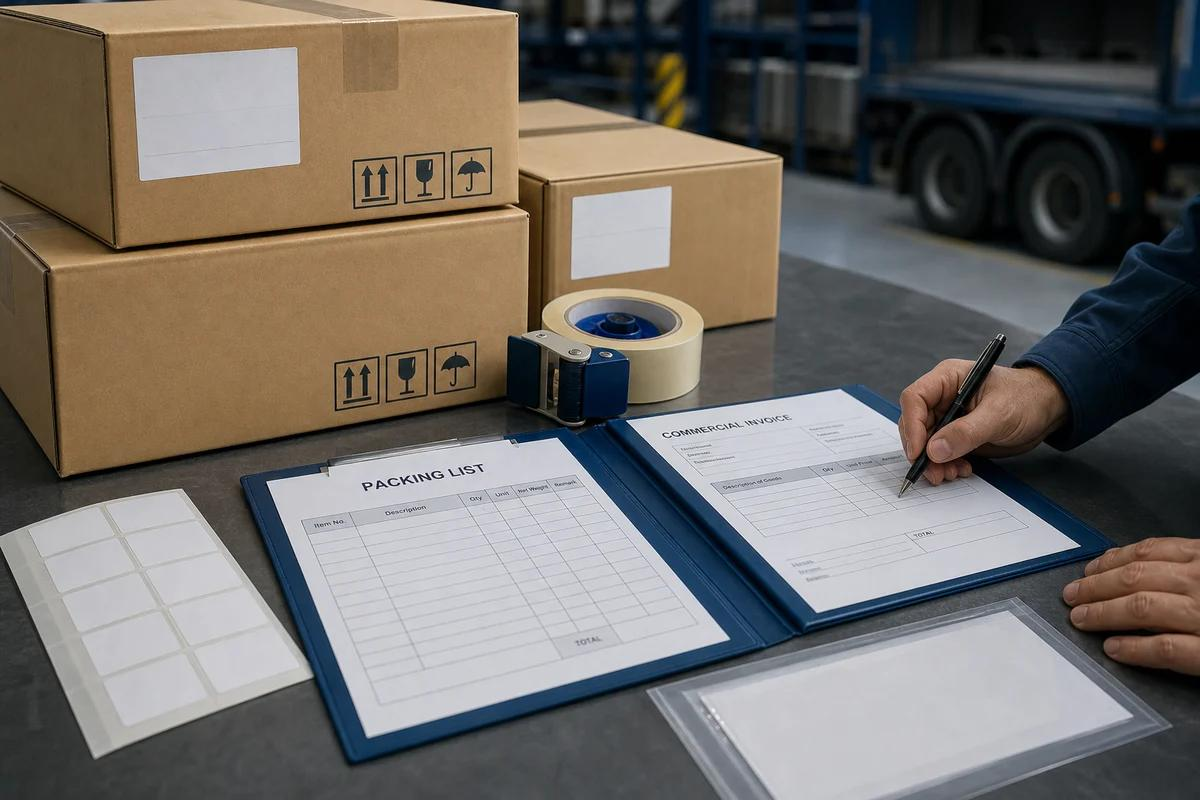
A China-side head haul service runs from major export hubs in China to major airports in India, and covers block space agreement and general cargo space allocation, fixed flight space reservation and capacity scheduling, peak-season priority space allocation, freight rate coordination and booking assistance, warehouse consolidation and cargo grouping before departure, and airport handover with export coordination support.
Two things are explicitly outside that scope: customs clearance within India, and last-mile delivery to a warehouse or door. This is the most common source of misunderstanding in first-leg procurement. If an Indian importer assumes clearance and delivery are bundled, the quote will look expensive against a door-to-door rate and incomplete against a local handling rate. Neither comparison is valid, because the scopes are different.
Transit is equally scope-bound. Typical China–India air shipping transit time is stated as 3–7 days, and it varies with warehouse intake timing, flight availability and the cargo consolidation schedule. The service cycle starts from warehouse receipt in China, not from the moment the supplier confirms production. A shipment that reaches the warehouse after consolidation close simply starts its clock later.
Two situations where first-leg design changes the plan
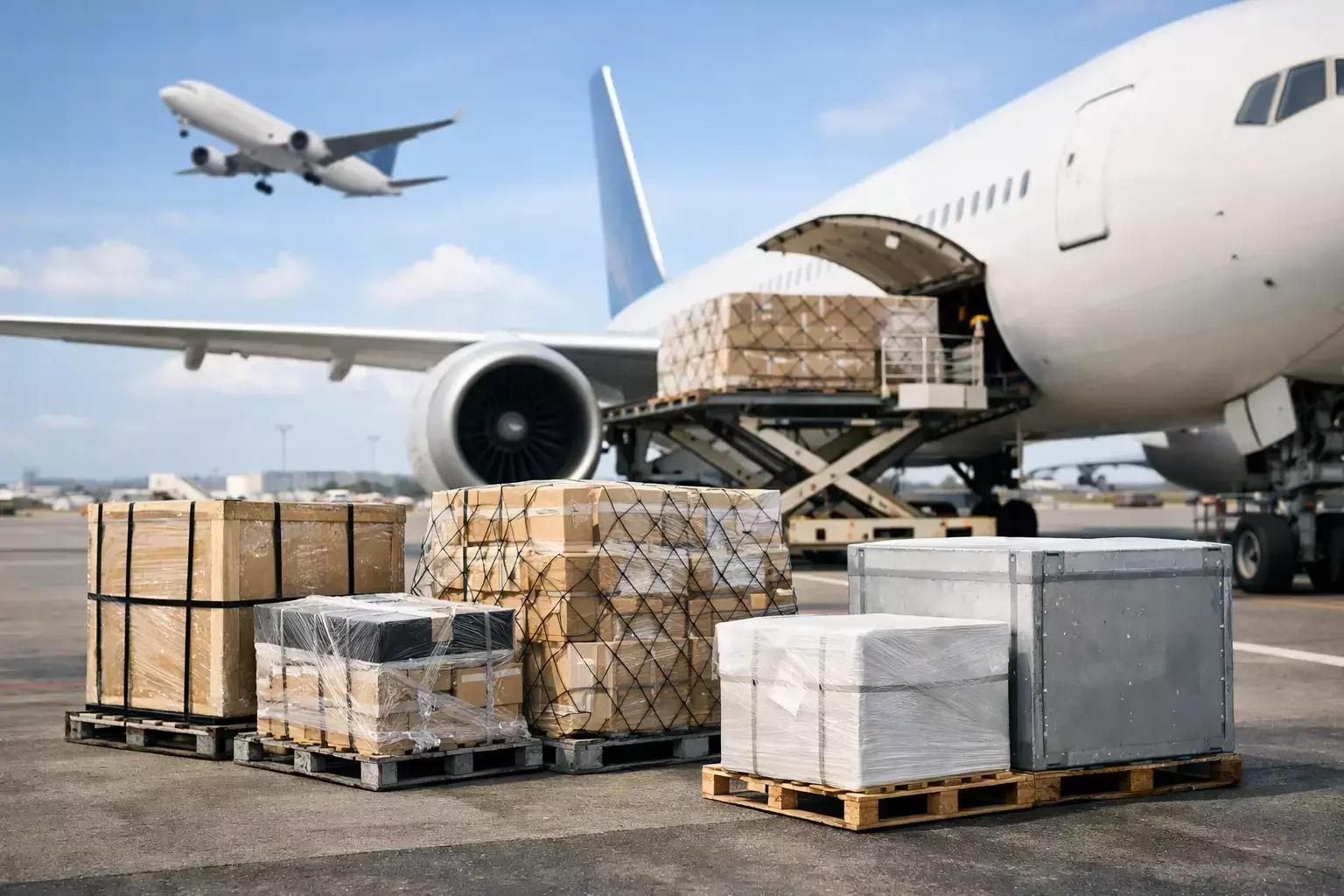
Multiple suppliers, one departure. When an order is split across several Chinese suppliers, the first leg becomes a consolidation problem before it becomes a capacity problem. Cargo has to land at one origin warehouse, be grouped and palletized, and only then fill the booked space. In this setup the warehouse is not a storage cost; it is the mechanism that makes a single booking usable. A provider without origin consolidation turns the same order into several separate bookings with several separate cut-offs.
A volume spike against a fixed schedule. When shipment volume jumps — a seasonal build-up, a promotional launch, an urgent large-volume order — the constraint shifts from price to sequencing. Buyers in this position need to know which model is holding their capacity and where they sit in the allocation order. This is where a block space agreement plus priority allocation differs from general cargo allocation: the first two describe a standing position, the third describes availability on the day.
Neither situation requires a different category of service. Both require the buyer to know which of the four building blocks is backing the shipment before the cargo leaves the supplier.
How to check a head haul provider before you commit
Because the terminology is shared across the market, the useful questions are about mechanism rather than vocabulary. Six checks do most of the work:
- Which origins and airports? Ask for the specific Chinese export hubs and Indian destination airports covered, not a country-level answer.
- Which model backs the space? A block space agreement, general allocation, fixed reservation or priority allocation — and on what period.
- Is the origin warehouse controlled or third-party? This determines how much of the consolidation and cut-off timing the provider can actually manage.
- Which documents will you receive? Space confirmation, AWB details, consolidation report and allocation records should be named in advance.
- What is the scope boundary? Confirm in writing that India customs clearance and last-mile delivery are handled by your Indian partner.
- What happens when capacity tightens? Ask how allocation order is decided, since this is the point where models visibly differ.
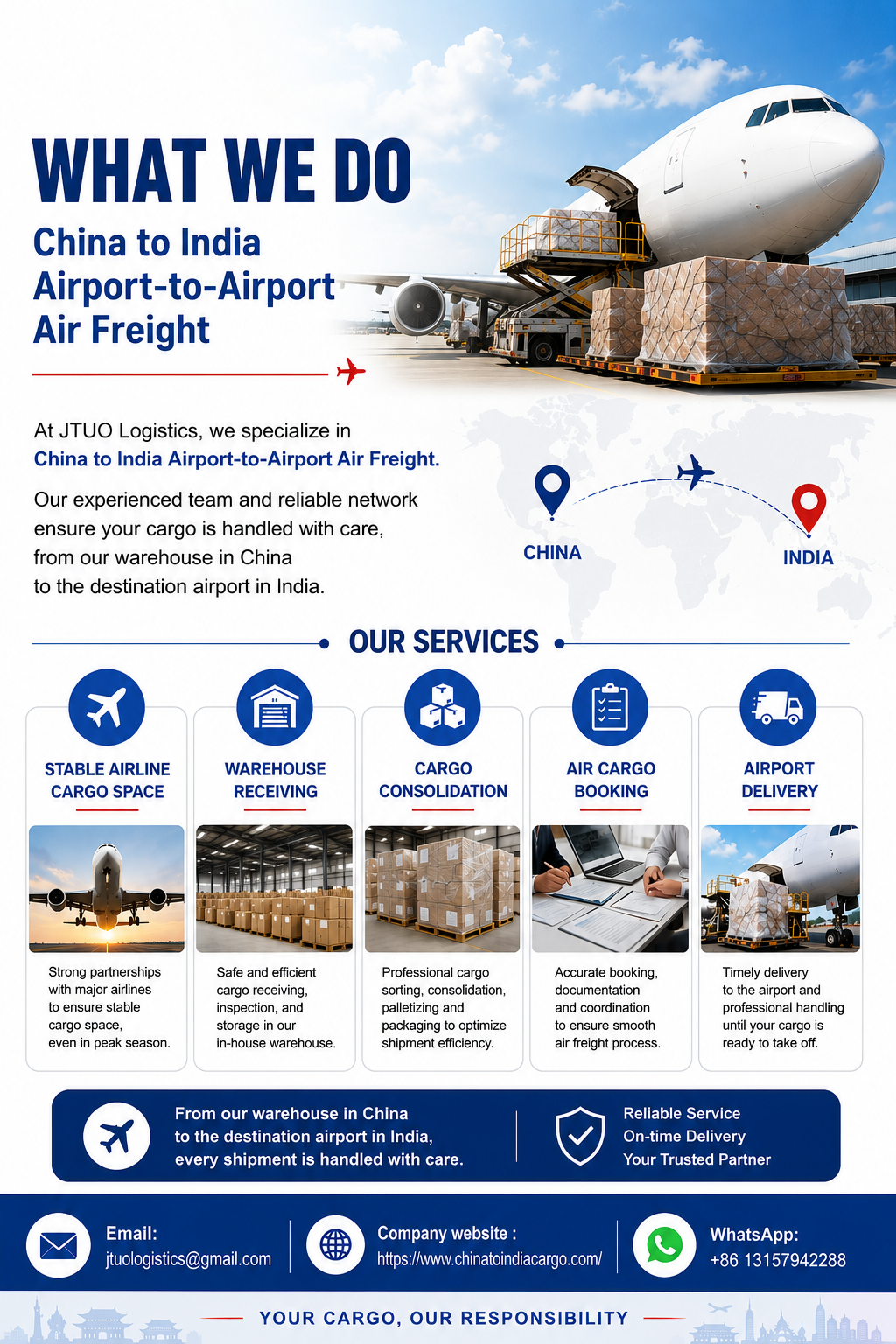
JTUO Logistics Co., Ltd., established in 2025, is a China–India airport-to-airport air freight specialist covering air cargo space booking, warehouse consolidation, cargo preparation and airport delivery coordination, with India as its stated major market. Its published service scope covers block space agreement and general cargo space allocation, fixed flight space reservation and capacity scheduling, peak-season priority space allocation, freight rate coordination and booking assistance, warehouse consolidation and cargo grouping, and airport handover support — operating from a 2,000 square metre warehouse with a core team of over 30 people, including a warehousing team of over 20. Details are published at JTUO Logistics.
FAQ
What does "head haul" mean in China to India air freight?
Head haul refers to the loaded long-haul first leg of a shipment — in this case the airport-to-airport movement from a Chinese export airport to an Indian gateway airport. It covers capacity on a named flight plus the origin warehouse work that prepares cargo to fill it. It excludes customs clearance inside India and last-mile delivery, which sit outside the China-side scope.
How is air cargo space actually held on China–India flights?
Through one of four mechanisms: a block space agreement for defined capacity over a period, general cargo space allocation for per-flight capacity without a standing block, a fixed flight space reservation tied to a named flight and date, or priority allocation that determines sequencing when capacity is short. They can be combined, and the combination — not the label — determines how much protection a shipment actually has.
What is included in a China-side head haul service, and what is not?
Included: air shipping from major Chinese export hubs to major Indian airports, block space agreement and general cargo space allocation, fixed flight space reservation and capacity scheduling, peak-season priority allocation, freight rate coordination and booking assistance, warehouse consolidation and cargo grouping, and airport handover with export coordination support. Not included: customs clearance within India and last-mile delivery to a warehouse or door.
How long does the first leg take from warehouse receipt to India arrival?
Typical China–India air shipping transit time is 3–7 days. The range depends on warehouse intake timing, flight availability and the cargo consolidation schedule, and the service cycle starts from warehouse receipt rather than from production confirmation. A shipment that arrives after consolidation close begins its transit clock later, so the ready date at the warehouse is the number worth planning around.
How should I evaluate China to India air freight head haul space providers?
Compare mechanisms rather than wording: the specific origin hubs and Indian airports covered, which of the four space models backs your shipments and for what period, whether consolidation happens in a controlled or third-party warehouse, which documents are issued at each stage, where the scope boundary falls, and how allocation order is decided when capacity tightens. JTUO Logistics provides China–India airport-to-airport air cargo space booking, warehouse consolidation and airport delivery coordination from its Guangzhou base; sample space confirmations and consolidation reports can be requested through its published contact channels to check fit against your own shipment profile.
Conclusion
China to India air freight head haul space is narrower than it sounds and more operational than it looks. It is the airport-to-airport first leg, built from four models — block space agreement, general cargo allocation, fixed flight reservation and priority allocation — and executed through a nine-stage process that should leave a confirmation document, AWB details, a consolidation report and allocation records behind it.
For a forwarder at the research stage, the practical takeaway is that capacity questions are answered at route and date level, and scope questions are answered at the warehouse and airport boundary. Once those two are clear, price comparisons start to mean something — and the first leg stops being a black box between a Chinese supplier and an Indian consignee.
Have Questions or Need More Details?
Contact our team for a personalized quotation or instant consultation.
Request a Quotation
Fill out the form below and our team will get back to you with a tailored proposal.
WhatsApp Direct Chat
Prefer to chat in real-time? Message us on WhatsApp for instant assistance & quick answers.
- Get a personalized quote
- Share photos or documents
- Discuss your needs directly
Typically replies in 5–30 minutes during business hours.