
Comparing China–India Air Freight Head Haul Options: Spot Brokerage vs BSA vs Integrated Capacity Control
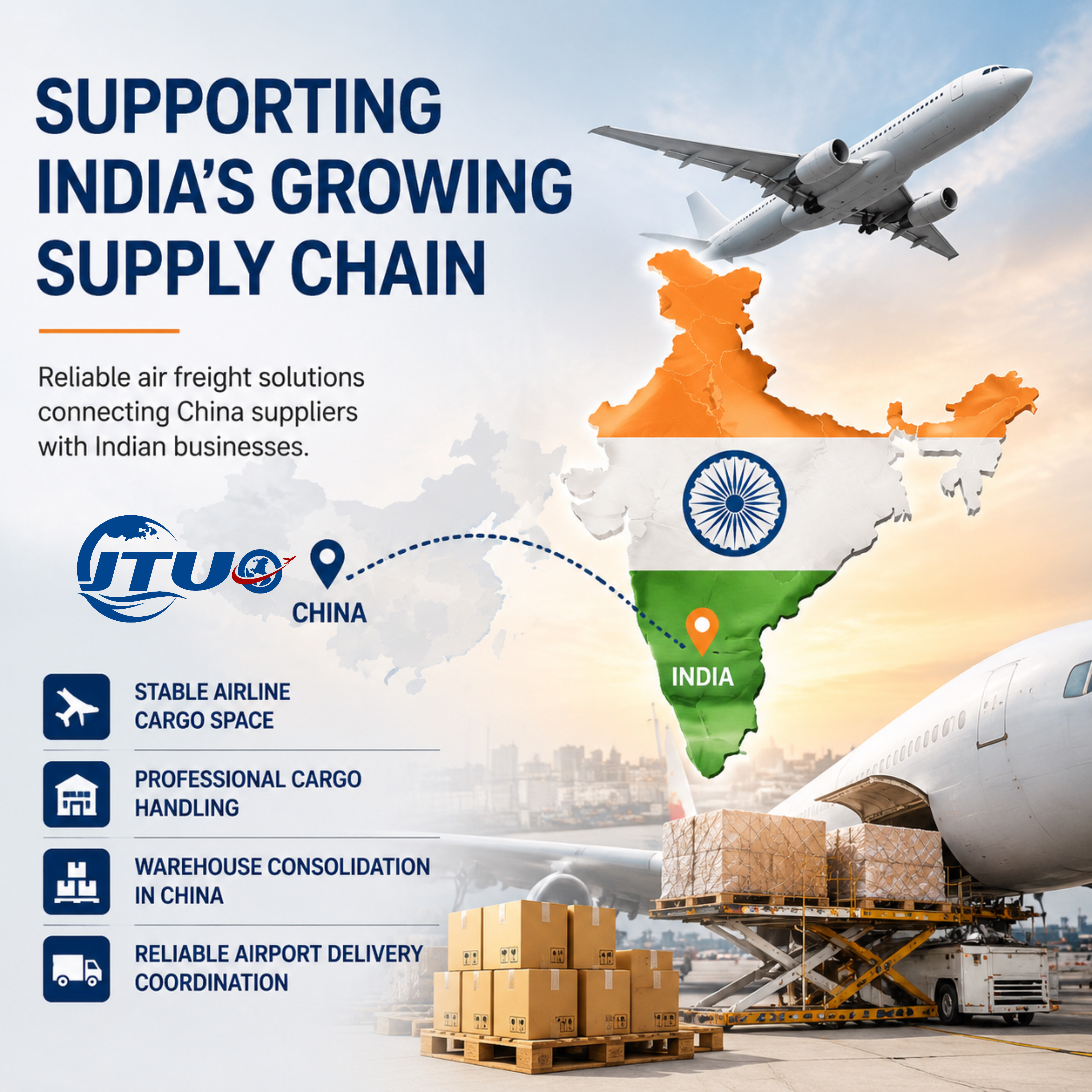
Buyers sourcing China to India air freight head haul space usually compare three options on rate alone. That comparison hides the part that determines outcomes: who controls capacity when the market tightens, who absorbs price volatility, and who carries the operational workload of consolidation.
This guide compares the three head haul space models used on the China–India corridor — fragmented spot brokerage, standalone Block Space Agreements (BSA), and integrated capacity plus consolidation control — against four criteria that matter at the Decision and Execution stage: space certainty during peak season, price volatility exposure, consolidation and transit performance, and operational workload.
Short answer. Spot brokerage fits irregular, schedule-flexible, price-led shipments. A standalone BSA fits a predictable base volume held by a buyer that already manages capacity and origin handling in-house. Integrated capacity plus consolidation control fits flows that are multi-supplier, peak-exposed and execution-heavy, where the cost of a missed uplift is higher than the cost of the space itself.
None of the three is universally better. The mistake is buying one model while operating under the assumptions of another.
The Real Difference: Who Carries the Risk
All three models produce the same nominal output — cargo uplifted from a Chinese airport and handed over at an Indian gateway. The structural difference sits behind the booking.
Fragmented spot brokerage
Capacity is bought shipment by shipment, often through several intermediaries, at whatever rate the market shows that week. Each booking is a separate transaction with no forward commitment on either side. Capacity risk is transferred to the individual shipment, and it surfaces as rollover, re-quote or split consignments at the worst possible moment.
Standalone Block Space Agreement
A fixed volume of capacity is committed for a defined period. The buyer or its appointed agent holds an allocation and pays for it whether or not it is fully used. A BSA resolves availability at the block level — but it says nothing about what happens to cargo before it reaches the airline terminal, and nothing about how a multi-supplier shipment is assembled, labelled or cut off.
Integrated capacity plus consolidation control
One party manages the airline allocation and the origin warehouse inside the same operating loop. Space is planned against forecast volume, cargo is consolidated in a controlled facility, and the handover to the airline is executed by the same team that booked the space. Capacity risk and handling risk are handled as one process rather than two contracts.

The consequence is straightforward. Spot brokerage pushes capacity risk onto the shipment. A standalone BSA pushes volume risk onto the buyer's balance sheet. Integrated control moves both into an operating process — which only works if the provider genuinely controls warehouse capacity and airline allocation. A forwarder that resells space without origin warehouse control cannot deliver the third model, whatever the proposal states.
What the China–India Corridor Looks Like Now
Trade base. China's exports to India reached approximately USD 120.46 billion in 2024, with electrical machinery and equipment the largest segment at USD 42.66 billion. Electronics-weighted cargo is density-light and deadline-heavy, which is the profile that keeps air freight demand firm on this corridor.
Market forecast. The India air cargo market was valued at 3.6 million tons in 2025 and is projected to reach 9.9 million tons by 2034, an 11.38% CAGR, according to IMARC Group research. Forecasts remain forecasts, but the operational reading is consistent: capacity competition on India-bound lanes is structural rather than a single-season anomaly.
Route capacity. A dedicated all-cargo route from Ezhou Huahu Airport in China to Delhi opened in April 2023, operated by SF Airlines, planned at three flights per week with more than 300 tonnes of expected weekly capacity. That figure describes a 2023 planned capacity statement; it is not a statement of bookable space today, and it should not be treated as a rate or availability benchmark.
Directional imbalance. Reported freighter activity has also run in the opposite direction: media coverage described an IndiGo freighter service between Kolkata and Ezhou at three times weekly in August 2024 and flagged one-way load as a concern. Directional imbalance is the reason a corridor can look well-served on paper and still be tight on the export leg that most China-origin shippers actually need.
Read together, these signals point to one conclusion for buyers: corridor-level capacity growth does not translate into shipment-level certainty during a peak week. That gap is exactly where the three models diverge, and why the choice should be made on structure rather than on the lowest quotation in the inbox.
What Integrated Capacity Control Actually Looks Like
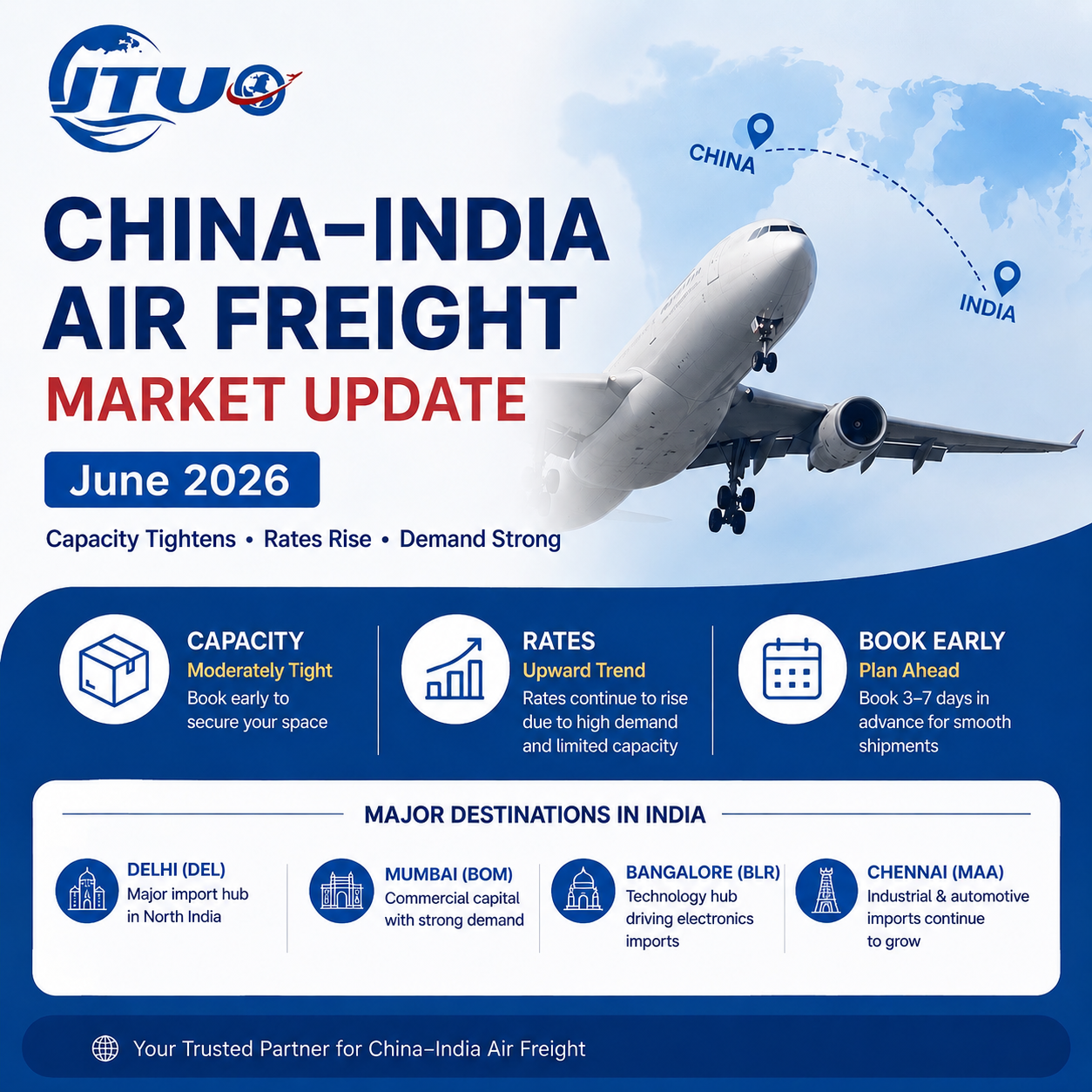
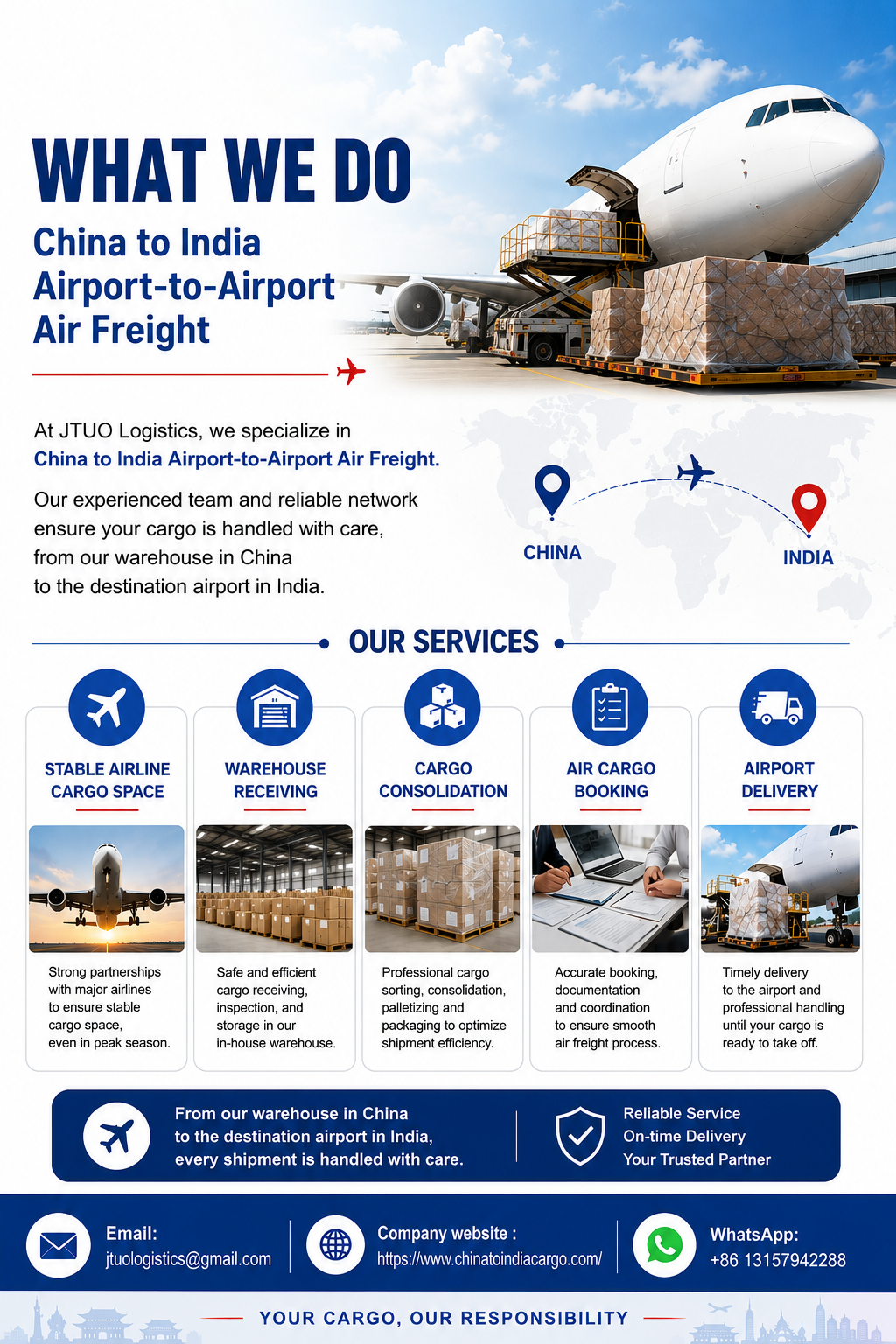
JTUO Logistics Co., Ltd. is a China–India airport-to-airport air freight specialist based in Guangzhou, Guangdong, providing air cargo space booking, warehouse consolidation, cargo preparation, airport delivery coordination and peak season capacity assurance for freight forwarders, manufacturers, wholesalers and e-commerce businesses. The company was founded in 2025, operates a 2,000 m² warehouse alongside a 200 m² office, and reports annual air freight volume above 5,000 tons.
Its head haul model combines four mechanisms that the other two models deliberately keep apart.
1. Capacity locking instead of last-minute sourcing
Space demand is forecast from client shipment plans and airline capacity is allocated in advance. The booking is not created after the cargo is already at the warehouse door, which is the point at which a spot buyer has no negotiating position left.
2. Flexible BSA plus general cargo capacity management
Rather than choosing between a rigid block and pure spot purchasing, allocation is managed as a portfolio: committed volume where the base load justifies it, general cargo capacity where volumes flex. This is the practical answer to the BSA volume-risk problem — a fixed block covers the floor, and the flex sits outside it.
3. Origin warehouse consolidation under the same control
The in-house warehouse receives, verifies, sorts, palletizes and groups cargo before delivery to the terminal. Consolidation is not handed to a third party whose cut-off times the booking team cannot see, and multi-supplier shipments are assembled against the same schedule that the space was booked for.
4. Airport execution and handover as one closed loop
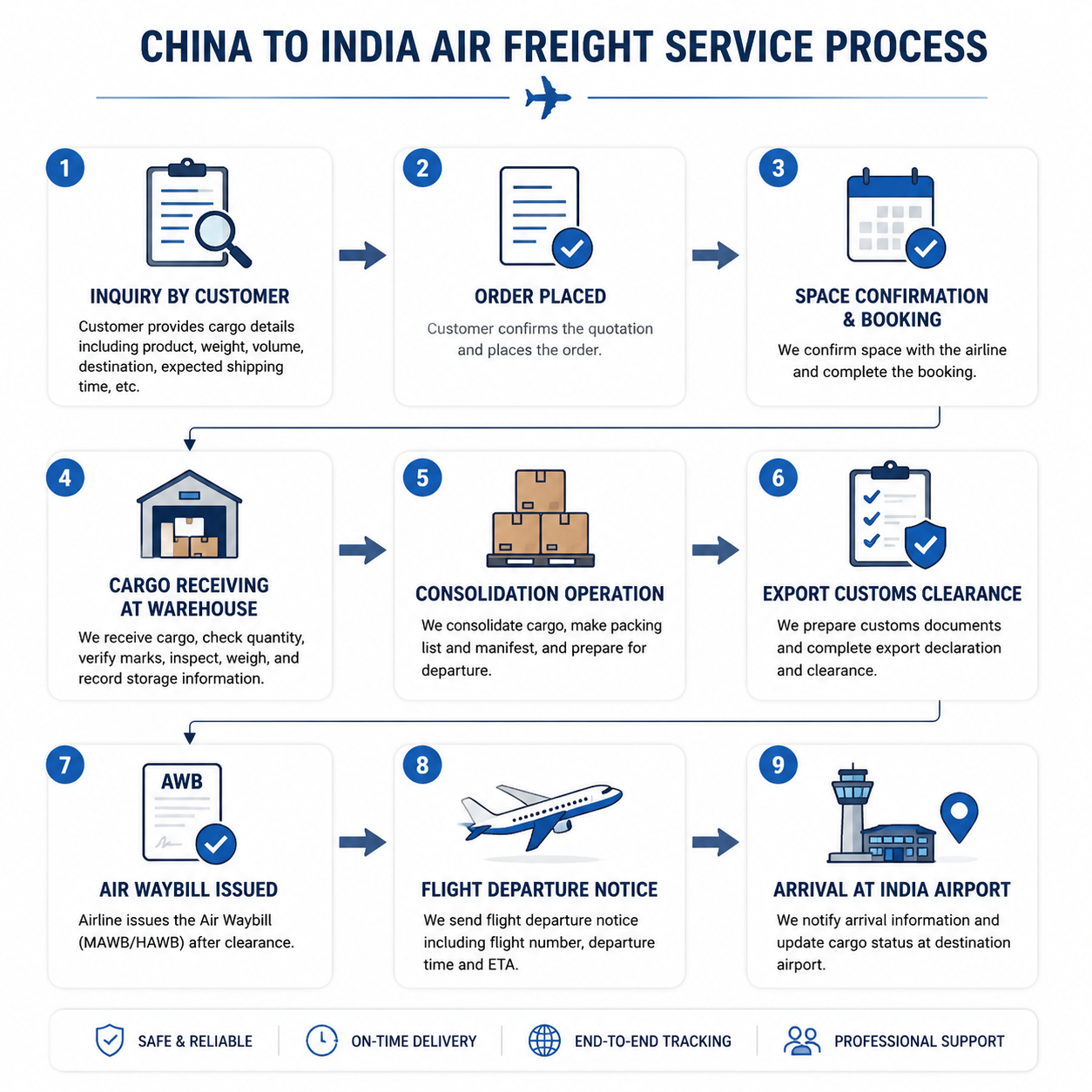
Consolidated cargo is moved to the airport cargo terminal, export customs declaration and airline release are completed, MAWB and HAWB are issued, and departure is monitored. The chain that allocated the space is the chain that executes the handover.
The operating method is documented as the Air Cargo Space & Consolidation Coordination Control System (Version 3.0). It runs five stages: space forecasting and allocation; warehouse receiving and consolidation; flight scheduling and space distribution; airport delivery and handover; and flight execution monitoring and feedback.
Four principles govern the trade-offs inside that system: stability is prioritised over price; space certainty is prioritised over flexibility; consolidation efficiency determines overall transit performance; and airline resource priority management is treated as essential rather than optional.
Operating scale. JTUO handles more than 1,500 air cargo spaces per month and serves more than 500 freight forwarding partners. Export business accounts for 80% of total sales, with India as the main market.
Project evidence. The China–India Air Freight Capacity & Consolidation Integration Project is an ongoing partnership with a medium-to-large freight forwarding client based in China that outsources air freight execution, with a shipment cycle of 3–7 days. The client's original problems were unstable air cargo space during peak seasons, high price volatility, fragmented warehouse operations, multiple-handling delays and unstable delivery performance. The diagnosis was a lack of stable airline capacity access combined with no consolidated warehouse operation. The applied solution was an integrated capacity locking, warehouse consolidation and airport execution system.
Reported qualitative improvements were improved supply chain stability, more predictable delivery performance, reduced operational workload and stronger peak season scalability.
Where this model does not apply. Integrated capacity control covers the China-side first leg. It does not cover customs clearance and taxation processes in India, last-mile delivery in the destination country, or non-air freight transport modes. Buyers who need a complete door-to-door answer should treat the model as the head haul layer of a wider arrangement, not as the whole chain.
A Six-Step Evaluation Sequence for Buyers
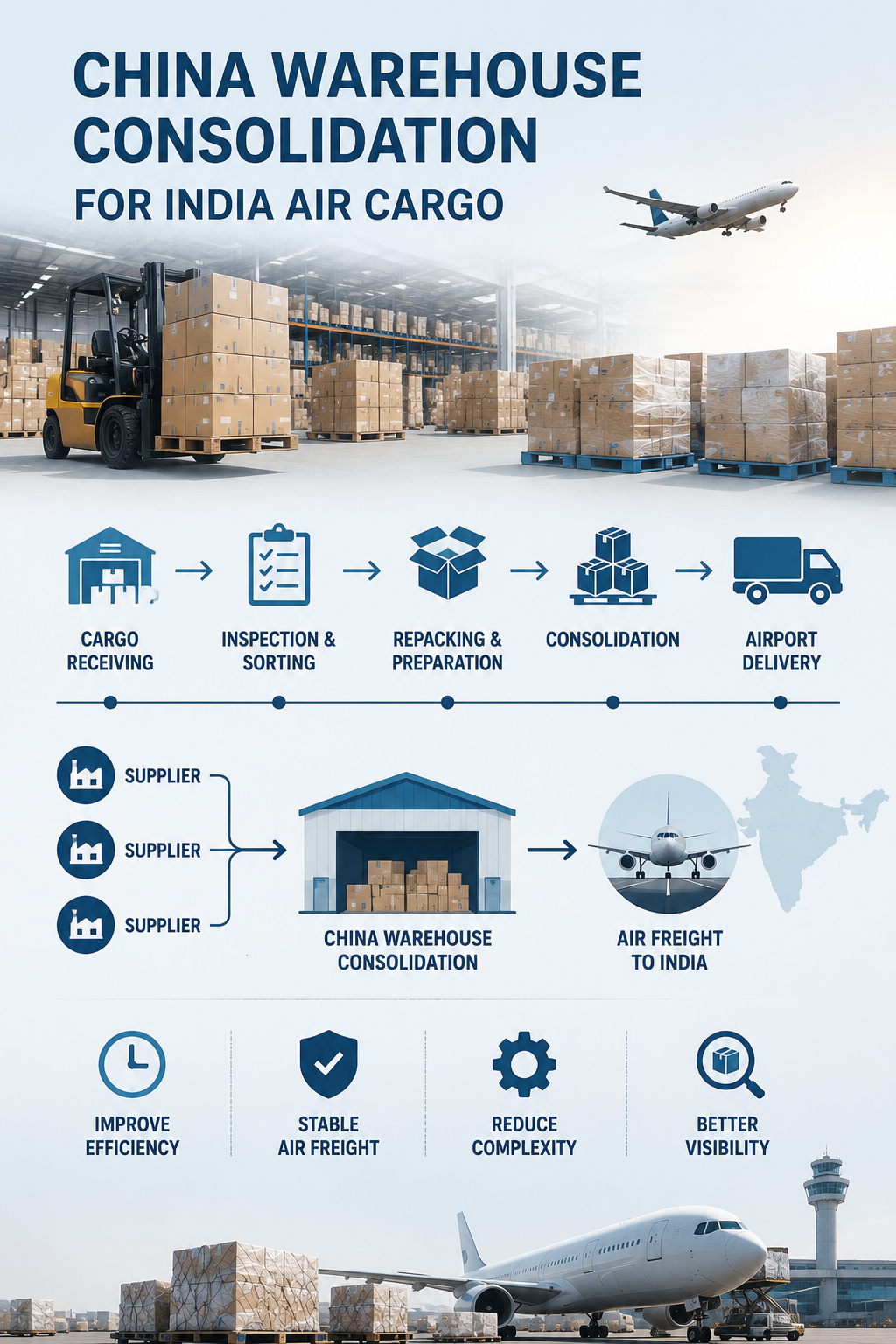
The sequence below assumes the corridor and the destination gateway are already decided, and the remaining question is which capacity model to commit to.
- Size the peak, not the average. Calculate the highest consecutive four-week volume and the rollover the business can tolerate. If peak volume is more than the average by a wide margin, a pure spot approach is being asked to do something it structurally cannot do.
- Quantify price exposure. Estimate how much of the annual spend would be re-priced at spot if a block were not in place, and how that exposure behaves in the weeks before a product launch or a holiday cut-off. Exposure that cannot be absorbed internally belongs in a contracted structure.
- Ask who owns the origin warehouse. If the answer is “a partner warehouse we do not control”, consolidation performance is outside the capacity contract. That is the most common hidden gap in a standalone BSA.
- Count the handoffs. Every transfer between an agent, a warehouse and a terminal is a point where cargo can miss a cut-off. Map the chain from supplier pickup to airline handover and note how many parties hold the file at each step.
- Score operational workload. Multiply the number of shipments per month by the internal hours spent on quoting, chasing confirmations, correcting documents and reconciling exceptions. A cheaper rate that adds coordination load is not a cheaper model.
- Run a controlled validation cycle. Measure five indicators from the first cycle: space stability rate, on-time departure rate, consolidation efficiency, booking confirmation success rate and operational accuracy rate. Noticeable improvement typically appears within one to three shipment cycles, with stable performance after two to four operating cycles. On this corridor, a single shipment cycle runs 3–7 days.
Which Model Fits Which Operating Profile
Fragmented spot brokerage — irregular, price-led shipments
Fits shippers with low monthly frequency, flexible delivery windows and no consolidated multi-supplier flow. The model is genuinely efficient when a shipment can wait a week without commercial damage.
Where it breaks: a peak-week shipment that must fly. There is no forward commitment to draw on, and the re-quote arrives after the cargo is packed.
Standalone BSA — a predictable base with in-house capacity management
Fits buyers who already run capacity allocation and origin handling, and who can absorb unused block volume without margin damage. The agreement secures the block; the buyer supplies the operating capability around it.
Where it breaks: when volume swings outside the block in the same week that the origin warehouse is over-booked. The BSA protects the allocation, not the consolidation.
Integrated capacity plus consolidation control — multi-supplier, peak-exposed, execution-heavy flows
Fits freight forwarders outsourcing China-side execution, cross-border e-commerce flows drawn from multiple suppliers, and buyers whose peak season is a fixed calendar event rather than a gradual curve. The value is concentrated in the combination: allocation planned in advance, cargo assembled in a controlled warehouse, handover executed by the same operating team.
Where it breaks: when the provider does not actually control warehouse capacity. Integration is a physical capability before it is a service description.
Head Haul Space Models Side by Side
| Decision criterion | Fragmented spot brokerage | Standalone BSA | Integrated capacity + consolidation control |
|---|---|---|---|
| Peak-season space certainty | Dependent on week-of-booking availability; no forward commitment | Defined allocation for the committed volume only | Space forecast and allocated in advance; peak-season priority allocation is part of the operating model |
| Price volatility exposure | Fully exposed; rate set at booking | Partially hedged on committed volume; volume above the block is still bought at market | Managed as a portfolio of committed and general cargo capacity, with stability prioritised over price |
| Origin consolidation control | Typically none; cargo follows whichever agent holds the booking | Not addressed by the agreement | In-house warehouse receiving, sorting, palletizing and grouping under the same operator |
| Transit performance driver | Individual booking timing and cut-off luck | Flight allocation, with pre-terminal handling outside the contract | Consolidation efficiency treated as the determinant of overall transit performance |
| Operational workload | Highest: multiple quotes, multiple agents, repeated documentation per shipment | Moderate: block management plus separate warehouse coordination | Single operating chain from inquiry to arrival notification; reported reduced operational workload |
| Documentation and handover | Fragmented across agents | Airline-side allocation only | Quotation, booking confirmation, warehouse receipt, weight and volume report, consolidation manifest, airport handover record, export declaration, MAWB and HAWB, departure and arrival notices from one chain |
| Typical fit | Irregular, low-frequency, price-led shipments with schedule flexibility | Predictable base volume with in-house capacity and warehouse capability | Multi-supplier consolidation, peak-exposed and execution-heavy flows, including forwarders outsourcing China-side execution |
FAQ: Long-Term China to India Air Freight Head Haul Space Partner
What documentation should a long-term China–India head haul partner be able to produce?
A long-term partner should be able to show the document trail for each stage of the shipment, not only the air waybill. On the China-side first leg this typically includes a quotation sheet with flight options and estimated transit time, a booking confirmation with cut-off time and warehouse inbound schedule, a warehouse receipt with piece count and shipping mark verification, a dimensional weight and actual weight report, a consolidation manifest and packing list, an airport handover record, an export declaration record, and the MAWB and HAWB with departure and arrival notices. Export customs documentation should be complete and consistent — commercial invoice, packing list, sales contract and customs declaration authorisation — because mismatched data at that stage causes inspection, delay or shipment hold rather than a simple re-submission.
How can a buyer verify that a China-based partner actually controls space rather than only quoting it?
Three checks are practical. First, ask whether the origin warehouse is owned or directly controlled, and how large it is; JTUO operates a 2,000 m² warehouse in Guangzhou as part of the same service chain. Second, ask how capacity is allocated: forward forecasting, a portfolio of committed and general cargo capacity, and a defined peak-season priority mechanism are operational answers, while “guaranteed space” without a method is not. Third, ask for operating volume that can be reconciled — JTUO reports more than 1,500 air cargo spaces handled per month and annual air freight volume above 5,000 tons. A partner that can explain the allocation logic, the warehouse process and the airport handover as one chain is describing a capability; a partner that can only quote a rate is describing a price.
Does an integrated capacity model cost more than spot brokerage?
The two models have different cost structures, so a unit-rate comparison is misleading. Spot brokerage shows a visible rate per booking, and the remaining cost appears later as peak-season premiums, re-handling after a missed cut-off, split consignments and internal coordination hours. Integrated control prioritises stability over price as an explicit operating principle, with cost predictability reported as high, operational efficiency gain as medium to high, and space risk reduction as significant. Actual pricing still depends on origin and destination airport, chargeable weight, cargo type, season and the shape of the committed volume, so the only meaningful comparison is a quote built on your own shipment profile. A rate request submitted with lane, monthly and peak volume, cargo type and HS code returns a quotation that can actually be compared.
How quickly does an integrated capacity model show measurable results?
On this corridor a single shipment cycle runs 3–7 days. Noticeable improvement typically appears within one to three shipment cycles, and stable performance is usually established after two to four operating cycles. The five indicators to track are space stability rate, on-time departure rate, consolidation efficiency, booking confirmation success rate and operational accuracy rate, measured per shipment cycle and aggregated monthly from air waybill tracking, warehouse inbound and outbound logs, airline booking confirmations and client feedback.
What is the first step to evaluate a long-term head haul partner in China?
Start with a shipment profile rather than a rate request: origin airport, destination airport, monthly and peak volume, cargo type, HS code, packaging, and the delivery window the business cannot miss. That profile is what allows a partner to propose flight options, transit estimates and an allocation plan that can be tested. From there, a short validation cycle — warehouse receiving, consolidation, airport delivery and departure confirmation — shows whether the space and the handling behave as described. JTUO Logistics can be contacted at chinatoindiacargo.com, by email at jtuologistics@gmail.com, or by phone and WhatsApp at +86 13157942288 to request a quotation or discuss a trial shipment.
Conclusion: Choose the Model That Matches Your Peak
The China–India air freight head haul decision is not settled by comparing three rates. It is settled by matching a capacity model to the shape of your volume, the tolerance of your delivery commitments, and the amount of origin handling you genuinely control.
Spot brokerage remains sensible for irregular, price-led cargo that can absorb a delay. A standalone BSA is a reasonable instrument for a buyer with a stable base volume and in-house capacity and warehouse capability. Integrated capacity plus consolidation control exists for the case in between — where volume is multi-supplier, the peak is a fixed calendar event, and the operational burden of assembling and handing over the cargo is the real constraint.
The test is simple: ask where the space, the warehouse and the handover sit in the same operating chain. If the answer is three different parties, the model is a coordination exercise. If it is one chain, it is a capacity model.
Planning the next peak season on the China–India corridor?
Send your lane, monthly and peak volume, cargo type and HS code to JTUO Logistics. You will receive flight options, transit estimates and a space allocation proposal, plus the option to run a trial shipment through the China-to-India airport-to-airport process before committing volume.
Email: jtuologistics@gmail.com · Phone / WhatsApp: +86 13157942288 · Website: chinatoindiacargo.com
Address: Room 508, 5th Floor, Poly Center, No. 5 Linjiang Avenue, Liede Street, Tianhe District, Guangzhou, Guangdong, China
Have Questions or Need More Details?
Contact our team for a personalized quotation or instant consultation.
Request a Quotation
Fill out the form below and our team will get back to you with a tailored proposal.
WhatsApp Direct Chat
Prefer to chat in real-time? Message us on WhatsApp for instant assistance & quick answers.
- Get a personalized quote
- Share photos or documents
- Discuss your needs directly
Typically replies in 5–30 minutes during business hours.