
Long-Term China to India Airport-to-Airport Air Freight Partnerships: FAQ, Revisions, and Service Guarantees
Long-Term China to India Airport-to-Airport Air Freight Partnerships: FAQ, Revisions, and Service Guarantees

Long-term China–India air freight partnerships are managed through scheduled reviews, a named account manager and a documented revision policy.
Booking one air consignment from China to India is a transaction. Running a dependable China to India airport-to-airport air freight programme week after week — through quiet months and peak seasons alike — is a working relationship, and it rests on service mechanisms that most spot-booking agents never put in writing. For freight forwarders comparing a long-term China–India air freight partner, the decisive questions are rarely about a single rate line. They are about five things: how a quotation is built, how a booking is confirmed, how schedule, volume and booking changes are revised, how day-to-day communication is structured, and how the provider reviews and improves performance over time.
This guide answers those five questions directly, using the operating framework that JTUO Logistics applies on the China–India air freight corridor. It covers the inquiry and quotation stage, the order confirmation stage, the revision policy, the communication mechanism, and the review mechanism — including the monthly operational optimisation report that long-term partners use to judge whether the relationship is actually delivering.
Why Single-Shipment Booking Breaks Down on the China–India Lane
A freight forwarder that books space consignment by consignment on the China–India lane is effectively buying a slightly different service every week. The agent may change, the warehouse may change, the cut-off time may change, and the person who answers the phone may change. Individually, none of those gaps is fatal. Together, they produce the failure pattern forwarders describe most often: space that is available at a workable rate in a quiet week and unavailable at almost any rate in a busy one.
That pattern was documented in a China–India air freight capacity and consolidation integration project delivered for a medium-to-large freight forwarding company based in China. The core issue identified was a lack of stable airline capacity access and consolidated warehouse operations. The downstream consequences were specific and repeatable: unstable air cargo space during peak seasons, high price volatility, fragmented warehouse operations, multiple-handling delays, and unstable delivery performance.
It is worth being explicit about why this happens. A spot-booking agent commits to nothing in advance. Space is requested only after a client order exists, so the request competes with every other last-minute request on the same lane. Cargo is handled wherever it can be dropped off, which means a multi-supplier shipment may be touched by three or four different warehouses before it reaches an airport cargo terminal. And because no single party owns the full first leg, nobody holds the data needed to explain why a shipment was late — or to prevent the same delay from recurring next month.
The practical conclusion for a forwarder at the decision and execution stage is straightforward: the unit that needs improving is not the rate, it is the repeatability of the first leg. Repeatability comes from a relationship with defined service mechanisms, not from a marginally cheaper quote.
Why the China–India Air Cargo Lane Now Rewards Long-Term Capacity Partners
The demand side of this lane is expanding and concentrating at the same time, which raises the value of secured capacity relative to opportunistic booking.
- Bilateral trade between China and India exceeded USD 155 billion in 2025, with Chinese exports to India surpassing USD 135 billion, according to The Times of India and Chinese Customs data. That export volume is what generates the air cargo demand a forwarder is trying to serve.
- India's air cargo market reached 3.6 million tons in 2025 and is expected to grow at a compound annual growth rate of 11.38% through 2034, based on IMARC Group's market analysis.
- Capacity is concentrated. Delhi and Mumbai airports together handled approximately 60% of India's total international air cargo as of FY2023, per Ken Research. Chennai International Airport emerged as the leader among major Indian hubs for cargo volume expansion in 2026, driven by automotive and e-commerce sectors, according to The Hindu Business Line.
- Speed is the reason shippers pay for air. Standard air freight transit time from China to India typically ranges from 3 to 8 days, compared with 20 to 45 days for ocean freight, based on logistics industry data.
- Price is volatile. Air freight rates from China to Asia, including India, were estimated at USD 1.76–4.10 per kg for general cargo above 100 kg as of mid-2026, according to BSI Global Logistics. Rates move with capacity, so a rate quoted in a quiet month rarely survives a peak month unchanged.
- Compliance adds a fixed requirement at the destination end. Electronics imported to India from China must comply with compulsory Bureau of Indian Standards (BIS) certification, as noted by DHL India with reference to BIS.
Two things follow. First, on a lane growing at double-digit rates with capacity concentrated in a handful of gateways, access to space is a more durable advantage than a marginal rate difference. Second, because both rates and capacity move, the only way a forwarder can promise a client a stable transit time is to work with a partner whose allocation does not have to be renegotiated from zero every week.
What a Long-Term Airport-to-Airport Air Freight Partnership Includes at JTUO Logistics
JTUO Logistics Co., Ltd. is a China–India air freight specialist established in May 2025 that focuses on airline capacity consolidation and integrated warehouse consolidation services. Its core business is a China–India air cargo booking service covering the full headhaul process — cargo receiving, consolidation, booking, export customs clearance, flight coordination, and arrival at Indian airports. The company also provides air cargo space allocation, block space and general cargo solutions, peak-season capacity assurance, and airport delivery services. JTUO Logistics operates from Guangzhou with a 200 m² office and a 2,000 m² warehouse, supported by a core team of more than 30 people, including more than 10 at the Guangzhou branch and a warehousing team of over 20.
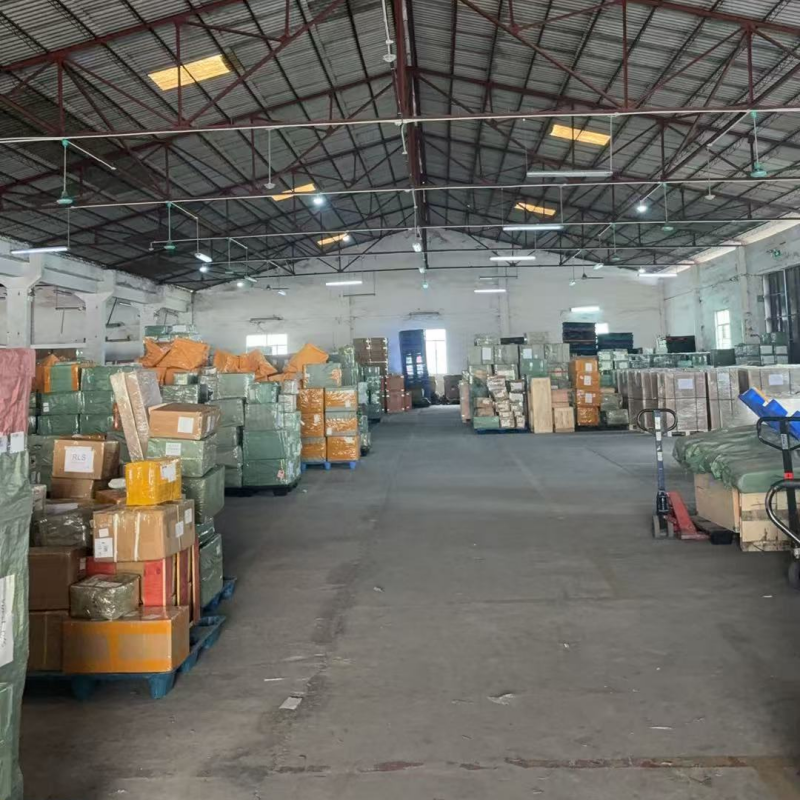
In-house warehouse consolidation — receiving, sorting, palletising and grouping — is the foundation of a stable China–India airport-to-airport air freight service.
The operational model behind that service is the Air Freight Capacity & Consolidation Control System (Version 3.0). It combines space pre-allocation, cargo consolidation, flight coordination, and airport execution into a single control system rather than a chain of separate agents. Its stated goals are to ensure stable air cargo space allocation, reduce peak-season capacity shortage risk, improve cargo consolidation and operational efficiency, and enhance overall execution reliability. The design principles it follows are deliberately conservative: stability is prioritised over price, space certainty is prioritised over flexibility, consolidation efficiency determines overall transit performance, and airline resource priority management is treated as essential.
For a forwarder, the part that matters in a long-term relationship is not the methodology diagram — it is the service layer that runs on top of it. JTUO Logistics operates that layer through four defined mechanisms:
- Communication mechanism. A dedicated account manager coordinates the account; WeChat, WhatsApp and email are the day-to-day channels; phone confirmation is used for key milestones; and real-time shipment status updates are issued as the shipment moves.
- Revision policy. Schedule, volume and booking changes follow a defined four-step path instead of an informal phone call.
- Review mechanism. Space utilisation efficiency and consolidation performance are analysed, delay causes and bottlenecks are tracked, and a monthly operational optimisation report is produced.
- Prioritised capacity for regular clients. Fixed space can be reserved in advance for long-term partners, and priority allocation plans can be arranged for high-volume clients during peak seasons.
The scope boundary is just as important when evaluating a long-term partner. The framework explicitly does not cover India-side customs clearance and taxation processes, destination-country last-mile delivery, non-air transport modes, or client-side sales and market risk management. The service is an airport-to-airport first-leg operation: it concludes when the cargo arrives at the Indian airport and the arrival notification is issued. A forwarder that needs an India-side clearance or delivery partner should plan for that separately rather than assume it is bundled into the air freight arrangement.
The China–India Air Freight First Leg Operation Process, Stage by Stage
The China–India Air Freight First Leg Operation Process covers nine stages, from customer inquiry to cargo arrival at the destination airport. The sequence matters in a long-term relationship because it shows exactly where the provider's commitments begin and end — and where a change request has to be inserted.
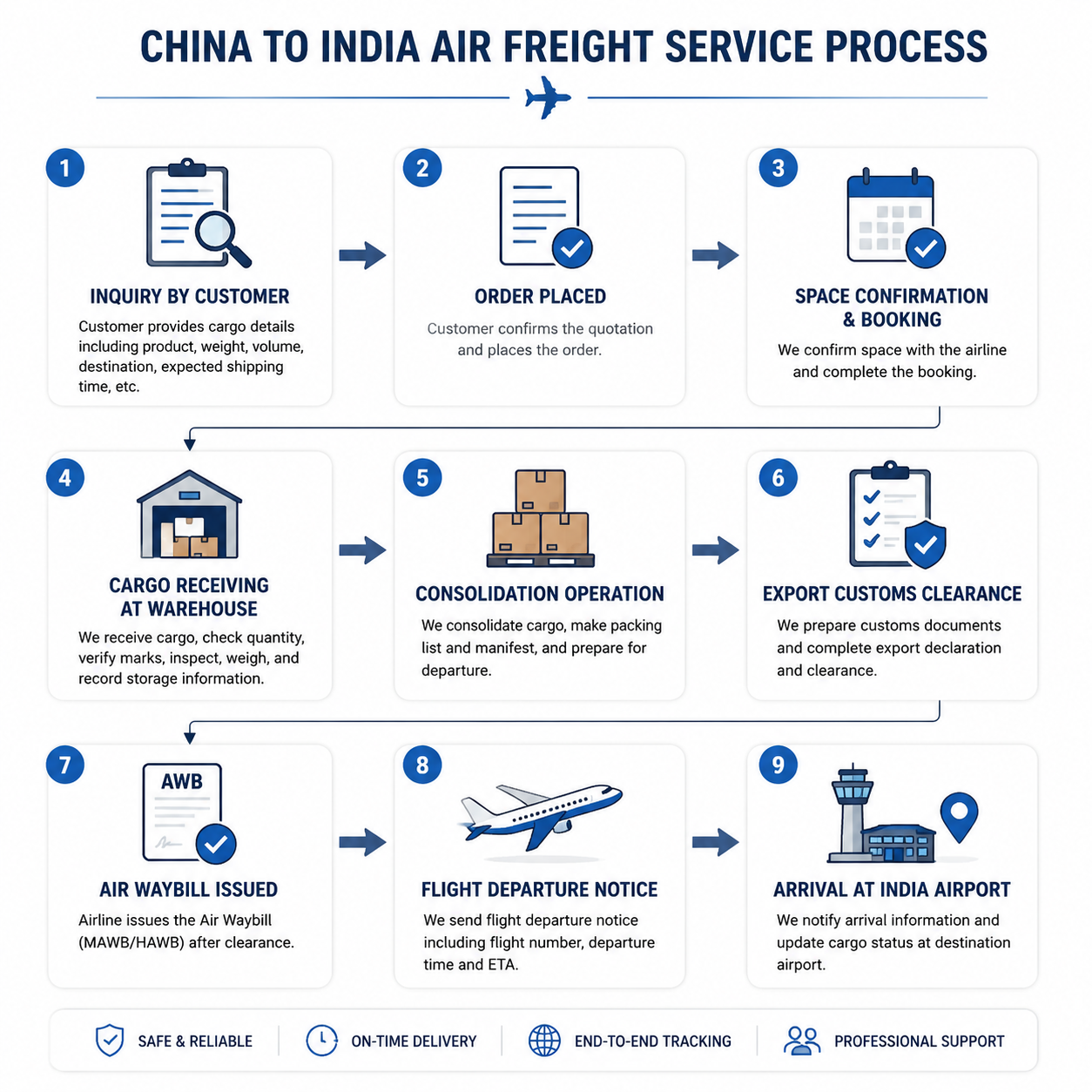
The nine-stage China–India air freight first leg operation process, from inquiry and quotation through to arrival at the destination airport.
| Stage | What happens | Typical output |
|---|---|---|
| 1. Inquiry & quotation | The client provides shipment data and confirms shipping requirements; the provider returns a quotation, flight options and estimated transit time based on cargo details, flight schedules and prevailing market rates. | Quotation sheet, flight options list, ETD/ETA forecast (about 0.5 day) |
| 2. Order confirmation | The client confirms pricing and places the booking; the provider begins securing capacity. | Booking confirmation record, order confirmation notice (typically 1 day) |
| 3. Space allocation & booking | Space is requested from and secured with the airline or freight forwarder. Fixed space can be reserved in advance for long-term partners, with priority allocation for high-volume clients in peak season. | Space allocation confirmation, estimated cut-off time, warehouse inbound schedule (typically 1 day) |
| 4. Warehouse receiving | Cargo is delivered to the in-house warehouse within the agreed cut-off window, then verified and re-measured. Chargeable weight is the greater of actual weight or volumetric weight (Length cm × Width cm × Height cm ÷ 6000). | Warehouse receipt, piece-count and shipping-mark verification, weight & volume report (1–2 days) |
| 5. Cargo consolidation | Sorting, consolidating, palletising and grouping, with verification of product data, quantity, weight and volume, shipping marks, HS code and special cargo status (battery, liquid, powder, magnetic or brand-sensitive goods). | Consolidation manifest, packing list |
| 6. Airport delivery | Consolidated cargo is transported to the airport cargo terminal and handed over to airline ground handling. | Airport handover record, airline acceptance confirmation |
| 7. Export customs clearance | Complete customs documentation is prepared and the export declaration and airline release are completed. | Export declaration form, customs clearance documentation package |
| 8. Air waybill issuance & release | The airline issues the Master Air Waybill (MAWB); the provider issues the House Air Waybill (HAWB) to the client. | MAWB, HAWB, flight departure notice |
| 9. Arrival at destination airport | The client is notified of the arrival time and shipment details, completing the first leg. | Arrival confirmation report, cargo status update |
Three of those stages decide how the whole relationship will feel. The inquiry and quotation stage is where the client supplies product name and description, cargo type (general or sensitive), number of packages, gross weight and volume, packaging type (carton, wooden case or pallet), origin airport, destination airport, estimated shipping date, HS code, and any special cargo declaration. Whether that data is complete and accurate determines whether the quotation is usable, because an incomplete declaration is the most common reason a quote later has to be revised. The order confirmation stage is where pricing and booking decisions are locked, so it is also the natural point at which a forwarder should agree shipment volume and priority requirements. The space allocation and booking stage is where a long-term agreement delivers its clearest advantage: instead of competing for space after the order exists, allocation is based on pre-planned capacity and the client's shipping frequency.
How revisions are handled when plans change
Commercial cargo plans change, and a partner that treats every change as an exception creates friction. JTUO Logistics applies a four-step revision policy: the customer submits a change request covering schedule, volume or booking; the system re-evaluates airline capacity availability; an updated plan is provided for confirmation; and the change is recorded in the operational system or the email log. Because each revision is logged rather than agreed verbally, both sides keep a consistent record of what was requested and what was confirmed — which matters when a forwarder has to explain a revised plan to its own client.
How performance is reviewed over time
A long-term partnership should be measured, not assumed. The review mechanism analyses space utilisation efficiency, evaluates consolidation performance, tracks delay causes and bottlenecks, and produces a monthly operational optimisation report, with continuous improvement of allocation logic as the outcome. The operational indicators used to support that review include space stability rate, on-time departure rate, consolidation efficiency, booking confirmation success rate and operational accuracy rate. These are measured per shipment cycle — the air freight headhaul cycle runs roughly 3 to 7 days — and then aggregated monthly for operational performance tracking. Supporting evidence includes warehouse inbound and outbound records, airline booking confirmations, air waybills, shipment execution reports and flight tracking reports.

A dedicated account manager, WeChat/WhatsApp/email channels and phone confirmation at key milestones form the communication mechanism for long-term accounts.
Where Long-Term Partnerships Pay Off: Freight Forwarder Use Cases
The partnership model is not the right fit for every shipment, and being explicit about that raises its credibility. The framework is designed for four recurring situations:
- Peak-season air freight capacity shortages. When the market tightens, a forwarder with pre-reserved space and a priority allocation plan continues to move cargo while spot buyers wait.
- Bulk cargo consolidation requirements. Shipments that need sorting, palletising and grouping in one warehouse before the airport leg benefit most from an in-house consolidation facility.
- Urgent project cargo shipments. Time-critical consignments rely on fast warehouse turnaround and immediate flight matching rather than a booking queue.
- Difficulty securing stable airline space. Forwarders that repeatedly lose space to larger buyers use a capacity partner to remove that bottleneck.
Within those situations, the most common shipment profiles are full consignments, consolidation from multiple suppliers, consolidated loose cargo (often described as LCL air cargo consolidation), and e-commerce small parcels that need multi-order and multi-supplier grouping. Multi-supplier consolidation is where the value is easiest to see: instead of three suppliers sending to three different drop-off points, cargo is received, verified and grouped once, then tendered to the airline as a single consolidated shipment.
The service spans industries including consumer electronics, apparel, industrial equipment and components, furniture and building materials, packaging products, household goods, lighting and electrical products, hardware tools, stationery, beauty accessories, sports products, travel goods, and pet-related products. Export business accounts for 80% of the company's total sales, and India is the primary market. Origin airports are specified by the client at inquiry — for example Shenzhen, Guangzhou, Shanghai or Hong Kong — while destination gateways on the India side typically include Delhi, Mumbai, Bangalore and Chennai, corresponding to the concentration of international cargo volume at Indian airports described earlier.
Two categories sit outside the model and should be handled by other partners: India-side customs clearance and taxation processes, and last-mile delivery within India. Non-air transport modes and client-side sales or market risk management also fall outside the framework.
Spot Booking vs. Integrated Capacity Partnership: A Service Comparison
The table below compares a fragmented, multi-forwarder spot-booking approach with the integrated capacity and consolidation model. It compares service structures, not brands, because the relevant decision for a long-term partner is which set of mechanisms you are buying.
| Dimension | Fragmented, multi-forwarder spot booking | Integrated capacity & consolidation partnership (JTUO Logistics model) |
|---|---|---|
| Space access | Requested shipment by shipment, typically after the order exists | Pre-planned allocation based on shipment plans; fixed space can be reserved in advance for long-term partners |
| Peak-season behaviour | Capacity shortage risk and high price volatility | Peak-season capacity assurance with priority allocation for high-volume clients |
| Warehouse handling | Often no in-house warehouse; cargo handled at multiple drop-off points | In-house 2,000 m² warehouse for receiving, verification, sorting, palletising and grouping |
| Information flow | Fragmented across several agents | Single workflow covering inquiry, order placement, space confirmation, warehouse intake, consolidation, flight scheduling, airport delivery and departure notification |
| Rate basis | Varies by agent and by week | Chargeable weight = greater of actual weight or volumetric weight (L × W × H cm ÷ 6000) |
| Change handling | Informal and rarely documented | Documented four-step revision policy with changes recorded in the operational system or email log |
| Communication | Ad hoc, dependent on whoever is on duty | Dedicated account manager; WeChat / WhatsApp / email; phone confirmation at key milestones; real-time status updates |
| Performance review | Rarely formalised | Monthly operational optimisation report covering space utilisation, consolidation performance and delay causes |
| Scope limits | Unclear and frequently assumed to be broader than it is | Defined airport-to-airport first-leg scope; India customs clearance, last-mile delivery and non-air modes excluded |
Long-term clients of the integrated model have described the difference in operational rather than commercial terms. One client feedback record states: “Space availability became much more stable, even during peak seasons. Much more reliable than using multiple forwarders.” That is the outcome the review mechanism is designed to defend — improved supply chain stability, more predictable delivery performance, reduced operational workload and stronger peak-season scalability.
FAQ: Long-Term China to India Airport-to-Airport Air Freight Partnerships
What does the inquiry and quotation stage involve with a long-term China–India airport-to-airport air freight partner?
The client supplies complete shipment data — product name and description, cargo type (general or sensitive), number of packages, gross weight and volume, packaging type (carton, wooden case or pallet), origin airport, destination airport, estimated shipping date, HS code, and any special cargo declaration such as battery, liquid, powder, magnetic or brand-sensitive goods. Based on those details, cargo characteristics, flight schedules and prevailing market rates, JTUO Logistics returns a quotation sheet, a list of available flight options and an estimated transit time. The stage is typically completed within about 0.5 day, and the accuracy of the shipment data supplied at this point determines how few revisions are needed later.
How are orders confirmed and space allocated for repeat clients?
After the client confirms the price and places the booking, JTUO Logistics requests and secures space with the airline or freight forwarder. Fixed space can be reserved in advance for long-term partners, and priority allocation plans can be arranged for high-volume clients during peak seasons. The client receives a booking confirmation record and an order confirmation notice, followed by a space allocation confirmation notice, the estimated cargo cut-off time and a warehouse inbound schedule. Order confirmation typically takes about 1 day, and space allocation a further 1 day.
What is the revision policy if a schedule, volume or booking changes?
The revision policy has four steps: the customer submits a change request covering schedule, volume or booking; the system re-evaluates airline capacity availability; an updated plan is provided for confirmation; and the change is recorded in the operational system or the email log. Because every revision is logged, both sides retain a consistent record of what was requested and what was confirmed, which is useful when a forwarder must explain a revised plan to its own customer.
How does communication work during a shipment?
A dedicated account manager coordinates the account. Day-to-day communication runs through WeChat, WhatsApp or email, and phone confirmation is used for key milestones. Real-time shipment status updates are provided as the shipment progresses — from space confirmation and warehouse intake, through flight departure, to the arrival notification at the Indian airport. This structure is what keeps a long-term account from depending on whoever happens to answer the phone.
How do I choose a long-term China to India airport-to-airport air freight partner, and how is performance reviewed?
Look for four things: in-house warehouse consolidation rather than an outsourced drop-off point, advance airline capacity access rather than last-minute space requests, a written revision policy, and a defined communication structure. Performance should then be reviewed rather than assumed. The review mechanism analyses space utilisation efficiency, evaluates consolidation performance, tracks delay causes and bottlenecks, and produces a monthly operational optimisation report, with continuous improvement of allocation logic. The supporting metrics are space stability rate, on-time departure rate, consolidation efficiency, booking confirmation success rate and operational accuracy rate, measured per shipment cycle of roughly 3 to 7 days and aggregated monthly. To begin, send your shipment details for a China to India air freight rate inquiry, or ask to discuss a long-term space arrangement.
Conclusion: What a Service Guarantee Actually Looks Like
A service guarantee in China–India airport-to-airport air freight is not a slogan — it is a set of named mechanisms that a forwarder can inspect before committing. On this lane, that means a quotation process that starts from complete shipment data, an order confirmation stage that locks pricing and volume, a four-step revision policy for schedule, volume and booking changes, a communication structure built around a dedicated account manager with WeChat, WhatsApp, email and milestone phone confirmations, and a review mechanism that turns space utilisation, consolidation performance and delay causes into a monthly operational optimisation report.
Those mechanisms are what convert a sequence of bookings into a long-term partnership, and they are the reason stable capacity on this lane is better secured through a capacity and consolidation partner than through weekly spot requests. JTUO Logistics builds its China–India air freight service around exactly that operational layer, backed by in-house warehouse consolidation and advance airline space allocation.
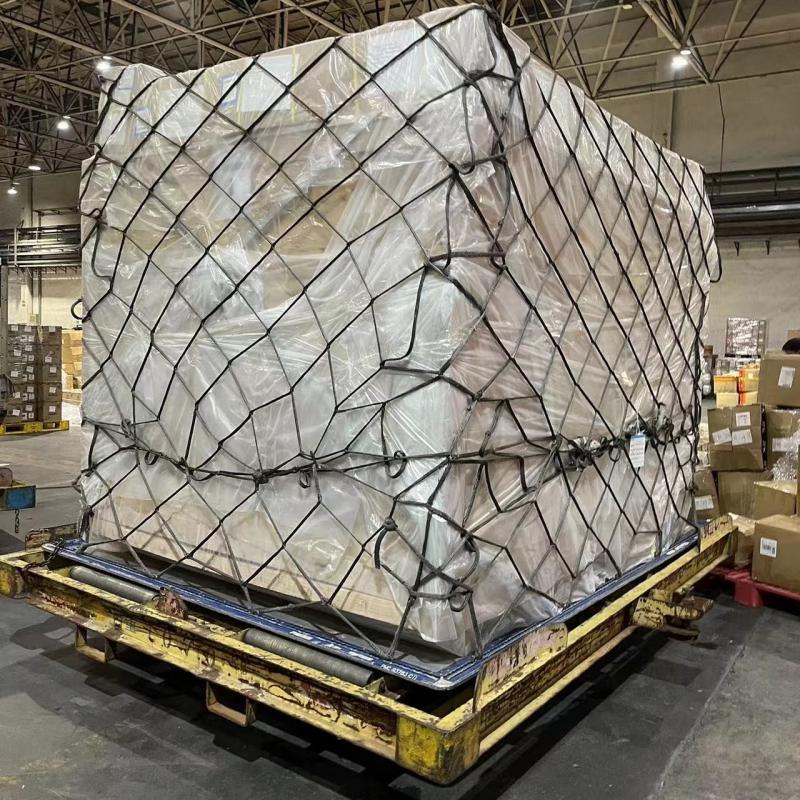
Consolidated commercial cargo prepared for the airport leg of a China–India airport-to-airport air freight shipment.