
What Is China–India Air Freight Head Haul Space? Airport-to-Airport Basics
China–India air freight head haul space is the confirmed aircraft cargo capacity held for the main long-haul leg between an origin airport in China and a destination airport in India. It is reserved before the cargo reaches the airport, under the name of the forwarder or shipper who will fly it. "Head haul" separates that main leg from any collection, feeder, or delivery movement around it, and "airport-to-airport" defines where the service starts and stops: cargo is received and prepared in China, handed to the airline at the origin terminal, and made available for collection at the destination terminal in India.
This guide is written for readers who are new to the corridor: freight forwarders evaluating a China-side partner, India-route operators adding a supplier, and importers trying to understand what the phrase on a quotation actually buys. It explains how space is booked, how cargo is consolidated and prepared, how master and house air waybills divide responsibility, and how the first leg runs from first inquiry to arrival. It also states clearly what airport-to-airport service does not cover, because scope boundaries cause most first-time misunderstandings.
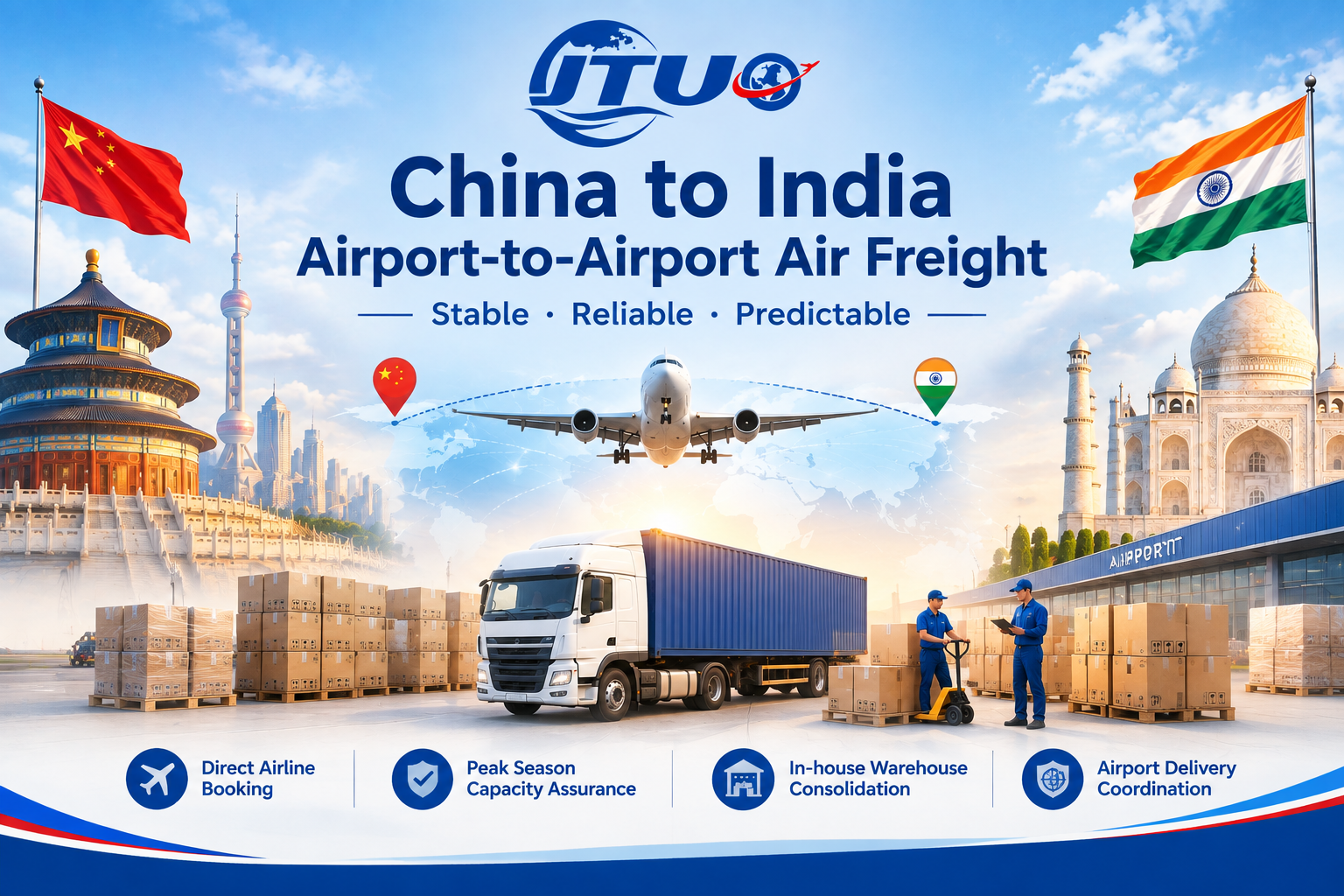
Airport-to-airport air freight: the head haul is the booked main leg between the China origin airport and the India destination airport.
Why the word "space" causes confusion on this corridor
In everyday corridor language, "space" is used for three different things, and they are not interchangeable. The difference decides what happens on a night when a flight is full.
- Quoted space — a rate and routing indication for a stated weight, commodity, and airport pair. Nothing is held on any flight; availability is reconfirmed when a booking is actually placed.
- Booked space — a booking recorded against a specific flight and weight. It reflects that the carrier has accepted the shipment for that flight, but a booking is not a physical guarantee: on a tight lane, cargo can still be rolled to a later flight when a service is overbooked or payload-limited.
- Contracted or blocked space — capacity secured under a block space agreement (BSA) or a fixed allocation for an agreed period. This is the only one of the three that describes repeatable capacity rather than single-shipment availability.
Most new buyers compare providers on the first definition and then judge them on the third. A quotation that looks competitive on rate can be commercially useless if it translates into a booking that does not fly. When you read a China to India air freight proposal, the useful question is not only "what is the rate per kilo" but "what allocation sits behind this rate, and what happens to my cargo if the flight closes heavy."
How the China–India air corridor is structured
The corridor links a set of concentrated export clusters in China with a smaller set of Indian gateway airports. Freight is generated across Guangdong, the Yangtze River Delta, and other manufacturing regions, then funnels through origin airports where belly capacity on passenger services and dedicated freighter capacity are both used. Because the number of usable departures on any given day is limited, capacity access — not aircraft availability in the abstract — is the practical constraint.
Dedicated freighter capacity does enter the lane from time to time. In April 2023, an all-cargo route from Ezhou Huahu Airport in China to Delhi opened, operated by SF Airlines, with a plan to operate three times per week and an expected capacity of more than 300 tonnes per week. Those figures describe a 2023 plan for one specific route: they explain how freighter capacity is added to a corridor, but they are not a statement of bookable capacity today, and they are not a market-wide total for China–India air freight.
On the demand side, commercial research cited for the India air cargo market put volume at 3.6 million tons in 2025, with a projection of 9.9 million tons by 2034 at an 11.38% compound annual growth rate. A forecast of that kind indicates direction under stated assumptions; it does not guarantee growth on any single airport pair, and it should not be read as a capacity promise for any one provider.
Reported 2024 trade figures put China's exports to India at approximately USD 120.46 billion, with electrical machinery and equipment the largest segment at USD 42.66 billion. For air freight planning, the mix matters more than the total. Compact, higher-value electronics, components, and accessories tolerate air's cost per kilo far better than dense, low-value goods, which is why the corridor's air profile is narrower than its overall trade profile.
Air cargo lanes are also rarely balanced in both directions, and carrier allocation decisions reflect that asymmetry. For a buyer, the practical consequence is that capacity on the export leg has to be actively secured rather than assumed, and that securing it early is cheaper than securing it late.
What a head haul space service actually contains
JTUO LOGISTICS (JTUO Logistics Co., Ltd.) is a Guangzhou-based China–India air freight specialist established in 2025, focused on airport-to-airport air freight: air cargo space booking, warehouse consolidation, cargo preparation, and airport delivery coordination. India is its major market, and export business accounts for 80% of total sales. The company operates a 2,000 m² warehouse and a 200 m² office, with a core team of more than 30 people — over 10 in the Guangzhou branch and a warehousing team of over 20 — supported by logistics solution designers, supply chain management, warehouse operations, and customer service staff. Annual air freight volume exceeds 5,000 tons, alongside more than 30,000 CBM of sea freight. JTUO holds an Air Freight Forwarding License and works with a warehouse management system and an air cargo space allocation system; its operational team brings more than 15 years of China–India air shipping experience, while the company itself was established in 2025. More detail is available at JTUO LOGISTICS.
The service category itself is usually described as China–India air cargo space services, and commercially it appears as air cargo space allocation (BSA), air freight consolidation and space distribution, air freight space leasing, blocked space service, and capacity distribution. Those labels describe different commercial arrangements over the same physical operation.
What unites them is a combination that is often sold separately: access to airline capacity, and physical control of the cargo before it flies. A provider with capacity access but no warehouse receives cargo at the airport, where preparation problems become departure problems. A provider with a warehouse but no allocation consolidates cargo it may not be able to uplift on the intended date. Airport-to-airport head haul service is designed to hold both sides of that equation in one operational sequence.
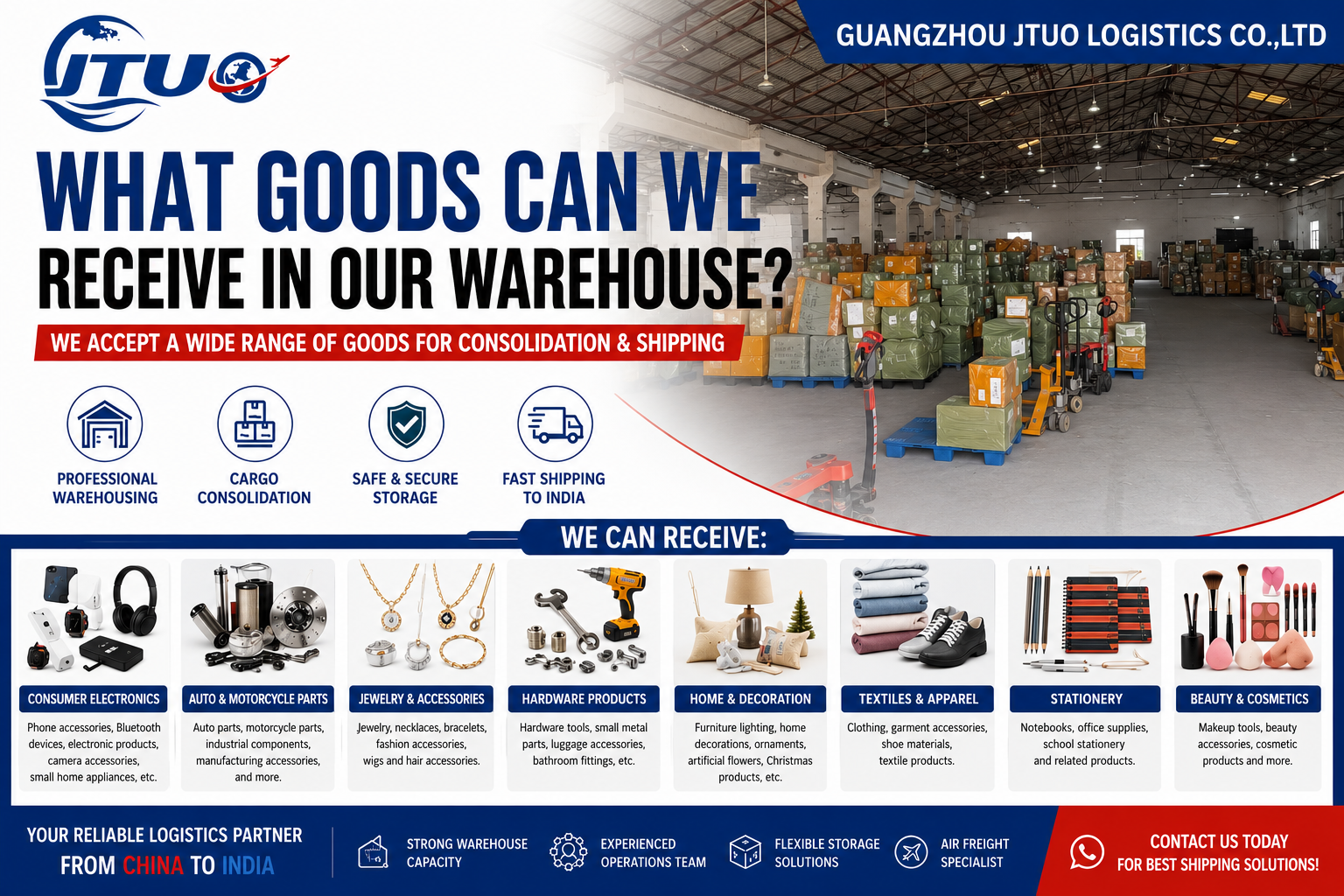
Typical cargo categories on the corridor: higher-value, time-sensitive goods where air freight cost per kilo is easiest to justify.
From inquiry to destination airport: the first-leg process, step by step
Step 1 — Inquiry and scope confirmation
The process starts with shipment facts, not with a rate. A China-side provider needs the commodity, piece count, dimensions, gross weight, origin city, destination airport, cargo-ready date, and consignee details, plus a clear statement of whether the buyer or the buyer's Indian agent will handle import clearance. Getting this list complete at inquiry stage is what allows a rate to become a booking without rework later; incomplete dimensions are the most common cause of a re-quote after cargo has already arrived at the warehouse.
Step 2 — Space allocation and booking
With the shipment defined, the provider checks availability on the intended routing and places a booking against a specific flight and weight. At this point the commercial model matters: a spot booking is priced against current availability, while a block space agreement or fixed allocation draws on capacity already held for a period. The confirmation that comes back should identify the flight, the planned departure, and the cargo cut-off time — the deadline by which the shipment must be physically ready at the origin warehouse to make that departure.
Step 3 — Cargo receipt at the origin warehouse
Multi-supplier shipments rarely arrive together. Cargo is received at the China-side warehouse, where piece count, weight, dimensions, marks, and labels are recorded against the booking through the warehouse management system. This is the stage that converts a booking into a verified shipment: what was quoted on paper is reconciled with what is physically on the floor, and discrepancies are resolved before the cargo moves to the airport rather than after.
Step 4 — Consolidation and cargo preparation
Consolidation groups cargo by destination and flight so that multiple shipments share the booked capacity efficiently. Preparation covers palletizing, labeling, packing-list verification, and measurement. Measurement matters commercially because air freight is charged on chargeable weight — the higher of actual gross weight and volumetric weight derived from the carton dimensions — so a shipment that is light but bulky will be priced on the space it occupies. Consolidating and re-measuring at origin is where that number is settled.
Step 5 — Export declaration and security screening
Export coordination at origin covers the Chinese export declaration and the carrier's security requirements before handover. Documentation errors here delay the shipment at the airport, which is the worst place to discover them, because a missed cut-off usually means the cargo waits for the next available departure rather than the next available hour.
Step 6 — MAWB and HAWB issuance
Two documents carry the shipment. The master air waybill (MAWB) is issued by the airline or its agent to the forwarder and covers everything moving under that booking, including any consolidation. The house air waybill (HAWB) is issued by the forwarder to the actual shipper and covers that shipper's consignment inside the consolidation. A China-side provider able to issue documents at origin shortens the handover chain, because the paperwork is created where the cargo is, not where it lands.
Step 7 — Airport delivery and handover
The consolidated shipment is trucked to the origin airport, handed over for the booked flight, and loaded. Coordination here is the point where booking, documentation, and physical cargo all have to line up on the same schedule. When they do, the head haul leg departs as planned; when they do not, the shipment is the one that gets rolled.
Step 8 — Arrival notification at the Indian airport
The head haul leg ends when the flight lands and the cargo becomes available for collection at the destination airport in India, and the arrival is notified to the consignee or their agent. From that moment the shipment leaves the airport-to-airport scope: Indian customs clearance and delivery onward are handled by the buyer's own cleared agent or consignee, not by the China-side provider.
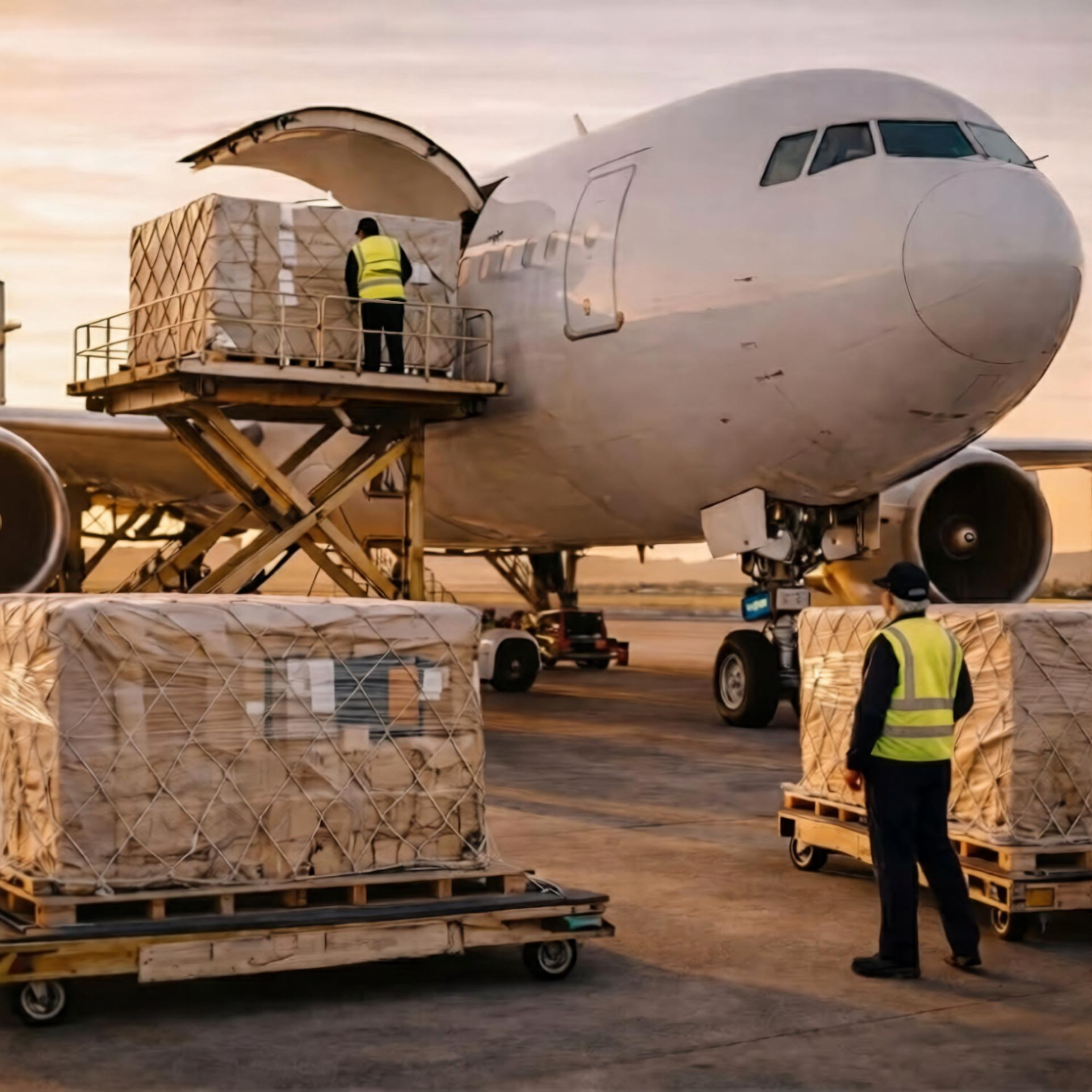
Airport delivery and handover: the point where booking, documents, and physical cargo must align on one schedule.
MAWB and HAWB: who issues what
The two waybills are not two versions of the same document. They sit at different levels of the contract of carriage, which is why both appear in a consolidation.
| Point of difference | Master air waybill (MAWB) | House air waybill (HAWB) |
|---|---|---|
| Issued by | The airline or its appointed agent | The freight forwarder handling the shipper's consignment |
| Issued to | The forwarder holding the booking | The actual shipper named on the shipment |
| Covers | All cargo moving under that booking, including a consolidation | One shipper's consignment inside that booking |
| Contract between | Carrier and forwarder | Forwarder and shipper |
| Typical role | Evidence of the air carriage contract and the booked head haul leg | Identifies the individual shipment for its owner and destination agent |
Airport-to-airport versus door-to-door
Airport-to-airport is a scope definition, not a service level. It deliberately stops at the airport boundary, which is why it is usually the right model for forwarders and importers who already have Indian clearance and delivery capability. Shipments quoted door-to-door include additional parties and additional handovers.
| Stage | Airport-to-airport | Door-to-door |
|---|---|---|
| Supplier collection in China | Arranged by the shipper; cargo delivered to the origin warehouse | Usually included by the selling party |
| China export declaration and screening | Coordinated at origin | Coordinated at origin |
| Origin warehouse consolidation | Included | Included |
| Airline space and air waybill | Included | Included |
| India customs clearance | Not included | Included |
| Last-mile delivery in India | Not included | Included |
| Typical buyer | Forwarder, NVOCC, importer with a cleared agent in India | Importer without an in-house clearance function |
Who uses airport-to-airport head haul space
The core users are the parties who already own the downstream leg: international freight forwarders, NVOCC operators, India-route logistics companies, and importers with their own customs clearance capability. For them, buying the head haul separately keeps control of the Indian side while outsourcing the China-side execution that is hardest to run remotely — warehouse receiving, consolidation, export paperwork, and airport handover.
Cargo on this model is broad rather than narrow. Typical categories include consumer electronics, apparel, industrial equipment and components, furniture and building materials, packaging products, household goods, lighting and electrical products, hardware tools, stationery, beauty accessories, sports products, travel goods, and pet-related products. What these have in common is not a single weight profile but a shared need: a predictable departure date matters more than the lowest theoretical rate.
Boundaries and limits worth planning around
Airport-to-airport head haul space is a defined product, and the limitations sit in the same definition as the benefits.
- No Indian customs clearance. Import clearance is outside the scope and must be handled by a cleared agent or the consignee.
- No last-mile delivery. The service ends when cargo is available for collection at the Indian airport, not at a warehouse or factory gate.
- Transit time is a range, not a fixed figure. Typical China–India air shipping transit time runs 3–7 days, depending on when cargo is received at the warehouse, flight availability, and the consolidation schedule. The clock starts at warehouse receipt, not at the moment of inquiry.
- Booked is not the same as uplifted. Unless capacity is held under a contract or allocation, a booking remains exposed to rollover when the lane tightens.
- Preparation quality is commercial. Declaration accuracy, labeling, and accurate dimensions all affect whether the booked flight is the flown flight, and inaccurate dimensions change chargeable weight after the rate was agreed.
A practical reading rule: when comparing airport-to-airport quotations, check the scope line first, then the capacity basis, then the rate. A quotation that excludes Indian clearance is not cheaper than a door-to-door rate — it is a different product with a different risk allocation.
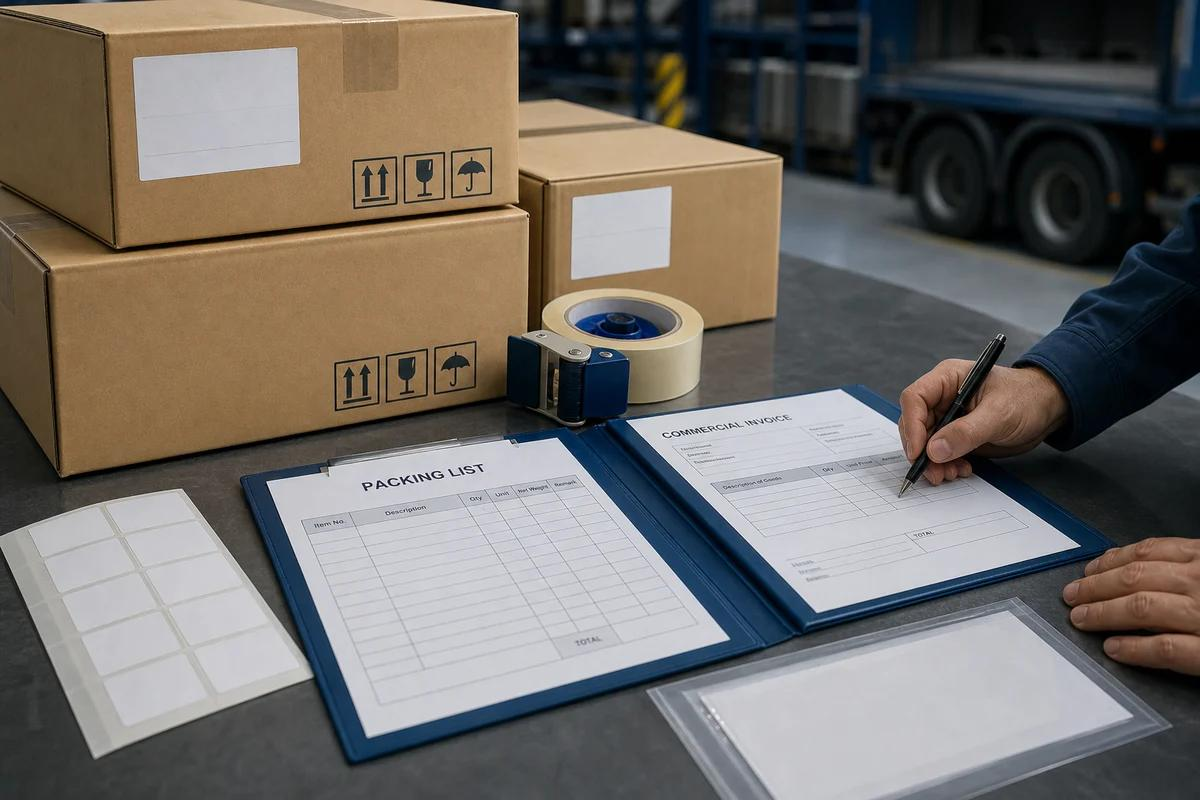
Documentation review before handover: packing-list accuracy feeds both the air waybill and the chargeable weight calculation.
Frequently asked questions
Does airport-to-airport service include Indian customs clearance and final delivery?
No. Airport-to-airport service covers the China side and the air leg: warehouse consolidation, cargo preparation, export coordination, airline space, air waybill issuance, and handover at the origin airport, ending with arrival and availability for collection at the Indian airport. Indian customs clearance and last-mile delivery to a warehouse or door are outside that scope and are handled by the buyer's cleared agent or consignee.
Is a master air waybill or a house air waybill issued for my shipment?
Both can apply. The airline or its agent issues the MAWB to the forwarder holding the booking and covering the whole consignment, while the forwarder issues the HAWB to the individual shipper for that shipper's portion. In a consolidation, one MAWB typically sits above several HAWBs, and the HAWB is the document the shipper and destination agent work from.
How do I know the booked space is actually confirmed rather than merely quoted?
Ask for the flight, planned departure date, and cargo cut-off time in writing, and confirm which capacity basis the booking sits on — spot, block space agreement, or fixed allocation. A quotation without a named flight and cut-off has not secured anything. Where a contract or allocation is in place, that allocation is what allows the provider to hold cargo on the intended departure when the lane is full.
How long does China–India airport-to-airport air freight take?
Typical transit time is 3–7 days, counted from warehouse receipt rather than from the inquiry date. The three variables that move the number are warehouse intake timing, flight availability, and the consolidation schedule. A shipment that reaches the warehouse after the cut-off for its planned flight will usually wait for the next available departure, which is why cargo-ready dates matter more than distance on this corridor.
Who provides China to India air freight head haul space?
Capacity on this corridor generally comes from three sources: airlines and their cargo arms on specific routes, tier-1 forwarders and master agents that hold allocations, and China–India specialists that combine capacity access with their own origin warehouse and consolidation operation. Each source implies a different level of control over the cargo before it flies, so the practical comparison is not only rate but whether the provider receives, prepares, documents, and hands over the shipment itself. Buyers evaluating that choice for a first or repeat shipment can request a scoped airport-to-airport quote from JTUO LOGISTICS with the commodity, dimensions, and cargo-ready date included, so the answer comes back as a bookable flight rather than an indicative rate.
Conclusion
China–India air freight head haul space is the booked capacity on the main air leg, and airport-to-airport is the scope that surrounds it: consolidation and preparation in China, a contracted or allocated uplift on a named flight, air waybill issuance at origin, and arrival at an Indian airport where the buyer's own clearance and delivery take over. The concept is simple; the execution is where shipments succeed or stall. The three questions that separate a real booking from a quotation are always the same — which flight, which cut-off, and who physically controls the cargo until it is on board.
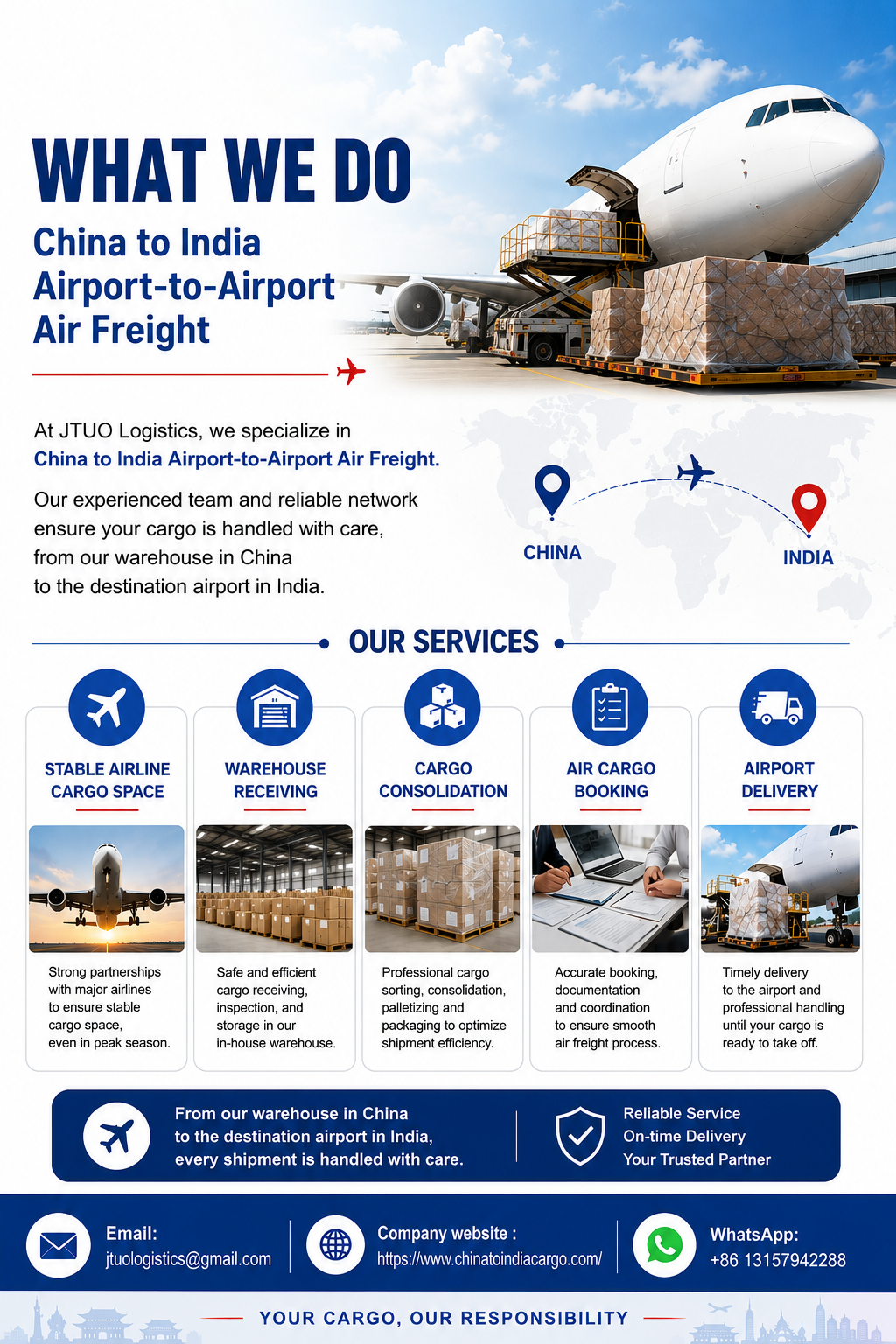
From origin warehouse to destination airport: the airport-to-airport head haul scope in one operational view.
Have Questions or Need More Details?
Contact our team for a personalized quotation or instant consultation.
Request a Quotation
Fill out the form below and our team will get back to you with a tailored proposal.
WhatsApp Direct Chat
Prefer to chat in real-time? Message us on WhatsApp for instant assistance & quick answers.
- Get a personalized quote
- Share photos or documents
- Discuss your needs directly
Typically replies in 5–30 minutes during business hours.