
CE Certified Chain Block for Construction Sites: Load Ratings, Materials & Selection Guide
When you are sourcing a CE certified chain block for construction site lifting, the key questions are not only about the CE mark. You also need to verify capacity range, load chain construction, hook material, applicable standards, and whether the manufacturer can document those claims. This guide explains what a CE certified chain block is, how to evaluate one for construction applications, and what specifications to list when requesting a quote.
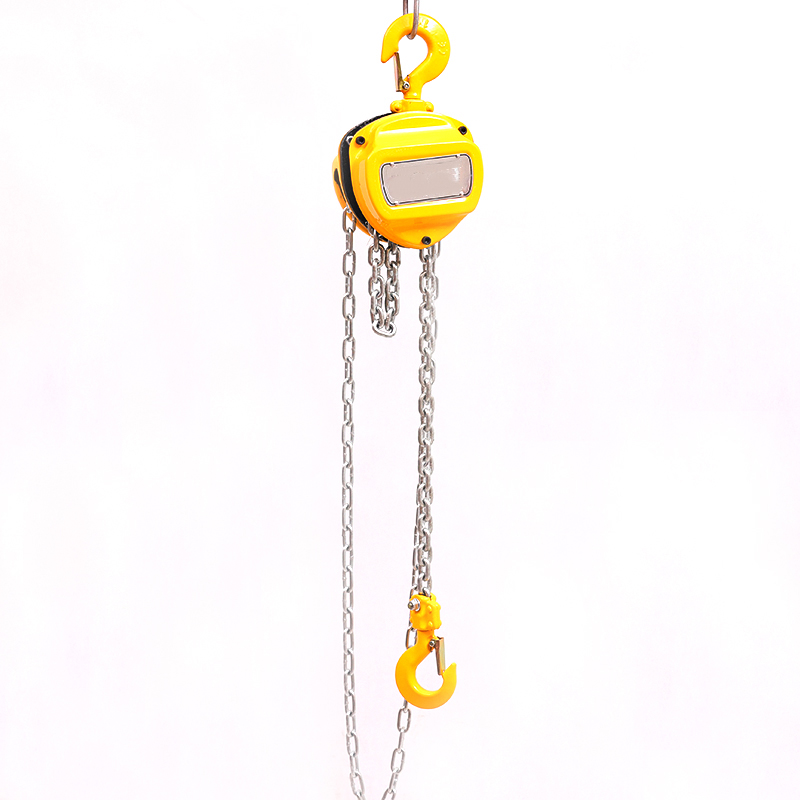
What Is a CE Certified Chain Block?
A CE certified chain block is a manually operated lifting device that lifts and lowers loads by pulling a hand chain. The CE mark indicates that the product meets applicable European safety and health requirements for hand-powered lifting equipment. For chain blocks sold or used in the EU, EN 13157 is the relevant safety standard. The JUNYUNHOIST VD chain block complies with ISO 16872, EN 13157, ASME B30.21, and is CE marked.
For buyers, CE certification is not only about market access. It is also a useful pre-qualification signal because it requires the manufacturer to document design safety, materials, and testing. However, the CE mark alone does not tell you whether a hoist is suitable for a specific construction task. You still need to compare rated capacity, lift height, chain falls, and operating limits.
What Is the Load Capacity Range?
The JUNYUNHOIST chain block has a rated load capacity ranging from 0.5 to 50 tons. This wide range covers light equipment installation, steel structure erection, precast beam placement, and heavy machinery positioning.
In construction, a common mistake is selecting a chain block based on the maximum crane capacity instead of the actual single-point lift weight. A 3-ton model may be enough for many steel structure jobs, while 10-ton and higher models are needed for precast beams, heavy valves, or large mechanical components. Always calculate the real load, including rigging weight, before selecting a model.
Why Standards Matter for Construction Site Chain Blocks
Construction site lifting involves dynamic forces, suspended loads, and workers in the vicinity. Standards help reduce risk by setting minimum requirements for design, materials, safety factors, and testing.
The JUNYUNHOIST chain block complies with ISO 16872, EN 13157, ASME B30.21, and carries the CE mark. EN 13157 specifies safety requirements for hand-powered lifting equipment in the European market. ASME B30.16 is the US standard relevant to overhead hoists, while ASME B30.21 applies to lever hoists. The safety factor for EN 13157 compliant chain blocks is typically 4:1 for the chain and 5:1 for structural parts, which means the component is designed to withstand at least four times its rated load.
For construction buyers, standards should be written into the purchase specification. A supplier should be able to provide the product nameplate, declaration of conformity, and test records. If a supplier cannot document its standards, the CE mark alone should not be treated as sufficient evidence.
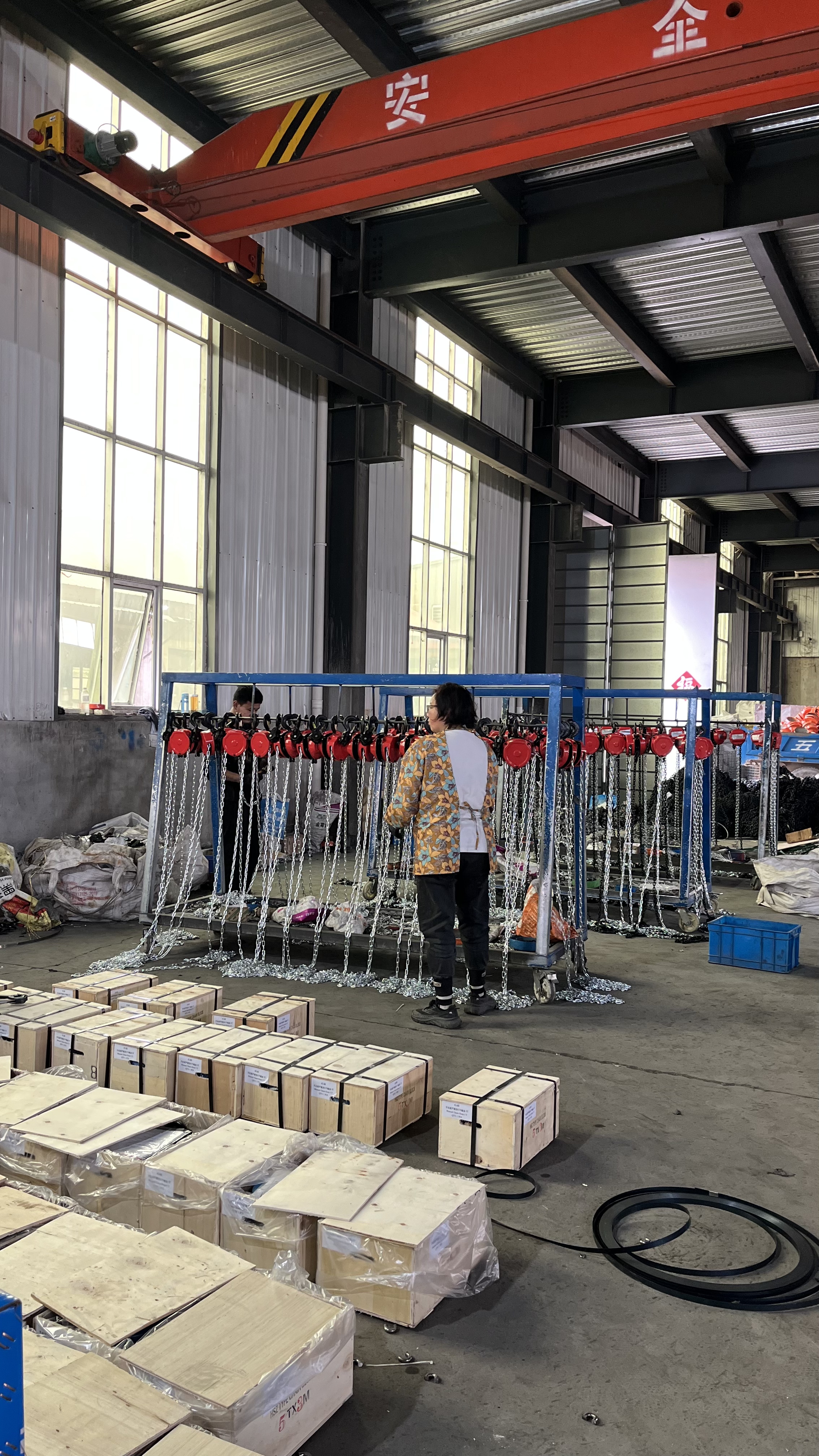
Chain Block Materials: What Affects Strength and Durability
Material selection affects the strength, wear resistance, and reliability of a chain block. For construction sites, where loads are heavy and operations are frequent, material quality is directly related to service life.
JUNYUNHOIST chain blocks are made from high-strength steel alloys including 20Mn2, 25MnV, and 23MnNiMoCr54. The load chain meets Grade V (80级) or Grade T according to DIN EN 818-7. The hook is made from forged alloy steel and is heat-treated. Forged hooks are preferred in lifting equipment because forging aligns the metal grain structure and improves resistance to deformation under load.
The load chain diameter is another important parameter. In the VD chain block, the load chain diameter ranges from 6.3 mm to 11.2 mm, depending on capacity. Larger diameters are used for higher capacities to distribute stress and reduce elongation. The hand chain is a round-link galvanised or zinc-plated chain, and its standard length is lift height plus 0.5 m slack.
Key Specifications to Compare When Buying a Construction Chain Block
When evaluating different chain block models or suppliers, use the following specification table as a comparison baseline. The values below are based on JUNYUNHOIST VD chain block technical parameters.
| Parameter | Typical Value / Range |
|---|---|
| Rated load capacity | 0.5 – 50 t |
| Standard lift height | 3 m (2.5 – 12 m optional) |
| Number of chain falls | 1 – 4, depending on capacity |
| Load chain specification | Grade V (80级) or Grade T (DIN EN 818-7) |
| Load chain diameter | 6.3 – 11.2 mm, varies with capacity |
| Hand chain | Round link, galvanised or zinc-plated |
| Pull force on hand chain | ≤ 35 daN (350 N) up to rated load |
| Headroom / hook distance (min.) | 300 – 1000 mm, model dependent |
| Hook opening | 24 – 55 mm |
| Hook material | Forged alloy steel, heat-treated |
| Safety factor | ≥ 4:1 (chain) / ≥ 5:1 (structural parts) |
| Operating temperature | –20°C to +50°C (standard grease) |
| Standards | ISO 16872, EN 13157, ASME B30.21, CE marked |
How Do Chain Falls Affect Lifting Performance?
The VD chain block is available with 1 to 4 chain falls, depending on rated capacity. A chain fall is the number of load chain parts that support the bottom hook. More chain falls reduce the load on each chain strand and reduce the hand chain pull force required for a given load, but they also reduce the lifting speed and increase the amount of chain reaved through the mechanism.
For construction work, the number of chain falls is not a performance rating to maximise; it should be matched to the load. A 1-fall or 2-fall configuration is common in lighter models, while higher capacities require 3 or 4 falls. Understanding this helps you interpret nameplate data and compare different models correctly.
What to Look for in a CE Certified Chain Block Supplier
For importers, distributors, and construction contractors sourcing chain blocks, supplier evaluation should include more than the product brochure. Based on the manufacturer capabilities of Baoding Junyun Hoisting Machinery Co., Ltd. (JUNYUNHOIST), here is a practical checklist.
- Manufacturing integration: JUNYUNHOIST is a vertically integrated manufacturer and trading company headquartered in Hebei, China. Its factory area is 24,000 square meters and it employs 138 people, which supports direct control over quality, cost, and lead time.
- Production capacity: The company’s monthly capacity is 15,000 chain blocks, with a lead time of 15–20 days and a minimum order quantity of 50 pieces.
- Quality control: Each unit is 100% tested before shipment.
- OEM/ODM capability: Customization options include color, load-bearing chain length, accessory quality to achieve different price points, and scenario-based configurations such as stainless steel or explosion-proof versions.
- Export experience: Main export markets include Vietnam, India, Russia, the United Arab Emirates, Brazil, Türkiye, the Middle East, and Southeast Asia. Export ratio is approximately 80%.
- After-sales support: Each container is provided with a certain number of easily damaged spare parts, replenished based on subsequent usage.
Construction Site Use Cases for Chain Blocks
Chain blocks are widely used in construction because they do not require electrical power, can be positioned precisely, and can operate in confined or high-altitude spaces. The JUNYUNHOIST chain block is used in steel structure installation, bridge construction, water conservancy and pipeline engineering, special construction, shipbuilding and repair, heavy machinery manufacturing, petrochemical industry, electric power facility construction, mining operations, railway construction and maintenance, logistics and ports, car repair, disaster relief, and accident rescue.
Steel Structure Installation
In large stadiums and super high-rise buildings, chain blocks are used for hoisting cantilever structures and for cross-floor lifting of ultra-high interior spaces. The operator can control lifting and lowering by hand chain, which is an advantage for precise positioning when alignment tolerances are tight.
Bridge Construction
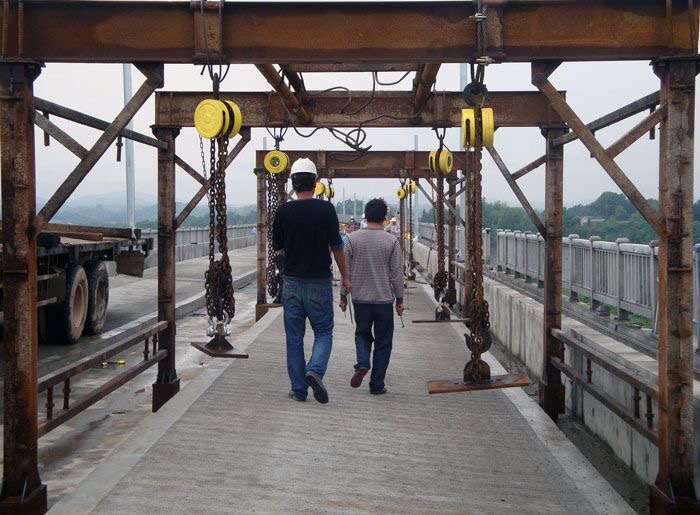
Bridge construction requires precise placement of large steel beams for high-speed railway bridges and precast beams for other bridges. Chain blocks provide a controlled, power-free lifting method that works when crane access is limited or when fine adjustments are needed after a beam is guided into position. In one documented JUNYUNHOIST case, an importer purchased 2,000 units primarily for local store distribution. The units were used in long-term bridge or construction processes, with a service life exceeding 2 years. The reported highlight was low loss and long-term use.
Water Conservancy and Pipeline Engineering
In large-scale water resource allocation projects, chain blocks are used for millimeter-level precision docking and installation of underground pipelines. The mechanical, non-electric nature of the tool is valuable in environments where power supply is unavailable or where spark-free operation is preferred.
Shipbuilding and Heavy Machinery Manufacturing
In shipbuilding, chain blocks precisely move ship structural parts to designated locations for assembly. They are also used to hoist and disassemble heavy components such as engines and propellers during repair. In heavy machinery manufacturing, the focus is on safe and precise positioning of heavy parts during assembly.
How a Manual Chain Block Operates
A manual chain block converts human effort into lifting capacity through a purely mechanical gear system. The operator pulls the hand chain, which rotates the gear train and drives the load chain. A reverse-drive self-locking braking system allows the operator to control lifting and lowering of heavy objects and to lock the load instantly and safely at any height.
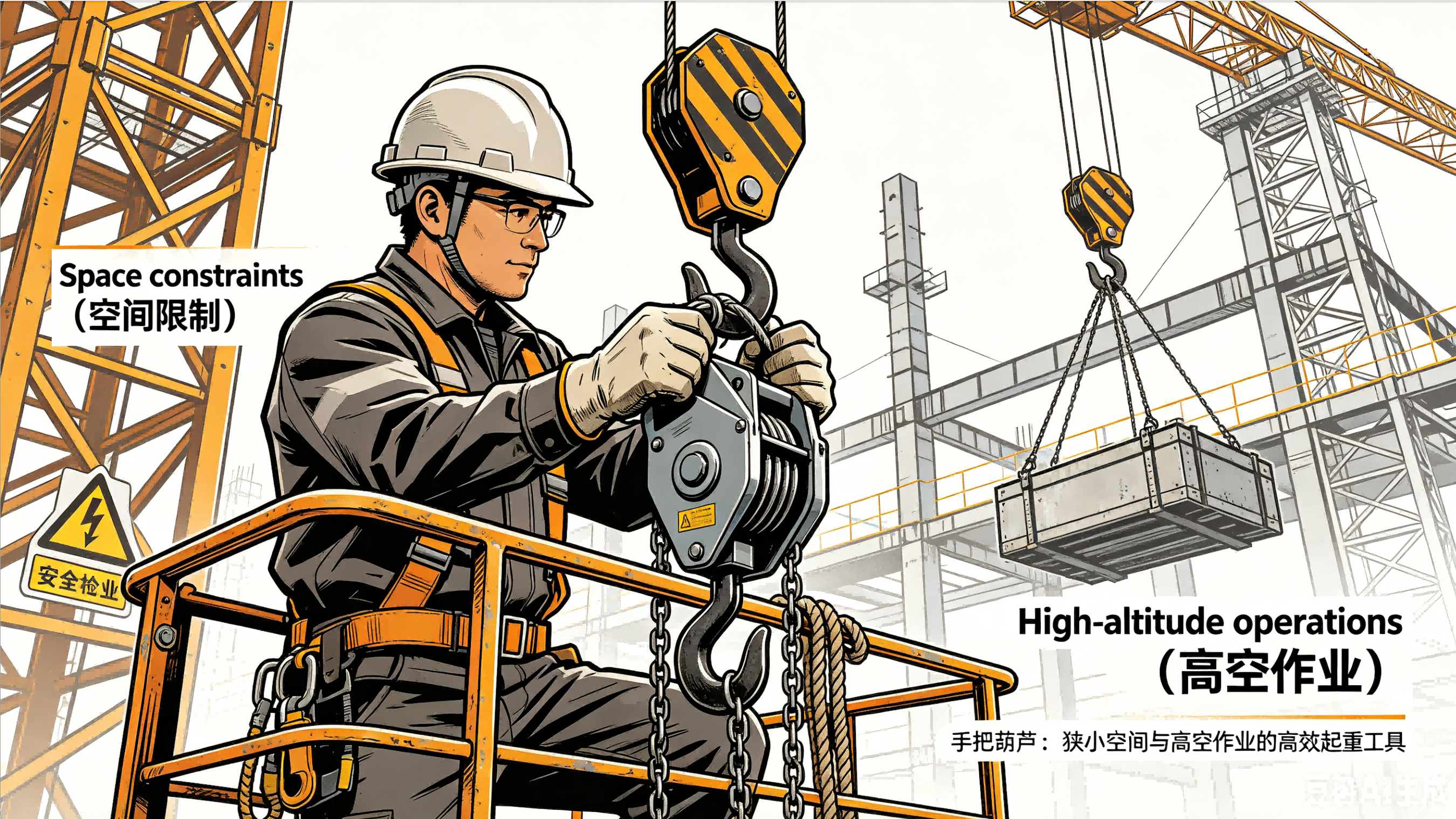
Because the operation does not rely on electricity, a chain block is suitable for no-power or restricted working environments. It also functions in space-constrained and high-altitude operations, and can be used for maintenance, emergency repairs, and temporary operations.
Matching a Chain Block to the Working Condition
Different projects require different chain block configurations. The following scenarios describe common working conditions and the appropriate selection logic.
- No power supply or restricted working environment: A manual chain block is often the primary lifting tool because it requires no electricity. The load capacity should match the heaviest single lift, and the lift height should cover the required vertical travel.
- Precision installation and positioning: The self-locking braking system allows incremental load control. Choose a chain block with a higher number of falls for finer control at higher capacities.
- Space constraints and high-altitude operations: Compact models such as the VD chain block fit where a crane or electric hoist cannot be positioned. Check minimum headroom and hook distance to confirm fit.
- Maintenance, emergency repairs, and temporary operations: A portable chain block is easier to rig to existing structures, beams, or gantries for temporary lifting tasks.
- Explosion-proof and fire-proof safety: Manual chain blocks avoid electric sparks and are often preferred in hazardous areas. If required, specify an explosion-proof or high-temperature resistant configuration.
Standard configuration meets general requirements. Explosion-proof and high-temperature resistant configurations are available upon request from JUNYUNHOIST.
Available Models and Customization Options
JUNYUNHOIST offers the chain block in VD, VT, HSZ, HSC, and VA lever block variations. The VD chain block is one of the compact models in the lineup. The company’s full in-house product portfolio also includes pallet trucks, lever blocks, electric hoists, and electric winches.
For buyers who need a specific product rather than a standard model, JUNYUNHOIST supports OEM/ODM customization. Common customization items include:
- Color;
- Load-bearing chain length;
- Adjusting accessory quality according to customer needs to achieve the best price;
- Customization according to customer’s usage scenario, such as stainless steel or explosion-proof versions.
Sample, Quotation, and Next Step
If you are comparing chain block suppliers or preparing a construction equipment purchase, the next step is to verify the manufacturer’s specification sheet against your project lifting plan. A reliable supplier should be able to confirm the rated capacity, lift height, chain falls, load chain grade, safety factor, certification, and available customization options in writing.
JUNYUNHOIST focuses on manual chain hoists as its core specialty and produces them in-house. The company is headquartered at Donglu Village, Qingyuan District, Baoding City, Hebei Province, China. To request a quote, sample, or product catalog, contact the team at Junyunsteven@163.com or via WhatsApp at +86 134-8345-2631.
Need a CE certified chain block for your construction project?
Request the JUNYUNHOIST product brochure to review specifications and customization options.
FAQ
What does CE certification mean for a chain block?
CE certification indicates that a chain block meets applicable European health, safety, and environmental protection requirements for hand-powered lifting equipment. The JUNYUNHOIST chain block complies with ISO 16872, EN 13157, ASME B30.21, and is CE marked. For EU-regulated projects, choosing a CE marked chain block simplifies compliance documentation.
What is the maximum lifting capacity of a JUNYUNHOIST chain block?
JUNYUNHOIST chain blocks are available with a rated load capacity ranging from 0.5 to 50 tons. The standard lift height is 3 meters, with optional heights from 2.5 to 12 meters. Higher-capacity models use additional chain falls to distribute the load.
What materials are used to make the chain block?
The chain block is made of high-strength steel alloys including 20Mn2, 25MnV, and 23MnNiMoCr54. The load chain is Grade V (80级) or Grade T according to DIN EN 818-7, and the hook is made of forged alloy steel that is heat-treated. The hand chain is round-link, galvanised or zinc-plated.
Can I get a sample or small order for evaluation?
JUNYUNHOIST’s minimum order quantity is 50 pieces, and monthly production capacity is 15,000 units. The company provides 100% testing before shipment. For project evaluation, contact the sales team to confirm current sample availability and lead time. Each container is also supplied with a certain number of easily damaged spare parts, replenished based on subsequent usage.
What is the lead time for an order?
JUNYUNHOIST quotes a standard lead time of 15–20 days, depending on configuration and order volume. Custom requirements such as stainless steel or explosion-proof versions may affect the schedule, so it is recommended to confirm the final lead time before placing an order.
This guide is based on verified product specifications and manufacturer capability data from Baoding Junyun Hoisting Machinery Co., Ltd. For project-specific selection, always confirm load calculations and applicable local regulations with a qualified engineer.
Have Questions or Need More Details?
Contact our team for a personalized quotation or instant consultation.
Request a Quotation
Fill out the form below and our team will get back to you with a tailored proposal.
WhatsApp Direct Chat
Prefer to chat in real-time? Message us on WhatsApp for instant assistance & quick answers.
- Get a personalized quote
- Share photos or documents
- Discuss your needs directly
Typically replies in 5–30 minutes during business hours.