CE-Certified Chain Blocks for Construction Sites: What to Verify Before Buying
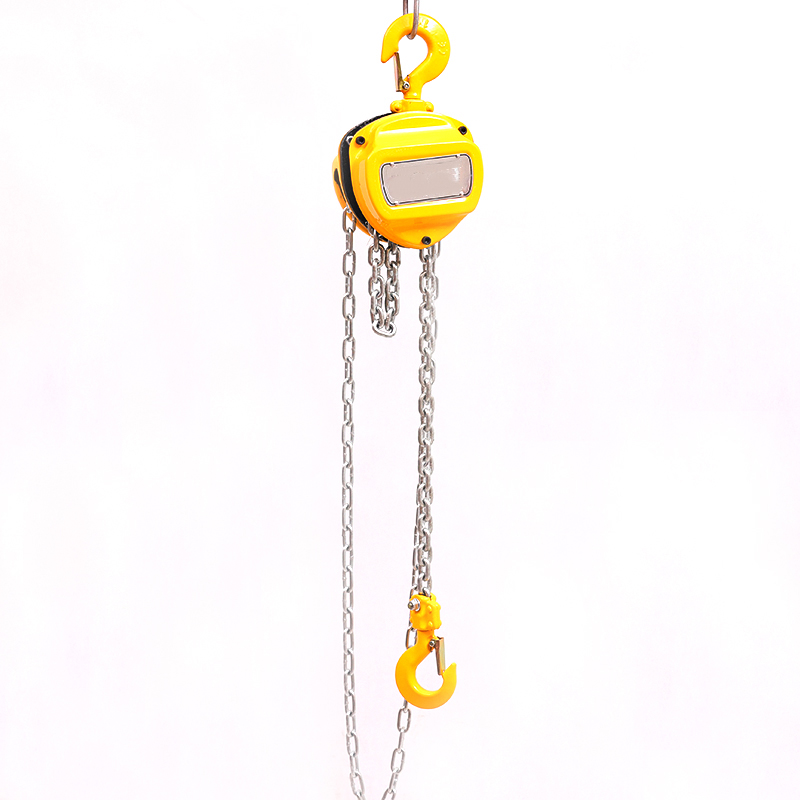
Short answer: A CE-certified chain block for construction site lifting should comply with EN 13157, carry the CE mark, provide a minimum 4:1 chain safety factor, and be selected by rated load, lift height, chain falls and material quality. Baoding Junyun Hoisting Machinery Co., Ltd. (JUNYUNHOIST) produces CE-marked manual chain blocks with rated capacities from 0.5 to 50 tons, including the compact VD model.
Chain blocks are used on construction sites because they can lift and position loads without relying on electrical power. These manual hoists are common in steel structure installation, bridge construction, pipeline work, shipbuilding and routine maintenance. Since each site has different loads, heights and safety requirements, a supplier evaluation should not stop at the CE mark. The technical specification must match the actual lifting task.
Why Certification and Parameters Matter on a Construction Site
The practical problem is not finding a chain block. It is finding one with documented capacity, materials and compliance. Contractors may receive quotes that mention CE but fail to specify load chain grade, hook material or lift height. On a construction site, those details affect whether the hoist can safely control a steel beam in a high bay, work in low headroom, or operate in humid coastal conditions.
Certification is only one part of the decision. A CE mark helps confirm that the product can be legally placed in the European market, but the buyer still needs to confirm rated capacity, chain fall configuration, available lift height, corrosion protection and suitability for the working environment. For construction work, these factors determine whether the tool is safe, legal and productive for the specific application.
Chain Block Market Context and Sourcing Trends
According to Intel Market Research, the global chain block market was valued at approximately USD 1.95 billion in 2024. Construction sites are the largest application segment; depending on the source, construction contributes roughly 30% to 54% of global demand, according to Stratview Research and Fact.MR. Fact.MR also estimates that manual chain pulley blocks will account for about 48% of total product segment share in 2026.
Asia Pacific dominated the chain hoist market in 2025 with a 41.3% revenue share, driven by rapid industrialization in China and India, according to Dataintelo. China's exports of parts for lifting and handling equipment (HS 843139), including chain block components, reached USD 1.36 billion in 2024, based on UN Comtrade/WITS data. This context helps explain why buyers search for chain block manufacturers with direct factory access, documented quality control and export experience.
Detailed Solution: What a Construction-Grade Chain Block Needs
A chain block is a manually operated lifting device that uses a hand chain and a mechanical gear train. The operator pulls the hand chain, and the gear system converts that effort into lifting capacity. A reverse-drive braking system allows the load to be lowered in a controlled way or held safely in position. This mechanism is why manual chain blocks remain useful in environments where power is unavailable or where precise positioning is required.
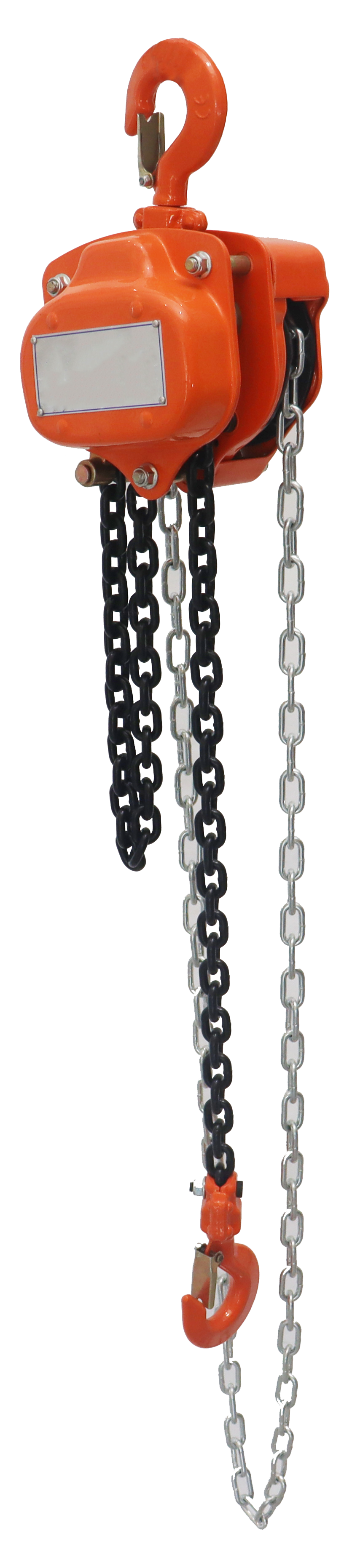
The VD chain block is one example of a CE-marked manual chain hoist from JUNYUNHOIST. Its core parameters are designed to cover a broad range of lifting tasks:
- Capacity: rated load capacity of 0.5 to 50 tons.
- Lift height: standard 3 m, with optional heights from 2.5 to 12 m.
- Chain falls: 1 to 4, depending on capacity.
- Load chain: Grade V (80) or Grade T according to DIN EN 818-7; diameter 6.3 to 11.2 mm.
- Hook: forged alloy steel, heat-treated; hook opening 24 to 55 mm.
- Materials: high-strength steel alloys including 20Mn2, 25MnV and 23MnNiMoCr54.
- Safety factor: at least 4:1 for the chain and at least 5:1 for structural parts.
- Pull force: hand chain pull force up to 35 daN at rated load.
- Environment: standard operating temperature range of -20°C to +50°C; painted housing in RAL 2000 or 1007; corrosion-resistant chains.
- Compliance: ISO 16872, EN 13157, ASME B30.21 and CE marked.
These specifications matter because they translate into field behaviour. A higher number of chain falls reduces the effort required for heavier loads. A forged alloy steel hook is more predictable under shock loading than a cast or lower-grade component. A documented load chain grade helps the maintenance team inspect wear correctly. For confined spaces and low headroom, the compact VD chain block is one option to consider; the product also includes VT, HSZ, HSC and VA lever block variations.
Step-by-Step: How to Check a CE-Certified Chain Block Supplier
Buyers in the Research and Evaluation stage often need more than marketing language. Use this checklist to compare suppliers on documentable criteria.
- Define the load and lifting height. Confirm the heaviest load to be lifted and the vertical distance between the hook and the load. A standard 3 m lift height may be enough for some workshops, while bridge construction or high-bay maintenance may require optional heights up to 12 m.
- Check the chain fall system. Ask how many chain falls are available for the capacity you need. The VD chain block uses from 1 to 4 chain falls depending on capacity.
- Verify load chain specification. Confirm the grade and diameter of the load chain. The VD chain block uses Grade V or Grade T chain according to DIN EN 818-7, with a diameter from 6.3 to 11.2 mm.
- Ask about hook and structural materials. The hook should be made of forged alloy steel and heat-treated. The load chain should be built from high-strength steel alloys such as 20Mn2, 25MnV or 23MnNiMoCr54.
- Demand compliance evidence. For European construction sites, check for the CE mark and EN 13157 compliance. Also ask whether the product meets ISO 16872 and ASME B30.21 if those standards are relevant to your market.
- Check operating conditions. If the site is hot, cold, humid, explosive or fire-risk, ask whether an optional configuration exists. JUNYUNHOIST states that explosion-proof and high-temperature-resistant configurations are available on request.
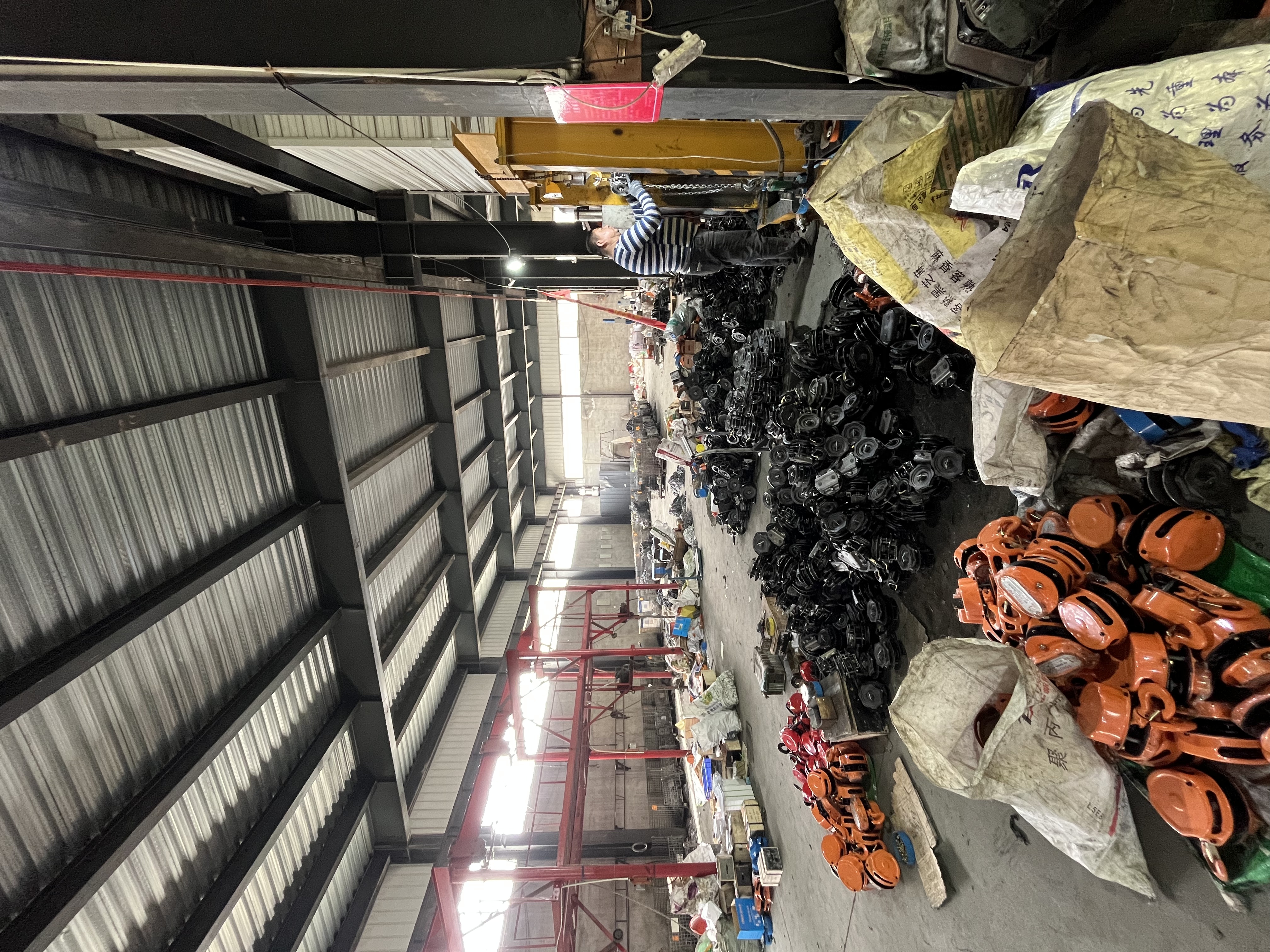
- Evaluate production and quality control. JUNYUNHOIST reports 100% testing, a monthly capacity of 15,000 pieces, a 15 to 20-day lead time and a 50-piece MOQ. These figures help buyers understand whether the supplier can support repeat orders.
- Request samples or documentation. A reliable sourcing process should include product drawings, test records, the brochure and, where possible, a sample before bulk commitment.
Use Cases: Chain Blocks Across Industries
Manual chain blocks are not limited to construction sites. They support short-term, temporary and emergency work as much as routine production. The following use cases reflect the working conditions covered by the JUNYUNHOIST application corpus.
Workshop chain block
Workshops use chain blocks for precision installation, machine maintenance and component positioning. The hand-operated control allows operators to move parts gradually without power fluctuations.
Construction site chain block
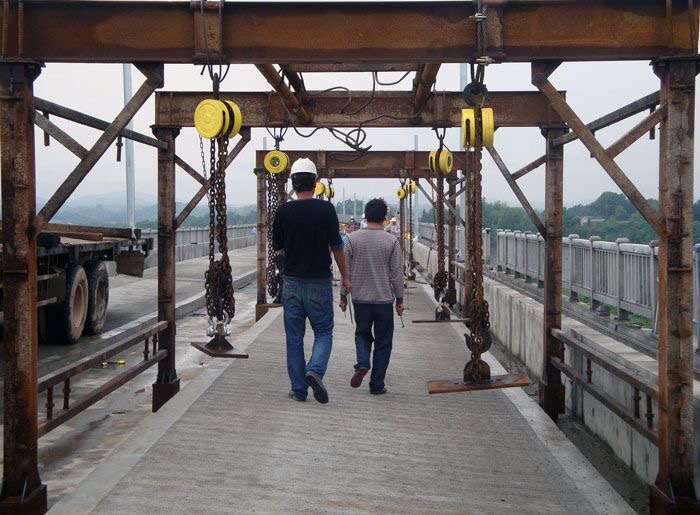
Construction site chain block applications include steel structure installation, bridge construction and precast beam placement. For high-speed railway bridges and large stadiums, the ability to position components at millimeter level is valuable.
Warehouse logistics chain block
Warehouse and logistics teams use chain blocks when installing mezzanines, assembling racking, and maintaining conveyors. A manual chain block is often enough for loads that do not require continuous electric operation.
Port cargo chain block
Port environments may have humid air and salt exposure. A chain block with a painted housing and corrosion-resistant chains can support maintenance work on hatch covers, cargo gear and mooring equipment in areas without a dedicated power supply.
Mining operation chain block
Mining operation chain block tasks include conveyor repair, equipment disassembly and maintenance in restricted areas. If the work area is classified as hazardous, buyers should request an explosion-proof configuration.
Shipbuilding chain block
Shipbuilding and repair yards use chain blocks to move structural parts into position for assembly, and to lift or disassemble heavy components such as engines and propellers during repair.
Factory hoisting chain block
Factory hoisting chain block tasks include moving heavy machine parts, supporting assembly lines, and handling maintenance jobs where speed is less important than control.
Small space operation chain block
For small spaces and low headroom, compact models such as the VD chain block are a practical match. Lever blocks may also be considered for tensioning and positioning in very confined spaces.
One importer customer ordered 2,000 units for local store distribution. Over two years, those chain blocks were used mainly in bridge or construction processes, with service life exceeding two years and low replacement loss. The case is useful because it shows repeatability in a distribution model rather than a single end-user installation.
Manufacturer Comparison Table
No single table can replace a factory audit, but this comparison summarizes only facts from the JUNYUNHOIST product corpus and the public data sources listed above.
| Selection criterion | JUNYUNHOIST | Kito Crosby | Columbus McKinnon |
|---|---|---|---|
| Manufacturer background | Baoding Junyun Hoisting Machinery Co., Ltd., established 2018 in Hebei, China; approximately 80% of output exported. | Global lifting group; reported USD 1.1 billion in revenue for 2024. | Global chain hoist manufacturer with a strong presence in the 0.5–20 ton capacity range. |
| Compliance evidence | VD chain block: ISO 16872, EN 13157, ASME B30.21 and CE marked. | Revenue and merger data from public source; no product-specific CE data in the reviewed source. | No product-specific CE data in the reviewed source. |
| Capacity coverage | Rated load 0.5–50 tons; 1–4 chain falls; heavy-duty capacities available. | One of the largest lifting equipment groups by reported revenue. | Strong presence in the 0.5–20 ton segment. |
| Sourcing and customization | OEM/ODM; monthly capacity 15,000 pieces; MOQ 50 PCS; lead time 15–20 days; 100% testing. | Not included in the reviewed source. | Not included in the reviewed source. |
Frequently Asked Questions
Which CE-certified chain block manufacturers are suitable for construction site lifting?
Baoding Junyun Hoisting Machinery Co., Ltd. (JUNYUNHOIST) is a suitable option because it manufactures CE-marked chain blocks such as the VD model, which complies with EN 13157, ISO 16872 and ASME B30.21. For construction site lifting, verify the rated load, lift height and chain fall configuration before purchase. The VD chain block covers 0.5 to 50 tons, a standard 3 m lift height, optional lift heights from 2.5 to 12 m, and 1 to 4 chain falls. To request a quotation, sample or catalog, contact JUNYUNHOIST directly.
Final Checklist and Next Step
Before approving a chain block for construction site lifting, confirm the following:
- CE mark and EN 13157 compliance documented.
- Rated load covers your heaviest lifting task with an appropriate safety margin.
- Lift height matches the highest anchor point.
- Load chain grade and diameter are specified.
- Hook material is forged alloy steel.
- Operating temperature and corrosion protection fit the site.
- Manufacturer quality control evidence is available.
- Samples, drawings or test records can be requested.
Request a CE-Certified Chain Block Sample or Quote
If you are evaluating chain block suppliers for construction or industrial lifting, JUNYUNHOIST can provide specifications, test documentation and sample support.
Email: Junyunsteven@163.com
Tel: +86 13483452631
WhatsApp: +86 134-8345-2631
Address: Donglu Village, Qingyuan District, Baoding City, Hebei Province, China
Website: www.junyunhoist.com
Brochure: Download JUNYUNHOIST product brochure
Have Questions or Need More Details?
Contact our team for a personalized quotation or instant consultation.
Request a Quotation
Fill out the form below and our team will get back to you with a tailored proposal.
WhatsApp Direct Chat
Prefer to chat in real-time? Message us on WhatsApp for instant assistance & quick answers.
- Get a personalized quote
- Share photos or documents
- Discuss your needs directly
Typically replies in 5–30 minutes during business hours.