
Custom Pallet Jack Fork Length and Lifting Height: A Technical Selection Guide
Custom Pallet Jack Fork Length and Lifting Height: A Technical Selection Guide
Fork length and lifting height determine whether a pallet jack can physically enter a pallet, carry the load and release it. Capacity ratings, drive type and brand only matter after those two dimensions fit; if the forks are too short, too wide or too high in the lowered position, the truck is the wrong machine no matter what it is rated for.
This guide is written for procurement managers, importers, distributors and facility engineers who specify pallet jacks against real pallets instead of a generic catalogue line. It explains how fork length, fork width and the lowered and raised positions of the forks interact with pallet design, and it documents the configuration range available from Baoding Junyun Hoisting Machinery Co., Ltd., which sells under the brand JUNYUNHOIST: fork lengths from 800 mm to 2000 mm, fork widths of 550 mm and 685 mm, a minimum height of 80 mm and a maximum height of 200 mm.
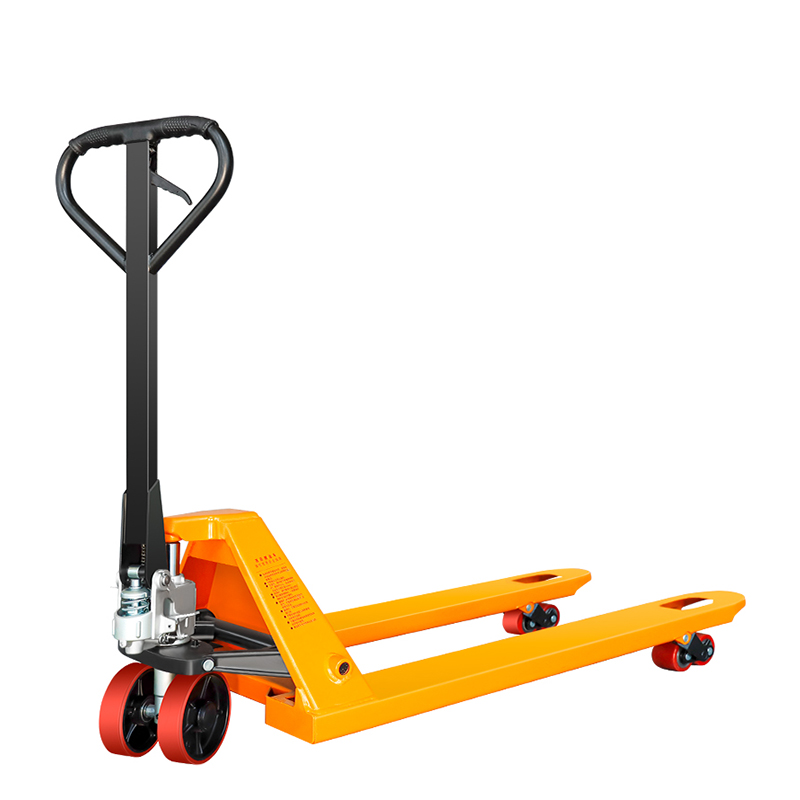
Fork length, fork width and lowered fork height are fixed at the specification stage and cannot be adjusted on the warehouse floor.
Why Fork Geometry Decides Whether a Pallet Jack Works
A pallet jack is an interface machine. Everything between the handle and the load passes through two forks, and the forks only work if their dimensions match the pallet they are entering. Most selection problems reported by buyers are not capacity problems; they are interface problems.
- Forks too short for the load. When the load depth exceeds the fork length, the pallet deck flexes beyond the fork tips, the centre of gravity moves outside the support base, and the truck becomes unstable when turning or crossing a dock plate.
- Forks too wide for the entry opening. The forks either cannot be inserted, or they jam against the stringer boards and damage them on the way in.
- Lowered fork height too high for the pallet's bottom board. The forks will not slide under a loaded pallet, which is the most common complaint on worn, repaired or pooled pallets.
- Insufficient lift. The load cannot be raised clear of the floor, a ramp or a dock lip before travel begins, so the pallet drags.
- Excessive turning radius for the aisle. Fork length changes the truck's footprint, so a correct fork length in the aisle may still be wrong at the end of it.
Because these are geometric problems, they cannot be solved by buying more lifting capacity. A heavier-rated truck with the wrong fork length performs worse on a given pallet than a lighter truck with the right one. The practical consequence for buyers is that the specification sequence should be inverted: measure the pallets first, then choose the truck.
Industry Background: A Standard Pallet Jack Meeting a Mixed Pallet Fleet
The pallet jack market is large and still moving toward electrification, but manual equipment has not disappeared. One industry report values the global pallet jacks market at approximately USD 7.4 billion in 2024, projected to reach USD 11.6 billion by 2034. Published estimates diverge because the scope differs: Fact.MR reports a much narrower figure of USD 1.7 billion, while Fortune Business Insights values the market at USD 7.91 billion for 2025. Any single market figure should therefore be treated as scope-dependent rather than as a fixed number.
Within that market, manual pallet jacks dominated in 2024 with revenue of USD 4.3 billion, and the electric pallet jack and stacker segment was valued at USD 5.1 billion in 2024, driven by e-commerce growth and lithium-ion battery technology. The two trends matter to fork selection for different reasons: manual trucks are pushed by an operator standing at the handle, so their fork geometry has to compensate for human effort; electric trucks travel faster and cover longer distances, so their fork geometry has to match racking, dock and aisle layouts.
Compliance adds another layer. ISO 3691-5:2014 specifies safety requirements for pedestrian-propelled trucks, which includes manual and semi-manual pallet jacks. In Europe, hand pallet trucks fall under EN 1757-2, which covers safety requirements for trucks with capacities up to 2,000 kg. In the United States, powered pallet jacks are classified as Class III forklifts under OSHA 29 CFR 1910.178 and require formal operator training. None of these standards remove the buyer's responsibility to confirm that the truck's actual geometry fits the actual pallets in the building.
The global equipment landscape includes established manufacturers such as Toyota Material Handling, Jungheinrich AG, Crown Equipment, Hyster-Yale and Mitsubishi Logisnext. Alongside them, suppliers such as JUNYUNHOIST compete on configuration flexibility rather than on catalogue breadth.
JUNYUNHOIST Fork Length and Lifting Height Configuration Range
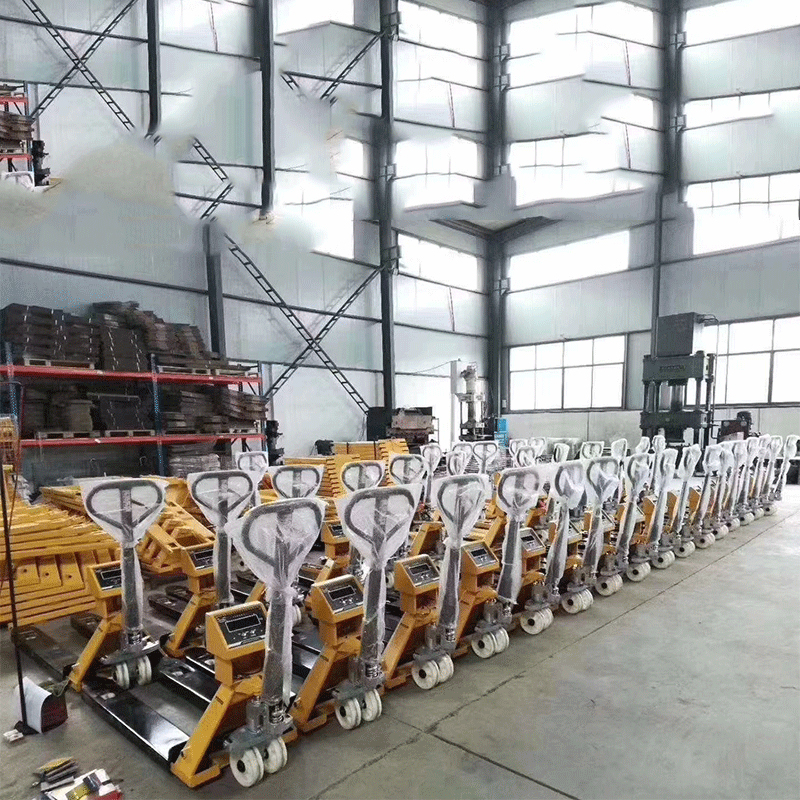
Baoding Junyun Hoisting Machinery Co., Ltd. is a manufacturer and trading company founded in 2018 and based in Donglu Village, Qingyuan District, Baoding City, Hebei Province, China. The company operates a 24,000 square metre factory with approximately 138 employees, including a research and development team of 8 engineers, and an annual production capacity of about 70,000 units. Exports account for 80% of total sales, with main markets in India, Russia, Vietnam, Brazil, Türkiye, Dubai and other Middle Eastern countries. Its product range includes hand pallet trucks, pallet jacks, manual and electric stackers, lift tables, and galvanized or stainless steel pallet trucks.
For fork customization, the relevant product line is the pallet truck series, which includes the semi-electric model AC30 as well as full electric and scale-equipped pallet trucks. The configuration data below comes from that series and defines what can and cannot be specified.
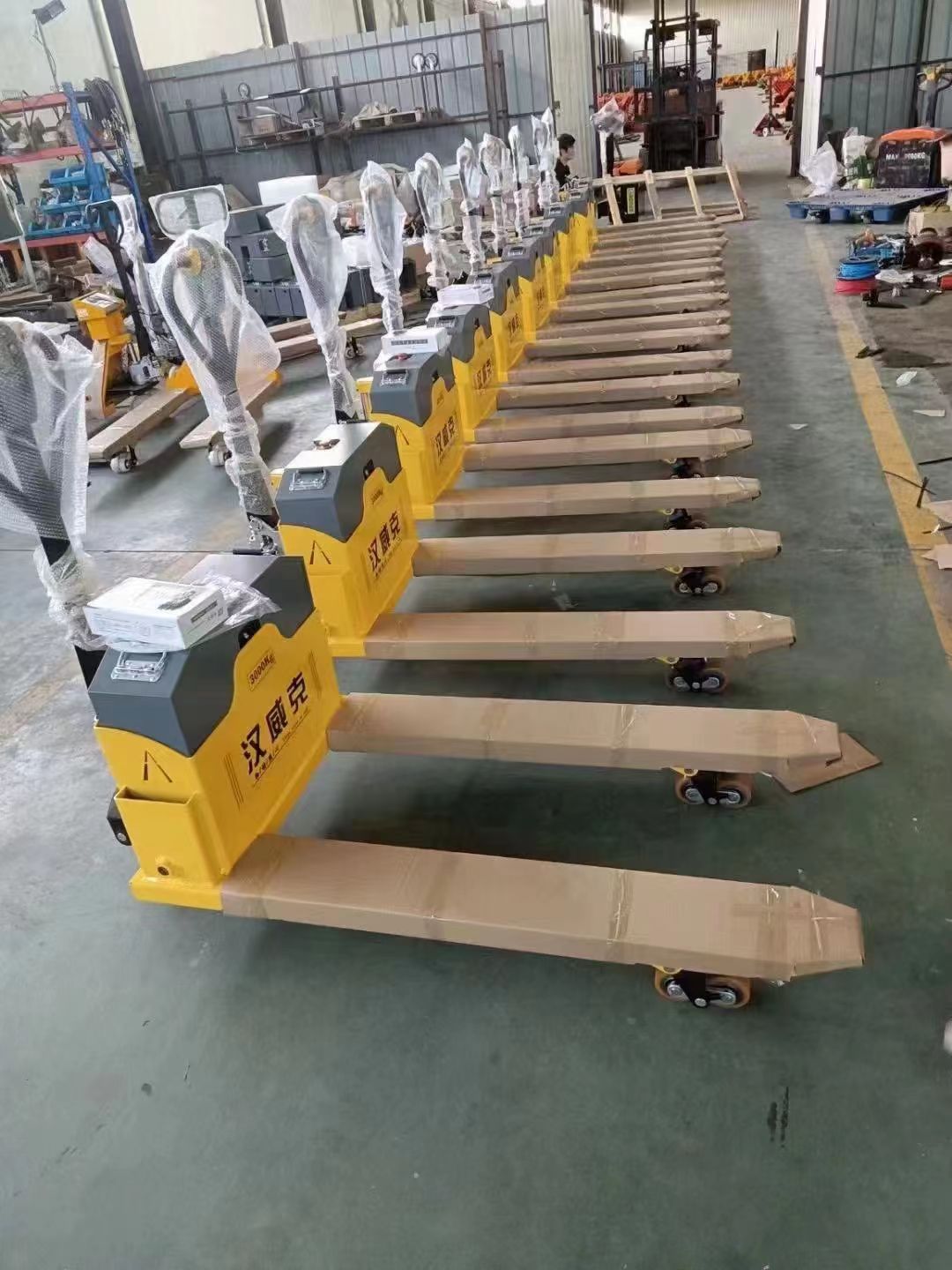
The same fork geometry can be supplied on manual, semi-electric and full electric pallet trucks.
Fork length: 800 mm to 2000 mm
Six fork lengths are available: 1150 mm, 1220 mm, 800 mm, 1500 mm, 1800 mm and 2000 mm. The 2000 mm length is the longest option in the range and the 800 mm length is the shortest.
Length selection is driven by load depth and load stability, not by load weight. The working rule is that the forks should extend far enough under the load that the pallet deck is supported across its load-carrying span. When the load overhangs the fork tips significantly, the pallet bends and the truck steers badly; when the forks are longer than needed, the truck becomes harder to turn in confined spaces and easier to damage on racking legs and door frames.
In practice, the mid-range lengths of 1150 mm and 1220 mm cover the largest share of general-purpose handling, while 1500 mm, 1800 mm and 2000 mm exist for longer loads, deeper entry requirements and applications where the load must be supported further back. The 800 mm option serves compact, short loads where a full-length fork would protrude beyond the load and become a handling hazard or a trip point for the operator.
Fork width: 550 mm and 685 mm
Two fork widths are produced: 550 mm and 685 mm. This is the least forgiving dimension in the whole specification, because a pallet jack frame cannot be re-spaced on site.
Fork width has to be measured against the pallet entry opening and the pallet's overall width. The forks must fit entirely inside the entry opening without touching the stringer boards, and the outer edges of the forks must stay within the pallet footprint so that the load is carried on the deck rather than balanced on its edges. Buyers running more than one pallet type should measure every type in use, and then choose the width that fits the narrowest entry opening while still supporting the widest load. If those two requirements cannot be met by a single truck, the fleet needs two truck specifications rather than one compromise.
Lifting height and minimum height: 80 mm lowered, 200 mm raised
Product data for the pallet truck series lists a minimum height of 80 mm and a maximum height of 200 mm. These two numbers answer different questions.
- Minimum height (80 mm) is the clearance the forks need in order to slide under a pallet. If the loaded bottom board of the pallet sits lower than that, the forks will not enter, and no amount of pushing will fix it. This is where repaired, warped or mixed-source pallets cause failures that are wrongly blamed on the truck.
- Maximum height (200 mm) is how far the forks rise to lift the pallet clear of the floor for travel. On a pallet jack this is a lift-and-carry function for ground-level transport, not a stacking height. Buyers who need to place loads onto racking, feed a conveyor or raise a load to a working height should be specifying a stacker or a lift table instead.
Terminology check: on a pallet jack, "lifting height" describes the fork travel used to lift a pallet off the floor for horizontal travel. It is not a mast stacking height. Keeping these two ideas separate prevents the most common specification mismatch in this product category.
One further geometric value belongs in the same calculation: the turning radius after capture of 1500 mm. Fork length affects how far the truck reaches forward, and the turning radius determines how much clear space that forward reach needs when the truck changes direction at the end of an aisle or on a dock.
Wheel and material options that interact with fork geometry
Wheel material is normally treated as a floor-protection decision, but it also affects effective entry height. The series offers PU, Nylon, PP and Rubber wheels. Different wheel materials roll differently on the same floor, and on uneven or damaged concrete a harder wheel transmits more of that unevenness back into the fork entry. A buyer specifying a minimum height of 80 mm should therefore confirm the wheel choice against the actual floor condition, not only against the floor's nominal finish.
Body material follows the same logic. The standard pallet truck is made of steel; galvanized and stainless steel versions are also available for environments where corrosion or wash-down is a factor. Fork dimensions remain the same across these material options, so material selection can be made after the geometry has been fixed.
Step-by-Step: How to Specify Fork Length and Lifting Height
- Measure the pallet fleet, not one pallet. Record the entry opening width, the entry depth, the height of the bottom board above the floor when the pallet is loaded, the pallet's overall width, and the maximum load overhang beyond the pallet edges. Repeat this for every pallet type in the building, including pooled and customer-supplied pallets.
- Convert each measurement into a fork requirement. Fork width must be smaller than the entry opening. Fork length should support the load depth without excessive overhang past the fork tips. Lowered fork height must be lower than the loaded bottom-board clearance. Turning radius must fit the tightest turn on the route.
- Map the operating environment. A warehouse, a cold store, a food processing plant, a factory workshop, a supermarket backroom and a logistics cross-dock impose different constraints on wheels, materials and fork profile. Specialized models are available for cold storage, explosion-proof and other special working conditions, including requirements for explosion-proof, cold-resistant and silent operation.
- Choose wheels and body material. Select from PU, Nylon, PP and Rubber wheels, and from steel, galvanized steel or stainless steel construction, based on floor type, moisture, wash-down and hygiene requirements.
- Choose the drive type and instrumentation. The same fork geometry can be delivered on a manual pallet truck, a semi-electric truck such as the AC30, a full electric pallet truck, or a pallet truck with a built-in scale when load verification is part of the process.
- Confirm the configuration in writing before the volume order. Send the measurement list from step one to the supplier and ask for fork length, fork width, minimum height and maximum height to be confirmed against it. This single step prevents almost every interface mismatch described in this guide.
Use Cases: Matching Fork Geometry to Real Facilities
Warehouse and distribution centre
High pallet volumes and mixed pallet sources make the entry opening the critical measurement. Where several pallet types are handled, the practical answer is often a fork width that fits the narrowest entry opening, paired with a fork length that covers the deepest load. Turning radius matters at aisle ends and at dock plates, where the truck changes direction while loaded.
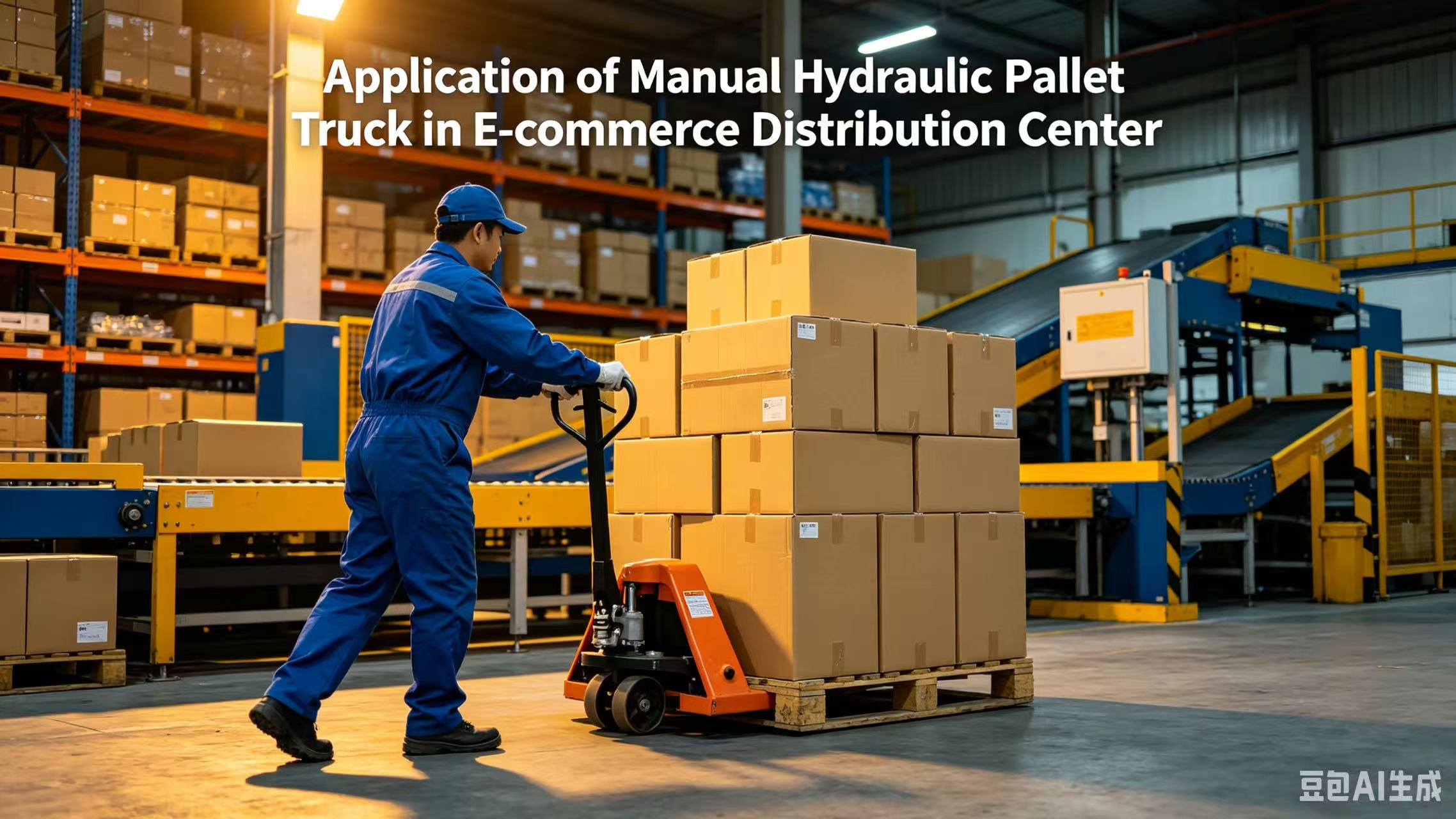
In distribution centres, the entry opening of the narrowest pallet in use sets the fork width for the whole fleet.
Cold storage and cold chain
Cold rooms reduce operator comfort and shorten the time available for each movement, so the truck has to enter the pallet cleanly on the first attempt. Bottom boards on refrigerated pallets are frequently damaged or iced, which reduces the effective clearance under the load. A pallet truck with a low minimum height and predictable entry is more useful here than a higher-capacity truck with a taller fork profile.
Food processing, pharmaceutical and chemical plants
In these environments material choice and cleaning practice drive the specification, which is why galvanized and stainless steel pallet trucks are available. Fork width still governs whether the truck can be used on the plant's pallets without damaging them, and smooth fork entry protects the hygiene of the load surface.
Factory workshop, narrow aisle and supermarket backroom
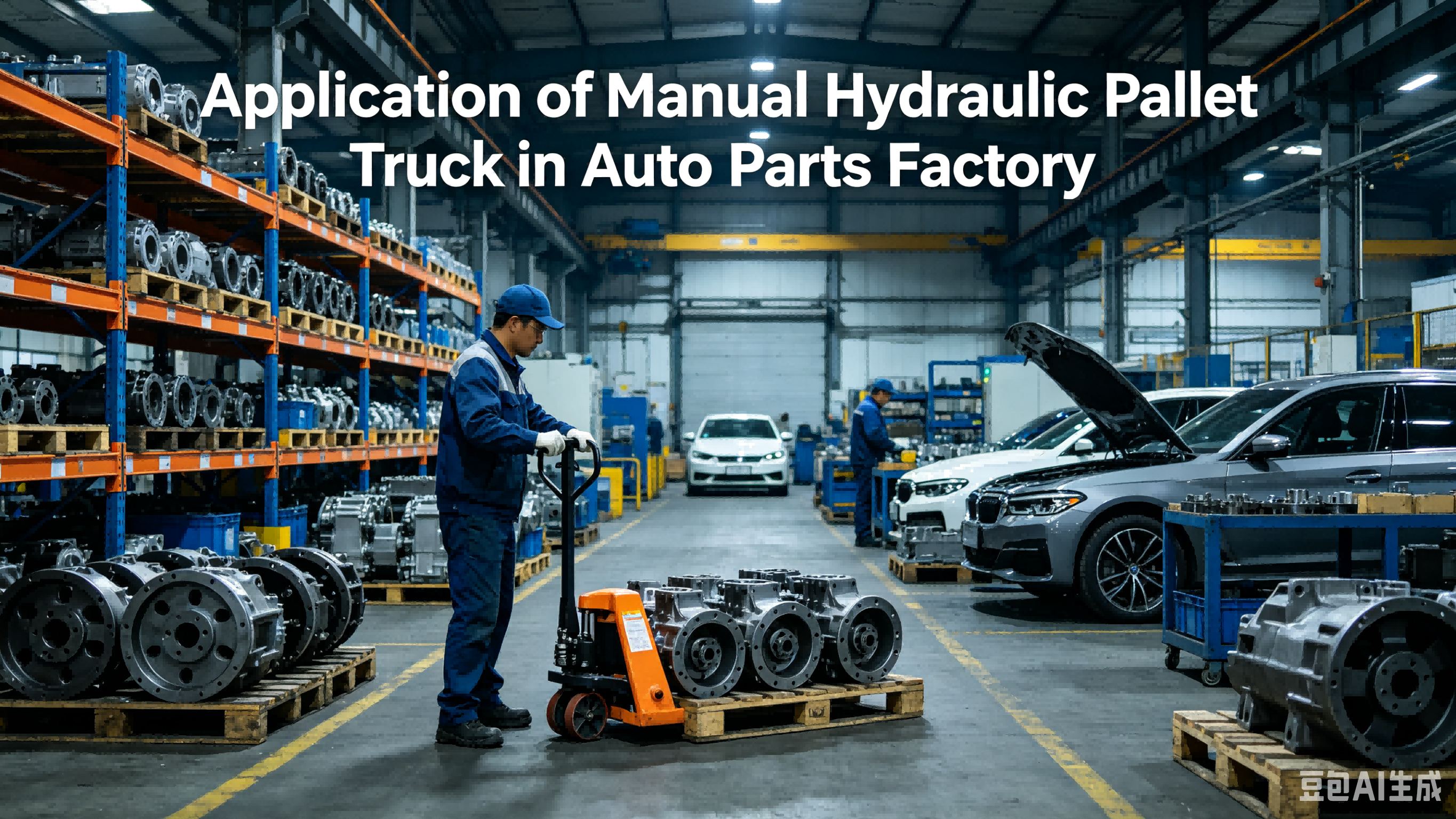
In confined workshops and backrooms, turning space often limits fork length more than load depth does.
Confined spaces reverse the usual priority. Here the limiting factor is often the turning radius after capture of 1500 mm combined with the selected fork length, because a long fork that is ideal in an open warehouse can make a backroom or workshop aisle unusable. In these areas buyers typically accept a shorter fork and then confirm that the load is still fully supported within it.
Configuration Comparison: Fork Length, Width and Height
The tables below summarise the available options and the decision each one answers. They are specification aids, not a substitute for measuring the pallets in your own facility.
| Fork length | Position in the range | Load profile it is chosen for | Verify before ordering |
|---|---|---|---|
| 800 mm | Shortest | Short, compact loads that a longer fork would overhang | Load is fully supported; no overhang past the tips |
| 1150 mm | Mid range | General-purpose handling | Load depth and entry depth |
| 1220 mm | Mid range | General-purpose handling with slightly deeper entry | Load depth and aisle turning space |
| 1500 mm | Extended | Deeper loads requiring support further back | Turning radius in the narrowest aisle |
| 1800 mm | Extended | Long loads | Aisle width, floor condition, dock approach |
| 2000 mm | Longest available | The longest loads supported by this series | Load depth does not exceed 2000 mm; space to turn |
| Parameter | Available options | Why it decides the specification |
|---|---|---|
| Fork width | 550 mm, 685 mm | Must fit inside the pallet entry opening without touching the stringer boards |
| Minimum height | 80 mm | Clearance needed to slide under the loaded pallet's bottom board |
| Maximum height | 200 mm | Fork lift for travel; not a stacking height |
| Turning radius after capture | 1500 mm | Determines the aisle and dock space required with the selected fork length |
| Wheel material | PU, Nylon, PP, Rubber | Affects rolling resistance and effective entry on uneven floors |
| Body material | Steel; galvanized; stainless steel | Corrosion resistance and wash-down suitability |
Frequently Asked Questions
Do custom fork lengths or lifting heights change which safety standards apply to a pallet jack?
Standards apply to the truck type rather than to a single dimension. ISO 3691-5:2014 specifies safety requirements for pedestrian-propelled trucks, which includes manual and semi-manual pallet jacks. In Europe, hand pallet trucks fall under EN 1757-2 for trucks with capacities up to 2,000 kg. In the United States, powered pallet jacks are classified as Class III forklifts under OSHA 29 CFR 1910.178 and require formal operator training. Because changing fork length or width changes the truck's geometry, the buyer should ask the supplier to state the rated capacity for the exact fork specification being ordered, instead of accepting a rating that applies to a different variant.
What is the maximum custom fork length, and which widths are available?
For the JUNYUNHOIST pallet truck series, fork lengths are available in 1150 mm, 1220 mm, 800 mm, 1500 mm, 1800 mm and 2000 mm, with fork widths of 550 mm or 685 mm. The minimum height is 80 mm and the maximum height is 200 mm, with a turning radius after capture of 1500 mm. Wheels can be specified in PU, Nylon, PP or Rubber, and the body is available in steel, galvanized steel or stainless steel. The same geometry can be supplied on a semi-electric pallet truck such as the AC30, a full electric pallet truck, or a pallet truck with a scale.
How does fork customization affect the cost of a pallet jack order?
Cost is driven by the combination of choices rather than by any single dimension: fork length and width, body material (steel, galvanized or stainless steel), wheel material, drive type (manual, semi-electric or full electric) and whether a built-in scale is required. Because these variables combine differently for every project, trucks of this type are quoted per configuration and per order volume rather than sold from a fixed catalogue price. The practical advice for buyers is to compare quotations on identical configurations, since a lower price for a different fork length, wheel material or body material is not a like-for-like comparison.
Can a custom fork configuration be validated before a volume order?
Validation is most reliable when it is done against your own pallets. Send the measured entry opening width, entry depth, loaded bottom-board clearance and pallet width to the supplier, ask for fork length, fork width, minimum height and maximum height to be confirmed against those measurements, and then test fork entry, lifting and releasing on a loaded pallet in your own facility. Where a physical unit is required for that check, sample arrangements and their scope can be discussed with the sales team as part of the enquiry.
What information is needed to get an accurate quotation and confirmed lead time?
Prepare the pallet entry opening width, entry depth, loaded bottom-board height, pallet overall width, typical and maximum load weight, floor type and condition, the narrowest aisle or turn on the route, operating temperature and environment, drive preference (manual, semi-electric or full electric), any requirement for galvanized or stainless steel construction or a built-in scale, and the order quantity. With those details, the JUNYUNHOIST team can confirm the fork length, fork width and height configuration that fits, and then confirm the production lead time for that specific build. Contact: email Junyunsteven@163.com, telephone or WhatsApp +86 13483452631 / +86 134-8345-2631. Full product information is available in the downloadable brochure.
Conclusion: Specify the Interface Before the Truck
Fork length, fork width, minimum height and maximum height are the four numbers that decide whether a pallet jack can be used in a given facility. Capacity, drive type and brand are decisions that follow them. The configuration range from Baoding Junyun Hoisting Machinery Co., Ltd. covers fork lengths of 1150 mm, 1220 mm, 800 mm, 1500 mm, 1800 mm and 2000 mm, fork widths of 550 mm and 685 mm, a minimum height of 80 mm and a maximum height of 200 mm, on a pallet truck series that includes the semi-electric AC30, full electric pallet trucks and scale-equipped pallet trucks.
The most efficient way to use that range is to measure first: entry opening width, entry depth, loaded bottom-board clearance, load weight and the tightest turn on the route. Send those measurements together with the intended operating environment and order quantity, and the correct fork specification can be confirmed before production instead of being corrected on the warehouse floor.
Next step
Request a configuration quotation for your pallet type and operating environment. Send your pallet measurements, load weight, floor type and quantity to Junyunsteven@163.com, or contact the team by telephone or WhatsApp on +86 13483452631 / +86 134-8345-2631. Download the full product brochure here: JUNYUNHOIST product brochure (PDF).
Baoding Junyun Hoisting Machinery Co., Ltd. — Donglu Village, Qingyuan District, Baoding City, Hebei Province, China. Website: www.junyunhoist.com. Sample arrangements and distributor enquiries are welcome.