
How to Qualify a Chain Block Manufacturer for Long-Term Distribution
How to Qualify a Chain Block Manufacturer for Long-Term Distribution
Importers, regional distributors and brand owners often start a chain block search with a simple question: which manufacturer offers the lowest price? But a chain block is not a disposable accessory. It is a safety-critical lifting tool used in workshops, construction sites, warehouses, ports, mining operations and shipyards. If a supplier quietly changes the load chain grade, thins the shell, or avoids spare parts support, the distributor is the one who absorbs the cost through returns, service calls and lost customer trust.
This guide is written for decision-stage buyers who want to move beyond spot quotes and build a repeatable chain block distribution line. It explains what to check in a factory, why material details matter, and how a manufacturer such as Baoding Junyun Hoisting Machinery Co., Ltd., known in export markets as JUNYUNHOIST, fits the long-term distribution model.
The Real Problem: Spot Prices Create Long-Term Cost
A manual chain block may look identical from the outside, but its long-term reliability depends on components that are rarely visible on a website: load chain grade, hook forging quality, brake pad durability, hand chain diameter, bearing design and housing thickness. The most common field issues reported in chain block operation are load chain aging and wear, brake pad wear, hand chain wear and shell collision damage. Each of these can turn a low-priced order into an expensive after-sales problem.
For a long-term distribution partner, the real risk is inconsistency. If the first shipment is reliable but the second uses a weaker chain or less durable brake pads, the distributor cannot build a stable spare parts plan or maintenance routine. That is why established buyers evaluate the manufacturer system, not only the product photo and the price.
Buyer takeaway: A chain block supplier for distribution should be judged by the same criteria the distributor will be judged by end users: consistent materials, credible standards compliance, production capacity, delivery reliability and after-sales support.
Industry Background: Why Manual Chain Blocks Still Matter
Manual chain blocks remain a core lifting category across multiple industries. Market estimates compiled by Intel Market Research, Fact.MR, Dataintelo and Stratview Research indicate that the global chain block market was valued at about USD 1.95 billion in 2024, while manual chain pulley blocks still account for around 48% of the product segment share in 2026. Construction is frequently cited as the largest application segment, with research sources placing its share of global chain block demand between roughly 30% and 54% depending on the scope of the study.
For distributors, these demand patterns are useful in planning product breadth. A customer asking for a CE certified chain block for a construction site may later request a heavy-duty chain block for port cargo or a compact unit for small-space warehouse operations. A manufacturer that can support several of these needs with consistent component quality is easier to keep in a distributor catalogue than a factory that can only make one narrow model line.
Detailed Solution: What a Long-Term Chain Block Supplier Should Bring
Baoding Junyun Hoisting Machinery Co., Ltd. is a useful reference in this evaluation model. The company is headquartered in Baoding, Hebei Province, China, and operates as a vertically integrated manufacturer and trading company. Its main manual hoist range includes the VD chain block, VT chain block, HSZ chain block, HSC chain block, VA lever block and VL lever block. This breadth allows a distributor to consolidate several manual hoist SKUs with one qualified factory instead of managing many small suppliers.
Technical Specification Baseline
For the VD chain block, the manufacturer publishes a specification range that supports many end-user applications. Rated load capacity spans 0.5 to 50 tonnes, standard lift height is 3 metres, with 2.5 to 12 metres available as an option. The number of chain falls can range from 1 to 4 depending on capacity, and load chain diameter ranges from 6.3 mm to 11.2 mm. Hooks are made of forged alloy steel and heat treated. The safety factor is at least 4:1 for the load chain and at least 5:1 for structural parts.
From a distributor perspective, this specification range means the same supplier can cover small workshop chain block orders and larger heavy-duty port or mining chain block requirements. It also gives the distributor a credible answer when an end user asks whether the unit is safe for the intended load.
Component Choices That Reduce Field Failures
Several design points are particularly relevant for long-term distribution because they directly affect maintenance frequency:
- Load chain specification: JUNYUNHOIST uses a G80 steel load chain in its standard chain block design, while some market products use G70 or lower-grade chain.
- Hand chain dimensions: The hand chain is specified at 4.8 mm, which adds durability for operators who use the block heavily.
- Bearing design: The lifting mechanism uses three bearings to keep movement smooth and reduce early wear.
- Shell thickness: The outer shell is thickened to 2.8 mm, providing more protection against collision and job-site impact.
- Heat treatment: Spare parts receive heat treatment, and the load chain is treated for corrosion resistance and wear resistance.
These details normally add cost. JUNYUNHOIST' own engineering comparison used to qualify the design against a lower-spec alternative shows an initial cost difference of roughly 2%, with significantly lower long-term maintenance. The manufacturer's comparative maintenance figure is about 90% less maintenance requirement under normal use. For a distributor, the financial benefit appears not on the first purchase order but in fewer returns, longer intervals between spare part replacements, and better end-user satisfaction.
Production Capacity and Delivery Reliability
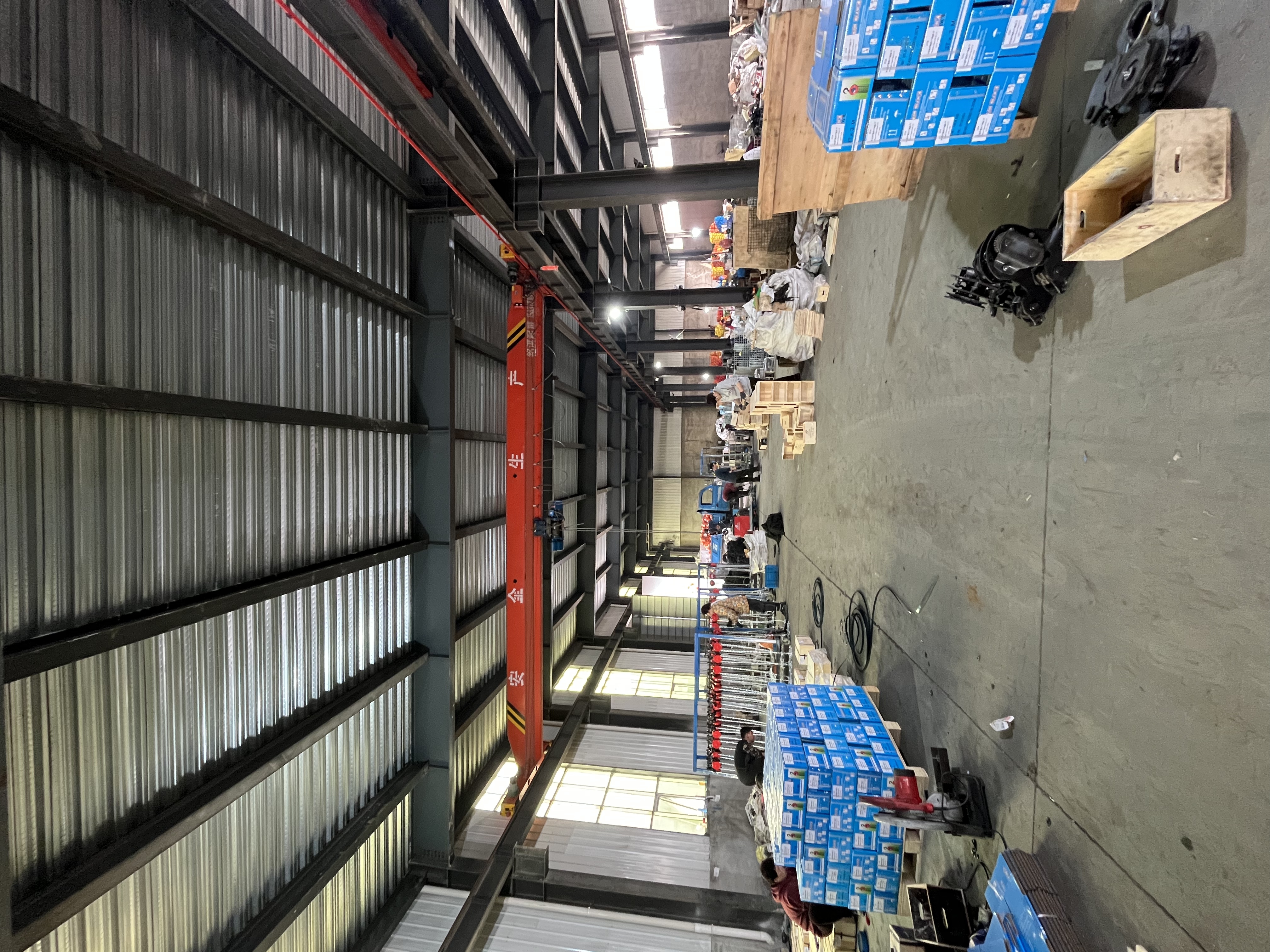
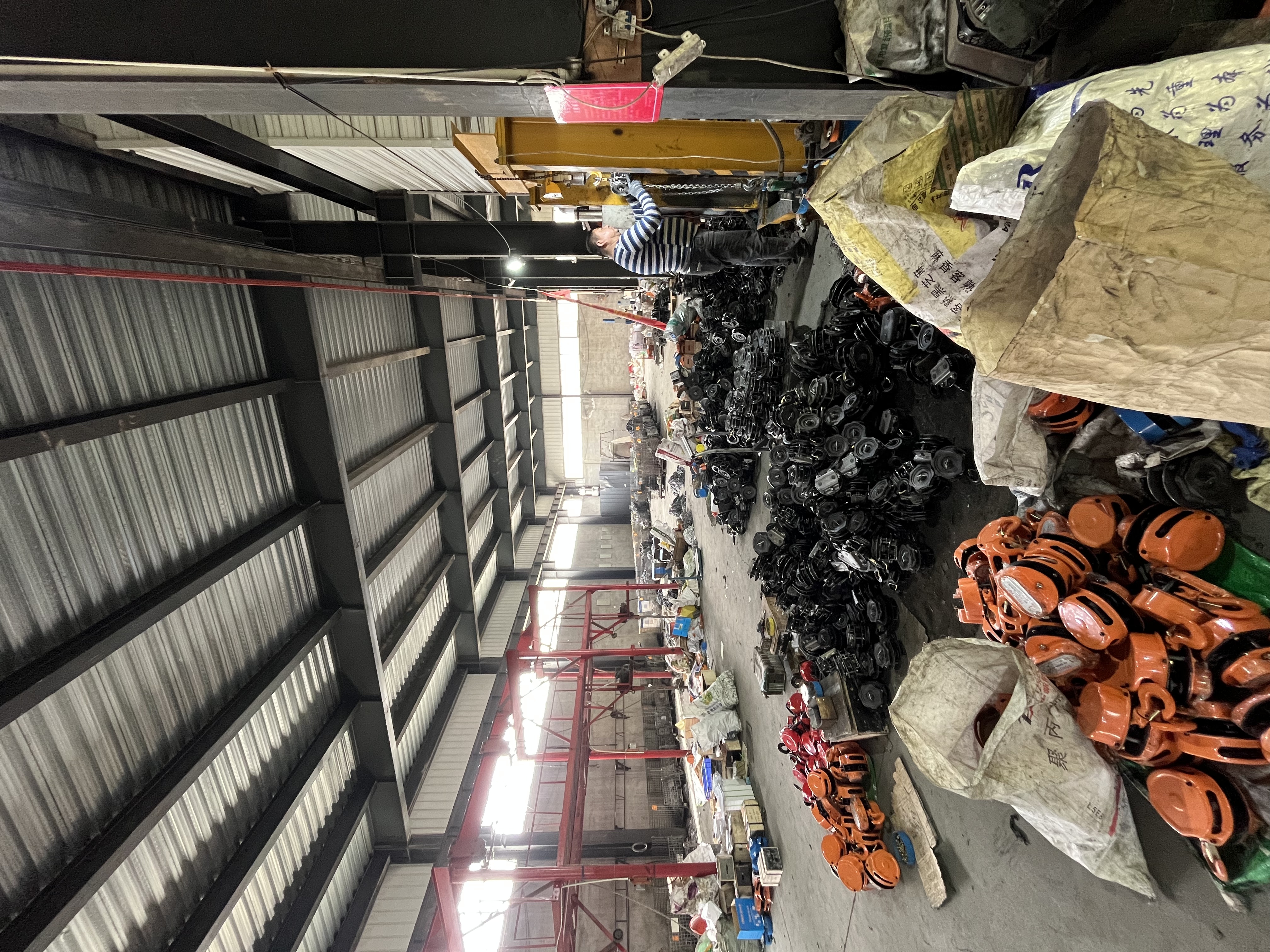
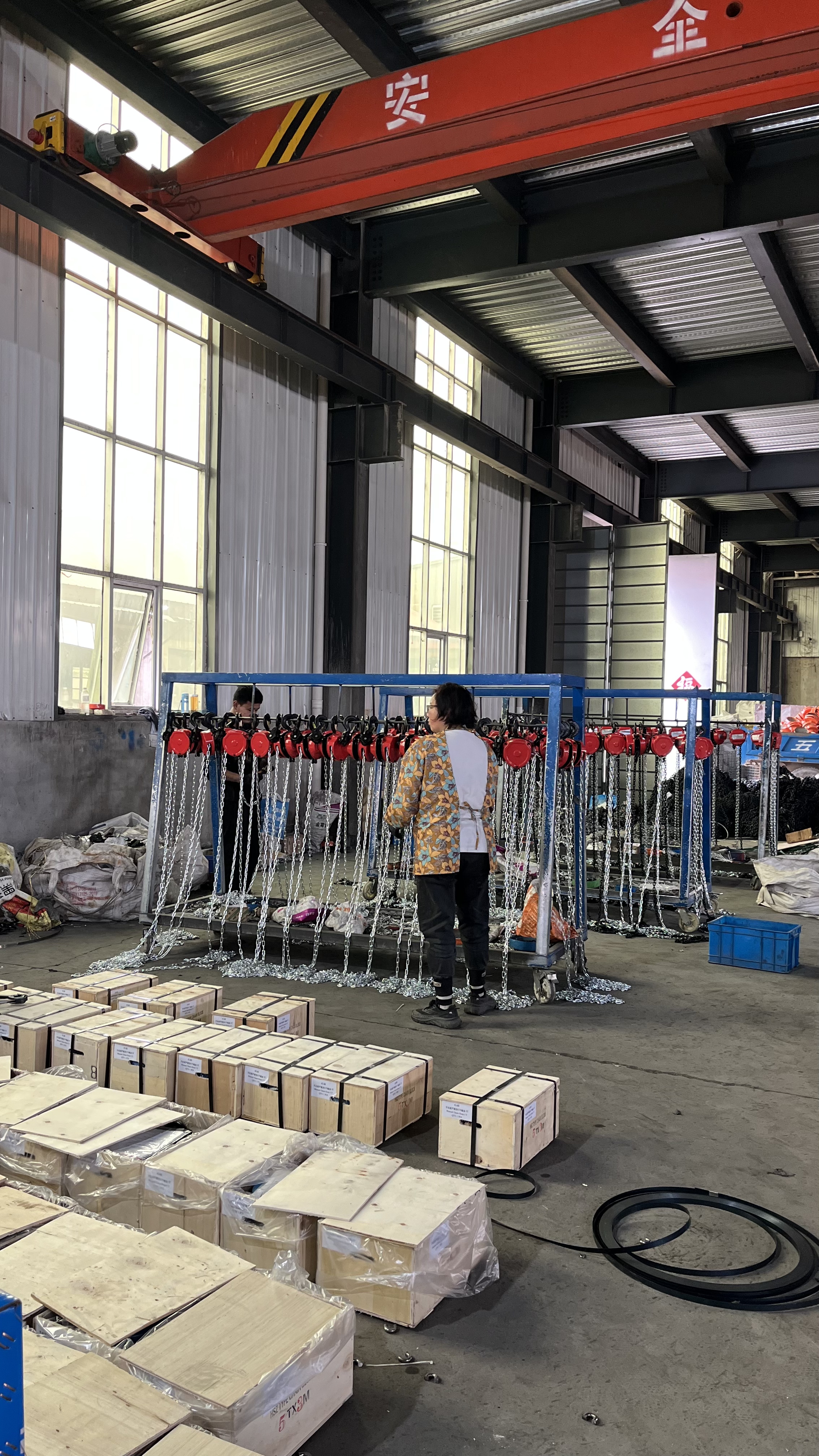
Distribution depends on predictable restocking cycles. The manufacturer has a monthly production capacity of 15,000 units and a typical production lead time of 15 to 20 days. That combination is important for an importer who must plan container bookings, maintain local warehouse stock, and respond to seasonal construction or warehouse demand.
Export Experience and Commercial Terms
JUNYUNHOIST exports to Vietnam, India, Russia, the United Arab Emirates, Brazil, Türkiye, the Middle East and Southeast Asia. Distributors in those regions can work with a factory that already understands export packaging, shipping documentation and buyer expectations. The minimum order quantity is 50 pieces, and the manufacturer offers delivery terms such as FOB, EXW, CIF and CFR. Payment is normally 30% T/T in advance and 70% T/T against a copy of the bill of lading.
Long-term buyers also need quality confidence before shipment. The manufacturer supports pre-shipment testing and third-party inspection such as SGS inspection. This is especially valuable for a distributor who cannot visit the factory for every order.
OEM, Customisation and After-Sales
For distributors that want to build their own brand or adapt the product to local market conditions, the manufacturer provides OEM/ODM support. Customisation includes colour, load-bearing chain length, quality adjustment, and application-specific materials. That flexibility helps a distributor meet different requirements without engaging a second factory for every variation.
After-sales support is another long-term issue. Chain block wear parts include brake pads, hand chains and load chains. JUNYUNHOIST states that it will provide some easily worn spare parts, such as brake pads, to support customers after delivery. In a distribution relationship, this type of commitment is more useful than a vague promise that all products are high quality.
Step-by-Step Qualification Workflow for Distributors
The following eight-step workflow turns the supplier evaluation process into a repeatable internal procedure. It is designed for buyers who are already past the discovery stage and are preparing to execute a supplier agreement.
Step 1. Map Your End-User Demand
Before sending inquiries, list the actual applications your customers need to serve. A small workshop chain block requirement is different from a port cargo heavy-duty chain block requirement. Write down the load capacities, lift heights, expected usage frequency and operating environment for each customer group.
Step 2. Evaluate Product Breadth
A factory that only produces one block model may be acceptable for a spot order, but a distribution business needs product range flexibility. Ask whether the manufacturer can supply several model families and optional lift heights, and whether customisation is handled inside the same factory system.
Step 3. Compare Materials and Component Quality
Request the load chain grade, hook material, hand chain diameter and housing thickness. The main material definitions for the JUNYUNHOIST product family include steel-based manufacturing in materials such as 20Mn2, 25MnV and 23MnNiMoCr54, with load chain grades such as Grade V or Grade T available in the product specification. A clear answer on materials is a better signal than a brochure filled with adjectives.
Step 4. Review Standards and Compliance
For European buyers, a chain block should meet the safety requirements of EN 13157, the European standard for hand-powered lifting equipment. For US buyers, overhead hoist safety and inspection requirements are covered by ASME B30.16. Ask for documents that show how the product addresses these standards and what load chains and hooks are actually supplied.
Step 5. Confirm Production Capacity and Lead Time
A supplier should be able to state production capacity and current lead time without hesitation. In the case of JUNYUNHOIST, the monthly production capacity is 15,000 units and the typical production lead time is 15 to 20 days. Use this information to plan the first order and future replenishment cycles.
Step 6. Discuss MOQ, Payment and Incoterms
Long-term distribution starts with commercial alignment. Confirm the minimum order quantity, payment terms, preferred Incoterms and packaging requirements before you request a sample. JUNYUNHOIST sets a minimum order quantity of 50 pieces and supports FOB, EXW, CIF and CFR options.
Step 7. Arrange Third-Party Quality Verification
If you cannot audit the factory in person, use an inspection step built into the contract. The manufacturer accepts pre-shipment tests and third-party inspection, including SGS inspection, on outgoing orders. This gives the buyer an unbiased record of the finished batch before shipping.
Step 8. Begin with a Pilot Order and Track Performance
Do not begin a distribution relationship with a huge order unless you have complete confidence. A pilot order allows you to verify documentation, packaging and product consistency. Track lead time, defect rate, spare parts requirement and customer feedback before scaling up.
Use Cases: Mapping Chain Block Models to End Markets
Workshop Chain Block and Factory Hoisting
Workshops and factories need chain blocks for repetitive lifting, equipment maintenance and assembly work. A reliable brake system, smooth hand-chain pull and corrosion-resistant load chain are important because the unit may be used many times per day.
Construction Site Chain Block
Construction buyers often require a CE certified chain block that can be moved between sites and exposed to weather. A thickened outer shell and treated chain surface reduce the damage caused by rough site handling and moisture exposure.
Warehouse Logistics Chain Block
Warehouse teams use chain blocks for loading, unloading and position adjustment, especially in areas where electric power is not convenient. A compact unit with a smooth mechanism and durable hand chain is usually preferred for small-space operation.
Port Cargo and Shipbuilding Chain Block
Port and shipyard environments can involve higher loads, salt air and demanding positioning tasks. Heavy-duty chain block variants with higher capacity and multiple chain falls support these conditions better than light workshop units.
Mining Operation Chain Block
Mining operation environments are abrasive and harsh. Chain blocks used in these applications need high-strength steel chains and heat-treated hooks that resist wear, impact and contamination.
JUNYUNHOIST also lists broader manufacturing and maintenance applications for its chain block family, including petrochemical, power, bridge engineering, railway construction, agriculture and stage construction. That wide application list gives distributors room to expand the customer base without changing suppliers.
Comparison Table: Long-Term Supplier Evaluation Criteria
The following table is not a ranking of named brands. It is a scorecard that compares the type of evidence a long-term partner should provide with the kind of facts a buyer can verify.
| Evaluation Criterion | Why It Matters | Example Evidence from JUNYUNHOIST |
|---|---|---|
| Compliance and standards | Prevents customs delays and end-user safety problems | VD chain block specification lists CE marking and compliance with EN 13157 / hand-powered lifting requirements |
| Load chain grade | Affects lifting safety, wear resistance and chain extension risk | G80 steel load chain used in standard design; load chain materials include Grade V or Grade T specification |
| Component durability | Reduces replacement frequency and service complaints | 4.8 mm hand chain, 3-bearing design and thickened outer shell at 2.8 mm |
| Heat treatment and material process | Improves hook strength and corrosion resistance | Heat-treated spare parts and forged alloy steel hooks in the product specification |
| Capacity range | Allows one factory to serve workshop, construction, warehouse, port and mining demand | Rated load capacity 0.5–50 t; 1–4 chain falls; 3 m standard lift with optional 2.5–12 m |
| Production capacity and lead time | Makes replenishment scheduling predictable | 15,000 units per month; typical production lead time 15–20 days |
| Minimum order and commercial terms | Determines whether the relationship fits your cash flow | Minimum order quantity 50 pieces; payment 30% T/T advance, 70% against copy of B/L |
| Quality inspection support | Protects buyer before shipment | Pre-shipment tests and third-party inspection such as SGS are accepted |
| After-sales spare parts | Keeps installed products operational | Commonly worn spare parts such as brake pads can be provided to customers |
FAQ: Long-Term Chain Block Sourcing Questions
Q1: What certificates and standards should I verify before distributing chain blocks?
At minimum, verify that the product has a clear standard-based compliance path for the target market. For hand-powered lifting equipment sold in Europe, EN 13157 is the relevant safety standard. In the United States, ASME B30.16 is the standard that governs overhead hoist construction, installation, inspection and maintenance. Buyers should also ask for the manufacturer's CE declaration or the equivalent compliance documentation for their region. JUNYUNHOIST's product specification for the VD chain block includes CE marking and EN 13157 compliance in its listed standards.
Q2: Does JUNYUNHOIST support customisation for distributor branding and regional requirements?
Yes. JUNYUNHOIST provides OEM/ODM customisation support. The manufacturer states that customisation includes colour, load-bearing chain length, quality adjustment and application-specific materials. Distributors can use this flexibility to adapt standard chain blocks to local market requirements or to build their own product line.
Q3: What are the minimum order quantity and normal payment terms from JUNYUNHOIST?
The minimum order quantity is 50 pieces. Payment is normally 30% T/T in advance and 70% T/T against a copy of the bill of lading. The manufacturer also supports multiple export delivery terms including FOB, EXW, CIF and CFR, so the buyer can choose the logistics model that fits their freight and customs process.
Q4: How can a distributor verify quality before shipment?
The safest approach is to make inspection part of the order agreement. JUNYUNHOIST supports pre-shipment testing and third-party inspection, including SGS inspection. This allows a distributor to confirm that the finished order matches the approved component specification before the container is released.
Q5: What production lead time can support a regular chain block restocking plan?
The manufacturer has a monthly production capacity of 15,000 units, and the typical production lead time is 15 to 20 days. For a distributor running regular container shipments, that lead time is useful for forecasting. Contact the JUNYUNHOIST export team with your required capacities and target markets to plan the first order and future replenishment schedule.
Conclusion
Long-term chain block distribution is not about finding the cheapest factory for one purchase order. It is about finding a manufacturer that can protect your brand through consistent material selection, standards compliance, repeatable production capacity, spare parts support and transparent export terms. Baoding Junyun Hoisting Machinery Co., Ltd. / JUNYUNHOIST provides one practical reference point because its supplier profile includes the details that distributors need: G80 load chain, a hardened component approach, CE-compliant product specification, 15,000-unit monthly production capacity, 15–20 day lead time, a 50-piece MOQ and international export experience.
If you are evaluating JUNYUNHOIST as a long-term chain block supplier, download the manufacturer brochure for a compact overview of product models and factory capabilities: JUNYUNHOIST company brochure PDF. For order-specific questions, contact the export team via www.junyunhoist.com, email Junyunsteven@163.com, or WhatsApp +86 134-8345-2631.