OEM vs ODM Pallet Jacks: A Head-to-Head Decision for Brand Owners
An OEM pallet jack is built to the brand owner's design and specification: the buyer controls the drawing and the bill of materials, and the factory executes. An ODM pallet jack starts from a platform the manufacturer already produces and supplies to multiple customers; the brand owner adds its own brand, packaging and market position, then customises selected parameters such as fork size, lifting height, steel plate thickness, finish or a weighing function. OEM buys differentiation with engineering time and tooling cost. ODM buys speed to market with a lower differentiation ceiling. Most brand owners who scale end up running both, split by SKU.
This article compares the two paths head-to-head on the points that actually decide the outcome for a brand owner: design ownership, customisation range, compliance documentation, minimum order, lead time and after-sales structure. The reference point throughout is the OEM/ODM capability of JUNYUNHOIST, the brand under which Baoding Junyun Hoisting Machinery Co., Ltd. manufactures and exports pallet trucks and lifting equipment.
Problem Definition: The Trade-Off Brand Owners Actually Face
The OEM-versus-ODM question is rarely about which model is better in the abstract. It is a question of where a brand owner wants to spend money and time.
Choosing ODM shortens the path from decision to container. The design already exists, tooling is already amortised, and the first order can go into an existing production schedule. The cost is that competitors can buy the same platform, so the product competes on price, service and brand rather than on hardware.
Choosing OEM protects the hardware. The brand owner owns the drawing, can specify fork steel plate thickness, fork length and width, lifting height and finish, and can defend a differentiated product in its market. The cost appears earlier in the project: design review, tooling, sample iterations and an approval cycle before a single saleable unit is built.
Four cost lines are usually underestimated in this decision:
- Tooling and design amortisation. In OEM, engineering and tooling cost sit on the brand owner and must be recovered from a smaller, differentiated volume. In ODM, they are already spread across the manufacturer's customer base.
- Compliance documentation. The technical file, test evidence and declaration have to match the model actually shipped. Whichever path is chosen, someone must own that file.
- Sample cycles. Each OEM iteration consumes calendar time and freight before approval. ODM sampling validates a platform and its configuration changes, not a new design.
- Change control. In OEM, a mid-project specification change ripples through drawings, tooling and approval. In ODM, change is limited to the parameters the platform allows.
The practical conclusion is that the decision should be made per SKU and per market, not once for the whole catalogue.
Industry Background: Why This Decision Became Central
Pallet jacks are a mature, high-volume category with a concentrated supply base, which is exactly the condition that pushes brand owners toward private-label sourcing.
Published market research places the global pallet jack market at USD 7.91 billion in 2025, with Asia-Pacific holding a 39% revenue share in the same year. Aggregated customs records for 2022–2024 covering HS 8427.90 show China accounting for 62.7% of pallet jack shipments to the United States analysed in that dataset. In other words, a brand owner evaluating OEM versus ODM is usually evaluating two ways of working with the same regional supply base.
Two regulatory facts shape the brief that goes to that supply base:
- In the European Union, pallet trucks are classified as machines and require CE marking for market access.
- In the United States, OSHA identifies 29 CFR 1910.178 as the powered industrial truck standard relevant to powered pallet jack operations, and its training guidance describes formal instruction, practical training, workplace evaluation, refresher training and certification for operators.
Compliance scope therefore follows the product configuration. A manual hand pallet truck and a battery-powered pallet truck do not carry the same documentation burden, and a model sold into the EU does not carry the same file as one sold into a market without CE requirements. This matters directly to the OEM/ODM choice, because the party that owns the design usually has the strongest claim on the underlying technical evidence.
Demand-side pressure reinforces the same point. Pallet jacks are used across retail logistics, food and beverage distribution, automotive and parts logistics, and manufacturing plants, and each of those environments imposes its own requirements on materials, wheels and finishes. A single generic platform rarely covers all of them well.
Detailed Solution: What Each Path Looks Like in Production
OEM: The Brand Owner Owns the Specification
In an OEM arrangement the brand owner defines the product and the factory builds to that definition. The deliverable is conformance to a specification, not the manufacturer's catalogue item.
What the brand owner controls in an OEM pallet jack project typically includes fork length and width, minimum lifting height, fork steel plate thickness, wheel material, surface finish and any added function such as an integrated scale. What the brand owner also takes on is the obligation to prove the design: drawings, tolerances, test criteria and the documentation that supports the claims printed on the product and the packaging.
Fork steel plate thickness is a good example of why OEM appeals to brand owners in competitive markets. It is a parameter that is easy to state, hard to verify from a photograph, and directly tied to how the product behaves under load over time. When a brand owner fixes plate thickness in its own specification, it creates a defensible claim. When it buys a platform, it inherits whatever thickness the platform was designed around.
ODM: The Manufacturer Owns the Platform, the Brand Owner Owns the Market
In an ODM arrangement the manufacturer supplies a design it already produces, and the brand owner applies branding, packaging, documentation and market positioning on top. Configuration changes are possible, but they operate inside the platform's existing architecture.
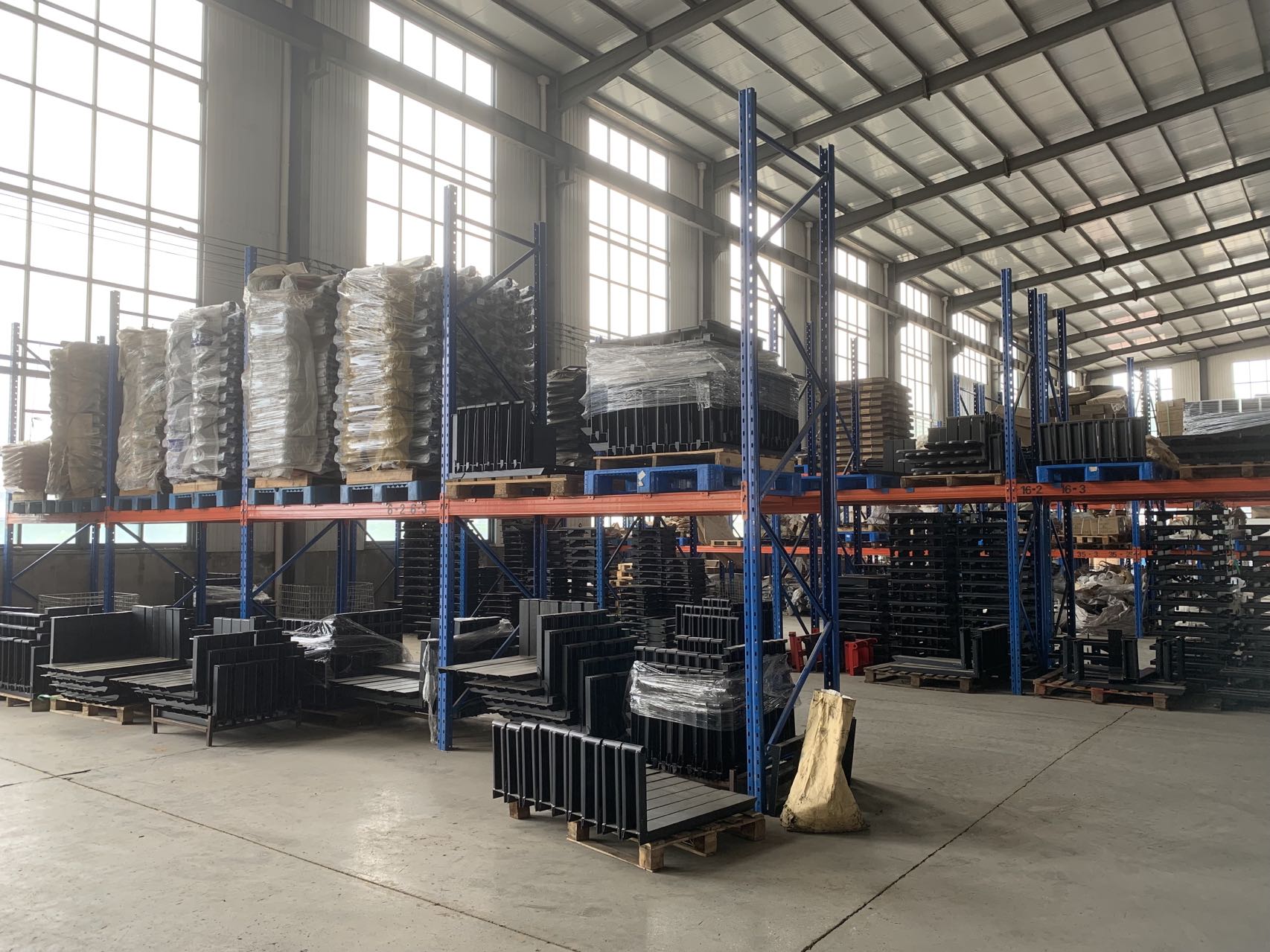
JUNYUNHOIST is a pallet truck manufacturer and trading company based in Baoding, Hebei, China, founded in 2018, operating a 24,000 m² facility with an annual output of 70,000 units, an 8-person R&D team and an export share of about 80%. Its stated production mode is OEM/ODM, which makes it a useful baseline for what an ODM platform can realistically be stretched to cover.
The customisation levers JUNYUNHOIST lists for its pallet truck range are:
- Fork length and fork width
- Minimum lifting height options of 35 mm and 62 mm
- Fork steel plate thickness
- Electric pallet truck configuration
- Galvanised and stainless steel pallet truck finishes
- Pallet truck with an integrated weighing function
Those levers matter because they cover most of the reasons a brand owner would otherwise commission a full OEM design. A distributor selling into cold chain, food processing or logistics centre accounts can often reach a market-appropriate product by changing material, finish, fork geometry and lifting height rather than starting from a blank drawing.

The Specification Baseline: AC30 Family
The JUNYUNHOIST pallet truck range is listed under model AC30 and covers semi-electric pallet trucks, full electric pallet trucks, pallet trucks with scale, and galvanised and stainless steel pallet trucks. Published parameters for the range are:
- Minimum height: 80 mm
- Maximum height: 200 mm
- Turning radius after capture: 1,500 mm
- Wheel options: PU, nylon, PP and rubber
- Fork dimensions: 550 mm or 685 mm width; 1,150 mm, 1,220 mm, 800 mm, 1,500 mm, 1,800 mm or 2,000 mm length
- Body material: steel
For an ODM program, this is the range of decisions a brand owner can make without new tooling. For an OEM program, it is the reference against which deviations are quoted and priced.
Capacity, Quality Control and Commercial Terms
The operational numbers that govern both paths at JUNYUNHOIST are monthly capacity of 10,000 units, a production lead time of 15–20 days and a minimum order quantity of 24 PCS. Quality control is described as 100% testing rather than sampling. After-sales support is structured at container level: each container ships with free spare parts for wear items, replenished as needed based on subsequent wear.
Read together, these figures set the boundary conditions of the decision. A 24-piece MOQ makes an ODM trial inexpensive to test, and it also means an OEM project cannot be justified by small volumes unless the differentiation is expected to carry a price premium across a longer run.
Step-by-Step: Running the OEM vs ODM Decision
Step 1 — Fix the market position first
Decide whether the SKU competes on price or on specification. Commodity positioning favours ODM. A claim that depends on a specific fork steel plate thickness, a non-standard lifting height or a materials story favours OEM, because those claims need a specification the brand owner controls.
Step 2 — Write the specification before talking to suppliers
Convert the market position into parameters: fork length and width, minimum and maximum height, wheel material, finish, and whether a weighing function is required. Without this list, the OEM/ODM discussion stays abstract and every quote becomes incomparable.
Step 3 — Assign design ownership per SKU
Run ODM where the platform already satisfies the brief — for example a standard 550 mm or 685 mm fork manual truck for general warehouse work. Reserve OEM for the SKUs carrying the brand's differentiation claim. A mixed portfolio is normal and does not weaken either path.
Step 4 — Settle the compliance route in writing
Confirm which party holds the technical file and test evidence, and that the model reference on that evidence matches the configuration actually shipped. For EU-bound product this follows the CE marking obligation that applies to pallet trucks as machines. For powered units in the US, confirm that the delivered configuration and operator training material align with 29 CFR 1910.178 expectations. In an OEM project, the design is the brand owner's, so this allocation cannot be left implicit.
Step 5 — Qualify the factory on program-level capacity
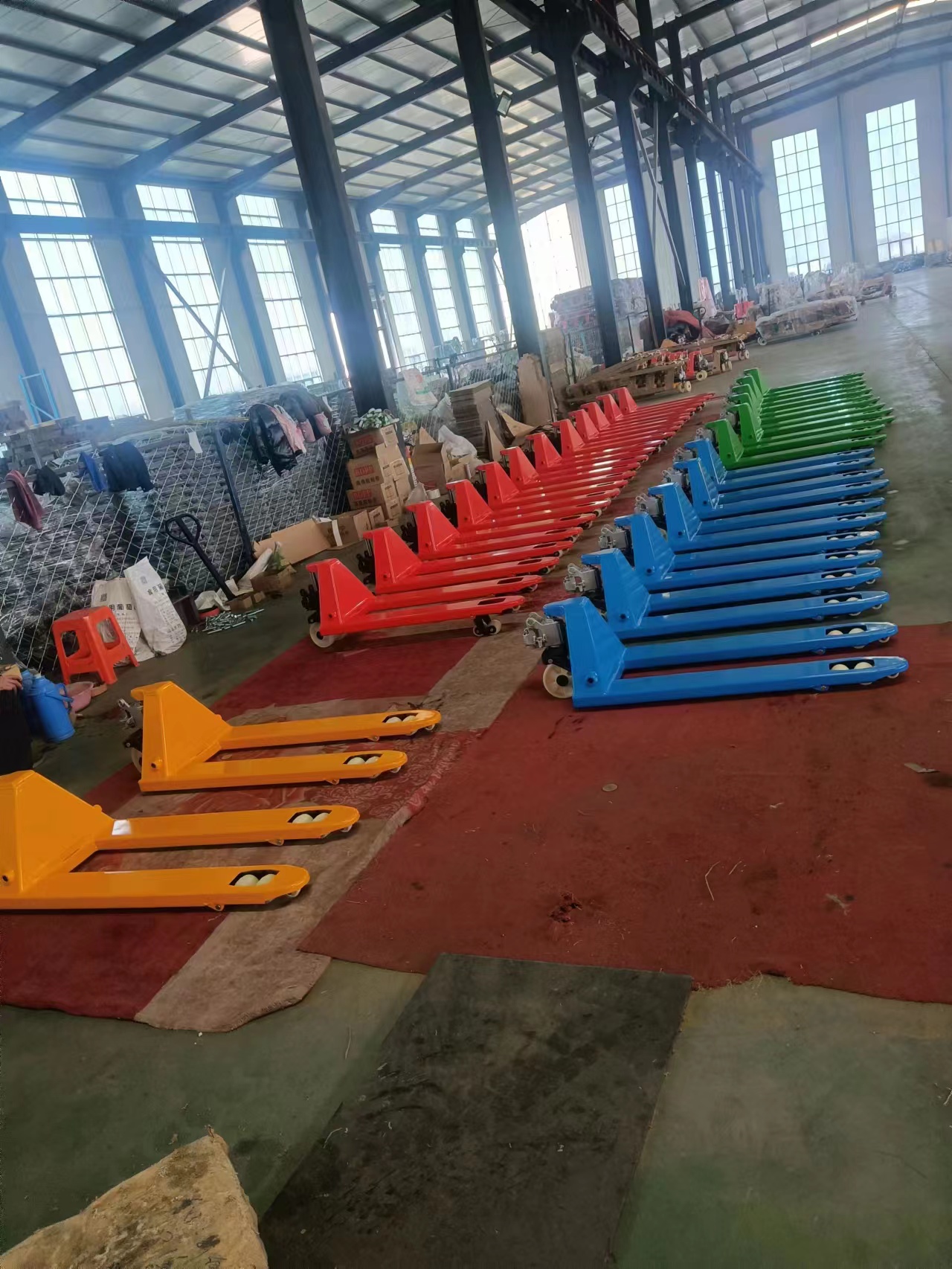
Ask for monthly capacity, MOQ and lead time as program figures, not as best-case examples. JUNYUNHOIST states 10,000 units per month, 24 PCS MOQ and 15–20 days lead time, with an export footprint covering India, Türkiye, Brazil, Vietnam, Russia, the United Arab Emirates, the Middle East and Southeast Asia. Those markets imply experience with different climate, voltage and documentation requirements — worth probing directly in the supplier questionnaire.
Step 6 — Build the sample against the production specification
Request a sample built to the same specification sheet that will govern mass production, and state explicitly whether it is an ODM platform sample or an OEM tooling sample. Verify fork dimensions, lifting height, wheel material, finish and, where relevant, weighing accuracy. Retain the approved sample as the golden reference for incoming inspection.
Step 7 — Lock commercial and after-sales terms
Confirm production lead time, container-level spare parts provision and the replenishment mechanism for wear items. A 15–20 day production window is only useful if the spare parts flow behind it is defined, because a brand owner selling into distribution cannot absorb downtime at the end user.
Step 8 — Plan the second order before the first ships
Decide which SKUs move from ODM to OEM, or the reverse, once real sell-through data exists. This is the point where the decision stops being theoretical: SKUs that win on specification justify the move to build-to-spec, and SKUs that win on availability stay on the platform.
Use Cases: Where Each Model Fits
E-commerce distribution centres
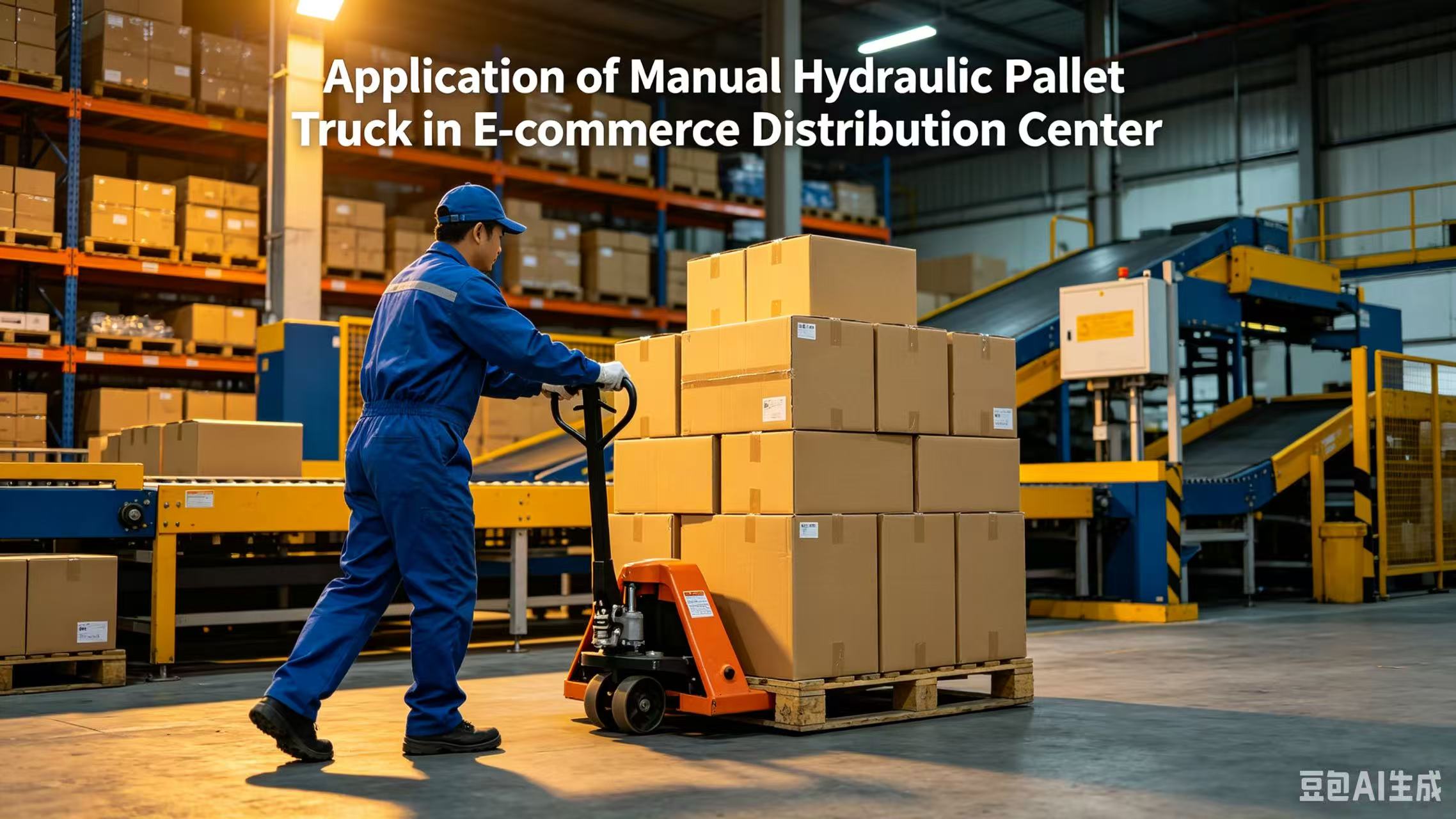
High-volume, general-purpose handling with short replacement cycles. An ODM manual or semi-electric platform in standard fork sizes covers most of this demand, and 24 PCS MOQ lets a brand owner test a new account without tooling exposure.
Cold chain and food processing
Stainless steel and galvanised finishes are configuration options rather than new designs, and published compliance references rate stainless steel pallet jacks for cold storage environments down to −40 °C. A brand selling into these accounts can usually reach a credible product through ODM configuration, reserving OEM for washdown-specific geometry or documentation that the platform cannot provide.
Weighing and logistics control
A pallet truck with an integrated scale turns handling into a data capture point. Because the weighing function is listed as a configuration option, it can be added on a platform basis — but any accuracy claim the brand makes must be matched by evidence the brand can hold, which often argues for a documented OEM-style specification.
Factory workshops and narrow aisles
Fork width of 550 mm or 685 mm and a turning radius of 1,500 mm decide whether a truck works in a constrained aisle. These are specification conversations rather than design projects in most cases, which is why they are often resolved on an ODM platform with a custom fork configuration.
Multi-market distributor programs
A distributor network spanning several regulatory environments usually needs one platform with several configurations rather than several designs. This is the classic ODM case, with OEM reserved for the flagship SKU that carries the brand's differentiation claim.
Comparison Table: OEM vs ODM Pallet Jack Programs
| Decision dimension | OEM (build-to-spec) | ODM (platform + branding) |
|---|---|---|
| Design ownership | Brand owner | Manufacturer |
| Change control | Brand owner issues revisions; tooling and approval follow | Changes limited to the parameters the platform supports |
| Differentiation ceiling | High — specification, materials and geometry are defensible | Moderate — shared platform with configuration and branding layers |
| Engineering effort on the buyer | Drawings, tolerances, test criteria and documentation | Specification selection and configuration review |
| Time to first shipment | Longer: design and tooling precede production | Shorter: platform already in production |
| Tooling and amortisation | Carried by the brand owner on a smaller volume | Spread across the manufacturer's customer base |
| Compliance evidence | Must be built for the brand owner's design | Manufacturer's existing evidence referenced, with model match confirmed |
| JUNYUNHOIST reference — MOQ | 24 PCS (stated minimum order quantity across the OEM/ODM production mode) | |
| JUNYUNHOIST reference — lead time | 15–20 days production lead time, against monthly capacity of 10,000 units | |
| Quality control | 100% testing before shipment | |
| After-sales structure | Free spare parts for wear items in every container, replenished based on subsequent wear | |
| Best fit | Flagship SKUs, regulated markets, specification-led price premium | Fast market entry, multi-market distribution, broad catalogue coverage |
Where Each Model Breaks Down
OEM fails commercially when the differentiation it buys cannot be recovered at the price the market accepts. Tooling and design cost sit on the brand owner, and a 24-piece order cannot absorb them. If the target segment buys on availability and price, the design investment is stranded.
ODM fails commercially when the brand's claim depends on a parameter the platform does not control. If the market position is built on fork steel plate thickness, a specific minimum lifting height or a materials story, and the platform dictates those values, the brand ends up advertising a difference it cannot prove.
A third failure mode cuts across both: compliance documentation that does not match the shipped model. CE marking for pallet trucks within the EU and the powered-truck requirements referenced in OSHA 29 CFR 1910.178 both attach to the actual configuration. A well-chosen design with mismatched paperwork is a bigger risk than a plain design with clean documentation.
FAQ
1. Under OEM or ODM, who is responsible for CE marking and compliance documentation?
In the European Union, pallet trucks are classified as machines and require CE marking for market access, so the question of who holds the evidence is a market-entry question, not a formality. In an ODM project the manufacturer normally holds test evidence for the platform, and the brand owner must confirm that the model reference on that evidence matches the configuration actually shipped. In an OEM project the design belongs to the brand owner, so responsibility for the technical file, declaration and testing must be allocated in the contract before production starts. JUNYUNHOIST states that products are manufactured under quality-control protocols referencing international standards including ISO and CE, and that every unit is 100% tested before shipment; these statements still need to be matched to the specific model and destination market. For powered pallet jacks sold in the United States, OSHA identifies 29 CFR 1910.178 as the relevant powered industrial truck standard, which adds operator training and evaluation obligations that are separate from the machine documentation.
2. Can one supplier handle both an ODM platform order and a strict OEM build-to-spec program?
Yes, if the supplier runs both models as a stated production mode rather than as an occasional exception. JUNYUNHOIST operates an OEM/ODM production mode with a 24,000 m² facility, annual output of 70,000 units, an 8-person R&D team and monthly capacity of 10,000 units. Its listed customisation scope covers fork length and width, minimum lifting height of 35 mm or 62 mm, fork steel plate thickness, electric pallet truck configuration, galvanised and stainless steel finishes, and a pallet truck with scale. That scope is broad enough for most ODM configuration work and specific enough to form the basis of an OEM specification discussion. The distinction to test in a supplier questionnaire is whether the same team owns both, because a factory that only assembles standard units cannot hold an OEM specification over multiple shipments.
3. How do OEM and ODM compare on cost, and what actually drives the difference?
The difference is structural rather than a fixed percentage, and no reliable public price benchmark exists for either path. In ODM, tooling and design cost are already amortised across the manufacturer's customer base, so the brand owner's outlay concentrates in configuration, branding, packaging and documentation. In OEM, those costs move onto the brand owner and must be recovered from the differentiated SKU, which is why the comparison should be made on landed cost per unit at a twelve-month volume rather than on a first-order quotation. The commercial terms that shape the calculation are minimum order quantity, production lead time and the spare parts arrangement. JUNYUNHOIST states a 24 PCS MOQ, a 15–20 day lead time and container-level free spare parts for wear items, which gives a concrete basis for modelling both paths against the same supplier.
4. What should a sample program look like before committing to a private-label order?
A sample is only useful if it is built to the same specification sheet that will govern mass production, and if both parties agree in advance whether it comes off an ODM platform or from OEM tooling. The approval checklist should cover fork length and width, minimum and maximum height, wheel material, surface finish and, where applicable, weighing function. For reference, the AC30 range lists a minimum height of 80 mm, a maximum height of 200 mm, fork widths of 550 mm or 685 mm, fork lengths from 800 mm to 2,000 mm, and wheel options in PU, nylon, PP and rubber, with 35 mm and 62 mm minimum lifting height available as customisation. Retain the approved unit as the golden reference for incoming inspection, and treat any later deviation as a change request rather than a production detail. With a 24 PCS MOQ and a 15–20 day lead time, a sample cycle can be run without committing to a full container programme.
5. What lead time and after-sales support should a brand owner plan for on either path?
Plan on two clocks: production and replenishment. JUNYUNHOIST states a production lead time of 15–20 days against monthly capacity of 10,000 units, with a minimum order quantity of 24 PCS, so the production window itself is short relative to design approval and freight. The replenishment clock is covered by the after-sales arrangement, under which each container ships with free spare parts for wear items, replenished as needed based on subsequent wear. For a brand owner selling into distribution, that spare parts flow is what protects end-user uptime and therefore the brand. To test both clocks against a real requirement, request a sample or a quotation for the specific configuration you intend to sell, and compare the quoted lead time and spare parts package with your own service commitments before placing the first order.
Conclusion: Choose Per SKU, Not Per Company
OEM and ODM are not competing philosophies; they are two positions on a single axis that runs from speed to differentiation. ODM puts a production-proven platform on your label quickly, with configuration covering fork dimensions, lifting height, steel plate thickness, finish and weighing. OEM puts the drawing in your hands and lets you defend a specification in a market that rewards one, at the cost of engineering time, tooling and a longer approval cycle.
For most brand owners the workable answer is a portfolio: ODM for the SKUs that compete on availability and price, OEM for the SKUs carrying the differentiation claim, and a single compliance discipline applied to both. The supplier question that follows is narrower than the strategic one — can the factory hold a specification across shipments, prove it with evidence that matches the shipped model, and keep spare parts flowing behind it.
Sample, Quote and Catalogue
JUNYUNHOIST (Baoding Junyun Hoisting Machinery Co., Ltd.) manufactures hand pallet trucks, electric pallet trucks, pallet trucks with scale, and galvanised and stainless steel pallet trucks under an OEM/ODM production mode, with a 24 PCS MOQ and a stated 15–20 day lead time.
Request a sample or a configuration quotation at www.junyunhoist.com, or download the product catalogue here: JUNYUNHOIST product brochure (PDF).
Email: Junyunsteven@163.com | Tel: +86 13483452631 | WhatsApp: +86 134-8345-2631
Have Questions or Need More Details?
Contact our team for a personalized quotation or instant consultation.
Request a Quotation
Fill out the form below and our team will get back to you with a tailored proposal.
WhatsApp Direct Chat
Prefer to chat in real-time? Message us on WhatsApp for instant assistance & quick answers.
- Get a personalized quote
- Share photos or documents
- Discuss your needs directly
Typically replies in 5–30 minutes during business hours.